Nobody plans to call a tow truck. The driver is stranded on a shoulder, keys locked inside, or staring at a wrecked bumper, and their phone is already in their hand. They will call the first company that answers and sounds capable. That is the whole marketing game for towing: be found in the panic moment, pick up fast, and show enough proof to win the call. The companies that dominate a town are rarely the biggest. They are the ones with the most reviews, the cleanest Google profile, trucks people recognize, and a phone that gets answered at 2 AM. This guide covers the exact ideas that win more calls for towing companies: police rotation lists, impound contracts, roadside visibility, a review engine, and the call systems that stop losing jobs after hours.
The quick answer
- Answer every call, every hour: the stranded driver calls whoever picks up first, so missed calls are lost revenue, not a small annoyance.
- Own the Google Business Profile: most towing searches end on the map pack, and the profile with the most recent reviews and clear 24/7 hours wins.
- Build a review engine: every driver should ask for a review at drop-off, and every review should get a reply within a day.
- Chase rotation and impound contracts: a police rotation slot or an impound contract produces steady monthly tows without ad spend.
- Turn trucks into billboards: lettered trucks with a big phone number earn cash calls every day they are parked or rolling.
- Track the cost per tow: measure what each idea costs per booked job and cut anything that cannot pay for itself in 90 days.
Why towing is a phone-first marketing game
Most local businesses market to people who compare options over days or weeks. Towing markets to people in a panic who decide in under a minute. The search is urgent, the need is immediate, and the buyer does not scroll ten listings. Industry tracking of emergency service calls consistently shows that the first company to answer wins the job the majority of the time, often on the very first call the driver makes. If your phone rings twice and goes to voicemail, the driver is already calling your competitor.
The economics make each call valuable. A local tow averages $125 to $275 depending on distance and hook type, and impound work adds storage fees on top. Losing ten calls a month is $1,250 to $2,750 walking away, and most towing companies lose far more than ten. Common trouble spots: the dispatcher is on a call, the driver is under a truck, the after-hours line goes to a sleepy cell phone, and weekend calls disappear entirely. Every marketing idea in this guide either produces more calls or makes sure fewer of them slip away.
There is a second buyer beyond the stranded driver: the institutions that assign tows. Police departments, highway patrol, insurance companies, motor clubs, dealerships, and property managers hand out hundreds of tows a year to companies they trust. Winning those contracts is a marketing campaign of its own, built on reputation, response time, and visibility rather than ads. Treat both buyers, the panicked driver and the contract manager, and the dispatch board stays full.
Own your Google Business Profile
When someone types “tow truck near me” or “towing service” into a phone, Google shows the map pack before anything else. For emergency towing, the map pack is the whole decision. Your Google Business Profile needs to look like the obvious choice in three seconds: open now, close by, well reviewed, and ready to roll.
Set the primary category to Towing Service and add Tow Truck Service and Roadside Assistance as secondary categories. List every town and neighborhood in the service area; towing searches are hyperlocal and the driver will pick the truck that looks closest. Mark the business as open 24 hours with no exceptions, because a profile that shows “closed” at 11 PM loses every late-night call to a profile that shows “open now”. Upload real photos: clean trucks with your lettering, drivers in uniform, the yard, the office. Profiles with current photos get noticeably more calls than profiles with a bare logo.
Use the built-in features most tow companies ignore. Post weekly updates: a reminder of 24/7 service, a storm-season note about roadside help, a thank-you to the city after a big event. Fill out the services list with specifics: light-duty towing, medium-duty towing, winch-outs, lockouts, jump starts, flatbed transport, motorcycle towing, long-distance hauling. Answer every question in the Q and A section before a stranger asks it, including “Do you take credit cards?” and “How fast can you get to downtown?” A complete profile outranks a lazy one with the same review count, and it costs nothing.
Build a review engine that feeds the rotation list
Reviews are the currency of the towing business. Drivers pick the truck with 4.8 stars and 300 reviews over the one with 4.2 stars and 40 reviews, and police departments reviewing rotation applicants look at the same ratings. The companies with the most reviews did not get lucky; they built a system where every job ends with an ask.
Give every driver a simple script. At drop-off, after the payment clears: “Glad we could get you sorted. If you have a minute, a Google review helps us more than you know. I can text you the link.” A short text with the review link arrives while the relief is fresh. Track asks per driver per week and share the running count at the weekly meeting; what gets measured gets done. Aim for 5 to 10 new reviews per truck per month. At that pace, a three-truck company adds 180 to 360 reviews a year, which moves the needle in any town.
Respond to every review within 24 hours. Thank the happy ones by name and mention the service: “Glad the team got you off Route 9 fast, Maria.” For bad reviews, reply calmly and publicly with a direct line: “We are sorry about the wait. Call me at the office and we will make this right.” Reviewers read owner replies before they call. For the full step-by-step playbook, see our guide on how to get more Google reviews for towing companies.
Never miss another dispatch call
The painful truth in towing: the best Google profile in town means nothing if the phone rings out. Many operators still rely on one dispatcher, one cell phone, and voicemail after 9 PM. Call tracking studies in home services routinely find missed-call rates of 20 to 40 percent during the day and far worse at night. In a business where the average call is worth $175, a missed call is not a minor gap; it is the most expensive line item you never see.
Start with a missed-call text-back system: any call that rings out or hits voicemail gets an instant automatic text, “Sorry we missed you. This is ABC Towing, 24/7. What do you need and where are you?” That one message recovers a large share of callers who would otherwise dial the next company. Our breakdown of missed-call text-back for towing companies covers the setup and the exact message wording.
The next layer is an AI answering service for towing companies: a virtual receptionist that answers every call in seconds, takes the pickup location and vehicle details, quotes the service, and dispatches to your on-call driver. It works nights, weekends, and storm surges when call volume triples and your dispatcher is already on another line. The cost is a fraction of a second dispatcher, and it pays for itself the first time it saves a 2 AM rotation call you would have slept through.
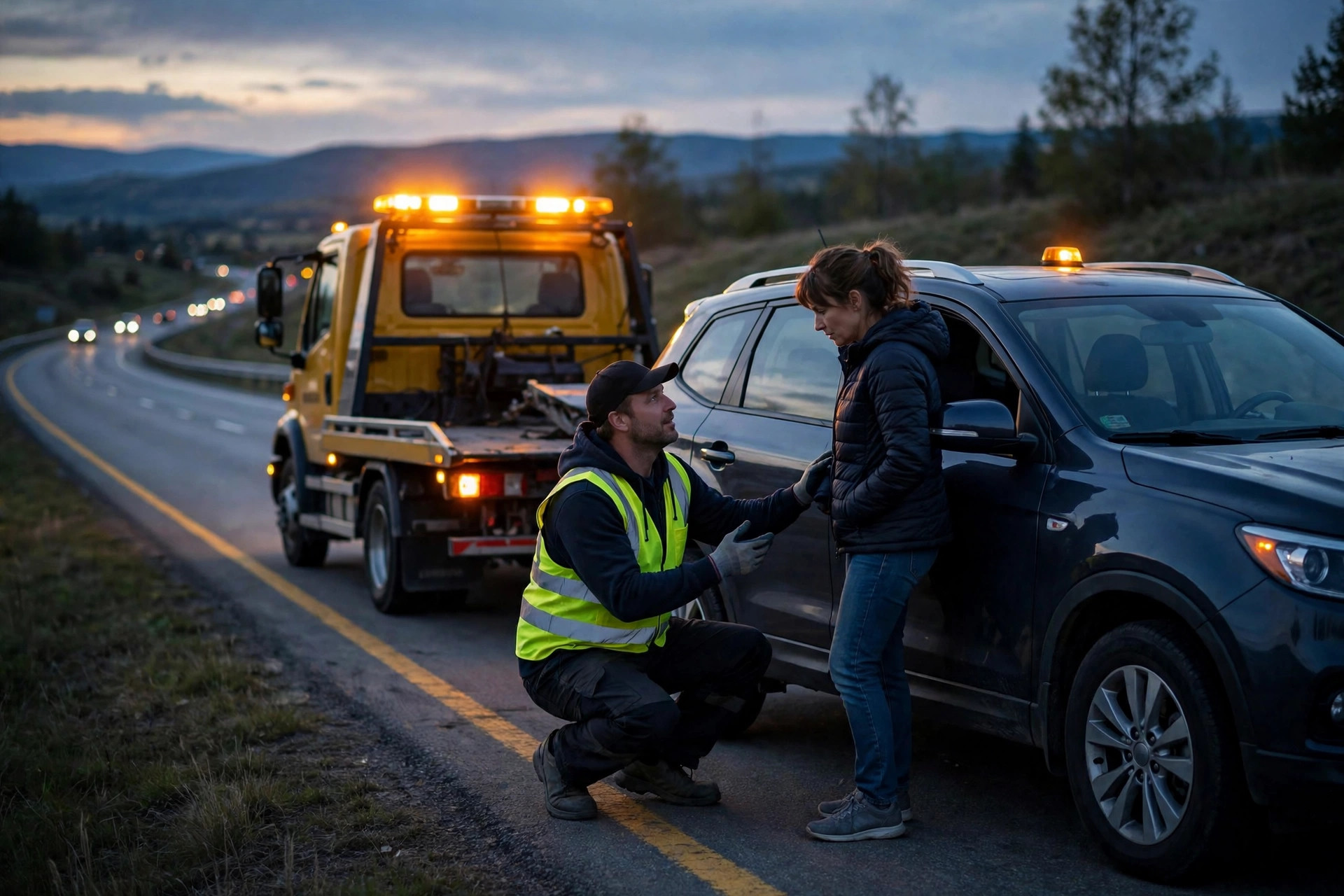
The driver who answers first usually wins the tow, which is why roadside presence and a working phone system matter as much as any ad.
Impound contracts and police rotation lists
The steadiest revenue in towing does not come from panicked drivers. It comes from contracts. Police rotation lists and impound contracts assign you tows on a schedule: accidents, DUIs, abandoned vehicles, parking enforcement. One contract can fill a truck’s calendar for years with zero marketing cost per tow.
Rotation lists work like this: the police department keeps a list of approved tow companies and rotates calls through it in order. Requirements vary by city and county but usually include a secured storage lot of a minimum size, 24/7 dispatch, GPS-equipped trucks, set response times (often 20 to 30 minutes), and proof of insurance. Applications open on a fixed cycle, and some departments only add companies once or twice a year. Call the non-emergency line or the traffic division and ask for the rotation coordinator. Get the requirements list, get the application window, and start preparing months ahead.
Impound contracts go further: you become the tow company for the whole city or county lot. The application asks for lot size and security, cameras, office staffing, records systems, and clean business standing. The reward is volume: a busy city impound lot can take in dozens of vehicles a month, and each one pays a tow fee plus daily storage until the owner claims it or the vehicle sells at auction. Bid honestly on the numbers. Winning a contract you cannot service fast will get you dropped, and departments talk to each other.
Motor clubs and insurance roadside programs are the third contract lane: AAA-style networks, insurance add-on programs, and fleet accounts. The per-tow rate is lower than a cash call, but the volume is predictable and the marketing cost is zero. Many operators treat motor clubs as the base load that keeps trucks moving between high-margin cash calls.
Turn your trucks into rolling billboards
A tow truck is a billboard that drives itself through your service area 50,000 miles a year. Yet plenty of operators run plain white trucks or faded lettering from a decade ago. Every day that truck is invisible is a day of free advertising wasted.
Lettering rules are simple. The phone number must be readable from 50 feet: tall digits, high contrast, on both doors and the rear. The company name should be legible at a glance, and “24/7” should appear wherever it fits. Add a short list of services on the flatbed rails or the rear: towing, lockouts, jump starts, winch-outs. Put a QR code on the rear door that opens your Google review page; people stuck in traffic behind your truck at a red light are a perfect audience. Skip the cluttered designs with ten services, three logos, and a slogan nobody reads.
Parking is the other half of visibility. A truck parked legally at a busy intersection or in front of your shop on a main road advertises to thousands of drivers a day. During storms and big events, a visible truck near trouble spots (with permission) earns calls that ads never would. Keep the trucks clean and the drivers in uniform with the logo; the stranded driver who sees a sharp, professional operation pulls the trigger faster than the one who sees a rusted truck with a hand-painted number.
A website and ads that convert stranded drivers
Your website has one job: turn a panicked visitor into a phone call within ten seconds. The click-to-call button belongs at the top of every page, big and impossible to miss. Under it, three trust signals: “24/7 dispatch”, “15 to 30 minute response”, and your star rating. Then a short list of services and a simple form for non-urgent requests like scheduled transport. Hide the call button behind a menu and the visitor bounces to the next listing.
Build one page per town or neighborhood you serve: “Towing in Riverside”, “Towing in Northside”, with the phone number, response-time promise, and services on each. These pages catch the long-tail searches like “flatbed tow truck riverside” that the map pack sometimes misses. Add a pricing page with honest ranges: hook fee plus per-mile rates for local tows, starting prices for winch-outs and lockouts. Drivers are scared of surprise prices; published ranges make the call feel safe.
Google Ads for towing is expensive and worth it when done right. “Tow truck near me” and “towing service open now” are among the highest-intent searches in local marketing, and a booked tow at $175 covers a $20 to $40 click easily. Run call-only ads so the tap rings your dispatcher directly, and only run them in hours and zones you can actually serve. Set negative keywords for jobs you do not want: repossession, junk car removal (unless you do it), auction, impound release. Track every call back to the keyword so you know the true cost per booked tow, then scale the winners and kill the rest.
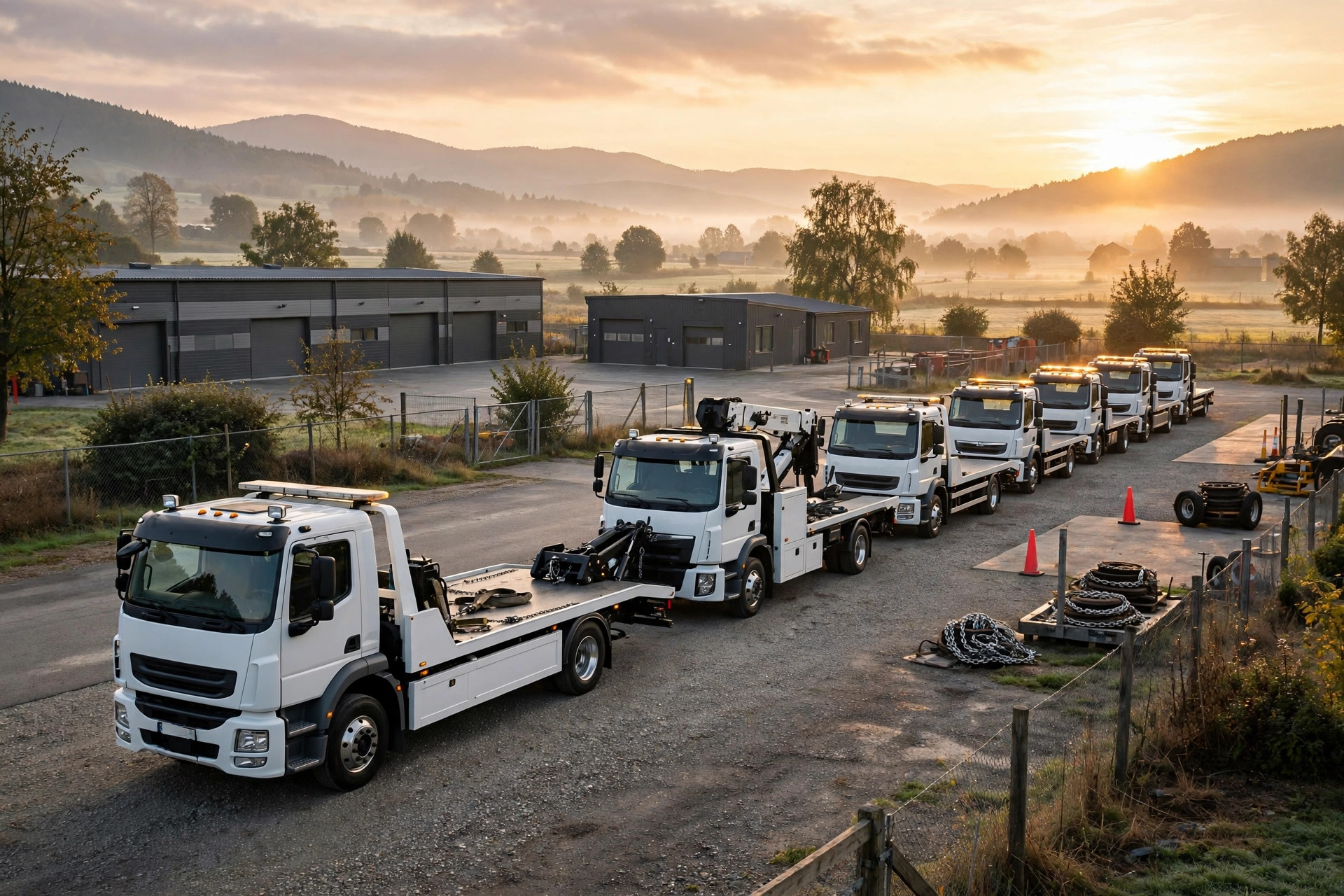
A clean, lettered fleet signals a company that shows up on time, and that impression starts long before the first call.
Referral partners that pay every month
The most profitable marketing in towing costs nothing per job. Repair shops, dealerships, body shops, tire stores, and insurance agents all have customers whose cars need to move. One repair shop that sends you five tows a month is worth more than any ad campaign, and it renews itself every month.
Walk the route. Visit every independent repair shop, transmission shop, and body shop within your service area with a simple pitch: “We are ABC Towing, 15-minute average response, damage-free flatbeds. If you need a car moved fast, here is the dispatch number. We pay $25 per referral and we will never poach your customer.” Leave a card with the dispatch number and the driver names. Follow up monthly; the shops that call you once will call you again if the driver was courteous and on time. Our notes on auto repair shop marketing ideas show what shop owners care about, which helps you pitch in their language.
Dealerships need auction transport, trade-in pickups, and customer breakdowns handled fast. Insurance agents need a reliable tow contact for their policyholders. Apartment complexes and property managers need parking enforcement and abandoned vehicle removal, which leads straight into private-property impound work. Fleet managers for delivery and service companies need a standing tow agreement with one number to call. And do not overlook neighboring auto businesses: auto detailing shops and car washes see disabled or neglected cars every week and make natural referral partners.
The marketing idea menu: cost and effort
Not every idea fits every company. Use the menu below to pick your first three based on budget and available hours. Start with the low-cost, high-impact items, then add the bigger plays as revenue grows.
| Marketing idea | Typical cost | Effort | What it produces |
|---|---|---|---|
| Google Business Profile optimization | Free to low | 4 to 6 hours setup, 1 hour a week | More map-pack calls from “tow truck near me” searches |
| Review engine (ask at every drop-off) | Free | 10 minutes a day | Review count and rating that wins the three-second comparison |
| Missed-call text-back | $30 to $150 a month | 1 hour setup | Recovers callers who would have dialed the next company |
| AI answering service | $150 to $600 a month | A few hours setup | Every call answered 24/7, dispatch details taken, after-hours revenue saved |
| Truck lettering and wraps | $500 to $3,500 per truck | One week per truck | Daily visibility calls from your service area for years |
| Police rotation application | Application and compliance costs vary | Weeks of paperwork and lot prep | Scheduled accident and enforcement tows for years |
| Impound contract bid | Bid prep plus lot investment | Months of preparation | Steady tow plus daily storage revenue (see the math below) |
| Referral partner route | Free, plus referral fees | One day a month | 5 to 20 shop-sent tows a month at zero ad cost |
| Google Ads call-only campaigns | $500 to $3,000 a month | Setup plus weekly tuning | Immediate calls for high-intent searches in hours you can serve |
| Website rebuild for calls | $1,000 to $5,000 one time | Two to four weeks | Higher conversion from every ad click and profile visit |
| Community sponsorships | $250 to $2,000 a year | Minimal | Local name recognition that shows up when contracts are awarded |
The pattern is clear: the cheapest ideas (profile, reviews, referral route, missed-call text-back) produce the fastest payback. The expensive ones (ads, wraps, contracts) compound over time. Run both tracks at once instead of waiting to afford the big plays.
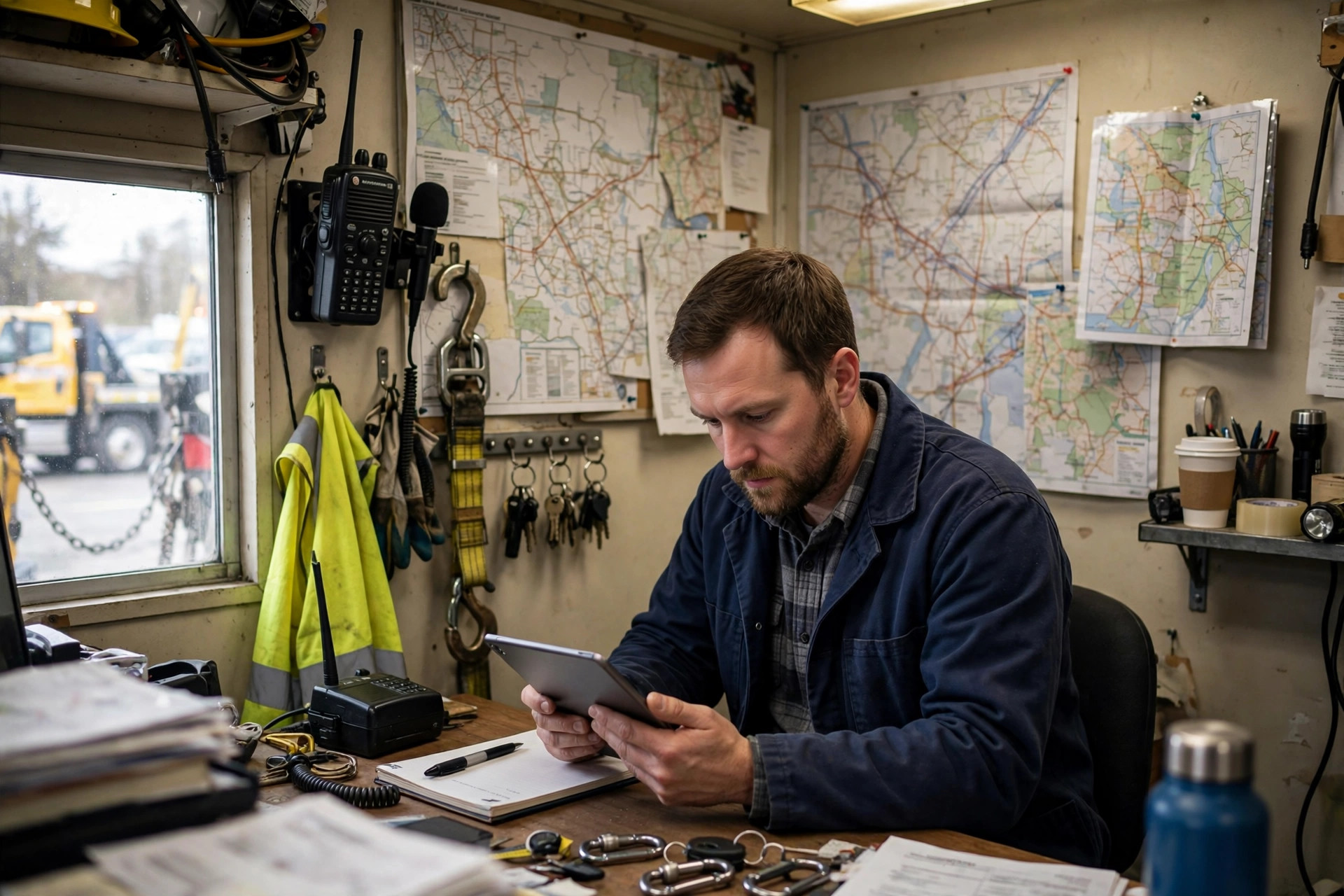
The owner who measures cost per tow and reviews the dispatch log weekly knows exactly which marketing idea pays.
Mistakes that burn towing marketing budgets
Buying ads before fixing the phone. Paying for clicks that ring out to voicemail is the most common waste in towing marketing. Fix answering first, then buy traffic.
Chasing broad SEO before the profile is done. A thin website outranks nothing if the Google Business Profile is incomplete. Win the map pack first; it is where the towing money is.
Fake or bought reviews. Platforms remove them in waves, and one removal notice costs more trust than the fake reviews ever earned. Earn them one drop-off at a time.
No call tracking. If you cannot tie calls to the ad, the listing, or the truck, you are guessing. Use tracked numbers on ads and the website so every dollar reports back.
Generic ad copy. “Best towing service in town” says nothing. “Flatbed tow in 20 minutes, 24/7, $95 hook fee” gets the call. Specifics beat slogans for panicked buyers.
Ignoring the lot as a marketing asset. Your secured lot, cameras, and clean records are the pitch for impound contracts. Document them with photos and put them in every bid.
Discounting cash calls to win volume. A $20 discount on a $175 tow saves the driver nothing meaningful and trains the market to haggle. Compete on response time, not price.
Letting drivers represent you badly. One rude driver, one scratched bumper, one late arrival produces the one-star review that sits at the top of your profile for a year. Marketing starts with the service.
Your rollout checklist
Work through these in order. Each one builds on the last.
- 1Claim and complete the Google Business Profile. Categories, service areas, 24-hour hours, real photos, and a full services list.
- 2Install call tracking. Tracked numbers on the website, ads, and profiles so every call reports back to its source.
- 3Fix the phone first. Missed-call text-back on every line, then an AI answering service for nights and overflow.
- 4Launch the review engine. Driver script at drop-off, texted review link, weekly ask counts, and replies within 24 hours.
- 5Letter every truck. Big phone number, company name, 24/7, services on the rails, QR code to the review page on the rear.
- 6Rebuild the website for calls. Click-to-call at the top, trust signals under it, one page per town, honest price ranges.
- 7Start Google Ads call-only campaigns. High-intent keywords, tight geo, hours you can serve, negative keywords set.
- 8Walk the referral route. Repair shops, dealerships, body shops, and insurance agents: pitch, card, monthly follow-up.
- 9Apply for the rotation list. Get the requirements, prepare the lot and paperwork, hit the application window.
- 10Bid the impound contract. Document the lot, cameras, and response times, bid the numbers honestly, and service it fast.
Frequently asked questions
How much should a towing company spend on marketing?
Most healthy tow companies spend 5 to 10 percent of revenue on marketing, weighted toward what produces calls: profile optimization, review systems, call answering, and targeted ads. Contract bids and truck lettering are capital costs on top of that, because they pay back over years.
Do towing companies need a website if the Google profile ranks?
Yes. The profile wins the first click, but drivers still check the website for prices, services, and trust signals before calling. A thin or missing website sends cautious drivers to the next company. Keep it simple: call button, hours, services, prices, and town pages.
How do I get on the police rotation list?
Contact the traffic division or the non-emergency line and ask for the rotation coordinator. You will get the requirements: secured lot, response-time standards, insurance, and dispatch standards. Prepare the lot and paperwork ahead of the application window, because most departments only open applications on a fixed cycle.
What is a good cost per tow from Google Ads?
With a $175 average tow and healthy margins, $40 to $80 per booked tow from ads is a solid result. If the number runs above $100, the usual culprits are broad keywords, wide geo-targeting, and missed calls, not the ad platform itself.
How many Google reviews does a tow company need?
Enough to beat the top two competitors in your map pack on both count and recency. In most towns that means 150 to 400 reviews at 4.6 stars or higher, with a steady flow of new ones each month. One old review pile loses to a smaller pile with fresh reviews.
Should I run Facebook ads for towing?
Rarely as a primary channel. Stranded drivers search Google; they do not wait for a Facebook ad. Social media is better used for free brand proof: job photos, driver spotlights, storm response, and community posts that make your company the familiar name when the panic moment comes.
How do I handle a bad review from a towed vehicle owner?
Reply publicly, calmly, and fast. Acknowledge the frustration, state the facts without arguing, and offer a direct phone number to resolve it. Readers judge the reply more than the complaint, and a professional response can neutralize the review entirely.
Can I get impound contracts without a big lot?
Usually not. Contract requirements set minimum lot sizes, fencing, cameras, and office standards that small operations cannot meet yet. Start with the police rotation list and private-property work, reinvest in the lot, and bid the impound contract when you qualify.
What should my truck lettering include?
Company name, a phone number readable from 50 feet, 24/7 service, and a short service list on the bed rails or rear doors. Add a QR code to your review page on the rear. Keep it clean: cluttered designs are unreadable at road speed.
How fast should we answer the phone?
On the second ring during business hours, and instantly after hours through an answering service. In towing, every unanswered call is a job lost to the next company on the list. Track your answer rate weekly like any other number in the business.
Get more tows without missing a single call
Digital Hayder builds AI answering systems, missed-call text-back, review engines, and call-converting websites for towing companies. Tell us about your fleet and we will design the marketing and phone system around it.
Contact Us