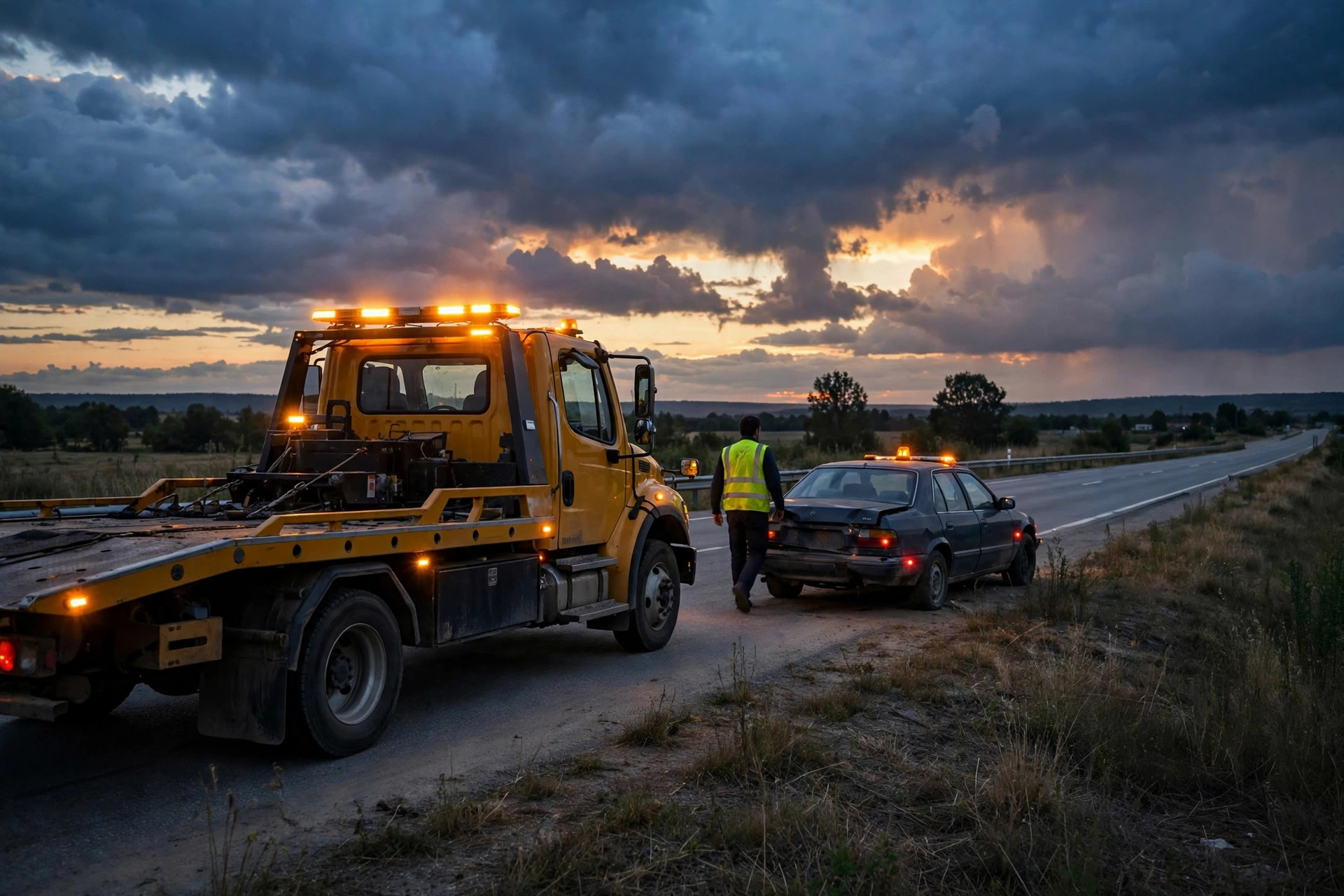
It is 1:40 AM on a Saturday. A driver is on the interstate shoulder with a blown tire, hazards blinking, semis roaring past. She calls your towing company. Your driver is mid-tow across town and cannot pick up. She hangs up and calls the next tower on Google. Ten seconds later she is talking to your competitor, and by the time your driver finishes the tow, that $175 job is rolling away on somebody else’s flatbed. Towing is the most time-pressured trade in the service world. A stranded caller does not compare reviews or study pricing pages. They call down the list until a live person answers. Missed call text back puts your company into that conversation within a minute of the missed call, while your driver finishes the job they are already on. This guide covers how towing companies use instant auto texts to capture stranded callers at any hour, the dispatch flow that turns a text into a rolling truck, the exact scripts to use, what it costs, and the math on a week of saved roadside calls.
The quick answer
- Distressed callers do not wait: a stranded driver calls the next tower within seconds, so a missed call at 2 AM is a lost job by 2:01.
- How it works: the missed call triggers an automatic text within a minute, asking where the caller is stranded and what happened.
- Text while you tow: the auto text goes out on its own while your driver finishes the current job, buying you time to respond.
- Location first, price second: the flow collects the location, the vehicle, and the situation, then quotes and dispatches without a phone call.
- It costs less than one tow: $50 to $300 a month plus pennies per text, against tows worth $125 to $300 plus after-hours fees.
- Three saved calls a week: at $175 a tow, that is over $27,000 a year recovered from calls that used to vanish.
Why towing companies lose callers in seconds
No trade punishes a missed call the way towing does. A homeowner with a garage cleanout might wait until morning. A stranded driver will not. They are on a dark shoulder, in a parking lot that closes at midnight, or blocking a lane with traffic building behind them. Fear and urgency drive every decision. They call the first listing, and if nobody answers, they call the second. The whole shopping process takes under a minute, and voicemail never enters the picture. Nobody sitting on a highway shoulder listens to a greeting and leaves a message.
The structure of most towing companies makes missed calls unavoidable. One-truck and two-truck operators dominate the trade, and the owner is usually the driver. You cannot answer a sales call while you are chaining down a car on a flatbed, winching a vehicle out of a ditch, or talking to highway patrol at a scene. Even companies with a dispatcher lose calls on the night shift, on holidays, and during the dinner rush when every truck is rolling. Industry estimates put after-hours and weekend work at a huge share of towing revenue, which means the calls you miss are not the cheap ones. They are the premium-rate tows, the lockouts, the winch-outs, the accident scenes that pay the best.
Answering services were supposed to fix this, and for many towers they made it worse. A generic call center agent cannot quote a tow, cannot check which truck is closest, and cannot calm a panicked caller with real answers. The caller waits on hold, gets told someone will call back, and hangs up to dial the next company. The result is the same as voicemail, except you paid $300 a month for it. The fix is not another human who cannot dispatch. It is an instant text that holds the caller in place until you or your dispatcher can take over.
What missed call text back does on a tow line
When a caller dials your dispatch number and nobody picks up, the system sends an automatic text within 30 to 60 seconds. It comes from your dispatch number, the same one they just called, and it asks the two questions that matter: where are you, and what happened. The caller replies by text. The conversation lands in your inbox, where you, your dispatcher, or your driver between jobs can read the location and the vehicle details and respond with a price and an ETA.
Walk through a real night. Your driver is loading a wreck at 11:20 PM. A call comes in from a driver with a dead battery in a grocery store parking lot. It rings out. At 11:21 the caller gets your text. At 11:23 they reply with the parking lot name and their car model. At 11:30 your driver finishes the load, reads the text, and replies with a price and a 25-minute ETA. The truck rolls. Without the text, that caller was talking to your competitor at 11:22. The auto text did not answer the phone for you. It held the customer for the nine minutes you needed.
The same pattern works in every truck-based trade where the owner is also the operator. Our guide to missed call text back for junk removal companies shows how haulers use the identical 60-second window to save jobs while the crew keeps working.
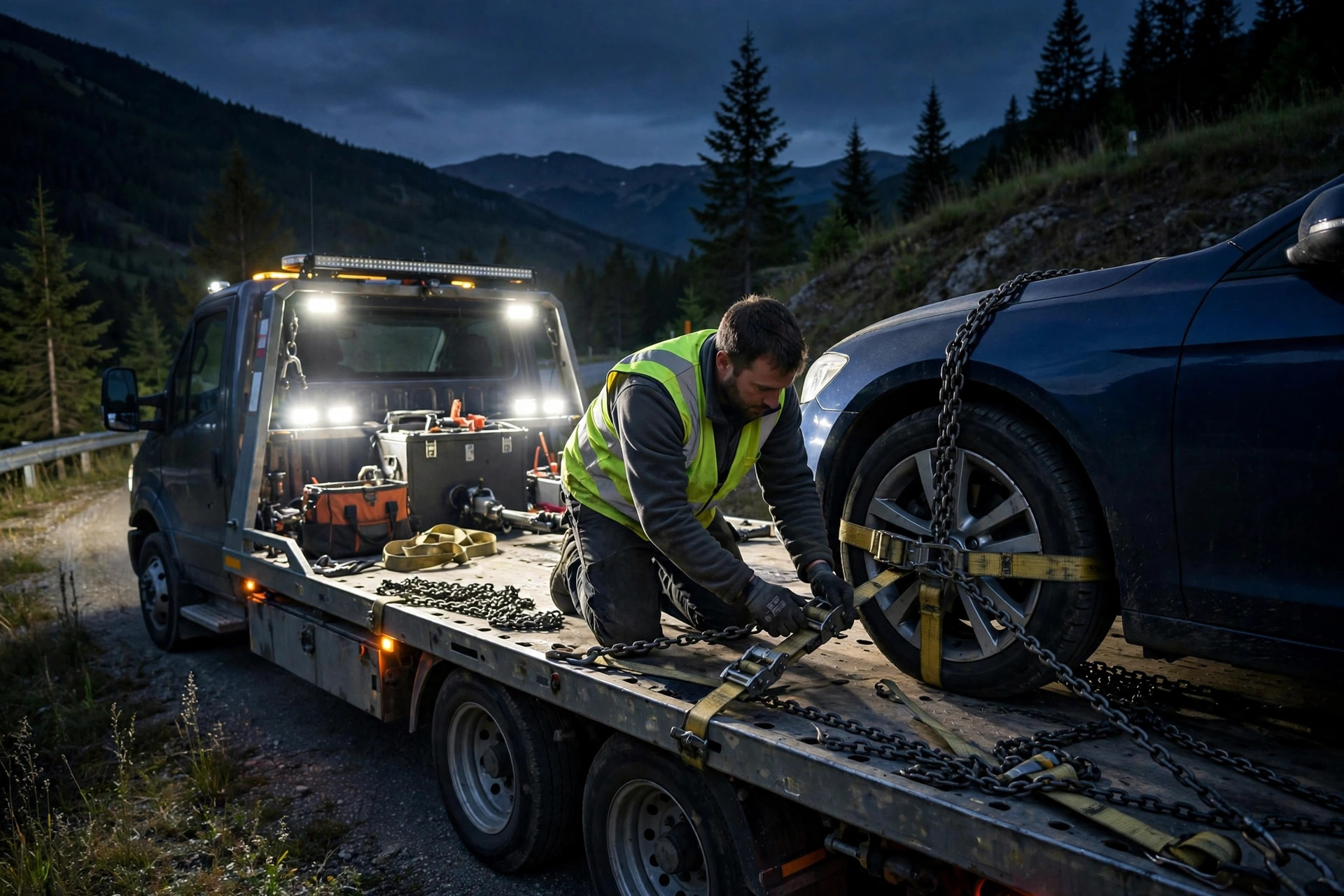
A driver chaining down a car cannot take a sales call, which is exactly when the automatic text has to go out on its own.
The math of a captured roadside call
Towing math is simple because the ticket is high and the caller has no patience. A standard local tow runs $125 to $200 in most markets. After-hours tows, winch-outs, and accident recoveries run $200 to $350 or more. There is no long sales cycle and no estimate appointment. The caller needs a truck now, and the first company that gives a price and an ETA gets the job. Every missed call is a finished sale walking to the next listing.
Run the numbers for a small operation. Say you get 30 calls a week and miss half of them because the trucks are rolling: 15 missed calls. Text back reaches all 15 within a minute. If a third reply with their location and a third of those turn into dispatches, that is roughly 2 to 3 saved tows a week. At $175 a tow, three saved calls a week is $525 a week, or $27,300 a year. That is revenue from callers who had already decided to pay somebody. You are not buying ads to find them. You are just answering faster than the next tower on the list.
The after-hours multiplier makes it bigger. Night, weekend, and holiday calls carry premium rates, and they are the calls you miss most. One saved Saturday night accident tow at $275 covers the entire month of the texting service by itself. Locksmiths face the same stranded-caller math, and the writeup of missed call text back for locksmiths shows how another emergency trade captures callers who will not wait.
The dispatch text flow: from missed call to truck rolling
A towing text flow has to do three things fast: find out where the caller is, find out what the vehicle needs, and get a truck moving. The flow below does all three in four messages. Every message is short enough to read on a phone screen on a dark shoulder.
Message 1, the instant reply. Sent automatically within a minute: “Hi, this is [Name] with [Company]. Sorry we missed your call. Where are you stranded right now, and what happened to the vehicle?” Location comes before everything. A caller who answers the location question is a caller who stopped dialing competitors.
Message 2, the vehicle and safety check. Once they send the location: “Thanks. What are you driving (year, make, model)? And are you and any passengers safe where you are?” The safety question matters twice: it is the right thing to ask, and it tells you whether this is a standard tow or something that needs a faster response. If anyone is in danger, the reply should tell them to call emergency services first.
Message 3, the quote and ETA. With location and vehicle in hand: “A tow from [location] to [destination or shop] is $[X]. Our driver can be there in about [N] minutes. Want me to send the truck?” Price and time in one message. The caller decides with one word.
Message 4, the dispatch confirm. When they say yes: “Truck is rolling. The driver will call this number when close. Stay somewhere safe, keep your hazards on, and reply here if anything changes.” The thread stays open for the driver and the customer to coordinate the handoff.
If the caller goes quiet after message 1, send one nudge after 15 to 20 minutes: “Still need a tow at [location]? Our driver is nearby and can be there in [N] minutes.” Stranded callers sometimes find help another way, but many just got distracted. One nudge recovers the ones who are still waiting. After-hours calls get a variant of message 1 that names the night rate up front, so there is no argument about the price later: “Heads up, our after-hours rate applies until 7 AM. Still want me to send the truck?”
Copy and paste texting scripts for towing
Below are the scripts towing companies use most. Swap in your details, keep every message short, and never make a stranded caller read a paragraph.
The missed call opener. “Hi, this is [Your Name] with [Company]. Sorry we missed your call. Where are you stranded, and what happened to the vehicle?”
The after-hours opener. “Hi, this is [Your Name] with [Company]. We missed your call. Where are you stranded? Our after-hours rate is in effect until [time], and I can quote you right now.”
The location and vehicle ask. “Can you send your exact location, a business name, cross streets, or a dropped pin? And what are you driving?”
The safety check. “Are you and any passengers safe where you are? If anyone is hurt or you feel unsafe, call 911 first, then reply here.”
The quote with ETA. “Tow from [pickup] to [drop-off] is $[X]. Driver can be there in about [N] minutes. Want me to roll the truck?”
The dispatch confirm. “You are confirmed. Driver is on the way and will call this number when close. Keep your hazards on and stay clear of traffic.”
The 20-minute nudge. “Still need a tow? Our driver is in the area and can reach you in about [N] minutes. Reply YES and I will dispatch now.”
The motor club answer. “We work with most motor clubs. Which one is yours, and do you have your membership number? I will check coverage while the truck heads your way.”
The price objection answer. “I hear you. That price covers the hook, the mileage, and the after-hours dispatch. The next closest option I can offer is a tow to the nearest safe lot for $[lower X]. Want that instead?”
The review ask after the tow. “Glad we got you home safe. If the driver took good care of you, a Google review would mean a lot: [link].”

One inbox for every text thread lets the dispatcher see locations, vehicles, and ETAs without juggling the driver’s personal phone.
Missed call text back vs voicemail vs answering service
Towing owners usually pick between voicemail, an answering service, and missed call text back for the calls they cannot take. Here is how the three compare when the caller is stranded and the clock is running.
| Missed call text back | Voicemail | Answering service | |
|---|---|---|---|
| Response time | Under 1 minute, automatic | Hours later, if you call back | Minutes on hold, then a message taken |
| After-hours coverage | Yes, around the clock | Yes, but stranded callers never wait | Yes, if you pay for the hours |
| Monthly cost | $50 to $300 plus pennies per text | Free | $200 to $600 for real coverage |
| Collects location | Yes, the first question in the thread | No | Sometimes, read back to you later |
| Quotes the tow | Yes, price and ETA by text | No | Rarely; agents cannot price tows |
| Dispatches the truck | Yes, confirm in the thread and roll | No | No, they page you and wait |
| Caller effort | Low: reply to a text | Pointless: they already hung up | High: hold music, then a stranger |
For towing, the comparison is not close. Voicemail loses every stranded caller. An answering service costs more than text back and still cannot quote or dispatch. Missed call text back is the only option fast enough for a caller who gives you 60 seconds. Garage door companies face a similar stuck-customer problem, and missed call text back for garage door companies covers their version. If you want a voice-based backup for complex calls, our look at the AI answering service for towing companies pairs well with texting.

Every text thread that ends with a dispatched truck is a tow your competitor never got a chance to quote.
What it costs and what a week of saved calls pays
Missed call text back is cheap for towing because the ticket is high. One saved tow can pay for months of the service. Pricing falls into three bands.
Texting add-on inside your dispatch software
If your dispatch or CRM software already supports texting, missed call text back is often a feature you switch on. You pay for the number and a few cents per text. Best for operators who already run everything through one dispatch screen.
- Automatic text on every missed call
- Shared inbox for drivers and dispatchers
- Location and photo messaging built in
Standalone missed call text back software
Dedicated tools with after-hours schedules, timed follow-up nudges, and templates for quotes, ETAs, and dispatch confirms. Best for companies that want the full flow without changing dispatch software.
- Instant auto text plus timed follow-ups
- After-hours and holiday rate messages
- Quote, ETA, and dispatch templates
- Review requests after completed tows
Done-for-you setup and management
A provider writes your scripts, connects your dispatch number, builds the flows, and monitors reply rates. Best for owners who want it handled completely while they drive.
- Custom scripts for tows, lockouts, and winch-outs
- Number setup and carrier registration
- Ongoing tuning of reply and dispatch rates
- Monthly report on captured calls
Texting costs a few cents per message, so even a busy week of threads adds only $10 to $30 a month. Stack that against a single $175 tow and the question answers itself.
Setting it up on your dispatch number
A towing owner can set this up in an evening. The steps are short because the system is simple.
Connect the dispatch number. Use the number on your Google listing, your trucks, and your website. Register it for business texting so carriers do not flag your messages. Do not run texts from a second number the caller does not recognize.
Write the two openers. One for the day shift, one for after hours with the night rate stated up front. Put your company name in the first line of both. Add the safety line to the flow: anyone who reports danger or injuries gets told to call emergency services first.
Set reply alerts everywhere. Your phone, your dispatcher’s phone, and the driver’s phone if they handle their own area. Replies need eyes on them fast, because a stranded caller who waits 30 minutes for a text reply will start dialing again.
Build the quote template. Save a fill-in template for the quote and ETA message so nobody types prices from scratch at midnight: pickup, drop-off, price, ETA. Speed and accuracy both improve.
Test it at night. Have someone call your dispatch number after hours, let it ring out, and read the whole flow on a phone screen. Fix anything confusing before a real stranded caller sees it.
The compliance note is the same as in every trade: identify your business in the first text, include an opt-out like “Reply STOP to opt out,” honor every opt-out immediately, and only text people who called you or agreed to hear from you. The software handles most of this. When in doubt, ask a professional.
Mistakes that strand callers and cost you the tow
The text arrives too late. A stranded caller gives you about a minute. If your auto text takes five, they are already talking to the next tower. Keep it under 60 seconds.
Asking them to call back. “Sorry we missed you, please call again” is the worst possible text. They called. You missed it. Ask for the location instead.
No business name in the text. A stranded driver getting a text from an unknown number assumes it is spam. Name your company in the first line.
Hiding the after-hours rate. Quote the night rate in the opener. A surprise fee at the scene turns into an argument, a bad review, or a cancelled tow.
No safety guidance. Every flow needs the line about calling emergency services when someone is hurt or unsafe. It protects the caller and it protects you.
Texting from a different number. The text must come from the dispatch number they dialed. Anything else breaks trust at the worst moment.
Nobody watching replies. The auto text holds the caller, but a human still dispatches the truck. Set alerts that wake somebody up, because the best calls come at 2 AM.
Your rollout checklist
Work through these in order. Each one builds on the last.
- 1Use your dispatch number. The number on your Google listing and your trucks, so stranded callers recognize the text instantly.
- 2Register the number for business texting. Complete carrier registration so night-time texts land instead of getting filtered.
- 3Write the daytime opener. Company name, apology, and the location question in under 40 words.
- 4Write the after-hours opener. Name the night rate up front so the price never becomes a scene-side argument.
- 5Add the safety line. Every flow tells callers to contact emergency services first if anyone is hurt or unsafe.
- 6Build the quote and ETA template. Pickup, drop-off, price, and minutes away, ready to fill in at midnight.
- 7Set reply alerts for driver and dispatcher. Somebody’s phone must buzz loud enough to beat the competitor’s callback.
- 8Add the 20-minute nudge. One follow-up for callers who went quiet, then let it go.
- 9Test with a real missed call at night. Read the full flow on a phone screen and fix anything confusing.
- 10Review the first 50 threads. Tune the wording where callers stall and confirm dispatch times match your ETAs.
Frequently asked questions
Will a stranded caller really reply to a text?
Yes. A stranded driver wants help, not a phone call. Texting is faster than dialing the next company, and the text arrives from the number they just called, so it reads as your company responding, not as spam. Reply rates on missed call texts are far higher than voicemail callbacks.
How fast does the text need to go out?
Under a minute. A stranded caller starts dialing the next tower within seconds of hanging up. Test the timing with a real missed call before launch. If the text takes longer than 60 seconds, fix the setup before a real emergency hits it.
What if the caller is in danger?
Your flow must tell them to call emergency services first if anyone is hurt or they feel unsafe. The text system is for dispatching tows, not for emergencies. Put the safety line in the second message of every flow and never skip it.
Can it handle motor club and insurance jobs?
Yes. Ask which club or carrier covers the caller and whether they have a membership or policy number. You can check coverage while the truck rolls. Many towers run motor club work through the same text flow as cash calls.
Can you really quote a tow by text?
Yes. You need three facts: pickup location, drop-off, and vehicle type. That is enough to price a standard tow and give an ETA. Unusual jobs, heavy winch-outs or long-distance hauls, can get a range by text and a firm price when the driver sees the scene.
What does missed call text back cost for a towing company?
Most operators pay $50 to $300 a month for the software plus a few cents per text, usually $10 to $30 extra. Managed setups run $300 to $600 a month. One saved tow covers months of the service.
Is it legal to text callers automatically?
A missed call from a customer is a strong basis for a reply text, but you must name your business, include an opt-out like “Reply STOP to opt out,” and stop texting anyone who asks. Rules vary by region and message type, so confirm the details with a professional.
My driver answers most calls. Do I still need this?
The calls he misses are the expensive ones: the ones that come while he is loading, strapping, or talking to police at a scene. Those are also the calls worth the most. Text back covers exactly the moments no human can answer.
Should I keep voicemail or an answering service too?
Keep voicemail as a backup for callers who insist on leaving one. Most towers find the text outperforms an answering service at a lower cost, because the text quotes and dispatches while the service only takes messages. Run both for a month and compare captured jobs.
How do I measure whether it is working?
Track four numbers monthly: texts sent after missed calls, reply rate, dispatches booked from text threads, and revenue from those dispatches. Most operators see the payback inside the first month because a single saved tow is worth more than the monthly cost.
Catch the calls your driver misses
Digital Hayder builds missed call text back systems for towing companies: instant auto texts on your dispatch number, location-first scripts, dispatch flows, and after-hours coverage that books the tow while your driver finishes the last one. Tell us about your operation and we will set it up for you.
Contact Us