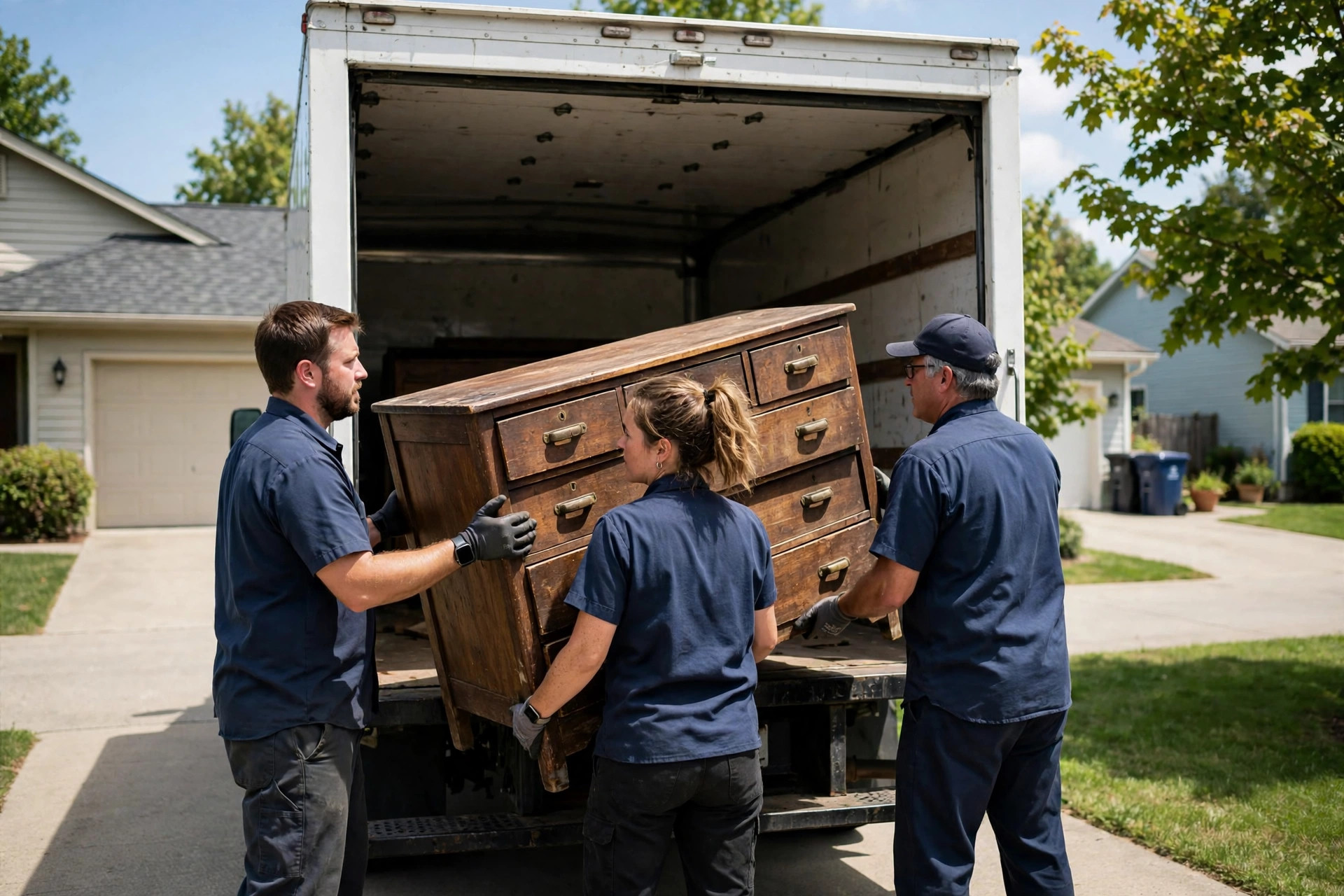
Your crew is mid-job. Two guys are wrestling a hot tub out of a backyard in the summer heat, and the office phone is sitting in the truck cab, buzzing with a call from a homeowner who needs a full garage cleanout this week. Nobody answers. The caller hears voicemail, hangs up, and dials the next junk removal company on Google. That job is gone before your crew finishes strapping down the load. This happens every day in junk removal. Crews cannot answer while they haul, owners cannot answer while they drive, and after hours nobody answers at all. Missed call text back fixes the exact moment a call goes unanswered. The instant a caller hangs up or the call goes to voicemail, they get a text from your company number asking how you can help. This guide shows how junk removal companies use it to capture jobs while the crew keeps working, the scripts that turn texts into booked pickups, what it costs, and the math on what one saved job a week is worth.
The quick answer
- The problem is the truck: crews haul, load, and drive for hours, so most junk removal companies miss 30 to 50 percent of daytime calls and nearly all after-hours calls.
- How it works: when a call goes unanswered, the system sends an automatic text within a minute asking the caller what they need hauled and when.
- Speed to lead decides the job: junk removal customers call down the Google list, and the first company that responds with a straight answer usually books the job.
- Quote texting closes it: ask for photos of the pile, send a price range by text, and book the pickup slot without a single phone call.
- It costs very little: most setups run $50 to $300 a month plus a few cents per text, against jobs worth $150 to $600 each.
- One saved job a week pays for it: a single captured cleanout covers months of the service. The full math is in the callout below.
Why junk removal companies miss so many calls
Junk removal is one of the worst industries in the country for answering the phone, and the reason is simple: the work makes it nearly impossible. Your crew spends the day lifting, loading, and driving. Hands are in gloves, not on phones. The truck is loud. The phone sits in the cab or in a pocket, ringing through a job that cannot pause for a sales call. The owner is usually working the truck too, or driving between jobs, or giving an estimate at a house with no office staff behind them. Industry surveys of home service businesses regularly find missed call rates of 30 to 50 percent during business hours. For owner-operator junk removal outfits, the real number is often worse, because there is no office and no receptionist. There is just the crew and the truck.
After hours is a total blackout. Most junk removal searches happen in the evening and on weekends, when people are home, staring at the garage they finally want cleared, or dealing with a move-out deadline. They search, they call the top three listings, and they book whoever picks up. If all three go to voicemail, they book whoever calls back first, which is almost never the company that waited until morning. Voicemail itself is nearly dead as a sales tool. Most callers under 50 do not leave voicemails at all. They hang up within seconds of hearing the greeting and move to the next number. Every missed call in this business is not just a missed conversation. It is a missed $150 to $600 job, handed to a competitor who answered.
The math gets ugly fast. Say your company gets 40 calls a week, a modest number for a junk removal business with decent Google visibility. Miss 40 percent of them and that is 16 missed calls. If even a quarter of those callers would have booked, that is 4 lost jobs a week. At a $250 average ticket, you are watching $1,000 a week, or $52,000 a year, ring through to voicemail. Missed call text back does not fix your staffing. It fixes the 60 seconds after the missed call, which is the only window that matters.
What missed call text back actually does
Missed call text back is exactly what the name says. When someone calls your business number and nobody answers, the system sends them a text message automatically, usually within 30 to 60 seconds. The text comes from your business number, the same one they just dialed, and it says something plain: who you are, that you missed their call, and a question about what they need. The caller can reply by text, and the conversation continues in your messaging inbox, where you or your dispatcher can take over from a phone, tablet, or computer.
Here is what happens step by step. The call comes in while your crew is loading. It rings out or hits voicemail. The system detects the missed call and fires the text. The caller, who was about to dial your competitor, sees a message from your company instead. Most people reply, because texting is easier than calling another number and starting over. Your phone buzzes with the reply. You answer between jobs, or your dispatcher answers from the office, or a short automated back and forth collects the job details and your team follows up within minutes. The job that would have been lost is now a text conversation, and text conversations convert.
This is not a chatbot pretending to be human, and it is not a phone tree. It is a safety net under every call. It works on the number you already advertise, so customers see one consistent business number everywhere. It works after hours, on weekends, and on holidays, when your office is dark. And it works when you are the one doing the hauling, because the first message goes out on its own and buys you time to reply when you can breathe. Junk removal owners who already run chat on their website will recognize the pattern. Our guide to the AI chatbot for junk removal companies covers the website side of the same idea.

Crews cannot stop mid-load to take a sales call, which is why the automatic text has to go out on its own within a minute.
The speed to lead math in junk hauling
Junk removal buyers behave like emergency buyers even when the job is not an emergency. They want the stuff gone, and they want it gone this week. That urgency shapes how they shop: they call down the Google list, and they stop at the first company that gives them a straight answer. Research on home service buyers has found again and again that the first business to respond in a useful way wins the job most of the time. The exact percentages vary by market, but the pattern never changes. The company that replies in five minutes beats the company that calls back in an hour, and both crush the company that returns the call the next day.
Put that against a normal junk removal day. A homeowner calls you at 6:40 PM on a Tuesday, right after dinner, standing in a garage full of boxes from a move. Your crew is finishing the last job. Without text back, that caller gets voicemail, and your callback lands at 8:00 the next morning. By then the homeowner has already booked the company that answered at 6:45 PM. With text back, the caller gets your message at 6:41 PM: a greeting, a question about what needs hauling, and a request for a photo. By 6:50 you have sent a price range and two pickup windows. The job is booked before your competitor finishes dinner. That is what speed to lead means in this trade. It is not a theory. It is Tuesday night.
The other side of the math is the follow-up you stop losing. Not every caller replies to the first text, but the text gives you a thread to follow. A short nudge an hour later, “Still need that garage cleared? I can hold a Thursday slot for you,” recovers jobs that a voicemail never could, because the caller never left a message and you would never have known they called. Moving companies live by the same rule. The breakdown of missed call text back for moving companies shows how another truck-based trade uses the same 60-second window.
The text flow that saves the job
A good missed call text back flow for junk removal has one job: turn a missed call into a booked pickup with as little back and forth as possible. The flow below is the one that works best for haulers. Every message is short, every message moves the job forward, and the customer never has to call you back.
Message 1, the instant reply. Sent automatically within a minute of the missed call: “Hi, this is [Name] with [Company]. Sorry we missed your call, the crew is out on a job. What do you need hauled away?” It names the business, explains the miss in human terms, and asks one open question.
Message 2, the photo ask. As soon as they describe the job: “Got it. Can you snap a quick photo of the items? I can give you an exact price from a photo, no visit needed.” Photos are the secret weapon of junk removal texting. They replace the on-site estimate, they let you price accurately, and customers love skipping the appointment.
Message 3, the price. After the photo: “Thanks. For that load it would be $[X] to $[Y], all in, and we haul it, sweep up, and take it to donation or disposal. Does that work for you?” A range is fine. The all-in framing kills the haggling before it starts.
Message 4, the booking. When they say yes: “Great. I have Thursday between 9 and 11 or Friday between 1 and 3. Which works better?” Two choices, not an open calendar. People decide faster with two options.
Message 5, the confirmation. “You are booked for Thursday between 9 and 11. The crew will text when they are 30 minutes out. Just reply here if anything changes.” The thread stays open, so day-of questions land in the same place.
If the caller goes quiet after message 1, one follow-up text an hour later and one the next morning is enough. More than that feels like pestering. If the call came in after hours, the first message should say so plainly: “Sorry we missed your call, we are closed for the night. What do you need hauled? I will send pricing first thing in the morning.” Honesty about hours beats pretending someone is awake.
Quote texting scripts you can copy word for word
Below are the exact scripts junk removal companies use most. Replace the bracketed parts with your details. Keep every message under 40 words. Short texts get read and answered. Long ones get skimmed and ignored.
The missed call opener. “Hi, this is [Your Name] with [Company]. Sorry we missed your call. What do you need hauled away, and when do you need it gone?”
The after-hours opener. “Hi, this is [Your Name] with [Company]. We missed your call and we are closed for the night. Tell me what you need hauled and I will send you pricing first thing in the morning.”
The photo request. “Can you send a quick photo of the pile? I can price it exactly from a photo, usually within a few minutes.”
The price quote. “For everything in the photo, it would be $[X] all in. That covers the hauling, the labor, and disposal or donation. We can do [Day] between [Time] and [Time]. Want me to lock it in?”
The too-expensive answer. “Totally understand. If you can get it all to the curb, I can do $[lower X]. Or if you have less than the photo shows, send an updated photo and I will reprice it.” Never just say no. Give them a cheaper path.
The one-hour nudge. “Hey [Name], just checking back. Still need the [items] hauled? I can hold a [Day] slot for you if you want it.”
The day-before reminder. “Hi [Name], confirming your pickup tomorrow between [Time] and [Time]. The crew will text when they are 30 minutes out. Reply here if anything changed.”
The review ask after the job. “Thanks for choosing [Company] today. If the crew did a good job, a Google review would mean a lot to us: [link].” Reviews are the fuel for the next round of calls. Our guide on how to get more Google reviews for junk removal companies lays out the full system.

One thread per caller keeps the quote, the photos, and the booking in a single place you can answer between jobs.
Missed call text back vs voicemail vs answering service
Most junk removal owners choose between three ways of handling the calls they cannot take: voicemail, an answering service, or missed call text back. Here is how they compare on the things that decide whether a caller becomes a job.
| Missed call text back | Voicemail | Answering service | |
|---|---|---|---|
| Response time | Under 1 minute, automatic | Hours later, if you call back | Immediate, but a stranger answers |
| After-hours coverage | Yes, texts go out around the clock | Yes, but almost nobody leaves a message | Yes, if you pay for the hours |
| Monthly cost | $50 to $300 plus pennies per text | Free | $200 to $600 for real coverage |
| Can price from photos | Yes, the natural next step in the thread | No | Rarely; agents take messages |
| Caller effort | Low: just reply to a text | High: leave a message, wait, and hope | Medium: talk to someone who cannot quote |
| Books the job | Yes: quote to booking in one thread | No: it only records a message | Sometimes: usually just message taking |
| Consistency | Same message every time, never has a bad day | Same greeting every time | Varies by agent and shift |
Voicemail is free and nearly useless for winning jobs. An answering service is better than nothing, but you pay hundreds a month for someone who cannot price a load and cannot book a slot. Missed call text back is the only option that responds instantly, collects photos, quotes, and books, for less than the cost of the answering service. Many owners keep voicemail as a backup for callers who insist on leaving one, but the text does the real work.
This is the result the customer wanted: a clear garage and one text thread that handled the whole job from quote to booking.
What it costs and what it pays back
Missed call text back is one of the cheapest tools a junk removal company can buy, because it does not find new callers. It converts the callers you already paid for with ads, SEO, and truck wraps. Pricing falls into three bands.
Texting add-on inside your CRM
If you already run a CRM with texting built in, missed call text back is often a feature you switch on, not a product you buy. You pay for the phone number and a few cents per text segment. Best for owners who already live in their CRM and want the simplest setup.
- Automatic text on every missed call
- Shared inbox for you and your dispatcher
- Basic templates and photo messaging
Standalone missed call text back software
Dedicated tools built for missed call text back, with smarter automation: after-hours messages, follow-up nudges, review requests, and integrations with your booking calendar. Best for companies that want the full flow running without touching a CRM.
- Instant auto text plus timed follow-ups
- After-hours and holiday message schedules
- Photo quoting and booking templates
- Review request automation after jobs
Done-for-you setup and management
An agency or provider writes your scripts, connects your number, builds the flows, and monitors replies. Best for owners who want it handled completely and never want to think about software.
- Custom scripts written for your services
- Number setup and carrier registration
- Ongoing tuning of reply rates
- Monthly report on captured jobs
Texting itself costs a few cents per message segment, so even a busy company sending a few hundred texts a month adds only $10 to $30 to the bill. Compare that with one average junk removal job at $150 to $600, and the payback math is almost silly. Which brings us to the callout.
Setting it up in a single day
You do not need a week of IT work. A junk removal owner can set up missed call text back in a day, most of it between jobs.
Morning: connect the number. Point your main business number at the texting service. This is the number on your Google listing, your truck, and your website. Do not run the texts from a second number callers do not recognize. Register the number for business texting with the carriers, which the software walks you through, so your messages do not get flagged as spam.
Midday: write the two openers. One for business hours, one for after hours. Use the scripts above. Keep your business name in the first line of every first text so the caller knows exactly who is texting.
Afternoon: set up reply alerts and test. Make sure missed call texts and replies buzz the right phones: yours, your dispatcher’s, or both. Then test it for real. Have a friend call your business number, let it ring out, and check that the text arrives within a minute and reads well on a phone screen.
Evening: build the follow-ups. Add the one-hour nudge for unanswered threads and the day-before booking reminder. Set the after-hours schedule so night and weekend calls get the right opener automatically.
One compliance note before you launch. Business texting rules require you to identify your business, honor opt-outs, and only text people who contacted you or agreed to hear from you. A missed call from a customer is a strong basis for a reply text, but always include a simple opt-out line in your first message, like “Reply STOP to opt out,” and stop texting anyone who asks. The software handles most of this automatically. If you run paid ads, check that your ad policies and the texting rules line up, and when in doubt ask a professional.
Mistakes that cost you jobs
The text arrives too late. The whole point is speed. If your auto text goes out five or ten minutes after the missed call, the caller already dialed your competitor. Test the timing and keep it under a minute.
No business name in the text. “Sorry we missed your call” from an unknown number looks like spam. “Hi, this is Mike with QuickHaul Junk Removal” gets a reply.
Skipping the photo ask. The photo is what turns a chat into a quote. Companies that ask for photos book far more jobs by text than companies that try to price blind or push everyone to a phone call.
Texting from a different number. If the caller dialed your main line and the text comes from a number they have never seen, trust drops. Send from the number they called.
Nobody watches the replies. The auto text buys you time, but a human still has to answer. Set alerts loud enough that replies get a response within 15 minutes during the day. An unanswered text thread is just a slower voicemail.
No after-hours version. Half your missed calls happen when you are closed. One generic message around the clock wastes the night traffic. Write the after-hours opener and schedule it.
Forgetting the opt-out. Every first text should carry a simple opt-out instruction. It keeps you compliant and it costs you nothing.
Your rollout checklist
Work through these in order. Each one builds on the last.
- 1Pick your main business number. Use the number on your Google listing, truck, and website so callers recognize the text that arrives.
- 2Register the number for business texting. Complete carrier registration so your messages land in inboxes instead of spam folders.
- 3Write the daytime opener. Business name, apology for the miss, and one question about what needs hauling.
- 4Write the after-hours opener. Name the closed hours honestly and promise pricing first thing in the morning.
- 5Set reply alerts on every phone that matters. Yours, your dispatcher’s, or both. Replies need a human within 15 minutes.
- 6Build the photo to quote flow. Photo request, price range, and two pickup windows, all inside the same thread.
- 7Add the follow-up nudges. One text an hour after silence, one the next morning, then stop.
- 8Connect your pickup schedule. The person quoting by text must see real availability, not guess at it.
- 9Test with a real missed call. Have someone call, let it ring out, and read the text on a phone screen within a minute.
- 10Review the first 50 conversations. Tune the wording where callers stall, and add any question that keeps coming up.
Frequently asked questions
Will customers think the automatic text is spam?
No, because they just called you. A text from the business they dialed, arriving seconds after the missed call, reads as good service, not spam. Put your business name in the first line and keep the message short, and reply rates stay high.
How fast should the text go out after a missed call?
Under a minute. The entire value of the system is beating the caller to the next number on their list. Test the timing with a real missed call before you launch, and fix it if the text takes longer than 60 seconds to arrive.
Does it work on my existing business number?
Yes. You connect the number you already advertise, and texts go out from that same number. Do not run it from a second number. Callers trust the number they dialed and ignore texts from numbers they do not recognize.
Can it really quote a junk removal job from photos?
Yes, and most haulers already do this informally. A clear photo shows the volume, the access, and the heavy items. Price a range from the photo, confirm any surprises on arrival, and you will quote accurately enough to book with confidence.
What does missed call text back cost per month?
Most junk removal companies pay $50 to $300 a month for the software, plus a few cents per text, which usually adds $10 to $30. Managed setups run $300 to $600 a month. One average job covers months of the service.
Is it legal to text people automatically after they call?
A missed call from a customer is a strong basis for a reply text, but you must identify your business, include an opt-out like “Reply STOP to opt out,” and stop texting anyone who asks. Rules vary by region and message type, so confirm the details with a professional before you launch.
What happens when someone replies at 2 AM?
They get your after-hours opener, which tells them you are closed and promises pricing in the morning. Their details and photos sit in your inbox waiting for you. You reply with the quote when you wake up, hours before any competitor who relied on voicemail.
I already pay for an answering service. Do I still need this?
Probably yes, or instead of it. An answering service takes messages. Text back takes messages, quotes from photos, and books the job. Many owners keep the service for overflow and let the text handle everything else, or drop the service and save the $200 to $600 a month.
Do I still need voicemail?
Keep it as a backup. A small share of callers will always prefer leaving a voice message, and some older customers do not text. Let the text do the heavy lifting and keep voicemail for the callers who insist on it.
How do I know the system is actually working?
Track four numbers each month: texts sent after missed calls, reply rate, quotes sent by text, and jobs booked from those threads. Compare booked jobs against your cost. Most owners see the payback inside the first month.
Stop losing jobs to voicemail
Digital Hayder builds missed call text back systems for junk removal companies: instant auto texts on your business number, photo quoting flows, booking reminders, and review requests that run while your crew hauls. Tell us about your company and we will set the whole thing up for you.
Contact Us