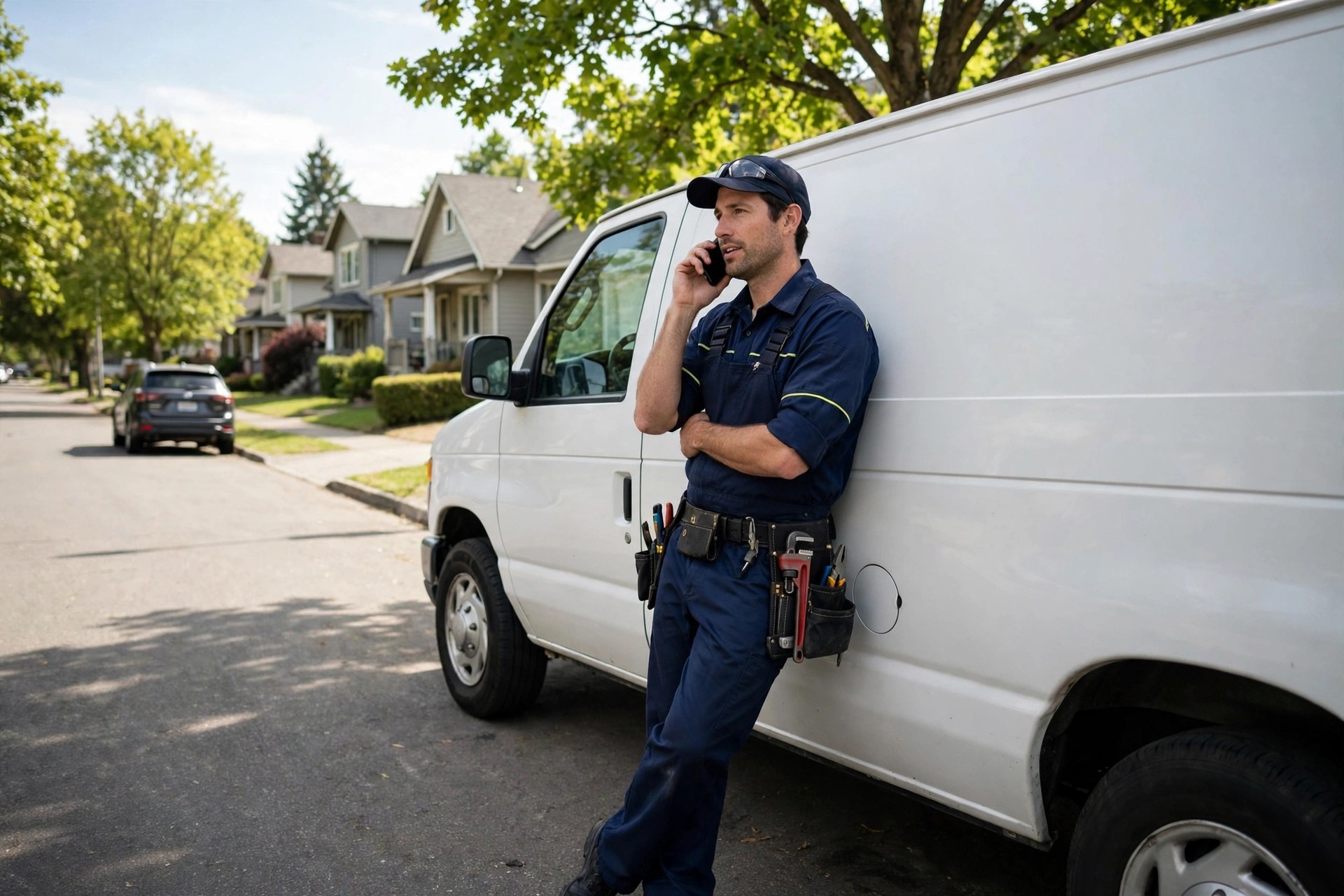
A plumbing shop quotes a $4,200 whole-house repipe on Tuesday. The estimator does a thorough walkthrough, the price is fair, and the homeowner says they need to think about it. Nobody follows up. The following Monday the homeowner hires a competitor who called twice, texted the quote recap, and offered financing. The first shop did not lose on price or quality. It lost on silence. This happens in plumbing businesses every single day: quotes that die from lack of follow-up, web inquiries answered hours late, maintenance customers never reminded, and happy customers never asked for reviews. The work to fix it is not more advertising. It is automation that makes sure every inquiry gets an instant response, every quote gets followed up at 24, 48, and 72 hours, every past customer gets maintenance reminders, and every finished job triggers a review request. This guide lays out the follow-up sequences that matter for plumbers, realistic setup options, and the revenue math on the quotes you are currently losing to slow responses.
The quick answer
- Speed wins the job: the company that responds first wins most of the time. Automate an instant text on every new inquiry.
- Quotes need 3 touches minimum: follow up at 24, 48, and 72 hours. Most unclosed quotes die from silence, not price.
- Maintenance reminders fill slow weeks: annual checkup emails and equipment-age triggers turn past customers into repeat revenue.
- Review requests run themselves: an automated ask 24 hours after every paid invoice compounds your Google rating.
- Start with your existing software: most field service and CRM tools can run these sequences. Integration beats fancy features.
- Recovered quotes are pure margin: the ad spend is already paid. Every quote you close through follow-up drops nearly straight to profit.
The real cost of slow follow-up
Put a number on it. If your shop quotes $200,000 of work a month and closes 35 percent, that is $70,000 booked and $130,000 walking away. Industry experience across home services consistently shows that a meaningful share of those lost quotes, often 10 to 20 percent, would close with proper follow-up. That is $13,000 to $26,000 a month left on the table, and the ad spend that produced those quotes is already gone. The speed problem is even starker on new inquiries. Widely cited sales research has long found that the business responding first wins the customer the large majority of the time, and that contact rates fall off a cliff as response time stretches from minutes to hours. A homeowner with a leaking water heater calls three plumbers and hires the one that answers. None of this is a marketing problem. It is an operations problem, and automation is the fix: systems that respond instantly and follow up relentlessly, whether or not anyone in the office remembers to.
Instant text on every new inquiry
The first five minutes after an inquiry are the highest-value minutes in your business. An automated instant text makes sure you never waste them again.
The 60-second rule
Every web form, chat message, and missed call should trigger an immediate text: within 60 seconds, around the clock. During business hours it buys time while a human calls back; after hours it holds the customer until morning. The text must come from a real local number and read like a person wrote it: “Hi, this is Apex Plumbing. Sorry we missed you. What plumbing issue can we help with?” Include the company name so it does not read as spam. Pair it with an instant internal alert to whoever is on call, because the text is the safety net, not the whole response; a human still needs to engage within minutes. Our guide to missed-call text-back for plumbers covers the call side of this in detail, and AI answering services for plumbers covers the after-hours side.
What the first text should say
Keep it short, specific, and easy to answer. Name the company, acknowledge the inquiry, and ask one simple question. “Thanks for contacting Apex Plumbing. Are you dealing with an emergency right now, or can we schedule a visit?” works because it sorts urgency immediately. Avoid links and long menus in the first message; the goal is a conversation, not a phone tree. If there is no reply in 10 minutes, one automated nudge is fine: “Just checking you saw our message. We have a tech in your area today.” Then stop and let the human take over. Measure response rate to the first text weekly; anything under 40 percent means the wording needs work.
The first five minutes decide who wins the job. Automation makes sure you never miss them.
Quote follow-ups at 24, 48, and 72 hours
Quoting is expensive: the drive, the walkthrough, the write-up, sometimes a second visit. Letting that investment die in silence is the costliest habit in the trade. A short, automated sequence recovers a real share of maybe-later customers without making your estimators feel like telemarketers.
The sequence
Trigger everything from the quote status in your system so it runs whether or not anyone remembers. At 24 hours, send a text with the quote recap: the scope in plain language, the price, and a one-tap accept or schedule link. At 48 hours, call, and if there is no answer, leave a short voicemail plus a text: “Checking in on the water heater quote. Happy to answer any questions or adjust the timing.” At 72 hours, send an email that answers the unasked objections: what happens if the work waits, financing options, and how long the price is honored. At 7 to 10 days, one final personal check-in from the estimator, then mark the quote dormant and move the contact to a long-term nurture list. Every touch should reference the specific job; generic “just following up” messages get ignored.
| Touch | Timing | Channel | What it says |
|---|---|---|---|
| Instant response | Within 60 seconds | Text | Acknowledge the inquiry, ask one sorting question, promise a fast callback |
| Quote recap | 24 hours after the quote | Text | Scope in plain language, price, one-tap accept or schedule link |
| Personal check-in | 48 hours after the quote | Call, then text if no answer | Answer questions, offer to adjust scope or timing |
| Objection handler | 72 hours after the quote | What waiting costs, financing options, price-honor deadline | |
| Final nudge | 7 to 10 days | Call or personal text | Last check-in from the estimator before the quote goes dormant |
| Maintenance reminder | 11 months after last visit | Email, then text | Annual checkup offer with one-click booking |
| Review request | 24 hours after paid invoice | Text, then email | Tech’s name, job done, direct Google review link |
Keep it personal at scale
Automation should feel like diligence, not spam. Use the estimator’s name, reference the actual job (“the water heater replacement we quoted Tuesday”), and keep each message short enough to read on a phone screen. Give estimators visibility into the sequence so they can pause it the moment a customer replies; nothing kills trust like an automated nudge arriving after a human already closed the deal. Track close rate by estimator as well as by campaign, because follow-up discipline varies by person and the data shows you who needs coaching. For the email side of quote recovery in more depth, see our guide to email marketing for plumbers.

The quote is an investment. Three automated touches protect it from going silent.
Maintenance-plan reminders
Past customers are the cheapest revenue in the business, and most plumbing shops ignore them until something breaks. Automated reminders turn the customer list into a second sales team that works for free.
Annual checkup reminders
Trigger an email and text 11 months after the last visit: “It has been almost a year since we serviced your home. Our annual checkup covers water pressure, the water heater, visible supply lines, and fixtures, about 45 minutes.” Include one-click booking and a plain price. The checkup itself is modest revenue, but the findings are where the money is: aging supply lines, a water heater near end of life, a slow drain the customer stopped noticing. One follow-up two weeks later to non-bookers with a seasonal angle, like pre-winter pipe protection, then stop until next year.
Equipment-age triggers
If your records include equipment ages, automate around them. A conventional tank water heater lasts roughly 8 to 12 years; email the owner at year 8 with education, at year 10 with a concrete replacement quote, and at year 11 with honest urgency about failure risk. The same logic applies to sump pumps before rainy season and aging washing machine hoses. If your records lack ages, start collecting them now: techs note brand and approximate age on every visit. Within a year you will have ages for a large share of the customer base, and the countdown campaigns will start filling the install calendar on their own.
Review-request automation after every job
Plumbing is one of the most review-driven trades, and review count directly affects both map rankings and close rates. The automation is simple; the compounding is powerful.
The 24-hour automated ask
Trigger on the paid invoice, not when the tech leaves, so you only ask paying customers. Text first, since open rates dwarf email: “Mike replaced your water heater yesterday. If the work was solid, a quick review helps our small shop: [link].” One email backup three days later for non-responders, then stop. Respond to every review within 48 hours, and treat negative reviews as public customer service. See how to get more Google reviews for plumbers for the full playbook, and plumber marketing ideas for how reviews fit the bigger plan.
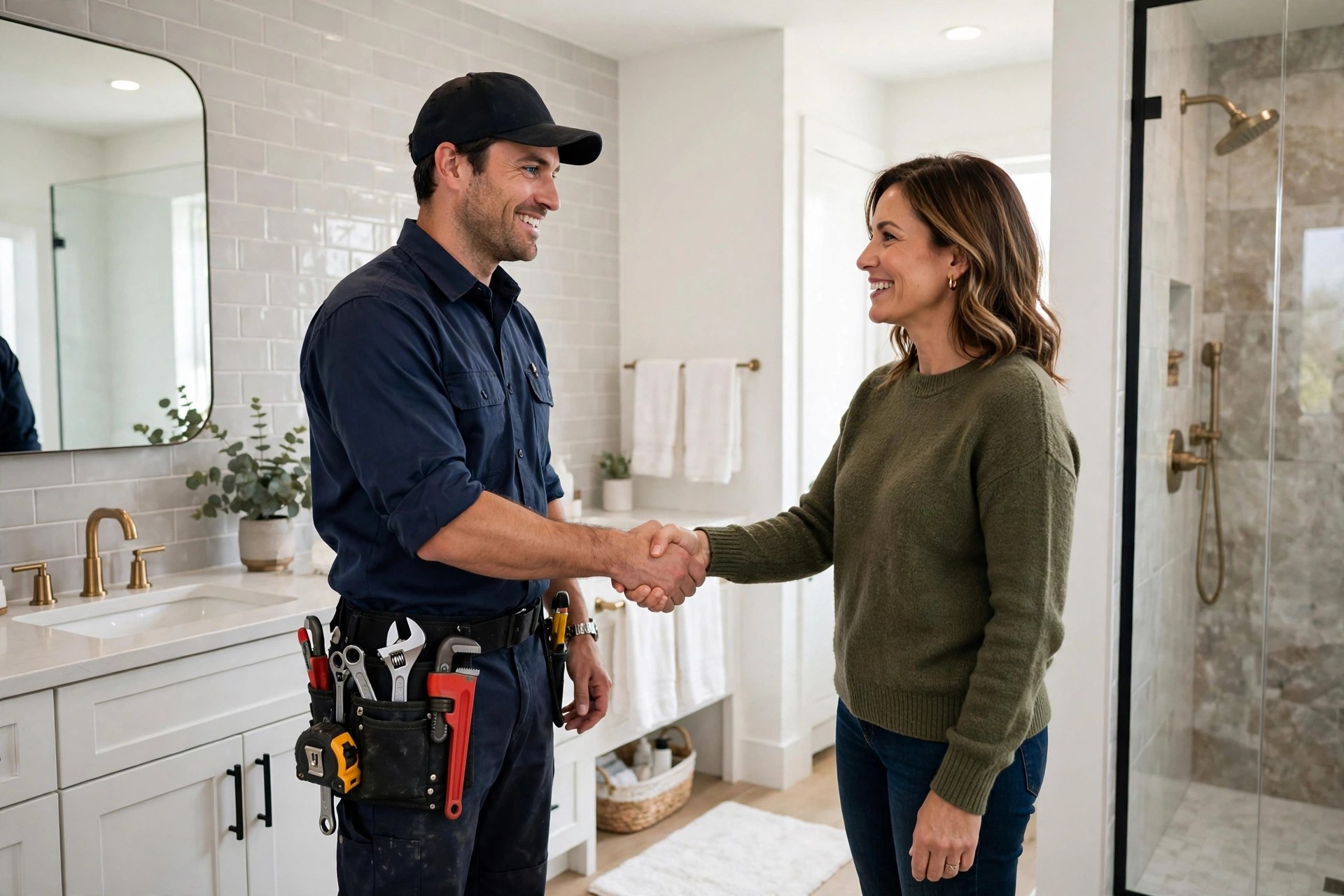
Every finished job is a review waiting to happen. The automated ask makes sure it happens.
Realistic setup options
You do not need exotic software. You need your existing tools wired to fire on the right triggers.
Start with what you have
Most field service software and plumbing CRMs can already send automated texts and emails on triggers like new lead, quote sent, invoice paid, and visit date. Before buying anything new, audit what your current system can do; half of shops own the capability and never turned it on. If your system cannot trigger on job events, that is the upgrade to prioritize, because every sequence in this guide depends on it. A basic CRM with texting, email, and pipeline automation typically runs $100 to $300 a month for a small shop, which the first recovered quote usually pays for several times over.
Keep the build order simple
Build in this order: instant text on new inquiries first, because it touches every lead starting today. Then the 24/48/72 quote sequence, because it recovers the revenue you already paid to create. Then the review request automation, because reviews compound everything. Then maintenance reminders and equipment-age triggers, which need cleaner data. Each layer takes a few hours to build and runs for years. Resist the urge to build all of it in week one; get the first sequence live and measured, then add the next.
Your rollout checklist
Speed first, then quotes, then the long-term layers.
- 1Wire the instant text. Every web form, chat, and missed call triggers a personal-feeling text within 60 seconds, plus an internal alert.
- 2Set the 5-minute human standard. The text buys time; a person still engages within minutes during business hours.
- 3Build the 24/48/72 quote sequence. Text recap at 24 hours, call at 48, objection-handling email at 72, final nudge at 7 to 10 days.
- 4Give estimators a pause button. Anyone can stop the sequence the moment a customer replies, so automation never talks over a human.
- 5Launch the review automation. Text 24 hours after the paid invoice with the tech’s name and a direct Google link.
- 6Build maintenance reminders. 11-month checkup trigger by email and text, with one-click booking and a seasonal follow-up.
- 7Start collecting equipment ages. Techs note brand and age on every visit to feed future replacement campaigns.
- 8Review the numbers monthly. Response time, inquiry-to-booking rate, quote close rate, and reviews per job. Fix the weakest link first.
Frequently asked questions
How fast should a plumber follow up with a new lead?
Within 5 minutes during business hours, with an automated text inside 60 seconds around the clock. The business that responds first wins the job the large majority of the time, so speed is the single biggest improvement most shops can make.
How many times should I follow up on a plumbing quote?
At minimum three touches: a recap at 24 hours, a personal check-in at 48 hours, and an objection-handling email at 72 hours, plus a final nudge at 7 to 10 days. Most unclosed quotes die from silence, not price, and this sequence recovers a real share of them.
Will automated follow-up annoy my customers?
Not if it is personal, specific, and limited. Reference the actual job, use the estimator’s name, keep messages short, and stop the sequence the moment someone replies or books. Three to four relevant touches over ten days reads as diligence; daily blasts read as spam.
What is the best way to follow up: call, text, or email?
Use all three in sequence. Text first for speed and open rates, call for the personal touch on bigger quotes, email for detailed recaps with pricing and financing. Match the channel to the moment rather than picking one.
How much does follow-up automation cost for a plumbing shop?
A basic CRM with texting, email, and pipeline automation typically runs $100 to $300 a month for a small shop. Most of the sequences in this guide can also be built inside field service software you already pay for. One recovered quote usually covers months of cost.
Should I automate review requests?
Yes. A text 24 hours after the paid invoice, personalized with the tech’s name and the job done, plus one email backup, is the standard that works. Reviews compound your map ranking and close rate month after month, and automation means it happens after every job without fail.
How do I measure whether follow-up automation is working?
Track response time to new inquiries, inquiry-to-booking conversion, quote close rate before and after the sequence, and reviews per completed job. Quote close rate is the single most telling number: it moves first and it moves revenue directly.
Stop losing quotes to slow responses
Digital Hayder builds follow-up automation for plumbing companies: instant inquiry texts, 24/48/72 quote sequences, maintenance reminders, and review automation wired into your real job data. Tell us about your shop and we will design the follow-up system around it.
Contact Us