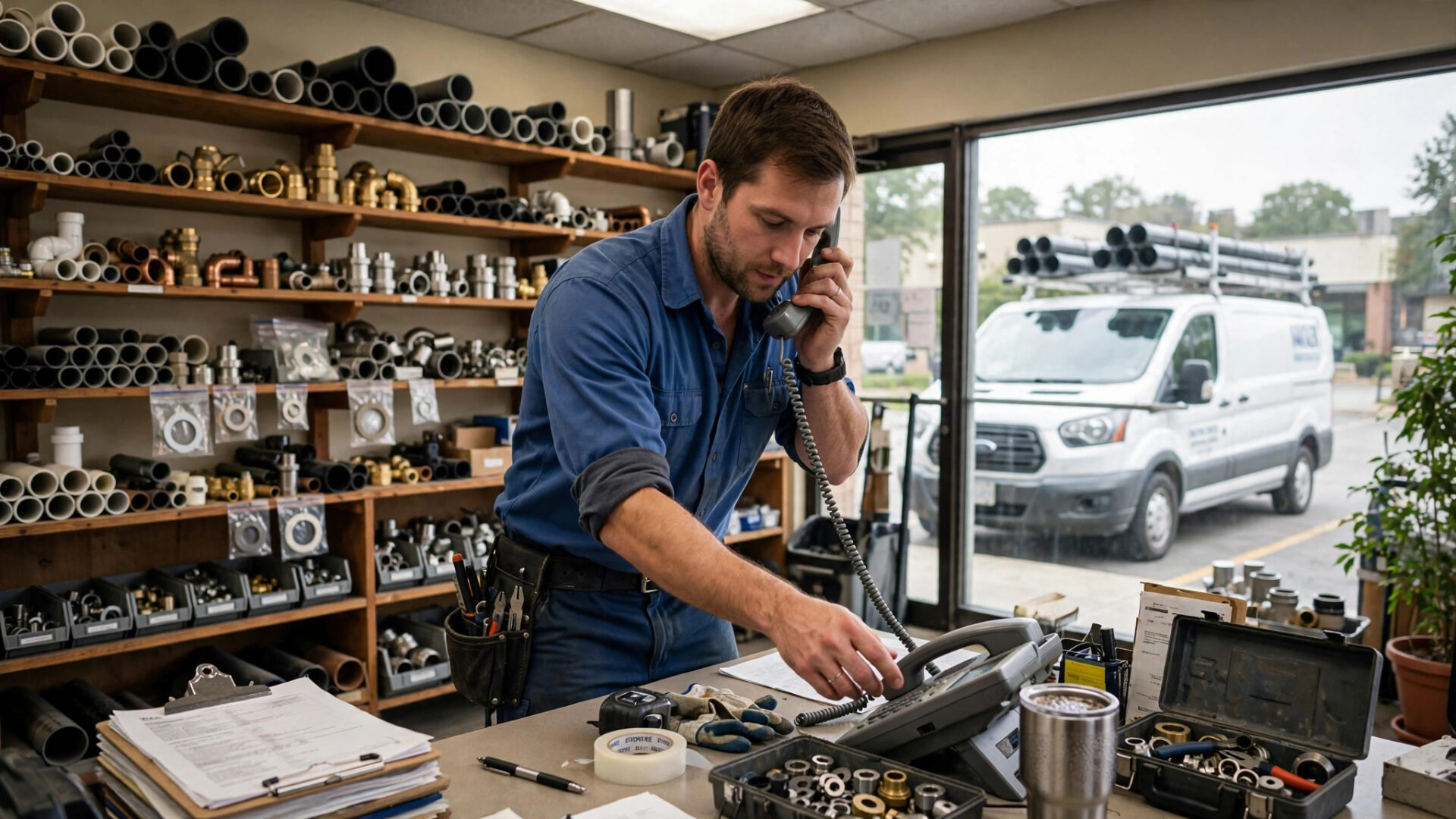
A homeowner with a burst pipe at 2 a.m. calls three plumbers. The first two go to voicemail. The third picks up and has a tech on the way within the hour. That is the entire story of why an AI answering service for plumbers exists: plumbing emergencies do not wait for business hours, and neither do the callers.
Missed calls are the quiet leak in a plumbing business. The phone rings while you are under a sink, in a crawl space, or driving between jobs. By the time you call back, the homeowner has already hired someone else. This guide explains what AI answering services do for plumbing shops, what they cost compared to human answering services and in-house staff, how emergency dispatch actually works, and the questions to ask before you sign anything.
The quick answer
- Cost: AI answering services for plumbers typically run $49 to $349 per month, depending on call volume and features. Human answering services run $300 to $800 or more, and a full-time receptionist costs around $35,000 a year in salary alone.
- What it does: answers every call 24/7, triages emergencies, patches urgent jobs to your on-call tech, books routine jobs into your schedule, and filters spam.
- Best fit: shops that miss calls during jobs, after-hours emergencies, and overflow on busy mornings. Pure after-hours plans start around $99 to $149 a month.
- The catch: AI handles job booking and triage well but cannot diagnose a problem or calm a panicked homeowner the way a person can. Know where the handoff happens.
What an AI answering service for plumbers actually does
An AI answering service is not a voicemail with a fancy greeting. It is a voice agent that answers your business line, holds a real conversation with the caller, and takes action based on what it hears. For a plumbing shop, the setup is tuned to the trade: the kinds of jobs you run, your service area, your on-call schedule, and your escalation rules.
Emergency triage and dispatch
This is the feature that matters most for plumbers. A good AI answering setup is trained to recognize emergency language: burst pipe, flooding, sewage backup, gas smell, water heater leaking, no hot water in winter. When it hears one of these, it follows your escalation plan. Usually that means patching the call through to the on-call technician immediately, or sending an urgent text alert while the caller is still on the line. Trade-focused providers let you write these rules in advance, so a flooded bathroom at midnight reaches your on-call phone within seconds while the caller is still talking.
Job booking for routine calls
For non-emergencies (a dripping faucet, a water heater replacement quote, a drain cleaning request), the AI collects the details, checks availability, and books the job into your scheduling software. Many trade AI services integrate with tools like Jobber, Housecall Pro, or ServiceTitan, so the job lands on the dispatch board with the customer’s details attached.
After-hours and overflow coverage
You can run the AI full time or only where the gaps are. Many shops use it strictly as an after-hours service (nights, weekends, holidays) and keep daytime calls in-house. Others use it as overflow: when your line is busy or your office person is on another call, the overflow routes to the AI instead of voicemail. A newly launched trade-specific service even charges less for after-hours-only plans than for full front-desk coverage, which fits shops that only need the net cast when nobody is around.
Spam filtering and call summaries
Solicitors and robocalls waste real money on per-call plans. The AI identifies spam and blocks it before it costs you anything. Every answered call gets recorded and summarized, so you wake up to a text digest of who called, what they needed, and what was booked.

The calls your plumbing shop is losing right now
Here is the number that should make every plumbing owner pause: research on small business calls found that 62% of calls to small businesses go unanswered, a figure that has been quoted across the trade press for years. The pattern is worse for shops like yours, where the owner is usually the one on the truck. You cannot be under a sink and on the phone at the same time.
Caller behavior makes unanswered calls fatal. According to industry research, only about 42% of callers leave a voicemail, 85% of callers who reach voicemail never call back, and 78% of US consumers say they have abandoned a business after an unanswered call. For home services specifically, roughly 67% of callers who cannot reach one business call a competitor instead (Invoca, CallRail and PATLive data compiled at usecarly.com). In plumbing, where the call is usually urgent, the caller does not wait. They dial the next number on Google.
Phone leads also convert far better than web form leads in the trades, which is why every missed ring costs more than a missed email. The fix is not complicated: someone (or something) has to answer. The AI option just does it for a fraction of the cost of a human service.
AI answering service for plumbers: cost vs. human answering service
Pricing in this market splits into two worlds: AI services that mostly charge a flat monthly rate, and human services that mostly charge by the minute. Understanding that split is the key to comparing quotes honestly.
Budget AI services
Entry-level AI answering plans with per-call or limited-call pricing. OnCrew, for example, publishes $49/month for 100 included calls and $149/month for 400 calls (oncrew.ai, ). AgentZap lists plans from $109/month with unlimited calls, and Rosie publishes $49/month with unlimited minutes (agentzap.ai). Good fit for a solo plumber or a two-truck shop that mostly needs after-hours and overflow coverage.
Trade-focused AI services
AI services built specifically for plumbing, HVAC, and electrical shops, with trade-specific triage, emergency escalation rules, and scheduling integrations. Wakeman, a recently launched trade-focused service, publishes $149/month for after-hours answering and $349/month for full front-desk coverage with Jobber integration (wisconsinbeacon.com). OnCrew’s Multi-Truck plan at $349/month covers 1,000 calls. This is the tier where the AI starts acting like a dispatcher rather than a receptionist.
High-volume and dispatch plans
For shops running multiple trucks with high call volume, deeper dispatch features, and custom routing. Wakeman’s Dispatch plan is $829/month for larger shops. Some premium AI platforms charge $200 to $500/month for advanced features. Only upgrade here when your call volume actually requires it.
Human answering services
Live agents answering in your company name. Typical structure is a $50 to $200 monthly base plus $0.79 to $1.50 per minute, with after-hours premiums of 1.5 to 2 times normal rates (getnextphone.com). At 50 calls a month averaging 3 minutes each, per-minute charges alone run $200 to $500 on top of the base fee. In a surge month (cold snap, storm season) the bill can double. Humans handle emotional and complex calls better, but you pay for every minute and every extra ring.
In-house receptionist
A full-time receptionist costs around $35,000 a year in salary before benefits, training, and overhead, and that person works 40 hours a week. Nights, weekends, and sick days are still uncovered (getnextphone.com). Worth it for shops with heavy walk-in and office traffic; expensive as a pure call-answering solution.
| Option | Typical monthly cost | Coverage | Best for |
|---|---|---|---|
| AI answering (budget) | $29 to $149 | 24/7 or after-hours | Solo plumbers, 2-truck shops |
| AI answering (trade-focused) | $149 to $349 | 24/7, dispatch integration | Growing shops with on-call techs |
| AI answering (high volume) | $500 to $829+ | 24/7, multi-truck routing | Large shops, high call volume |
| Human answering service | $300 to $1,500+ | 24/7, per-minute billing | Shops needing live empathy on every call |
| In-house receptionist | ~$2,900+ (salary) | 40 hrs/week | Shops with walk-in traffic and admin load |
A note on these numbers: they are planning ranges from published pricing pages, not fixed industry rates. Every quote depends on your call volume and features. Per-call and per-minute billing can swing a “cheap” plan expensive in a busy month, so always run the math on your actual call count.

7 questions to ask before you buy
Not every AI answering service understands the trades. Use these questions to separate a real dispatch tool from a generic chatbot with a phone number.
- 1Can it tell an emergency from a routine call? Ask how it triages. It should recognize flooding, sewage, burst pipes, and gas-related calls as urgent, and know exactly who to page for each. If the answer is “it takes a message,” that is voicemail, not triage.
- 2What counts as a billable call? Get it in writing: do spam calls, wrong numbers, and 10-second hang-ups count against your plan? Reputable trade services exclude spam automatically.
- 3Does it book into my scheduling software? The AI should place jobs directly into Jobber, Housecall Pro, ServiceTitan, or whatever you run. If it only emails you a message, you have bought an expensive notepad.
- 4How does it handle nights, weekends, and holidays? Confirm there is no premium per-call rate for after-hours, and that emergency patch-through works the same at 3 a.m. as at 3 p.m.
- 5Can I hear it on a real call? Listen to a demo call on a plumbing-specific scenario, not a restaurant reservation. You want to hear how it handles an address, a callback number, and a panicked caller.
- 6What happens when it cannot help? Ask for the escalation path. A good setup transfers to you or your on-call tech, or takes a detailed message, rather than improvising an answer it does not know.
- 7What are the contract terms? Setup fees, contract length, auto-renewal, rate-increase clauses, and who owns your call data if you cancel. Month-to-month with a trial is the low-risk way to start.
Where an AI answering service for plumbers falls short
Honest section, because the sales pages will not give you one. AI voice agents are good at structured tasks: answering, qualifying, booking, dispatching. They are worse at the human parts of a plumbing call.
A homeowner with sewage backing up into the house at midnight is scared and upset. A live dispatcher calms them down while paging the tech. An AI can take the details and trigger the page, but it cannot offer real reassurance, and some callers will hang up when they realize they are talking to software. That matters most for emergency calls, which is exactly where plumbing businesses earn their reputation.
The AI also cannot diagnose. It can record that the water heater is making a strange sound and book a visit, but it cannot say whether it is safe to leave it running, and it should never try. Gas-related calls go straight to a human.
The practical answer for most shops is a hybrid setup: AI answers after hours and overflows during the day, escalating real emergencies to a live person the moment they are identified. You get the coverage without trusting the machine with your most sensitive calls. Dental practices have adopted the same pattern with AI receptionists that book consults after hours (see how it works for dental offices), and the logic is identical for plumbers.
How to roll it out without disrupting your shop
Start with after-hours only: forward unanswered calls to the AI after closing time and on weekends. Give it your trade scripts (how you define an emergency, your service area, your on-call rotation, pricing for common jobs). Run it for two to four weeks and read the call summaries every morning, checking that real emergencies paged correctly and routine jobs landed in the schedule with accurate details.
Most services offer free trials of about two weeks, which is enough to answer these questions. After the trial looks clean, extend coverage to daytime overflow so no call ever hits voicemail. And keep your existing business number: you forward your current number to the service, so callers hear your company name and notice no change.
Frequently asked questions
How much does an AI answering service for plumbers cost per month?
Typical published pricing runs $29 to $349 a month for most AI plans, from budget services with per-call pricing up to trade-focused plans with dispatch features. Human answering services run $300 to $1,500 or more a month with per-minute billing. Your actual cost depends on call volume, so run the math on your real monthly call count before comparing plans.
Can an AI answering service handle plumbing emergency calls?
Yes, within clear limits. It recognizes emergency keywords like flooding, burst pipe, sewage backup, and gas smell, then follows your escalation plan: patching the call to your on-call tech or sending an urgent alert while the caller is still on the line. It cannot diagnose problems or give safety advice, so gas calls should be scripted to reach a human immediately.
Will callers know they are talking to an AI?
Depends on the provider. Some identify themselves as an AI assistant up front; others answer in your company name without saying so. If this matters to you, ask before you sign. Most callers care more about getting help fast than about who picks up, especially at 2 a.m.
Can it book jobs into my scheduling software?
Trade-focused services integrate with common field-service tools like Jobber, Housecall Pro, and ServiceTitan, placing booked jobs directly on the dispatch board. Budget services may only email you a message. If direct booking matters, confirm the integration exists before buying.
Is an AI answering service better than a human answering service for plumbers?
For cost and after-hours coverage, AI usually wins: flat monthly rates, instant answer, no per-minute surge billing. For emotional and complex calls, humans win. Many shops use AI after hours and keep a live service or in-house person for the day, which gives the best of both.
Do I need to change my phone number?
No. You keep your existing business number and forward unanswered or all calls to the service. Callers hear your company name and notice no change in how they reach you.
Stop losing jobs to voicemail
Digital Hayder sets up AI answering and call-capture systems for home-service businesses: emergency triage, after-hours coverage, and job booking that lands straight in your schedule. Tell us about your shop and we will map the right setup for your call volume.
Contact Us