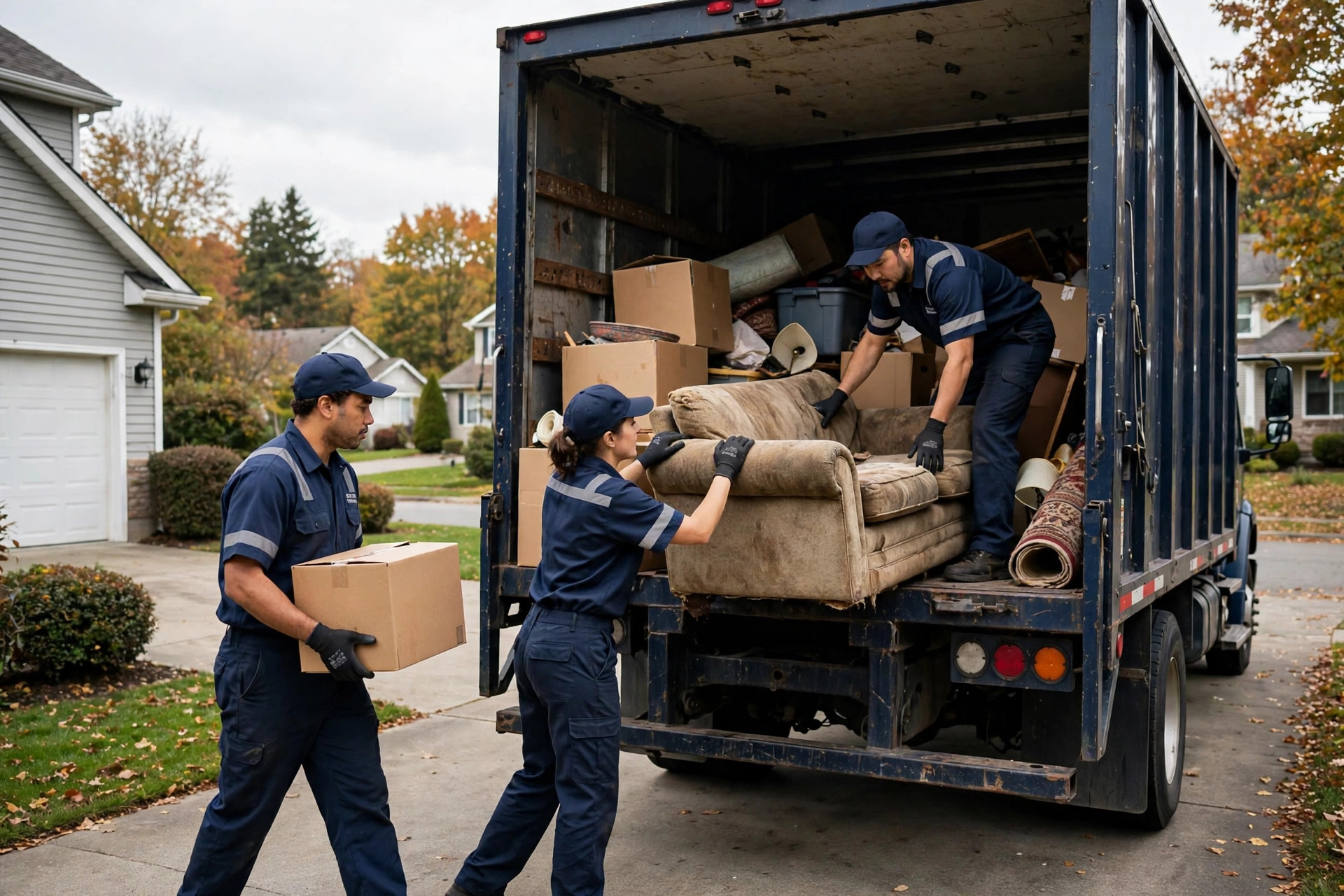
A junk removal customer decides fast. They are staring at a garage full of boxes, a curb piled with an old mattress and a broken dresser, or a rental unit that needs to be empty by Friday. They search on their phone, and they contact the first company that responds with a price and a pickup time. If your crew is on a truck and your office line goes to voicemail, that customer is gone in minutes. An AI chatbot for junk removal companies fixes exactly this. It answers in seconds, takes photos of the junk, gives an instant quote range, and books the pickup, while your crews keep hauling. This guide explains what the chatbot does, what it costs, and how the math works out for a typical junk removal operation.
The quick answer
- Speed wins every job: customers contact two to three junk removal companies and book whoever answers first with a price.
- The chatbot quotes in seconds: photo-based quote requests get an instant range and a booked pickup, even at midnight.
- After-hours gold: a large share of quote requests arrive evenings and weekends when nobody is at the desk.
- Costs stay small: chatbot software runs $50 to $300 a month, with agency setup from $500 to $2,500 one time.
- Route density bonus: chat booking fills nearby slots first, cutting drive time between jobs.
- Live in under two weeks: connect the site and phone, load your pricing rules, train the bot on your services, and launch.
Why junk removal leads go cold in minutes
Junk removal is an impulse purchase with a deadline. The customer wants the stuff gone, and they want it gone soon. Unlike a kitchen remodel, there is no long research phase. Studies of home-service buyer behavior consistently show that most customers contact multiple providers and hire the first one that gives them a clear price and a time. Every minute of silence from your company is a minute the customer spends talking to your competitor.
The structure of a junk removal business makes this worse. Your best people are on trucks, not at desks. The office phone rings while the crew is carrying a piano down three flights of stairs. After 5 PM and on weekends, when a huge share of homeowners finally deal with their junk, there is often nobody to answer at all. Voicemail is where quote requests go to die: few customers leave a message, and most of the ones who do will have booked someone else by the time you call back.
Then there is the quote problem. Junk removal pricing depends on volume, item type, access, and location, which means customers cannot get a price from a static website. They have to ask. If asking means waiting hours for a callback, many simply will not bother. An AI chatbot removes the wait. It asks the same questions your estimator asks, collects photos of the junk, and returns a quote range on the spot. The customer gets what they came for in under a minute, and your company gets the booking before the competitor even sees the lead.
What the chatbot actually does all day
An AI chatbot is an automated assistant that talks with your website visitors and texters, answers their questions, and moves them toward a booked job. For a junk removal company, its daily work breaks into five jobs.
Takes quote requests around the clock
The core job. A visitor opens the chat, the bot asks what needs to go, where it is, and when they want it gone. It collects photos, applies your pricing rules, and gives a quote range instantly. The customer picks a pickup window, the bot confirms the booking, and your dispatcher sees a complete job ticket: name, address, photos, items, and time window. No phone tag, no lost sticky notes.
Answers the same ten questions forever
Do you take mattresses? How much for a couch? Do I need to be home? What areas do you serve? Do you donate or recycle? Your team answers these dozens of times a week. The bot answers them instantly from your service info, any hour, while your people do the work that needs hands. When a question falls outside the script, the bot hands off to a human with the full conversation attached.
Books pickups into real time slots
A chatbot connected to your schedule offers actual pickup windows, not “we will call you to schedule.” Customers pick Tuesday between 10 and 12, the slot fills, and the crew route updates. This matters because junk removal customers book on momentum; every extra step between “yes” and “booked” loses jobs. If you already worry about calls you cannot answer, our guide to missed-call text-back for junk removal companies covers the phone-side backup that pairs with chat.
Follows up on quotes that stall
Not every quote books on the spot. The chatbot follows up automatically: a text the next day asking if they still need the pickup, another a few days later with a nudge about your next available slot. These follow-ups recover jobs that would otherwise evaporate, and they cost you nothing in staff time.
Collects reviews after the job
After a completed pickup, the bot texts the customer a thank-you and a direct link to your Google review page. Reviews are the lifeblood of a local junk removal company, and asking at the right moment, right after the truck pulls away, is when customers are happiest. Our guide to getting more Google reviews for junk removal companies goes deeper on turning happy pickups into five-star proof.
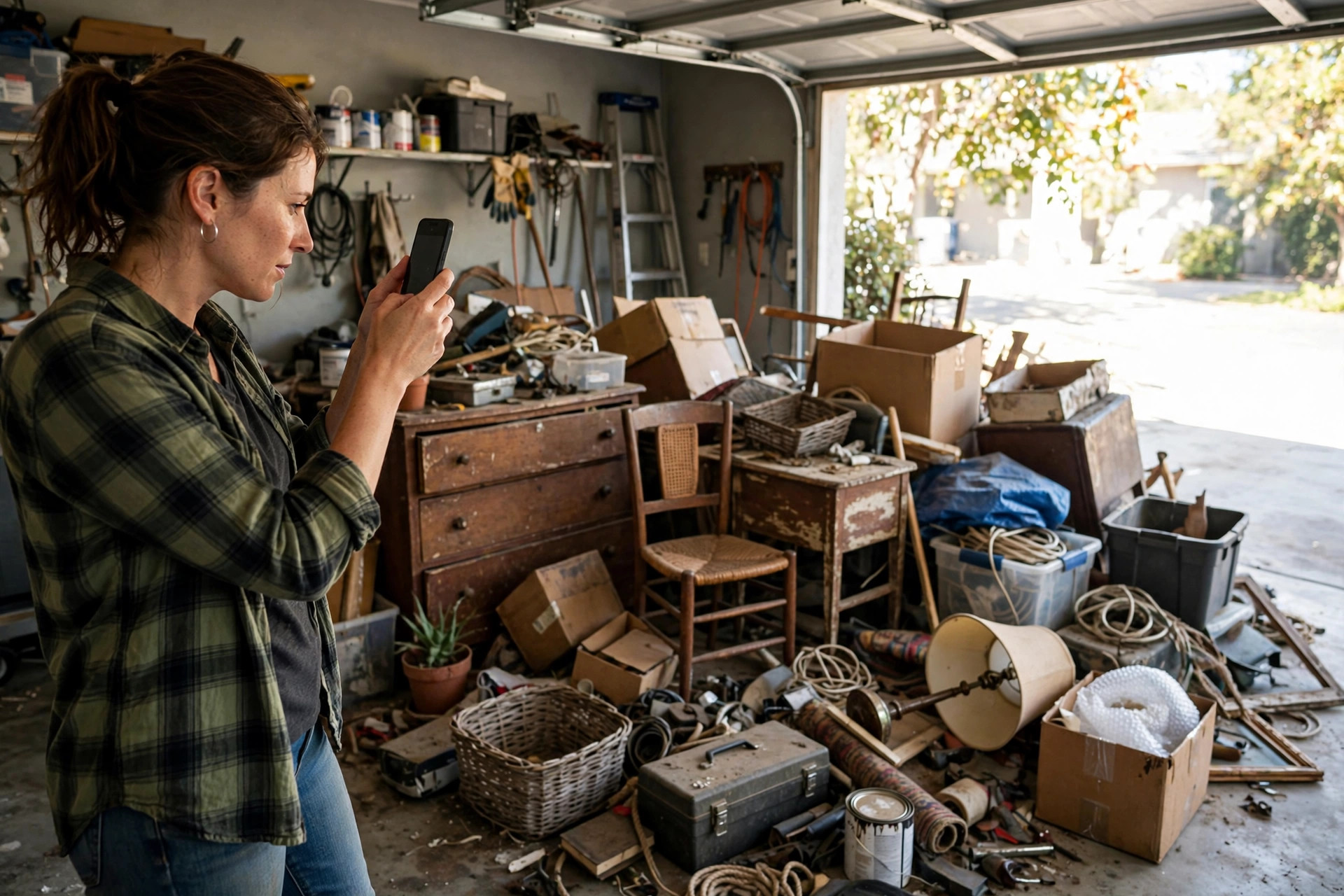
Photo-based quotes let customers get a price in under a minute, which is exactly how fast junk removal decisions get made.
Instant quotes while your crews are on the trucks
The quote flow is the heart of the system, so it has to be fast and simple. Here is how a good junk removal chatbot quote works from the customer’s side.
Step 1, what is going. “What do you need hauled away? You can describe it or just send photos.” Most customers send photos, because it is easier than typing a list. The bot accepts up to five or six images.
Step 2, where and when. “What is the pickup address, and is this inside the home, in the garage, or at the curb?” Curbside is cheapest, in-home costs more; the bot applies your rules. “When do you need it gone?” with quick options: today, tomorrow, this week, flexible.
Step 3, the quote range. Based on your pricing rules, the bot replies with a range: “Based on the photos, this looks like a quarter truckload. That typically runs $180 to $240. The final price is confirmed on site before we load anything.” Ranges build trust; nobody believes an exact price sight unseen, and ranges protect you from photo surprises.
Step 4, the booking. “We have Tuesday 10 to 12 and Wednesday 2 to 4 open in your area. Want me to hold one?” The customer picks, gives a name and phone number, and gets a confirmation text. Total time: under two minutes. Total staff time: zero.
The pricing rules are yours. You set the ranges per load size, the extra charges for stairs or long carries, the items you will not take, and the minimums. The bot applies them consistently, which also ends the quiet problem of different team members quoting different prices for the same job. For the full economics of a service website that supports this kind of quoting, see our breakdown of septic service website costs, where the same quote-capture logic applies to another field trade.
The after-hours bookings you are missing right now
Think about when homeowners deal with junk. Evenings after work. Saturday mornings. Sunday afternoons before the work week. These are exactly the hours when most junk removal offices are closed or short-staffed. Industry data on home-service inquiries consistently shows that a large share of quote requests arrive outside business hours, and junk removal skews even later because the trigger is often a weekend cleanout.
Every one of those after-hours visitors faces a choice: your contact form promising a reply “within one business day,” or the competitor’s chat that gives a price now. “Within one business day” loses to “right now” almost every time. The chatbot turns your website into a 24-hour estimator. It cannot load a truck at midnight, but it can do everything short of that: quote, book, confirm, and put a complete job on tomorrow’s schedule before your dispatcher has had coffee.
The compounding effect matters. After-hours bookings do not just add jobs; they add the best kind of jobs. A customer who books at 10 PM on a Sunday has already decided. They are not shopping three companies on Monday morning. First response wins, and the chatbot is always first.
Photo-based quotes: the feature customers love most
Ask junk removal owners what changed their close rate, and the ones with photo quoting all say the same thing: customers love sending pictures. It feels natural, it takes ten seconds, and it removes the awkwardness of describing a “medium pile of stuff” over the phone. For your business, photos do three jobs at once.
First, they make the quote accurate. Your estimator sees the actual items, the access, and the volume instead of guessing from a vague description. Fewer surprises on site means fewer price adjustments at the curb, and price adjustments are where one-star reviews are born. Second, they pre-qualify the job. The photos show immediately if there are items you do not take, like hazardous materials, so the bot can say so upfront instead of your crew discovering it on arrival. Third, they create commitment. A customer who has sent photos and received a price has invested in the process; they book at far higher rates than someone who filled out a bare contact form.
Set expectations clearly in the chat: photos get a quote range, the final price is confirmed on site before anything is loaded, and the on-site price matches the range unless the load is bigger than the photos showed. This honesty is what makes photo quoting work. Customers accept a range; they do not accept surprises.
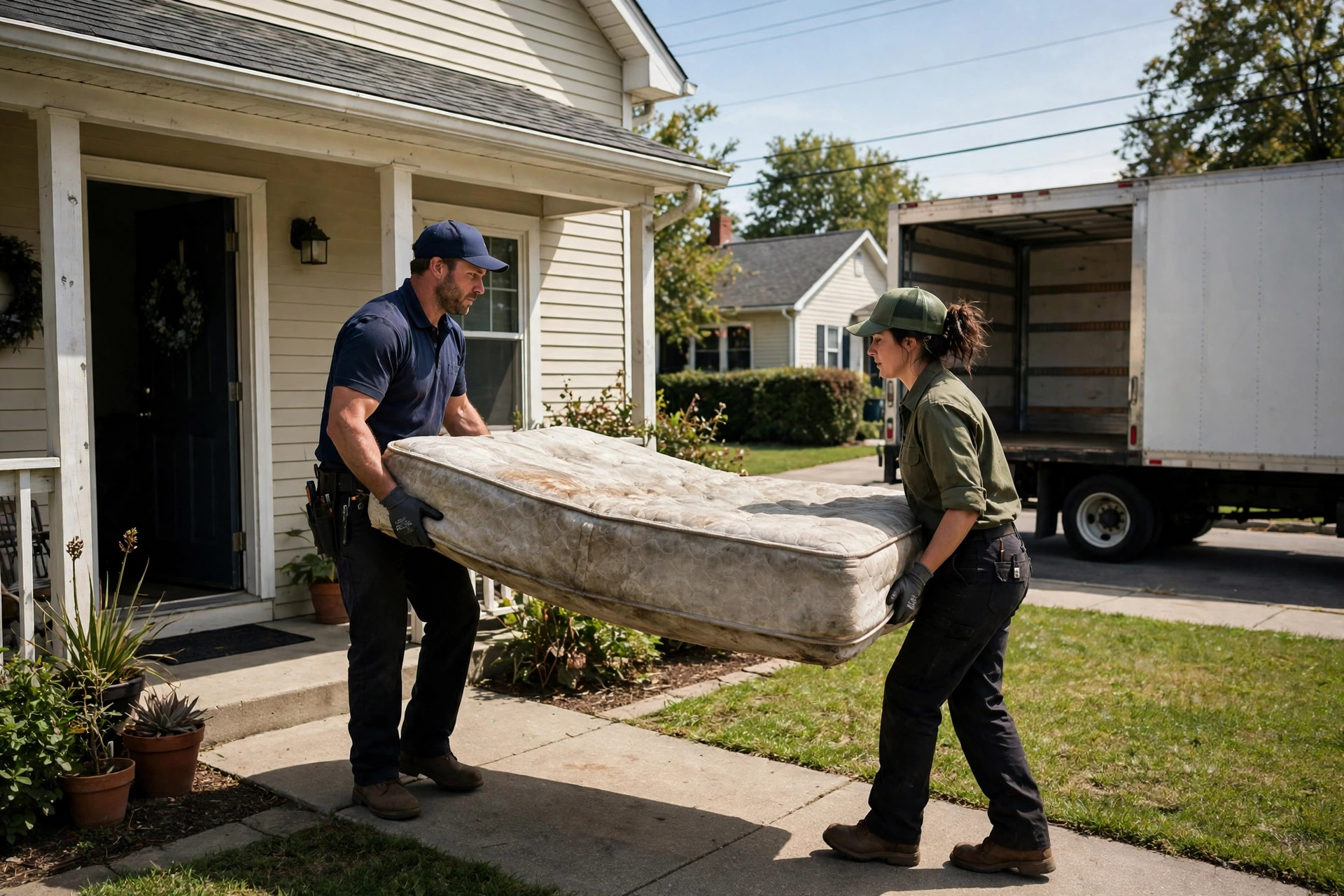
Accurate photo quotes mean fewer price surprises on site, and fewer surprises mean better reviews.
Route density: booking smarter, not just more
More bookings are good. Bookings clustered together are better. Every junk removal owner knows that drive time between jobs is dead money: fuel, wages, and truck wear with zero revenue. A chatbot connected to your schedule can do something a contact form never will, which is steer bookings into dense routes.
The logic is simple. When a customer asks for a pickup window, the bot offers the windows where you already have jobs nearby first. “We will already be in your neighborhood Tuesday morning” is a genuine selling point for the customer, faster service, and a gift to your margins. Over a month, tighter routes can cut drive time per job noticeably, which drops straight to profit.
This also helps with same-day jobs, the highest-margin work in junk removal. When a truck finishes early, the dispatcher can see chat-booked jobs near the crew’s current location and offer them immediately. The chatbot keeps feeding the schedule all day, including the hours when nobody is watching the phones, so the next morning starts with a full, dense route instead of a blank board.
You do not need fancy software for the basic version. Even a chatbot that books into defined service windows by zone gives you far more control than first-come first-served phone bookings. The advanced version ties into your dispatch tool and optimizes automatically, but the zone-based version captures most of the value.
What a junk removal chatbot costs
Chatbot pricing has three layers: the software, the setup, and any ongoing management. Here is what each typically runs for a junk removal company.
| Option | Typical price | What you get |
|---|---|---|
| DIY chatbot builder | $50 to $150 per month | Drag-and-drop flows, website widget, basic quote forms; you build and maintain everything |
| Managed chatbot platform | $150 to $300 per month | Done-for-you quote flows, photo upload, scheduling integration, review requests, monthly tuning |
| AI receptionist bundle | $300 to $600 per month | Chatbot plus AI phone answering, missed-call text-back, and follow-up automation in one system |
| One-time agency setup | $500 to $2,500 | Flow design, pricing rules, schedule integration, team training; then you pay the monthly software |
| Custom build | $5,000 and up | Fully custom quoting logic, dispatch integration, multi-location support; overkill for most |
For most junk removal companies, the sweet spot is a managed platform at $150 to $300 a month after a one-time setup. That is less than the revenue from a single average job. The DIY route saves money but costs your time, and the flows tend to stall at “leave your number and we will call you,” which defeats the purpose. Cleaning companies face nearly identical math, as our guide to AI chatbots for cleaning companies shows: the businesses that win are the ones whose bots complete the booking, not the ones whose bots take messages.
Chat vs texting vs phone: where each wins
A chatbot does not replace your phone. It takes the jobs it does best and leaves the rest to humans. Here is the honest comparison.
| Task | Website chatbot | Phone call | Texting |
|---|---|---|---|
| Instant quote with photos | Best: guided flow, photos, instant range | Good but slow; no photos, ties up staff | Okay for simple jobs, messy for complex ones |
| After-hours inquiries | Answered and booked instantly | Voicemail; most callers move on | Auto-reply only, no real conversation |
| Booking into time slots | Real availability, instant confirmation | Good if someone answers | Back-and-forth, easy to lose the thread |
| Complex or unusual jobs | Hands off to a human with photos attached | Best: nuance and judgment | Poor fit for detail |
| Follow-up on open quotes | Automatic, perfectly timed | Staff time, often skipped | Good if someone remembers to send it |
| Cost per conversation | Pennies after setup | Staff wages per minute | Low, but staff time per thread |
The practical setup is all three working together: the chatbot as the always-on front door, the phone for complex jobs and customers who prefer talking, and texting for follow-ups and confirmations. The handoff is what makes the mix work: a chat that starts with photos and a quote range can move to a call with zero repeated questions.
Setting it up without the headache
A junk removal chatbot is a one-to-two-week project if you keep the scope tight. Start with quoting and booking; add the fancy parts later.
Days 1 to 2: your pricing rules. Write down your load sizes and price ranges, extra charges for stairs and long carries, items you will not take, minimums, and service areas. This document is the brain of the bot; everything else hangs on it. Be honest about the ranges. The bot can only quote as well as your rules.
Days 3 to 5: the flows. Build the quote flow, the booking flow, and the FAQ answers: what you take, pricing, timing, payment, donation and recycling policy. Connect the schedule so the bot offers real pickup windows. Add photo upload and test it on real phones, because customers will use old phones with bad cameras.
Days 6 to 8: testing with real jobs. Run the quote flow against photos from actual past jobs. Does the bot’s range match what you actually charged? Fix the rules where it drifts. Test the handoff: when the bot cannot handle something, does the right person get the conversation with the photos attached?
Days 9 to 10: team training. Show dispatchers the booking dashboard, agree on who handles handoffs and how fast, and set the rule that chat bookings get the same priority as phone bookings. A team that does not trust the bot will quietly ignore it.
Days 11 to 14: launch and watch. Turn it on, watch the first 50 conversations closely, and fix the spots where customers get confused. Most fixes are wording, not technology: clearer questions, better answer options, one less step.
Every completed job is a review opportunity; the chatbot asks at the exact moment customers are happiest.
Mistakes that cost you jobs
Quoting without ranges. A bot that says “we will call you with a price” is a contact form with extra steps. Publish your ranges and let the bot quote. Customers who wanted a callback would have called.
Too many questions. Every extra step loses people. Name, address, photos, timing: that is the quote. Save the rest for the confirmation. If your flow has twelve steps, cut it in half.
No photo upload. For junk removal, chat without photos misses the point. The photos are what make the quote credible and the booking sticky. Make upload prominent and accept several images.
Fake availability. A bot that books slots you do not have creates angry customers and chaos for dispatch. Connect the real schedule or do not offer booking.
No human escape hatch. Every flow needs “talk to our team” at every step. A customer with an unusual job who cannot reach a human will leave, and may leave a review about it.
Ignoring the handoffs. The bot will escalate tricky conversations. If nobody answers those within minutes, you have built a fast front door into an empty room. Assign handoffs to a person, not a group inbox nobody checks.
Setting it and forgetting it. Read the conversation logs monthly. You will find questions the bot fumbled, prices that drifted from your real charges, and new FAQs to add. An hour a month keeps it sharp.
Your rollout checklist
Work through these in order. Each one builds on the last.
- 1Write your pricing rules. Load sizes, ranges, extra charges, excluded items, minimums, service areas.
- 2Pick the platform. DIY builder for tight budgets, managed platform for done-for-you quote flows.
- 3Build the quote flow. Four steps: what is going, photos, address and timing, instant range.
- 4Connect the real schedule. The bot offers actual pickup windows by zone, never fake availability.
- 5Load the FAQ answers. What you take, pricing, timing, payment, donation and recycling policy.
- 6Set handoff rules. Who gets escalations, response-time targets, photos attached every time.
- 7Add quote follow-up. Automatic texts at one day and three days for quotes that did not book.
- 8Add review requests. Thank-you text with a Google review link after every completed pickup.
- 9Train the team. Dispatchers trust the dashboard, chat bookings get phone-booking priority.
- 10Watch and tune monthly. Read conversation logs, fix pricing drift, add the questions customers actually ask.
Frequently asked questions
Should my junk removal company use an AI chatbot?
Yes, if you want to capture the quote requests that arrive when nobody can answer. Customers contact multiple companies and book whoever responds first with a price. A chatbot answers in seconds, quotes with photos, and books the pickup around the clock, which is exactly where most junk removal jobs are won or lost.
How much does a junk removal chatbot cost?
Chatbot software runs $50 to $300 a month depending on whether you build it yourself or use a managed platform. One-time agency setup costs $500 to $2,500. An AI receptionist bundle with phone answering and text-back runs $300 to $600 a month. Most companies spend about $250 a month all-in after setup.
Can a chatbot really give accurate junk removal quotes?
It gives accurate ranges, which is what customers need to decide. The bot applies your pricing rules to the customer’s photos and description, quotes a range, and the final price is confirmed on site before loading. Ranges plus honest on-site confirmation beat a delayed exact quote every time.
What happens when the chatbot cannot handle a question?
It hands the conversation to your team with the full chat history and photos attached, so nothing gets repeated. Set a response-time target of a few minutes during business hours, and assign handoffs to a specific person rather than an inbox nobody watches.
Will customers trust a quote from a chatbot?
They trust ranges from a clear process. Show the load size, the range, and the promise that the on-site price matches the range unless the load is bigger than the photos showed. Photo-based ranges feel more honest than a phone estimate from someone who has seen nothing.
Does the chatbot replace my phone line?
No. It handles quoting, booking, and routine questions, and hands complex or unusual jobs to your team. Many customers still prefer calling, especially for large cleanouts. The right setup is chatbot plus phone plus texting, each doing what it does best.
How long does setup take?
One to two weeks for quoting, booking, and FAQs. The pricing-rules document is the longest step because it requires your decisions. Schedule integration and testing take a few days. Start with the core quote flow and add follow-ups and review requests after launch.
Can it help with route planning?
Yes. A chatbot connected to your schedule can offer pickup windows where you already have nearby jobs, which builds denser routes and cuts drive time. Even zone-based windows beat first-come phone booking. Full dispatch integration adds automatic optimization on top.
Do I still need my office staff?
Yes. The chatbot removes repetitive quoting and scheduling so your staff can handle dispatch, complex jobs, commercial accounts, and the customers standing in front of them. Most companies redeploy the saved hours into growth rather than cutting roles.
How do I measure whether it is working?
Track quote requests per month, after-hours bookings, close rate on chat quotes versus phone quotes, average response time, and review count. Compare against the two months before launch. Most companies see the after-hours bookings move first, usually within 30 to 60 days.
Quote every customer in under a minute
Digital Hayder builds AI chatbots for junk removal companies: photo-based instant quotes, real pickup windows, after-hours booking, quote follow-up, and review requests that run while your crews are on the trucks. Tell us about your operation and we will design the system around your pricing.
Contact Us