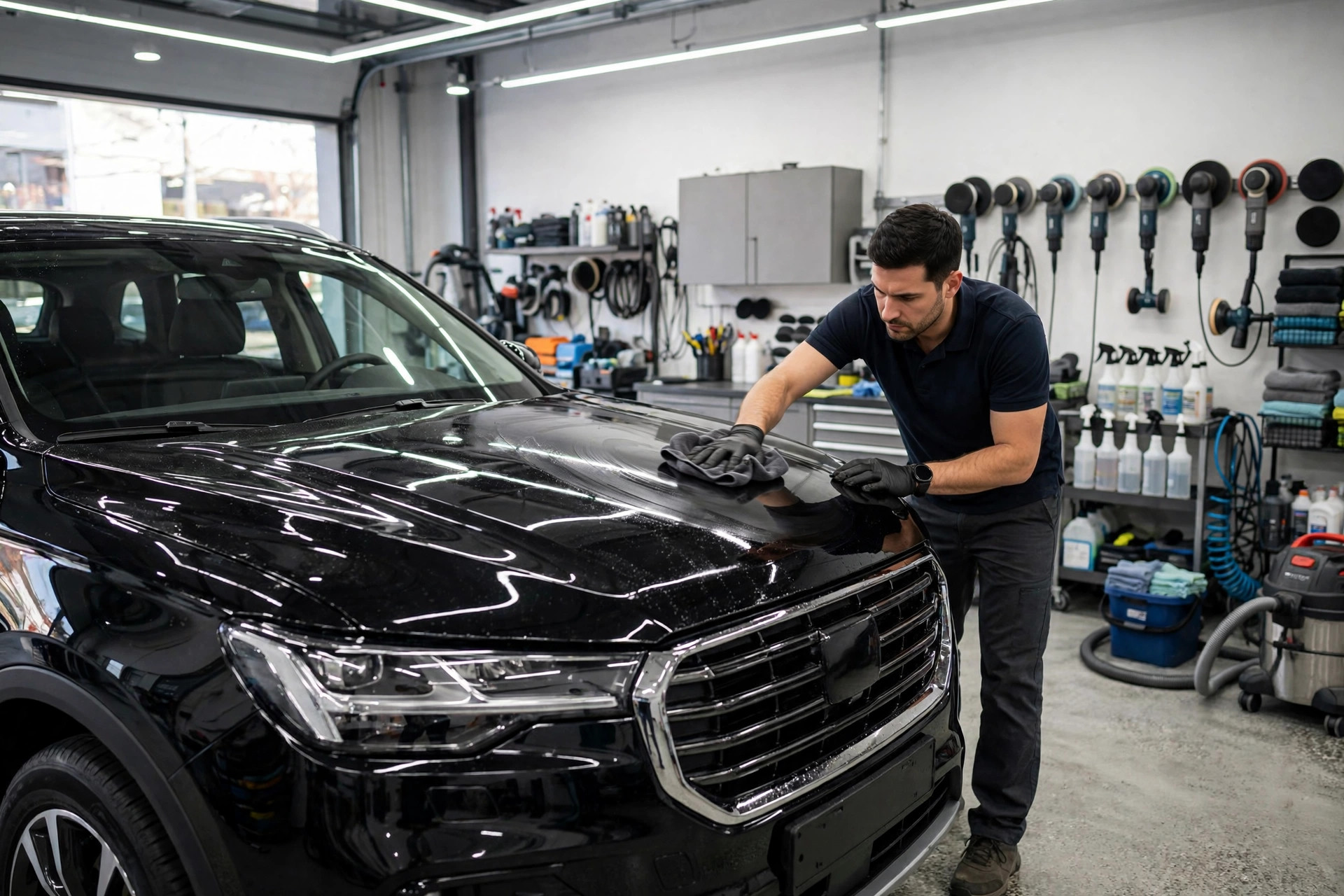
Your best quote requests arrive when you cannot answer the phone. A driver searches for detailing on Sunday evening, wants a price for a full interior on a three-row SUV, and your crew is off for the weekend. By Monday morning that customer has already booked with the shop that replied first. An AI chatbot for auto detailing companies fixes exactly that. It answers the message in seconds, prices the job by vehicle size and package, books a bay with a deposit, sends reminders and before and after photos, and follows up after the visit to sell the next detail. This guide covers what the chatbot does day to day, the exact quote flow that turns price shoppers into booked jobs, what it costs, how to set it up in about two weeks, the mistakes that waste the investment, and the math on after-hours quote requests you are converting right now.
The quick answer
- Instant quoting by vehicle and package: the bot prices jobs by vehicle size (coupe, sedan, SUV and truck, oversized) and service package (express wash, interior, full detail, paint correction) with zero staff time.
- Bay booking around the clock: real calendar availability, deposit collection, arrival instructions, and day-before reminders that cut no-shows.
- Before and after photos that sell: the bot delivers the job gallery after each detail and turns great work into reviews and referrals automatically.
- Follow-up that sells memberships: day-30 maintenance plan offers turn one-time details into monthly recurring revenue.
- Modest cost: chatbot software runs $40 to $250 a month, one-time setup runs $750 to $3,000, and per-message costs are near zero.
- Live in about two weeks: load your price rules, connect the calendar, build the quote and booking flows, test with real phones, then launch.
Why detailing customers message instead of call
Car owners do their research on their phones, usually in the evening or on weekends, right in the driveway while staring at the stains on the seats. Industry data on local service searches consistently shows that most “near me” quote requests arrive outside business hours. That is the exact moment a detailing shop is hardest to reach: the owner is finishing the last car of the day, the crew is cleaning equipment, or everyone is home for the weekend. The phone goes to voicemail. The website form says “we will get back to you within 24 hours.” The customer, who wanted a number now, moves to the next listing.
Detailing also attracts a specific kind of buyer: the price shopper. Nobody books a $250 full detail sight unseen. They want to know what it costs for their exact vehicle and how soon you can fit them in. That question is perfect for chat and terrible for voicemail, because it has a clear answer your price sheet already contains. A bot can read it instantly. A missed call turns that easy answer into a callback game the next morning, by which time the shopper has prices from two competitors and you are just one more quote in the mix.
There is also the mobile detailing angle. If you run a mobile operation, your team spends the day at customer driveways, often with loud extractors and polishers running. They physically cannot take a scheduling call mid-job. A chatbot takes the quote requests, books the next open route slot, and collects the vehicle details while the tech keeps working. The phone stops being a bottleneck on revenue and the day’s route fills itself.
What an AI chatbot does for an auto detailing company
An AI chatbot is an automated assistant that holds text conversations with your customers on your website, your Facebook page, or your Google Business Profile’s message button. Customers type naturally, the way they would text a friend, and the bot replies instantly with prices, open time slots, and answers. When the conversation needs a human, it hands off to you or your office staff with the full chat history attached. Think of it as a service advisor that works nights and weekends and never misses a quote request.
Quotes by vehicle size and package
This is the core job. The bot asks two questions, vehicle type and service package, and returns a price range immediately. Your price rules live behind it: a sedan express wash at $59, a full-size SUV full detail at $279, an oversized truck interior at a higher band, paint correction quoted as a range with a note that final price depends on paint condition. The customer gets an answer in under a minute instead of waiting for a callback. For add-ons like pet hair removal, odor treatment, or engine bay cleaning, the bot offers them as one-tap options after the base quote, which quietly raises average ticket size.
Books bays and arrival times
Once the customer picks a package, the bot shows real openings: Tuesday 9:00 AM, Wednesday 1:30 PM, Saturday 8:00 AM. It takes the pick, collects name, phone, and vehicle details, takes a deposit by card link if you require one, and sends arrival instructions. For mobile detailing, it books route slots by service area and asks for the address and parking situation. Deposits alone cut flakes dramatically, because a customer who has paid $50 to hold a bay shows up.
Answers the same pricing questions all day
How long does a full detail take? Do you remove pet hair? Can you get coffee stains out of cloth seats? Do you offer ceramic coating? What is your cancellation policy? The bot answers these from your FAQ in seconds, any hour of the day. Shops that track their calls find that 60 to 70 percent of inquiries are some version of these same ten questions. Answering them automatically is what frees your time for the actual work. If you also want to see how the same approach works for a neighboring trade, our guide to an AI chatbot for auto repair shops shows the booking and handoff setup that transfers directly.
Sends before and after follow-ups
The bot does not stop at booking. It sends the day-before reminder with arrival details, a thank-you message after the job with the photo gallery attached, a review request a few days later, and a rebooking nudge when the next detail is due. Each message is short and personal-feeling. Together they keep the customer relationship warm without you remembering to do any of it.
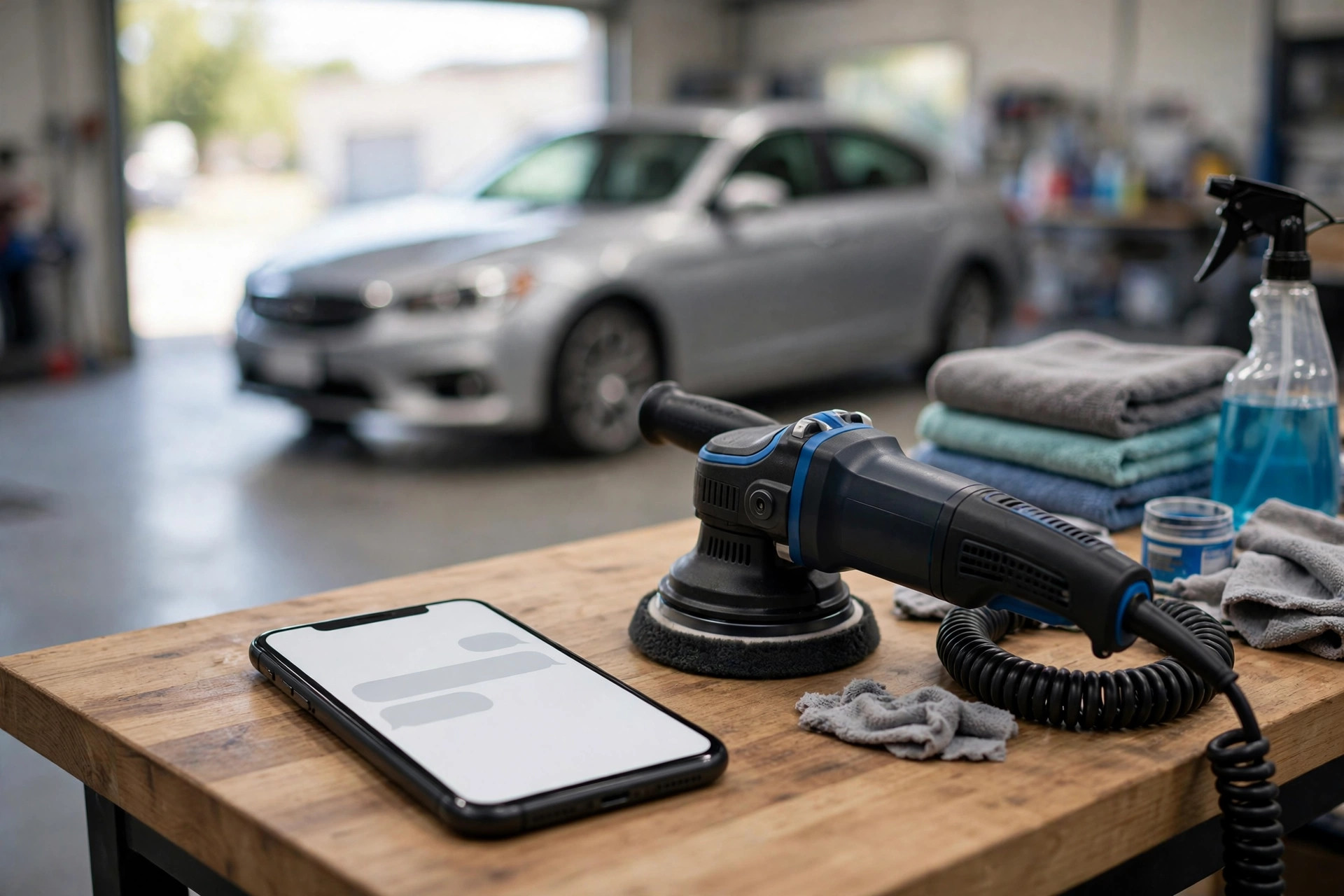
Quote requests answered in seconds instead of next morning turn price shoppers into booked bays.
The quote flow customers actually finish
The difference between a chatbot that books jobs and one that frustrates people is the flow. Keep it short, offer clear choices, and ask for nothing twice. Below is a proven quote flow for a detailing shop. Adapt the prices to your menu.
Step 1, the greeting. “Hi, this is Apex Auto Detailing. Want a price, want to book, or have a question? Reply 1, 2, or 3.” Three options, no open-ended essay prompt.
Step 2, the vehicle. “What are you driving? Reply: 1 for coupe or small car, 2 for sedan, 3 for SUV or truck, 4 for oversized (3-row SUV, full-size truck, van).” This one question sets the whole price table.
Step 3, the package. “For your SUV, here are the packages: 1 Express Wash, from $89. 2 Interior Detail, from $169. 3 Full Detail inside and out, from $249. 4 Paint Correction, from $499. Reply with the number.” Add-ons come after the pick: “Want pet hair removal for $40? Reply YES or NO.”
Step 4, the time pick. “We have these openings: Tuesday 9:00 AM, Wednesday 1:30 PM, Saturday 8:00 AM. Reply with the number, or say MORE for next week.” Never show more than three to four slots; a wall of times makes people stall.
Step 5, the hold. “To hold Saturday 8:00 AM for your full detail, we take a $50 deposit. Tap this link to pay, and I will send your confirmation and arrival details.” The deposit is what separates serious bookings from tire kickers.
The whole exchange takes under two minutes. Compare that with phone tag: voicemail, callback, back and forth on times, then the customer has to find their wallet for a deposit. Keep the bot’s price table matched to the one on your website and your Google Business Profile, since a customer who sees $249 online and hears $299 in chat will not trust either number. Many quote requests start on your Google Business Profile’s message button, so make sure the listing itself is solid; the GBP playbook we wrote for pest control companies at Google Business Profile optimization for pest control companies covers the same listing principles that win detailing calls.
Pricing your chatbot: cost options
Chatbot pricing has three common setups. DIY software is cheapest but you build and maintain the flows. A managed chatbot platform costs more per month but arrives with detailing-ready templates and support. An agency build costs the most up front but you hand over the whole project. Pick based on how much time you want to spend versus how fast you want it live.
DIY chatbot software
You build the quote flow yourself on a flow builder, connect your calendar, and maintain the price table. Best if you are comfortable with software and your pricing rarely changes.
- Flow builder with templates
- Calendar integration included
- You write all the scripts and FAQs
Managed chatbot platform
Done-for-you setup with detailing quote flows, add-on upsells, reminder sequences, and review requests prebuilt. The platform tunes the bot monthly from your conversation logs.
- Detailing-ready quote and booking flows
- Deposit and payment links built in
- Monthly tuning and reporting
Agency build and management
An agency builds the whole system, writes your scripts, integrates payments and your calendar, trains you, and manages it ongoing. Best if you want zero learning curve.
- Custom flows matched to your price menu
- Calendar, payment, and review tool integrations
- Ongoing optimization and campaign management
| Cost layer | Typical price band | What it covers |
|---|---|---|
| Chatbot software (DIY) | $40 to $120 per month | Flow builder, calendar integration, reminder automation; you build and maintain |
| Chatbot software (managed) | $150 to $250 per month | Prebuilt detailing flows, analytics, human handoff, monthly tuning |
| Website chat widget | Free to $30 per month | The chat bubble on your site; most platforms include it |
| Per-message charges | Near zero | Website and Facebook chat cost nothing per message; SMS follow-ups cost 1 to 3 cents |
| Agency setup | $750 to $3,000 one time | Price rules, flow design, integrations, team training |
| Agency management | $150 to $400 per month | Monitoring, monthly optimization, campaign management, reporting |
A realistic budget for a single-location shop: $1,500 one-time setup plus $200 a month for software. That is about $200 a month all-in after setup. One full detail a month covers it several times over. The expensive option is the status quo: quote requests that die in voicemail every night.
Before and after photos that sell jobs while you sleep
Detailing is a visual trade and the chatbot turns your photo gallery into a salesperson. When a customer asks for a price on an interior detail, the bot can send two or three before and after photos of similar jobs right in the chat. A stained seat that came back to life is worth more than any paragraph about your process. Load your ten best transformations into the bot’s media library, tagged by package: interior jobs for interior quotes, paint correction results for correction quotes.
After each completed job, the bot asks the customer for permission to share their photos, then sends the gallery link and requests a review in the same thread. This is where a detailing shop’s review count grows on its own. Shops that systematize the photo and review ask commonly double their monthly review count within a few months, and those reviews feed the next round of quote requests. For more ideas on turning finished work into new business, see our auto detailing marketing ideas guide, which pairs well with the automated follow-up system described here.
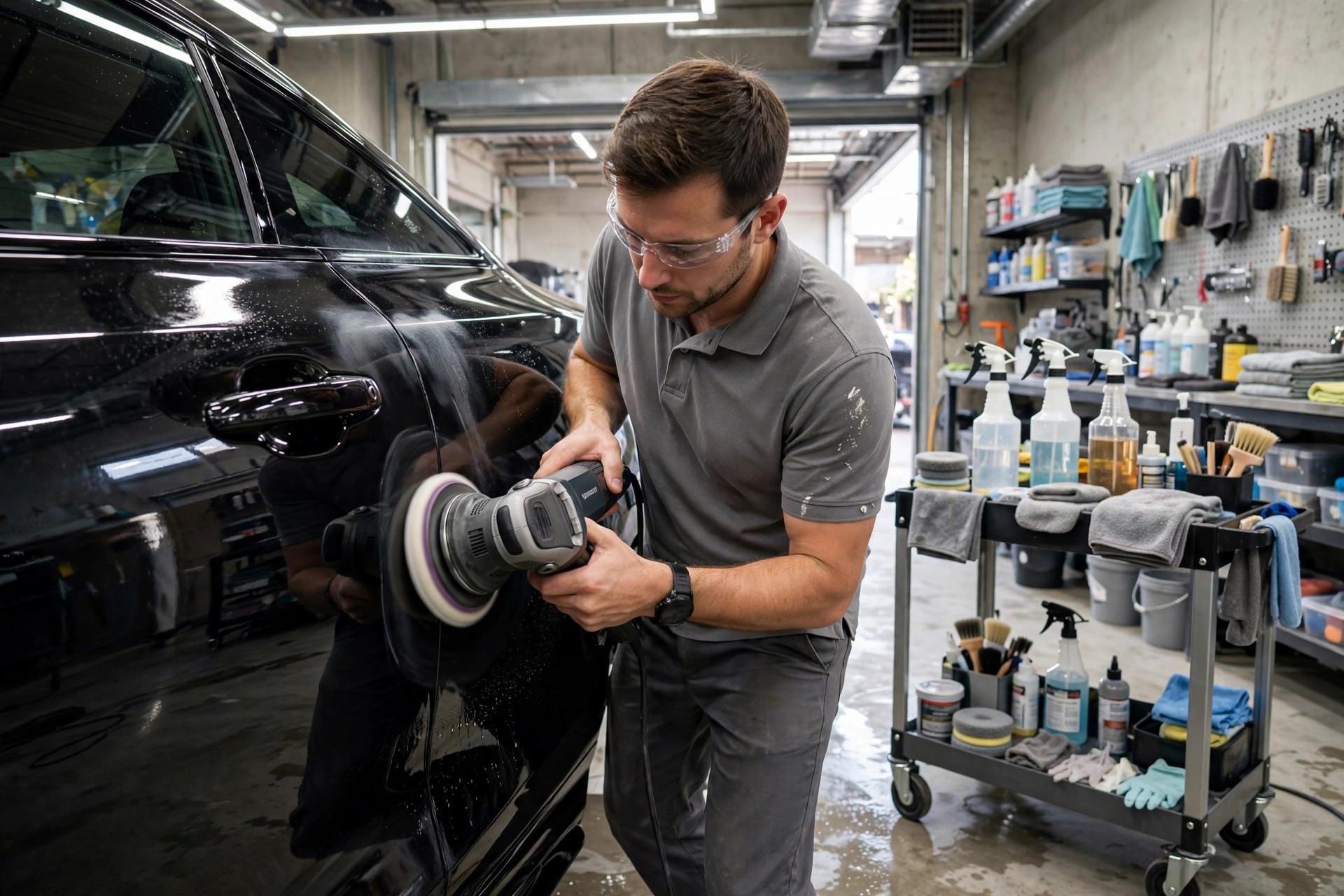
While the bot handles quotes and scheduling, the crew keeps working without phone interruptions.
Follow-ups and review requests on autopilot
Most detailing shops lose repeat business simply because they never ask for it. The customer loved the detail, meant to come back, and forgot your name six weeks later. An automated follow-up sequence fixes that with a handful of well-timed messages.
Day before the appointment: reminder with arrival time, address, and what to bring (keys, no need to empty the car fully). This alone cuts no-shows.
Day of, after pickup: thank-you message with the before and after gallery link. The customer is proud of the car right now; this is the peak moment for a share.
Day 7: review request with a direct link to your Google review page. One tap, no searching. Reviews posted this week mention the fresh detail, which reads better than generic praise.
Day 30: maintenance check-in: “Your detail is about a month old. Want to keep it fresh? Our monthly maintenance plan is $99 a visit for sedans.” This message alone is the highest-value text in the sequence, because it sells the membership.
Day 90 and seasonal: a nudge when the next full detail is due, plus seasonal offers like pre-winter protection or spring pollen cleanup. Keep these rare, two or three a year, so the channel stays welcome.
Each message includes a one-tap booking link that opens the same quote flow. The customer never has to call or find your website. If your shop also wants to tighten the phone side, our sibling guide on missed calls pairs well; for now, the key point is that follow-up is where a chatbot quietly pays for itself many times over, because repeat customers are cheaper than new ones by every measure.
Selling memberships and maintenance plans in chat
Recurring revenue is the most valuable thing a detailing shop can build, and chat is the natural place to sell it. A customer who just paid $249 for a full detail is the perfect audience for a $99-a-month maintenance plan. The bot makes the pitch at the exact right moment, day 30 after the job, when the car still looks good and the customer wants to keep it that way.
The pitch should be simple: “Keep it looking this good without thinking about it. One maintenance detail a month, priority booking, 10 percent off add-ons, $99 a month for your sedan, cancel anytime.” The bot answers the follow-up questions: what is included, can I skip a month, what if I sell the car. It can even sign the customer up with a payment link and book the first maintenance visit. Shops that push memberships in chat commonly convert 5 to 10 percent of their full-detail customers into plan members within a year. Twenty members at $99 a month is nearly $2,000 in predictable monthly revenue, sold by a bot while you were polishing cars.
Chatbot vs phone vs web form for your shop
Most shops already run on phones and a contact form. The chatbot does not replace either; it takes the jobs it does best and leaves the rest. The comparison below shows where each channel wins.
| Task | AI chatbot | Phone call | Web form |
|---|---|---|---|
| After-hours quote requests | Answered and priced instantly, books directly | Voicemail, callback next day | Sits unread until morning |
| Pricing questions | Instant from your price table, with photos | Staff time per call, often interrupted | No answer until someone replies |
| Booking and deposits | Real availability, deposit link, confirmation | Manual calendar check, card over the phone | Request only, still needs a callback |
| Reminders and follow-ups | Automatic sequences, review asks, membership offers | Staff time, usually skipped | None |
| Cost per inquiry | Pennies after setup | Staff wages per minute | Free but converts poorly |
| Complex or custom jobs | Hands off to a human with full history | Best: tone and judgment calls | Poor: back and forth by email |
The practical setup for most shops is all three working together: the chatbot for quotes, booking, and follow-ups; the phone for custom work like paint correction estimates and nervous first-time customers; and the form as a backup for the rare customer who prefers it. The handoff feature is what makes the mix work, because a chat that starts with the bot can move to a call with zero repeated questions.
Setting it up: from zero to live in two weeks
An auto detailing chatbot is a two-week project, not a two-month one. The shops that stall try to automate every edge case on day one. Start with quoting and booking, add the rest later.
Week 1, days 1 to 2: the price table. Write down your packages by vehicle size, your add-ons with prices, your service area or shop address, and your deposit and cancellation policy. This document becomes the bot’s brain. If your prices live only in your head, this step alone will pay off in other ways.
Week 1, days 3 to 5: the flows. Build the quote flow, the booking flow, the deposit link, and the FAQ answers for timing, pet hair, stains, and coatings. Connect the shop calendar so the bot sees real availability. Load your ten best before and after photos, tagged by package.
Week 2, days 6 to 8: testing. Run every flow with real phones. Quote a sedan, quote an oversized truck, add pet hair, book, pay the deposit, cancel, ask weird questions. Test the handoff: when the bot gives up, does the right person get pinged with the chat history?
Week 2, days 9 to 10: the team. Show whoever answers the shop phone how the handoff inbox works and what the response-time target is. Agree on the rule: handoffs answered within 15 minutes during working hours.
Week 2, days 11 to 14: soft launch. Put the chat on the website and the Facebook page first. Watch the first 100 conversations and fix the spots where customers stall or the bot fumbles. Then connect the Google Business Profile messages and launch the follow-up sequences.
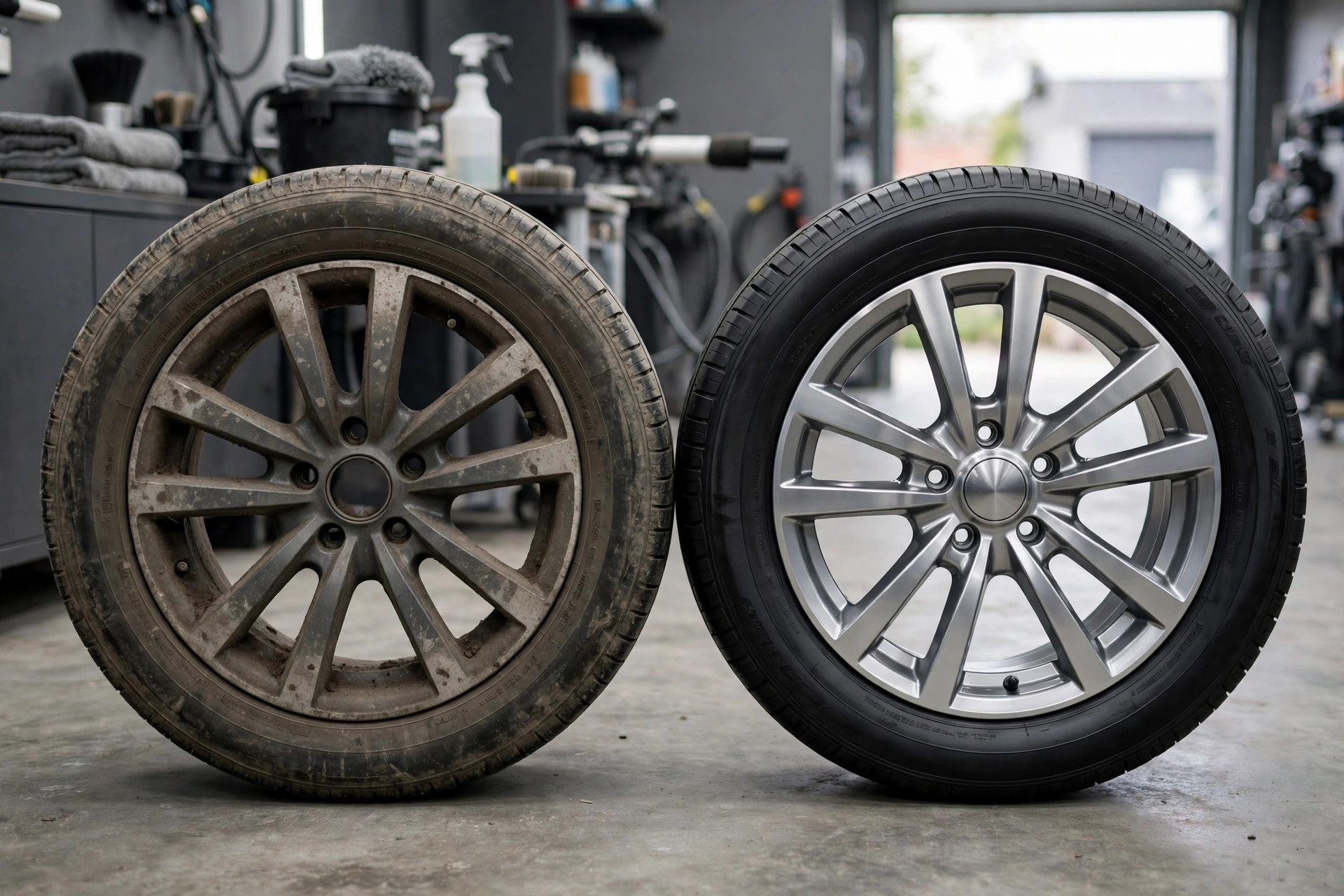
Before and after photos in the chat do more selling than any paragraph about your process.
Mistakes that cost you bookings
Prices that do not match the website. Nothing kills trust faster than a chat quote that differs from the website price. Keep one price table and update both places together, or the bot will argue with your own site.
Quoting paint correction like a car wash. Paint correction needs eyes on the paint. Let the bot quote a range and book an in-person assessment, not a fixed price it cannot honor. A wrong fixed quote either loses you money or loses the customer when you correct it.
No deposit on bookings. A booking without a deposit is a suggestion. Take a modest deposit on full details and paint correction through the chat. Your no-show rate will drop immediately.
Hiding the human. Every flow needs an escape hatch: “Reply 0 to talk to us” at every step. A customer with a scratched bumper who cannot reach a person will leave, and may leave a review about it.
Skipping the calendar connection. A bot that takes booking requests and promises a callback is a fancy contact form. Real availability, real confirmation, or do not launch.
Forgetting mobile logistics. Mobile detailers need the address, the parking situation, and water and power access answered in the flow. A bot that books a mobile job without an address creates a mess for the tech.
Blasting promotions. Chat is a conversation channel, not an email list. Keep campaigns to rebooking nudges and genuinely useful seasonal offers, a few times a year. Weekly discount blasts get the number blocked.
Setting it and forgetting it. Review the conversation logs monthly. You will find questions the bot fumbled, prices that changed, and new FAQs to add. Fifteen minutes a month keeps it sharp. For broader promotion ideas that pair with the automated system, our auto repair shop marketing ideas cover cross-promotion tactics that work for auto service businesses of all kinds.
Your rollout checklist
Work through these in order. Each one builds on the last.
- 1Write the price table. Every package by vehicle size, every add-on with a price, deposit and cancellation policy in one document.
- 2Pick the channels. Website chat first, then Facebook page, then Google Business Profile messages.
- 3Connect the shop calendar. Real-time bay or route availability with buffer rules between jobs.
- 4Build the quote flow. Vehicle, package, add-ons, then price, in five steps or fewer.
- 5Build the booking flow. Time pick, contact details, deposit link, arrival instructions, instant confirmation.
- 6Write the FAQ answers. Timing, pet hair, stains, coatings, service area, and payment methods.
- 7Load the photo library. Ten best before and after shots, tagged by package for the bot to send in chat.
- 8Build the follow-up sequences. Day-before reminder, post-job thank you, day-7 review ask, day-30 membership offer.
- 9Set handoff rules and train the team. Who answers, response-time targets, where the chat history lives.
- 10Soft-launch and tune. Watch the first 100 conversations, fix the dead ends, then open all channels.
Frequently asked questions
How much does an AI chatbot for an auto detailing company cost?
Most shops pay $40 to $250 a month for the chatbot software, depending on whether it is DIY or managed. Agency-built setups add a one-time $750 to $3,000 for build and integration, plus $150 to $400 a month for management. All-in, a typical single-location shop spends about $200 a month after setup.
Can the chatbot quote paint correction accurately?
It can quote a range and book an in-person assessment, which is the honest approach. Paint condition varies too much for a fixed price sight unseen. Let the bot say “paint correction starts at $499 depending on paint condition” and book the assessment, where you close the real number.
Will customers trust a bot with their booking?
Yes, when the bot is fast, accurate, and clearly connected to your real calendar. Customers care about getting a price and a confirmed time, not about whether a human typed it. Always include an easy path to a human for custom questions.
Can it take deposits?
Yes. The bot sends a secure payment link at booking time and confirms the slot once the deposit clears. Deposits are the single best no-show prevention tool a detailing shop has, and collecting them in chat removes the awkward phone payment.
Does it work for mobile detailing?
Very well. The bot books route slots by service area, collects the address and parking details, and confirms water and power access. It fills the next open route slot while the tech keeps working the current job.
How does the chatbot handle price shoppers?
By giving them the number immediately. Price shoppers are not the enemy; slow answers are. A bot that quotes in under a minute converts the shoppers you would have lost to voicemail, and the add-on offers raise the ticket on the ones who book.
Can it sell maintenance plans?
Yes, and this is its highest-value job. The day-30 follow-up pitches the monthly maintenance plan with a signup link. Shops commonly convert 5 to 10 percent of full-detail customers into members, building recurring revenue on autopilot.
What happens when the bot cannot answer?
It hands the conversation to you or your staff with the full chat history attached, so nobody repeats themselves. Set a 15-minute response target during working hours so handoffs do not sit.
How long does setup take?
About two weeks: price table and flows in week one, testing and team training in week two. The calendar integration and the photo library are the steps that take the longest. Start with quoting and booking, add follow-up sequences next.
How do I measure whether it is working?
Track five numbers monthly: after-hours quote requests captured, quote-to-booking rate in chat, no-show rate, review count growth, and maintenance plan signups. Compare against the two months before launch. The quote capture and booking numbers usually move first, within 30 to 60 days.
Turn every quote request into a booked bay
Digital Hayder builds AI chatbots for auto detailing companies: instant quotes by vehicle size and package, 24/7 bay booking with deposits, before and after photo delivery, and follow-up sequences that sell maintenance plans. Tell us about your shop and we will design the chat system around your price menu.
Contact Us