
When someone hears scratching in the attic at 11 PM, they do not research. They search “pest control near me,” glance at the top three Google Business Profiles, and call the one that looks trustworthy. That decision takes about thirty seconds, and your profile either wins it or loses it. Google Business Profile optimization for pest control companies is the work of making your free listing the obvious choice in those thirty seconds: complete service information, photos that build trust, a steady stream of fresh reviews, service areas that match where you actually work, and posts that show up when seasonal pests do. This guide covers every field that drives treatment calls, the 30-day tune-up plan, what optimization costs, the mistakes that bury a profile, and the math on how many calls a tuned profile actually produces.
The quick answer
- The profile is the storefront: most pest control searches end on the profile, not your website, so the listing decides who gets the call.
- Complete every field: services, service areas, hours, photos, and attributes all feed how often you show up and how trustworthy you look.
- Review velocity matters most: a steady stream of new reviews beats a high but stale count, and replies to every review build trust with the next caller.
- Answer your own Q and A: pre-answer the ten questions every worried homeowner asks before a stranger ever posts one.
- Post for the season: timely posts about ants, wasps, rodents, and termites catch searches exactly when the pest shows up.
- Tune it in 30 days: one focused month of field-by-field fixes, then a weekly ten-minute routine keeps the profile winning.
Why your Google Business Profile decides who gets the treatment call
Pest control is a panic purchase. Nobody plans for ants in the kitchen or a wasp nest under the deck. When the problem appears, the search is urgent and local, and Google answers it with the map pack: three business profiles with a call button front and center. Industry research on local service searches consistently shows that the majority of callers choose directly from the profile without ever visiting the company website. The profile is the ad, the reviews, the price list, and the phone number, all in one screen.
That makes the profile your highest-value free marketing asset. Paid ads stop the moment you stop paying. A website ranks slowly. The profile can start pulling calls within weeks of a proper tune-up, and it keeps working every hour you are not touching it. Pest control companies that treat the profile as a second website, with complete services, fresh photos, and new reviews every week, regularly report that it becomes their single biggest source of new treatment calls. Companies that set it up once and ignore it wonder why the phone is quiet while a competitor with a thinner website but a thicker profile takes the calls.
There is also a trust angle specific to pest control. You are asking strangers to let a technician into their home, often to deal with something they find disgusting or frightening. Reviews, photos of real technicians and real trucks, and clear service descriptions do the reassuring work before the call. A bare profile with three old reviews says nothing; a complete one with 120 reviews and photos of recent jobs says “we do this every day and your neighbors trust us.” For a fuller picture of how the profile fits into your wider marketing, see our pest control marketing ideas guide.
The GBP fields that win treatment calls
Every field on the profile either helps you show up or helps the caller choose you. Most pest control profiles are half empty. The sections below show what to fill in and why each one matters for treatment calls.
Business info and categories
Start with the basics, done exactly right. Your business name must be your real business name, no keyword stuffing like “ABC Pest Control Termite Removal Exterminator,” which violates policy and can get the profile suspended. Set the primary category to “Pest control service.” Add secondary categories that match what you do: “Termite treatment service,” “Wildlife removal service,” “Bed bug extermination service” if they apply. Hours matter more than most owners think: pest control calls spike in the evening, so if you answer until 8 PM, list it. Holiday hours should be set before each holiday so the profile does not show you closed when you are open.
The service catalog
The services section is where the profile starts selling. Add every treatment you offer as its own service with a clear description and, where sensible, a starting price: ant treatment, roach treatment, spider treatment, wasp and hornet nest removal, rodent exclusion, termite inspection and treatment, bed bug treatment, mosquito barrier, wildlife removal, commercial pest control. Write descriptions the way a homeowner talks, not the way a chemical label reads. “We find where ants are entering, treat the trails and entry points, and the colony, not just the ones you see.” Prices, even “from $129,” filter out tire kickers and raise call quality.
Service areas
List every city and town you actually serve, but keep it honest: claiming a city you do not serve hurts you when the tech cannot get there. For a home-based pest control business that does not want the home address public, set the profile as a service-area business and hide the address; Google allows this and it changes nothing about ranking. Your service area is also the foundation for the strategy in the next section.
Photos that build trust
Upload photos constantly. Profiles with more photos get more calls; that pattern holds across every local service study published on the topic. What to post: your technicians in uniform at work, your trucks, your equipment, before and after shots of exclusion work like sealed entry points, and your team. Ask customers for permission to photograph the work and upload a few every week. Skip stock photos. Homeowners can smell stock photography, and a real technician on a real porch beats a model in a headset every time.

Your service areas should match where your trucks actually go, since claimed areas you cannot serve backfire on reviews.
Building a service catalog that sells pest treatments
The service catalog deserves its own section because it is the most underused field in pest control profiles. Most competitors list “Pest Control” and stop. Each service you add is another doorway into your profile from search. Someone searching “wasp nest removal near me” is more likely to see your profile if “wasp and hornet nest removal” is a named service with a description.
Write each service entry like a mini sales page. Name the pest, name the pain, name the outcome: “Rodent exclusion: we seal the entry points mice and rats use to get in, set monitored traps, and check back until activity stops. From $199.” Add the same seasonal treatments as their own entries: mosquito barrier service for summer, fall rodent prevention for autumn. Keep descriptions plain and specific. A homeowner comparing two profiles will pick the one whose services sound like they understand the actual problem.
Update the catalog when your offerings change. New termite baiting system, add it. Dropped bird control, remove it. An outdated catalog creates awkward calls where the tech says “we do not do that anymore,” which is worse than never listing it. Review the catalog quarterly, ideally at the start of each season, so it always matches what you want to sell right now.
Service areas: winning the map beyond your office
You rank strongest near your location, and weaker farther out. That is the reality of the map. A complete service-area setup plus supporting content is how you push that boundary outward.
First, the profile itself: list all the cities and towns you serve, up to the limit Google allows, prioritizing the ones where you already have customers. Second, support the profile with location pages on your website, one per major service area, describing the pest problems common there and linking back to the profile. Third, get reviews from customers across your service area, because reviews mentioning towns by name strengthen your presence in those places. None of this requires tricks. It requires the unglamorous work of claiming every place you serve and proving you work there.
One warning: do not create fake locations or virtual offices to game the map. Google suspends profiles for this, and recovery is slow and painful. Build real presence: real jobs, real reviews, real photos from those towns. The profile rewards the company that actually shows up.
Review velocity: the ranking factor you actually control
You cannot directly control where Google ranks you, but you can control how many new reviews arrive each month, and review velocity is one of the strongest signals you can influence. A profile with 200 reviews but none in the last six months looks dormant next to a competitor with 90 reviews and six new ones this month. Google treats fresh reviews as proof the business is active and trusted right now, and callers read it the same way.
The system is simple. After every completed treatment, the technician or an automated message sends a review request with a direct link to your Google review page. Make it one tap. Do not ask the customer to search for you; they will not. Send the request while the relief is fresh, ideally the same day as the treatment, when the wasp nest is gone and the homeowner is grateful. Companies that ask after every job typically see 10 to 20 percent of customers leave a review. At 40 jobs a month, that is 4 to 8 new reviews monthly, which outpaces almost every competitor in a local market.
Reply to every review, good and bad. Thank the happy customers by name and mention the treatment. For bad reviews, reply once, calmly and professionally, offering to make it right. Future customers read your replies as closely as the reviews themselves, and a thoughtful reply to a complaint often impresses them more than a perfect five-star page. If you want a dedicated playbook for the ask itself, our guide to getting more Google reviews pairs with everything in this section.
Questions and Answers: pre-answering the worried homeowner
The Q and A section on your profile is public, and anyone can ask or answer. Most pest control owners ignore it, which means the questions sit empty or get answered by random strangers. The fix takes one afternoon: post and answer your own ten questions. Google allows the business owner to ask and answer, and it is the fastest trust-building field on the profile.
The ten questions to pre-answer: Do you offer same-day service? Are your treatments safe for kids and pets? How much does a general pest treatment cost? Do you guarantee your work? How fast do bed bug treatments work? What should I do before the technician arrives? Do you treat commercial properties? Which areas do you serve? Do I need to leave the house during treatment? What happens if the pests come back? Answer each in two or three plain sentences with a specific detail, not marketing fluff. “Yes, our standard treatments are safe for kids and pets once dry, usually about two hours. We will tell you exactly when it is safe to re-enter before we leave.” That answer wins the call from the parent who was worried.
Monitor the section monthly. If a stranger posts a question, answer it fast. If someone posts a wrong answer, correct it politely with the right information. An active, well-answered Q and A makes the profile feel staffed and caring, which is exactly what a nervous homeowner wants to see.
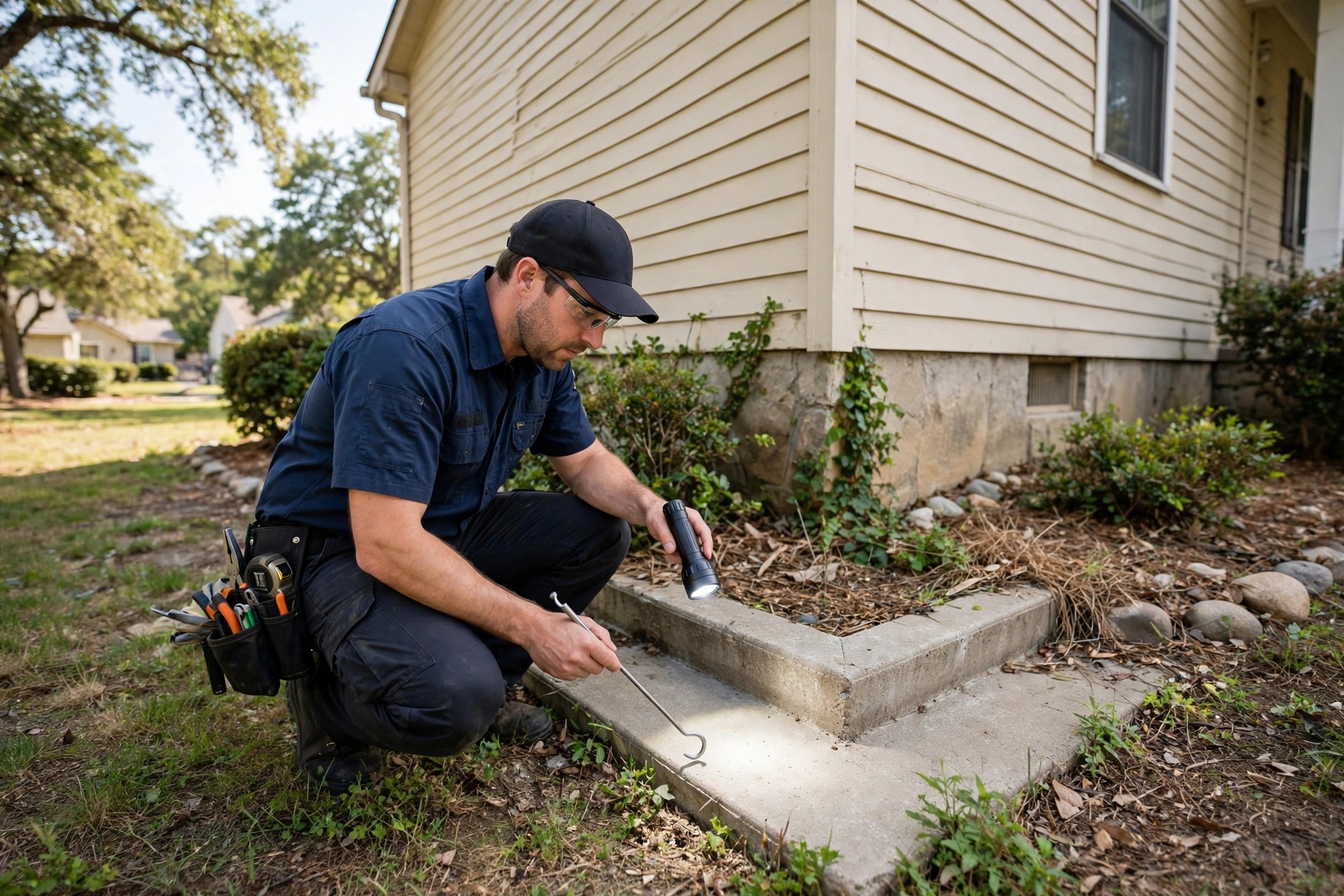
Photos of real inspection work tell homeowners you find the source, not just spray and leave.
Google Posts for seasonal pests
Google Posts are short updates that appear on your profile. They expire after a while, which is exactly why they are perfect for seasonal pest content. When ants invade kitchens in spring, post about ant treatment with a photo of a technician at work. When wasps peak in late summer, post about nest removal. When rodents seek warmth in fall, post about exclusion work. Each post catches the searches happening right now and shows a profile that is active this week, not last year.
Write posts like mini-ads with a clear next step. Headline naming the pest and the season, two sentences about the treatment, and a call or quote button. “Wasp nest removal in August: nests are at their largest and most aggressive right now. We remove them safely, usually the same day. Call for a quote.” Publish at least two posts a month, weekly during your peak season. Posts alone will not carry the profile, but a profile with fresh seasonal posts next to a competitor with nothing from last year wins the comparison every time.
Use the offer post type for seasonal promotions: a fall rodent prevention package, a spring exterior barrier special. Keep discounts modest and tied to real services. The goal is a reason to call this month, not a race to the bottom on price.
Turn on messaging and the quote button
Two features turn profile views into conversations. First, GBP messaging: turn it on so searchers can message you straight from the profile. Pest control callers often prefer a quick message to a phone call, especially for embarrassing problems like bed bugs or roaches. Answer messages within minutes during the day; Google shows your typical response time, and a fast one wins. If you cannot watch the inbox all day, a chatbot can answer the common questions instantly and hand off the real quote requests to you. Our guide to an AI chatbot for pest control companies covers that setup in detail, and if you want to see the same quoting logic in a different trade, our walkthrough for AI chatbot for auto detailing companies shows the full flow.
Second, the quote request button: enable it so searchers can request a quote without calling. Treat incoming quote requests like incoming calls, because that is what they are: respond fast, with a real number or a clear next step. A profile with messaging on, the quote button enabled, and a five-minute response habit converts a meaningful share of views that would otherwise bounce to the next listing.
GBP vs website vs paid ads
The profile, the website, and ads each have a job. Knowing which does what keeps you from overspending in the wrong place.
| Channel | Google Business Profile | Website | Paid ads |
|---|---|---|---|
| Cost | Free | Hosting and maintenance, plus build cost | $1,500 to $5,000+ a month in most pest markets |
| Speed to calls | Weeks after a proper tune-up | Months of content and link work | Same day, stops when you stop paying |
| What it does best | Wins “near me” searches with call buttons | Closes the deal with detail, pricing, trust | Buys extra volume on demand |
| Trust signals | Reviews, photos, Q and A | Testimonials, case studies, guarantees | None built in; borrows from the landing page |
| Maintenance | Weekly: reviews, photos, posts | Monthly content and updates | Constant: budgets, bids, ad copy |
| Biggest weakness | You do not own it; Google sets the rules | Slow to rank in competitive markets | Expensive and stops instantly |
The practical setup for most pest control companies: the profile as the front door for “near me” searches, the website as the closer for shoppers who want detail, and ads as the volume dial you turn up in peak season. If you are already running ads, make sure the profile is tuned first; every ad click from a searcher who then checks your thin profile is money wasted. Our breakdown of Google Ads cost for pest control companies shows what the paid side runs so you can compare it against the free profile work honestly.
What GBP optimization costs
Profile optimization costs far less than most marketing, because the profile itself is free. You are paying for someone’s time and judgment, or investing your own.
DIY optimization
You do the full tune-up yourself following a checklist like the one below. Best if you have a few free hours a week and want to learn the system.
- Complete every field and service entry
- Upload photos weekly
- Run the review request system yourself
Freelancer tune-up
A local SEO freelancer completes the full field-by-field optimization, writes your service descriptions, and sets up the review request system. You maintain it afterward.
- Full profile audit and rebuild
- Service catalog and Q and A written for you
- Review and photo system handoff
Agency management
An agency manages the profile ongoing: posts, photos, review responses, Q and A monitoring, and monthly reporting. Best if you want it handled completely.
- Weekly posts and photo uploads
- Review monitoring and response
- Monthly performance reporting
| Cost layer | Typical price band | What it covers |
|---|---|---|
| DIY | $0 | Your time: fields, services, photos, posts, review requests |
| Freelancer tune-up | $300 to $800 one time | Audit, field completion, service descriptions, Q and A, system setup |
| Agency management | $400 to $1,200 per month | Ongoing posts, photos, review responses, monitoring, reporting |
| Review software | $30 to $100 per month | Automated review requests and monitoring across sites |
| Photography | $200 to $500 one time | Half-day shoot: team, trucks, equipment, real job sites |
A realistic path for a small company: a $500 one-time freelancer tune-up, $50 a month for review software, and ten minutes of your own time a week for photos and posts. That is under $1,200 in the first year. Against even a modest lift in profile-driven calls, it is the cheapest marketing a pest control company can buy.

Every completed job is a review opportunity: ask while the relief is fresh and the technician is still there.
The 30-day GBP tune-up plan
One focused month takes a profile from ignored to competitive. Work through it in order.
Days 1 to 3: the audit. Open the profile and check every field against the checklist: name, categories, hours, phone, website, services, service areas, description, photos. Note what is missing or wrong. Check for duplicate profiles and request removal of any you find.
Days 4 to 7: the rebuild. Fix the name and categories. Write the business description with the pests you treat and the areas you serve. Add every service with a plain-language description and starting prices. Set honest service areas. Upload your first 20 photos.
Days 8 to 14: reviews and Q and A. Send review requests to your last 30 happy customers with a direct link. Post and answer your own ten Q and A questions. Reply to every existing review you have never answered.
Days 15 to 21: content. Publish your first two Google Posts tied to the current season. Upload a fresh batch of job photos. Turn on messaging and the quote button, and set up notifications so nothing sits unanswered.
Days 22 to 30: measure and adjust. Check the profile’s built-in insights: views, calls, direction requests, website clicks. Compare against the previous month. Double down on whatever moved, and set the weekly ten-minute routine: one post, a few photos, review replies, Q and A check.
Mistakes that bury your profile
Keyword stuffing the business name. Adding “termite bed bug exterminator” to your name violates policy and risks suspension. Use your real name. Put the keywords in services and descriptions where they belong.
One category and nothing else. The primary category alone leaves ranking signals on the table. Add every relevant secondary category, from termite treatment to wildlife removal, so you show up for the full range of searches.
Ignoring the services section. An empty services section means missed searches and a profile that answers nothing. Each named service is another doorway into your listing.
Stock photos only. Homeowners trust real technicians and real trucks. Ten genuine job photos beat fifty stock images every time.
Stale reviews. A great count with nothing new for six months looks dormant. The review request system must run after every job, forever.
Never replying to reviews. Silence on reviews, especially bad ones, tells future customers you do not care. Reply to every single one.
Fake service areas. Claiming cities you do not serve leads to angry customers and bad reviews when the tech cannot get there. Claim only what you cover.
Setting it and forgetting it. Hours go stale, services change, seasons turn. A quarterly review of the whole profile keeps it accurate, and the weekly ten-minute routine keeps it alive.
Your rollout checklist
Work through these in order. Each one builds on the last.
- 1Audit the profile. Check every field, look for duplicates, and list everything missing or wrong.
- 2Fix name and categories. Real business name, “Pest control service” primary, every relevant secondary category added.
- 3Set hours and contact details. Accurate hours including evenings if you answer, correct phone and website links.
- 4Build the service catalog. Every treatment as its own service with a plain-language description and starting prices.
- 5Set honest service areas. Every city you actually serve, nothing you cannot reach.
- 6Upload 20 real photos. Technicians, trucks, equipment, and real job sites; no stock photography.
- 7Pre-answer the Q and A. Post and answer your own ten questions before strangers ask them.
- 8Start the review system. Same-day review requests after every job, direct link, reply to every review.
- 9Turn on messaging and quotes. Enable both, set up notifications, answer within minutes.
- 10Post and maintain. Two seasonal posts a month, weekly photos, and a quarterly full-profile review.
Frequently asked questions
How long does Google Business Profile optimization take to show results?
Most pest control companies see movement in 3 to 6 weeks: more views, then more calls as reviews accumulate. The full effect builds over 3 to 6 months as review velocity and fresh content compound. The 30-day tune-up in this guide gets the foundation right fast.
Is Google Business Profile really free?
Yes. Creating and managing the profile costs nothing. You pay only if you hire help for the tune-up, buy review software, or run ads. The profile itself, the posts, the photos, and the reviews are all free.
Can I add keywords to my business name to rank higher?
No, and you should not try. Keyword stuffing the business name violates policy and can get the profile suspended. Use your real name and put keywords in your services, description, and posts where they belong.
How many reviews do I need to compete?
There is no fixed number; it depends on your market. What matters more than the total is velocity: new reviews arriving every month. A profile adding 5 reviews a month will pass a competitor sitting on a stale 150 within a year in most local markets.
Should I respond to negative reviews?
Yes, once, calmly and professionally, offering to make it right. Never argue. Future customers read your replies closely, and a thoughtful response to a complaint builds more trust than a page of five-star reviews alone.
Do Google Posts actually help a pest control company?
They help in two ways: they keep the profile looking active for shoppers comparing listings, and seasonal posts catch searches happening right now. They are not the main ranking driver, but a profile with fresh posts consistently outperforms an identical one without them.
What if I work from home and do not want my address public?
Set the profile as a service-area business and hide the address. Google allows this for businesses that serve customers at their locations, which covers most pest control companies. It does not hurt your ranking.
Can I run the profile myself or do I need an agency?
You can absolutely run it yourself. The 30-day plan in this guide plus a weekly ten-minute routine covers it. An agency makes sense only if you will not do the routine yourself, because consistency is what wins.
How do I handle the Q and A section?
Post and answer your own ten most common questions first, then monitor monthly. Answer stranger questions quickly and correct wrong answers politely. An active Q and A makes the profile feel staffed and trustworthy.
How do I measure whether the optimization is working?
Check the profile’s built-in insights monthly: profile views, phone calls, direction requests, message and quote requests, and website clicks. Track review count and rating too. Compare against the month before the tune-up; calls and quote requests are the numbers that matter most.
Make your profile the obvious choice in thirty seconds
Digital Hayder optimizes Google Business Profiles for pest control companies: complete service catalogs, service-area strategy, review systems that run after every job, seasonal posts, and messaging that catches callers before competitors do. Tell us about your company and we will tune the profile around your services and service area.
Contact Us