A homeowner sees a mouse in the kitchen at 9 PM, searches “pest control near me,” and calls the first company that answers. That single search is worth hundreds of dollars in recurring revenue, which is exactly why pest control keywords are some of the most competitive in local advertising. Google Ads cost for pest control companies reflects that reality: clicks on high-intent treatment keywords run far higher than most home-service owners expect, but the recurring nature of pest control plans means the math still works when the account is set up correctly. This guide breaks down what pest control clicks actually cost, what a booked job costs you once clicks become calls, what monthly budget fits your company size, and the campaign structure, landing pages, and retargeting that turn ad spend into steady recurring revenue.
The quick answer
- CPC ranges are real but manageable: general pest control keywords typically cost $6 to $12 per click, while emergency and specialty keywords like termite or bed bug treatment run $12 to $28.
- Expect $35 to $80 per booked job: a typical cost per lead of $25 to $60, combined with normal close rates, puts an acquired customer in the $35 to $80 range for a well-run account.
- Recurring plans carry the whole equation: one new quarterly-plan customer is worth $400 to $600 a year, so acquisition cost is usually recovered inside the first two visits.
- Start at $1,500 to $3,000 a month: that range buys enough daily traffic in a mid-size market to book 20 to 60 new jobs a month without starving the campaigns.
- Separate emergency from recurring campaigns: wasps, bed bugs, and termites get their own high-bid campaigns, while general prevention runs cheaper and feeds the plan base.
- Retarget plan members: reminders for missed quarterly visits and win-back ads for canceled plans are the cheapest revenue in the account.
What pest control clicks actually cost
Google Ads charges you each time someone clicks your ad, and the price depends on how many competitors are bidding on the same search. Pest control sits in a busy corner of home-services advertising because the jobs are urgent, the ticket sizes are solid, and the revenue recurs. That combination pulls national franchises and strong local operators into the same auctions, which pushes click prices up on the searches that matter most.
Broad searches like “pest control near me” or “exterminator near me” usually cost between $6 and $12 per click in a mid-size US market. In large metro areas with heavy competition, the same clicks can reach $14 to $18. These keywords have the highest search volume, so they form the backbone of most accounts, but they also mix tire-kickers with ready buyers, which is why everything after the click matters so much.
Problem-specific keywords cost more because the intent is stronger and fewer searches exist. “Bed bug exterminator” and “termite inspection” regularly cost $12 to $20 per click, and in competitive metros they can push past $25. The upside is that someone searching for bed bug treatment is not browsing; they have a problem today and are comparing two or three companies, not twenty. One-time wildlife removal keywords such as “raccoon removal” or “bat removal from attic” sit in a similar band, often $10 to $22 per click, because the jobs carry high one-time tickets.
Preventive and informational searches are cheaper. “Quarterly pest control cost” or “is quarterly pest control worth it” might cost $3 to $6 per click. These people are earlier in the decision, but they are exactly the audience that becomes your best recurring-plan customers. A smart account does not ignore cheap research keywords; it uses them to feed the plan base while the expensive emergency keywords feed the trucks this week.
The table below shows typical US cost-per-click bands by keyword group. Treat these as planning ranges, not promises. Your market, your ad quality, and your landing page will move every number.
| Keyword group | Typical CPC range | Buyer intent | What it is good for |
|---|---|---|---|
| General: “pest control near me”, “exterminator” | $6 to $12 | Mixed | Volume and steady plan signups |
| Emergency: “wasp nest removal”, “mouse in house” | $10 to $20 | Very high | Same-week bookings, one-time tickets |
| Termite: “termite inspection”, “termite treatment cost” | $12 to $25 | High | High-ticket jobs, $500 to $2,500 per treatment |
| Bed bug: “bed bug exterminator”, “bed bug treatment” | $12 to $28 | Very high | Urgent jobs, $300 to $1,200 per treatment |
| Wildlife: “raccoon removal”, “squirrel in attic” | $10 to $22 | High | One-time jobs, $200 to $600 each |
| Research: “quarterly pest control cost”, “pest control plans” | $3 to $6 | Medium | Cheap plan signups, long-term members |
| Brand and local modifiers | $1 to $4 | High | Capturing people already looking for you |
Notice the spread. Your account will never pay one flat click price; it will pay a blended average across these groups, and your job is to steer that blend toward the keywords that produce the best customers per dollar. For more on structuring the rest of your marketing around paid search, our pest control marketing ideas guide shows how ads, reviews, and referrals work together.

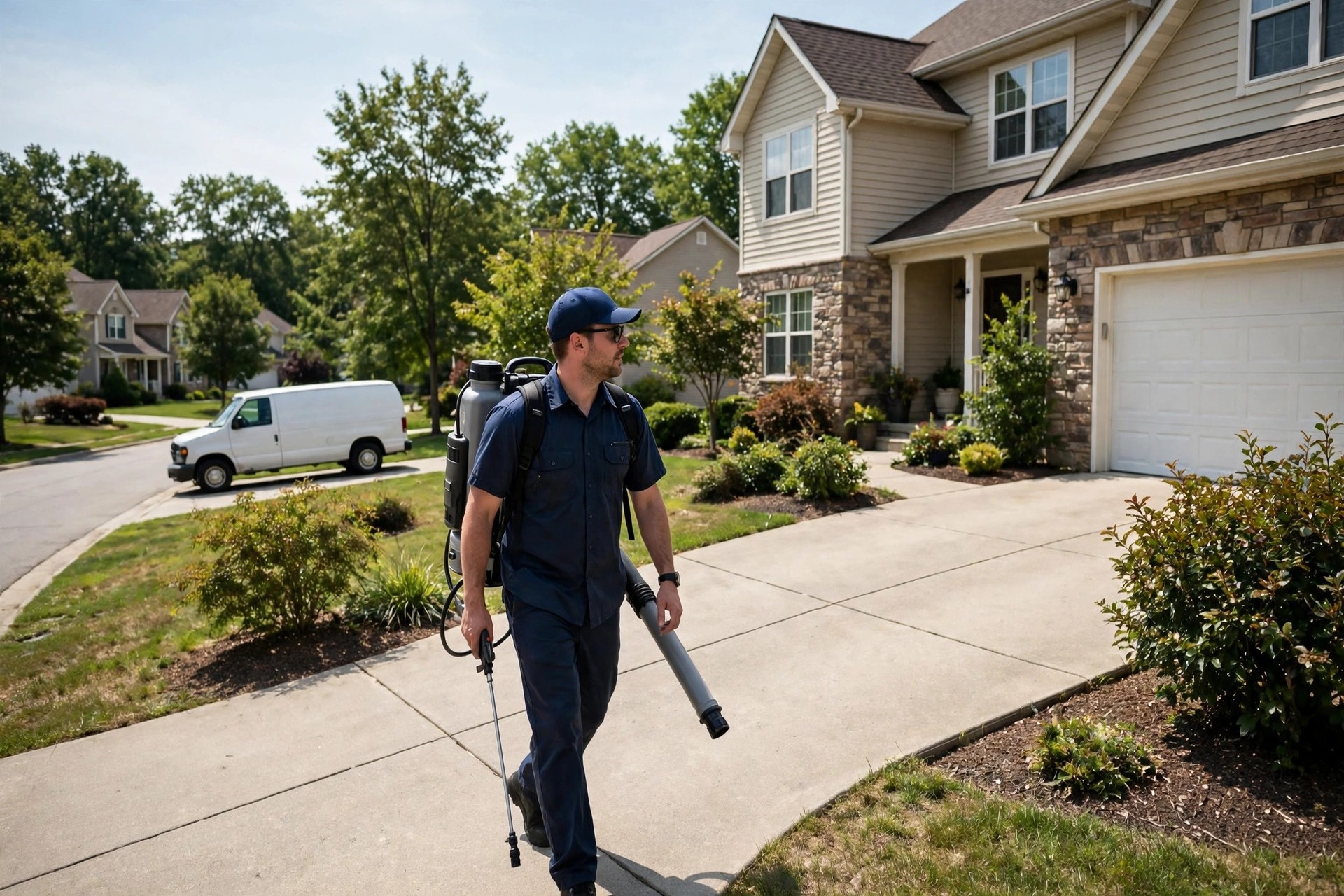
Every ad click is buying a shot at exactly this: a technician at a customer’s door. The economics only work when the backend turns clicks into booked visits.
What a booked job actually costs you
The click price is only the first number in the chain. What matters is the cost per lead and then the cost per acquired customer. Work the chain backward from your own numbers and you will know exactly what you can afford to bid.
Start with your website’s conversion rate, which is the share of ad clicks that turn into a call, form fill, or chat. A good pest control landing page converts 8 to 15 percent of clicks into leads. An average site converts 4 to 7 percent. If your clicks cost $8 on average and your page converts at 10 percent, you are paying $80 per click to get one lead? No, do the math the right way: ten clicks at $8 cost $80 total, and at a 10 percent conversion rate those ten clicks produce one lead, so your cost per lead is $80. Bring the conversion rate to 15 percent and the same math gives you a $53 lead. That is why the landing page section of this guide matters as much as the bidding section.
Next, your close rate: the share of leads that become paying customers. Pest control companies with fast call answering typically close 40 to 60 percent of inbound leads. Companies that answer slowly or miss calls after hours close far fewer, sometimes under 30 percent. At a $53 cost per lead and a 50 percent close rate, your cost to acquire one customer is about $106. At a 30 percent close rate, it is $177. The ad account did not change; the phones did. Speed to answer is the cheapest optimization in the entire business.
Put the realistic middle together: $8 average click, 10 percent page conversion, 50 percent close rate. Cost per lead: $80. Cost per acquired customer: $160. For a one-time $150 wasp nest job, that looks tight. For a quarterly plan customer worth $500 a year, it looks like a bargain. The next section is where that difference lives.
Why recurring plans make expensive clicks worth it
Pest control has something most home services do not: customers who pay you four times a year for years. A quarterly plan at $99 to $129 per visit produces $396 to $516 in revenue per customer per year, and the average plan member stays three to five years. That means the lifetime value of one new plan customer often lands between $1,200 and $2,500 before you count upsells like mosquito treatment, termite monitoring, or attic insulation.
This changes every bidding decision. A handyman who earns $250 once from a job has to keep acquisition cost well under $250. A pest control company that earns $1,500 over the life of a customer can spend $100 to $200 to acquire that customer and still earn a strong return. You can afford to bid more aggressively than a competitor who only thinks in single-visit tickets, which is exactly how you win the auction for the best keywords.
The trap is treating every lead like a one-time job. If your ads, your phone scripts, and your technician visits all push toward one-time treatments, you are paying recurring-customer prices for one-time revenue. Build the whole funnel around the plan: the ad mentions the quarterly plan, the phone rep quotes the plan first, and the technician’s visit ends with a plan offer. Companies that convert 40 percent or more of new customers into recurring plans see their effective acquisition cost per dollar of lifetime revenue drop to a fraction of what single-job competitors pay.
One-time specialty jobs still deserve their own math. A $1,200 bed bug treatment or a $900 termite job can absorb a $25 click and a $150 acquisition cost easily, because the ticket is large and immediate. Keep those keywords in their own campaigns with their own budgets so they do not get starved by the cheaper general keywords, and do not let their costs scare you away from the high-intent searches.

Track cost per lead and cost per plan signup separately. Blending one-time jobs with recurring plans in one report hides where the real profit comes from.
What you should spend each month
There is no magic budget number, but there is a floor below which campaigns cannot learn. Google needs roughly 30 conversions a month per campaign to optimize bidding well, and each campaign needs enough daily budget for 10 to 20 clicks a day. For a pest control account running three to four campaigns, that puts the practical minimum around $1,500 a month in ad spend in a mid-size market. Below that, the campaigns collect data too slowly to ever get smart.
A useful starting structure for most single-location companies looks like this: 40 percent of budget on general pest control keywords, 25 percent on emergency and specialty keywords (bed bug, termite, wildlife), 20 percent on your city plus service keywords (“pest control Austin”), and 15 percent on retargeting and research keywords. This mix balances this-week bookings with plan-base growth.
| Monthly ad spend | Rough daily budget | Expected clicks | Expected leads | Best fit |
|---|---|---|---|---|
| $1,500 | $50 | 180 to 250 | 15 to 30 | Small operator, one truck, testing paid search |
| $3,000 | $100 | 350 to 500 | 30 to 60 | Growing company, 2 to 5 techs, wants steady plan growth |
| $5,000 | $165 | 600 to 850 | 55 to 100 | Multi-truck company, aggressive growth, big metro |
| $10,000+ | $330+ | 1,200+ | 110+ | Multi-location, franchise, or dominant local player |
These lead estimates assume a $7 to $9 blended click cost and an 8 to 12 percent conversion rate, which is what a decent landing page and prompt call answering produce. If your numbers land far outside these bands, the problem is almost always the landing page or the phone process, not the budget.
Three budget tiers are common in this industry. Pick the one that matches where your company actually is, not where you wish it were.
Starter: prove the channel
For companies running their first serious Google Ads test. One tight service area, three to four campaigns, manual review of every search term weekly. The goal is 15 to 40 leads a month and proof that the cost per plan signup beats your other channels.
- General and city keywords only, plus one specialty campaign
- One landing page with click-to-call and a short form
- Weekly search-term cleanup to block irrelevant clicks
Growth: feed the route
For companies with trucks to fill and a real recurring base to grow. Full campaign structure by job type, separate budgets for emergency keywords, retargeting live, and call tracking tied to booked jobs. The goal is a predictable cost per plan signup you can scale.
- Separate campaigns for general, emergency, termite, and bed bug
- Dedicated landing pages per job type
- Retargeting for quote abandoners and lapsed plan members
Dominate: own the market
For multi-location operators and franchises competing for page one in big metros. Every profitable keyword covered, brand defense running, seasonal pushes for mosquito and termite swarm season, and offline conversion tracking feeding the bidding.
- Full keyword coverage plus competitor and brand terms
- Seasonal campaigns for mosquito, termite, and wildlife peaks
- CRM-fed bidding on actual booked revenue, not just leads
The pricing pattern is similar across other home services, but the numbers move with ticket size and competition. Our breakdown of Google Ads cost for cleaning companies shows a cheaper keyword set with its own math, and plumber Google Ads cost sits closer to pest control on the emergency side.
Build your campaigns around job types
The accounts that waste money almost always have one big campaign with every keyword thrown in together. Google then spends your budget on the cheapest clicks, not the best customers. The fix is a simple structure where each job type gets its own campaign, its own budget, and its own landing page.
Campaign 1: General pest control. “Pest control near me,” “exterminator near me,” “pest control [city].” Highest volume, mixed intent, moderate bids. This is your plan-feeder campaign; the ad copy and landing page should push the quarterly plan.
Campaign 2: Emergency and urgent. “Wasp nest removal,” “mouse exterminator,” “ants in kitchen.” Higher bids, ad copy promising same-day service, landing page with a big phone number and “technicians available today.” These searches happen when the problem is happening, so speed wins.
Campaign 3: Termite. “Termite inspection,” “termite treatment cost,” “signs of termites.” Its own budget because the CPCs are high and the tickets are huge. The landing page should explain the inspection process and show the treatment guarantee.
Campaign 4: Bed bug and wildlife. “Bed bug exterminator,” “raccoon removal,” “squirrel in attic.” High intent, high ticket, seasonal swings. Keep these separate so a summer mosquito surge does not eat the termite budget.
Campaign 5: Research and retargeting. “Quarterly pest control cost,” “how much is pest control,” plus all retargeting audiences. Lower bids, plan-focused messaging, and the job of catching people who are still deciding.
Keep each campaign geo-targeted to the area you can actually serve within a reasonable drive. Pest control companies bleed money on clicks from towns they will never visit. Draw the radius honestly, and use location bid adjustments to push harder in the zip codes where your best plan customers live. If you serve multiple distinct areas, our electrician Google Ads cost guide covers the same multi-zone structure from another trade’s angle.
Write ads that get the call
Pest control searchers are not reading your ad for fun; they are scanning three or four ads in ten seconds and picking the one that feels safest and fastest. Your ad has to win that scan.
Lead with the thing they searched. If the keyword is “wasp nest removal,” the headline should say wasp nest removal, not “ABC Pest Solutions.” Match the search term in the headline, then add the reassurance: same-day service, licensed and insured, satisfaction guarantee. The description lines carry the plan pitch for general keywords and the urgency pitch for emergency ones.
Use every ad asset Google offers. Call assets put your number right in the ad. Location assets show your address and distance. Sitelink assets send people straight to “Quarterly Plans,” “Termite Inspection,” or “Same-Day Service” pages. Price assets can show “Quarterly plans from $99/visit” for plan keywords. Accounts that fill out all assets consistently see higher click-through rates, which raises ad quality scores and lowers the actual cost per click. That is free money most small operators leave on the table.
Write at least three ad variations per ad group and let Google rotate them. Test the angle, not just the wording: one ad leads with price (“Quarterly plans from $99”), one leads with speed (“Same-day service available”), one leads with trust (“Licensed, insured, 500+ five-star reviews”). After a few hundred clicks, keep the winner and test a new challenger. This never ends, and the accounts that keep testing keep their click costs lower than the ones that set ads once and forget them.
The landing page that turns clicks into booked jobs
Most pest control companies send ad clicks to their homepage, where the visitor has to hunt for the phone number and figure out what to do. That single habit can cut conversion rates in half. Every campaign deserves a landing page built for one job: turn this click into a call or a booking.
The page needs five things above the fold: a headline matching the ad (“Wasp Nest Removal in [City]”), a subheadline with the offer (“Same-day service, guaranteed removal”), a large click-to-call button with the actual phone number, a short form asking only for name, phone, and pest problem, and one trust signal (review count, license badge, or guarantee). Nothing else competes for attention up there. No sliders, no company history, no blog links.
Below the fold, answer the three questions every searcher has: What will it cost? When can you come? What if the pests come back? A simple price range table, a same-day availability note, and a clear guarantee statement handle all three. Add a short FAQ section targeting the exact questions from your search-term reports, because those are the words real customers use, and they also help the page rank for related searches over time.
Match the page to the campaign. Emergency keywords get the phone-first page with “available today” language. Termite keywords get the inspection-explainer page with the guarantee. Plan keywords get the plan page with the quarterly pricing and the “what is included” list. One generic page for everything is how $12 clicks turn into $12 bounces.
Mobile does most of the work. Over 70 percent of pest control searches happen on phones, often while the person is staring at the pest. Test your page on a real phone, not just a desktop preview. The call button should be thumb-reachable, the form should take under 30 seconds, and the page should load in under three seconds on a normal connection. Every extra second of load time quietly raises your cost per lead.

The first visit is where a one-time job becomes a plan member. Train the visit around the plan offer and your ad economics improve with every route.
Retargeting: bring back the plan members
The cheapest revenue in your Google Ads account comes from people who already know you. Retargeting shows ads to past website visitors, past quote-requesters, and past customers, and it costs a fraction of cold search clicks, often $1 to $3 per click.
Build three retargeting audiences and treat them differently. Quote abandoners visited the booking page but did not submit. Show them ads for 14 days with a direct nudge: “Still dealing with pests? Get your free quote.” These are the warmest prospects you have, and a small budget here often produces the best cost per lead in the account.
Plan members with missed visits are pure gold. Upload your customer list and show reminder ads to members who skipped a quarterly treatment: “Your quarterly treatment is due. Book in 60 seconds.” Winning back a lapsed member for a $2 click beats acquiring a new one for $80, and it protects the recurring revenue you already built.
One-time customers from the past year are your plan upsell audience. Show them the plan pitch after their single treatment: “One visit fixed it. A quarterly plan keeps it fixed.” Technicians should make this offer in person too, but the ads catch everyone the tech missed and everyone who said “let me think about it.”
Set frequency caps so people do not see your ads twenty times a day; five to eight impressions a day is plenty. Exclude people who already converted in the last 30 days from the quote-abandoner audience so you are not paying to remind someone who already booked. And keep retargeting budgets modest, 10 to 15 percent of total spend. Retargeting is the amplifier, not the engine.
Mistakes that burn pest control budgets
Bidding on DIY keywords. “How to get rid of ants” and “best wasp spray” are people looking to solve the problem themselves, not hire you. These searches are cheap, which makes them tempting, but they convert near zero. Add DIY terms as negative keywords or put them in a separate low-bid research campaign.
Ignoring the search-term report. Google will happily spend your money on “pest control jobs,” “pest control training,” and “free pest inspection scams” if you let it. Review the actual searches triggering your ads every week for the first two months, and block the irrelevant ones as negative keywords. This single habit can cut wasted spend by 20 to 30 percent.
No call tracking. Most pest control leads call instead of filling forms. If you are not tracking which keywords and ads produced each call, you are flying blind on more than half your results. Call tracking costs $30 to $50 a month and is non-negotiable.
Slow call answering. The data is brutal on this: calling back within five minutes converts dramatically better than calling back in thirty. If your office cannot answer every call live, add an AI receptionist or a dedicated answering process before you raise the budget. More ad spend on missed calls is just a faster way to burn money.
One landing page for everything. Covered above, but worth repeating as a budget issue: mismatched pages raise your cost per lead, which raises your cost per customer, which makes every keyword look “too expensive” when the real problem is the page.
Pausing too early. New campaigns need two to four weeks of real data before you judge them. Pausing after five days because “it is not working” guarantees you never learn what works. Set a test budget you can afford to spend for a full month, then judge.
Forgetting seasonality. Mosquito season, termite swarm season, and fall rodent season move both search volume and competition. Budgets that stay flat all year miss the peaks and overspend the valleys. Plan a seasonal calendar and shift budget into the months when your market searches most.
Your rollout checklist
Work through these in order. Each one builds on the last.
- 1Set your target cost per plan signup. Work backward from plan lifetime value: if a member is worth $1,500 over four years, you can afford $100 to $200 to acquire one.
- 2Define your real service area. Draw the radius you can serve profitably and exclude the zip codes you cannot, before you spend a dollar.
- 3Build the five campaigns. General, emergency, termite, bed bug and wildlife, and research plus retargeting, each with its own budget.
- 4Write three ad variations per ad group. Test price, speed, and trust angles against each other and keep the winner.
- 5Build one landing page per campaign. Headline matching the ad, click-to-call button, short form, price ranges, and the guarantee.
- 6Install call tracking and conversion tracking. Track calls, forms, and chats back to the keyword and ad that produced them.
- 7Fix call answering first. Live answer during business hours and a fast callback process after hours, before you raise the budget.
- 8Launch with a one-month test budget. Commit to $1,500 to $3,000 for a full month and do not judge results before week three.
- 9Clean search terms weekly. Review actual searches for the first two months, add negatives, and watch wasted spend drop.
- 10Add retargeting in month two. Quote abandoners, missed quarterly visits, and one-time customers get their own audiences and budgets.
Frequently asked questions
How much should a small pest control company spend on Google Ads?
Start with $1,500 to $2,500 a month in ad spend. That is enough for 180 to 300 clicks a month in a mid-size market, which should produce 15 to 35 leads with a decent landing page. Run it for a full month before judging, then scale the budget on the campaigns with the best cost per plan signup.
What is a good cost per lead for pest control?
Most well-run accounts land between $25 and $60 per lead. General keywords sit at the low end and termite or bed bug keywords at the high end. If your cost per lead is over $80, check your landing page conversion rate and your negative keyword list before blaming the bids.
Are Google Ads worth it for pest control companies?
Yes, when the account is built around recurring plans. A new plan member is worth $1,200 to $2,500 over their lifetime, which gives you room to pay $35 to $80 to acquire them. Companies that chase only one-time jobs with the same ad spend often find the math tight; companies that sell the plan find it very profitable.
Which pest control keywords cost the most?
Bed bug and termite keywords are the most expensive, typically $12 to $28 per click, because the jobs are urgent and high-ticket. Emergency keywords like wasp nest removal run $10 to $20. General “pest control near me” searches are cheaper at $6 to $12 but need higher volume to produce the same revenue.
Should I bid on my competitors’ names?
It can work, but keep it in its own small campaign with a modest budget. Competitor keywords are cheap because the intent is mixed, but the conversion rate is low since the searcher already has a company in mind. Never use a competitor’s name in your ad text; that invites trademark complaints.
How long until Google Ads produce results for pest control?
Calls and leads usually start within days of launch. Reliable cost-per-lead data takes two to four weeks as the campaigns collect clicks and Google’s bidding learns. Give it a full month at a real budget before deciding whether the channel works for your market.
Do I need a separate landing page or can I use my website?
Use dedicated landing pages. Sending ad clicks to a homepage typically cuts conversion rates in half compared with a focused page that matches the ad. Each campaign should land on a page with a matching headline, a click-to-call button, a short form, and the guarantee.
What is the best bidding strategy for pest control Google Ads?
Start with manual bidding or maximize clicks while you collect the first 30 conversions, so you control costs during the learning phase. Once a campaign has steady conversion data, switch to target cost per acquisition or maximize conversions with a target, set from your actual cost-per-lead history.
How do I stop wasting money on irrelevant clicks?
Review the search-term report weekly and add negative keywords for job seekers, DIY searches, and unrelated pests you do not treat. Common negatives include “jobs,” “careers,” “DIY,” “homemade,” “free,” and species you do not service. This routine alone often cuts wasted spend by 20 to 30 percent.
Should pest control companies run Google Ads all year?
Yes, but shift the budget with the seasons. Keep general and plan keywords running year-round at a maintenance budget, then push extra spend into mosquito campaigns in summer, termite campaigns during swarm season, and rodent campaigns in fall. Flat budgets all year miss the peaks when search volume and intent are highest.
Turn pest control searches into recurring revenue
Digital Hayder builds Google Ads campaigns for pest control companies: keyword structures built around job types, landing pages that convert clicks into calls, call tracking tied to booked jobs, and retargeting that brings plan members back. Tell us about your service area and we will design the account around it.
Contact Us