Tree service is one of the most expensive home service niches on Google Ads, and the reason is simple: the jobs are big, urgent, and dangerous to do yourself. A homeowner with a leaning pine over the garage is not shopping for the lowest price or reading reviews for a week. They want a crew on site, fast. That urgency pushes bidding up, and tree companies routinely pay $15 to $40 per click on their core keywords, with storm and emergency terms climbing higher. The good news is that the math still works. Average tree jobs run $400 to $1,500, and emergency removals can top $2,500, so even pricey clicks turn into profitable work when the account is built right. This guide breaks down exactly what tree service companies pay for Google Ads: click costs by keyword, monthly budgets by market size, storm-season strategy, call-only campaigns, landing pages that convert, and the cost per booked job you should expect.
The quick answer
- Click costs run high: expect $8 to $25 per click for trimming and pruning terms, and $25 to $60 for emergency tree removal keywords.
- Budget by market size: small markets work on $1,500 to $3,000 a month, mid-size markets need $3,000 to $7,500, and large metros start around $7,500.
- Storms change the game: after a big storm, search volume and click prices both spike; call-only campaigns capture the surge better than website ads.
- Your landing page decides the outcome: dedicated service pages with click-to-call convert 2 to 3 times better than sending paid traffic to your homepage.
- Cost per booked job: a well-run tree account lands between $75 and $150 in ad cost per booked job, against average jobs worth $400 to $1,500.
- Live in about two weeks: build the keyword structure, set location targeting, add call tracking, then launch with tight budgets and expand on winners.
Why tree service keywords cost more than most home services
Google Ads is an auction, and tree service auctions are crowded because the prize is large. A booked tree removal can be worth $800 to $2,500 to the company that answers the phone first. When every bidder knows the job value, they bid accordingly, and clicks settle at prices that would shock a house cleaner or a lawn care operator. That is the first cost driver: high job values support high bids.
The second driver is urgency. Most tree work is not planned. A storm splits a trunk, a dead limb hangs over a driveway, a tree starts leaning after heavy rain. The homeowner searches “emergency tree removal near me” at 7 AM and calls the first company that picks up. Advertisers pay a premium for that moment because the conversion rate is so high. Someone searching “tree trimming cost” might be comparing quotes for next month. Someone searching “tree fell on house” is booking today. Google charges for the intent, not just the click.
The third driver is competition density. Tree service has low barriers to entry for the small stuff but high barriers for the real work, so mid-size markets often have a dozen companies bidding on the same core terms, plus national lead aggregators and directory sites bidding on your keywords to resell the lead back to you at a markup. Every extra bidder in the auction pushes the clearing price up a little.
Finally, geography concentrates demand. Tree work clusters around wooded suburbs and storm corridors, so the auction in a single zip code can be fiercer than in an entire rural county. A company serving a dense suburban ring around a mid-size city often pays double the click price of a company covering a spread-out rural service area, simply because more bidders chase the same searches. If you are coming from another trade, our roofer Google Ads cost guide shows a similar storm-driven pattern, and the plumber Google Ads cost breakdown covers how emergency keywords price out in a comparable urgent trade.
Tree service keyword costs: what each click runs
Not all tree keywords cost the same. Informational searches like “how much does tree removal cost” are cheap because the searcher is researching, not buying. Service searches like “tree trimming service” cost more. Emergency searches cost the most. The table below shows typical US cost-per-click ranges for the keyword groups that matter to a tree company. Your market will sit somewhere inside these bands, with dense suburbs at the top and rural areas at the bottom.
| Keyword group | Example searches | Typical CPC | Buyer intent |
|---|---|---|---|
| Tree trimming and pruning | tree trimming service, tree pruning near me | $8 to $18 | Medium: planning, may compare quotes |
| Tree removal | tree removal service, tree cutting service near me | $14 to $30 | High: usually has a specific tree in mind |
| Stump grinding and removal | stump grinding service, stump removal cost | $7 to $16 | Medium: often follows a removal job |
| Emergency tree service | emergency tree removal, tree fell on house | $25 to $60 | Very high: needs a crew now |
| Storm damage cleanup | storm damage tree cleanup, fallen tree removal | $20 to $50 | Very high: spikes after weather events |
| Informational and cost terms | tree removal cost, how much to trim a tree | $4 to $10 | Low: researching, long sales cycle |
| Commercial tree service | commercial tree service, tree service for HOA | $12 to $28 | High: bigger contracts, slower decisions |
A few notes on reading this table. First, exact match keywords usually cost less per click than broad match for the same term, because exact match avoids paying for loose variations. Second, the top of each range is what you pay in competitive suburbs during peak season; the bottom is small markets and off-season. Third, mobile clicks skew toward the higher end for emergency terms because those searches happen on phones, and mobile auctions in local services run hot. Fourth, these are click costs, not lead costs; the next sections show how clicks turn into calls and booked jobs.
The smart way to use this table is to budget each campaign separately. Put emergency terms in their own campaign with their own daily budget so a storm surge does not eat the budget for your steady trimming work. Put informational terms in a low-budget campaign or skip them entirely if your budget is tight. Most tree companies get their best return from three campaigns: emergency and storm, core removal and trimming, and stump grinding as an upsell add-on to removal traffic.
Monthly budgets by market size
Your monthly budget decides how much of the available demand you can capture. Spend too little and your ads stop showing by noon. Spend without structure and you pay for clicks that never become jobs. The ranges below assume a company that answers the phone, runs dedicated landing pages, and tracks calls, which are the conditions that make ad spend work. They cover ad spend only, not management fees.
| Market size | Example | Monthly ad spend | What it buys |
|---|---|---|---|
| Small market | Single county, under 150,000 people | $1,500 to $3,000 | Core service campaigns; limited emergency coverage |
| Mid-size market | Suburban ring around a mid-size city | $3,000 to $7,500 | Full keyword coverage, storm surge budget, call-only ads |
| Large metro | Major metro area or multi-county region | $7,500 to $15,000 | Aggressive coverage across all services, commercial terms included |
| Storm response mode | Any market, first 72 hours after a major storm | 2 to 4 times the normal daily budget | Temporary surge to capture peak emergency demand |
Here is how those numbers translate into clicks and calls. Take a mid-size market at $5,000 a month with an average click cost of $20. That buys about 250 clicks a month. A well-built tree account converts 8 to 15 percent of clicks into calls, which is 20 to 37 calls. If your crew books half of qualified calls, that is 10 to 18 booked jobs a month from a $5,000 spend, or roughly $275 to $500 per job in the roughest math. In practice the numbers come in better, because call-only ads and emergency terms convert at higher rates, and because repeat storm work compounds. The money math section at the end works this out precisely.
Start at the low end of your band and scale monthly. A common mistake is launching at full budget on day one. Google needs two to three weeks of conversion data to learn which searches turn into calls, and during that learning period your cost per lead runs high. Start at 60 percent of your target budget, let the account gather data, cut the keywords and search terms that produce junk calls, then raise the budget on the campaigns that book jobs. Patience in month one saves thousands over the year.
Emergency and storm keywords: the expensive clicks that pay best
Emergency keywords are the most expensive clicks in the tree business and also the best value, which sounds like a contradiction until you look at the close rates. A homeowner searching “tree trimming near me” might call three companies and pick the cheapest quote next week. A homeowner searching “tree fell on my roof” calls the first company that answers and books on the spot. Close rates on emergency calls regularly run 50 to 70 percent, versus 20 to 35 percent for planned work. At those close rates, a $45 click that becomes a $1,200 emergency removal is a bargain.
Storms deserve their own playbook because demand arrives all at once. After a major wind or ice event, search volume for fallen tree and storm cleanup terms can jump 5 to 10 times normal for 48 to 72 hours. Click prices spike too, because every tree company in the county raises bids at the same time. The companies that win the surge are the ones that prepared before the storm: emergency campaigns already built and paused, ready to switch on; call-only ads with storm-specific copy; landing pages that mention storm damage; and crews scheduled for rapid response. If you wait until the storm hits to build all of this, the surge is half over before your ads are approved.
Storm copy should be specific and honest. “Storm damage tree cleanup, crews available today” beats generic “tree service.” Mention your actual response capability: same-day assessments, 24-hour emergency line, licensed and insured. Avoid promising arrival times you cannot keep; one storm season of missed promises fills your reviews with one-star warnings that cost you for years. If your capacity is full, pause the ads rather than paying for calls you cannot serve. Nothing burns money faster than a $40 click that reaches a voicemail.
Seasonal storm planning also means watching the forecast like a business input. In hurricane and tornado regions, pre-storm weeks are the time to raise budgets on preparedness terms like “tree trimming before storm season” and “dead tree removal,” which are cheaper than post-storm emergency terms and book the preventive work that keeps crews busy between events. Our roofer Google Ads cost guide covers a similar pre-storm and post-storm bidding pattern that translates well to tree work.
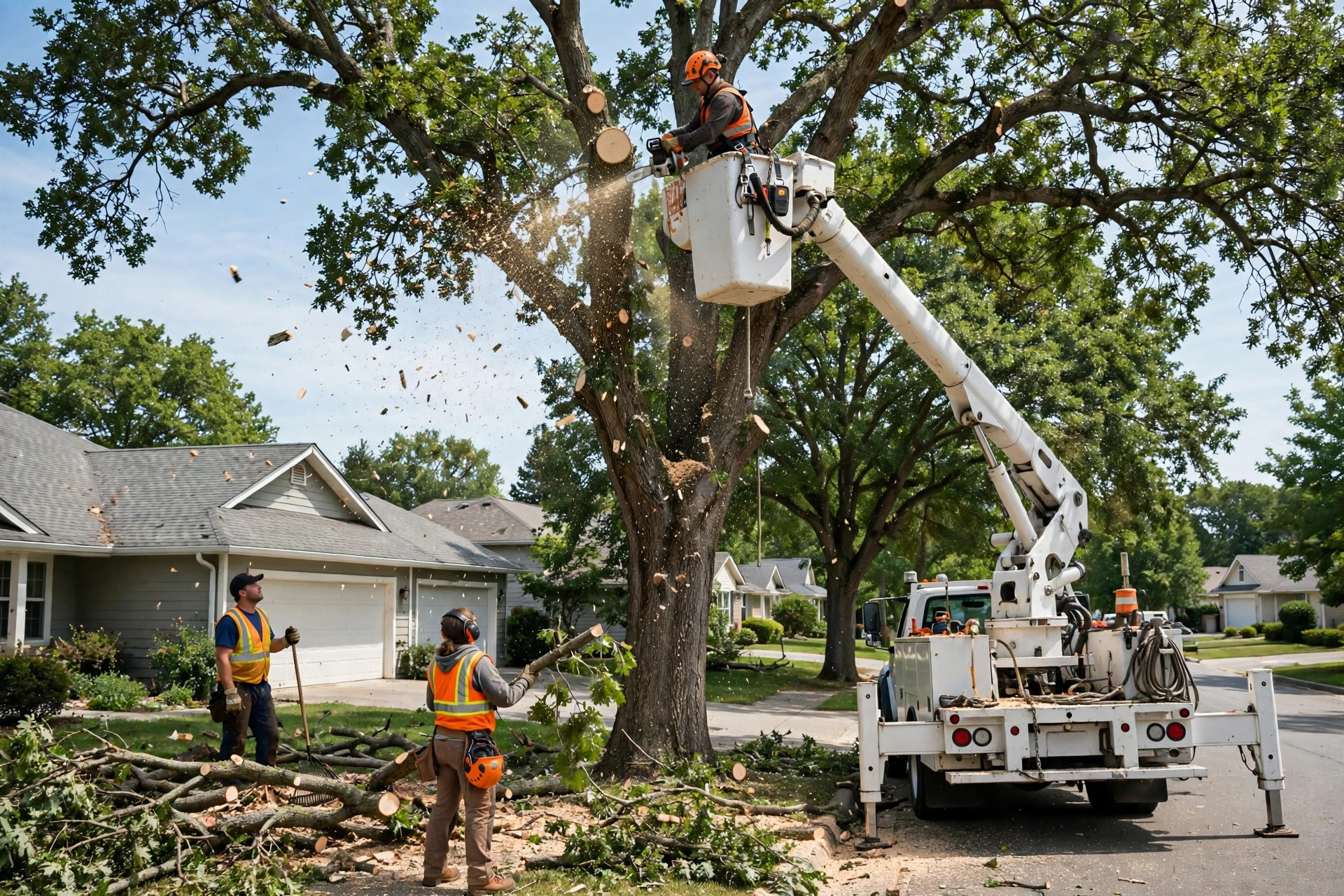
Emergency tree work commands premium prices, which is why expensive emergency clicks still produce profitable jobs when the account is built right.
Call-only campaigns during storms
Call-only ads are the highest-converting format for tree service, and during storms they are not optional. A call-only ad shows your phone number as the entire ad, with no website visit in between. The searcher taps and the phone rings. For emergency tree work, where the customer decides in seconds and every extra step loses the job, removing the website from the path can lift conversion rates by 30 to 50 percent compared with sending the same click to a landing page.
Build a dedicated call-only campaign for emergency and storm terms, separate from your standard search campaigns. Set it to run only during the hours your phones are actually answered, or around the clock if you have an answering service that can take storm calls at 3 AM. There is no point paying $40 for a click that reaches voicemail; schedule the campaign to your real coverage and use a call tracking number so every call is recorded and attributed.
Write the ad copy for the moment. Headlines like “Emergency Tree Removal” and “Tree on Your House? Call Now” match the searcher’s panic and state. Use call extensions with your actual local number, not a toll-free line; local numbers get more calls in local services. Add location targeting tight enough that you are not paying for calls from towns your crews cannot reach within a reasonable drive. A 20 to 30 mile radius around your yard is a common starting point, tightened during storms when drive time between jobs matters most.
During an active storm surge, raise the call-only budget aggressively and check the account twice a day. Search volume moves fast, and the auction price for “emergency tree service” can double between morning and evening. Set a maximum cost-per-call target in your head before the storm: if a booked emergency job is worth $1,200 and you close half your calls, you can afford to pay up to $150 to $200 per booked job and still clear a strong margin. That ceiling tells you when to keep bidding and when the auction has gone past the point of profit.
Landing pages that turn tree clicks into booked jobs
The landing page is where tree ad budgets are won or lost. Most tree companies send paid clicks to their homepage, which is a mistake. A homepage talks about everything: trimming, removal, stump grinding, the company history, the service area. A paid click arrives with one specific problem, and the page should talk about that problem and nothing else. Dedicated landing pages for your top services consistently convert 2 to 3 times better than a homepage, which cuts your cost per booked job in half without changing your bids.
Every tree service landing page needs the same core elements. A headline that matches the ad: if the ad says “Emergency Tree Removal,” the page headline says the same thing, not “Welcome to ABC Tree Care.” A click-to-call button visible without scrolling, on mobile especially, because 70 percent or more of tree searches happen on phones. Proof of trust above the fold: licensed and insured badges, years in business, review count with stars. A short form as a backup for people who will not call, asking only for name, phone, and a description of the tree problem. Three fields, not ten. Every extra field costs you conversions.
Photos do heavy work on tree pages. Show your actual crews, your actual trucks, and your actual equipment, not stock photos of forests. Homeowners are inviting you onto their property with chainsaws; they want to see professionals. Before and after photos of removals and cleanups are the strongest trust builders in this trade. Add a service area list with the towns you cover, which also helps the page rank for local searches over time. If your site needs work before it can carry paid traffic, our guide to how much a tree service website costs breaks down what a conversion-ready site runs.
Speed is a conversion factor. A tree landing page that loads in under three seconds on a phone converts measurably better than one that takes six. Compress your images, cut the heavy animations, and test the page on a real phone over a cellular connection, not just on office wifi. During storms, people search from their yards with one bar of signal; a slow page is an invisible tax on every click you bought.
Budget pacing through the seasons
Tree service demand moves with the seasons, and your budget should move with it. Spring is the biggest season in most markets: homeowners see winter damage, plan yard projects, and book trimming before summer. Late summer brings storm season in many regions. Fall brings pre-winter removals of dead and leaning trees. Winter is the slow season in cold climates, though it brings its own emergency work from ice and snow loads.
The practical approach is a base budget plus seasonal multipliers. Set your base at the level that keeps core campaigns running year round, then raise it 30 to 50 percent in spring and during your region’s storm season, and trim it 20 to 30 percent in the slowest weeks of winter. Never go dark entirely. Pausing campaigns for months throws away the account’s learning history, and restarting costs you the two to three week learning period all over again. A small maintenance budget in slow months keeps the data flowing and catches the off-season emergency calls that convert at premium rates.
Watch for the shoulder-season opportunity. Late winter, when competitors cut budgets to the bone, is often the cheapest time to buy tree clicks all year. Click prices can drop 20 to 30 percent while a steady stream of homeowners plans spring work. Companies that keep spending through February and March enter spring with trained campaigns and lower costs, while competitors are still warming up their accounts. The calendar is a competitive weapon if you use it deliberately.
Local Services Ads vs Google Search ads for tree companies
Local Services Ads, the Google Guaranteed listings at the very top of search results, are available to tree service companies in many markets, and they work on a different model: you pay per lead, not per click. That sounds simpler, and for some companies it is, but the two formats serve different purposes and most serious tree companies run both.
Local Services Ads win on trust placement. They sit above the regular ads with a Google Guaranteed badge, review stars, and a direct call or message button. For a homeowner choosing between unfamiliar companies, that badge carries weight. The cost per lead typically runs $25 to $60 for tree services, which is competitive with search ads. The catch is control: you cannot choose your keywords, write your ad copy, or send traffic to a landing page. Google decides when your business shows, and disputes over lead quality are common.
Search ads win on control and coverage. You choose the keywords, write the copy, build the landing pages, and scale the budget up or down by the hour. You can bid on commercial terms, storm terms, and specific services that Local Services Ads may not cover well. The catch is complexity: a poorly built search account wastes money fast, and it needs ongoing management.
The standard advice for tree companies is to run Local Services Ads as a baseline and search ads as the growth engine. Get verified for Local Services Ads, keep the profile complete with photos and reviews, and dispute bad leads promptly. Then build search campaigns for the terms and situations where you need control: storms, commercial work, specific high-value services. The two channels together cover more of the page than either one alone.
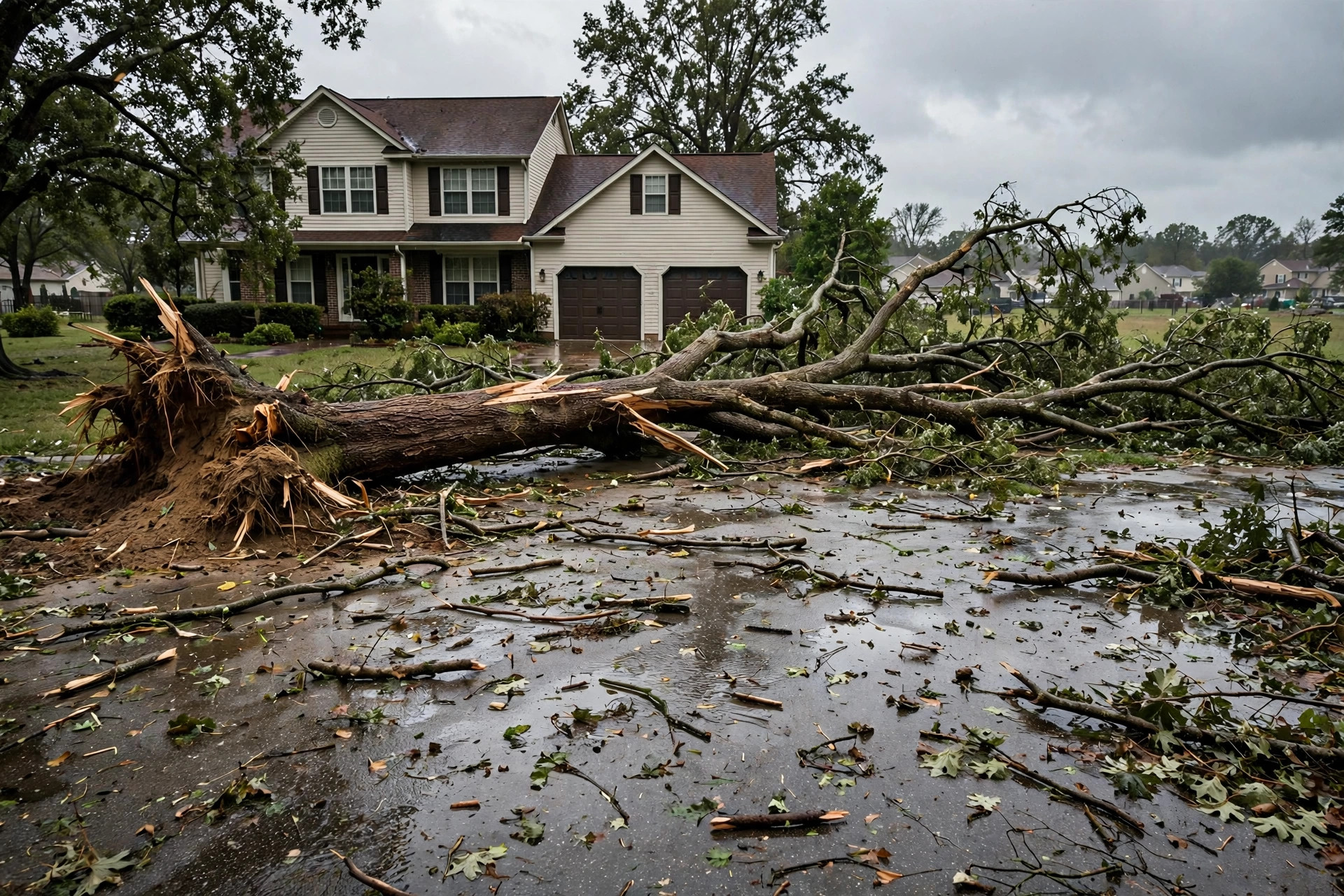
Storm damage creates the highest-intent searches in tree service. Companies with pre-built emergency campaigns capture the surge instead of scrambling.
Tracking every booked job back to its click
You cannot manage what you do not measure, and tree companies have a measurement advantage: almost every job starts with a phone call. That makes call tracking the single most important piece of your setup. Use a call tracking number on your ads and landing pages so every call is logged, recorded, and tied to the keyword that produced it. Without this, you are guessing which half of your budget works.
Set up conversion tracking for two actions: phone calls over a minimum duration, and form submissions. A 60-second minimum call duration filters out wrong numbers and price shoppers who hang up in ten seconds. Import booked jobs back into Google Ads as offline conversions if your CRM supports it; this is the step that separates amateur accounts from professional ones. When Google’s bidding learns from actual booked revenue instead of raw calls, your cost per booked job drops over two to three months because the algorithm stops chasing cheap clicks that never book.
Review the search terms report weekly. This is where you find the money leaks: searches for “tree service jobs” (job seekers clicking your ads), “free tree removal” (not your customer), “how to cut down a tree yourself” (DIY researchers). Add these as negative keywords the moment you see them. A tree account without active negative keyword management typically wastes 15 to 25 percent of its spend on irrelevant searches. Fifteen minutes a week on the search terms report is the highest-paid quarter hour in your marketing.
Track by service line, not just in total. Stump grinding clicks might cost $10 and book $150 jobs; emergency removal clicks might cost $45 and book $1,400 jobs. Both can be profitable, but they need different budgets and different targets. A simple monthly report with spend, calls, booked jobs, and revenue per campaign tells you exactly where to put the next dollar. If you also run Google Ads for pressure washing as a second service line, keep the tracking separate so each trade’s numbers stay clean.
Mistakes that burn tree service ad budgets
Bidding on the whole country. Tree service is local. Ads showing outside your service area produce calls you cannot serve and clicks you cannot get back. Set location targeting to your real service radius, use presence targeting so you only reach people physically in the area, and exclude the towns you do not cover.
One campaign for everything. Emergency, removal, trimming, and stump grinding have different click costs, close rates, and job values. Lumping them into one campaign means one budget and one bid strategy for four different businesses. Split them and manage each on its own numbers.
Sending traffic to the homepage. Covered above, but worth repeating because it is the most common and most expensive mistake. A homepage converts paid traffic at half the rate of a dedicated page. Fix the landing pages before raising the budget.
No call answering plan. Tree clicks convert into calls, and calls convert into jobs only if someone picks up. If your crew is on a job site all day with no one answering, you are buying $30 clicks for voicemail. Use an answering service, rotate office coverage, or at minimum use missed-call text-back so every missed call gets an instant message.
Ignoring negative keywords. Job seekers, DIY researchers, and free-service hunters click tree ads every day. Without negative keywords, they eat 15 to 25 percent of your budget. Check search terms weekly without fail.
Pausing during the learning period. Google needs two to three weeks of conversion data to optimize. Pausing, making big bid changes, or restructuring in week one resets the learning and keeps costs high. Launch, then leave the structure alone for at least two weeks while you only adjust negatives and budgets.
No storm plan. The biggest revenue weeks of the year arrive with 48 hours of warning. Companies without pre-built emergency campaigns watch competitors take the surge. Build the storm campaign now, keep it paused, and switch it on when the forecast turns.

Call tracking ties every booked job back to the keyword that produced it, so you know exactly what each job cost to win.
Your rollout checklist
Work through these in order. Each one builds on the last.
- 1Set your service radius. Map the towns and zip codes your crews can actually reach, and set that as your location targeting from day one.
- 2Install call tracking. Put a tracked number on ads and landing pages, set a 60-second minimum call duration as a conversion, and record calls for quality review.
- 3Build three campaigns. Emergency and storm, core removal and trimming, and stump grinding, each with its own budget and landing page.
- 4Write the negative keyword list. Start with job seeker terms, DIY terms, and free-service terms, then grow it from the search terms report weekly.
- 5Build dedicated landing pages. One per campaign, with a matching headline, click-to-call above the fold, trust badges, real crew photos, and a three-field form.
- 6Set up the call-only campaign. Emergency terms only, scheduled to your real phone coverage, with a local number and storm-ready ad copy.
- 7Prepare the storm playbook. Pre-built surge campaign, raised budgets, rapid-response crew scheduling, and a rule for when to pause if capacity fills.
- 8Launch at 60 percent budget. Give Google two to three weeks of learning data before scaling, and touch only negatives and budgets in that window.
- 9Review search terms weekly. Fifteen minutes a week adding negatives and spotting new keyword opportunities keeps waste under 10 percent.
- 10Import booked jobs as conversions. Feed real booked revenue back into Google Ads so bidding optimizes for jobs, not just calls.
Frequently asked questions
How much does Google Ads cost per month for a tree service company?
Most tree service companies spend $1,500 to $7,500 a month on ad spend, depending on market size. Small single-county markets can compete on $1,500 to $3,000, mid-size suburban markets typically need $3,000 to $7,500, and large metros start around $7,500. Add management costs on top if you hire an agency, usually $500 to $1,500 a month or a percentage of spend.
What is the average cost per click for tree service keywords?
Trimming and pruning keywords run $8 to $18 per click, standard removal terms run $14 to $30, stump grinding runs $7 to $16, and emergency and storm terms run $25 to $60. Your position in these ranges depends on market density, season, and device, with competitive suburbs and peak season at the top.
Why are emergency tree removal clicks so expensive?
Because the buyer intent is extreme. Someone searching “tree fell on house” books today and the job is often worth $1,000 or more. Advertisers bid aggressively for that moment, and the auction price reflects the job value. The high close rate, often 50 to 70 percent, usually makes these the most profitable clicks despite the price.
Should I run call-only ads or send traffic to my website?
Run both, with call-only ads for emergency and storm terms. Call-only ads convert 30 to 50 percent better for urgent searches because they remove the website step. Standard search ads to dedicated landing pages work better for planned work like trimming, where the customer wants to see photos, reviews, and pricing information before calling.
How long until Google Ads produces booked jobs for my tree company?
Expect the first calls within days of launch, but give the account two to three weeks of learning before judging performance. Cost per lead runs high during learning, then settles as Google learns which searches convert. Most tree companies see stable, predictable cost per booked job by week six to eight.
Are Local Services Ads worth it for tree service?
Yes, as a baseline channel. The Google Guaranteed badge and top placement build trust, and cost per lead of $25 to $60 is competitive. But you give up control over keywords and copy, so run search ads alongside for storms, commercial work, and specific services where you need precise targeting.
What is a good cost per booked job for tree service Google Ads?
A well-run account targets $75 to $150 in ad cost per booked job on standard trimming and removal work, and $150 to $300 on emergency work. Against average job values of $400 to $1,500 for standard work and $1,000 to $2,500 for emergency removals, those costs leave a healthy margin.
Should I increase my budget after a storm?
Yes, temporarily. Raising daily budgets 2 to 4 times normal for the first 48 to 72 hours after a major storm captures peak emergency demand. Have the surge campaign pre-built and paused so you can switch it on immediately, and pause it when your crews reach capacity rather than paying for calls you cannot serve.
What negative keywords should tree service companies use?
Start with job seeker terms like “tree service jobs” and “arborist jobs,” DIY terms like “how to cut down a tree” and “DIY tree removal,” and free-service terms like “free tree removal.” Review the search terms report weekly and add anything that spends money without producing qualified calls.
Can I manage Google Ads myself or should I hire an agency?
You can manage it yourself if you commit to weekly search term reviews, monthly landing page testing, and learning the platform basics. Most owners do better hiring a specialist for the build and the first 90 days, then deciding whether to take it in-house. The deciding factor is time: an unmanaged account drifts and wastes 15 to 25 percent of spend within a few months.
Turn expensive clicks into booked tree jobs
Digital Hayder builds and manages Google Ads for tree service companies: emergency and storm campaigns, call-only ads, dedicated landing pages, and call tracking that ties every booked job back to its keyword. Tell us about your market and we will map the budget that books jobs at a cost that makes sense.
Contact Us