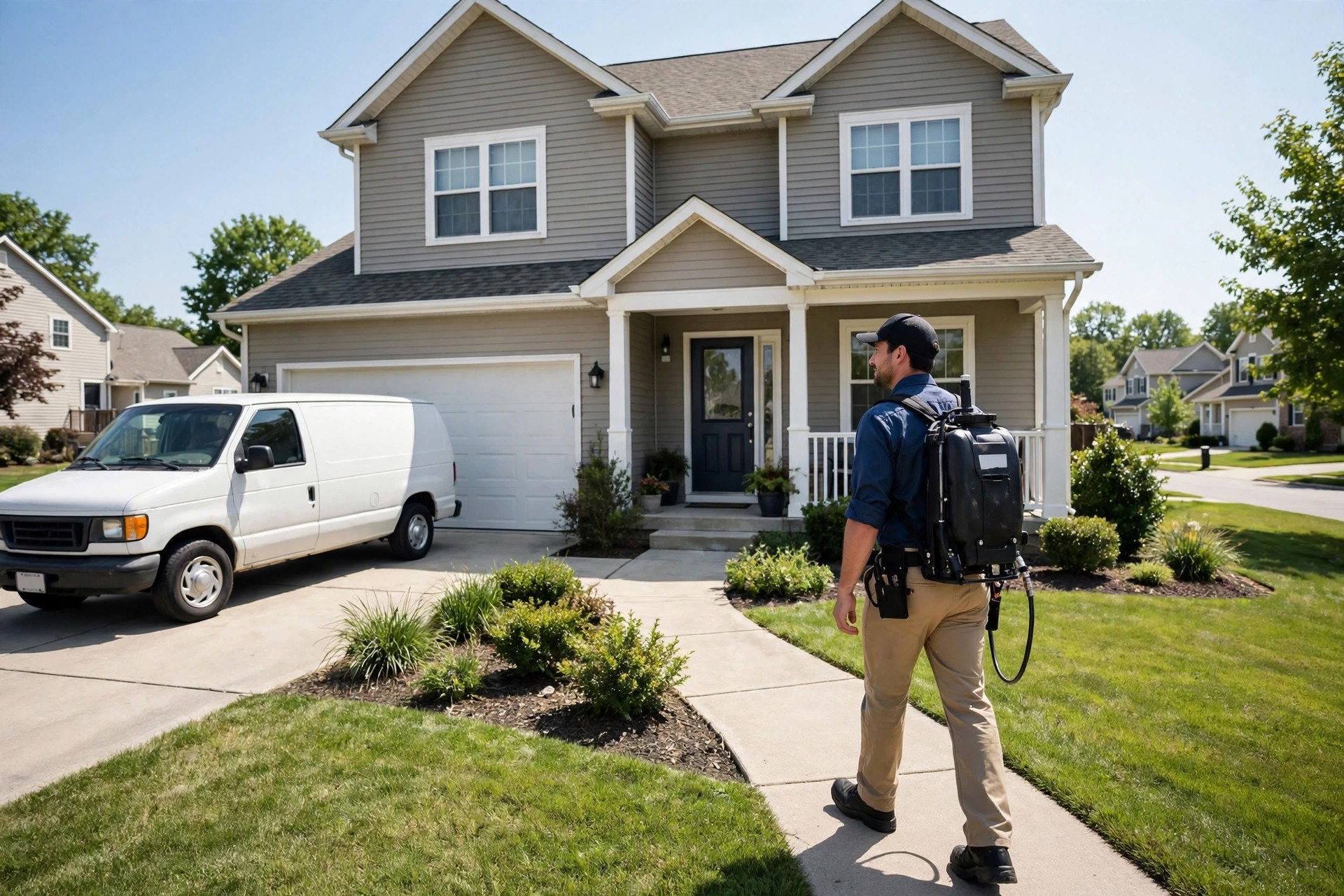
Most pest control jobs start with a panicked search. Ants across the kitchen counter at 9 PM. A wasp nest growing by the front door on a Saturday morning. The homeowner grabs a phone and types “pest control near me” or “ant exterminator in Springfield.” Google answers with a map of three companies and a short list of websites below it. That list decides who gets the call, and it is decided by local SEO: your Google Business Profile, your reviews, your service area pages, and the pest-specific content that answers the exact question the homeowner just asked. This guide is the full local SEO playbook for pest control owners. It covers what to fix first on your profile, how to build town pages that rank, how to earn reviews on a steady schedule, and the money math that shows why free organic calls beat paid clicks over time.
The quick answer
- Map pack or nothing: the top three map results capture most “pest control near me” clicks, so your first goal is getting into that three-pack for your main towns.
- Profile first: a complete Google Business Profile with the right categories, a full services list, real photos, and correct hours is the fastest ranking win most companies have.
- One town, one page: a dedicated service area page per town, with real local detail, beats a single page that lists twenty cities in a bullet list.
- Reviews are ranking fuel: steady new reviews that mention pests and towns in the text lift visibility and raise the call rate on the clicks you already earn.
- Answer the panic: pages for specific pests (ants, termites, bed bugs, rodents) match the exact searches homeowners type when they are ready to book today.
- Organic compounds: paid ads stop producing the day you stop paying, while local SEO keeps generating calls month after month at a fraction of the cost per job.
Why the search box decides who sprays this week
Pest control is an urgency business. Nobody plans a pest problem three months ahead. They notice something, they feel uncomfortable, and they want it handled fast. That urgency shapes every search. Queries like “pest control near me,” “exterminator open now,” and “wasp nest removal Springfield” carry immediate buying intent. The person typing is not researching for fun. They are choosing a company within minutes, often on a phone, often outside your office hours.
This is why the map pack matters more here than in most industries. For “near me” searches, Google puts a map with three business listings above the regular website results, and those three get the bulk of the calls. Businesses in positions four and five can have great websites and still lose the job to a competitor with a stronger profile and more reviews. The homeowner rarely scrolls past the map. They tap a call button on the listing that looks most trustworthy: strong rating, recent reviews, photos of real technicians and trucks, and hours that say someone will answer.
The pattern repeats across every pest. Termite season brings “termite inspection cost” searches. Summer brings mosquitoes and wasps. Fall brings rodents moving indoors. Bed bugs spike after travel seasons. Each wave is a fresh batch of homeowners typing urgent questions, and each wave rewards the company that already has the pages and the profile in place. You cannot build rankings the week the ants arrive. You build them now, so the calls arrive when the season does.
How Google ranks pest control companies locally
Google explains local rankings with three factors: relevance, distance, and prominence. You cannot change your distance from the searcher, but you can win on the other two, and distance matters less than most owners think because people search from inside the towns you serve all day.
Relevance is how well your business matches the search. It comes from your primary category (“Pest control service”), the services you list on your profile, the words on your website pages, and how your business name, description, and posts describe what you do. A company whose profile lists “bed bug treatment,” “termite inspection,” and “rodent exclusion” is more relevant for those searches than one with a blank services section.
Prominence is how well known and trusted your business looks. It comes from your review count, your average rating, how often new reviews arrive, mentions of your company on other websites, directory listings, and links to your site. Prominence is the factor you can grow fastest. Every review, every citation, and every local mention is a vote.
For pest control, prominence carries extra weight because of the trust problem. You are asking a stranger to let your technicians into their home around their kids and pets. A company with 180 recent reviews and photos of uniformed techs beats a company with 12 reviews even if the smaller company is closer. Your local SEO job is to look like the obvious safe choice at every step: the profile, the reviews, the website, and the photos all telling the same story of a professional, established company.
Your Google Business Profile: the listing that books the jobs
Your Google Business Profile is the single most valuable asset in this whole playbook. For most pest control companies, the profile generates more calls than the website does. Treat it like a second homepage, not a directory entry you set up once and forgot.
Start with the basics, done completely. Business name exactly as it appears on your truck and license. Primary category set to “Pest control service.” Correct phone number, the one your team actually answers. Service area set to the towns you genuinely serve, not a wish list of counties. Hours that reflect reality, including a note if you take emergency calls after hours. A business description of 750 characters that names your main services and your main towns in plain language. Every empty field is a missed signal.
List every service you offer. The services section is where relevance is built. Add each pest as its own service with a plain description: ant control, bed bug treatment, termite inspection, termite treatment, rodent exclusion, roach control, wasp and hornet nest removal, mosquito control, spider control, wildlife trapping, attic insulation services if you offer them. Homeowners search for the pest, not for “pest management solutions.” Match their words.
Upload photos constantly. Profiles with photos get noticeably more calls and direction requests than profiles without them. Add photos of your technicians in uniform, your trucks, your team at work (from a respectful distance), and before-and-after shots of exclusion work like sealed entry points. Skip stock photos. Homeowners can spot them, and they do nothing for trust. Add new photos monthly so the profile looks active.
Use posts and Q and A. Post seasonal offers and tips: spring termite swarm warnings, summer mosquito reminders, fall rodent prevention. These posts keep the profile fresh and give you more space to mention services and towns. In the Q and A section, seed the questions customers always ask: “Do you offer same-day service?” “Are your treatments safe for pets?” “Do you guarantee your work?” Then answer them yourself. If you do not, strangers will answer for you.
Turn on messaging and keep booking easy. Enable the message button so searchers can text you from the listing, and answer fast. A profile that shows “usually responds in minutes” converts far better than one that never answers. Link the profile’s booking button to your quote form or online scheduler so the path from search to booked job has no dead ends.
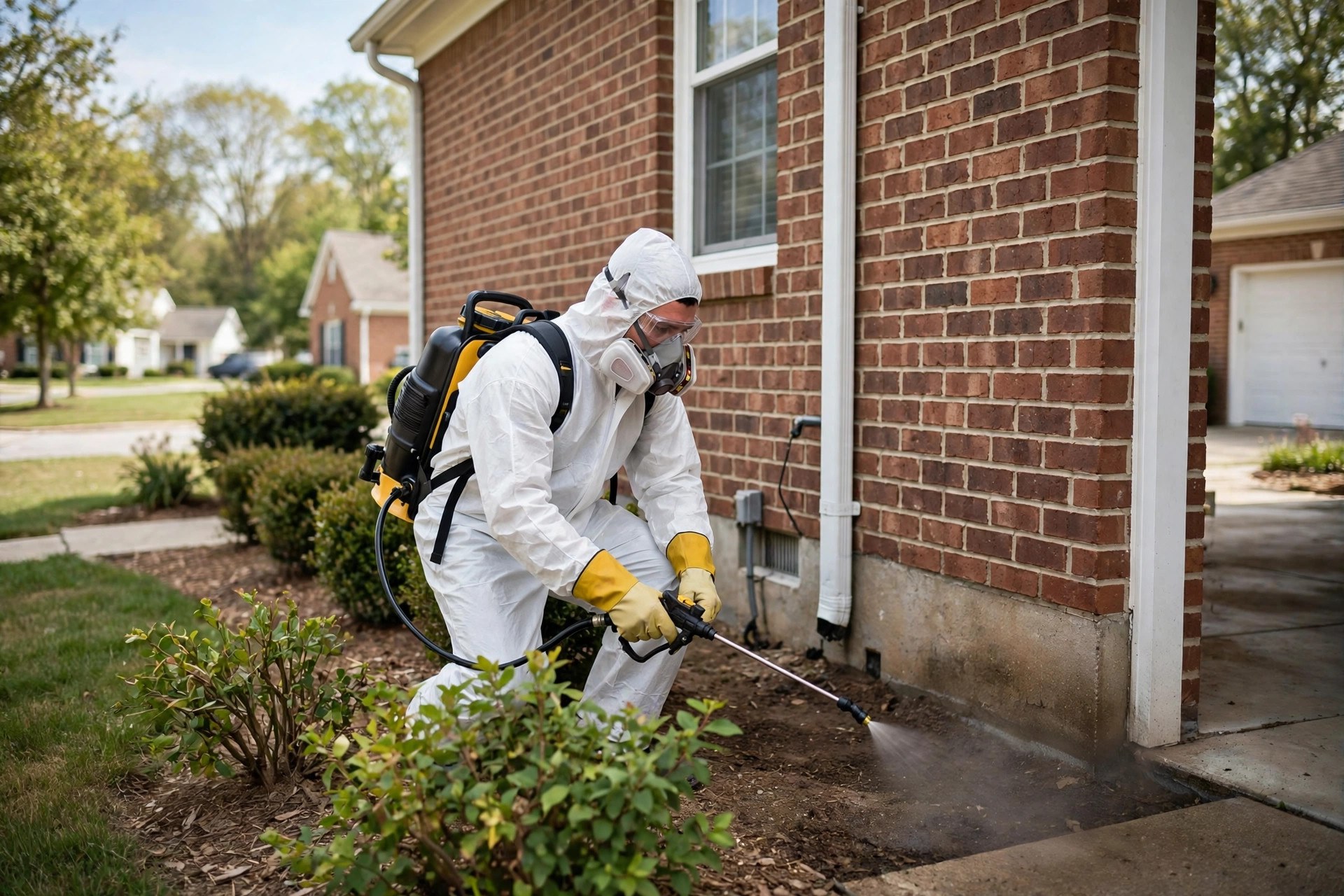
Real photos of your team at work make your profile look like the safe, professional choice it needs to be.
Service area pages that actually rank in the towns you serve
Most pest control websites have one “Service Area” page with a bullet list of twenty towns. That page ranks for nothing, because it tells Google nothing specific about any town. The pages that rank are dedicated: one page per town, each one written like it belongs to that town. “Pest Control in Springfield” is a real page with real content. “Pest Control in Riverside” is another. This is the core of local SEO for pest control companies, and it is where most competitors are weak, which is your opening.
Each town page needs genuine local substance, not swapped city names. Name the neighborhoods you serve. Mention the local conditions that drive pest pressure: older housing stock near downtown, wooded lots on the north side, the river corridor where mosquitoes breed, new subdivisions where construction disturbs ant colonies. Reference a landmark or two so a local reader knows you actually work there. Describe the three to five most common pest problems in that specific town and link each one to your pest-specific pages. Add a photo from a real job in that area if you have one, your service map, your local phone number, and a quote form.
Start with the five to ten towns that produce most of your revenue, and build one page per week. A town page of 800 to 1,200 words with real detail will outperform a competitor’s thin page every time. Resist the urge to publish forty pages in a weekend with only the town name changed. Google recognizes that pattern, and it reads as spam. Slow, real, and specific wins. If you run more than one home service brand, the same town-page playbook applies trade by trade; our guide to local SEO for junk removal companies shows how the structure adapts to a hauling business.
| Page element | What to include | Why it ranks |
|---|---|---|
| Title and heading | “Pest Control in [Town]” in the title tag and H1, naturally | Matches the exact town search query |
| Local pest detail | 3 to 5 common pests in this town, with local causes | Builds relevance for pest plus town searches |
| Neighborhoods | Named neighborhoods and nearby areas you serve | Captures hyper-local searches and looks genuinely local |
| Proof | A real job photo, a local review quote, years serving the town | Builds the trust that turns rankings into calls |
| Services list | Your core services with links to pest-specific pages | Spreads ranking strength across your whole site |
| Contact block | Local phone number, quote form, service hours | Converts the visit into a call instead of a bounce |
Pest-specific pages that turn panic into bookings
When someone finds bed bugs in a hotel room they just came home from, they do not search “pest control.” They search “bed bug exterminator near me” or “how to get rid of bed bugs fast.” Every major pest deserves its own page on your site, written for the person in that exact moment. These pages rank for high-intent searches and convert better than any homepage because the visitor already knows what they need.
Build one strong page per pest: ants, bed bugs, termites, cockroaches, rodents (mice and rats), wasps and hornets, mosquitoes, spiders, fleas, and wildlife if you handle it. Each page should follow the same conversion-focused structure. Open with a plain statement of what you do for this pest and where you do it. Then cover the signs of the problem, so the visitor self-diagnoses and feels understood. Then your treatment process in three to five steps, written in plain language, no chemical brand names the homeowner will not recognize. Then honest pricing guidance: a range for a typical treatment in your market, what makes a job cost more, and whether you offer free inspections. Then safety: what the family and pets need to do before and after treatment. Then proof: a review quote from a customer with the same pest problem. Close with the call to action and the quote form.
Two details make these pages perform. First, add a short FAQ section on each page answering the questions people actually ask: “How long does bed bug treatment take?” “Will termite treatment damage my home?” “How fast can you come out for wasps?” These questions match voice searches and the “People also ask” boxes, which is free extra visibility. Second, link every pest page to the town pages it is relevant to, and link every town page back to the pest pages. That internal linking tells Google your site is the authority on pest control in your market, and it keeps visitors clicking instead of bouncing back to the search results.
Content like this also feeds your broader marketing. The pest guides you write for SEO can be shortened into social posts, email tips, and seasonal campaigns. Our roundup of pest control marketing ideas shows how to reuse this material across every channel without writing everything twice.

Homeowners book the company they trust inside their home, so every page should answer their safety questions before they have to ask.
Reviews: the ranking engine that never stops
Reviews do double duty in local SEO. They lift your rankings directly, because Google treats review count, average rating, and review freshness as prominence signals. And they lift your conversion rate, because a 4.8-star company with 200 recent reviews gets the tap over a 4.9-star company with 9 reviews from two years ago. Most pest control companies collect reviews in bursts: ten after a good month, then nothing for half a year. Google rewards the steady drip instead.
Ask at the right moment, every time. The best time to ask is right after the service, while the relief is fresh. The technician finishes the treatment, the homeowner is happy the wasps are gone, and the tech says: “I am glad we got that handled. Would you mind leaving us a quick Google review? It takes about a minute.” Then a text with the direct review link arrives within the hour. Make this part of the job closeout checklist, not something the office remembers to do on Fridays.
Make it effortless. Send a short text or email with one link that opens the review form directly. No logins to create, no pages to find. Companies that text the link within an hour of the visit collect reviews at several times the rate of companies that ask verbally and hope. Follow up once, politely, for customers who did not review. Never offer payment or discounts for reviews; it violates platform rules and cheapens the ones you earn honestly.
Respond to every review. Thank the happy customers by name and mention the service: “Thanks, Maria. Glad the ant treatment solved the kitchen problem.” For negative reviews, respond fast, stay calm, take responsibility where it is due, and move the conversation offline: “We are sorry the follow-up visit was late. Please call me directly at this number so we can make it right.” Prospects read your responses to bad reviews more carefully than the reviews themselves. A thoughtful response to a complaint can win you the job.
The words inside reviews matter too. When customers mention the pest and the town (“great termite inspection in Springfield”), those keywords reinforce your relevance. You cannot script reviews, but you can prompt them: the follow-up text can say “tell us what pest we helped with.” For the full system, see our guide on how to get more Google reviews for pest control companies.
| Company size | Review target per month | How to get there |
|---|---|---|
| 1 to 2 trucks | 6 to 10 new reviews | Text the link after every job; techs ask on every closeout |
| 3 to 5 trucks | 15 to 25 new reviews | Automated post-visit texts plus one manual follow-up for non-responders |
| 6 plus trucks or multiple branches | 30 to 50 new reviews | Automated asks per branch, a weekly review report, and a small team incentive for participation (never per-review payment) |
Citations and NAP consistency: the boring work that holds rankings up
Citations are mentions of your business name, address, and phone number (NAP) on other websites: directories, review sites, and local pages. They confirm to Google that your business is real and established. Inconsistent citations, a different phone number on Yelp than on your website, an old address on a directory you forgot, create doubt and drag rankings down.
Start with the directories that matter for home services: Google Business Profile, Bing Places, Apple Maps, Yelp, Facebook, Angi, HomeAdvisor, Thumbtack, the Better Business Bureau, Yellow Pages, Nextdoor, and your local chamber of commerce. Then add pest-industry and state association listings. Your name, address, and phone number must match everywhere, down to the suite number and the way you write “Street” versus “St.”
Two common mistakes to avoid. First, using different tracking phone numbers on different directories. It breaks NAP consistency. Use your real main number everywhere, and handle call tracking on your website with dynamic number insertion instead, so Google always sees the same number on the profile and the site. Second, ignoring duplicate listings. Search your business name plus your towns and claim or merge duplicates. A duplicate profile splits your reviews and confuses customers; cleaning it up is unglamorous and effective.
This is a one-time cleanup plus a quarterly check. Audit your citations with a scan tool, fix what is wrong, and recheck every few months. It will never be the exciting part of your marketing, but companies with clean, consistent citations outrank sloppy competitors with the same review counts.
Your website: fast, mobile, and ready to take the booking
Most of your local SEO traffic arrives on a phone, often in a hurry. Your website has one job in that moment: make calling or requesting a quote effortless. A beautiful desktop site that loads slowly on mobile and hides the phone number is a ranking asset wasted.
Speed and mobile come first. Aim for pages that load in under three seconds on a phone. Compress your images, cut the plugins you do not use, and test on a real phone over a cellular connection, not just office wifi. Google uses mobile page experience as a ranking factor, and visitors bounce from slow pages before they ever read your content.
Make the call button impossible to miss. Put a sticky call button and a “Get a Free Quote” button in the mobile header so they follow the visitor down every page. Keep the quote form short: name, phone, town, and pest problem. Every extra field you add costs you completions. Show your license number, your guarantee, and a few review stars near the form. Trust signals at the moment of decision are what turn a visit into a call.
Add schema markup. Schema is code that tells Google exactly what your pages mean: this is a local business, this is the phone number, these are the service areas, this is the aggregate rating. A LocalBusiness or PestControl schema with your NAP, hours, and geo coordinates helps Google display rich results and strengthens the connection between your profile and your site. Most good SEO setups handle this in an afternoon.
Capture the after-hours leads. A large share of pest searches happen in the evening, when your office is closed. If the website just shows a phone number, that lead calls your competitor. An AI chatbot for pest control companies answers the quote request at 11 PM, collects the details, and books the inspection for the morning. Your local SEO brings the visitor; the chatbot makes sure the visit becomes a job.
Organic calls vs paid clicks: where the money actually goes
Paid search works for pest control. Nobody disputes that. But the cost per click for terms like “pest control near me” and “bed bug exterminator” is punishing in most markets, and the price rises every year as more companies bid. Local SEO is the counterweight: slower to start, far cheaper per job once it is running, and it keeps working whether or not you feed it budget that month.
The comparison below uses typical US market figures. Your exact numbers will vary by city and season, but the shape of the math holds almost everywhere: paid search rents the top of the page at a premium, while local SEO owns a permanent position for a fixed monthly effort.
| Metric | Google Ads (paid search) | Local SEO (organic and map pack) |
|---|---|---|
| Cost per click | $25 to $70 for core pest terms in competitive markets | $0 per click; you pay for the work, not the traffic |
| Click to call rate | 5 to 10 percent of clicks become calls | 10 to 20 percent of map pack views become calls or direction requests |
| Cost per booked job | $250 to $700 once clicks, no-shows, and tire-kickers are counted | $30 to $80 per job once rankings are established, covering tools and labor |
| Time to first result | Days; live as soon as the campaign launches | 3 to 6 months for competitive towns and terms |
| Durability | Stops the day you pause the budget | Keeps producing calls with maintenance-level effort |
| Best use | New markets, slow weeks, testing new services | The everyday engine that keeps the schedule full |
The smart setup is not either-or. Run paid search for immediate coverage while you build the organic foundation, then shift budget as the free calls grow. Many companies find that once their map pack rankings are solid in their core towns, they can cut ad spend in those towns and redirect it to new territories. The organic rankings are the asset; the ads are the bridge.
Track it: prove the calls are coming from organic
Local SEO earns its budget by producing calls you can count. Set up tracking before you change anything, so you have a baseline to beat. The setup is simple and it pays for itself in better decisions.
Call tracking on your website. Use dynamic number insertion so each visitor sees a tracking number tied to their source, while Google still sees your real number in the site code. This shows you exactly how many calls came from organic search versus ads, social, or direct visits. Record the calls (with the required legal notice) so you can hear whether the leads are real jobs or wrong numbers.
Watch the profile insights. Your Google Business Profile reports how many people called, requested directions, visited your website, and messaged you from the listing each month. These numbers are your map pack scoreboard. When calls from the profile rise month over month, your local SEO is working, regardless of what any ranking tool says.
Track rankings per town. A rank tracker that checks your map pack position by search location shows where you are winning and where you are invisible. Check your five core towns weekly. If a town page goes live and the map ranking for that town climbs over the next two months, you know the playbook is working there, and you repeat it in the next town.
Build a one-page monthly report. Five numbers: calls from the profile, calls from organic website visits, direction requests, new reviews, and booked jobs attributed to organic. Compare each to the prior month and to the baseline before you started. That single page is what turns “SEO” from a vague expense into a line item with a return.

Every review-worthy job feeds the cycle: great service earns the review, the review lifts the ranking, the ranking brings the next job.
Your rollout checklist
Work through these in order. Each one builds on the last.
- 1Claim and complete your Google Business Profile. Correct name, category, phone, hours, service areas, and a full 750-character description naming your services and towns.
- 2List every service on the profile. Each pest as its own service with a plain-language description, so the profile matches the searches homeowners type.
- 3Upload 30 real photos. Technicians, trucks, uniforms, and job photos. Add new ones monthly and retire nothing that still looks current.
- 4Start the review system. Text the review link within an hour of every job, have techs ask on closeout, and respond to every review within two days.
- 5Build town pages for your top five towns. One dedicated page each, 800 to 1,200 words of real local detail, with quote forms and local phone numbers.
- 6Build pest pages for your top five pests. Signs, treatment process, pricing guidance, safety info, FAQs, and a strong call to action on each.
- 7Clean up your citations. Audit the major directories, fix every NAP inconsistency, and merge duplicate listings.
- 8Fix the website basics. Under-three-second mobile load, sticky call and quote buttons, a four-field quote form, and LocalBusiness schema.
- 9Set up call tracking and the monthly report. Dynamic numbers on the site, profile insights watched monthly, rankings checked per town weekly.
- 10Keep the cadence. One new town or pest page a month, review asks on every job, fresh photos monthly, and a quarterly citation recheck.
Frequently asked questions
How long does local SEO take for a pest control company?
Expect 3 to 6 months before competitive towns and pest terms move meaningfully. Quick wins like completing your profile and starting reviews can lift calls within weeks, but durable map pack rankings in contested markets are built over months of steady work, not one big push.
Should I hire an agency or do local SEO myself?
A motivated owner can handle the profile, reviews, and photos, which are half the battle. Town pages, pest pages, and citation cleanup take real writing and technical time, so many companies do the profile and reviews in-house and outsource the content and technical work. Either way, keep ownership of your profile and your website logins.
How many towns should my service area pages cover?
Start with the five to ten towns that produce most of your revenue and build one genuine page per town. Expand only into towns you actually serve well. Dozens of thin pages with swapped city names hurt more than they help.
Do I need a separate page for every pest?
For your main revenue pests, yes: ants, bed bugs, termites, roaches, rodents, wasps, and mosquitoes each deserve a page. Minor or rare pests can share a general page. The rule is simple: if homeowners search for it by name with buying intent, give it a page.
Can I rank in towns where I do not have an office?
Yes, through your service area settings and town pages, though the map pack favors businesses physically near the searcher. Companies routinely rank in neighboring towns with strong town pages, good reviews, and consistent citations, especially for less competitive pest terms.
How do I get customers to mention the pest and town in reviews?
Prompt gently in your follow-up text: “Tell us what pest we helped with and where.” Most happy customers will naturally include the detail. Never write reviews yourself and never pay for them; both violate platform rules and can get your profile penalized.
Should I use call tracking numbers on my Google Business Profile?
No. Keep your real main number on the profile and every directory to protect NAP consistency. Use dynamic number insertion on your website instead, so you get source-level call tracking without confusing Google about which number is yours.
What is the biggest local SEO mistake pest control companies make?
Publishing dozens of near-identical town pages with only the city name changed. It reads as spam, it does not rank, and cleaning it up later costs more than doing it right once. One town, one genuinely local page.
Do Google Ads hurt or help my organic rankings?
Neither directly. Ads do not change your organic position, but running them while you build SEO covers the gap and gives you conversion data on which pest terms book best, which sharpens your content priorities. Many companies reduce ad spend town by town as organic rankings take over.
How do I know if my local SEO investment is paying off?
Watch five numbers monthly: calls from your profile, calls from organic website visits, direction requests, new reviews, and booked jobs attributed to organic. If calls and bookings rise against your pre-SEO baseline while your cost per job falls, it is working.
Get found first when pests show up
Digital Hayder builds local SEO systems for pest control companies: Google Business Profile optimization, town and pest pages that rank, review generation, and call tracking that proves the return. Tell us about your service area and we will map the fastest path to the top of the map pack.
Contact Us