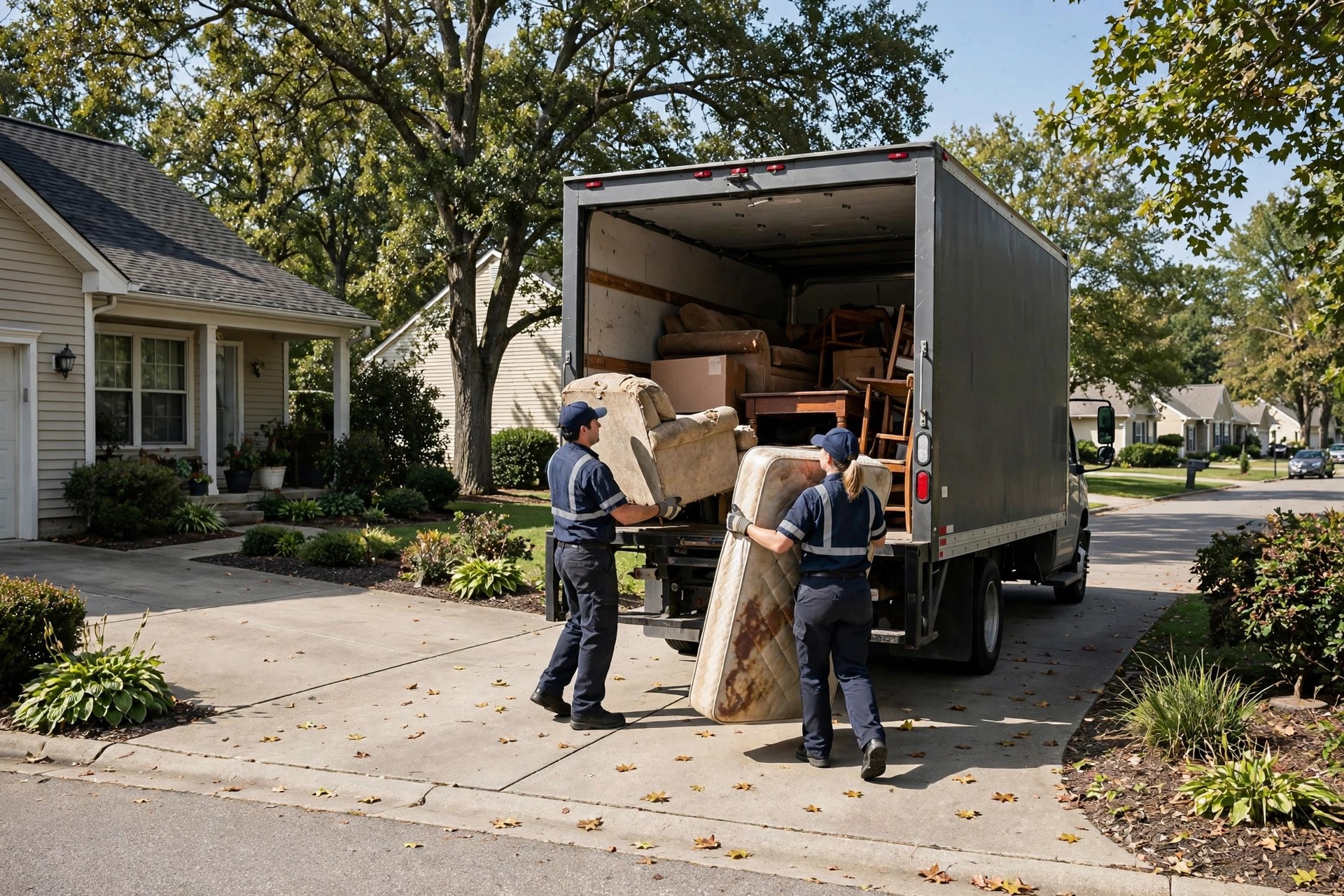
Junk removal is a “need it gone today” business. The couch has to go before the new one arrives. The estate has to be cleared before closing. The garage cleanout happens this Saturday or not at all. So the customer does what everyone does: pulls out a phone and searches “junk removal near me” or “furniture removal Springfield.” Google shows a map with three companies, and the job goes to whichever one looks fast, trustworthy, and easy to book. Local SEO is what puts your company in that map, and this guide is the full playbook for junk removal owners: your Google Business Profile, neighborhood pages, load-type content, reviews, citations, and the money math on free calls from Maps versus paid ads.
The quick answer
- Maps win the job: most junk removal searches are “near me” queries on phones, and the three companies in the map pack get the first call almost every time.
- Profile built for haulers: the right category, every load type listed as a service, photos of your trucks and cleared spaces, and honest pricing signals beat a bare listing.
- Neighborhood pages rank: dedicated pages for each town and neighborhood you serve capture the “junk removal in Riverside” searches your competitors ignore.
- Load-type pages convert: pages for furniture removal, hot tub removal, estate cleanouts, and construction debris match the exact urgent searches customers type.
- Reviews with photos win: steady reviews that mention the job type and town, ideally with before-and-after photos, lift both rankings and booking rates.
- Free calls compound: once your Maps and organic rankings are solid, every booked job arrives with no per-click cost, which paid ads can never match.
Why junk removal lives and dies on “near me” searches
Nobody browses junk removal companies for fun. The search happens at a moment of need, and the need is usually physical and immediate: a basement full of old furniture, a rental that must be cleared by the first of the month, storm debris across the yard. These customers want three answers fast: do you come to my area, how soon can you come, and what will it cost. The company that answers all three on the first screen gets the job.
That first screen is almost always Google Maps. Junk removal searches are overwhelmingly local and mobile, which means the map pack sits at the very top of the results, above the website listings. The customer sees three business cards with star ratings, review counts, photos, and a call button. They tap the one that looks most capable: strong rating, lots of recent reviews, photos showing real trucks and real loads, and a profile that says “open now.” The fourth-place company, no matter how good its trucks, is one scroll and several taps away, which in this business might as well be another city.
Speed also shapes the booking. A large share of junk removal inquiries arrive outside office hours: evenings when people finally face the garage, weekends when the cleanout happens. Your local SEO brings them to your profile and website; what happens next decides whether they become your job or your competitor’s. The companies that win are the ones whose profile, reviews, and booking path all say the same thing: fast, easy, and trustworthy.
How Google ranks junk removal companies locally
Local rankings rest on three factors: relevance, distance, and prominence. You cannot move your trucks closer to every searcher, so you win on relevance and prominence, and in junk removal those two are wide open because most competitors do the bare minimum.
Relevance is how closely your business matches the search. It comes from your primary category (“Junk removal service”), the full list of services on your profile (furniture removal, appliance removal, mattress disposal, hot tub removal, estate cleanout, construction debris removal, yard debris removal), the wording on your website pages, and your business description. A profile that lists twelve specific load types is more relevant for “hot tub removal near me” than a profile with an empty services section and a generic description.
Prominence is how established and trusted you look. Reviews are the biggest lever: count, average rating, and how recently they arrived. Then come photos, citations on directories, mentions on local websites, and links to your site. Prominence matters more in junk removal than many owners expect, because the customer is handing over their keys or letting a crew into their home. A company with 150 recent reviews and photos of cleared garages and happy driveways beats a closer company with 8 reviews.
The same relevance plus prominence formula works across home services, just with different keywords and pages. If you also run or plan a second trade, our guide to local SEO for pest control companies shows how the identical structure adapts to a different service business.
Your Google Business Profile: built for haulers
Your Google Business Profile is your most valuable marketing asset. For most junk removal companies it produces more booked jobs than the website, the ads, and social media combined. Set it up like a storefront, not a formality.
Get the fundamentals exactly right. Business name as it appears on your trucks. Primary category “Junk removal service” (add “Waste management service” or “Hauling service” as secondary categories where they fit). Your real phone number, answered by a human or a system that responds in minutes. Service areas covering the towns you actually serve. Hours that match reality, with a clear note if you offer same-day or weekend pickups. A 750-character description that names your main load types and your main towns in plain language.
List every load type as a service. This is where relevance is won. Add each job type as its own service with a one-line description: furniture removal, mattress disposal, appliance removal, hot tub and spa removal, estate and eviction cleanouts, garage and basement cleanouts, office cleanouts, construction debris removal, yard debris removal, hoarding cleanout assistance, shed and deck demolition, curbside pickup. Customers search for the thing they need gone, not for “junk removal solutions.” Match their words exactly.
Show the work in photos. Junk removal has the best photo content of any home service: dramatic before-and-after shots. Upload photos of your trucks, your uniformed crew, full loads, and cleared spaces. Before-and-after pairs of garages, basements, and yards are the single most persuasive thing on your profile. Add new photos every month so the profile looks active and current. Profiles with strong photo galleries get noticeably more calls and direction requests.
Be upfront about pricing signals. You do not need to publish a full price list, but profiles and websites that discuss pricing win the comparison. Add posts about your pricing model: free on-site estimates, volume-based pricing, curbside discounts. Answer the “how much does it cost” question in your Q and A section with your typical ranges for common loads. Customers who see pricing signals call with intent to book, not to interrogate.
Turn on messaging and respond fast. Enable profile messaging so searchers can text you straight from the listing, and answer within minutes. Junk removal customers message photos of their pile and ask “how much for this?” The company that replies first with a real answer usually books the job. A profile that shows fast response times is a quiet conversion weapon.

Photos of real crews doing real loads turn profile visitors into callers before they ever visit your website.
Neighborhood pages that capture the towns you serve
Most junk removal websites have one service area page listing a dozen towns. That page ranks for none of them. The pages that rank are dedicated: one page per town or neighborhood cluster, written with real local substance. “Junk Removal in Springfield” and “Junk Removal in Riverside” are separate pages, each one sounding like it was written by someone who works there.
Each page needs genuine local detail. Name the neighborhoods. Mention the local drivers of junk: the college area with end-of-lease move-outs every spring, the older neighborhoods with estate cleanouts, the new subdivisions generating construction debris, the lake community with dock and shed removals. Reference a local landmark so residents know you are really there. List the load types you haul most in that town and link each to your load-type pages. Include a real job photo from the area, your local phone number, and a fast quote form.
Build the five to ten towns that produce most of your revenue first, one page per week. Pages of 800 to 1,200 words with real detail consistently beat thin competitor pages. Do not publish forty pages in a weekend with only the town name swapped; Google treats that as spam and it will not rank. One town, one real page, steady pace. The same town-page discipline works in every trade, which is why this playbook transfers so well if you ever expand.
| Page element | What to include | Why it ranks |
|---|---|---|
| Title and heading | “Junk Removal in [Town]” in the title tag and H1, naturally | Matches the exact town search query |
| Local demand detail | Neighborhoods, move-out seasons, common local job types | Builds relevance for town plus service searches |
| Load-type links | Links to your furniture, appliance, cleanout, and debris pages | Spreads ranking strength across the whole site |
| Proof | Before-and-after photos from the town, a local review quote | Converts rankings into booked jobs |
| Booking block | Local phone number, photo-quote form, same-day availability note | Captures the urgent visitor before they bounce |
Load-type pages that match the exact urgent search
When someone needs a hot tub gone, they search “hot tub removal near me,” not “junk removal.” Every major load type deserves its own page, written for the person ready to book today. These pages rank for high-intent searches and convert better than any generic page because the visitor already knows exactly what they need hauled.
Build one strong page per load type: furniture removal, mattress disposal, appliance removal, hot tub and spa removal, estate cleanouts, eviction cleanouts, garage cleanouts, basement cleanouts, office cleanouts, construction debris removal, yard debris removal, and shed or deck demolition. Follow the same structure on each. Open with what you haul and where, plus your speed: same-day and next-day availability stated plainly. Then the process in three steps: send photos or get a free on-site estimate, approve the upfront price, watch the crew load and sweep up. Then honest pricing guidance with typical ranges for that load type and what pushes a job above or below the range. Then the details customers worry about: do you carry it from inside the house, do you disconnect appliances, what happens to the items (donation, recycling, disposal). Close with proof and the quote form.
Photo quotes are the conversion feature that matters most here. Let visitors text or upload photos of their pile and get a firm price without a site visit. Junk removal is visual; a photo quote removes the friction of scheduling an estimate for a job the customer wants done tomorrow. Put the photo-quote option on every load-type page and in your profile posts.
These pages also power your wider marketing. The same content becomes seasonal campaigns: spring cleaning cleanouts, end-of-lease move-out specials, storm debris response. Our collection of junk removal marketing ideas shows how to reuse this material across ads, social, and email without writing everything twice.

Load-type pages answer the one question every customer has: can you take this specific pile, and what will it cost.
Reviews: steady, recent, and full of job details
Reviews are the prominence engine of junk removal local SEO, and they convert at the same time. A customer choosing between two haulers picks the one with 180 recent reviews mentioning furniture removals and estate cleanouts over the one with 14 reviews and no detail. The gap is rarely about quality of work. It is about who asked.
Ask on every single job. The crew finishes, the space is clear, the customer is standing in a clean garage feeling relieved. That is the moment. The crew lead says: “Glad we got it cleared out. Would you mind leaving us a quick Google review? It takes about a minute.” A text with the direct review link follows within the hour. Build this into the job closeout routine for every crew, every day. Companies that ask consistently collect reviews at several times the rate of companies that ask when someone remembers.
Encourage photo reviews and specific details. A review with before-and-after photos of a cleared basement is worth ten plain five-star reviews. It proves the work and it keeps prospects on your profile longer. Your follow-up text can prompt the detail: “Tell us what we hauled away.” Customers will naturally mention the town and the job type, and those keywords reinforce your relevance for exactly those searches.
Respond to all of them. Thank happy customers by name and mention the job: “Thanks, Dave. That garage looks like a different house now.” For negative reviews, respond within a day, stay professional, acknowledge the issue, and move it offline with a direct number. Prospects read how you handle complaints more carefully than the complaints themselves. One graceful response can neutralize a bad review entirely.
| Crew size | Review target per month | How to get there |
|---|---|---|
| 1 truck, owner-operator | 8 to 12 new reviews | Ask on every job closeout; text the link within the hour |
| 2 to 3 trucks | 20 to 30 new reviews | Closeout script for every crew plus one automated follow-up text for non-responders |
| 4 plus trucks or multiple territories | 40 to 60 new reviews | Per-crew tracking, a weekly review scoreboard, and recognition for crews with the best ask rates |
Citations and NAP consistency
Citations are listings of your business name, address, and phone number on directories and review sites. They confirm to Google that your business is real and established, and inconsistencies create doubt that costs you rankings. Junk removal companies move, change numbers, and rebrand more often than most businesses, which makes this cleanup especially important.
Cover the directories that matter: Google Business Profile, Bing Places, Apple Maps, Yelp, Facebook, Angi, HomeAdvisor, Thumbtack, the Better Business Bureau, Yellow Pages, Nextdoor, and your local chamber of commerce. Your name, address, and phone number must match everywhere, character for character. If you run call tracking, keep your real number on every directory and use dynamic number insertion on your website instead, so Google always sees one consistent number for your business.
Hunt down duplicates and old listings. Search your business name plus each town you serve. Old profiles from a previous phone number or a former partner split your reviews and confuse customers. Claim them, merge them, or remove them. Then recheck quarterly. Citation work is unglamorous, but companies with clean consistent listings outrank equally reviewed competitors with messy ones.
Your website: fast, mobile, and built to quote
Your website gets the overflow from the map pack: customers who want pricing detail, who compare two companies, or who land on your load-type pages from organic search. On a phone, in a hurry, the site has one job: make getting a quote effortless.
Speed first. Pages should load in under three seconds on a phone over a cellular connection. Compress images, remove unused plugins, and test on a real device. Slow pages lose the urgent customer before your headline loads, and Google factors mobile page experience into rankings.
Quote in one tap. Put a sticky “Get My Price” button and a call button in the mobile header. Offer photo quotes prominently: “Text us a photo of your junk for a fast price.” The quote form stays short: name, phone, town, and what needs to go, plus the photo upload. Every extra field costs completions. Show your rating stars, your license and insurance note, and your service area near every form.
Price transparency wins comparisons. You do not need fixed prices for every load, but publish your pricing model and typical ranges: minimum charges, quarter-load to full-load ranges, common items like mattresses and sofas. Customers comparing three companies call the one whose pricing feels honest and predictable. Add LocalBusiness schema markup with your NAP, hours, service areas, and aggregate rating so Google connects your site to your profile cleanly.
If paid search is part of your mix, know what each click is worth before you spend. Our breakdown of Google Ads cost for junk removal companies lays out typical click prices and cost-per-job figures so you can compare paid against the organic engine you are building here.
Free calls from Maps vs paid clicks: the money math
Paid search buys junk removal jobs today, and the top ad slot above the map pack is tempting. But the click prices for “junk removal near me” and “furniture removal” keep climbing, and every booked job carries that cost forever. Local SEO builds a different asset: rankings that produce calls with no per-click charge, month after month.
The table below uses typical US market figures. Your numbers will vary by market, but the structure of the comparison holds: ads rent attention at a rising price, while organic rankings own it for the cost of steady maintenance.
| Metric | Google Ads (paid search) | Local SEO (Maps and organic) |
|---|---|---|
| Cost per click | $15 to $45 for core junk removal terms in competitive markets | $0 per click; you pay for the work, not the traffic |
| Click to call rate | 6 to 12 percent of clicks become calls | 12 to 25 percent of map pack views become calls, messages, or direction requests |
| Cost per booked job | $120 to $400 once clicks, missed calls, and price shoppers are counted | $25 to $60 per job once rankings are established, covering tools and labor |
| Time to first result | Days; live as soon as the campaign launches | 3 to 6 months for competitive towns |
| Durability | Stops the day you pause the budget | Keeps producing calls with maintenance-level effort |
| Best use | New territories, slow weeks, storm and seasonal surges | The everyday engine that keeps the trucks rolling |
The winning setup runs both. Ads cover you while rankings build, and they are useful for surges like storm cleanup season. As your map pack positions solidify town by town, shift that ad budget into new territories or bank the savings. The organic rankings are the asset that compounds; the ads are the tool you use while the asset grows.
Track it: know exactly where the calls come from
Local SEO earns its keep in countable calls. Set up tracking before you change anything so you have a baseline to beat, then watch the numbers monthly.
Call tracking on the website. Use dynamic number insertion so each visitor sees a tracking number tied to their source while Google still sees your real number in the code. This separates organic search calls from ad calls, social calls, and direct visits. Record calls with the required legal notice so you can hear which ones are real jobs.
Profile insights as your scoreboard. Your Google Business Profile reports monthly calls, direction requests, website visits, and messages from the listing. When these climb month over month, your Maps presence is working, no matter what any ranking tool claims.
Rankings checked per town. A rank tracker that measures your map pack position by search location shows exactly where you are visible and where you are invisible. Check your core towns weekly. When a neighborhood page goes live and the map ranking for that area climbs over the following weeks, you have proof the playbook works, and you repeat it in the next town.
One page, five numbers, monthly. Calls from the profile, calls from organic website visits, direction requests, new reviews, and booked jobs attributed to organic. Compare against the prior month and against your starting baseline. That single page turns local SEO from a vague expense into a line item with a return you can defend.

Every cleared driveway is a photo, a review, and a ranking signal that brings the next job.
Your rollout checklist
Work through these in order. Each one builds on the last.
- 1Claim and complete your Google Business Profile. Exact business name, “Junk removal service” category, real phone number, service areas, hours, and a 750-character description naming load types and towns.
- 2List every load type as a service. Furniture, appliances, mattresses, hot tubs, cleanouts, debris, each as its own service with a plain description.
- 3Upload 30 real photos. Trucks, crews, full loads, and before-and-after shots of cleared spaces. Add new photos monthly.
- 4Start the review system. Crew closeout ask on every job, review link texted within the hour, and a response to every review within two days.
- 5Build neighborhood pages for your top five towns. One dedicated page each, 800 to 1,200 words of real local detail, with photo-quote forms.
- 6Build load-type pages for your top jobs. Furniture, mattresses, hot tubs, estate cleanouts, and debris, each with process, pricing guidance, and FAQs.
- 7Add photo quotes everywhere. Text-a-photo pricing on every load page, the homepage, and your profile posts.
- 8Clean up citations. Audit the major directories, fix every NAP inconsistency, and merge or remove duplicate and outdated listings.
- 9Fix the website basics. Under-three-second mobile load, sticky call and quote buttons, a short quote form with photo upload, and LocalBusiness schema.
- 10Track and keep the cadence. Call tracking live, the five-number monthly report, one new page a month, fresh photos monthly, quarterly citation recheck.
Frequently asked questions
How long does local SEO take for a junk removal company?
Plan on 3 to 6 months for meaningful movement in competitive towns. Profile completion, photo uploads, and the first review pushes can lift calls within weeks, but durable map pack positions are earned through months of steady reviews, pages, and citations.
Should I do local SEO myself or hire someone?
Most owner-operators can handle the profile, photos, and review asks themselves; that is a large share of the results. Neighborhood and load-type pages plus technical cleanup take writing and SEO time, so many companies keep the profile work in-house and outsource the content. Keep ownership of your logins either way.
How many towns should I build pages for?
Start with the five to ten towns that produce most of your jobs, one genuine page each. Expand only where you actually run trucks. Mass-produced thin pages with swapped town names do not rank and can hurt the pages that do.
Do I really need a separate page for each load type?
For your main revenue loads, yes. Customers search “hot tub removal” and “mattress disposal” as exact phrases, and a dedicated page matches that intent far better than a generic services page. Minor loads can share a page until they earn their own.
Can I rank in towns where my trucks are not based?
Yes, through service area settings and strong town pages, though the map pack favors businesses near the searcher. Haulers routinely rank across a metro area with good pages, steady reviews, and clean citations, especially for specific load-type searches with less competition.
Should I publish my prices online?
Publish your pricing model and typical ranges even if you cannot fix every price. Customers comparing haulers call the company whose pricing feels transparent. Photo quotes bridge the rest: a firm price from a photo beats a vague “call for estimate” every time.
How do I get photo reviews from customers?
Ask at the moment of delight, right after the space is cleared, and make it easy with a direct link. Before-and-after photos you take yourself (with permission) can also be uploaded to your profile and attached to your review responses, which keeps the visual proof flowing even when customers do not upload.
Will Google Ads hurt my organic rankings?
No. Ads do not change organic positions, but they buy coverage while your rankings build and reveal which load types convert best, which sharpens your content priorities. Many haulers trim ad spend town by town as their map positions take over.
What is the biggest local SEO mistake junk removal companies make?
A bare profile: wrong category, no services listed, a handful of old photos, and a review count in the single digits. In a trust business where crews enter homes, that profile loses to every competitor that looks established, regardless of who has the better trucks.
How do I measure whether local SEO is paying off?
Track five numbers monthly: calls from your profile, calls from organic website visits, direction requests, new reviews, and booked jobs attributed to organic. Rising calls and a falling cost per booked job against your baseline mean it is working.
Fill the truck with free Maps calls
Digital Hayder builds local SEO systems for junk removal companies: Google Business Profile optimization, neighborhood and load-type pages that rank, review generation, photo-quote funnels, and call tracking that proves the return. Tell us about your service area and we will map the fastest path to the top of the map pack.
Contact Us