
A homeowner with a broken garage door opens Google and searches “garage door repair near me.” Three companies appear in the map pack. One has 212 reviews at 4.9 stars with reviews from last week. One has 34 reviews at 4.6 stars, the newest from eight months ago. The third has 11 reviews. The homeowner calls the first company without scrolling any further. Nothing about the trucks, the techs, or the prices decided that call. The reviews did. For garage door companies, Google reviews are not a vanity metric. They are the deciding vote in the exact moment a stranger chooses who to trust with their home. This guide is the complete playbook for getting more of them: when to ask, what to say, the SMS and email templates, how your techs ask in person, how to respond to every review, how to handle the negative ones, and the weekly volume targets that move you up the map pack.
The quick answer
- Why it matters: garage door buyers compare companies in seconds. Review count, star rating, and recency decide who gets the call before price is ever discussed.
- When to ask: within 24 hours of a completed job, while the relief and gratitude are fresh. The tech asks in person, then an automated text follows the same day.
- How to ask: a short SMS with your direct Google review link converts best. Email and a QR code on the invoice catch the rest.
- What to say: keep it personal, name the tech, make it a one-tap process, and never offer payment or discounts for reviews.
- Respond to everything: every review gets a reply within 48 hours. Positive reviews get thanks, negative ones get a calm public reply and a private fix.
- The weekly target: aim for 2 to 5 new reviews a week, every week. Steady velocity beats occasional bursts and tells Google your business is active and trusted.
Why reviews decide who gets the garage door job
Garage door work is a high-trust, low-frequency purchase. Most homeowners hire a garage door company once every several years, so they have no personal experience to fall back on. They cannot judge your spring work from your website, and they will not call three companies for quotes when the door is stuck open. Instead they do what every buyer does now: they scan the map pack, read the stars, skim a few recent reviews, and call the winner. The company with the strongest review profile wins the call before the conversation about price or availability even starts.
Reviews also feed the ranking itself. Google’s local results weigh review count, rating, and recency as trust signals, alongside relevance and distance. A company with 200 recent reviews at 4.8 stars has a real edge over a company with 30 aging reviews at 4.5, even when both are equally close to the searcher. And the reviews do double duty after the click: homeowners read them to confirm the choice, looking for mentions of on-time arrival, fair pricing, clean work, and how the company handled problems. In an emergency trade where the buyer is stressed, a review that says “they came the same night and the price matched the quote” is worth more than any ad you could run.
The numbers that matter: review benchmarks
Not all review profiles are equal. Before you build the system, know what good looks like for a garage door company in a competitive market. The table below gives practical targets. Small towns need fewer reviews to stand out; large metros need more.
| Metric | Minimum viable | Competitive | Dominant |
|---|---|---|---|
| Total Google reviews | 50 | 150-300 | 400+ |
| Star rating | 4.5 | 4.7-4.8 | 4.8-4.9 |
| New reviews per week | 1 | 2-3 | 4-5 |
| Recency | A review within the last month | Reviews every week | Multiple reviews per week |
| Response rate | Respond to negatives only | Respond to 80%+ of all reviews | Respond to 100% within 48 hours |
| Review keywords | Generic praise | Mentions of services: spring, opener, install | Service mentions plus neighborhood names |
Two things in that table deserve emphasis. First, recency matters as much as the total count. A profile with 300 reviews where the newest is six months old looks dormant next to a competitor with 120 reviews and five from this week. Google shows review dates, and so do your buyers. Second, the words inside the reviews help. When customers naturally mention “broken spring repair,” “new garage door installation,” or the neighborhoods you serve, those keywords reinforce what your business does and where. You cannot write reviews for customers, but you can ask the tech to mention the service by name at the door, which makes customers more likely to name it in the review.
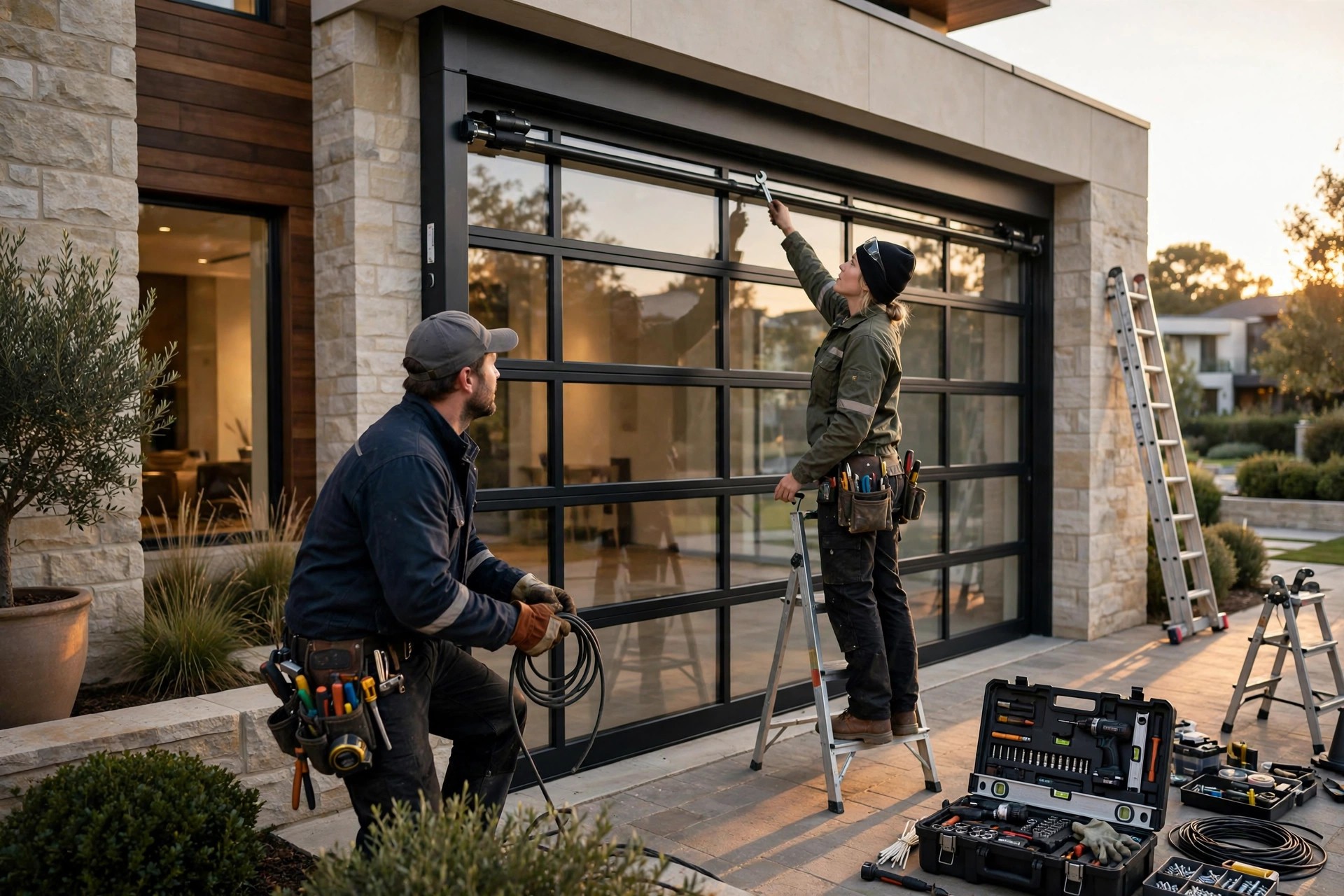
Every completed installation is a review opportunity. The system starts the moment the job is done.
When to ask: timing the request
Timing is the single biggest lever in review generation. Ask too early, before the job is finished, and the customer has nothing to review. Ask too late, a week after the visit, and the gratitude has faded into the background of their life. The sweet spot is within 24 hours of job completion, with the in-person ask happening the moment the tech finishes and the automated text landing later the same day.
The three-touch sequence
Touch one is the tech at the door: a 30-second ask right after the customer sees the finished work and pays. Touch two is the automated SMS, sent 2 to 4 hours after the job closes in your system: a short personal message with the direct review link. Touch three is the follow-up, 3 to 5 days later, to customers who opened the text but did not leave a review: one polite nudge, then stop. Three touches is the limit. More than that and you trade a review for irritation, and an irritated customer is a negative review waiting to happen. Emergency repairs deserve the same sequence; a customer whose door got fixed at 9 PM is often your most grateful reviewer the next morning.
Which jobs to prioritize
Ask on every completed job, but if your volume is high, prioritize the moments of peak satisfaction: full door installations, same-day emergency rescues, and warranty callbacks that you handled well. A customer who watched you fix a problem another company created will write you a novel. One caution from Google’s own policies: never selectively ask only happy customers while suppressing unhappy ones. That practice, called review gating, violates policy and can get reviews removed. Ask everyone, fix the problems fast, and let the average reflect the real business.
How to ask: the channels that convert
Different customers respond to different channels, so run all three and let the customer pick their path. SMS converts best by a wide margin because it arrives on the device where the review gets written, with a link that opens the review form in one tap. Email works for the customers who prefer it, especially older homeowners and property managers, and it gives you room for a slightly warmer message. A QR code on the printed invoice or a small card the tech leaves behind catches the customers who ignore both messages. The QR code must open your Google review link directly, not your homepage; every extra tap loses reviewers.
Copy-paste SMS templates
Keep every message short, personal, and one tap. Replace the bracketed parts and send.
Template 1, same-day text: “Hi [Name], this is [Tech] from [Company]. Glad we got your [spring/opener/door] sorted today. If you have 60 seconds, a Google review would mean a lot to our small team: [link]. Thanks again.”
Template 2, the nudge (3 to 5 days later): “Hi [Name], quick follow-up from [Company]. Still happy with the [door repair/installation]? If so, your review here helps more than you know: [link].”
Template 3, installation: “Hi [Name], [Tech] here from [Company]. Hope you are enjoying the new [door style] door. Would you share your experience on Google? It takes about a minute: [link]. Thank you for trusting us with the project.”
Copy-paste email template
Subject lines that work: “How did we do, [Name]?” or “Quick favor after today’s visit.” Body: “Hi [Name], thanks for choosing [Company] for your [service]. [Tech] mentioned everything went well, and I wanted to check in personally. If you have a minute, a Google review helps our local team more than anything else: [button/link]. And if anything about the visit was less than great, reply to this email and I will fix it personally. Thanks, [Owner name], [Company].” The reply-to line is doing quiet work: it gives unhappy customers a private channel, which keeps some complaints off your public profile.
The technician’s 30-second ask
The tech’s in-person ask is the highest-converting moment in the whole system, because it happens face to face at peak satisfaction. But most techs hate asking, so give them a script that feels natural and make it part of the job closeout, not an awkward add-on. The script: “Everything is working great. Before I head out, would you mind leaving us a Google review? It really helps our small company, and you will get a text with the link in a bit. It takes about a minute.” Then the tech moves on. No begging, no hovering while the customer writes it, no offering discounts for reviews.
Train the team on three rules. First, ask every time, on every job, so it becomes habit instead of a judgment call. Second, never offer anything in exchange for a review: no discounts, no gift cards, no entries into a drawing. Google’s policy prohibits incentivized reviews, and getting caught costs far more than the reviews were worth. Third, if the customer seems unhappy, do not ask for the review. Fix the problem first, or flag it to the owner. Asking an unhappy customer for a public review is how you manufacture one-star ratings. Track ask rates per tech if your system allows it; techs who ask consistently will show two to three times the review output of techs who “forget,” and that gap is pure coaching opportunity.
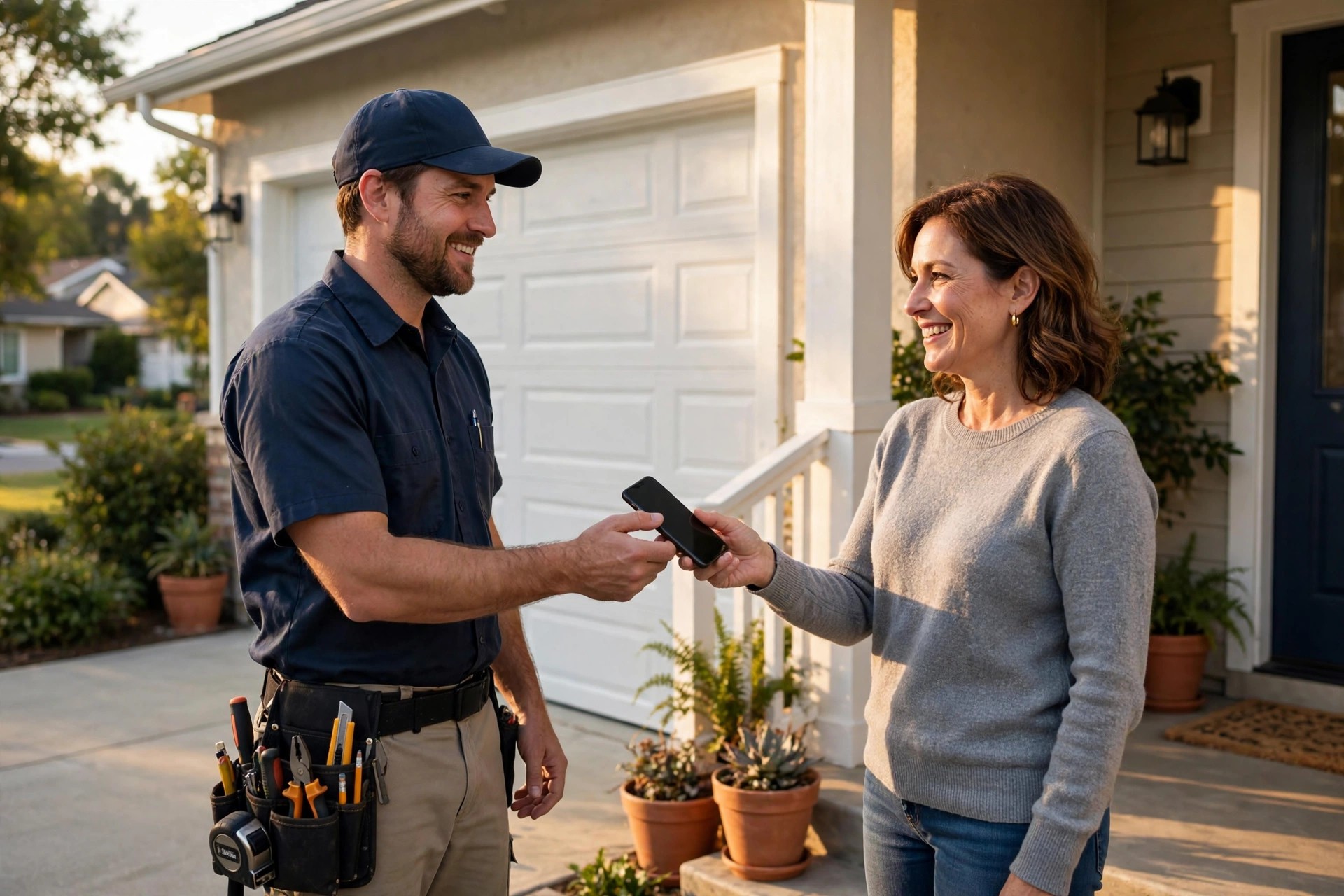
The in-person ask at the door, followed by a text with the link, is the highest-converting combination.
Responding to reviews: the response playbook
Responding to reviews is not optional anymore. Buyers read owner responses, and they judge your company by them, especially on negative reviews. A calm, specific, human reply to a bad review can win you the next customer who reads it. A missing reply, or a defensive one, does the opposite. Set a simple standard: every review gets a reply within 48 hours, written by a named person, never a copy-paste template that reads like one. Vary the wording, mention something specific from the review, and keep it short.
| Review type | Response strategy | Example reply |
|---|---|---|
| 5-star, detailed | Thank by name, reference the specifics, invite them back | “Thanks, Maria. Glad the new insulated door is running quiet. Enjoy it, and call us any time you need a tune-up.” |
| 5-star, one line | Short thanks with a service mention | “Thanks for the kind words, James. Happy we could get the spring replaced same day.” |
| 4-star with a minor gripe | Acknowledge the gripe, show the fix | “Thanks, Dan. You are right that we ran 20 minutes past the window, and we have tightened our scheduling since. Glad the opener is working well.” |
| 3-star, mixed | Take the valid point seriously, offer the private channel | “Thanks for the honest feedback, Lisa. I would like to make the pricing confusion right. Please call me directly at [number]. [Name], owner.” |
| 1-2 star, legitimate complaint | Apologize without excuses, move it offline fast | “I am sorry we missed the mark, Tom. This is not the standard we hold ourselves to. Please call me at [number] so I can fix this personally. [Name], owner.” |
| 1-star, fake or mistaken | Stay factual and brief, then report it | “We have no record of this visit at our company, and we take fake reviews seriously. We have reported this to Google for review.” |

A 48-hour response standard on every review shows buyers you are paying attention.
Negative reviews: the recovery playbook
Every garage door company gets negative reviews. Doors fail again, techs run late, prices surprise people. The review itself is not the damage; your response is the marketing. Here is the playbook that turns a one-star review from a liability into an asset.
Step 1: respond publicly within 24 hours. Speed signals that you care. Keep it to three or four sentences: acknowledge the experience, apologize without arguing the facts, and invite them to a private channel with your name and direct number. Never debate the customer in public, never reveal private details, and never blame the tech by name.
Step 2: fix it privately. Call the customer, listen, and make it right: a free return visit, a partial refund, a discounted future service. Most negative reviewers are not enemies; they are disappointed customers who wanted to be heard. A meaningful fix turns a surprising number of them into updated reviews, and an updated 4-star review with “the owner called and fixed it” is more persuasive than a plain 5-star.
Step 3: ask for the update, once. After you fix the problem, one polite ask: “If you feel we made it right, updating your review would mean a lot.” Never pressure, never offer payment for the update. Some will, some will not; either way the public record now shows a company that responds and fixes.
Step 4: report the truly fake ones. Competitor spam, reviews for jobs you never did, and reviews with no real customer behind them can be flagged to Google for removal. Document why it is fake: no matching job record, wrong company, clearly unrelated. Google removes a meaningful share of flagged fakes, but it takes days to weeks, so keep the calm public reply up in the meantime. For the full mechanics of handling bad reviews, see our guide on how to respond to negative Google reviews.
The volume strategy: steady beats sporadic
Google rewards steady review velocity. Ten reviews in one week followed by three silent months looks like a campaign; two to three reviews every single week looks like a thriving business. The algorithm notices the pattern, and so do buyers, who trust a stream of recent reviews more than a pile of old ones. Build the volume into operations instead of running review “pushes”: the automated text after every job, the tech’s in-person ask on every visit, and the follow-up nudge. That system produces 2 to 5 reviews a week for a typical one-to-three-truck shop without anyone thinking about it.
Track the numbers weekly: reviews requested, reviews received, and the conversion rate between them. A healthy system converts 10 to 20 percent of requests into reviews. If the number drops, the usual culprits are the text link breaking, the techs skipping the ask, or the follow-up nudge getting turned off. HVAC companies run nearly the same review engine for the same emergency-driven buyer behavior; our guide to getting Google reviews for HVAC companies shows how the pattern transfers across trades.
Reviews beyond Google
Google is where the calls come from, so it gets 80 percent of your effort. The remaining 20 percent goes to the platforms that back it up. Facebook reviews matter because buyers check them when they see your ads or your page. Yelp matters in some metros and barely at all in others; check whether your competitors have meaningful Yelp profiles before investing effort there. The Better Business Bureau profile matters for older homeowners and commercial work. The rule is simple: build Google first until you hit the competitive benchmark, then add one platform at a time. Never spread the ask across five platforms at once; you will dilute the Google velocity that actually drives calls. And reviews only convert if the rest of the funnel holds: a strong profile sending traffic to a weak website leaks jobs, which is why our breakdown of garage door company website costs pairs naturally with this guide.
Common mistakes that kill review programs
Most garage door review programs die from the same short list of mistakes. Asking only happy customers, which violates Google’s policy and risks review removal. Offering discounts or gift cards for reviews, which violates policy and poisons the well. Sending the review link to the homepage instead of the direct review form, which adds taps and kills conversion. Asking once and never following up, which leaves half the reviews on the table. Letting the techs opt out of the in-person ask, which removes the highest-converting touch. Ignoring reviews for weeks, which tells buyers you do not care. Arguing with negative reviewers in public, which scares off the next ten buyers who read it. Running one big review push and then going silent for months, which creates the burst-and-flat pattern Google discounts. And measuring nothing, so nobody notices when the system breaks. Fix that list and the reviews compound on their own.
Your rollout checklist
Build the system once, then let it run on every job.
- 1Claim and complete your Google Business Profile. Correct hours, service areas, phone, and categories before you drive a single review to it.
- 2Get your direct review link and QR code. Test both on a real phone. The link must open the review form, not your homepage.
- 3Write the three-touch sequence. Same-day SMS, a 3 to 5 day nudge, and an email version for customers who prefer it.
- 4Automate the send. Trigger the SMS from the completed job in your field software so no job is ever missed.
- 5Train the techs on the 30-second ask. Script it, role-play it once, and make it part of every job closeout.
- 6Set the 48-hour response standard. Assign one person to reply to every review, positive or negative, with varied human wording.
- 7Build the negative-review playbook. Public reply within 24 hours, private fix, one ask for an update, flag the fakes.
- 8Ban incentives and gating. No discounts for reviews, no asking only happy customers. Put it in writing for the team.
- 9Track weekly. Reviews requested, reviews received, conversion rate, average rating, and response time. Fix drops fast.
- 10Review the system quarterly. Refresh templates, check the link still works, and compare your profile against the top three competitors.
Frequently asked questions
How many Google reviews does a garage door company need?
Aim for at least 50 to look credible, 150 to 300 to compete in most markets, and 400 or more to dominate a large metro. Just as important as the total: keep new reviews coming every week, because recency is a ranking and trust signal on its own.
When is the best time to ask for a review?
Within 24 hours of the completed job. The tech asks in person the moment the work is done, and an automated text with the review link follows 2 to 4 hours later. One polite nudge 3 to 5 days later catches the rest. After that, stop.
Should I offer a discount for a Google review?
No. Google’s policy prohibits offering money, discounts, or gifts in exchange for reviews, and violations can get reviews removed or the profile penalized. Ask for honest reviews and earn them with the work instead.
Can I ask only my happy customers for reviews?
No. Selectively soliciting only positive reviews, known as review gating, violates Google’s policy. Ask every customer, respond to all feedback, and fix problems fast so the honest average works in your favor.
How should I respond to a negative review?
Reply publicly within 24 hours: acknowledge the experience, apologize without arguing, and invite the reviewer to contact you directly by name and phone number. Then fix the problem privately and ask once for an updated review. Never debate or blame in public.
What if a review is fake?
Reply briefly and factually, then flag it to Google for removal with your evidence, such as no matching job record. Google removes a meaningful share of flagged fakes, though it takes days to weeks. Keep your calm public reply visible in the meantime.
Do reviews actually help my Google ranking?
Yes. Review count, rating, and recency are established local ranking signals alongside relevance and distance. A steady stream of recent reviews also lifts the click-through and call rate from the customers who see your profile.
Text, email, or QR code: which ask works best?
SMS converts best because it lands on the phone where the review gets written, with a one-tap link. Email catches customers who prefer it, and a QR code on the invoice covers the rest. Run all three and let the customer choose.
How do I get my techs to actually ask for reviews?
Give them a 30-second script, make the ask part of the standard job closeout, and track ask rates per tech. Techs who ask on every job produce two to three times the reviews of techs who skip it. Coach the gap; do not leave it to personality.
How fast should I respond to reviews?
Within 48 hours for every review, and within 24 hours for negative ones. Assign one owner, vary the wording so replies read human, and mention something specific from each review.
Turn every job into your next five-star review
Digital Hayder builds review systems for garage door companies: automated post-job SMS and email requests, technician ask scripts, response playbooks, and the weekly tracking that keeps your profile climbing the map pack. Tell us about your service area and we will design the system around your shop.
Contact Us