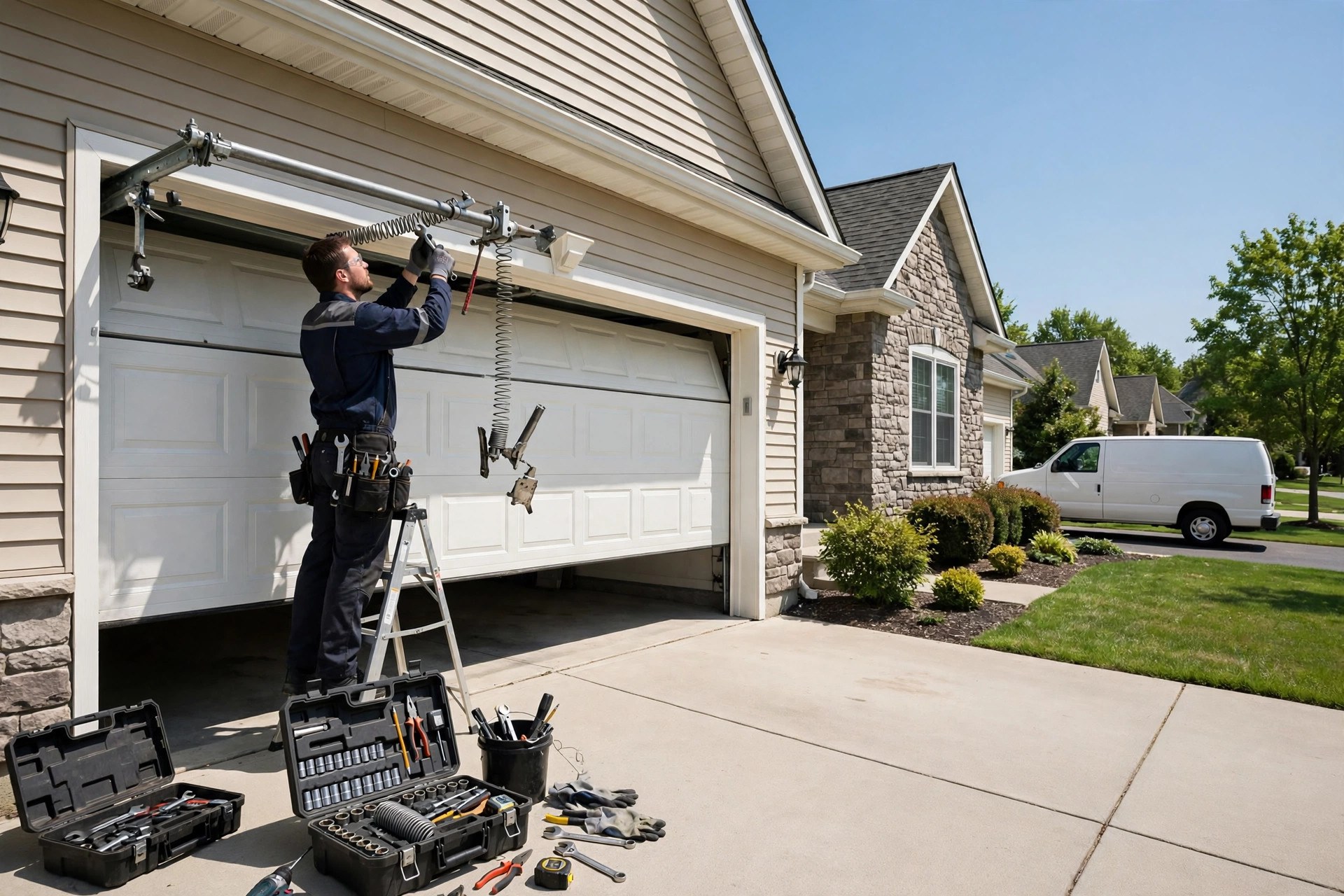
A homeowner hears a loud bang from the garage, walks over, and finds the door hanging crooked with a broken spring. The car is trapped inside, it is 7:40 in the evening, and they need someone tonight. They call the first garage door company on Google. Nobody picks up. They call the second one. Someone answers, and that company gets the job. This happens every single day in the garage door business, and the company that missed the call usually never knows it happened. Missed-call text-back fixes exactly this: when a call goes unanswered, the caller automatically gets a text message within seconds, starting a conversation that books the job even though nobody picked up the phone. This guide covers the full setup for garage door companies: what it costs, the exact text templates that get replies, how to handle after-hours emergency calls, the compliance rules, and the revenue math that makes this one of the highest-return tools a garage door shop can install.
The quick answer
- What it is: when your shop misses a call, the caller instantly gets an automatic text asking how you can help, so the conversation starts even without a person answering.
- Why it matters for garage doors: broken doors are emergencies, customers call two or three companies, and the first one that responds usually wins the job.
- What it costs: most CRMs include it in plans from about $97 to $300 a month; standalone texting tools run $50 to $150 a month on top of per-text fees.
- The reply window: texts go out within seconds of the missed call, and most replies arrive within the first five minutes, which is when the customer is still deciding.
- After-hours power: paired with simple triage questions and an emergency dispatch fee, text-back turns 9 PM broken-spring calls into booked jobs instead of voicemails nobody returns.
- The compliance rule: register your business number for texting (10DLC), include an opt-out line, and keep marketing texts out of the conversation.
Why garage door companies lose more calls than almost any trade
Every trade misses calls, but garage door companies miss the expensive kind. A broken garage door is not a “call back tomorrow” situation. When a spring snaps or a cable breaks, the homeowner often cannot get their car out, the garage will not secure, and the problem feels urgent in a way a dripping faucet never does. That urgency drives behavior: the caller is sitting next to a broken door, phone in hand, and they are already calling the next company on the list before your voicemail finishes. Industry sales research has repeatedly found that the majority of buyers go with the company that responds first, with the often-cited figure sitting around 78 percent. In an emergency trade like garage doors, that first-responder advantage is even stronger, because the customer has no reason to wait.
The structure of most garage door shops makes the problem worse. A large share of companies run one to three trucks, and when the tech is on a ladder replacing a spring, nobody is by the phone. Lunch hours, drive time between jobs, and the evening rush are all peak missed-call windows. After hours, the math gets brutal: a meaningful share of garage door emergency calls comes in after 6 PM, when most small shops have nobody answering. Those are also the highest-value calls, because after-hours emergency work carries a premium dispatch fee and the customer is choosing fast, not cheap. For a comparison of how other emergency trades handle the same problem, see our guide to missed-call text-back for HVAC companies, where the after-hours dynamics are nearly identical.
Voicemail does not save these calls. Most callers under 50 will not leave a voicemail at all; they hang up and dial the next listing. Even callers who do leave one expect a callback within minutes, and a callback three hours later usually reaches someone who already booked your competitor. Text-back changes the channel at the exact moment it matters: within seconds of the missed call, the caller gets a text from your business number, and the conversation happens in the medium people actually answer. The customer never had to decide to “wait for a callback.” They are already talking to you.
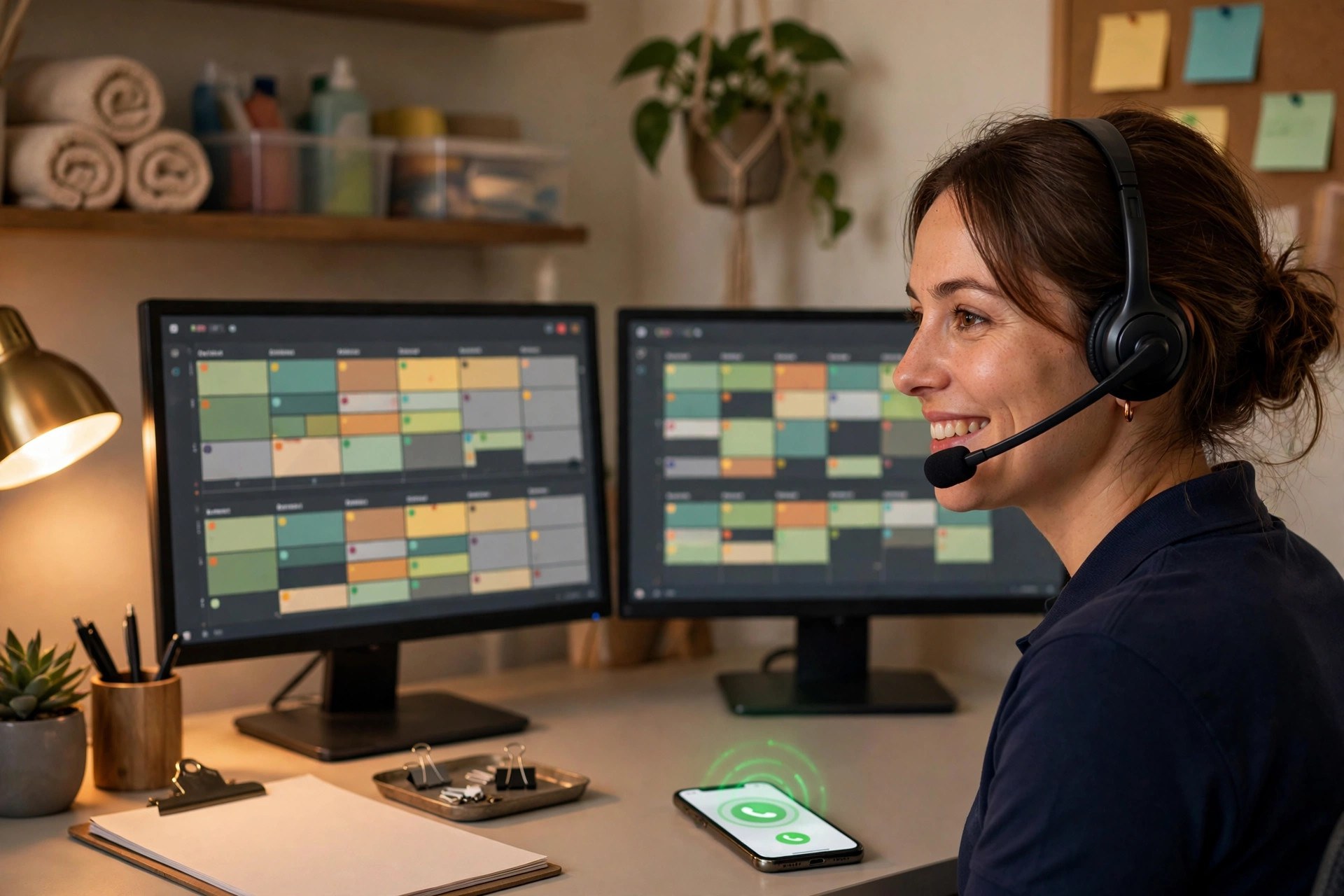
Small shops miss the most calls when techs are on jobs. An automatic text catches the caller before they dial the next company.
What a missed call really costs a garage door shop
Owners tend to think of a missed call as a minor annoyance. Run the job values and it looks more like a leak in the fuel tank. A standard spring replacement or cable repair typically runs $180 to $350. Opener installs land in the $350 to $650 range. A full door replacement runs $900 to $3,500 depending on size, insulation, and style. Even a basic service call carries a diagnostic fee of $75 to $150. Now count the misses: a busy two-truck shop easily misses 3 to 6 calls a day during work hours, plus whatever comes in after close. If even two of those missed calls a day were real jobs at an average value of $300, that is $600 a day, $3,000 a five-day week, walking to a competitor who answered.
The table below breaks down typical job values against what text-back recovery looks like. These are US market bands, and they vary by region and company pricing, but the pattern holds everywhere: the calls you miss skew toward the urgent, higher-value work, because those are the callers who will not wait.
| Call type | Typical job value | Why the caller will not wait | Text-back recovery play |
|---|---|---|---|
| Broken spring or cable | $180 to $350 | Car trapped, door unsecured | Instant text, same-day slot offer |
| Door off track or stuck | $200 to $400 | Security risk, cannot close the door | Triage questions, emergency dispatch option |
| Opener failure or install | $350 to $650 | Daily routine broken, remote buying | Quote by text, booking link |
| Full door replacement | $900 to $3,500 | Shopping two to three companies | Fast response wins the estimate |
| Maintenance or tune-up | $99 to $199 | Less urgent, but easy to lose | Next-available booking link |
The math on a typical week
Take a modest shop that misses 20 calls a week. Assume half were real prospects, so 10 real callers. Without text-back, maybe 2 of those leave a voicemail and 1 books. With text-back, a well-set-up system typically gets replies from 30 to 50 percent of texted callers, and a solid share of those conversations turn into bookings. If text-back recovers just 3 extra jobs a week at a $300 average, that is $900 a week, or roughly $3,600 a month in recovered revenue, against a tool cost of a few hundred dollars. That is the entire pitch: it is not a marketing expense, it is a recovery system for revenue you already earned through your ads, your reviews, and your trucks, then dropped at the last step.
How missed-call text-back actually works
The mechanics are simple, which is why the system is so reliable. Your business phone number is connected to a platform that watches for unanswered calls: calls that ring out, go to voicemail, or arrive outside business hours. The moment a call is missed, the platform sends an automatic text from the same business number the customer just dialed. To the caller, it feels like your shop texted them back personally. Everything after that is a normal two-way text conversation, and every message is logged in the same place your leads live.
The five moving parts
First, the trigger: define exactly which missed calls fire a text. Most shops text on every unanswered inbound call during and after hours, but exclude known spam numbers and existing customers with open jobs if you want tighter targeting. Second, the first message: a short text that names your company, acknowledges the missed call, and asks one clear question. Third, the conversation: either a person on your team picks up the text thread from their phone or computer, or an automated flow asks two or three triage questions and offers a booking link. Fourth, the booking: a link to your online scheduler or a simple “reply with your address and a time window” flow that puts the job on the board. Fifth, the follow-up: if the caller goes quiet, one or two check-in texts over the next day keep the thread warm. Each part is simple on its own; the power is that all five fire automatically, every time, including at 10 PM on a Sunday.
There are two flavors of the conversation. The manual flavor sends the first text automatically and then notifies your team, who continue the thread by hand. This works well for shops with an office person or an owner who keeps the phone nearby, and it costs the least. The automated flavor uses a short question flow: “Is the door stuck open, stuck closed, or making noise?”, then routes the answers to a booking link or a dispatch alert. Automation shines after hours, when nobody is watching the phone. Many shops run a hybrid: automation handles the first few exchanges and nights, humans take over during office hours. Either way, the caller gets an answer in seconds, which is the entire point.
The first text: templates that get replies
The first text does 80 percent of the work. It has to arrive fast, sound human, name the company, and ask one question that is easy to answer. Long texts with three questions and a booking link feel like a robot and get ignored. Keep it under 160 characters, write like a person, and end with a question. Below are starting templates for the four situations a garage door shop sees most. Adjust the wording to match how your team actually talks.
Repair and service requests
“Hi, this is [Company] – sorry we missed your call! What is going on with your garage door? We have same-day openings today.” This works because it apologizes, identifies the company, and asks the easiest possible question. The mention of same-day openings gives the caller a reason to reply now instead of calling the next company. A second useful variant for general inquiries: “Hi, this is [Company], sorry we missed you! Are you looking for a repair or a new door? I can get you pricing in a few minutes.”
After-hours emergency calls
“Hi, this is [Company] – sorry we missed your call! If your door is stuck or broken, reply with what happened and your address. We run emergency calls with a $[X] dispatch fee.” Naming the dispatch fee in the first text is a deliberate choice: it filters out price-only shoppers while signaling to real emergencies that you are genuinely available. A follow-up for non-replies an hour later: “Still need help with the door tonight? Reply YES and I will get a tech headed your way.”
New door quotes and installs
“Hi, this is [Company] – sorry we missed your call! Are you looking to replace your garage door? Reply with your door size (single or double) and I will send a price range.” Asking for single or double is a low-effort question that starts the quoting conversation and tells you the job size in one reply. When they answer, send the range plus a booking link for a free in-home estimate: “A double door replacement typically runs $[X] to $[Y] installed. Want me to schedule a free measurement? Here is our calendar: [link].” Plumbing shops run the same playbook for their own emergency work; see missed-call text-back for plumbers for the pattern.
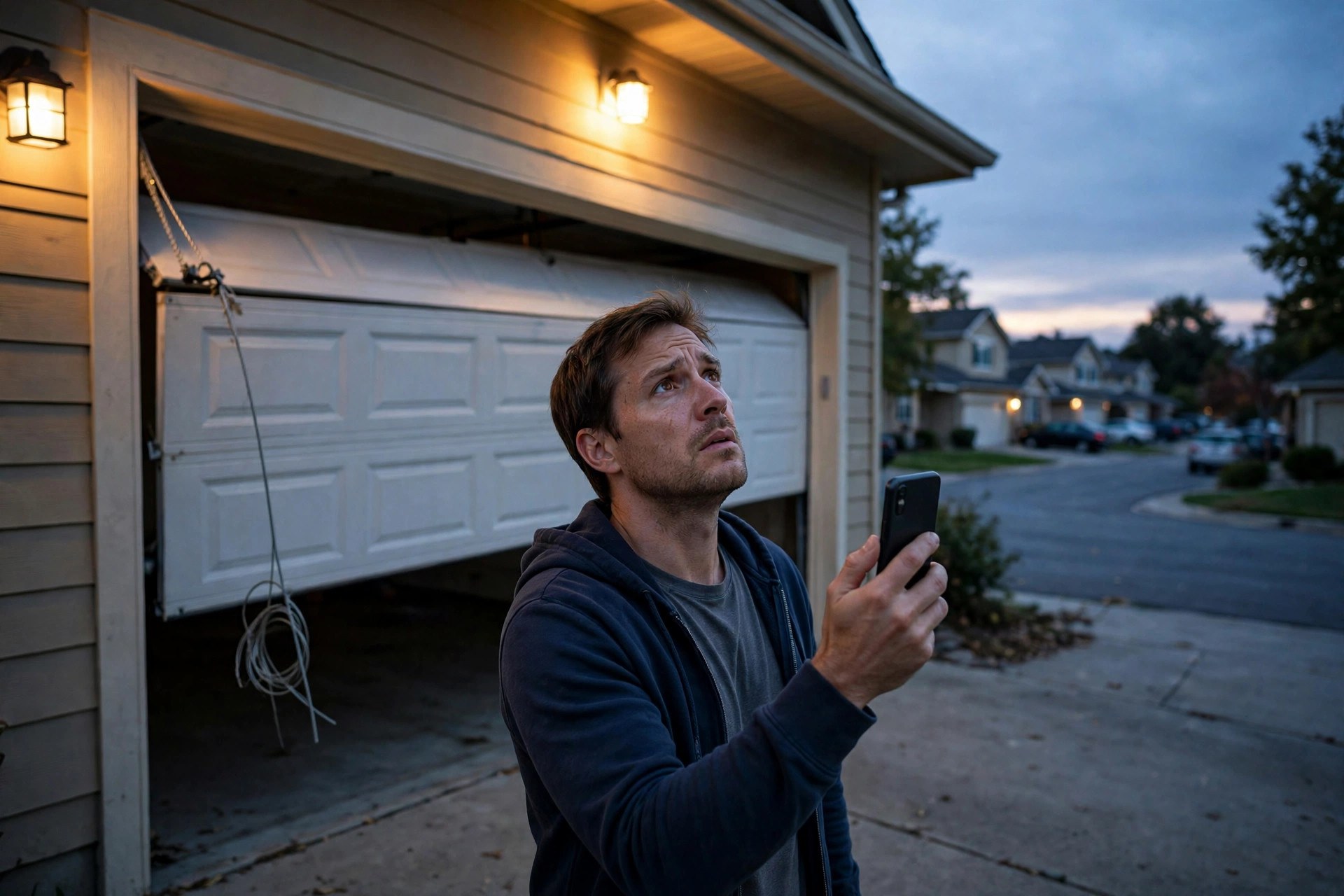
After-hours callers are often standing next to the broken door. A fast text meets them at the moment of need.
After-hours calls: your highest-value net
Daytime missed calls are a volume problem. After-hours missed calls are a margin problem, because the caller who reaches you at 9 PM is pre-sold on speed and will pay an emergency fee without haggling. The tragedy is that most small shops treat after-hours calls as voicemail-only territory. A customer with a door stuck open at night is not leaving a message and waiting for morning; they are calling down the Google results until someone picks up. Text-back turns your after-hours line from a dead end into a booking channel.
Triage in three texts
Keep the after-hours flow tight, because a worried homeowner at night wants action, not a questionnaire. Text one is the template above, naming the emergency dispatch fee. When they reply, text two asks the two questions that decide everything: “Is the door stuck open or closed, and is anyone able to secure it tonight?” A door stuck open is a security problem and justifies an immediate roll; a door stuck closed with the car outside can usually wait for the first morning slot. Text three closes it: “I can have a tech there [tonight between 9 and 11 / first thing at 7 AM]. The emergency visit is $[X] plus the repair. Reply YES to confirm and send your address.” Three texts, one decision, job booked while competitors are asleep.
Set clear dispatch rules before you launch, so the person or automation handling the thread never has to guess. Define your after-hours window, your emergency fee, your response promise (“a tech within 2 hours for doors stuck open”), and the cutoff where a call rolls to morning. Write these rules on one page and give them to everyone who might answer a text thread. The most common after-hours failure is not technical; it is a tech who answers the text at 10 PM, promises to come “soon,” and shows up at midnight to an angry customer. Specific promises beat vague ones.
Setting it up: the technical rollout
Setup is measured in hours, not weeks. The core steps: pick the platform, connect your business number, write your first-text templates, set your business hours and after-hours rules, register the number for business texting, test with real missed calls, and train whoever answers the threads. Most shops go from decision to live in a day or two. The table below compares the three common routes, with typical US pricing bands.
| Setup route | Typical monthly cost | Setup effort | Best for |
|---|---|---|---|
| CRM with built-in text-back | $97 to $300 | 1 to 2 hours | Shops that want calls, texts, and pipeline in one place |
| Standalone texting tool | $50 to $150 plus per-text fees | 2 to 4 hours | Shops happy with their current phone system |
| Answering service plus text-back | $200 to $600 | 1 week of onboarding | Shops that want humans answering every call |
The compliance part nobody should skip
Business texting in the US runs under carrier rules that exist to kill spam, and they apply to you. Register your business number for 10DLC (10-digit long code) texting through your platform; it is usually a short form with your business name, address, and website, and approval takes a few days. Every first text should include your company name and an opt-out line like “Reply STOP to opt out.” Never add marketing blasts to a text-back thread; the system is for responding to people who called you, and promotional messages have stricter consent rules. Keep texts between roughly 8 AM and 9 PM in the recipient’s timezone unless the conversation is an active emergency the customer started. None of this is hard, but skipping registration is the fastest way to get your number flagged and your texts blocked, which defeats the whole system.
Connecting text-back to your CRM, dispatch board, and ads
Text-back earns its keep twice: once when it recovers the call, and again when the conversation data flows into your systems. Every text thread should land in your CRM as a lead or contact with the caller’s number, the time of the missed call, and the transcript. Tag these leads by source, such as “missed-call-text,” so you can measure exactly how many jobs the system produces. Route new threads into your pipeline the same way web leads enter it, with a stage for “text conversation” and one for “booked from text.” If your dispatcher works from a board, new bookings from text threads should appear there automatically, not as a sticky note someone has to re-enter.
Two integrations pay for themselves fast. First, owner alerts: the owner or manager gets a notification for every after-hours text thread, so nothing sits unread overnight and emergency jobs get a human eye. Second, ad call tracking: if you run Google Ads, use call tracking numbers on your ads so you can see which campaigns produce the missed calls that text-back recovers. That closes the loop on ad spend: you are not just counting the calls your ads generated, you are counting the jobs your recovery system saved. And if your website is the source of most calls, make sure the click-to-call buttons and the booking page actually work on a phone; our breakdown of how much a garage door company website costs covers what a call-focused site should include.
Recovered calls turn into real jobs. Log every text-booked visit so you can measure the revenue the system saves.
Common mistakes that tank response rates
Most text-back failures are not software problems. The first is a generic first text: “Thanks for calling, we will get back to you” with no question and no company personality. It reads like a robot and gets deleted. Name the company, acknowledge the miss, ask one question. The second is replying too slowly by hand. The automatic first text buys you a few minutes, not a few hours; if your team takes 45 minutes to continue the thread, the customer has already booked elsewhere. Set a rule: text threads get answered within 5 minutes during work hours, and after-hours threads get the automated flow so nobody waits on a sleeping phone.
The third mistake is texting without a booking path. A great conversation that ends with “call us tomorrow to schedule” wastes the whole system. Every thread should be able to end in a booked job: a scheduling link, a confirmed time window, or a dispatched tech. The fourth is the dead thread: the caller replies, your team answers one question, and then nobody follows up when the caller goes quiet. One check-in text the next morning (“Still need that door looked at? I have a slot at 10 or 2 today”) recovers a surprising number of stalled conversations. The fifth is ignoring the data. If you never look at how many missed calls got texts, how many replied, and how many booked, you cannot tell whether the system is working or whether your templates need rewriting. Check the numbers weekly for the first month.
The numbers to watch every week
You do not need a data analyst for this. Five numbers, checked weekly, tell you everything about whether text-back is paying for itself. Missed calls is the raw input: how many unanswered calls fired a text. Reply rate is the share of those callers who texted back; 30 to 50 percent is a healthy band, and below 20 percent means your first text needs rewriting. Booked jobs from text is the outcome that matters: how many text conversations turned into scheduled work. Revenue recovered is booked jobs times your average ticket, minus the system cost. And first-reply time is how fast a human or automation continued the thread after the automatic text; keep it under 5 minutes in hours.
| Metric | Healthy target | What to fix if you miss it |
|---|---|---|
| Reply rate | 30 to 50 percent of texted callers | Rewrite the first text; shorten it, name the company, ask one question |
| First-reply time | Under 5 minutes in work hours | Add the automated flow or assign thread duty to one person |
| Text-to-book rate | 20 to 40 percent of conversations | Add a booking link, train staff to close in the thread |
| After-hours bookings | At least 1 to 2 a week | Check the after-hours flow fires; review the dispatch fee wording |
| Revenue recovered | 5 to 10 times the monthly system cost | Re-audit missed-call volume; you may be missing more calls than you think |
Your rollout checklist
Work this list in order. Most shops finish it in a weekend.
- 1Count your missed calls. Pull a week of call logs from your phone system and count unanswered inbound calls, split by work hours and after hours. This is your baseline.
- 2Pick your platform. A CRM with built-in text-back ($97 to $300 a month) or a standalone texting tool ($50 to $150 a month). Choose the one your team will actually open every day.
- 3Connect your business number. Port or forward your main number so missed calls trigger the text flow. Test that the caller ID shows your business number.
- 4Write your first-text templates. One each for repairs, after-hours emergencies, and new-door quotes. Keep each under 160 characters, name the company, end with one question.
- 5Set business hours and after-hours rules. Define the after-hours window, the emergency dispatch fee, the response promise, and the roll-to-morning cutoff on one page.
- 6Register for business texting. Complete 10DLC registration with your business details, add “Reply STOP to opt out” to first texts, and set quiet hours for non-urgent threads.
- 7Wire threads into your CRM. Every text conversation becomes a lead with source tag “missed-call-text,” flowing into the same pipeline as web leads.
- 8Build the booking path. Connect a scheduling link or a confirm-by-text flow so every thread can end in a booked job without a phone call.
- 9Test with real missed calls. Call your own number from three different phones, at work hours and after hours, and walk the full flow as a customer would.
- 10Review weekly for a month. Track missed calls, reply rate, booked jobs, and revenue recovered. Rewrite any template performing below the targets in the metrics table.
Frequently asked questions
What is missed-call text-back for a garage door company?
It is an automatic text message sent to anyone whose call your shop misses. The text goes out within seconds from your business number, names your company, and starts a conversation that can book the repair or install even though nobody answered the phone.
How much does missed-call text-back cost?
Most CRMs include it in plans from about $97 to $300 a month. Standalone texting tools run $50 to $150 a month plus small per-text fees. An answering service that adds text-back typically costs $200 to $600 a month. Against even one recovered job a week, every option pays for itself.
Does it work for after-hours emergency calls?
Yes, and after hours is where it earns the most. A broken door at night is an emergency the caller will not wait on. An automatic text with your emergency dispatch fee and a triage question turns those calls into booked jobs instead of voicemails nobody returns until morning.
Will customers think the text is spam?
Not when it arrives seconds after they called you. The caller recognizes your business number and the context is obvious: they just tried to reach you. Texts that name the company and reference the missed call get reply rates of 30 to 50 percent in a typical setup.
What should the first text say?
Keep it short: apologize for the miss, name your company, and ask one easy question. Example: “Hi, this is [Company] – sorry we missed your call! What is going on with your garage door? We have same-day openings today.” Avoid long messages with multiple questions.
Do I need special software, or can my phone do this?
You need a platform that detects missed calls and sends texts automatically; a personal cell phone cannot do it reliably. Most shops use a CRM with the feature built in or a standalone business texting tool connected to their main number.
Is business texting legal? What are the rules?
Yes, with registration and basic hygiene. Register your number for 10DLC business texting, include your company name and a “Reply STOP to opt out” line, and avoid promotional blasts to people who only called about service. Keep non-urgent texts inside daytime hours.
How fast do I need to reply after the automatic text?
The automatic text buys you minutes, not hours. Aim for a human or automated follow-up within 5 minutes during work hours. After hours, let an automated triage flow handle the first exchanges so the caller never waits on a sleeping phone.
Can text-back handle new door quotes, not just repairs?
Yes. A quote template asks whether the door is single or double and sends a price range by text, then offers a booking link for a free in-home measurement. Fast quoting by text wins estimate jobs because the customer is comparing two or three companies at once.
How do I know if it is actually working?
Track five numbers weekly: missed calls, reply rate (target 30 to 50 percent), text-to-book rate (target 20 to 40 percent), after-hours bookings, and revenue recovered versus the monthly system cost. If revenue recovered is not at least 5 times the cost, rewrite your templates and check your reply speed.
Stop losing jobs to the company that answered first
Digital Hayder builds missed-call text-back and CRM automation for garage door companies: automatic texts on every missed call, after-hours triage flows, booking links, and pipelines that track every recovered dollar. Tell us about your call volume and we will design the recovery system around it.
Contact Us