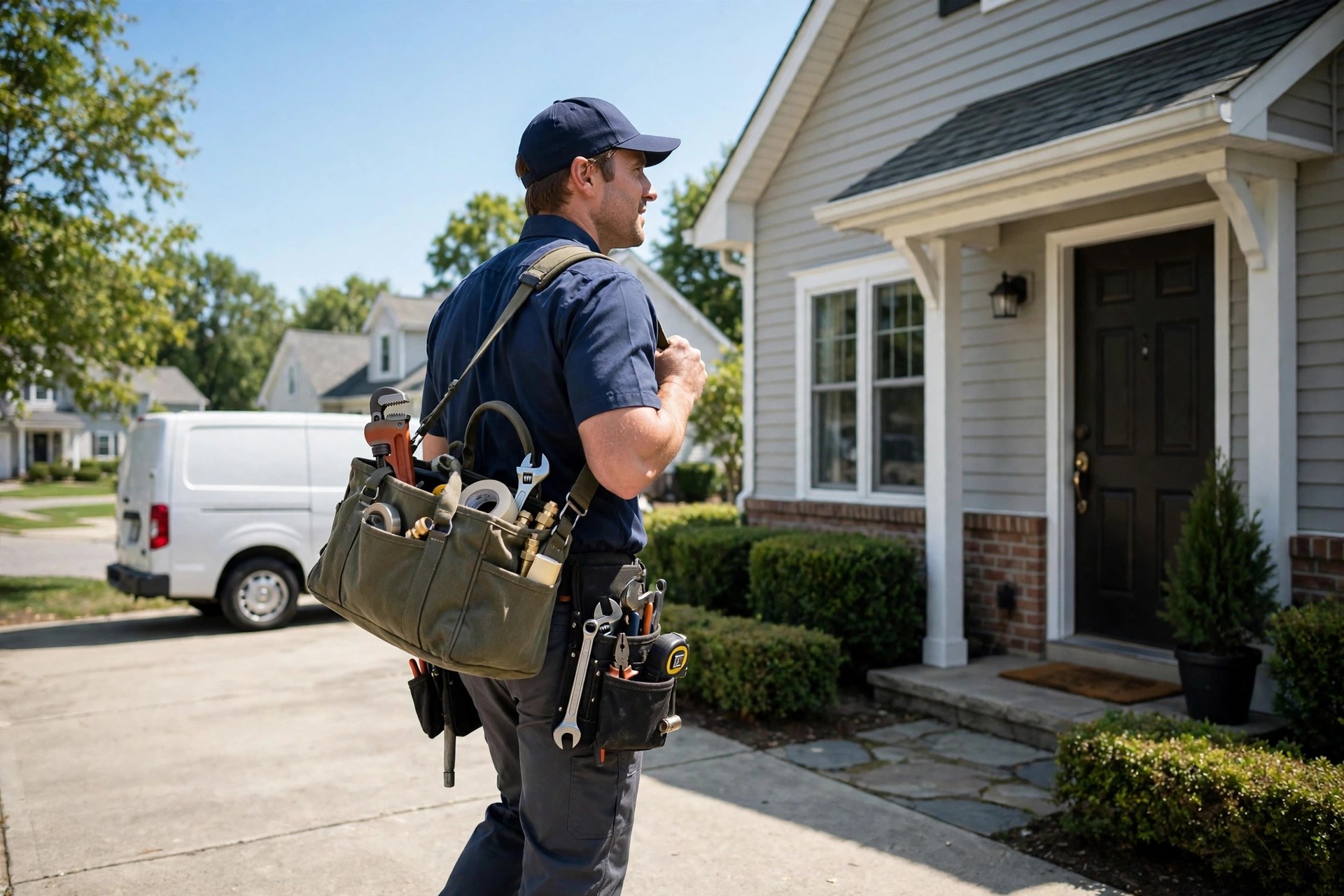
When a pipe bursts at 11 PM, nobody scrolls to page two of Google. They tap one of the three plumbers in the map pack, call the first one who picks up, and book whoever sounds competent. That decision takes about ninety seconds, and your Google Business Profile is the entire interview. For plumbers, GBP optimization is not about looking polished. It is about showing up for emergency searches, proving you serve the caller’s town, and looking like the crew that shows up fast and fixes it right. This guide covers the exact GBP setup that wins emergency plumbing calls: categories, emergency keywords, service areas, dispatch photos, reviews, and the weekly habits that keep you in the top three.
The quick answer
- The map pack is the market: most emergency plumbing calls go to the top three map results, so ranking there is worth more than any other marketing for plumbers.
- Emergency keywords win after hours: “emergency plumber,” “24 hour plumber,” and “burst pipe repair” need to appear in your services, description, and posts.
- Service areas beat a bigger radius: list the specific towns you dispatch to, not a giant circle, and match them on your website too.
- Dispatch photos prove the work: real job photos, trucks, and techs outperform stock images and build trust before the call.
- Review velocity matters most: a steady stream of recent reviews with plumbing keywords beats a large old total.
- Weekly habits keep the ranking: posts, Q&A answers, photo uploads, and review replies compound over months, not days.
Why the map pack decides who gets the emergency call
Plumbing searches are the most urgent searches in home services. A homeowner with water pouring through a ceiling is not comparison shopping; they are picking the first credible option. Google knows this, which is why the map pack dominates plumbing results: three businesses with star ratings, review counts, hours, and a call button, all above the regular listings. On a phone, the map pack often fills the entire first screen. If you are not in it, you barely exist for emergency work.
The economics make the map pack even more important. A single emergency call can be worth $300 to $800, and water heater replacements run $1,200 to $3,500 installed. Google Ads clicks for “emergency plumber near me” routinely cost $30 to $80 in competitive markets, so every call the map pack delivers for free is a call you did not have to buy. Plumbers who rank in the top three for their core towns often report that the map pack drives 40 to 60 percent of their inbound calls. That is why this guide treats GBP as your most valuable marketing asset, not a directory listing to set and forget.
Google ranks map pack results on three things: relevance, distance, and prominence. Relevance is whether your profile matches the search: the right categories, services, and keywords. Distance is how close you are to the searcher, or to the town they searched. Prominence is how well-known and trusted you look: reviews, photos, and activity. You cannot move your shop, but you can win relevance and prominence outright. That is what the rest of this guide does.
Categories, services, and attributes: the foundation
Most plumber profiles get the basics half right and lose relevance because of it. Fix the foundation first; everything else builds on it.
Primary and secondary categories
Set your primary category to “Plumber.” This is the single biggest relevance signal on the profile, and it must match what you actually are. Add secondary categories only for work you genuinely do: “Drainage service” if you do drains, “Water heater repair service” if that is a real line of business, “Emergency plumber service” where available. Do not add categories for work you do not do; mismatched categories dilute relevance and attract the wrong calls.
The services list is your keyword engine
The services section is where emergency and specialty keywords live. Google matches service names against searches, so write them the way customers search, not the way the trade talks. Include: emergency plumbing, burst pipe repair, leak detection, drain cleaning, sewer line repair, water heater installation and repair, toilet repair and installation, faucet repair, garbage disposal installation, sump pump installation, gas line repair, repiping, and backflow testing if licensed for it. Write a one-sentence description for each service using plain customer language: “Fast response for burst pipes, major leaks, and flooding, available day and night.” This is also where 24-hour language belongs, tied to specific services rather than floating vaguely in the description.
Attributes that filter the call
Attributes are the small labels Google shows on your profile, and for plumbers the important ones are practical: “Identifies as women-led” if true, “Online appointments” or “Onsite services,” and the accessibility attributes if they apply. The attribute that matters most for emergency work is your hours: set them accurately, including holiday hours, and use the “open 24 hours” setting only if someone truly answers around the clock. A profile that says 24 hours but sends callers to voicemail at midnight earns bad reviews fast.
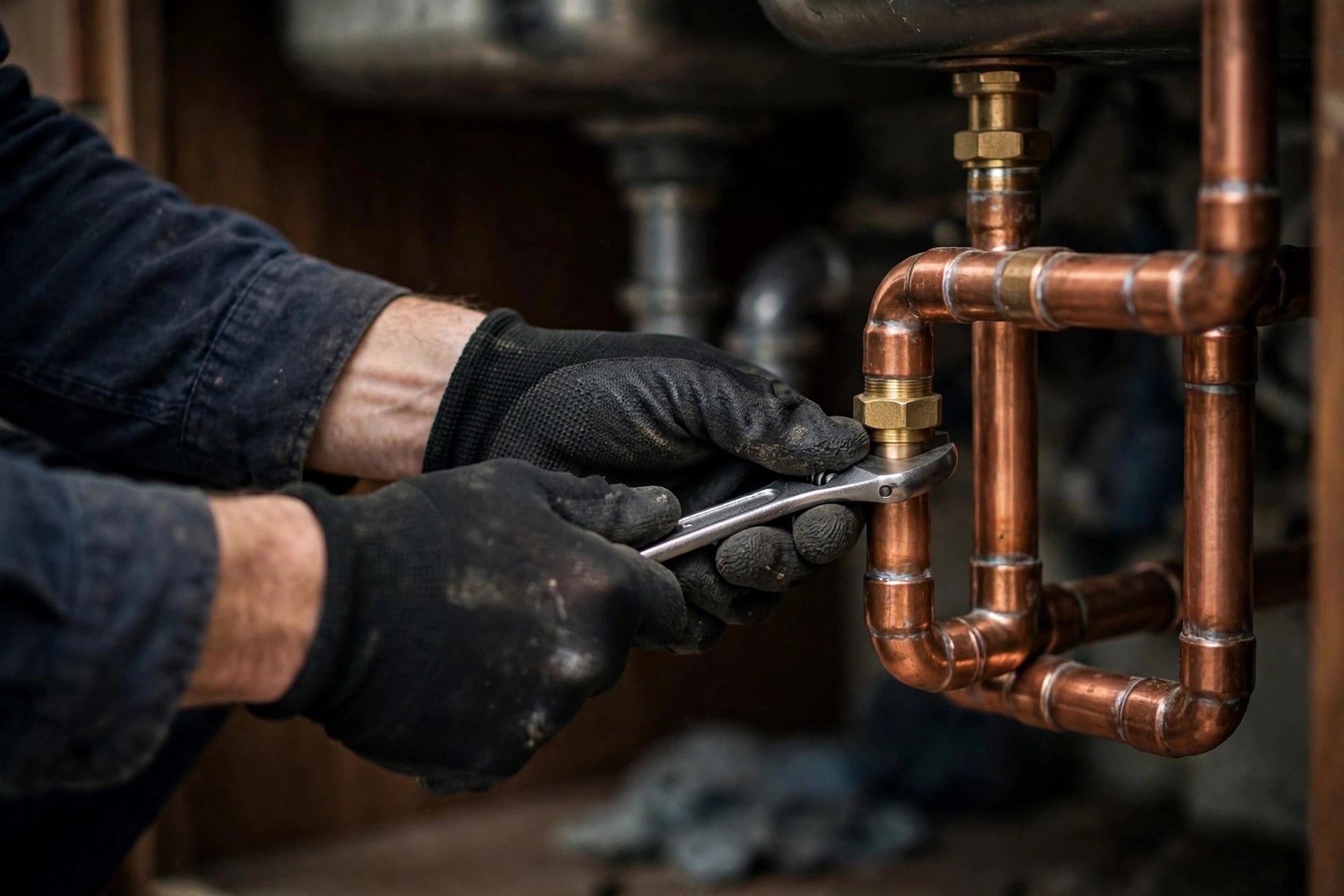
Real job photos of actual repair work tell emergency callers you do this every day, which stock photos never do.
Emergency keywords: winning “plumber near me” at 2 AM
Emergency searches convert at rates routine searches never touch, because the caller has already decided to hire someone. Your profile needs to match the exact phrases panicked homeowners type.
The phrases that matter
Build your profile around the searches that carry buying intent: “emergency plumber near me,” “24 hour plumber,” “burst pipe repair,” “water heater leaking,” “sewer backup,” “drain cleaning near me,” and “gas leak plumber.” These phrases should appear naturally in your business description, in individual service descriptions, and in your posts. Do not stuff them into the business name; adding keywords to the name violates Google’s guidelines and can get the profile suspended. Put the keywords in the fields Google built for keywords.
The description that sells the call
You get 750 characters. Use the first 250 for the emergency pitch, because that is what shows before the “read more” cut: who you are, that you handle plumbing emergencies day and night, the towns you serve, and how fast you typically respond. Example: “Family-owned plumbing company serving Springfield and the surrounding towns for 15 years. We handle burst pipes, major leaks, sewer backups, and water heater failures with same-day emergency service, day and night. Licensed and insured. Call now for immediate dispatch.” The rest of the space covers your main services in plain language. Mention response time honestly; “usually on-site within 90 minutes” beats a vague “fast service” every time.
Posts that rank for the emergency
Google Posts are short updates that appear on your profile, and they are indexed for search. Publish a rotating set of emergency-focused posts: “Burst pipe? We are dispatching now in Springfield and Riverside. Call for immediate help.” “Water heater leaking? Same-day replacement available.” Each post should name the service, name the towns, and end with a call to action. Post at least weekly; profiles with fresh posts consistently outperform dormant ones, and each post is another chance to match an emergency search phrase.
Service areas done right
For plumbers, the service-area setting is a strategic decision, not an afterthought. Most of your emergency calls come from within a 20 to 30 minute drive, and Google knows where your searchers are. Set the areas to match reality.
List towns, not a giant circle
Google lets you define service areas by town or by radius. Choose towns: list every city and suburb you actually dispatch to, by name. A 50-mile radius looks impressive and ranks for nothing, because Google treats broad areas as weak signals. Ten named towns you genuinely serve is a strong signal. If you hide your address because you work from home or a yard, which many plumbers do, the service-area list becomes your entire location footprint, so get it right.
Match the website
Google cross-checks your profile against your website. If your GBP lists twelve towns but your website mentions three, the profile looks thin. Build a simple service-area page on your site that names every town on the profile, ideally with a sentence about each: typical response time, common local issues like hard water or old clay sewer lines. Consistency between the profile and the site is one of the quietest ranking factors in local search, and most plumbers ignore it completely.
Photos that prove you do the work
Plumbing customers are inviting a stranger into their home during a stressful moment. Photos are how they decide you look trustworthy before they call. Profiles with 50 or more photos get dramatically more calls and direction requests than profiles with a handful, and for plumbers the type of photo matters more than the count.
Prioritize dispatch and job photos: your branded truck in a driveway, techs in clean uniforms at a front door, before-and-after shots of real repairs, water heater installations in progress, trenchless sewer work, a tech using a camera for drain inspection. Add the owner or the team: faces build trust faster than equipment. Add the office or shop exterior so the business looks real. Update monthly; a stream of fresh job photos signals an active, busy company, and Google rewards active profiles. For the full photo and review playbook, see our guide to getting more Google reviews as a plumber.
What to avoid: stock photos of smiling models with wrenches, which customers spot instantly and which tell Google nothing; blurry night shots; photos with other companies’ branding; and before photos of sewage without any context. Every photo should answer one question: would I let this crew into my house?
Reviews: velocity, keywords, and responses
Reviews are the prominence half of the ranking formula, and for plumbers they do double duty: they rank the profile and they close the caller. A homeowner choosing between two emergency plumbers at midnight picks the one with 180 recent reviews over the one with 40, even if both have 4.9 stars. What matters most is not the total but the velocity: a steady flow of new reviews every month signals a busy, trusted company, while a profile whose newest review is eight months old looks dormant.
Ask at the moment of relief: right after the repair is done, the water is back on, and the customer is grateful. A short text with the review link beats every other method; email asks get ignored and paper cards get lost. Train techs to make the ask part of the job wrap-up: “If you were happy with the work, a Google review helps us more than anything. I will text you the link.” Aim for 5 to 15 new reviews a month for a mid-size shop. Reviews that mention the service in the customer’s own words, “fixed our burst pipe at midnight,” “replaced the water heater same day,” reinforce your emergency keywords naturally, so never script what customers write.
Respond to every review, positive and negative, within a few days. Thank the happy customers by name and mention the work done. For negative reviews, respond calmly, take responsibility where it is due, and move the conversation offline: “We are sorry about the wait time that night. Please call us at this number so we can make it right.” Never argue in public. A thoughtful response to a bad review often impresses future callers more than the review itself hurt.
Posts, Q and A, and messaging: the weekly habits
Rankings decay on neglected profiles. Three small habits, done weekly, keep a plumber’s profile ahead of competitors who set theirs up once and forgot it.
Posts: one per week, alternating between emergency availability, seasonal work, and trust content. Winter: “Frozen pipe prevention and 24-hour emergency repair in these towns.” Spring: “Sump pump checkups before the rainy season.” Summer: “Water heater flushes and replacements, same-day service.” Always end with a call to action and the phone number.
Questions and answers: Google lets anyone ask questions on your profile, and unanswered questions look abandoned. Seed your own Q and A with the questions customers actually ask: “Do you charge for emergency calls after hours?” “How fast can you get here?” “Do you warranty your work?” Answer each one plainly. Then watch for new questions weekly and answer them within a day or two.
Messaging: turn on GBP messaging so searchers can text the business straight from the profile. Emergency callers who cannot get through on a busy line will message instead, and a fast reply wins the job. If nobody can monitor messages during the day, set clear expectations or route them to your dispatch system. An unanswered message thread is worse than no messaging at all.
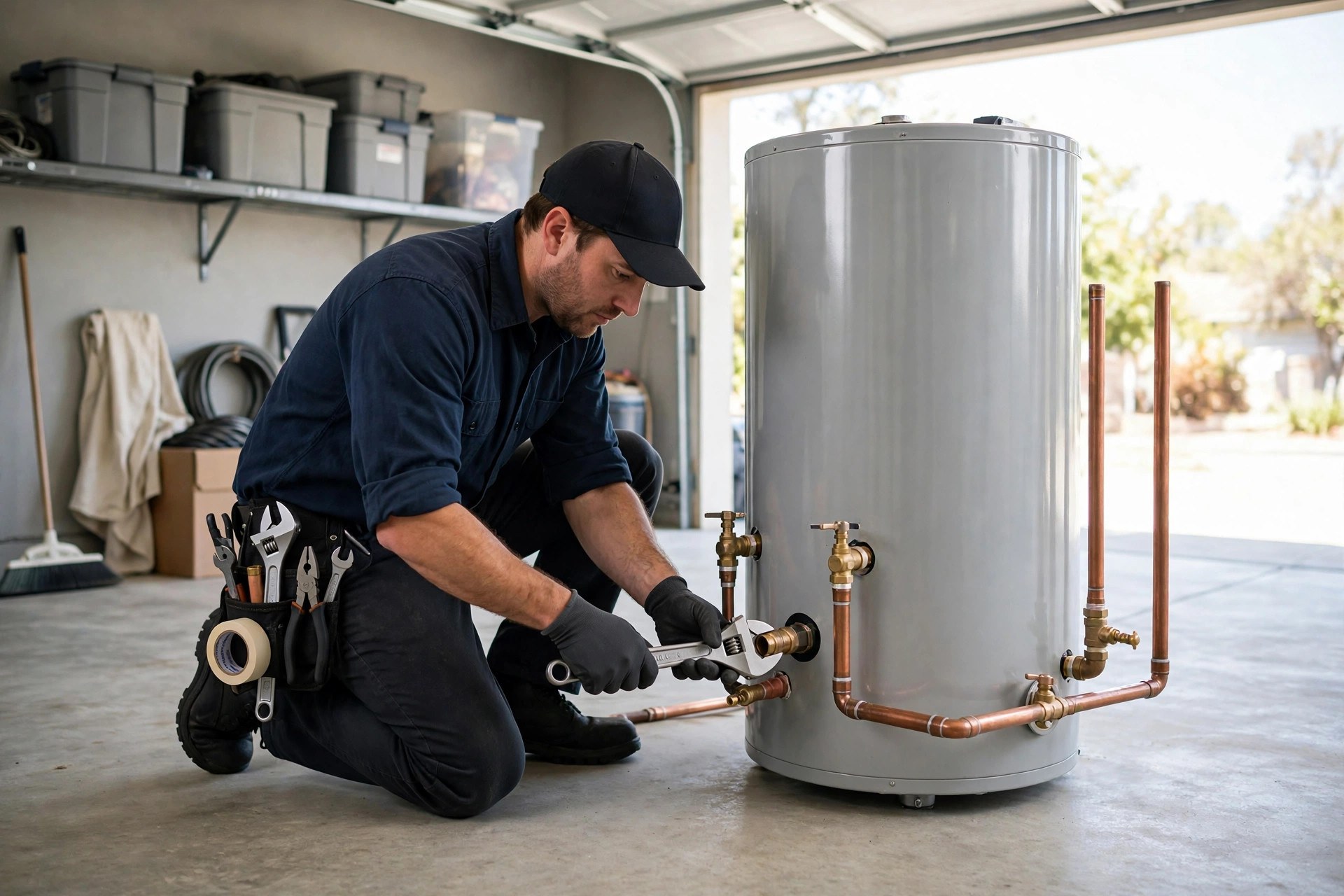
Water heater replacements are high-ticket jobs that start as map-pack searches. Your profile should sell them explicitly.
Tracking what the profile earns you
GBP gives you free analytics, and plumbers should check them monthly. The numbers that matter are calls, direction requests, website clicks, and message conversations. Compare them against your job calendar: how many calls turned into dispatched jobs, and what was the average ticket? The table below shows the metrics worth tracking and what good looks like.
| Metric | Where to find it | Healthy target for a mid-size shop |
|---|---|---|
| Profile calls per month | GBP insights, calls | 80 to 200, growing with review velocity |
| Direction requests | GBP insights, directions | Steady growth as service-area coverage improves |
| Photo views vs competitors | GBP insights, photos | At or above the median for similar businesses |
| Review velocity | Profile review count over time | 5 to 15 new reviews per month |
| Call-to-job conversion | Your dispatch records | 50 to 70 percent of qualified calls booked |
| Average ticket from GBP calls | Your job records by source | Track separately; emergency calls run higher |
If calls are rising but bookings are flat, the problem is not the profile; it is the phones. Missed calls during dispatch hours and slow callbacks kill GBP ROI silently. Pair the profile work with a call safety net; our guide to missed-call text-back for plumbers covers the exact setup.
Common mistakes plumbers make on GBP
Keyword-stuffing the business name. “Springfield Emergency Plumber 24 Hour Drain Cleaning” violates Google’s guidelines and risks suspension. The real business name, nothing more.
Setting 24-hour hours without 24-hour answering. Callers who reach voicemail at 2 AM leave one-star reviews. Only claim round-the-clock hours if someone truly answers.
A five-town service area for a twenty-town business. Every town you dispatch to and do not list is a town where competitors outrank you by default.
Ten photos, all from opening day. Stale profiles look closed. Upload fresh job photos monthly, even phone snapshots of clean work.
Ignoring the Q and A section. Unanswered questions sit on your profile like unanswered phones. Seed the common ones and monitor weekly.
Never posting. A profile with no posts for a year signals a business that stopped caring. One post a week takes ten minutes.
Buying reviews or review gating. Asking only happy customers for reviews, or paying for them, violates policy and can wipe out the profile. Ask everyone, respond to everything.
What GBP optimization costs
Most of this work is labor, not software. The table below shows realistic bands for doing it yourself versus hiring it out.
| Approach | Typical cost | What you get |
|---|---|---|
| DIY | Free, plus 2 to 4 hours a month | Full control; works if you actually do the weekly habits |
| One-time optimization | $400 to $1,200 one time | Categories, services, description, photos, Q and A seeding, review system setup |
| Monthly management | $250 to $750 per month | Weekly posts, photo uploads, Q and A monitoring, review responses, monthly reporting |
| Part of full local SEO | $750 to $2,000 per month | GBP plus website service-area pages, citations, and review generation across the business |
The DIY path works fine for owner-operators who will genuinely spend a few hours a month on it. The failure mode is always the same: a perfect setup in January and silence by March. If that sounds like you, pay for management. For the wider marketing picture beyond the profile, see our plumber marketing ideas guide.

Emergency calls are won by the profile that looks ready right now, not the one with the prettiest logo.
Your rollout checklist
Do these in order. The first five take one focused afternoon.
- 1Claim and verify the profile. Full ownership, correct business name with no keyword stuffing, accurate primary category of Plumber.
- 2Build the services list. Every emergency and specialty service written in customer language, with plain-English descriptions.
- 3Write the 750-character description. Emergency pitch in the first 250 characters, towns served, honest response-time claim.
- 4Set service areas by town name. Every town you dispatch to, listed individually, matched on your website.
- 5Fix hours and attributes. Accurate hours including holidays; claim 24-hour only if someone truly answers.
- 6Upload 30-plus real photos. Trucks, techs, job sites, before-and-after repairs, the shop exterior. No stock photos.
- 7Seed the Q and A. The ten questions customers actually ask, answered plainly in your own words.
- 8Start the review engine. Text the review link at the moment of relief on every job; target 5 to 15 new reviews a month.
- 9Turn on messaging. Route profile messages to a monitored phone or dispatch, with a response-time target under 15 minutes.
- 10Run the weekly habits. One post, photo uploads, Q and A check, and review responses, every week, for six months.
Frequently asked questions
How long does GBP optimization take to work for plumbers?
Expect movement in 4 to 8 weeks and meaningful ranking changes in 3 to 6 months. Emergency keyword relevance and review velocity compound; profiles that post weekly and add reviews steadily usually see the map pack shift within two quarters.
Should I add “emergency plumber” to my business name?
No. Google prohibits keyword-stuffing business names and can suspend profiles that do it. Put emergency language in your services, description, and posts, where it belongs and where it still ranks.
How many towns should I list in my service area?
Every town you genuinely dispatch to, usually 8 to 20 for a mid-size shop. List them by name rather than using a wide radius, and make sure the same towns appear on your website’s service-area page.
Do Google Posts really help plumbers rank?
They help relevance and freshness, especially for emergency phrases. A weekly post naming the service and the towns is a small ranking signal that compounds, and it also converts searchers who read the profile before calling.
How many reviews does a plumber need?
There is no magic number, but velocity beats totals. A shop adding 5 to 15 reviews a month will outrank a competitor sitting on 300 old reviews within a year in most markets. Keep the flow steady rather than chasing a milestone.
Should I respond to negative reviews?
Yes, every one, calmly and within a few days. Acknowledge the issue, avoid arguing about facts in public, and invite the reviewer to call a direct number. Future customers read your responses as closely as the reviews.
Can I run GBP optimization myself?
Yes, if you will do the weekly work: posts, photos, Q and A, and review replies. The setup itself takes an afternoon. Most plumbers who fail at DIY fail on consistency, not knowledge, which is when paying $250 to $750 a month for management makes sense.
Does hiding my address hurt rankings?
Not if you set service areas correctly. Many plumbers hide the address because they work from home. When you do, the town list becomes your location footprint, so list every town you serve and keep it matched on your website.
What photos work best for a plumbing profile?
Real job photos: branded trucks, uniformed techs at doors, before-and-after repairs, water heater installs, drain camera work. Fifty or more real photos outperform ten polished stock images for both rankings and caller trust.
How do I track whether GBP is working?
Watch profile calls, direction requests, and message conversations in GBP insights monthly, then match them to dispatched jobs in your own records. The number that matters is booked jobs per month from profile calls, not views or clicks.
Win the emergency calls in your towns
Digital Hayder optimizes Google Business Profiles for plumbing companies: emergency keyword coverage, service-area strategy, review engines, and weekly management that keeps you in the map pack. Tell us about your market and we will build the plan around it.
Contact Us