Here is the daily reality of running a carpet cleaning company: your crew is inside a customer’s home, the machine is running, and the phone is ringing in the van. By the time anyone checks it, the caller has booked with the competitor who picked up. An AI receptionist for carpet cleaning companies fixes exactly this. It answers every call on the first ring, quotes your per-room prices, books the job into your schedule, and texts confirmations, while your team keeps cleaning. It works after hours, on weekends, and during the jobs themselves. This guide covers what the AI receptionist does day to day, how it quotes and books carpet jobs, what it costs, and the money math on the bookings it captures that voicemail never would.
The quick answer
- It answers while crews clean: every call is picked up on the first ring, even with the machine running and the phone in the van.
- It books real jobs: the AI quotes per-room pricing, checks your schedule, and confirms the appointment on the call.
- After-hours calls stop dying: evening and weekend callers get a quote and a booking instead of voicemail.
- It costs $200 to $600 a month: a fraction of a part-time office hire, with no sick days and no missed calls.
- Reminders cut no-shows: automatic confirmations and day-before reminders protect the schedule you just filled.
- The math is simple: capturing 6 to 10 extra booked cleanings a month usually pays for the system many times over.
The missed-call problem carpet cleaners live with
Carpet cleaning has a structural phone problem that most other trades do not. A plumber can step out of a job to take a call. A carpet cleaning crew cannot: the technician is moving furniture, running a loud extractor, or mid-way through a staircase. The owner is often the second technician, in the same noisy room. Calls land on a phone sitting in the van or buried in a pocket, and they go to voicemail. Industry tracking of home service calls consistently shows that 25 to 40 percent of calls go unanswered during work hours, and close to all of them go unanswered after hours.
Each missed call is not just a lost conversation. Carpet cleaning shoppers behave like all home service shoppers: they call two or three companies and book the one that answers. A caller with a pet-stained living room and guests arriving Friday does not leave a voicemail and wait patiently. They hang up and call the next listing. When the work itself keeps you from answering, you are not losing leads to better competitors; you are losing them to faster ones. The companies that win are the ones whose phones get answered while the crew is working.
Hiring office help is the traditional answer, and it has real costs. A part-time dispatcher runs $1,500 to $2,500 a month in most markets, needs training, takes sick days, and still cannot cover 7 PM on a Sunday. For a one or two truck operation, that payroll line is hard to justify. This is the gap an AI receptionist fills: full coverage of every call, every hour, at a cost closer to a phone bill than a payroll.
What an AI receptionist does for a carpet cleaning company
An AI receptionist is a voice system that answers your business line like a trained office coordinator. It is not a phone tree that says “press 1 for booking.” It holds a natural conversation: greeting the caller by your company name, asking what they need, quoting prices from your rate card, offering open appointment times, and booking the job. When the call needs a human, it transfers or takes a detailed message and alerts you instantly by text.
For a carpet cleaning company, the day-to-day work breaks into five jobs. First, answering: every call picked up on the first ring with your company greeting, no hold music, no voicemail. Second, quoting: per-room prices, stain treatment add-ons, and upholstery upsells quoted from the rate card you set. Third, booking: real appointments written into your calendar with the customer’s name, address, service details, and price quoted. Fourth, rescheduling: existing customers move appointments without calling you. Fifth, messaging: every booking confirmed by text immediately, with a reminder the day before. The system runs this loop around the clock, and you see every call, every booking, and every message in a dashboard or by text summary.
The key difference from a generic answering service is the carpet cleaning knowledge. A human answering service reads from a script and takes messages. An AI receptionist trained on your business knows that a three-room clean is $129, that pet stain treatment is an add-on, that stairs are priced per step set, and that Tuesday mornings are your open slots. It answers the questions callers actually ask instead of promising a callback, and that is what turns calls into booked jobs.
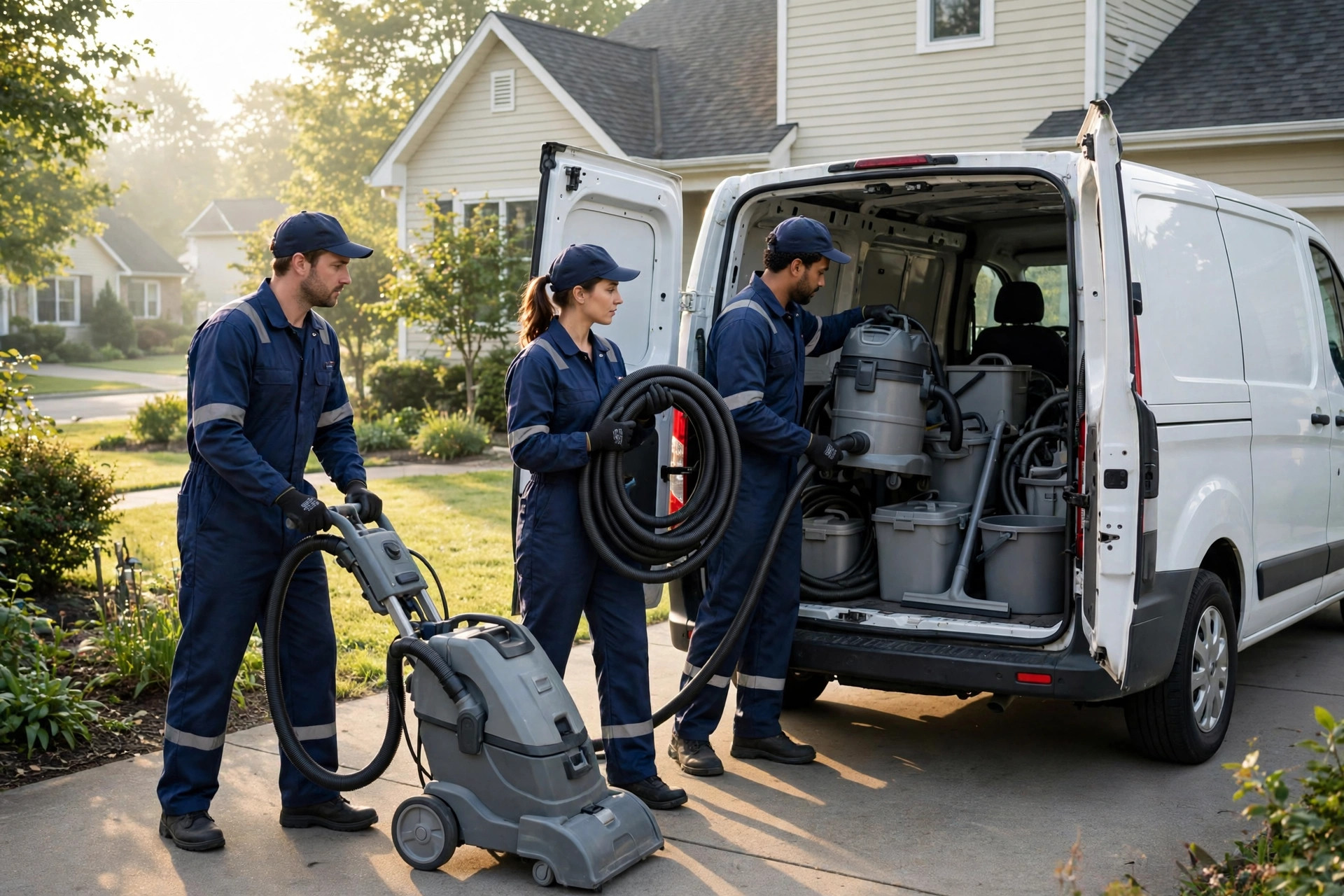
The crew cannot stop mid-job to answer the phone. The AI receptionist picks up every call so the schedule keeps filling while the team keeps cleaning.
How it books jobs while your crew is working
Walk through a typical call. A homeowner searches for carpet cleaning, taps your number, and the AI answers in two seconds: “Thanks for calling Bright Carpet Care, this is Ava. How can I help you today?” The caller says their dog ruined the living room carpet and they need it cleaned this week. The AI asks three short questions: how many rooms, any stairs or upholstery, and the zip code to confirm the service area. From your rate card it quotes: three rooms at your flat rate, pet treatment add-on, total price. Then it offers your real openings: “I have Thursday between 9 and 11, or Friday afternoon. Which works better?” The caller picks Thursday. The AI takes the name, address, and phone number, books it into the calendar, and sends a confirmation text with the date, time window, price, and your arrival policy. Total call time: about two minutes. Nobody from your team touched the phone.
This matters most during the hours you are unreachable. Field data from home service companies shows that 40 to 50 percent of booking calls arrive outside the 9-to-5 window or while the crew is on a job. Those are exactly the calls a one-truck operation misses today. The AI does not just take a message for these callers; it completes the booking, which is the difference between a lead and revenue. A message that says “call back tomorrow” loses to a competitor who books tonight.
Speed also protects your ad spend. If you run paid search, every unanswered call is an ad click you paid for with nothing to show. Our breakdown of Google Ads cost for carpet cleaning companies puts the cost per booked cleaning at $50 to $150; letting half your calls go to voicemail effectively doubles that cost. The AI receptionist is the cheapest way to make every ad dollar count, because it converts the calls the ads already bought.
Per-room quoting: how the AI quotes without you
Carpet cleaning quotes are simple enough to automate well, which is why the AI works so naturally here. You load your rate card once: price per room, minimum visit charge, stairs pricing, pet stain treatment, deodorizer, upholstery per seat or per sofa, area rug rates, and any current offers like a three-room package. You also set the rules: service area zip codes, which jobs need a human quote (water damage, commercial space over a size limit, hoarding situations), and when to escalate instead of booking.
On the call, the AI collects the room count and add-ons, applies your rates, and states the total clearly: “That comes to $189 for three rooms with pet treatment, and Thursday morning is open.” Consistency is the quiet advantage. Every caller hears the same prices, the same offers, the same policies. No more “the tech quoted one price and the office quoted another.” When a job falls outside the rules, the AI says so honestly and books a callback or an on-site estimate instead of guessing: “Water damage needs an in-person look. I can have our estimator call you within the hour, or book a free assessment for tomorrow. Which do you prefer?”
Update the rate card when prices change and the AI quotes the new numbers on the next call. Seasonal offers work the same way: load a holiday package price, and every caller hears it until you turn it off. For owners who also take online bookings, keep the website rate card in sync; our guide to how much a cleaning company website costs covers building a site with a booking form that matches the phone quotes.
After-hours and weekend capture
Evenings and weekends are when carpet cleaning customers have time to deal with their homes, and that is when they call. A working parent notices the stained hallway at 8 PM and searches. A landlord turns a unit on Saturday and needs it cleaned before the new tenant arrives. These callers are motivated and ready to book, and they will not wait until Monday morning. Without coverage, every one of them hears voicemail.
The AI receptionist treats a 9 PM Sunday call exactly like a 10 AM Tuesday call: greeting, questions, quote, booking, confirmation text. There is no “we are closed” message, no promise of a callback, no lost momentum. Owners are often surprised by the Monday morning summary: three or four bookings that arrived while the family was having dinner. For a company doing 40 jobs a month, capturing even five extra after-hours bookings is a 12 percent revenue lift from calls you were already getting.
Set clear boundaries so after-hours booking stays safe. The AI books into your real availability, so it never promises a slot you cannot staff. Jobs flagged as complex, like flood work or large commercial quotes, get scheduled as callbacks during business hours instead of firm bookings. You wake up to booked jobs and a short list of callbacks, not a voicemail box of people who already hired someone else. The broader playbook for cleaning companies is covered in our guide to AI receptionists for cleaning companies, which includes the after-hours scripts that work across residential cleaning services.
Reminders, confirmations, and repeat bookings
Booking the job is only half the value. Empty appointments cost a carpet cleaning company the drive time, the crew hours, and the slot that could have gone to someone else. The AI receptionist sends a confirmation text the moment a job is booked, a reminder the day before with the time window and a reply-to-confirm prompt, and a morning-of message with the technician’s estimated arrival. Customers confirm with one word or reschedule with a tap, and freed slots go back on the market for waitlisted callers.
Carpet cleaning repeats naturally, which makes the follow-up automation especially valuable. Six months after a cleaning, the system texts the customer: a short check-in with a one-tap rebooking link. Nobody at your company has to remember, build a list, or make the calls. With 25 to 40 percent of one-time buyers becoming repeat clients in this industry, the rebooking texts quietly rebuild your schedule every month. Add a review request after each completed job, sent when the carpet is fresh and the customer is happiest, and the same system feeds your Google reviews.
Commercial accounts get their own rhythm. Offices and property managers need recurring service, and the AI can quote the recurring schedule, book the first visit, and set the repeat cadence. One property manager with ten units on a six-month rotation is worth more than a month of residential ads, and the AI keeps that relationship warm with reminders and easy rebooking between visits.
Confirmation texts and day-before reminders protect every booked slot, because an empty appointment costs the drive time and the crew hours.
What an AI receptionist costs
Pricing comes in three layers: the software subscription, any per-minute or per-call usage, and setup. For a carpet cleaning company, the realistic all-in range is $200 to $600 a month after a one-time setup of $300 to $1,500. The spread reflects call volume and how much customization the booking flow needs.
| Cost layer | Typical price band | What it covers |
|---|---|---|
| Basic AI answering plan | $100 to $250 per month | Answers every call, takes messages, basic FAQs, text summaries; limited booking |
| Full booking receptionist | $250 to $500 per month | Quotes from your rate card, books into your calendar, confirmations and reminders |
| Managed plus campaigns | $400 to $600 per month | Everything above plus rebooking texts, review requests, and monthly tuning |
| Usage overages | $0.10 to $0.40 per minute | Charged only above the plan’s included minutes on some platforms |
| One-time setup | $300 to $1,500 | Rate card build, calendar integration, greeting and script setup, testing |
Three tiers fit most carpet cleaning operations. Match the tier to your call volume, not your ambitions; you can move up when the phone proves it.
The Solo Truck: never miss a call again
For the owner-operator whose crew is one van. Every call answered, quotes from your rate card, jobs booked into your calendar, instant text summaries after each call.
- Answers every call on the first ring, 24 hours a day
- Per-room quoting from your rate card
- Calendar booking with confirmation texts
- After-hours and weekend coverage included
The Growing Company: booking plus follow-up
For one to two crews that need the schedule managed, not just answered. Adds reminders, rescheduling, and rebooking texts that bring past customers back.
- Everything in the Solo Truck tier
- Day-before reminders with reply-to-confirm
- Automated six-month rebooking texts to past customers
- Review requests after completed jobs
The Multi-Crew Operation: full front office
For companies running multiple crews across a metro. Multi-calendar support, commercial quoting rules, and monthly tuning of scripts and offers.
- Everything in the Growing Company tier
- Separate calendars and rate cards per crew or territory
- Commercial lead qualification and estimator callbacks
- Monthly call review and script optimization
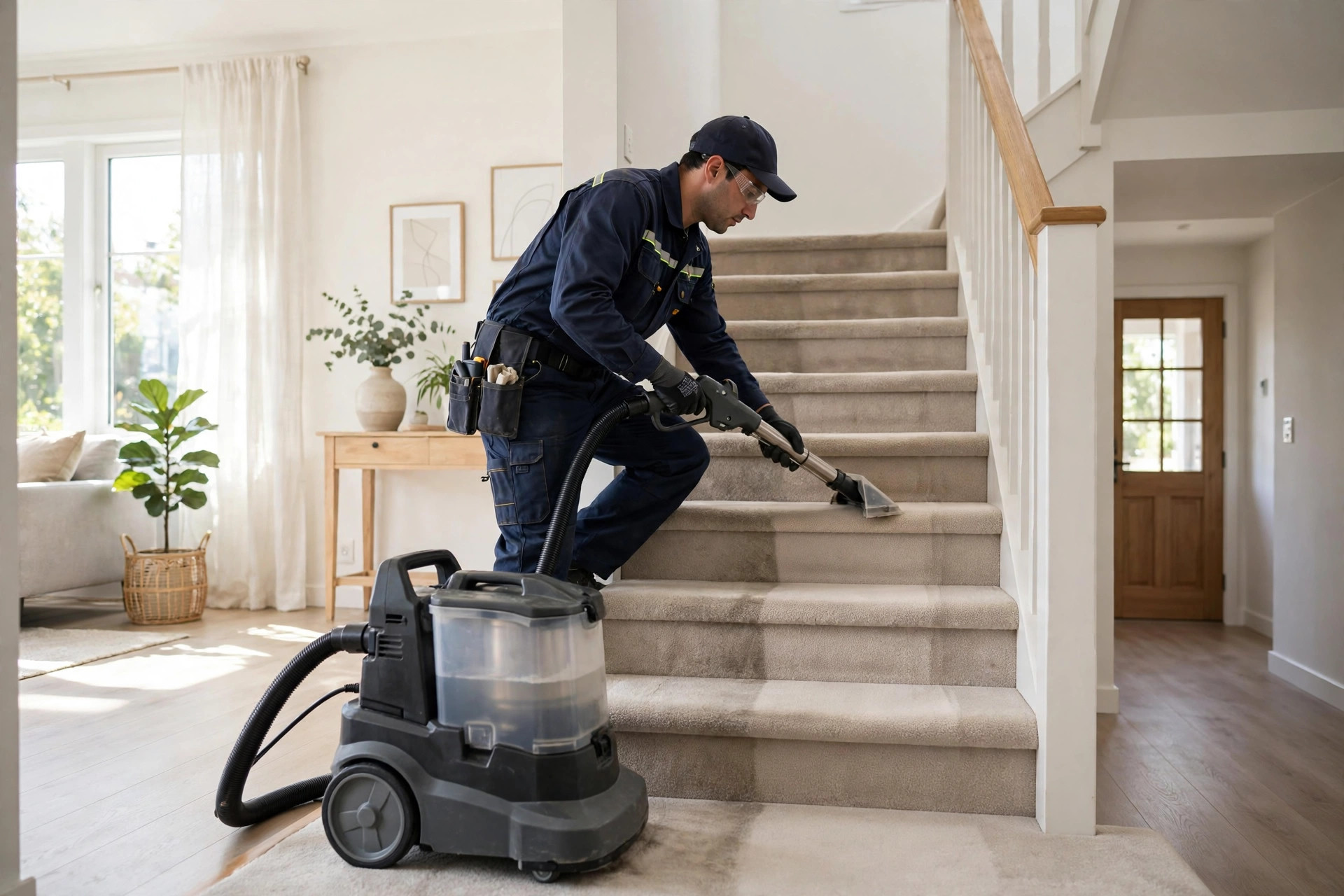
Every call answered while the crew is on a job is a booking your competitor never gets a chance to steal.
AI receptionist vs hiring office help
The honest comparison is not AI versus nothing; it is AI versus the part-time dispatcher most owners consider hiring. The table below lays out the trade-offs for a typical carpet cleaning company.
| Factor | AI receptionist | Part-time office help |
|---|---|---|
| Monthly cost | $200 to $600 | $1,500 to $2,500 |
| Hours covered | 24 hours, every day, including holidays | 20 to 30 hours a week, business hours only |
| Speed to answer | First ring, every call at once | One call at a time, misses overflow |
| Quote consistency | Same prices and offers on every call | Varies by person, mood, and memory |
| Training | One-time setup, updates in minutes | Weeks to train, retrain on every change |
| Complex judgment | Escalates unusual jobs to you | Handles nuance and upset callers better |
| Upselling | Offers add-ons on every call, never forgets | Inconsistent, depends on the person |
The human wins on judgment: an upset customer, a strange job, a negotiation. The AI wins on everything repetitive: answering instantly, quoting consistently, booking accurately, and never missing a call. Most carpet cleaning companies do not need to choose. The practical setup is the AI handling every call first, with clear escalation to you for anything unusual, and a human touch reserved for the conversations that deserve it. That combination costs less than one part-time hire and covers more hours than two.
Mistakes that break the setup
Loading a wrong rate card. The AI quotes what you tell it. If the rate card has last year’s prices or misses the pet treatment add-on, every quote is wrong. Review the rate card quarterly and after every price change.
No calendar integration. A receptionist that takes “booking requests” and promises a callback is a message taker with a nicer voice. Connect the real calendar so offered slots are real slots, with drive-time buffers your crew trusts.
No escalation rules. Decide in advance which calls go to you: water damage, commercial jobs over your size limit, angry customers, anything the AI cannot price. Unclear rules mean the AI guesses, and guesses create bad bookings.
Skipping the test calls. Call the system yourself twenty times before launch: price shoppers, confused callers, Spanish speakers if you serve them, people who change their minds mid-call. Fix every awkward moment before a real customer hears it.
Hiding it from the team. Tell the crew how it works and where bookings appear. If technicians do not trust the calendar entries, they will double-book by phone and the system looks broken when it is not.
Setting it and forgetting it. Listen to a few calls a month. You will hear questions the AI fumbled and offers that confuse people. Fifteen minutes of review keeps the booking rate climbing.
No backup for outages. Rare, but plan for it: calls should fall back to your mobile or a simple voicemail-to-text if the service ever goes down. Five minutes of setup avoids a bad day.
Your rollout checklist
Work through these in order. Each one builds on the last.
- 1Write the rate card. Per-room prices, minimum charge, stairs, pet treatment, upholstery, and current offers in one document.
- 2Set the quoting rules. Which jobs the AI prices, which get callbacks, and which need on-site estimates.
- 3Connect the calendar. Real availability with drive-time buffers, synced to the phones the crew checks.
- 4Write the greeting and scripts. Your company name, the questions it asks, and the exact offer wording.
- 5Set escalation rules. Who gets transferred, who gets a text alert, and the response-time target for callbacks.
- 6Build the text flows. Instant confirmation, day-before reminder, morning-of arrival note, and review request.
- 7Make twenty test calls. Price shoppers, confused callers, mid-call changes, and after-hours scenarios.
- 8Brief the crew. Where bookings appear, how to read them, and who to tell when a slot looks wrong.
- 9Launch on all calls. Point the business line at the AI and watch the first week of bookings closely.
- 10Review monthly. Listen to calls, update the rate card and offers, and track captured bookings against cost.
Frequently asked questions
How much does an AI receptionist cost for a carpet cleaning company?
Most companies pay $200 to $600 a month all-in, after a one-time setup of $300 to $1,500. A solo truck usually lands at $200 to $300 a month; multi-crew operations with follow-up campaigns run $400 to $600.
Can it really quote carpet cleaning prices accurately?
Yes, because carpet pricing is rule-based: per room, stairs, add-ons, minimums. You load the rate card once and the AI applies it the same way on every call. Jobs outside the rules, like water damage, get escalated to you instead of guessed at.
Will customers know they are talking to an AI?
Most do not think about it. The voice is natural, the conversation flows, and it answers questions directly instead of reading a script. Customers care that someone picked up, quoted a price, and booked the job, not what is behind the voice.
What happens when a caller has a problem the AI cannot handle?
It transfers the call to you or takes a detailed message and texts you instantly, based on the escalation rules you set. Water damage, large commercial jobs, and upset callers go straight to a human.
Does it work after hours and on weekends?
That is its strongest shift. Evenings and weekends produce a large share of carpet cleaning calls, and the AI answers, quotes, and books them exactly like a weekday call. Owners often find new bookings waiting in the Monday morning summary.
Can it connect to my scheduling software?
Yes, if your calendar or job software has an open connection. Most setups sync with Google Calendar, and many connect directly to field service apps. The integration is what makes real-time booking work, so confirm it during setup.
How does it reduce no-shows?
Every booking triggers an instant confirmation text, a day-before reminder with reply-to-confirm, and a morning-of arrival note. Customers confirm with one word or reschedule with a tap, so fewer slots go empty and freed slots can be refilled.
Can it bring back past customers?
Yes. Automated texts go out six months after a cleaning with a one-tap rebooking link, plus review requests after each job. With 25 to 40 percent of buyers becoming repeat clients, this quietly rebuilds the schedule every month.
Is it better than hiring a part-time dispatcher?
For most carpet cleaners, yes on cost and coverage: $200 to $600 a month for 24-hour coverage versus $1,500 to $2,500 for part-time hours. A human still wins on judgment for unusual situations, which is why the best setup pairs the AI with clear escalation to you.
How long does setup take?
One to two weeks: rate card and scripts in the first few days, calendar integration and test calls in the second week. The longest step is usually deciding on the quoting rules and escalation list, not the technology.
Stop losing jobs to voicemail
Digital Hayder builds AI receptionist systems for carpet cleaning companies: every call answered, per-room quotes from your rate card, real calendar booking, confirmations and reminders, and after-hours capture that books while you sleep. Tell us about your call volume and we will design the system around it.
Contact Us