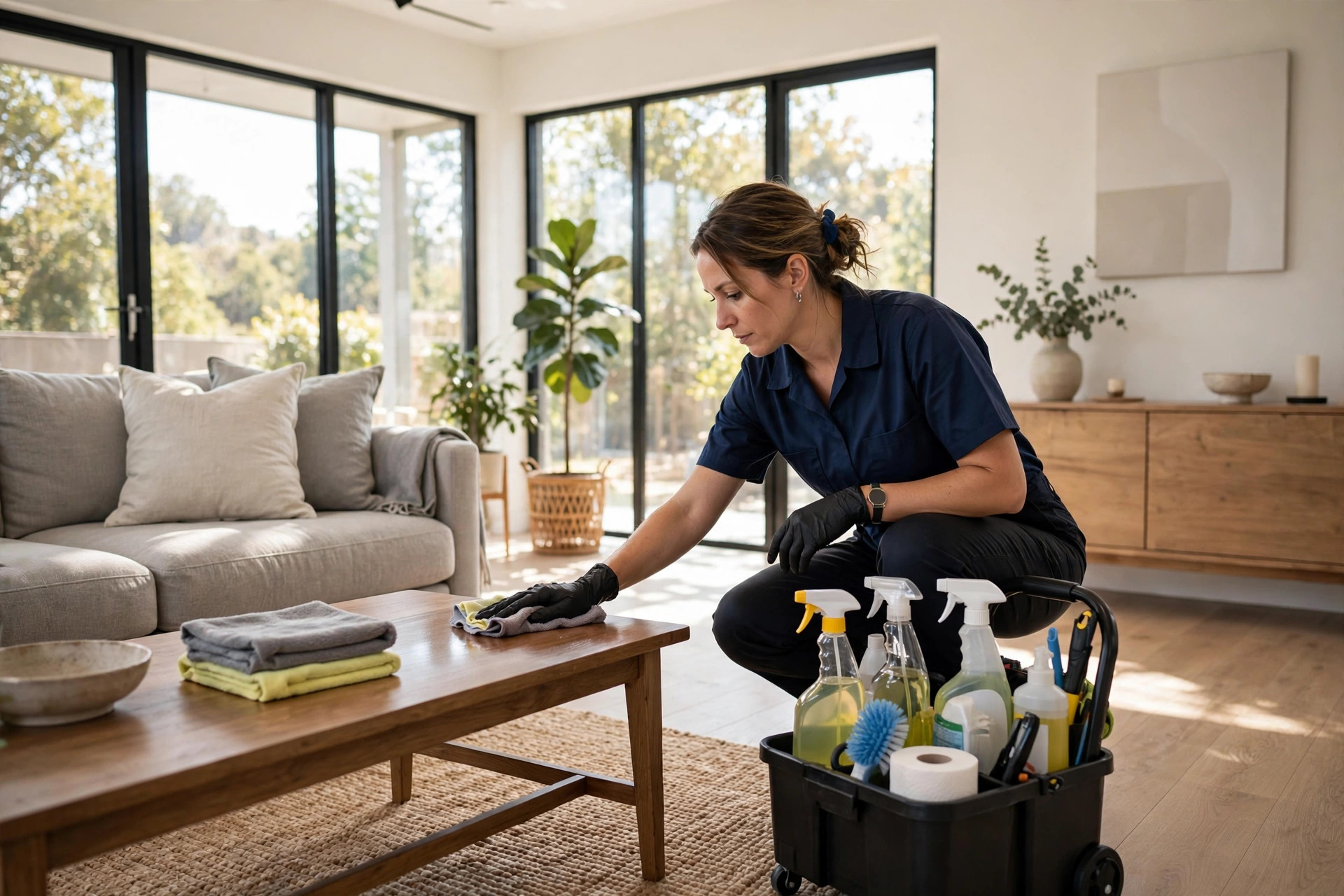
You are on your knees scrubbing a shower when your phone rings in the next room. By the time your gloves are off, the call has gone to voicemail. That caller wanted a quote for a biweekly cleaning, and she is already calling the next company on her list. This is the daily reality of cleaning businesses: the owner is on site doing the work, so the phone rings exactly when nobody can answer it. An AI receptionist for cleaning companies answers every call, gives quote estimates from your pricing rules, checks that the caller is inside your service area, books one time and recurring cleanings into your schedule, and handles reschedules. This guide covers what these systems do for cleaning businesses, why cleaning is one of the strongest fits for an AI receptionist, what to demand before you buy, and the math on quote requests you are currently missing.
The quick answer
- What it does: answers every cleaning company call around the clock, gives quote estimates from your pricing, checks service area coverage, books one time and recurring cleanings, and handles reschedules and cancellations.
- Why cleaning is a strong fit: the owner is on site with gloves on when the phone rings, and industry booking data shows about 38 percent of bookings happen outside business hours.
- Quote math: a standard home cleaning runs $140 to $260, and a recurring biweekly client is worth roughly $1,500 in the first six months. Missing a few quote calls a week is missing thousands a month.
- Speed math: homeowners typically contact three to five companies for a quote, and the first to respond professionally wins the job most of the time.
- Typical cost: roughly $150 to $400 a month for a cleaning company, against the cost of an office hire or the jobs lost to voicemail.
- Setup time: one to two weeks, most of it spent on your pricing rules, service area map, and booking flow.
Why cleaning companies are a perfect fit for an AI receptionist
Most businesses buy an AI receptionist to cover the gaps. Cleaning companies buy one because the gap is the whole job. In a dental office, the front desk is at least near the phone. In a cleaning business, the person who would answer the phone is inside someone’s house with a vacuum running, gloves on, and both hands busy. The phone is in the car, in a bag in the next room, or facedown on a counter where it cannot be heard over the equipment. Every hour of the workday is an hour the phone cannot be answered properly.
The owner is on site when the phone rings
Small cleaning companies run on the owner’s labor. You are the cleaner, the scheduler, the quoter, and the customer service department, and you do all of it between jobs. The callback happens in the car between houses, during lunch, or at 9pm after the last job, which means every quote request waits hours for a response. Meanwhile the homeowner who called at 11am has spent the afternoon calling your competitors.
The math on those missed calls is painful once you write it down. A standard cleaning for a typical home runs $140 to $260. A homeowner who converts to biweekly service at $125 a visit, twice a month, held for six months, is worth $1,500. Industry booking data shows about 38 percent of cleaning bookings happen outside business hours, between 6pm and 8am, when you are definitely not answering. Those are not edge cases. They are more than a third of your demand arriving while you are unreachable.
Quote requests need speed, not just answers
Cleaning quotes are a race. Industry data from adjacent home services shows homeowners typically contact three to five companies when requesting a quote, and the first company to respond with a professional estimate wins the job most of the time. A homeowner requesting a move out clean on a Tuesday needs it done by Friday. She is not waiting for your evening callback. She is hiring whoever gives her a clear number first.
This is why voicemail is so costly for cleaners. A voicemail asks a motivated buyer to wait, and waiting is exactly what she will not do when four other companies are one call away. An AI receptionist answers on the second ring, works through your pricing questions, and gives a quote estimate on the spot, while your competitors’ phones are still ringing out. For more on what your online presence should cost alongside this, see our guide to how much a cleaning business website costs.
What an AI receptionist for cleaning companies actually does
An AI receptionist is a voice system that answers your business line with natural spoken conversation. Callers talk to it the way they would talk to you: they describe the house, ask what it costs, and book the cleaning. Here is the day to day work it takes off your plate.
Gives quote estimates from your pricing rules
The core job is quoting. The AI asks the questions you would ask: How many bedrooms and bathrooms. Roughly how many square feet. What kind of cleaning: standard, deep, or move in and move out. Any pets. When was the last professional cleaning. Then it applies your pricing rules and gives the caller a quote estimate on the spot, with your real numbers.
The pricing rules are yours and they stay exact. Per bedroom and bathroom rates, square footage tiers, deep clean multipliers, pet hair add ons, move out premiums: all of it goes in during setup, and the AI quotes from those rules without improvising. It also knows what to do with the edge cases. A hoarding situation, a post construction clean, or a home far outside your normal scope gets a polite explanation and a path to a custom quote from you, not a made up number. An AI that invents prices is worse than voicemail, so test the pricing with twenty different home descriptions during the trial.
Checks the service area before booking
Nothing wastes a cleaner’s time like booking a job forty minutes outside the service area. The AI checks every caller’s address against your service map before anything gets booked. Inside the area, the call moves to quoting and booking. Outside the area, the AI says so plainly and, if you want, takes the details for a possible travel fee quote or a polite decline. This one feature saves more drive time than most owners expect, because out of area quote requests are constant and each one used to cost you a callback.
Keep the service area definition simple: a list of zip codes or a radius from your base, plus any exceptions you actually serve. Update it when you expand. A service map nobody updates for a year starts declining jobs in neighborhoods you now cover.
Books one time and recurring cleanings
Quoting is only half the job. The other half is getting the cleaning onto the schedule while the caller is motivated. The AI connects to your booking calendar, offers real open slots that fit the job length, and books the cleaning with the quote, the address, and any notes attached. For recurring service, it offers your standard frequencies: weekly, biweekly, or monthly, explains any pricing difference, and sets up the repeating schedule.
Recurring bookings are where cleaning companies make their money, and the AI should sell them the way you would. A caller asking for a one time clean hears the honest math: recurring clients get priority scheduling and a better rate, and most homes do best on a biweekly plan. Automated rebooking data suggests repeat booking rates can reach 52 percent with systematic followup versus 31 percent with manual effort. The AI also handles the confirmation texts and day before reminders, which cut no shows the same way they do in every appointment business.
Every quote call answered is a job your competitors do not get. Speed wins the quote race.
Handles reschedules and cancellations
A large share of cleaning calls are existing clients moving or cancelling appointments. The AI looks up the booking, offers alternative slots for reschedules, and processes cancellations according to your policy: required notice period, cancellation fees, and what happens to the recurring schedule when one visit is skipped. Consistent policy enforcement matters here: clients who learn that late cancellations always carry the fee stop cancelling late.
The AI also protects your route density. When a client cancels, it can offer the open slot to your waitlist or suggest moving a nearby client earlier, keeping your driving efficient. Route density is profit in a cleaning business: every avoided cross town drive is money kept.
What to look for before you buy
Most vendors will show you a polished demo with a simple quote for a standard home. Real cleaning calls are messier: unusual homes, vague descriptions, price shoppers, and callers who change the scope mid call. Judge every option against the five points below.
Pricing rule accuracy
Ask the vendor to load your actual pricing during the trial: every rate, tier, add on, and every exception. Then test it the way callers talk. Describe a three bedroom two bath home with two dogs and ask for a deep clean price. Describe a studio apartment and ask for standard cleaning. Describe a move out clean and check that the premium applies. Then check every quote against your own math. A system that misquotes by even ten percent either loses you money on every job or loses you the job to a competitor with the right number.
Service area handling
Give the vendor your service area definition and test the boundaries. An address just inside the line should book normally. An address just outside should get your out of area response. An address in a neighborhood you do not serve should never get a booking. Also test the vague callers: “I live near the mall” should get a polite request for the zip code, not a guess.
Recurring booking logic
Ask the vendor to demo the recurring setup separately from one time booking, because it is a different flow. The AI should offer your frequencies, explain the pricing, set up the repeating schedule, and handle the skip and pause cases: what happens when a biweekly client skips one visit, and what happens when they pause for a month. If the vendor treats every booking as one time, the product was not built for cleaning companies.
Schedule and notification integration
Name your scheduling tool during the trial and demand a live test. Book a cleaning, reschedule it, cancel it, and set up a recurring plan, and watch your real calendar at every step. Your team needs notifications they will actually see: new bookings, cancellations, and anything unusual, delivered by text or wherever your crew checks. If the system keeps its own separate calendar that someone has to copy over, walk away.
Human handoff that actually works
Test the words a frustrated caller would say: “I want to talk to a person,” “your price is wrong,” “this is complicated.” The handoff should be immediate and obvious, with the conversation notes going to you. Also ask what happens when the AI does not understand a caller after two tries. The right answer is a handoff, not a third guess. And confirm the AI handles the quote disputes gracefully: it should never argue about price, only offer to have the owner call back.
| Question to ask the vendor | Why it matters | A good answer sounds like |
|---|---|---|
| Can you load my exact pricing rules in the trial? | Misquotes lose money or lose jobs | “Yes, send us your rates and we will quote twenty test homes this week.” |
| How does it handle addresses outside my service area? | Out of area bookings waste drive time | A live demo of an inside address booking and an outside address declining politely |
| Can it set up weekly, biweekly, and monthly plans? | Recurring clients are the business | “Yes, including skip and pause handling, which we will demo.” |
| Which scheduling tools do you integrate with? | Manual copying kills adoption | Your tool named specifically, with a tested book, move, and cancel cycle |
| What does it say to a price shopper? | Price shoppers are most of your call volume | “It quotes your rates confidently and offers to book, no discounting.” |
| How are cancellation policies enforced? | Inconsistent enforcement trains bad behavior | “We configure your notice period and fees exactly, applied every time.” |
| What happens when it cannot understand a caller? | Trapped callers hire competitors | Immediate handoff to you with the conversation notes attached |
| How do I review call transcripts? | You need to catch misquotes before jobs do | A review screen with editable bookings and weekly summaries |

Homeowners call when the need hits them, often in the evening. The AI answers and quotes on the spot.
AI receptionist vs hiring office help
Cleaning companies usually compare an AI receptionist against two alternatives: hiring part time office help, or just keeping the phone on themselves and calling back between jobs. Here is the honest comparison.
| AI receptionist | Part time office help | Calling back yourself | |
|---|---|---|---|
| Monthly cost | Roughly $150 to $400 | $1,500 to $2,500 plus training and turnover | $0, but hours of your week |
| Coverage | Every call, 24 hours a day | Only scheduled shifts | Between jobs, evenings, whenever you remember |
| Quote speed | Quotes on the spot, in the first call | Fast during shifts, voicemail otherwise | Hours later, after the caller moved on |
| Consistency | Same pricing rules every call | Varies with training | You know your prices, but you are rushed |
| Recurring setup | Offers plans on every quote call | Depends on the person | Often skipped when you are in a hurry |
| After hours bookings | Books at 9pm on Sunday | No | Only if you answer your cell at dinner |
| Judgment calls | Escalates to you | Handles routine issues, escalates the rest | You handle everything |
The pattern that works for most cleaning companies is the AI plus the owner, not the AI instead of the owner. The AI answers, quotes, and books. You handle the judgment calls, the unusual homes, and the relationships. Your evenings stop being callback sessions, and your workdays stop being interrupted by a phone you cannot reach.
What it costs
Cleaning company AI receptionists price by call volume and integration depth. Typical market ranges:
| Setup | Typical cost | What you get |
|---|---|---|
| Starter, owner operator | $100 to $250/mo | Call answering around the clock, quote estimates, service area check, booking, text confirmations |
| Standard, small team | $200 to $400/mo | Everything above plus scheduling sync, recurring plan setup, reminders, cancellation policy enforcement |
| Growing multi crew | $350 to $600/mo | Everything above plus per crew routing, centralized reporting, review request followup |
Setup fees typically run $0 to $500, covering pricing rule configuration, service area mapping, and schedule connection. If you want the website side covered too, our guide to AI chatbots for home service websites covers quote capture for visitors who prefer to type.
Rolling it out without disrupting the business
The cleaning companies that get value from an AI receptionist treat the first month as a tuning period, not a launch event. This order keeps risk low:
- 1Write your pricing rules first. Every rate, tier, add on, and exception, in writing. If it is not written down, the AI cannot quote it correctly.
- 2Define your service area. Zip codes or radius, plus exceptions. Test addresses on both sides of every boundary.
- 3Connect the schedule. Test a full cycle: quote, book, confirm, remind, reschedule, cancel, set up a recurring plan. Fix anything that needs manual copying.
- 4Run thirty test calls. Include the hard ones: a vague home description, a price shopper, an out of area address, “I want a human,” and a caller who changes scope mid call. Check every quote against your own math.
- 5Start with after hours and overflow. Let the AI cover nights, weekends, and calls that arrive while you are on site for two weeks. Review every transcript, tune the pricing, then expand.
- 6Review transcripts weekly for a month. Look for misquotes, wrong service area decisions, and recurring plan errors. Tune the rules, then move to a monthly review.

Start with after hours coverage, verify every quote against your own math, then expand once the pricing is proven.
Mistakes cleaning companies make with AI receptionists
The most expensive mistake is sloppy pricing rules. If the rates are wrong or incomplete, the AI misquotes on every call, and misquotes either lose you money or lose you the job. Write the pricing down completely and test it hard. The second mistake is a fuzzy service area. Without a clear map, the AI books jobs you cannot serve profitably, and every wasted drive is an hour you will never get back. The third is skipping the recurring flow. The whole economics of a cleaning business runs on repeat clients; an AI that only books one time cleans is leaving the real money alone. The fourth is hiding the human handoff. A caller with an unusual home or a complaint needs you fast, not a third attempt from the AI. The fifth is treating launch day as the finish line. Prices change, the service area expands, and new services get added. A system nobody updates for a year quietly starts quoting last year’s prices to this year’s callers. Finally, do not buy on demo charm. The vendor that loads your actual pricing and maps your actual service area in the trial is showing you the product. The vendor that plays you a recording is showing you marketing.
Frequently asked questions
How much does an AI receptionist for cleaning companies cost?
Cleaning companies typically pay $100 to $250 a month for a starter setup with call answering and quoting, $200 to $400 a month with scheduling integration and recurring plan setup, and $350 to $600 a month for multi crew operations. Setup fees usually run $0 to $500. Compare that to $1,500 to $2,500 a month for part time office help, or the jobs lost to voicemail.
Can an AI receptionist really give accurate cleaning quotes?
Yes, if your pricing rules are loaded completely and tested. Every rate, tier, and add on goes in during setup, and you verify the quotes against your own math with dozens of test homes before going live. The AI quotes from your rules without improvising, and unusual jobs get routed to you for a custom quote.
Will it check whether the caller is in my service area?
The ones built for home services do. You define the area by zip code or radius, and the AI checks every address before booking. Out of area callers get your polite decline or travel fee path instead of a booking you cannot serve profitably.
Can it set up recurring weekly or biweekly cleanings?
It should. Ask the vendor to demo the recurring flow separately: offering your frequencies, explaining the pricing, setting up the repeating schedule, and handling skips and pauses. Recurring clients are the economics of a cleaning business, so this flow matters more than the one time booking flow.
Will callers be put off by talking to an AI instead of me?
Most callers care about getting a clear quote fast, not about who gives it. A system that answers on the second ring and quotes on the spot beats a voicemail that asks them to wait for your evening callback. Be honest that it is automated and make the handoff to you instant for anyone who asks.
Book quotes while you clean
Digital Hayder builds AI receptionists for cleaning companies with exact pricing rules, service area checks, recurring plan setup, and real schedule booking. Tell us your rates and we will map your quote flows before you pay anything.
Contact Us