
Most junk removal customers hire exactly once. A garage cleanout, a sofa that has to be gone today, a rental unit that must be empty by Friday. They do not comparison shop for weeks, they do not remember brand names, and they will probably never hire you a second time. They pick the first company that answers the phone, shows up on time, and looks like it will treat their property with care. That single fact shapes every marketing decision in this business. You are not building a brand people love. You are building a machine that puts your company in front of stressed, time-pressed homeowners at the exact moment they need you, and you are doing it over and over in the same neighborhoods. This guide breaks down the junk removal marketing ideas that actually book jobs: realtor and property manager partnerships, Google Business Profile plays, a review engine, before and after proof, route density marketing, and speed-to-lead. Each idea comes with honest cost and effort numbers, plus the math on what one good property manager account is really worth.
The quick answer
- Partnerships beat ads for repeat work: one active realtor or property manager can send 10 to 30 jobs a year, and each relationship costs almost nothing to build.
- Your Google Business Profile is your homepage: most junk removal customers call straight from the map results, so photos, services, Q and A, and reviews matter more than website design.
- Reviews close the sale: 50 or more recent five-star reviews with fast, personal replies turn a nervous first-time caller into a booked job.
- Before and after photos sell while you sleep: a photo of every single job, posted to your profile and social pages, is the cheapest advertising you will ever run.
- Market the street you are already on: door hangers, yard signs, and neighborhood posts around each job build route density, which cuts drive time and raises profit per job.
- Answer in under five minutes: the first company to respond wins most junk removal jobs, so missed-call text-back and after-hours coverage pay for themselves fast.
Why junk removal marketing works differently
Junk removal breaks most of the normal marketing rules. In most local services, the customer shops around, reads reviews for a week, and comes back next year. None of that happens here. Three traits define the junk removal buyer, and your whole marketing plan should be built around them.
First, the need is urgent. Nobody plans a junk removal job a month out. The sofa is blocking the hallway, the landlord needs the unit empty, the estate has to be cleared before the listing goes live. When the need hits, the customer searches, calls two or three companies, and hires whoever picks up first and sounds competent. Speed beats polish every time.
Second, it is a one-time purchase. A homeowner might need you once a decade. There is no loyalty program, no subscription, no repeat visit to win. That means customer lifetime value is basically one job, usually $150 to $600, with full cleanouts running higher. Every dollar of marketing has to pay back on a single transaction, which rules out expensive, slow-burn brand campaigns.
Third, the trust barrier is high. You are sending strangers into someone’s home or garage to haul things away. The customer’s biggest fear is not the price. It is whether your crew will show up on time, treat the property with care, and not make a mess. Reviews, photos of real jobs, and a professional-looking crew matter more here than in almost any other trade.
These three traits point to a clear strategy. Be findable the moment the need appears, which means Google Business Profile and local search. Be the most trusted option in the first ten seconds, which means reviews and before and after photos. And get your repeat business from referral partners instead of customers, which means realtors and property managers. Everything else is secondary. For a broader look at service-business promotion, our cleaning business marketing ideas guide covers tactics that transfer well to junk removal.
Win the repeat work: realtor and property manager partnerships
If customers only hire you once, the smartest move in junk removal marketing is to find people who hire you fifty times. Realtors and property managers are those people. A single active realtor lists 10 to 20 homes a year, and a surprising share need a cleanout before the listing photographs go up: hoarder situations, estate sales, inherited homes, sellers who moved and left the garage full. Property managers are even better. A manager with 100 to 150 rental units sees constant turnover, evictions, and abandoned property. Every one of those is a job with a motivated buyer and a deadline.
The pitch is simple because you are solving a real scheduling headache for them. Realtors lose listing momentum waiting on cleanouts. Property managers need units turned fast so they stop bleeding rent. What they want from you is not the lowest price. It is reliability: a crew that shows up when promised, photos before and after, and a single point of contact. Walk in with a one-page sheet that states your service area, your typical response time, your price ranges by load size, and one sentence about how you send photo proof of every completed job. Leave it, shake hands, and follow up in two weeks.
Follow-up is where most owners quit too early. One visit does not build a referral habit. Plan on touching each partner monthly for the first quarter: a quick text with a recent before and after from their neighborhood, a coffee drop-off, a short note when you finish a job for another agent in their office. After three months of steady contact, you become the name they think of when a cleanout comes up. It costs you almost nothing, and one working relationship can out-produce an entire ad campaign.
Do not stop at realtors and property managers. Storage facility managers deal with abandoned units. Estate attorneys and probate contacts handle inherited homes. General contractors and remodelers generate construction debris they would rather not haul themselves. Each of these sends a few jobs a year, and together they form a base of recurring work that smooths out the slow weeks. The table below ranks the partner types worth pursuing.
| Partner type | Typical jobs per year | What to offer them |
|---|---|---|
| Property managers | 15 to 40 | Priority scheduling, volume pricing, photo proof of every job, one monthly invoice |
| Realtors | 5 to 20 | Fast pre-listing cleanouts, before and after photos they can show sellers, weekend availability |
| Storage facilities | 5 to 15 | Abandoned-unit clearouts on short notice, per-unit flat pricing |
| Estate attorneys | 3 to 10 | Full-home cleanouts, donation receipts where possible, patient timelines |
| Contractors and remodelers | 5 to 15 | Debris haul-away between phases, flexible pickup windows |
| Apartment complexes | 10 to 30 | Turnover cleanouts, bulk-item pickup for tenants, scheduled weekly runs |

Realtors need cleanouts before listings go live, which makes each active agent a source of repeat jobs all year.
Your Google Business Profile is your real homepage
Here is the uncomfortable truth for most junk removal companies: customers do not visit your website first. They search “junk removal near me,” see the map with three businesses, and call one of them. Your Google Business Profile is the page that wins or loses that moment. Treat it like your most important asset, because it is.
Start with the basics, done completely. Primary category set to Junk Removal Service. Every service listed with a plain-English description and a price or price range: single item pickup from $75, quarter truckload, half truckload, full truckload, garage cleanout, estate cleanout, eviction cleanout, yard debris removal. Real price ranges filter out tire-kickers and pre-sell serious callers before they dial. Add your true service area, every town you will actually drive to, and your real hours, including whether you take evening or weekend jobs.
Photos are the highest-payoff work on the profile. Google rewards profiles that add new photos regularly, and customers judge you by them. Post at least one new photo a week: the crew at work, the truck, and above all the before and after shots from real jobs. A profile with 100 real job photos crushes a profile with five stock images of smiling models. Name the photos descriptively when you upload them, since that helps them surface in searches.
Use the Q and A section before customers do. Seed it with the ten questions you hear on every call: How much does a full truckload cost? Do you take mattresses? How fast can you come? Do I need to be home? Do you donate or recycle? Answer each one in two or three sentences. When real customers ask new questions, answer within a day. Google shows your responsiveness, and prospects read every word.
Finally, post weekly updates. A short post with a recent before and after photo, a same-day availability notice, or a seasonal reminder keeps the profile fresh and gives Google new content to show. Track profile calls separately from website calls if you can, because the profile usually drives the majority of inbound jobs, and you want to know exactly how many.
Build the review engine
In a business where the customer hires a stranger to enter their property, reviews are not a nice extra. They are the entire trust mechanism. The company with 80 recent five-star reviews beats the company with 6, even when the second one is cheaper and faster. Your goal is 50 or more reviews, recent and specific, with a system that keeps new ones arriving every week.
The ask has to happen at the job, not later. The best moment is right after payment, when the customer is standing in their clean garage feeling relieved. Your crew says one sentence: “If everything looked good today, a quick review would really help our small business. I can text you the link.” Then the text goes out within the hour with the direct review link, not a link to your homepage. Every extra click loses reviews. Make the link go straight to the review form.
Respond to every single review within 24 hours, good and bad. For good reviews, mention specifics: the street, the job type, the crew member’s name. “Thanks, Maria. Glad we could clear the garage on Elm Street same-day. Dave and crew appreciated the cold water.” Specific replies prove the reviews are real and show future customers what working with you feels like. For bad reviews, respond once, stay calm, state the facts briefly, and move the conversation to a phone call. Never argue in public.
Watch your review velocity, not just the total. Ten new reviews a month beats 200 old ones for map rankings. If reviews stall, the problem is almost always the ask, not the service. Mystery-shop your own crew: are they actually asking, every job, or only when they remember? Tie a small bonus to review counts and watch the numbers move.
Before and after photos are your best salesperson
No other content sells junk removal like a transformation photo. A picture of a garage buried in boxes next to the same garage swept clean tells the whole story in two seconds. It answers the customer’s real question, which is not “how much” but “can these people actually handle my mess.” Every job you finish is a free advertisement waiting to be captured, and most companies leave it on the table by never taking the photo.
Make photography part of the job, not an extra. The crew takes a wide before photo on arrival and a matching after photo when the truck is loaded. Same angle both times, so the transformation is obvious. Pay a small bonus per usable photo pair if you have to; it is the cheapest content you will ever buy. Store them in a shared folder organized by job type: garages, estates, evictions, yard debris, single items. Within a month you will have a library that covers every service you sell.
Then put those photos everywhere they can work. Upload them to your Google Business Profile weekly. Post them on Facebook and Instagram with the neighborhood name and the job type. Put the best ones on your website’s gallery page and on each service page. Short video clips of the transformation work even better on TikTok and Reels, where junk removal cleanouts are a proven viral format. One crew member with a phone can produce a month of content from a single busy week.
The compound effect is what matters. Each photo makes the next customer more likely to call, and each call is a chance to capture two more photos. Companies that photograph every job for a year end up with a visual record that no competitor can match without doing the same work. It is a moat built one garage at a time, and it costs nothing but discipline.

The “before” half of the most powerful ad a junk removal company can run. Photograph every job and the marketing builds itself.
Route density: market the street you are already on
The most profitable junk removal companies do not drive all over the metro area chasing single jobs. They stack jobs close together, which cuts fuel, cuts drive time, and lets the crew finish more jobs per day. Route density is an operations idea, but marketing is how you build it. Every job should generate the next three jobs on the same street.
The door hanger is the workhorse here. After each job, hang 30 to 50 door hangers on the surrounding houses with a simple message: “We just cleared a garage on this street. Same-day pickup available this week.” Include a photo of a recent local job, your phone number in large type, and a small discount for neighbors. The timing is perfect because the neighbors may have seen your truck, and social proof is strongest within a few doors of the original job.
Yard signs work the same way during the job itself. With the customer’s permission, place a sign at the curb while the crew works: “Garage cleanout in progress by” plus your name and number. Passersby and dog walkers are exactly your future customers, and the sign connects your brand to visible, real work happening right now. Collect the sign when the crew leaves.
Take the same before and after photos to Nextdoor and local Facebook groups. Post the transformation with the neighborhood name and an offer for neighbors. These posts routinely outperform paid ads for junk removal because the audience is hyper-local and the proof is undeniable. Finally, build one service page per town on your website. Each page names the town, shows local job photos, and lists the services. Those pages capture “junk removal” plus town-name searches and feed the map rankings too.
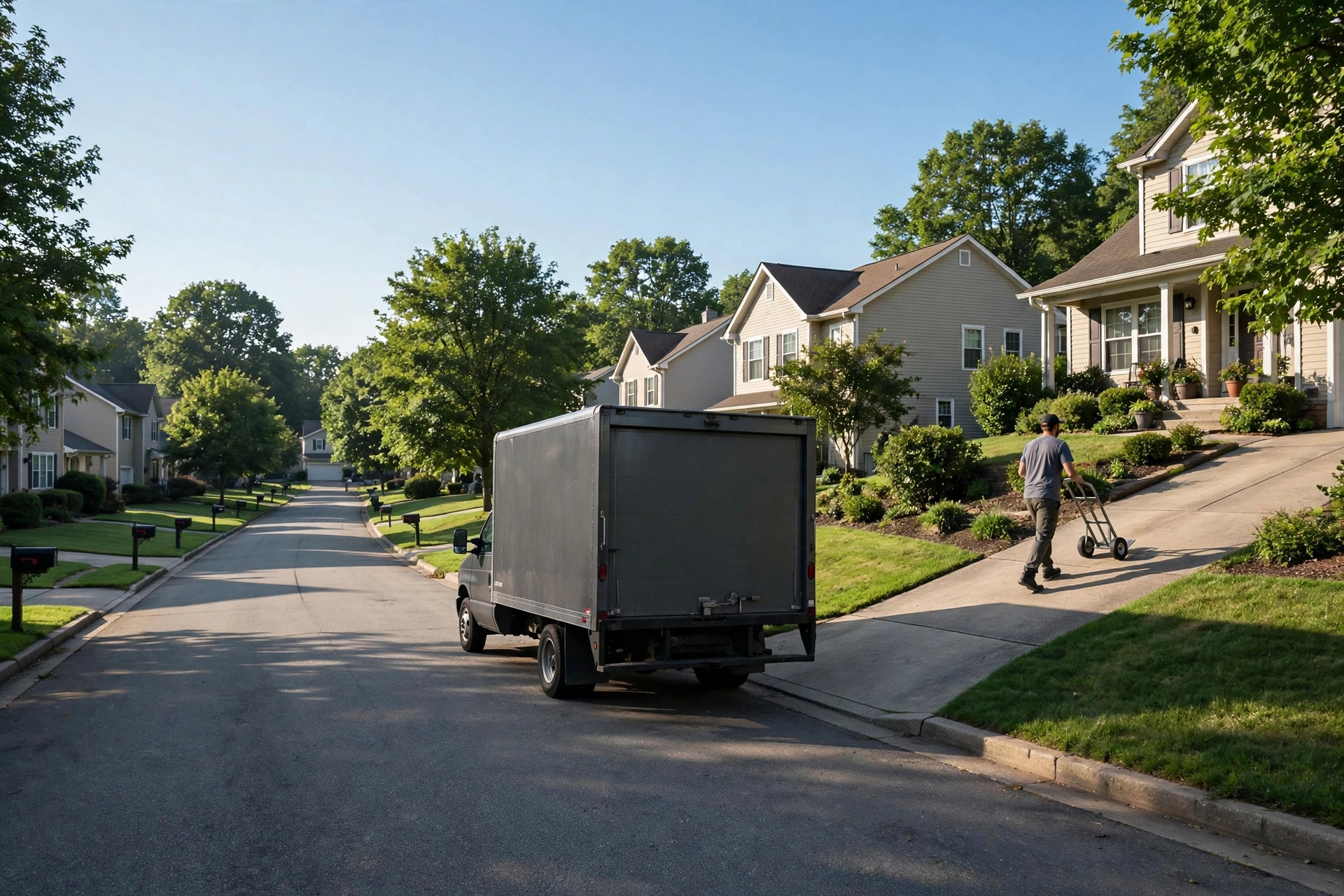
Every job on a street is a chance to book the next three. Door hangers, yard signs, and neighborhood posts turn one visit into route density.
Speed-to-lead: answer first, book the job
Home-service research keeps landing on the same finding: the first company to respond wins the job far more often than the second or third. Junk removal is the extreme case, because the customer is standing next to a pile of junk they want gone today. If you call back in two hours, they have already hired someone. If you answer in two minutes, the job is yours to lose.
The leak most companies ignore is the missed call. A large share of junk removal inquiries arrive while the crew is on a job, hauling, with no free hand for the phone. Every one of those missed calls used to be a lost job. A missed-call text-back system fixes it: the moment a call goes unanswered, the caller automatically gets a text like “Sorry we missed you, we are on a job. What do you need hauled away? Send a photo for a fast quote.” That single automation recovers jobs that were already paid for by your other marketing. Our guide to missed-call text-back for junk removal companies walks through the exact setup.
After hours is the second leak. Evening searches spike because that is when homeowners finally deal with the garage. An AI chatbot for junk removal companies or a simple after-hours answering setup can take the details, give a price range, and book the job for the morning. Even a voicemail that promises a callback by 8 AM beats silence, but instant beats everything.
Quote speed matters as much as answer speed. Train whoever answers the phone to give a price range on the first call using the customer’s photos. “Send me two photos of the pile and I will give you a firm price in five minutes” beats “we can schedule a free estimate Thursday.” The company that prices fastest usually books the job, because the customer stops shopping the moment they have a number they trust.
Every idea, ranked by cost and effort
Not every idea deserves the same budget. Below is every major junk removal marketing idea ranked by what it costs and what it takes to run, so you can pick the ones that fit where your company is right now. Start at the top of the list and work down. The first five cost almost nothing and produce most of the results.
| Marketing idea | Typical monthly cost | Effort level | What it produces |
|---|---|---|---|
| Google Business Profile optimization | $0 | Medium, then low | More calls from the map pack, the top source of jobs for most companies |
| Review engine | $0 to $50 | Low | Trust that converts callers; 50 plus reviews changes close rates |
| Before and after photos | $0 | Low | Content for profile, social, and website that sells around the clock |
| Realtor and property manager partnerships | $50 to $200 | High at first, then low | 10 to 40 repeat jobs a year per active partner |
| Door hangers and yard signs | $100 to $300 | Medium | Route density: more jobs per day, less drive time |
| Missed-call text-back | $30 to $100 | Low | Recovers jobs from calls you already paid to generate |
| Nextdoor and local groups | $0 | Medium | Hyper-local trust and neighbor referrals |
| Website rebuild or upgrade | $1,500 to $5,000 one time | Low for you | A quote-focused site that converts ad and search traffic; see our carpet cleaning website cost breakdown for comparable pricing |
| Facebook and Instagram ads | $500 to $2,000 | Medium | Before and after creative works; needs tight geo-targeting |
| Google Ads | $1,500 to $5,000 | Medium | Immediate calls at $30 to $80 per click; requires call tracking to stay profitable |
Mistakes that burn the marketing budget
Running Google Ads with no call tracking. Junk removal clicks are expensive, and most conversions happen by phone. If you cannot tie each call to the ad that produced it, you cannot tell a profitable campaign from a money fire. Set up call tracking before you spend the first dollar.
A pretty website with no reviews. Owners spend thousands on design while their Google profile shows four reviews. Flip the priority. Reviews and photos close junk removal jobs; design is a distant third. Build the trust assets first.
Marketing in bursts. A month of door hangers, then nothing for six months, produces nothing. Every idea on this list works on consistency: weekly photos, monthly partner visits, daily review asks. Pick three ideas and run them for a year instead of ten ideas for a month.
Ignoring commercial work. Offices, retail stores, and property cleanouts pay more per job and repeat more often than residential one-offs. One commercial account can be worth twenty residential jobs. Add a commercial page to your site and pitch it to every partner on your list.
Stock photos instead of real crews. Customers can spot stock photography instantly, and in a trust business it actively hurts. Your crew, your truck, your jobs. Real beats polished every time.
No system for the photos. The crew takes great before and after shots, and they sit on someone’s phone forever. Build the shared folder, assign someone to post weekly, and make it part of the job checklist. Content that never gets posted is the same as content never captured.
Your rollout checklist
Work through these in order. Each one builds on the last.
- 1Claim and complete your Google Business Profile. Category, services with price ranges, service area, hours, and 20 starter photos.
- 2Start the photo protocol. Before and after shots on every job, same angle, into a shared folder the same day.
- 3Set up the review text. A direct review link sent by text within an hour of every completed job.
- 4List your partners. 20 realtors, 10 property managers, plus storage facilities and contractors in your service area.
- 5Print the one-page partner sheet. Service area, response time, price ranges, and your photo-proof promise.
- 6Visit five partners a week for a month. In person, brief, with the sheet. Follow up with every one of them twice.
- 7Turn on missed-call text-back. Every unanswered call gets an instant text offering a fast photo quote.
- 8Start the door hanger routine. 30 to 50 hangers around every job, plus a yard sign during the work with permission.
- 9Post weekly. One before and after set to your profile, one neighborhood post to Nextdoor or local groups.
- 10Track cost per booked job monthly. Keep what books under your target cost, cut or fix everything else.
Frequently asked questions
How much should a junk removal company spend on marketing?
Plan on 5 to 10 percent of revenue. For a one-truck operation doing $15,000 a month, that is $750 to $1,500 a month. Spend the first dollars on free and cheap ideas, partnerships, reviews, photos, and missed-call text-back, before touching paid ads.
Do Google Ads work for junk removal?
Yes, but they are expensive, often $30 to $80 per click in competitive markets, and they only work with call tracking and a fast quote process. Most companies should build the free channels first and add Google Ads once the review base and response speed can convert the clicks.
How do I get realtors to refer me?
Offer what they actually need: same-day or next-day pre-listing cleanouts, before and after photos they can forward to sellers, and weekend availability. Visit in person with a one-page sheet, then follow up monthly for a quarter. Reliability beats low prices for this audience.
How many Google reviews does a junk removal company need?
Fifty is the practical minimum to compete in most markets, and recent matters as much as total. Ten new reviews a month keeps you ahead of competitors whose reviews are two years old. Ask by text within an hour of every job.
Should I run Facebook ads for junk removal?
Before and after creative can work on Facebook and Instagram with tight geo-targeting around your service area. Cold prospecting is weaker than Google search for urgent needs, so treat social as a supplement, not the core channel.
What is route density marketing?
It is marketing designed to stack jobs close together: door hangers and yard signs around each completed job, neighborhood posts on Nextdoor, and service pages per town. Denser routes mean less drive time, more jobs per day, and higher profit per job.
Do I need a website if my Google Business Profile brings the calls?
Yes, for two reasons. Paid ads need a landing page that converts, and some customers check the website before calling to confirm you are legitimate. It does not need to be fancy: services, prices, photos, reviews, and a big phone number.
How fast should I respond to a new lead?
Under five minutes is the target. The first company to respond wins most junk removal jobs, so use missed-call text-back for unanswered calls and an after-hours answering setup for evenings and weekends.
Should I offer free estimates?
Offer fast phone estimates from customer photos for standard jobs, and reserve in-person estimates for full cleanouts and estates. “Send two photos, get a firm price in five minutes” books more jobs than “we can come look Thursday.”
How do I market during the slow season?
Lean into partnerships and commercial work, which do not follow the residential seasons. Estate cleanouts, eviction turnovers, office moves, and contractor debris run year-round, and winter is the best time to build the realtor relationships that pay off in spring.
Get a marketing system that books jobs while you haul
Digital Hayder builds marketing systems for junk removal companies: Google Business Profile optimization, review engines, missed-call text-back, AI chat, and websites built to convert. Tell us about your operation and we will map the fastest path to more booked jobs.
Contact Us