Junk removal runs on speed. A customer with a garage full of old furniture wants it gone this week, not next month, and they search Google at the exact moment they are ready to hire. That is what makes Google Ads so powerful for hauling companies, and so expensive when it is set up wrong. Junk removal keywords are some of the priciest in home services, because every click is a customer with cash in hand. This guide breaks down what junk removal companies actually pay per click, what monthly budgets make sense for one truck or five, when to use call-only ads versus full search campaigns, what your landing page must do, and the real math on cost per booked job.
The quick answer
- Clicks are pricey: core junk removal keywords typically cost $8 to $18 per click, with specialty terms like hoarding cleanup running $12 to $25.
- Budget by truck: a single-truck operation usually needs $1,500 to $3,000 a month; multi-truck companies often spend $5,000 or more.
- Call-only ads win for urgent jobs: customers searching “junk removal near me” want to call now, so call-only campaigns often book cheaper than website campaigns.
- The landing page sets your cost: a focused page with instant quote options can cut your cost per lead nearly in half versus sending traffic to your homepage.
- Expect $120 to $250 per booked job: at typical conversion rates, that is the all-in ad cost of one paying hauling job from Google Ads.
- Start narrow, then expand: launch with your five best keywords and a tight service area, prove the math, then scale the budget.
What junk removal companies pay per click
Google Ads charges per click, and in junk removal those clicks cost real money. The reason is competition and intent. “Junk removal” as a search term is almost pure buying intent: nobody researches junk removal for fun. Every hauler in your market bids on the same small set of keywords, and Google’s auction rewards the highest bidders. In most US metro markets, the core keyword set lands between $8 and $18 per click. Smaller markets run a few dollars cheaper; dense metros like New York, Los Angeles, and Chicago run higher.
Specialty keywords cost more because the jobs pay more. Hoarding cleanup, estate cleanouts, and commercial junk removal keywords regularly clear $12 to $25 per click, because a single booked job can be worth $1,000 to $5,000. Long-tail searches like “couch removal near me” or “mattress disposal pickup” are cheaper, often $5 to $10, and they convert well because the customer has already decided exactly what they need gone.
Two things move your actual cost per click more than anything else. The first is Quality Score: Google discounts clicks for ads and landing pages it judges relevant, so a tight ad matched to a tight landing page can pay 20 to 30 percent less than a sloppy competitor bidding on the same keyword. The second is time of day and device. Most junk removal searches happen on phones during daytime hours, and mobile clicks in the evening, when customers plan weekend cleanouts, can run cheaper with less competition. A smart schedule trims waste before you spend a dollar more.
The keywords that eat your budget
Not all junk removal keywords deserve your money. The table below shows typical cost-per-click bands for the terms haulers bid on most, plus how each one tends to convert.
| Keyword | Typical CPC band | Intent level | Notes |
|---|---|---|---|
| junk removal | $8 to $18 | Very high | The core term; expensive but books consistently |
| junk removal near me | $9 to $20 | Very high | Mobile-heavy; ideal for call-only ads |
| furniture removal | $7 to $14 | High | Strong converter; add as its own ad group |
| couch removal / sofa removal | $6 to $12 | High | Cheaper clicks; great for single-item jobs |
| mattress removal / mattress disposal | $5 to $11 | High | Lower cost; watch for low-margin jobs |
| hot tub removal | $10 to $18 | Very high | Pricey clicks but jobs run $400 to $800 |
| hoarding cleanup | $12 to $25 | Very high | Big tickets; needs a sensitive landing page |
| estate cleanout | $9 to $16 | High | Often multi-load jobs worth $1,000 plus |
| commercial junk removal | $10 to $22 | High | Longer sales cycle; worth it for contracts |
| free junk removal | $2 to $5 | None | Add as a negative keyword on day one |
Notice the last row. “Free junk removal” and its cousins, “free couch pickup,” “junk removal free near me,” are budget killers. The clickers want a freebie you do not offer, and they will never book. Negative keywords are free to add and they save real money: block “free,” “DIY,” “dumpster rental” (unless you offer it), “jobs,” “salary,” and “donate” from day one. Review the actual search terms report weekly for the first two months and keep adding negatives. Most wasted ad spend in junk removal comes from searches the owner never looked at.
Monthly budgets that make sense
The right budget depends on trucks, market, and how full your schedule already is. A company with one truck and open days needs enough clicks to fill the week; a five-truck operation with full routes needs ads to feed growth, not survival. The budget tiers below are starting points for a single metro service area.
Test budget
For a new advertiser proving the math in a small or mid-size market. Covers your five best keywords in a tight radius.
- 5 to 8 core keywords, exact and phrase match only
- One landing page with click-to-call and a quote form
- Ads running daytime hours, mobile-first
- Expect 8 to 15 booked jobs a month once tuned
Growth budget
The sweet spot for most single-truck and two-truck companies. Enough volume to keep the schedule full and test new keywords.
- Full keyword set plus specialty terms like hot tub removal
- Call-only campaigns alongside search campaigns
- Separate landing pages for furniture, cleanouts, and commercial
- Expect 15 to 35 booked jobs a month once tuned
Scale budget
For multi-truck operations and competitive metros. Funds broader coverage, longer hours, and remarketing to site visitors.
- Multiple campaigns by service line and by city
- Evening and weekend coverage when competitors go dark
- Remarketing to quote-form abandoners
- Expect 35 to 80+ booked jobs a month once tuned
Whatever tier you pick, treat the first month as paid research. Your cost per booked job will be higher in weeks one and two while Google learns and you add negative keywords. Judge the campaign at day 45, not day 10. Owners who panic and pause after a week of expensive clicks never get to the tuned phase where the math actually works. If paid search feels steep next to free channels, remember that review-driven local rankings compound for free; the smartest companies run both.

Most junk removal searches happen on phones at the moment of need, which is why mobile-first ads and instant calling win the click.
Call-only ads vs search campaigns
Junk removal customers mostly want one thing: a truck at their curb soon, with a price they can live with. That makes the phone call the conversion that matters, and Google offers two different ways to get it. Understanding the trade-off is the single most important campaign decision you will make.
| Factor | Call-only ads | Search campaigns (to a landing page) |
|---|---|---|
| What the customer sees | Your phone number as the headline; one tap calls you | A normal text ad that opens your landing page |
| Best for | Urgent same-day jobs; mobile searches | Quote shoppers; bigger cleanouts; commercial |
| Cost per click | Often 10 to 20 percent cheaper than search clicks | Standard auction pricing |
| Conversion tracking | Built in: calls over a set length count as conversions | You track form fills and calls from the page |
| After-hours weakness | Calls go unanswered if nobody picks up | The form captures the lead for morning follow-up |
| Quote shoppers | Poor fit: callers want a price on the spot | Better: the page can show pricing guidance first |
The winning setup for most haulers is both. Run call-only ads during business hours when your team can answer, because a answered call books at a far higher rate than a form fill. Run search campaigns to a strong landing page in the evenings and for bigger-ticket keywords like estate cleanouts, where customers compare options before calling. The critical detail: if you run call-only ads, someone must answer the phone. Every unanswered call from a $12 click is money burned. If after-hours calls go to voicemail, pair the ads with an AI chatbot for junk removal companies or a missed-call text-back system so the lead gets a response in seconds instead of silence.
Your landing page decides your cost per job
Two junk removal companies can bid on the same keyword, pay nearly the same per click, and end up with wildly different costs per booked job. The difference is the landing page. Sending ad traffic to your homepage is the most common and most expensive mistake: the homepage talks about everything, so the visitor does a little reading and leaves. A dedicated landing page talks about one thing, the exact service they searched for, and pushes toward one action.
Every junk removal landing page needs the same core elements. The headline must match the search: “Furniture Removal in [City]” for the furniture ad, not a generic “Welcome to our site.” The phone number must be big, clickable, and visible without scrolling on a phone. A short quote form, name, phone, zip, what needs hauling, with three fields or fewer, catches the shoppers who will not call yet. Trust signals go right under the headline: star rating, review count, “licensed and insured,” and photos of real trucks and crews, not stock images. Price guidance matters enormously in this trade: a simple “most single-item pickups run $X to $Y” line filters out price mismatches and lifts conversion, because shoppers who see no prices assume the worst and bounce.
Speed is a conversion factor, not a technical nicety. A page that loads in over three seconds on a phone loses a large share of paid clicks before the headline even appears, and you still paid for those clicks. Compress images, skip the video background, and test the page on a real phone over a cellular connection. Finally, match one page to one ad group. The couch removal ad opens the couch removal page. The hoarding cleanup ad opens a page written with care for that sensitive situation. Relevance raises Quality Score, which lowers your cost per click, which lowers your cost per job. The landing page is where ad spend turns into profit or into waste.
Google Ads vs other ways to get junk removal jobs
Google Ads is not the only way to fill a truck. It is the fastest and most controllable, but the cost per job should be weighed against the alternatives most haulers already use.
| Channel | Typical cost per booked job | Speed | Trade-offs |
|---|---|---|---|
| Google Ads (tuned campaign) | $120 to $250 | Jobs within days of launch | Needs management; costs rise with competition |
| Google Business Profile / local SEO | Near zero after setup | Months to build | Free jobs once ranked, but slow and competitive |
| Lead marketplaces (per-lead services) | $40 to $120 per lead, not per job | Immediate | Shared with competitors; close rates are low |
| Facebook / Instagram ads | $80 to $200 per booked job | Days to weeks | Interruption marketing; weaker intent than search |
| Truck wraps and yard signs | $30 to $80 amortized | Ongoing | Great local branding; no targeting control |
| Referrals and repeat customers | Near zero | Ongoing | Best margin; limited volume without a system |
The pattern is clear: nothing beats search intent for speed, and nothing beats owned channels for margin. Most healthy junk removal companies run Google Ads for predictable volume while building reviews and local rankings that lower the blended cost per job over time. Cost benchmarks vary by trade, but the structure is the same everywhere; compare with our breakdowns of roofer Google Ads costs, plumber Google Ads costs, and electrician Google Ads costs to see how click prices and job values balance out in neighboring trades.

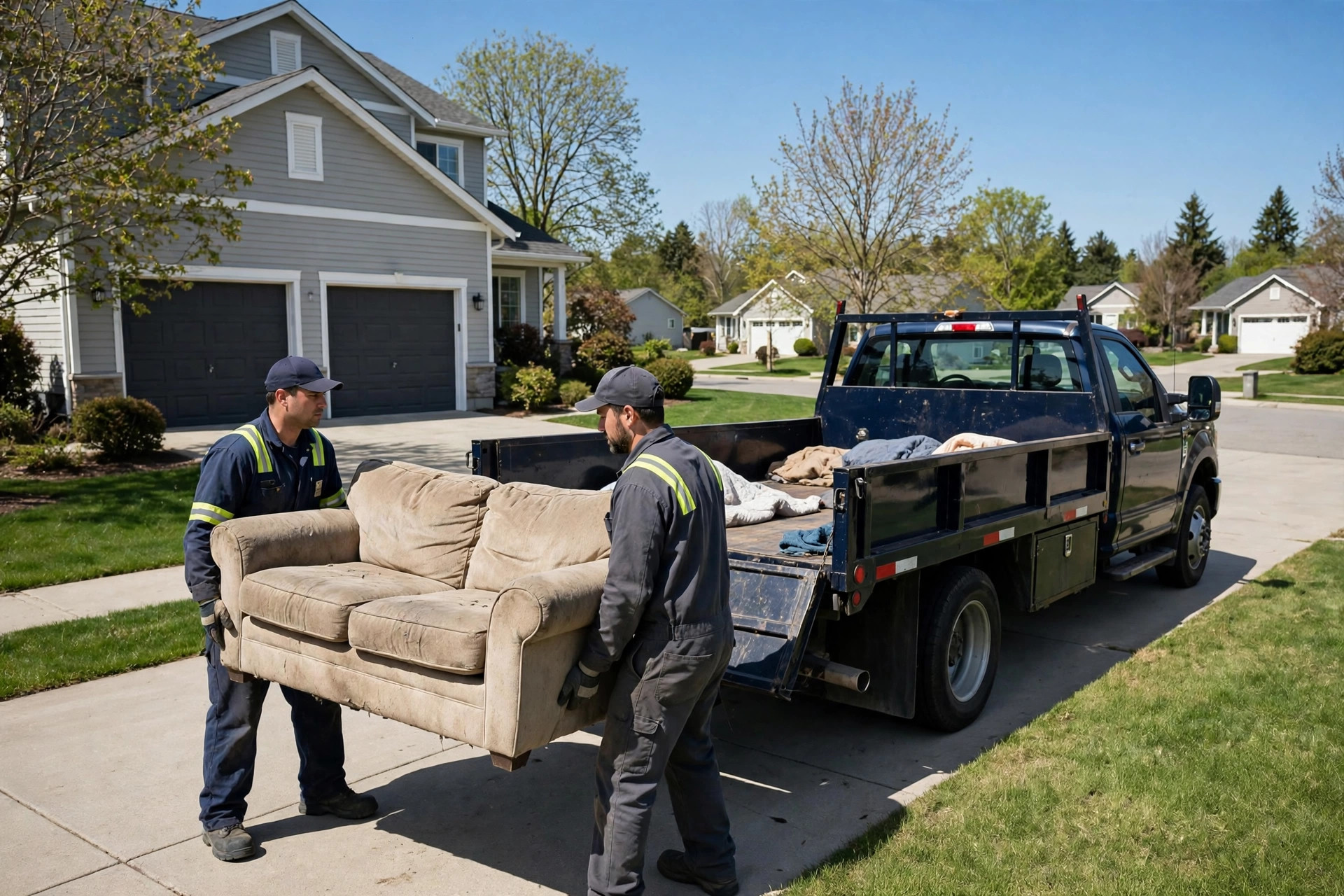
Every paid click should end at a truck like this one: the ad, the landing page, and the crew all sell the same promise of fast, clean hauling.
A sample $2,000 monthly budget, line by line
Budgets get real when you see where every dollar goes. Here is a realistic $2,000 monthly plan for a single-truck junk removal company in a mid-size market, after the first tuning month.
| Budget line | Monthly amount | What it buys |
|---|---|---|
| Core search campaign (junk removal terms) | $900 | About 70 clicks at ~$13 average CPC |
| Call-only campaign (mobile, business hours) | $600 | About 55 calls at ~$11 average cost per call |
| Specialty campaigns (furniture, hot tub, cleanouts) | $350 | About 30 clicks at ~$12 average CPC |
| Remarketing to site visitors | $150 | Cheap reminder ads to quote-form abandoners |
| Management (DIY or agency) | $0 to $500 | DIY costs time; agencies typically charge $300 to $800 |
Now the funnel math on that $2,000 in ad spend. Roughly 155 paid interactions (clicks plus calls) enter the funnel. A tuned junk removal funnel converts about 20 percent of those into real leads, people who talk to you or submit the form, which is 31 leads. A decent sales process closes 40 to 50 percent of leads into booked jobs, so call it 14 jobs. Fourteen jobs at an average ticket of $350 is $4,900 in revenue against $2,000 in ad spend, or about $143 per booked job. That is a healthy ratio for this trade, and it improves as Quality Scores rise and negative keyword lists grow. The same structure scales: double the budget in the same market and you roughly double the jobs until you saturate your service area, at which point expansion means new cities, not bigger bids.
The money math on cost per booked job
The only number that matters in Google Ads is cost per booked job, not cost per click. Clicks are a means; booked jobs pay the truck note. Here is how to think about it for your own company. Take your average job ticket: for most residential haulers it lands between $250 and $450. Multiply by your gross margin after disposal fees, fuel, and labor, typically 40 to 55 percent for a well-run truck. A $350 job at 50 percent margin leaves $175 in gross profit. If your cost per booked job stays under that $175, every ad dollar earns its keep; the gap between the two is your true return.
Work it backward to set your targets. If you need cost per booked job under $175 and your close rate on leads is 45 percent, you can afford to pay up to about $79 per lead. If 20 percent of clicks become leads, you can afford up to about $16 per click. That one chain, ticket to margin to close rate to click value, tells you exactly which keywords you can afford and which to avoid. Keywords above your affordable CPC are not bad keywords; they are keywords for a company with a higher ticket or a better close rate. Raise your average ticket with upsells like garage cleanouts and donation runs, tighten your phone script to lift close rates, and keywords that were too expensive suddenly fit.
Mistakes that burn ad spend
Sending traffic to the homepage. The homepage converts at half the rate of a dedicated landing page. Every campaign needs its own page matched to the ad.
Running ads nobody answers. Call-only ads with calls rolling to voicemail are the fastest way to burn money in this trade. Answer live during ad hours or route after-hours calls to a text-back system.
Skipping negative keywords. “Free,” “jobs,” “DIY,” and “donate” searches will happily spend your budget. Check the search terms report weekly at first.
Bidding on your whole state. Junk removal is local. A 20 to 30 mile radius around your base, tightened by zip code once you see the data, beats a metro-wide blast.
No conversion tracking. If you cannot see which keyword produced which call, you cannot cut losers or scale winners. Set up call tracking before you spend the first dollar.
Pausing after one bad week. New campaigns need two to four weeks of data and tuning. Owners who judge at day seven kill campaigns that were about to work.
Ignoring the phone script. A $12 click that reaches a rushed, unhelpful answerer is a wasted $12. The person answering the phone is part of the ad campaign.
Forgetting disposal costs in the math. A $400 hoarding job with $150 in dump fees is a $250 job for ROI purposes. Price your targets on margin, not revenue.

Cost per booked job is the only metric that matters: track it weekly and let it, not cost per click, decide which keywords survive.
Your rollout checklist
Work through these in order. Each one builds on the last.
- 1Set your target cost per booked job. Work backward from average ticket, gross margin, and close rate so every keyword has a pass or fail number.
- 2Build one landing page per service. Matched headlines, click-to-call, a three-field quote form, trust signals, and price guidance on each.
- 3Install call tracking. Know exactly which keyword and ad produced every call before spending the first dollar.
- 4Write your negative keyword list. Free, jobs, DIY, donate, dumpster rental, and everything the search terms report reveals in week one.
- 5Launch call-only ads for business hours. Mobile-first, tight radius, answered live. This is your cheapest booked job.
- 6Launch search campaigns to landing pages. Start with five to eight exact and phrase match keywords per ad group.
- 7Fix the phone process. Script the greeting, the price range, and the booking close. Every click deserves a professional answer.
- 8Review search terms weekly. Add negatives, pause losing keywords, and shift budget to the winners for the first two months.
- 9Judge at day 45. Compare cost per booked job against your target with a full tuning cycle behind you, not a single week.
- 10Scale what works. Raise budgets on winning campaigns, add specialty keywords, then expand the radius or open the next city.
Frequently asked questions
How much do Google Ads cost for a junk removal company?
Most single-truck companies spend $1,500 to $3,000 a month; multi-truck operations often spend $5,000 or more. Clicks typically cost $8 to $18 for core keywords, and the all-in cost per booked job usually lands between $120 and $250 once the campaign is tuned.
What is a good cost per click for junk removal keywords?
Anything under $15 for core terms like “junk removal” is reasonable in most markets; $8 to $12 is strong. What matters more is whether the click fits your math: work backward from your target cost per booked job to find the maximum CPC each keyword can carry.
Are call-only ads better than search ads for junk removal?
For urgent same-day jobs on mobile, yes: call-only ads often book cheaper because the customer taps once and talks to you. For bigger cleanouts and quote shoppers, search ads to a landing page work better. Most haulers run both, with call-only during business hours.
How long until Google Ads produce jobs?
Calls can start the same day you launch. But the campaign needs two to four weeks of tuning, negative keywords, bid adjustments, landing page fixes, before the cost per booked job settles. Judge performance at day 45, not day seven.
Should I send ad traffic to my homepage?
No. Dedicated landing pages matched to each ad group convert far better than a homepage. The page needs a matched headline, click-to-call, a short quote form, trust signals, and price guidance, and it must load fast on a phone.
What negative keywords should junk removal companies use?
Start with “free,” “jobs,” “DIY,” “donate,” “dumpster rental” (unless you offer it), and “salary.” Then check the search terms report weekly and add every irrelevant term you find. Most wasted spend comes from searches owners never review.
Can a small junk removal company compete with big franchises on Google Ads?
Yes, locally. Franchises bid broadly; you can out-relevance them with tighter geography, better reviews on your landing page, faster answering, and specialty pages they do not bother building. Quality Score rewards relevance, which directly lowers your cost per click.
What is a good conversion rate for junk removal ads?
A tuned campaign typically turns about 15 to 25 percent of clicks and calls into leads, and closes 40 to 55 percent of leads into booked jobs. If your numbers sit below that, fix the landing page and the phone script before raising the budget.
Do Google Ads work for commercial junk removal?
Yes, but the playbook differs: longer sales cycle, higher tickets, and landing pages built for facilities managers rather than homeowners. Commercial keywords cost $10 to $22 per click, so the math only works when your average commercial job clears $800 or more.
Should I hire an agency or manage Google Ads myself?
DIY works if you will actually check search terms weekly and learn the basics; agencies typically charge $300 to $800 a month plus ad spend. Either way, keep ownership of the account and the conversion data. Never let anyone run ads in an account you cannot access.
Get more booked jobs from every ad dollar
Digital Hayder builds Google Ads systems for home-service companies: tuned campaigns, high-converting landing pages, call tracking, and after-hours lead capture so no paid click goes to waste. Tell us about your operation and we will map the budget to your trucks.
Contact Us