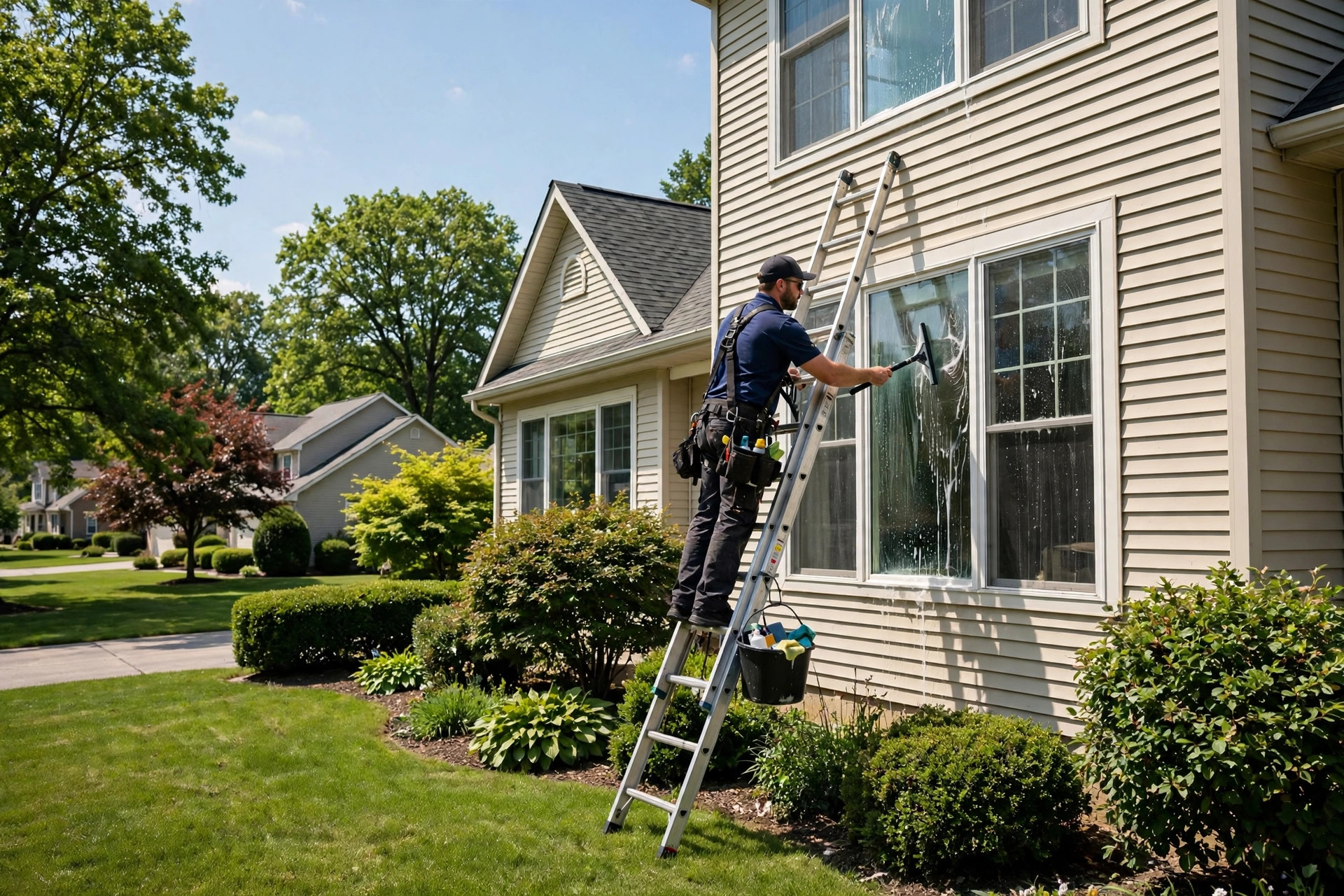
Window cleaning is a business where the result is literally visible. Customers can see the difference the moment you finish, and that moment is worth money if you capture it. Most window cleaning companies earn reviews by accident: a few happy customers remember to leave one, most never get around to it, and the Google profile sits at 14 reviews while a competitor with 80 reviews takes the best jobs in town. Reviews decide who gets the call in local service, and Google rewards the company that collects them steadily. This guide shows window cleaning owners exactly when to ask, what to say word for word, how to run separate review playbooks for homes and commercial accounts, which tools are worth the money, and what a stronger review profile is worth in booked jobs.
The quick answer
- Ask at the reveal: request the review in person the moment the customer sees the finished glass, then send the link by text within 30 minutes.
- Residential is about timing: homeowners say yes right after the walkthrough; a text with a direct Google link later that day doubles your capture rate.
- Commercial is about the right person: ask the property manager or facilities contact, not the front desk, and time it with contract renewals.
- Scripts beat improvising: a calm 20-second ask gets two to three times more reviews than hoping customers remember on their own.
- Use simple tools: a short Google review link, a QR card on the invoice, and an automated follow-up text cover nearly every job.
- Volume moves the needle: climbing from 20 reviews to 60 or more can lift inbound calls by a third or more without spending a dollar on ads.
Why reviews decide which window cleaner gets hired
When a homeowner searches “window cleaning near me,” Google shows three businesses before anything else. Those three spots, the local pack, are decided mostly by three things: how close the business is, how relevant its profile is, and how strong its reputation looks. Review count, average rating, and how recently the reviews arrived all feed that ranking. A company with 60 recent five-star reviews outranks an identical company with 12 old ones, even when both do the same quality of work. That means reviews are not a vanity metric for window cleaners. They are the front door of the business.
Customers read them the way they would inspect your work. Window cleaning is a high-trust home service: you are on ladders around their house, inside their rooms, near their kids and pets. Nobody hires that kind of contractor blind. Industry surveys of local service buyers consistently show that a large majority read online reviews before calling, and that they compare star counts and recent review dates between the top two or three options. A profile with a 4.9 rating and 80 reviews reads like a safe choice. A profile with a 4.2 rating and 9 reviews reads like a gamble, even if the 4.2 company does better work.
There is a compounding effect most owners miss. More reviews raise your local ranking, which puts you in front of more searchers, which brings more jobs, which gives you more chances to ask for reviews. The flywheel spins in both directions: companies that never ask stay stuck at 15 reviews and wonder why the phones are quiet, while companies with a simple asking routine pull away year after year. The good news is that window cleaning has a built-in advantage most trades do not: the customer sees a dramatic before and after every single visit. That visual payoff makes people genuinely happy, and happy people leave reviews when you ask at the right moment. Related home-service trades face the same game; our guide to getting more Google reviews for cleaning companies covers the same timing principles for house cleaners, and the pool-service version at getting reviews for pool companies shows how another visual trade runs its review routine.
The moment to ask: right after the streak-free reveal
There is a single best moment to ask for a review, and it lasts about five minutes. It is the moment the customer looks at the finished windows for the first time. In window cleaning, that reveal hits hard: glass they had stopped noticing is suddenly invisible, light pours in, and they usually say something like “wow, I forgot how clear these could look.” That sentence is your cue. Ask while the feeling is fresh, not later when the glow has worn off and the day has moved on.
The routine that works is two steps. First, ask in person during the final walkthrough. You do not need a speech. Something plain works best: “Glad you like how they turned out. Would you mind leaving us a quick Google review? It takes about a minute and it really helps our small business.” Then stop talking. Let them answer. Most people say yes, because saying no to a person standing in front of them feels rude, and because they are genuinely pleased in that moment.
Second, send the review link by text within 30 minutes of leaving. This is the step that separates companies with 20 reviews from companies with 80. The in-person ask gets the commitment; the text makes it effortless to follow through. The message should be short and personal: “Hi Karen, this is Mike from ClearView. Thanks again for today. Here is the quick review link I mentioned: [link]. Appreciate it.” Send it from the same number you used to confirm the appointment so the customer recognizes it. Companies that add this 30-minute text routinely double the share of jobs that turn into reviews compared with asking in person alone.
What does not work is asking by email three days later, burying the request in the invoice fine print, or hoping customers will think of it on their own. Attention decays fast. By the next morning, your perfect windows are just the normal state of the house, and the review you would have gotten yesterday becomes a chore they never get around to. Same-day matters more than anything else in this playbook.
The residential review playbook
Residential jobs are your review engine. Homeowners are emotionally invested in how their house looks, they make the buying decision themselves, and they tend to write longer, warmer reviews that mention details future customers care about: punctual, careful around the flower beds, great with the dog, windows look brand new. One detailed residential review sells more than three one-line ratings. So the residential routine deserves the most care.
Start the job by planting the seed. When you arrive, a casual line sets up the ask later: “We will do a walkthrough together at the end so you can check everything.” This tells the customer the reveal is coming, which makes the final moment feel like an event instead of a rushed goodbye. During the job, be the kind of crew that earns a review anyway: shoe covers inside, careful around furniture, ladders that do not tear up the lawn. The ask only works on top of good work. No script fixes a sloppy job.
At the walkthrough, do the reveal deliberately. Walk the customer to the windows that were worst before, the patio doors, the big living room panes, and let them see the difference. When they react positively, make the ask right there, in person, using the simple script above. If both spouses are home, ask the one who seems most enthusiastic, but send the text link to the contact on the booking so it reaches the decision maker.
Then leave something physical. A small card on the invoice or the door hanger with a QR code that opens your Google review page catches the customers who said yes in person but forgot by the time the text arrives. Print a short line on it: “Happy with your windows? Scan to leave us a review. It takes one minute.” Some owners put the QR card in a magnetic sleeve on the fridge of repeat customers, a small touch that keeps the ask visible for next time. The residential target is a review from 40 to 60 percent of jobs. If you are below 20 percent, the weak point is almost always the in-person ask: crews skip it when they are rushed or when a new tech feels awkward. Train it like any other part of the job.
The commercial review playbook
Commercial window cleaning works differently, and most owners apply the residential playbook to it and get nothing. The person who watches you clean the storefront glass usually cannot leave a review that matters, because Google reviews carry the most weight when they come from real customers describing real service. For commercial accounts, the reviewer you want is the decision maker: the property manager, the facilities contact, the office manager who signed the contract, the restaurant owner.
Time the ask around service milestones, not individual visits. Nobody wants a review request after every monthly storefront cleaning; that is how you get ignored. Instead, ask quarterly, after a standout visit, or at contract renewal, when the relationship is warmest. A good rhythm: after the first quarterly service of a new account, once the manager has seen your consistency, and again at renewal. One thoughtful commercial review that says “they handle all 12 of our locations, always on schedule, never a complaint from tenants” is worth a dozen residential one-liners for landing the next big account.
Make it easy for busy people. A property manager will not hunt for your Google listing. Send a short email with the direct link and a line they can reply to instead: “Hi Dana, we appreciate having your buildings on our route. Would you be open to a quick Google review of our service? Here is the link, it takes about a minute: [link].” For retail and restaurant owners, ask in person after a visit when they are on site and happy, then follow with the text. For national accounts with a local contact, ask the local contact; their review still counts.
One more commercial lever: put a QR code on your route sheet or service report. When the on-site contact signs off on the visit, the QR is right there with a one-line prompt. It will not convert like a personal ask, but across hundreds of commercial visits a year it adds a steady trickle of reviews from exactly the audience that influences the next contract bid.
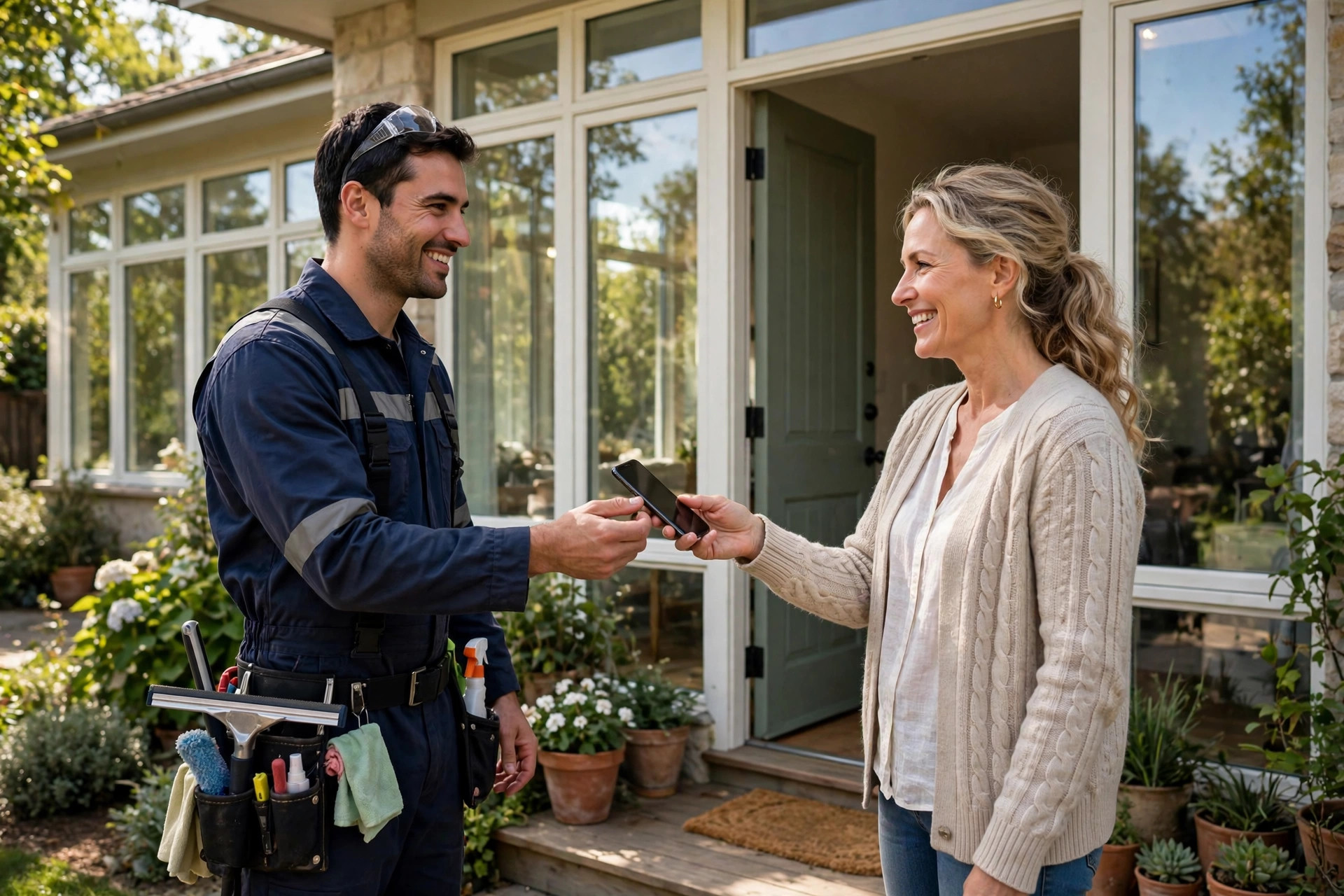
The in-person ask during the final walkthrough gets the yes; the text with the direct link sent within 30 minutes turns it into a posted review.
What to say: scripts that feel natural
Crews avoid asking for reviews because they do not know what to say. Give them exact words and the awkwardness disappears. Below are scripts that owners have used for years. Adapt the names and keep the plain tone.
The in-person ask (residential). “Everything looks great, glad you are happy with it. Would you mind leaving us a quick Google review? It takes about a minute and it honestly helps our business more than anything.” Pause and let them answer. If they say yes: “Thank you. I will text you the link right after I pack up.”
The follow-up text (send within 30 minutes). “Hi [Name], this is [Your Name] from [Company]. Thanks again for today, glad the windows turned out well. Here is the review link I mentioned: [link]. Really appreciate you taking a minute.”
The gentle nudge (text again after 3 days, only if no review posted). “Hi [Name], quick follow-up from [Company]. If you get a spare minute, that review link is here: [link]. No worries at all if not. Thanks again for the business.”
The commercial email. “Hi [Name], thanks for having us on the [property/building] route. We take pride in keeping your glass perfect, and a quick Google review from you would mean a lot: [link]. It takes about a minute. Appreciate the partnership.”
The QR card text (printed). “Happy with your windows? Scan to leave us a Google review. One minute, big help to our local business.” Keep it to two lines. Nobody reads a paragraph on a card.
The reply to a great review (post within 24 hours). “Thank you, [Name]. Glad the [patio doors/whole house/storefront] turned out well. We will see you at the next cleaning.” Personalize one detail so future readers see a real human runs the business.
Notice what these scripts do not do: they never offer a discount, gift card, or prize for a review. Google’s policy forbids incentivizing reviews, and incentivized reviews read as fake to customers anyway. Earn them with the reveal and the timing, not with bribes.
Review tools compared
You do not need expensive software to collect reviews, but the right tool removes the friction that kills your capture rate. Here is how the common options compare for a window cleaning company.
| Method | Cost | When to use it | Typical capture rate |
|---|---|---|---|
| Short Google review link sent by text | Free | Every residential job, within 30 minutes | Highest: the link opens the review form directly |
| QR code card on the invoice or door hanger | A few cents per card to print | Every job, as a backup for the text | Medium: catches the people who miss the text |
| Automated review software | $50 to $200 per month | Companies doing 40 or more jobs a month | High: sends the text and the nudge automatically |
| Email follow-up with the link | Free | Commercial accounts and older customers | Lower: email gets opened late or never |
| Review request in the service reminder | Free | Repeat customers at rebooking time | Medium: loyal customers are the easiest yes |
| Asking verbally with no link sent | Free | Never rely on this alone | Lowest: good intentions die without a link |
For most window cleaning companies, the winning stack is simple: get your free short review link from your Google Business Profile, send it by text after every job, and keep QR cards in the truck as backup. When you grow past about 40 jobs a month, review software pays for itself by automating the text and the three-day nudge so nothing slips through when the office gets busy. Whatever you choose, measure it: track reviews per job each month so you know whether the routine is actually running or just a plan on paper.
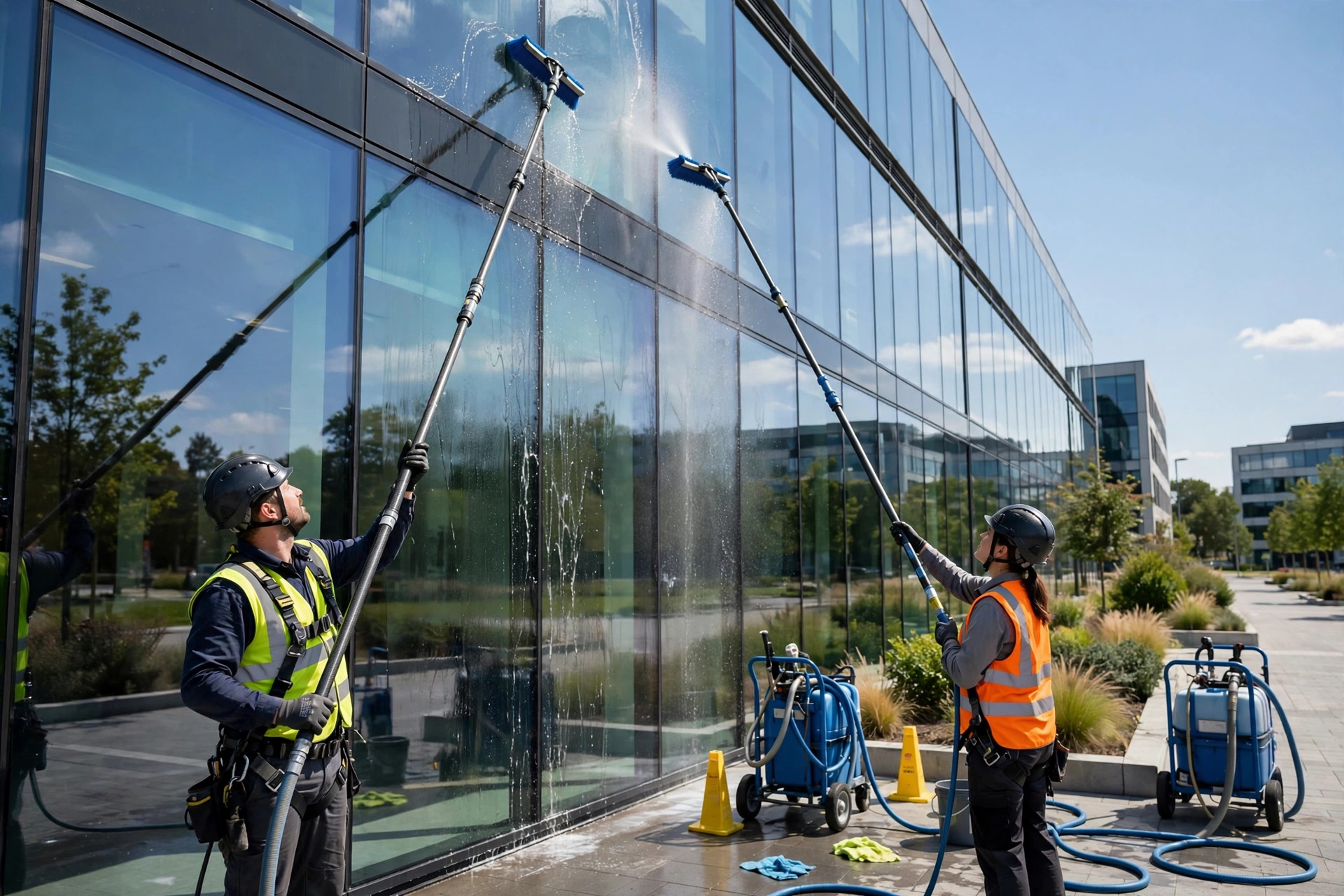
Commercial reviews come from decision makers, so time the ask with quarterly service milestones and contract renewals, not every visit.
Turning bad reviews into booked jobs
Every window cleaning company eventually gets a bad review: a missed spot, a scratched sill dispute, a customer who expected the frames detailed when they booked glass-only. How you handle it matters more than the review itself, because future customers read your response before they read the complaint. A calm, professional reply to a one-star review can win more business than ten five-star reviews with no replies.
Respond within 24 hours, every time. Start by acknowledging the experience without arguing: “We are sorry the visit did not meet your expectations.” Then state what you will do: “We would like to make this right. Please call me directly at [number] so we can sort it out.” Take the details offline; a public back-and-forth never looks good. When the issue is resolved, it is fair to ask politely whether they would consider updating the review. Many will, and an updated four-star review with a story of great service recovery sells better than a perfect record.
Reply to the good reviews too, and do it with specifics. “Thanks” on autopilot looks robotic. “Thanks, Maria, glad the skylights came out clean” shows future readers that the owner pays attention. Google has confirmed that responding to reviews is a positive signal for the business profile, and customers notice: a profile where every review has a thoughtful reply reads like a company that will take care of them too.
Watch for patterns. If three reviews in a month mention streaks or missed upstairs windows, that is not a review problem, it is an operations problem. Fix the cause, then mention the fix in your replies: “We have retrained the crew on final inspections since your visit.” Readers love seeing a business that improves. Never fake reviews, never ask family to post them, and never review-gate by only sending the link to happy customers; Google penalizes manipulation, and customers can smell it.
What more reviews are worth in booked jobs
Reviews are free to collect and expensive to ignore. Here is the math for a typical two-crew residential window cleaning company. Say you do 60 jobs a month at an average ticket of $275. Your Google profile has 22 reviews at 4.6 stars, and a competitor across town has 95 reviews at 4.9. In local search tests across home services, the business with the stronger review profile typically converts 25 to 40 percent more of its profile views into calls, and it wins the head-to-head comparison most shoppers make between the top two listings.
Run the conservative end of that: your profile gets 400 views a month from Maps and local search, and 5 percent of viewers call you. That is 20 calls a month from Google. Lift the conversion to 6.5 percent with a stronger review profile, which is a 30 percent improvement, and you get 26 calls. If your office books half of all calls, that is 3 extra jobs a month, or $825 in monthly revenue, $9,900 a year, from a routine that costs you nothing but discipline. At the higher end, with 60 to 100 fresh reviews and replies on every one, companies commonly report call lifts of 40 to 50 percent from the same search visibility.
Commercial math is even starker. One property management review describing reliable multi-location service can be the difference in a bid worth $15,000 to $40,000 a year in recurring route work. A single quarterly ask to five property managers costs you five emails. The return on that email is absurd by any measure.
Mistakes that quietly kill your review count
Asking days later. The reveal glow fades fast. Every day you wait cuts the response rate. Same-day or nothing.
Skipping the in-person ask. A text alone converts far worse than an in-person yes followed by a text. The personal ask is the commitment; the link is the follow-through.
Sending customers to your profile instead of the review form. A link to your Google listing makes people hunt for the review button. Use the short review link from your Business Profile that opens the review form directly. Every extra tap loses people.
Only asking happy customers. Picking and choosing who gets the link is review gating, and it violates Google’s policy. Send the link after every job. If the job went badly, you find out in the review instead of never hearing about it, and you get the chance to fix it publicly.
Offering rewards for reviews. Discounts, gift cards, and prize draws for reviews are against the rules and they cheapen the reviews you get. Readers trust unprompted-sounding reviews; incentivized ones read as bought.
Never replying. An owner who replies to nothing looks absent. Reply to every review within a day or two, good and bad, with one specific detail.
Asking the wrong person on commercial jobs. The tenant who held the door cannot give you the review that lands the next contract. Get the decision maker’s name on every commercial ticket and direct the ask there.
No owner tracking the number. If nobody watches reviews per job each month, the routine dies quietly. Put one number on the office whiteboard: reviews this month divided by jobs this month. Crews manage what gets measured.

The result sells itself: dramatic before-and-after glass is the easiest review trigger in home services, if you ask while the customer is looking at it.
Your rollout checklist
Work through these in order. Each one builds on the last.
- 1Claim and complete your Google Business Profile. Correct name, address, service area, hours, categories, and photos of real jobs before you ask for a single review.
- 2Get your short review link. Generate the direct link from your Business Profile that opens the review form in one tap, and save it on every office and crew phone.
- 3Write your two scripts. The 20-second in-person ask and the 30-minute follow-up text, word for word, approved by you and printed for the trucks.
- 4Train the reveal walkthrough. Every tech learns to walk the customer to the finished glass, wait for the reaction, and make the ask on the spot.
- 5Set up the 30-minute text. Whoever closes the job sends the link text within half an hour, from the number the customer already knows.
- 6Print QR backup cards. A simple card with the QR code and a two-line prompt, kept in every truck and attached to every invoice.
- 7Build the commercial list. Decision-maker names and emails for every commercial account, with quarterly ask dates on the calendar.
- 8Start replying to every review. Within 24 hours, with one specific detail, good and bad. Make it a daily office habit.
- 9Track reviews per job monthly. Reviews divided by jobs, posted on the office board. Aim for 40 percent on residential work.
- 10Review and tighten quarterly. Check which techs and which job types produce reviews, fix the weak spots, and refresh the QR cards and scripts.
Frequently asked questions
How many Google reviews does a window cleaning company need?
There is no magic number, but in most local markets the top-ranked window cleaners have 60 to 100 or more reviews. More important than the total is steady growth: ten new reviews a month beats fifty old ones. Aim to pass your closest competitor’s count while keeping your rating at 4.7 or above.
When is the best time to ask a customer for a review?
In person, at the final walkthrough, the moment the customer reacts to the clean glass. Then send the direct review link by text within 30 minutes. Same-day asking converts two to three times better than asking the next day or later.
Should I offer a discount for leaving a review?
No. Google’s policy prohibits offering money, discounts, or gifts in exchange for reviews, and it can get reviews removed or your profile penalized. Ask based on good work and good timing instead. The reviews you earn honestly also read as more trustworthy to future customers.
How do I get the direct link to my Google review form?
Open your Google Business Profile, go to the option for getting more reviews, and copy the short link it provides. This link opens the review form directly instead of your listing page. Save it on every crew phone and in your texting templates so it is always one tap away.
What should I do about a fake or unfair review?
Reply calmly and factually, then flag it for removal through your Business Profile if it clearly violates policy, such as a review from someone who was never a customer. Keep the reply short and professional either way, because future customers will read it. Never accuse the reviewer of lying in public.
How do I get reviews from commercial clients?
Ask the decision maker, the property manager or facilities contact, not the on-site staff. Time it quarterly or at contract renewal rather than after every visit, and send a short email with the direct link. One detailed commercial review about reliable multi-location service can win your next big contract.
Should I reply to every review?
Yes. Reply within 24 hours with one specific detail from the job. Responding is a positive signal for your Business Profile and it shows future customers that a real, attentive owner runs the company. Keep replies short and warm, and take any dispute offline with a phone number.
Can I ask for reviews by text message?
Yes, and for residential window cleaning it is the highest-converting method. Send the direct review link by text within 30 minutes of the job from a number the customer recognizes. One polite follow-up text after three days is fine; more than that becomes annoying.
Why do my competitors have more reviews than me?
Almost always because they ask systematically and you ask occasionally. Review count is a process output, not a luck output. Companies with a written routine, in-person ask plus timed text, collect 40 to 60 percent of jobs as reviews. Companies that hope customers remember collect under 10 percent.
How long until more reviews improve my Google ranking?
Most owners see movement within one to three months of steady review growth, especially when reviews arrive weekly and mention your services and area. Reviews are one ranking factor among several, so keep your profile complete and your service area accurate while the review count climbs.
Turn every finished job into your next five-star review
Digital Hayder builds review systems for home-service companies: timed text follow-ups, QR review cards, commercial outreach sequences, and Google Business Profile optimization that turns finished jobs into a steady stream of reviews. Tell us about your company and we will design the routine around your crews.
Contact Us