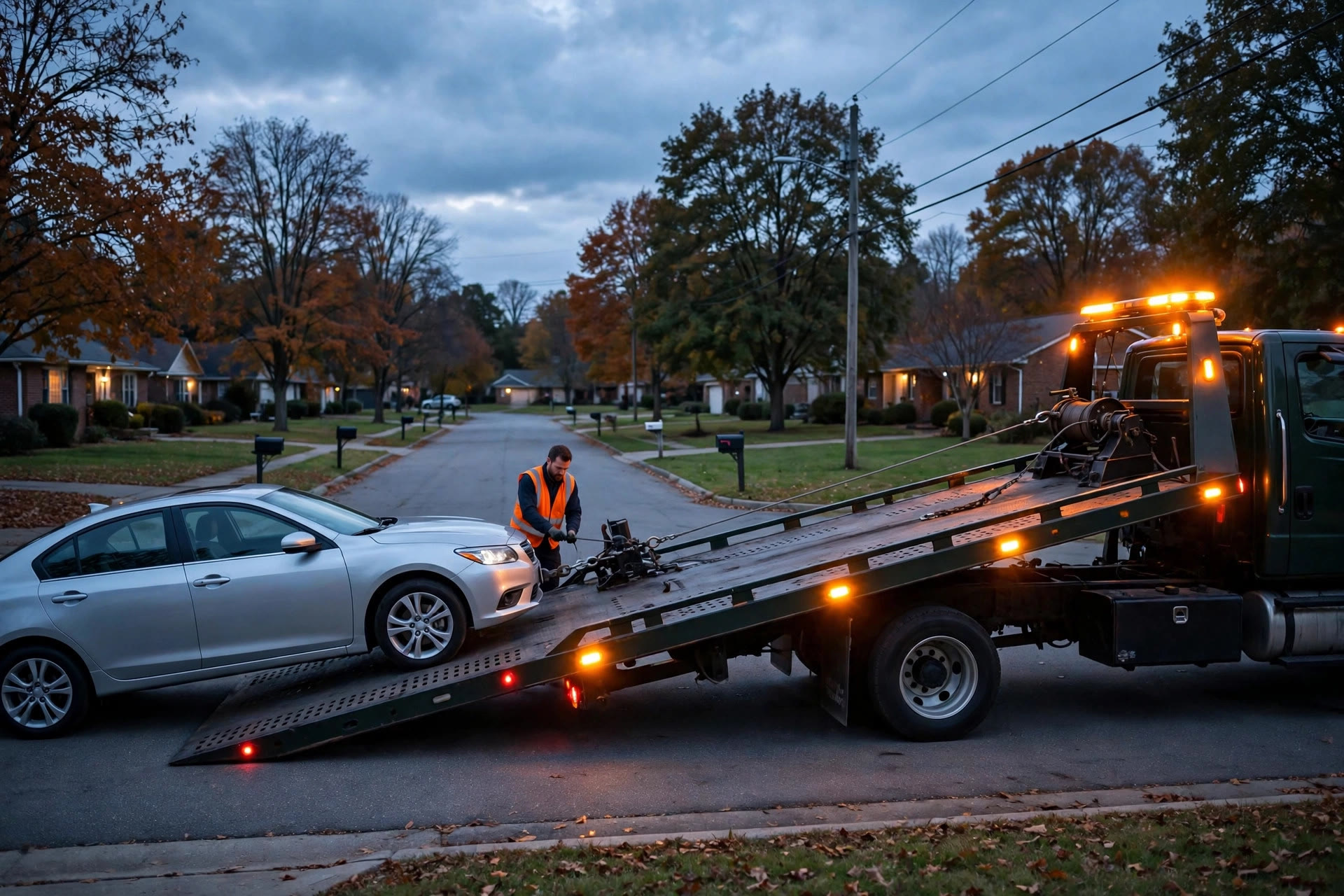
Nobody plans to call a tow truck. Your customer is standing on a highway shoulder at midnight, or staring at a dead car in a grocery store parking lot, or watching their teenager’s first car get loaded onto a flatbed. They are stressed, they are in a hurry, and they picked your number from a Google search thirty seconds ago. That is exactly why Google reviews matter more in towing than in almost any other trade: the customer has no time to research, so the star rating under your name makes the decision for them. This guide shows towing owners how to get more Google reviews from customers who called you on the worst day of their month: when to ask, what your drivers should say, how to handle the negative reviews this industry attracts, and what the review math looks like in real dollars.
The quick answer
- Ask in the relief window: the minutes after safe delivery, when the stress breaks, are when a towing customer is most willing to review.
- Drivers are the review team: a driver who asks at drop-off beats any automated email; train the ask like any other job step.
- Text within the hour: a short text with a direct review link turns the driver’s in-person ask into an actual review.
- Bad reviews need a playbook: towing attracts price and wait-time complaints; a calm 24-hour reply protects your rating.
- Know who you can ask: retail cash customers are fair game; check your motor club and rotation contracts before soliciting those jobs.
- Volume beats perfection: a steady flow of honest reviews outranks a thin profile with a perfect score, and it buries the unfair ones.
Why reviews hit harder in towing than almost any trade
Most service purchases give the buyer time. They compare plumbers, read about roofers, get three quotes for a fence. Towing gives them none of that. The average towing customer searches, glances at the map results, and calls the first company that looks legitimate. “Looks legitimate” in a thirty-second decision means a real star rating, a real review count, and recent reviews that mention fast arrival and fair pricing. Everything else on the screen is noise.
That urgency cuts both ways. The same customer who called you in a panic will also review you from emotion. Towing collects more one-star reviews than most trades, and the reasons are predictable: the price was higher than expected, the wait was longer than hoped, or the situation itself was miserable and the company became the target. You cannot change the fact that breakdowns are stressful. You can change the ratio of happy reviewers to angry ones, and that ratio is the entire game.
There is a second audience most owners forget: the people who never break down but choose your company anyway. Fleet managers, dealerships, body shops, and property managers all check reviews before they put a towing company on their call list. So do the agencies that manage police rotation lists in many areas. A 4.7-star profile with hundreds of reviews does not just win the midnight highway call; it wins the commercial accounts that pay the bills in the slow season.
Finally, reviews are your price shield. Towing prices surprise people because most customers have never paid for a tow and have no idea what one costs. A company with strong reviews can hold its rates because the reviews explain the value before the dispatcher quotes the price: showed up fast, handled the car carefully, driver was professional. Without that proof, every quote becomes an argument.
The relief window: when a towing customer will say yes
Asking a towing customer for a review feels wrong if you picture the wrong moment. Do not picture the highway shoulder at midnight with hazard lights flashing. Picture the drop-off: the car is safely at the shop, the customer has their keys situation sorted, the driver shook their hand. The stress breaks all at once, and what replaces it is relief and gratitude. That is the relief window, and it lasts about an hour.
The sequence that works is the same one-two punch as other trades, adapted for the road. The driver asks in person at drop-off, briefly and warmly. The office or an automated system sends a text with the review link within the hour. One gentle follow-up goes out the next day to anyone who did not review. The in-person ask matters even more in towing than in scheduled trades, because the customer may never hear from your office again; the driver is the whole relationship.
Drivers need permission to read the room. If the customer is crying, furious about the situation, or dealing with an accident scene, the driver skips the ask entirely and just does a great job. Forcing a review ask onto a genuinely bad moment creates the exact one-star review you were trying to prevent. The rule is simple: ask when the customer is smiling or thanking you, never when they are upset. Most tows end with thanks. Those are your reviews.
Driver-led prompts after safe delivery: the exact scripts
Drivers are not salespeople, and the scripts should not make them feel like ones. Each script below is one or two sentences, said once, in the driver’s own words. Print them on a small card for the visor or the dispatch clipboard until they become habit.
The drop-off ask
Said after the car is unloaded and the paperwork is done, when the customer thanks the driver: “Glad we could get you here safe. If you have a minute later, a quick Google review really helps our drivers out. The office will text you a link.” Short, grateful, and it sets up the text so it does not feel random. The phrase “helps our drivers out” works because the customer just spent twenty minutes with that driver and likes them.
The text within the hour
Sent from the business number within 60 minutes of the completed tow: “Hi [Name], this is [Company]. Glad we could get you taken care of today. If you have 30 seconds, would you share your experience on Google? It means a lot to our team: [review link].” The link must open your Google review form directly. Test it on your own phone. If it opens anything else, fix it before you send a single text.
The next-day follow-up
One follow-up, sent the next afternoon, only to customers who received the first text and did not review: “Hi [Name], quick follow-up from [Company]. If our driver earned it yesterday, we would appreciate a short Google review: [review link]. No worries if not. Hope the car situation is sorted!” The well-wish at the end fits towing perfectly, because the customer’s problem is usually still ongoing with the repair shop.
The winch-out and roadside version
Not every job ends at a shop. For jump starts, lockouts, tire changes, and winch-outs, the job ends at the roadside with the customer back in their car. The driver says: “You are all set. If that saved your day, a quick Google review would mean a lot: I will have the office text you the link.” Same structure, same warmth, adapted to a five-minute job.

The drop-off is the relief window: the car is safe, the stress breaks, and a short ask from the driver turns gratitude into a review.
Know who you can ask: retail, motor club, and rotation jobs
Not every tow is review-eligible, and asking the wrong customer creates problems. Sort your jobs into three buckets and set a rule for each.
Retail and cash calls: always ask. The customer found you, paid you, and chose you. These are your best review candidates and the bulk of your review flow. Every retail job gets the driver ask and the text.
Motor club jobs: check the contract first. Roadside assistance programs and insurance dispatch networks often have rules about soliciting their members, and some forbid it outright. Read your agreements before you text a single motor club customer. If the contract is silent, a soft in-person ask from the driver is usually safe, but keep the automated texts for retail jobs until you have written confirmation. One contract dispute costs more than fifty reviews.
Police rotation and impound: do not ask. Nobody towed against their will is leaving you five stars, and asking can look tone-deaf or worse. Skip these jobs in your review system entirely. The same goes for repossessions and any involuntary tow. Your review flow should filter by job type before any text goes out, which is one more reason to tag job types clearly in your dispatch system.
When in doubt, the test is simple: did the customer choose you freely and pay you directly? If yes, ask. If a third party chose you or the customer had no choice, skip it.
Make leaving a review a 30-second job
A stressed customer who just survived a breakdown will not hunt for your Google profile. Remove every tap between your text and the review form.
Start with your direct Google review link from your Business Profile. It should open the review form for your company with no searching. Put that link in the text message, and keep a copy where dispatch can grab it. Next, print a QR code on the invoice or the payment receipt that opens the same link, labeled “Scan to review us on Google.” Older customers and anyone whose phone is low on patience will use the QR code instead of tapping a link.
Give your drivers an NFC tag as well. A small tap sticker on the driver’s clipboard or phone lets the customer tap and land on the review form in two seconds. It also gives the driver a natural prop for the ask: “Tap your phone here and it opens our review page.” Tags cost a few dollars, and drivers like having something concrete to point at.
One caution for towing specifically: do not put the review ask on anything the customer receives before the job is done. A QR code on the dispatch confirmation text, sent while they are still waiting on the shoulder, will read as tone-deaf. The ask belongs after delivery, never before. Timing is part of friction: the right ask at the wrong time feels like pressure.
Review tools compared for towing operations
Towing dispatch runs around the clock, which makes manual review texting harder than in a nine-to-five trade. The right tool depends on your call volume and whether your dispatch software can trigger messages automatically.
| Approach | Typical cost | How it works | Best for |
|---|---|---|---|
| Manual texting by dispatch or office | Free | Someone sends the review link by text after each eligible job and tracks follow-ups | Small operations doing under 100 tows a month with an office person who owns the habit |
| Review software with dispatch integration | $100 to $400 per month | Connects to dispatch or invoicing software, texts the review link automatically when a retail job closes, sends one follow-up, filters by job type | Multi-truck companies where manual texting falls apart on night and weekend shifts |
| All-in-one CRM with review tools | $200 to $600 per month | Review requests plus missed-call text-back, after-hours answering, and customer messaging in one system | Companies losing calls while drivers are on jobs; a missed-call text-back system for towing plus reviews covers both ends of the funnel |
| Google Business Profile alone | Free | You share the link by hand and hope | Not a strategy; fine as the destination, useless as the system |
The job-type filter is the feature that matters most when you shop for software. Your system must be able to tell a retail tow from a motor club tow from a rotation impound, and only text the retail ones. If a tool blasts every closed job, you will eventually text a customer you should not have texted. Ask the vendor exactly how job-type filtering works before you sign. The same filtering logic matters in other trades too; our guide to getting Google reviews for junk removal companies covers a simpler version of the same system.
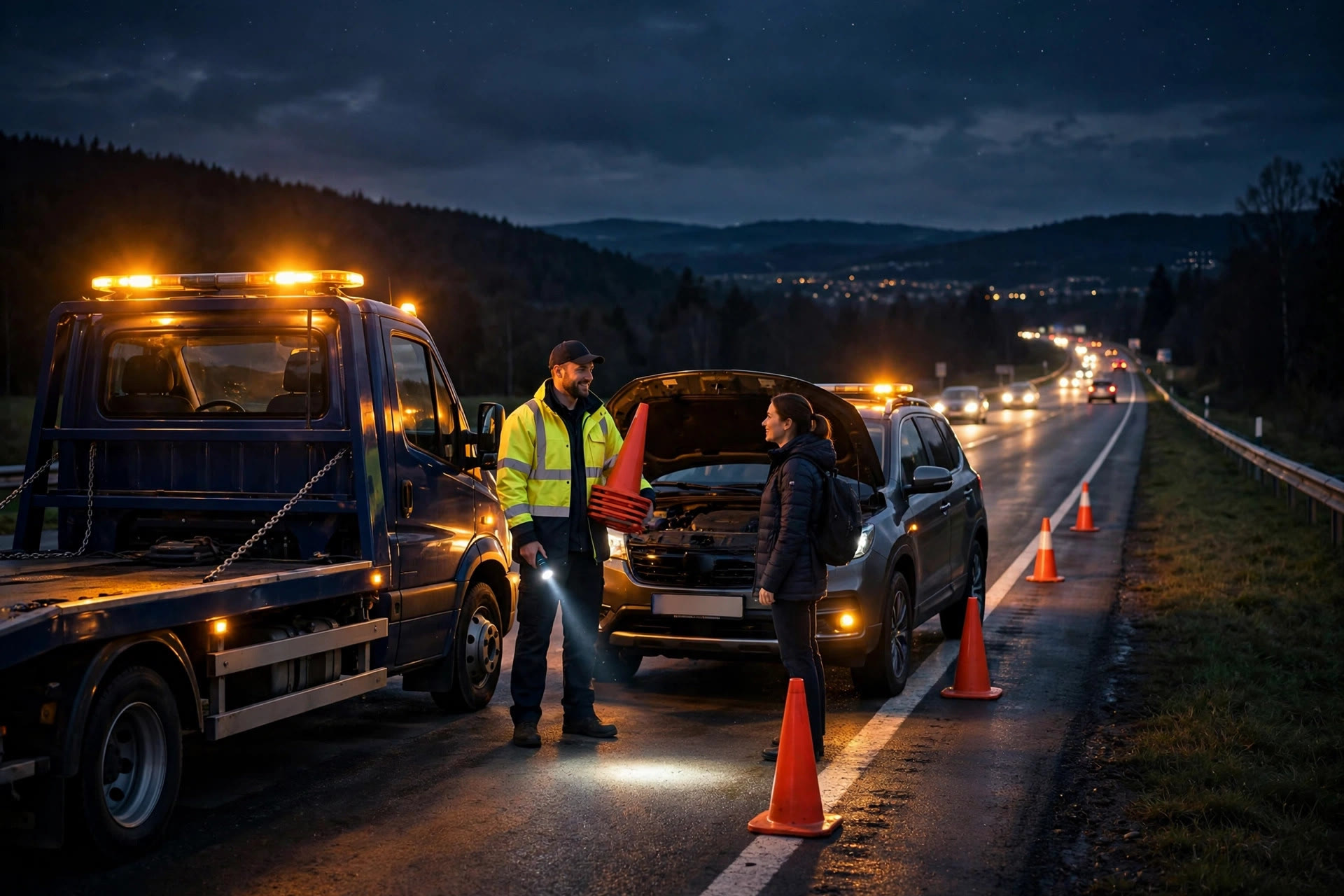
Night calls are where reputations are made. A calm, professional driver on a dark shoulder earns the reviews that win the next hundred calls.
Responding to negative reviews without losing your cool
Towing will always attract more negative reviews than a scheduled trade. Accept that, and build a response system that turns complaints into proof of professionalism. Future customers read your replies to bad reviews more carefully than the reviews themselves.
The golden rules: reply within 24 hours, never argue, never post the customer’s personal details, and never admit fault or discuss damage claims in public. A public reply is marketing, not a courtroom. Move every real problem to a private channel immediately.
The price complaint. “I was quoted $X and charged $Y” or “way overpriced.” Reply: “We understand the price was a surprise, [Name], and we are sorry for the frustration. Our rates are set by [distance / vehicle type / time of day], and we quote every job before we hook. Please call me at [number] so I can walk through your invoice line by line. – [Your name], Owner.” You explain the pricing logic once, calmly, and invite the offline conversation. Readers learn that you quote upfront, which is exactly what they want to hear.
The wait-time complaint. “Took two hours to show up.” Reply: “You are right that the wait was too long that night, [Name], and I apologize. We had [weather / a major accident / high call volume] stacking our queue, and we should have updated you with a better ETA. We have changed how we communicate delays since then. If you would like to talk it through, I am at [number]. – [Your name], Owner.” Acknowledge, explain briefly, show the fix, invite the call. Never promise a 20-minute ETA you cannot keep just to win the dispatch; the review you avoid is worth more than the job you rushed.
The damage claim. “They scratched my bumper.” This is the one that needs the most discipline. Reply: “We take any damage concern seriously, [Name]. Please call me directly at [number] so we can review the pre-tow photos and the claim process together. – [Your name], Owner.” Say nothing about fault, nothing about what the driver reported, nothing about insurance. Handle it privately, document everything, and let the process work. A calm reply here protects you legally and commercially at the same time.
The fake or mistaken review. Competitors, wrong-company reviews, and people who were never customers all show up. Reply once, briefly and factually: “We have no record of this tow in our system, but we would like to check. Please call [number] with your invoice or date of service.” Then flag it in your Business Profile. Google removes some and ignores others. Do not reply twice, do not argue about it, and do not let it pull you into a public fight.
For positive reviews, reply short and human, and use the driver’s name when the customer mentions one: “Thanks, Dana! Mike will appreciate hearing that. Stay safe out there.” Drivers who see their name in owner replies start asking for reviews on their own, because the recognition feels good.
Put your reviews to work beyond Google
Every review you earn can work in more than one place. Start with your website: a reviews page and a star strip on the homepage turn visitors into callers, especially the ones comparing you with two other companies at 1 AM. Add your rating to your Google Ads and Local Service Ads, where the stars show up inside the ad and lift click rates directly.
Use reviews in your commercial pitches. A one-page sheet of your best reviews, especially ones mentioning fast response and careful handling, belongs in every fleet proposal, dealership introduction, and body shop visit. Commercial buyers are risk-averse; other people’s words de-risk you. If you bid for rotation or municipal work anywhere that considers reputation, your review profile is part of the bid whether the paperwork asks for it or not.
Put the number on the trucks. “Rated 4.8 from 900+ reviews” on the back of a flatbed is seen by thousands of drivers a week, including future customers sitting in dead cars. Keep it honest, update it twice a year, and make sure the rating on the truck matches the rating on Google. The same cross-trade logic applies elsewhere; see how appliance repair companies and pool companies put their reviews to work in completely different buying situations.
The money math: reviews vs call volume
In towing, the math runs through the map pack. Most customers call one of the top three results and never look further. Reviews are one of the heaviest inputs into who those three are, and they are the entire reason a caller picks you over the truck next to you. Here is what the climb typically looks like for a company running three to five trucks.
| Review profile | Map visibility | Calls per month | What changes |
|---|---|---|---|
| Under 40 reviews, mixed ratings | Rarely in the top 3 | Baseline | You win on price shoppers and luck |
| 150+ reviews, 4.6 stars or higher | Regularly in the top 3 | About 30 to 50 percent more calls | Callers arrive pre-sold on trust; fewer price arguments |
| 400+ reviews, 4.7 stars or higher, fresh reviews weekly | Dominates the map pack | About 60 to 100 percent more calls | You become the default choice; commercial accounts start calling you |
Mistakes that stall review growth in towing
Never asking at all. The most common system in towing is no system: the driver drops the car, everyone moves on, and the only customers who review are the angry ones. An unasked customer base produces a review profile written entirely by complaints. Ask, and the happy majority finally shows up.
Texting every job type. Blasting review links to motor club members against the contract, or to impound customers who had no choice, creates disputes and terrible reviews. Filter by job type before any text goes out. Retail and cash calls only, unless a contract says otherwise in writing.
Asking before the job is done. A review link in the dispatch confirmation text, sent while the customer is still waiting on the shoulder, feels like pressure. The ask belongs after delivery. Timing is part of the message.
Arguing with bad reviews. A defensive public reply tells the next hundred readers that you fight with customers. One calm reply with an offline phone number tells them you fix problems. The reply is the advertisement, not the rebuttal.
Offering incentives. Discounts or gift cards for reviews violate Google’s policy and can get reviews removed. Ask for honest reviews, offer nothing, and let the service earn the stars.
Ignoring the dispatch phone. Reviews bring calls, but only if someone answers. A company that finally ranks in the top three and then misses half its calls has built a funnel with a hole in it. Pair the review system with a missed-call safety net so every new call gets answered or called back in minutes.
Stopping at a nice round number. Hitting 200 reviews and quitting lets the profile go stale. Google and customers both weigh recency, and a profile whose newest review is months old looks dormant. A few new reviews every week, forever, is the whole strategy.
A strong review profile does the selling before the phone rings: it wins the map pack, the midnight call, and the commercial account.
Your rollout checklist
Work through these in order. Each one builds on the last.
- 1Claim and polish your Google Business Profile. Correct hours, phone, service area, and real photos of trucks, drivers, and the yard.
- 2Get your direct review link. Copy Google’s short review link and test it on your phone: one tap opens your review form.
- 3Sort your job types. Tag retail, motor club, rotation, and impound jobs in dispatch, and set the rule: review texts go to retail only.
- 4Check your motor club contracts. Confirm in writing which programs allow review requests before you text those customers.
- 5Write your driver scripts. The drop-off ask, the within-the-hour text, and the one next-day follow-up. Print the driver card.
- 6Train every driver. One meeting, practice the ask twice, teach the read-the-room rule, and explain the no-incentive policy.
- 7Set up the text flow. Manual at first, then automated on retail job close, with the one follow-up the next day.
- 8Assign review replies. One owner or manager replies to every review; bad reviews get a calm reply within 24 hours, always with an offline number.
- 9Reuse your best reviews. Website, ads, commercial proposals, and the back of the trucks once the count earns it.
- 10Track it monthly. New reviews, average rating, response rate by driver, and calls from Google. Fix what the numbers flag.
Frequently asked questions
How many Google reviews does a towing company need?
Enough to outrank the other tow companies in your service area, which in most markets means 150 to 200 to compete and 400 or more to dominate the map pack. After that, a steady weekly flow of fresh reviews matters more than the total, because recency feeds both rankings and caller trust.
Can we ask motor club customers for reviews?
Only if your contract with the motor club or dispatch network allows it. Some programs forbid soliciting their members, and violating that can cost you the contract. Check the agreement in writing first. Retail cash customers are always fair game.
What if a customer threatens a bad review to get a discount?
Stay calm and do not negotiate against the threat. Say you would like to fix any real problem and give them the offline number. If they post the review, reply professionally and factually. Most readers can spot a shakedown review, and a composed reply protects you better than a discount would.
Should drivers ask for reviews in person?
Yes, at drop-off, when the customer is relieved and grateful. Keep it to one or two sentences and teach drivers to skip the ask when the customer is upset or the situation is sensitive. The in-person ask is what makes the follow-up text feel expected instead of random.
How do we respond to a review that claims vehicle damage?
Reply once, briefly, without admitting fault or discussing details: take damage concerns seriously, invite the reviewer to call you directly, and mention reviewing the pre-tow documentation together. Handle everything else privately through your claims process. Never debate the damage in public.
Is it okay to offer a discount for a five-star review?
No. Google forbids offering anything in exchange for reviews, and violations can get reviews removed and the profile penalized. Ask every eligible customer for an honest review and offer nothing. The policy and the long-term strategy are the same.
Do reviews actually affect our map ranking?
Yes. Review count, average rating, and how recently reviews arrive are established local ranking signals. In a trade where most customers call one of the top three map results, moving up one position can change your monthly call volume dramatically.
What is the best time to send the review text?
Within the hour after the job is complete, while the relief is fresh. A driver ask at drop-off plus a text within 60 minutes is the combination that produces the highest response rates. One follow-up the next afternoon catches the rest. Never send the ask before the job is done.
How do we handle reviews in a language our office does not speak?
Reply in the reviewer’s language using a careful translation, or reply in English with a translated sentence added. The effort is visible and appreciated. Free translation tools are fine for a short thank-you; have a bilingual speaker check anything sensitive before you post it.
Our rating dropped after a bad week. How fast can we recover?
With a consistent ask system, most companies add enough new reviews to move the average within four to eight weeks. Answer every negative review well in the meantime, because strong replies limit the damage while the new reviews arrive. The fastest recovery is always more honest reviews, not fighting the old ones.
Win the midnight call before the phone rings
Digital Hayder builds review and call-handling systems for towing companies: automated review texts after every retail tow, missed-call text-back so no stranded caller waits, and after-hours answering that captures the jobs your competitors miss. Tell us about your operation and we will design the system around it.
Contact Us