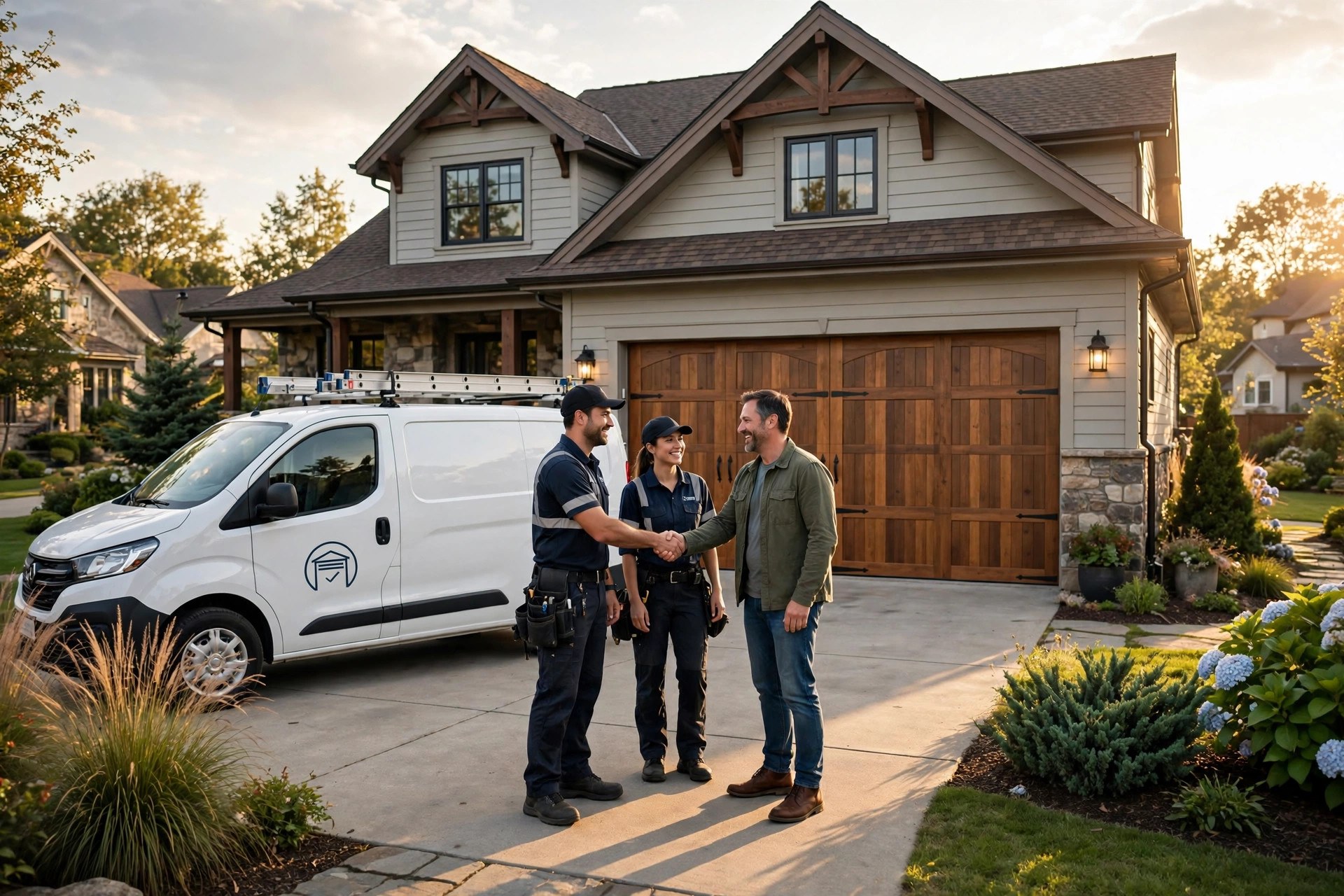
Two garage door companies open in the same suburb in the same year. Five years later, one runs six trucks, has 400 Google reviews, and turns away work in the busy season. The other still runs two trucks and wonders why the phone only rings when something breaks in the neighborhood. The difference is rarely the quality of the work. Both shops can replace a spring. The difference is marketing: the winning shop shows up first on Google, collects reviews on every job, runs ads that pay for themselves, and stays in front of past customers until the next door needs replacing. This is the complete playbook for marketing a garage door company: every channel that actually produces jobs in this trade, what each one costs in real US dollars, how long each takes to work, and the order to build them in. No fluff, no generic small-business advice. Just the channels, the numbers, and the sequence.
The quick answer
- The core four: Google Business Profile, Google reviews, Local Services Ads, and a website built to convert calls win most garage door jobs. Build these first.
- Typical budgets: a one to three truck shop should plan $1,500 to $4,000 a month across ads and tools; larger shops scale to $5,000 to $15,000 a month.
- Fastest jobs: Local Services Ads and Google Ads produce calls in days. Reviews, local SEO, and referrals compound over months.
- Review target: aim for 100-plus Google reviews at 4.8 stars or better, adding 5 to 15 new reviews a month. Reviews decide the close in this trade.
- Ad economics: garage door clicks typically cost $15 to $40 and Local Services leads run $25 to $60; at a $300 to $400 average ticket, the math works if you answer fast and close well.
- The multiplier: speed-to-lead and follow-up decide ROI more than the channel. The shop that answers in under five minutes beats the shop with the bigger ad budget.
Why garage door marketing is a local search game
Almost nobody plans a garage door purchase. The demand is urgent and local: a spring snaps at 8 PM, a door gets hit by a car, an opener dies on a Monday morning. The customer opens Google, types “garage door repair near me,” and calls one of the first three results. That single behavior pattern shapes the entire marketing strategy. National branding does not matter. Clever social campaigns do not matter much. What matters is being visible at the exact moment of need, looking trustworthy in the five seconds the customer scans the results, and answering the phone or the text when they reach out.
This also means the buying cycle splits into two very different jobs. Emergency repair is same-day, price-aware but speed-driven, and won by whoever responds first. Door replacement is considered, shopped across two or three companies, and won by reviews, photos of past work, and a professional estimate process. Your marketing has to serve both: instant-response systems for the emergency buyer and trust-building content for the replacement buyer. The channels below are ordered by how directly they produce jobs, starting with the ones that catch urgent demand and moving toward the ones that build the brand over time.
Google Business Profile: your most important listing
For “garage door repair near me” searches, the Google Business Profile and the map pack sit above everything else. Many customers never scroll past it. A complete, active profile is free and it is the highest-return marketing asset a garage door company owns. Start with the fundamentals: the correct primary category (“Garage door supplier” or “Garage door repair service” depending on your mix), every service listed with descriptions, accurate hours including any after-hours or emergency availability, and a service area that matches where your trucks actually go. Add your real phone number, not a tracking number, on the profile itself.
Photos and posts that win the click
Photos are the tiebreaker in the map pack. Upload real photos of your techs, your trucks, and finished installs: before-and-after door replacements, spring repairs in progress, and clean shots of carriage-style and modern doors you have installed. Aim for 50-plus photos and add new ones monthly. Use Google Posts for seasonal offers and service announcements: spring tune-up specials, storm-damage repair availability, holiday hours. Posts expire, so a monthly rhythm keeps the profile looking alive. Businesses with complete profiles and fresh photos consistently get more calls from the map pack than bare listings, because the customer can see a real local company instead of a name and a phone number.
Reviews, Q and A, and the details competitors skip
Turn on messaging if you can staff it, and answer every question in the Q and A section before a competitor or a random stranger does. Seed it with the questions customers actually ask: “Do you offer same-day repair?”, “What does a spring replacement cost?”, “Do you service my town?” Fill the services section with prices where you can; even “Spring replacement from $189” filters out pure price shoppers and attracts serious buyers. Check the profile weekly for suggested edits from the public, because wrong hours or a wrong phone number on your listing will quietly cost you jobs. For the same profile tactics applied to a sister trade, see our guide to getting more Google reviews for HVAC companies, which covers the review-velocity habits that apply here too.

Reviews decide the close in this trade. Ask for them while the new door is still the best thing the customer sees.
The Google review engine
In garage door work, the review count on your Google profile is often the entire decision. The customer cannot judge your spring-replacement skill from a search result, so they judge your review count and your rating. A shop with 250 reviews at 4.9 stars beats a shop with 12 reviews at 5.0 stars nearly every time, because volume reads as proof. The target for a serious local player is 100-plus reviews at 4.8 or better, growing by 5 to 15 new reviews a month. That pace keeps you ahead of competitors and keeps the review dates fresh, which customers notice.
The ask, timed to the relief
The best moment to ask is right after the job is done, while the tech is still there and the customer is looking at a working door. Train techs on a one-line script: “If you are happy with the work, a Google review helps us more than anything. I can text you the link right now.” Send the review link by text within an hour of job completion; texted links convert far better than emailed ones or a card left on the counter. Follow up once the next day if they have not left one, then stop. Automate the whole sequence from your dispatch software so it fires on every completed job without anyone remembering to do it.
Answering every review, good and bad
Reply to every review within a few days. Thank the happy customers by name and mention the work done; it shows future readers that real jobs sit behind the stars. For bad reviews, respond calmly, take responsibility where it is due, and move the conversation offline with a phone number. Never argue in a public reply. A well-handled negative review can actually help: prospects read them to see how a company behaves when something goes wrong, and a professional response builds more trust than a perfect 5.0 with no replies at all.
Local Services Ads: pay per lead at the top of Google
Local Services Ads (LSA) put your company in the very top slot on Google with a “Google Guaranteed” badge, and you pay per lead instead of per click. For garage door companies, this is one of the most efficient paid channels available, because the intent is pure: the person clicked a button that says they want a garage door pro now. Typical cost per lead runs $25 to $60 depending on the market, and the leads skew toward real jobs rather than tire-kickers. In many markets, LSA is the first paid channel a shop should turn on.
Getting approved and staying visible
Approval takes some paperwork: business license, insurance verification, and background checks for owners and techs. Start it early because it can take one to three weeks. Once live, your position depends on review count, review rating, responsiveness, and how quickly you answer or decline leads. The review requirement is the real gate: LSA pulls your Google reviews, so the review engine from the previous section directly powers your ad position. Pause or dispute junk leads through the LSA dashboard; Google credits leads that are spam, wrong numbers, or outside your service area, and disputing them promptly keeps your effective cost per real lead down. Our breakdown of Local Services Ads for HVAC companies walks through the same approval and dispute mechanics.
Google Ads for garage door companies
Google Ads (the pay-per-click text ads) catch the same urgent demand as LSA, with more control over keywords, geography, and budget. The core campaign targets repair intent: “garage door repair,” “broken garage door spring,” “garage door stuck,” plus your city and neighborhood names. A second campaign targets replacement intent: “new garage door cost,” “garage door installation near me.” Keep the campaigns separate because the economics differ: repair clicks convert faster and cheaper, while replacement clicks cost more but produce $1,500-plus jobs.
Realistic costs and the math that matters
Garage door keywords typically cost $15 to $40 per click in most US markets, with big metros running higher. At a 10 to 15 percent click-to-call rate, that puts cost per lead roughly in the $100 to $300 band for competitive markets, lower in smaller towns. The number that matters is cost per booked job, not cost per click. If $2,000 a month in ad spend produces 12 booked jobs at a $350 average ticket, that is $4,200 in revenue on $2,000 in spend, before counting the replacement jobs that come from the same campaigns. Track calls with tracking numbers, record which keywords produce jobs rather than clicks, and cut the keywords that eat budget without booking work. Common budget wasters: DIY keywords (“how to replace garage door spring”), job-seeker keywords, and broad national terms.
Landing pages, not your homepage
Send ad clicks to dedicated landing pages, not your homepage. A repair ad should land on a page about repair with the phone number huge, a “book now” button, same-day availability stated plainly, and three trust signals: review count, years in business, and the guarantee. A replacement ad lands on a page with door styles, price ranges, and a free-estimate form. Every extra click between the ad and the phone call costs you jobs. Mobile experience decides everything here, because the emergency buyer is on a phone standing next to a broken door.
A website built to convert calls
Your website has one job in this trade: turn a worried homeowner into a caller or a booked estimate within 30 seconds. That means the phone number in the header on every page, a sticky call button on mobile, and a short form for estimates that asks for name, phone, address, and the problem, nothing more. The homepage should answer three questions immediately: what you do, where you do it, and why a stranger should trust you. Service pages for each offering (spring repair, opener install, door replacement, commercial doors) give Google something to rank and give the customer something specific to land on from ads.
What to spend and what to skip
A solid garage door company website typically costs $2,000 to $8,000 to build professionally, with $100 to $300 a month for hosting, maintenance, and small updates. Template-based builds from general web designers sit at the low end; custom designs with real photography, service-area pages, and booking integration sit higher. Skip the fancy animations and the stock-photo homepage. Spend the money on real photos of your work, a fast mobile load time, and clear calls to action. For the full cost breakdown, see our guide to how much a garage door company website costs. The most expensive website is the pretty one that nobody calls from.
Photos, service areas, and proof
Build a gallery of real installs organized by door style: carriage house, modern glass, traditional raised panel. Each project gets the neighborhood or town name, which doubles as local SEO content. Create a page for each main service area you target; a page about garage door repair in a specific suburb can rank for that suburb’s searches and feeds your ad landing pages too. Add the proof elements that replacement buyers look for: manufacturer certifications, warranty terms stated plainly, and a handful of detailed customer stories with photos. These pages do quiet work for years.

Replacement buyers shop styles and prices. Real photos of your installs beat stock images on every page.
Local SEO beyond the profile
Local SEO is the slow channel that keeps paying after the ads stop. The foundation is citation consistency: your business name, address, and phone number identical across Google, Yelp, Angi, HomeAdvisor, the BBB, and the local directories that matter in your market. Inconsistent listings confuse Google and cost you map-pack positions. Next, the website content: service pages per offering plus service-area pages per town, each with genuinely useful local content rather than swapped-out city names. A page that mentions the common door types in a neighborhood’s housing stock and your actual response times there will outperform a generic page every time.
Earn local links the honest way: sponsor a youth sports team, join the chamber of commerce, and get listed by the manufacturers whose doors you install. A handful of real local links beats a hundred directory submissions. Track rankings for your money keywords monthly (“garage door repair [city]”, “garage door installation [city]”), but judge the channel on calls and booked jobs from organic search, not on positions alone. Expect three to six months before local SEO moves the needle, and a year before it becomes a pillar. For a look at how a neighboring trade structures the same playbook, see our HVAC marketing ideas guide.
Social media: what is actually worth doing
Garage door companies do not need a content empire. They need two things from social: proof of work and local presence. The highest-return format is short before-and-after videos of installs and repairs: a rusted, dented door transforming into a clean carriage-style door in 30 seconds. Post them on Facebook, Instagram, and TikTok. They get shared by the homeowner, saved by neighbors planning their own replacement, and they double as ad creative. Film every interesting job; the camera work does not need to be fancy, the transformation is the content.
Facebook is the practical platform for this trade because the homeowner demographic lives there. Keep a business page with current hours, reviews enabled, and the photo albums organized by door style. Boost the best before-and-after posts to homeowners within your service area for $5 to $20 a day; it is cheap local awareness that pays off when the door breaks six months later and they remember your name. Run one simple paid campaign if you run any: a “free estimate” offer for door replacement targeted to homeowners in your zip codes, with the form asking for the door size and a photo upload. Skip daily posting pressure. Two to four genuine posts a week beats a month of silence followed by a week of filler.
Referrals and repeat business
A garage door customer buys infrequently but talks constantly. The neighbor sees the new door, asks who did it, and that recommendation carries more weight than any ad. Make referrals easy and worth it: a simple program where the referrer and the new customer each get $50 off, or a $50 gift card for every referred job that books. Mention it at the end of every install while the customer is happiest, and put the referral offer on the invoice. Track who refers so you can thank your best advocates personally; a hand-written note to someone who sent you five jobs costs almost nothing and cements the relationship.
Repeat business comes from maintenance. Offer an annual tune-up plan at $99 to $149 a year: lubrication, balance test, safety check, and priority scheduling. It keeps your name in front of the customer, catches failing springs before they snap at midnight, and produces a steady stream of replacement leads when the tune-up reveals a door at the end of its life. Email and text the plan members with seasonal reminders, and you have a small recurring revenue line that most garage door shops completely ignore.
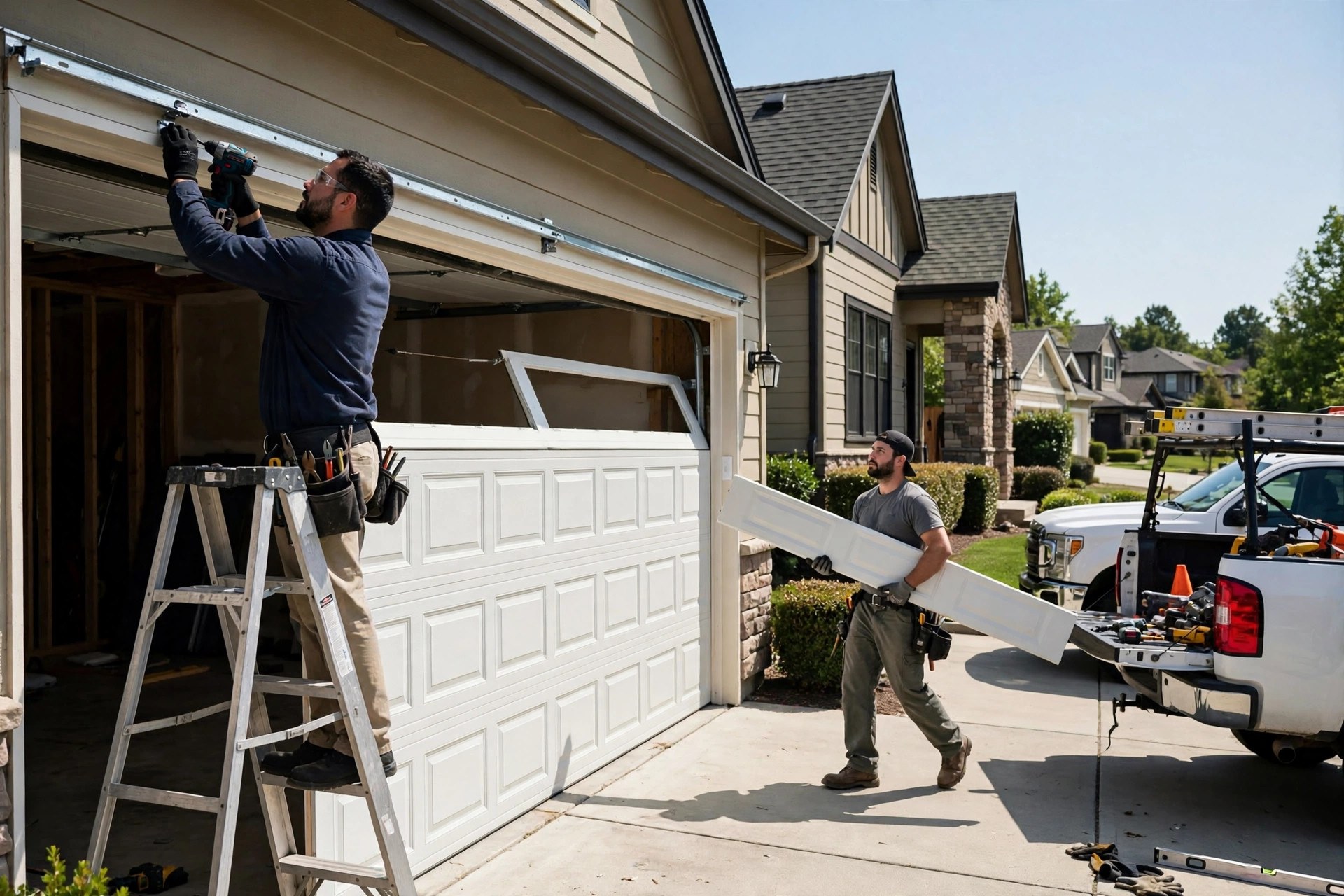
Every install is marketing. Trucks, uniforms, and yard signs turn one job into neighborhood awareness.
Direct mail, yard signs, and truck wraps
Old channels still work in this trade because the customer is a homeowner in a specific neighborhood. Direct mail to homes 15 to 25 years old, which is when original garage doors start failing, is sharply targetable: buy a mailing list by home age and zip code, and send a simple postcard with a before-and-after photo, a tune-up offer, and a big phone number. Expect $0.50 to $1.00 per mailed piece all-in, and a 0.5 to 2 percent response rate on a good list. One replacement job from a 5,000-piece mailing pays for the whole campaign several times over.
Yard signs are the cheapest advertising in the business. Put a clean, readable sign in the yard at every install and leave it for a week with the homeowner’s permission: company name, phone number, “Another beautiful door by [Company].” Neighbors notice. Truck wraps turn every drive between jobs into impressions; a full wrap runs $2,500 to $5,000 per vehicle but lasts five-plus years, making it one of the lowest cost-per-impression buys available. Uniforms and shoe covers cost little and signal professionalism at the door, which feeds the reviews that feed everything else.
Email and SMS marketing for past customers
Your customer list is an asset most garage door shops never use. Collect a phone number and email on every job, with permission to follow up, and you own a marketing channel that costs almost nothing. The core campaigns: a tune-up reminder every spring, a holiday safety check offer, and a replacement nudge for customers whose doors are 12-plus years old. SMS gets the urgent and timely messages (appointment reminders, “tech on the way” texts that cut no-shows); email carries the longer seasonal content with photos of recent installs.
Two automations earn their keep. First, the post-job sequence: thank-you text, review request, then a referral offer a week later. Second, the aging-door campaign: customers with doors over a decade old get a yearly “your door is X years old, here is what to watch for” email with a free inspection offer. A $2,000 door replacement from a ten-year-old customer record is the cheapest acquisition in the business. Keep the list clean, honor opt-outs immediately, and never buy lists.
Seasonal campaigns that fill the slow weeks
Garage door demand has a rhythm, and marketing to it smooths the year. Spring is tune-up season: market the annual maintenance visit as winter recovery, because cold months are hard on springs and openers. Summer brings storm damage and the home-improvement mindset, which is prime time for replacement marketing with before-and-after creative. Fall is preparation season: “get the door ready for winter” messaging sells insulation upgrades, weather seal replacements, and opener battery backups. Winter itself is emergency season in cold climates, when metal contracts and old springs snap; make sure your emergency messaging and after-hours response are sharpest when the temperature drops.
Plan one campaign per season with a clear offer, a start and end date, and creative to match. A spring tune-up special at $89, a summer replacement rebate tied to a manufacturer promotion, a fall weather-seal package, a winter emergency-response guarantee. The campaigns give your ads, posts, mailers, and emails something specific to say, which beats generic “call us” messaging every time. They also give your team a reason to contact the dormant customer list four times a year without it feeling like spam.
Budget guide: what to spend at each stage
Marketing budgets should scale with revenue, not with ambition. The table below gives realistic monthly bands for US garage door companies at three stages. These assume the owner or a small team handles the free channels (reviews, posts, photos) and the budget covers paid ads, tools, and outside help.
| Channel | 1 to 2 trucks (monthly) | 3 to 5 trucks (monthly) | 6 plus trucks (monthly) |
|---|---|---|---|
| Local Services Ads | $500 to $1,500 | $1,500 to $4,000 | $4,000 to $10,000 |
| Google Ads | $500 to $1,500 | $1,500 to $4,000 | $4,000 to $10,000 |
| Website, hosting, tools | $150 to $400 | $300 to $800 | $800 to $2,000 |
| Reviews and CRM software | $100 to $300 | $200 to $500 | $400 to $1,000 |
| Social ads and boosting | $100 to $300 | $300 to $800 | $800 to $2,000 |
| Direct mail | $0 to $500 | $500 to $1,500 | $1,500 to $4,000 |
| Total typical band | $1,500 to $4,000 | $4,000 to $10,000 | $10,000 to $25,000 |
The instinct is to spend the budget on ads first, but the order matters more than the amount. A shop spending $3,000 a month on ads with 12 Google reviews and a slow phone response will lose to a shop spending $1,500 with 200 reviews and instant text-back. Fix the conversion foundation (profile, reviews, website, response speed) before scaling ad spend, or you are paying to send customers to a listing that loses them.
Timeline: what to expect and when
Set expectations by channel so nobody panics in month two. Local Services Ads and Google Ads produce calls within days of launch, once approval and campaigns are live. The review engine shows results in weeks: review count climbs, star rating stabilizes, and close rates on estimates start improving. Direct mail produces its first responses within two to three weeks of a drop. Social proof content compounds over months as the library of before-and-after posts grows. Local SEO takes three to six months to move rankings and six to twelve months to become a real lead source. Referral and repeat programs build over a year as the customer base grows.
| Channel | First results | Full effect | How to judge it |
|---|---|---|---|
| Local Services Ads | Days | 1 to 2 months | Cost per booked job |
| Google Ads | Days | 2 to 3 months | Cost per booked job by keyword |
| Google reviews | Weeks | Ongoing | New reviews per month, estimate close rate |
| Website conversion | Weeks | 2 to 3 months | Call rate from visitors |
| Direct mail | 2 to 3 weeks | Per campaign | Jobs per mailing, revenue per piece |
| Local SEO | 3 to 6 months | 9 to 12 months | Organic calls and booked jobs |
| Referrals and repeats | Months | 12 months plus | Share of jobs from past customers |
Your rollout checklist
Build in this order. Each step makes the next one more effective.
- 1Claim and complete your Google Business Profile. Correct category, all services listed, accurate hours, 50-plus real photos, Q and A seeded, messaging on if you can staff it.
- 2Launch the review engine. Text a review link within an hour of every completed job, follow up once, and reply to every review. Target 5 to 15 new reviews a month.
- 3Fix response speed. Missed-call text-back on the main number, a 5-minute reply rule in work hours, and an after-hours plan before spending a dollar on ads.
- 4Start Local Services Ads. Begin license and background-check paperwork now; it takes one to three weeks. Dispute junk leads weekly.
- 5Launch Google Ads with dedicated landing pages. Separate repair and replacement campaigns, call tracking on, DIY and job-seeker keywords excluded.
- 6Rebuild the website for calls. Phone number in the header, sticky mobile call button, short estimate form, real project photos, one page per core service.
- 7Start local SEO groundwork. Fix citation consistency, publish service-area pages, and earn the first local links through sponsorships and manufacturer listings.
- 8Film every good job. Before-and-after photos and short videos feed social posts, the website gallery, review replies, and ad creative.
- 9Activate past customers. Build the email and SMS list from job records, launch the tune-up reminder and aging-door campaigns, and put a referral offer on every invoice.
- 10Review the numbers monthly. Cost per booked job by channel, review velocity, estimate close rate, and repeat-customer share. Cut what does not book jobs; feed what does.
Frequently asked questions
What is the best marketing for a garage door company?
The core four win most jobs: a complete Google Business Profile, a steady stream of Google reviews, Local Services Ads, and a website built to convert calls. Add Google Ads for scale, then layer in referrals, direct mail, and social proof content. Channels outside this list rarely earn their keep until the core four are working.
How much should a garage door company spend on marketing?
A common band is 5 to 10 percent of revenue. In dollars, a one to two truck shop typically spends $1,500 to $4,000 a month, a three to five truck shop $4,000 to $10,000, and larger operations $10,000 to $25,000. Spend less until the review base and response speed can convert the traffic you buy.
How much do Google Ads cost for garage door companies?
Clicks typically run $15 to $40 in most US markets, higher in big metros. That usually works out to $100 to $300 per lead in competitive markets. Judge the spend on cost per booked job, not cost per click, and cut keywords that produce clicks without jobs.
Are Local Services Ads worth it for garage door repair?
Usually yes. You pay per lead ($25 to $60 typical) instead of per click, the leads carry strong intent, and the Google Guaranteed badge builds trust. The review count on your profile directly affects your ad position, so run the review engine alongside the ads.
How many Google reviews does a garage door company need?
Aim for 100-plus reviews at 4.8 stars or better, adding 5 to 15 new ones a month. Volume beats a perfect rating: customers trust a 4.8 with 250 reviews more than a 5.0 with 12. Ask by text within an hour of every completed job.
Does social media work for garage door companies?
As a direct lead source it is modest, but as proof and local presence it works well. Before-and-after install videos on Facebook and Instagram get shared by homeowners and remembered by neighbors. A small boosted-post budget ($100 to $300 a month) keeps your name in front of your service area.
Should I do SEO or ads first?
Do the free foundation first (profile, reviews, response speed), then ads for immediate jobs, then SEO for the long term. Ads produce calls in days; local SEO takes three to six months to move and up to a year to become a pillar. You need both, in that order.
Does direct mail still work for garage door companies?
Yes, when targeted. Mailing to homes 15 to 25 years old in your service area puts a tune-up or replacement offer in front of owners whose doors are aging out. Expect $0.50 to $1.00 per piece and a 0.5 to 2 percent response rate; one replacement job pays for thousands of pieces.
How do I get more repeat customers?
Sell an annual tune-up plan ($99 to $149), run seasonal reminder campaigns by email and text, and track door ages so you can offer free inspections when replacements come due. A past customer who needs a new door is the cheapest acquisition in the business.
What is the biggest marketing mistake garage door companies make?
Spending on ads before fixing conversion: too few reviews, a website that does not push calls, and slow response to inquiries. The second biggest is never asking for reviews or referrals, which starves the two cheapest growth channels a shop has.
Build the marketing engine that fills your schedule
Digital Hayder builds full marketing systems for garage door companies: Google Business Profile optimization, review engines, Local Services and Google Ads management, high-converting websites, and the CRM automation that answers every lead in seconds. Tell us about your market and we will design the growth plan around it.
Contact Us