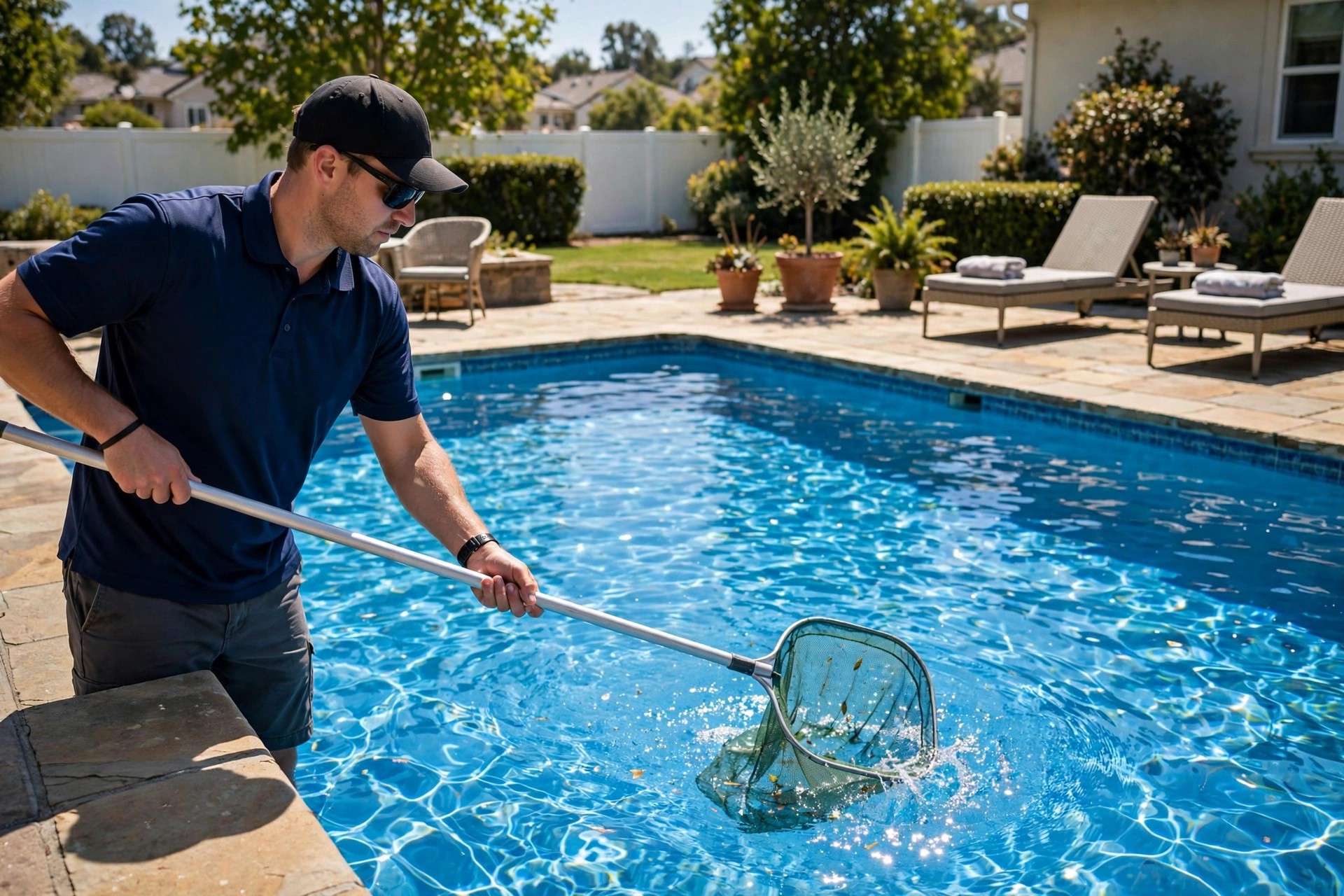
It is the first 90-degree Saturday of the season. A homeowner walks out to a green pool two days before a birthday party, and the panic sets in. They call your pool company. Your techs are mid-route, your office line is ringing into an empty room, and the call rolls to voicemail. That homeowner dials the next company on Google, books a one-time cleanup for $350, and never calls you again. Meanwhile your own customers are calling with a dead pump or a heater that quit, and they are getting the same silence. Pool companies live and die on the phone in ways most owners underestimate: the business is seasonal, urgent, and route-based, which means every missed call is either a high-value repair job or a recurring weekly customer walking away. This guide covers how an AI answering service fits a pool company specifically: what it does with route-business calls, how it handles equipment emergencies and seasonal rushes, what it costs against the alternatives, and how to set it up so every call becomes a booked job or a scheduled route stop.
The quick answer
- Route-business intake: the AI answers every call, checks whether the caller is an existing route customer or a new lead, and routes each one correctly.
- Emergency equipment calls: dead pumps, green pools, and heater failures get triaged fast, with urgent jobs dispatched to a tech the same day.
- Seasonal booking: openings, cleanings, and weekly service signups get booked straight into your schedule during the spring rush, even at midnight.
- Typical cost: most AI answering setups run $300 to $800 a month, against $2,000 to $3,500 for a human answering service and $3,000-plus for an in-house receptionist.
- What matters most: route-customer recognition, equipment triage that knows a pump from a filter, and seasonal scripts that change with the calendar.
- Payback window: one to two captured repair jobs or a single new weekly route customer a month usually covers the entire cost.
Why pool companies lose more to missed calls than they think
A pool company has three kinds of callers, and each one is worth real money. First, the existing route customer: someone paying $200 to $400 a month for weekly service who calls because the water turned green, the pump sounds wrong, or the cleaner is stuck. If that call goes unanswered, the customer does not just have a problem, they start questioning the service. Route churn is the silent killer in this business. Losing a $300-a-month customer costs you $3,600 a year, and it usually starts with a call nobody picked up. Second, the repair caller: dead pump, leaking filter, heater that will not fire, automation panel throwing errors. These are $300 to $1,500 tickets, and the caller is shopping fast because the pool is unusable. Third, the seasonal caller: spring openings, new weekly service signups, one-time cleanups before parties. These arrive in waves, mostly when your team is already slammed, and they go to whoever answers.
The structural problem is that pool companies are almost never near a phone. Techs are in backyards with skimmers, not at desks. The office, if there is one, is one person juggling dispatch, billing, and chemical orders. During the spring rush, call volume can double or triple for six to eight weeks while the crew is working ten-hour days. After hours, equipment failures do not wait: a pump that dies on a Friday night can turn a pool green by Monday, and the customer who cannot reach you spends the weekend calling competitors. An AI answering service does not get tired during the rush and does not close at 5. It answers on the first ring, knows the difference between a route customer and a new lead, and gets every call into the right workflow.
There is also a trust angle unique to pools. Your techs go into backyards when nobody is home. Customers hand over gate codes and alarm codes. The company that answers the phone calmly, knows the customer by name, and says “I see you are on our Tuesday route, and I can have a tech out tomorrow morning” keeps that trust. The company that lets it ring four times and dumps to voicemail makes the customer wonder who is actually running the operation. First impressions on the phone set the tone for the whole relationship, and in a recurring-revenue business, the whole relationship is the product.
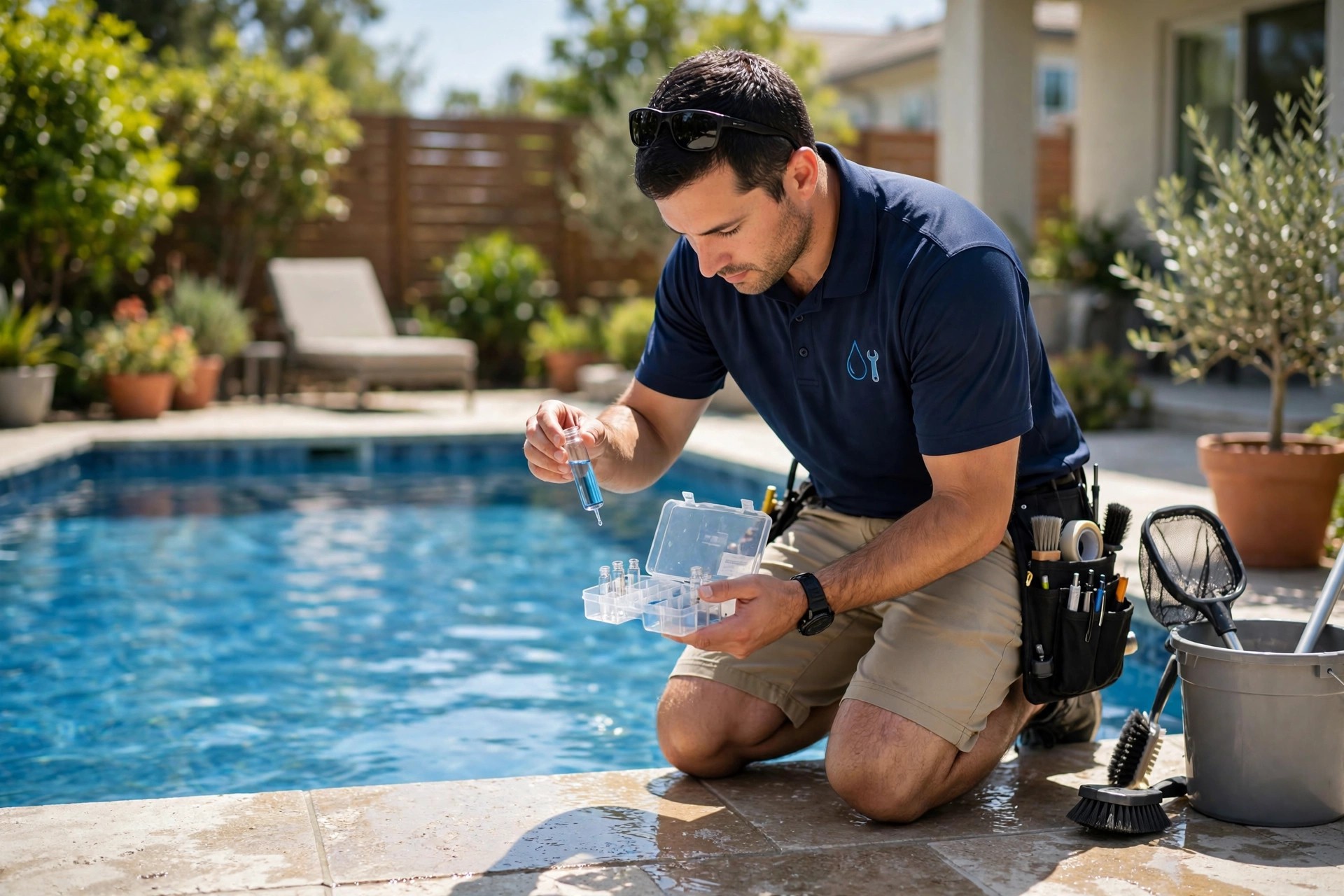
Route customers call about water problems first: the company that answers keeps the $300-a-month account.
What an AI answering service actually does for a pool company
For a pool company, the AI has a harder job than in most trades because it has to serve two masters: the route book and the repair board. A generic answering script treats every caller the same and books everything into one calendar. A pool-specific setup starts every call by identifying who is calling. Existing customer or new lead changes everything about the conversation: the customer gets route-aware help, the lead gets sold and scheduled. Here is how the call flow breaks down.
Recognizing route customers and handling their calls
The AI should greet returning customers with recognition, not interrogation. When the caller ID matches a customer in your system, the script shifts: “Hi, this is the service line for [company]. I see you are on our Tuesday route. Are you calling about the pool water, the equipment, or scheduling?” From there it handles the common route calls on its own. Water turned green: it logs the issue, checks the route schedule, and offers the next available stop or an emergency visit if the customer wants it sooner. Pump making noise: it asks the two or three diagnostic questions your techs always ask (is water flowing, any error lights on the panel, when did it start), logs the answers, and dispatches or schedules. Billing question: it pulls the balance and either answers directly or promises a callback from the office with a specific time window. Gate code changed: it updates the record on the spot, which saves a wasted trip.
The key detail is route awareness. A customer who hears “your tech is already scheduled for Tuesday, and I have added a note about the green water so he brings the shock treatment” feels looked after. A customer who hears “someone will call you back” feels like a ticket number. The AI can only do the first version if it is connected to your route data, which is why the integration matters more than the voice quality. Ask any provider to show you a live route-customer call before you sign.
Turning repair and seasonal callers into booked jobs
New callers get a different conversation, one built around the three things that close pool jobs: speed, competence, and a real number. The script opens with the problem: “Are you calling about a pool that needs cleaning, equipment that stopped working, or starting weekly service?” For equipment calls it runs the triage your techs would run: what is the equipment doing or not doing, how old is the pool, is the pool currently swimmable. Then it quotes your diagnostic or service-call fee confidently and offers the next real openings. For seasonal calls it does the seasonal math out loud: “Spring openings are booking about ten days out right now. I can get you scheduled for the week of the 12th, and weekly service starts the same week if you want it.”
The seasonal rush is where this pays for itself twice over. During peak weeks, a two-person office physically cannot answer every call while dispatching a full route board. Callers who reach a smart AI get booked; callers who reach voicemail call the next company. The AI also handles the capacity conversation honestly, which protects your reputation: “We are booking about ten days out for openings, but I can put you on the cancellation list and text you if something opens sooner.” That is a better answer than a stressed office manager snapping “we are slammed, call back next week.” For the same never-miss-a-call thinking applied to texts, see our guide to missed-call text-back for pool companies.
Equipment emergencies: triage that knows a pump from a filter
Pool equipment calls need real triage because the urgency varies enormously and the cost of getting it wrong is a dead pool or a wasted emergency dispatch. An AI that treats every equipment call as “we will send someone out” will dispatch techs to problems a five-minute phone fix could solve, and an AI that books everything for next week will let pools turn green. The triage script needs the decision tree your best tech carries in their head.
Start with the true emergencies: pump completely dead with no water circulation in hot weather, major leak with visible water loss, electrical issues like breakers tripping or burning smells from the equipment pad, and commercial pools with health-code exposure. These get same-day dispatch. Then the urgent-but-schedulable tier: heater not firing, automation panel errors, cleaner not running, salt system warnings. These get the next available slot, usually within 48 hours, with phone troubleshooting offered in the meantime. Then the routine tier: minor water clarity issues on a route account, filter pressure questions, timer adjustments. These get logged as route notes or booked as standard visits.
The phone troubleshooting piece is underrated. A surprising number of “dead pump” calls are tripped breakers, clogged pump baskets, or timers knocked out by a power outage. An AI that walks the caller through checking the breaker and the pump basket resolves maybe one in five equipment calls without a truck roll, and the caller remembers that you saved them a service fee. That is how you earn the weekly account and the five-star review. Build the troubleshooting steps with your lead tech, keep them to things a homeowner cannot get hurt doing, and put a hard rule in the script: anything involving electrical panels beyond a breaker check, or anything the caller is unsure about, gets a tech dispatched, no exceptions.
Quoting repair bands with confidence
Pool owners fear open-ended repair bills more than almost anything, because they have all heard the story of the $200 visit that became a $2,000 equipment pad rebuild. The AI should quote your standard bands the way your best office person does: service-call or diagnostic fee first, then the typical range for the common jobs. Pump replacement, filter replacement, heater repair, salt system cell replacement, leak detection visit, automation panel work. Give the AI the bands and the honest caveat: “The tech confirms the exact price on site before any work starts, and the diagnostic fee applies toward the repair if you go ahead.” Callers who hear real numbers book. Callers who hear “it depends” keep dialing. Load the bands during setup and review them quarterly, because equipment prices move and a stale quote is worse than no quote.
Seasonal scripts: spring rush, summer steady, fall close, winter watch
A pool company is really four different businesses across the year, and the AI should sound like it knows which one it is working for. In spring, the script leads with openings and weekly service signups, quotes the current booking lead time honestly, and offers the cancellation list. In summer, it handles the steady flow of water-quality calls, vacation holds on routes, and one-time cleanups before parties, with same-week availability as the selling point. In fall, it pivots to closings, equipment winterization, and heater repairs for the customers stretching the season. In winter, in warmer markets it keeps the year-round routes humming, and in colder markets it handles off-season equipment quotes and early-bird spring signups with a deposit.
The practical move is a quarterly script review, fifteen minutes with the owner. Update the lead times, the seasonal offers, and the top three call types you are seeing. A script that still talks about spring openings in August tells callers nobody is minding the store. The providers worth paying for make these updates same-day without a support ticket; ask about it before you sign. This seasonal rhythm also applies to your marketing: the same calendar thinking that drives the AI scripts should drive your review requests and reactivation campaigns, because a customer who opened with you in spring is a weekly route candidate by summer.
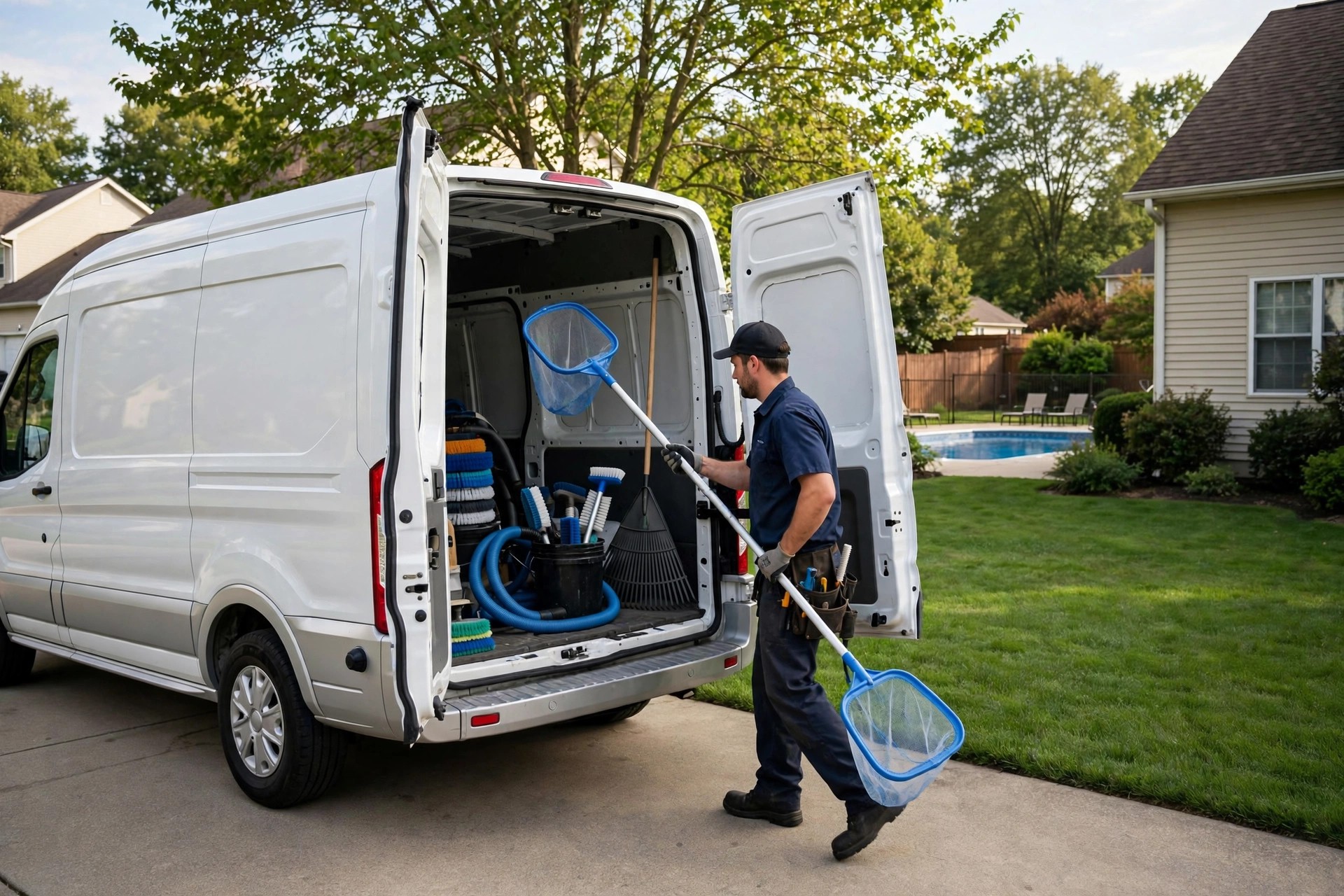
Spring rush doubles call volume while crews work ten-hour days: the AI books while the techs clean.
What it costs: AI vs the alternatives for a pool company
Pool companies usually weigh the same three options as other trades, and the seasonal shape of the business changes the math. A human answering service at $2,000 to $3,500 a month charges you the same in February as in May, which stings when winter revenue is thin. An in-house receptionist at $3,000 to $4,500 a month all-in sits idle in the off-season and still misses calls during the rush. An AI answering service typically runs $300 to $800 a month, scales to any call volume without overtime, and never takes a vacation in May. For a seasonal business, that flat, low cost is a structural advantage, not just a saving.
| Option | Typical monthly cost | Spring rush capacity | Route-customer recognition | After-hours coverage |
|---|---|---|---|---|
| AI answering service | $300 to $800 | Unlimited simultaneous calls | Yes, with system integration | 24/7 included |
| Human answering service | $2,000 to $3,500 | Limited, hold times grow | Rarely, generic scripts | 24/7 at extra cost |
| In-house receptionist | $3,000 to $4,500 | One person, misses the overflow | Excellent, knows every customer | None |
| Owner’s cell / voicemail | $0 | Collapses under volume | Owner knows them, if they pick up | None reliably |
Setup costs run $500 to $2,000 professionally done, covering the route integration, equipment triage script, seasonal scripts, pricing bands, and dispatch rules. Doing it yourself costs a week of focused time, most of it spent writing the triage decision tree with your lead tech. Watch for the two cost traps: per-minute overage billing with no cap during the spring rush, and SMS fees on the confirmation and reminder texts. Both are manageable if you ask about them upfront and set alerts. Even at the high end of the range, the monthly cost is less than a single pump replacement job, and most pool companies capture several of those a month purely from calls that would have gone to voicemail. The same cost logic plays out in the other wet trades; our AI answering service for plumbers guide runs the identical comparison for pipe emergencies.
Common mistakes pool companies make with answering services
The number one mistake is a generic script with no pool knowledge. An AI that cannot tell a salt cell from a sand filter, that asks “what seems to be the problem with your pool” and then has nothing useful to say about the answer, is worse than voicemail because it wastes the caller’s time and makes your company look amateur. The script needs the vocabulary of the trade: pumps, filters, heaters, salt systems, automation panels, main drains, skimmers, DE versus sand versus cartridge. Your lead tech should review every line before launch.
The second mistake is no route integration. If the AI cannot see who is a customer, every caller gets the new-lead treatment, and your best customers get asked for their address like strangers. That is a churn machine wearing a headset. The integration does not need to be fancy: caller ID matching against your customer list plus the ability to log notes to the route is enough to transform the experience. The third mistake is ignoring the seasonal script updates. A company that sets the script in March and never touches it is quoting spring lead times in September and talking about openings during closing season. Put the quarterly review on the calendar now.
The fourth mistake is dispatch rules that do not match reality. If the AI pages your lead tech for every green-pool call at 9 at night, the tech will start ignoring the pages within two weeks, and then the real emergency pages get ignored too. Reserve the page for true emergencies, define them tightly, and give everything else a clear next step the AI can promise. The fifth mistake is forgetting the human backup. Storms knock out power and internet, AI providers have outages, and some callers will always want a person. Keep a simple failover: if the AI system is unreachable, calls roll to the owner’s cell, not to a dead line. Test it twice a year.
Choosing a provider: what to ask before you sign
Pool companies need a provider that understands route businesses, not just appointment businesses. Use these questions to separate the two.
Show me a live route-customer call. Not a recording, a live demo where the AI recognizes a returning customer, references their route day, and handles a water-quality complaint. If the provider cannot do this, their product was built for dentists, and your customers will feel like strangers.
How does the equipment triage work, and who writes it? You need a decision tree built with your lead tech, not a generic template. Ask how the triage handles the gray areas: a pump that is running but not priming, a heater that fires then quits, a salt system throwing a low-salt warning after a refill. Vague answers here mean misclassified calls later.
What does it do with my route and scheduling software? The AI must read customer records and write bookings and notes back. Ask for the exact integration list and what happens for customers on software that is not on it. Manual re-entry of every booking defeats the purpose.
How are seasonal script changes handled? You need same-day updates to lead times, offers, and greetings as the season turns. Ask who makes the change, how long it takes, and whether it costs extra. A provider that charges per script edit will nickel you all year.
What happens during the spring volume spike? Ask how overages are billed, whether there is a monthly cap, and what the per-minute rate is. Then model your worst week: if calls triple for two weeks, what is the bill? Get the answer in writing.
Can it handle Spanish-speaking callers? Pool service has a large Spanish-speaking customer base in many markets, on both sides of the phone. Even intake-level Spanish with a handoff option captures jobs you are currently losing. Ask if it is included.
Who owns the recordings and transcripts? You do, or keep shopping. Call recordings are how you catch the misclassified equipment calls, settle the “nobody told me about the fee” disputes, and train the script. Anything less than full ownership with easy export is a dealbreaker.
What is the failover when your system goes down? Storms and outages happen. Calls should roll to a backup number automatically, and you should get an alert that the failover is active. If the provider has no answer for this, imagine your phones dead during the busiest Saturday of the year.
If you are comparing AI against keeping a person on the phones, our guide to choosing an AI receptionist walks through the decision with cost worksheets. And if your shop also does irrigation or outdoor work with the same seasonal shape, the dispatch thinking transfers directly.
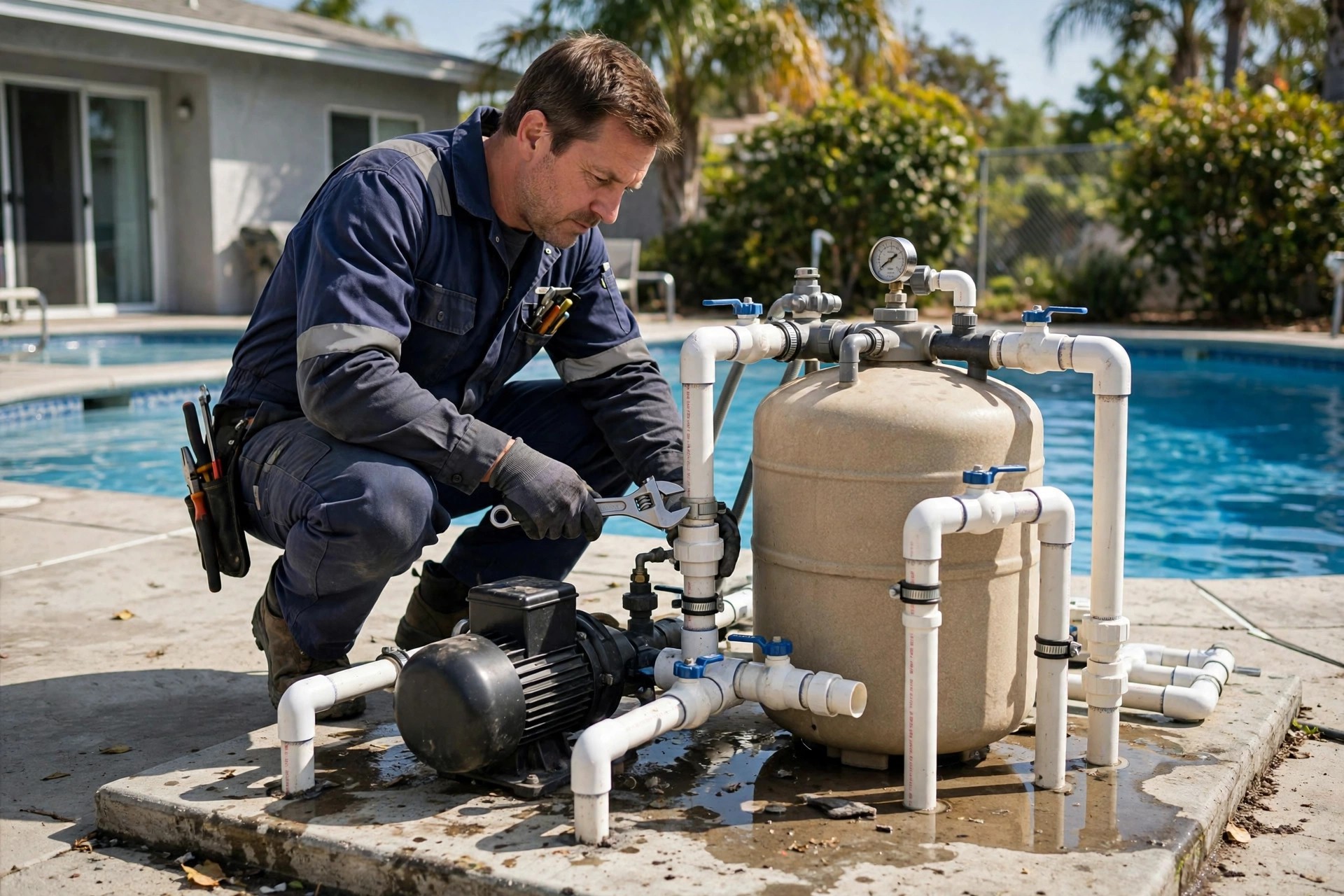
Real triage knows which equipment calls need a same-day truck and which need a five-minute phone fix.
Your rollout checklist
Start in the off-season if you can; launching mid-rush means tuning the script while drowning.
- 1Count your missed calls for a month. Pull call logs and tally the ring-outs, voicemails, and after-hours calls. Split them into route customers, repair leads, and seasonal leads.
- 2Build the equipment triage tree with your lead tech. True emergencies, urgent-but-schedulable, and routine, with the exact symptoms and the phone-fix steps for each.
- 3Write the route-customer script. Caller ID recognition, route-day reference, and handling for the five most common customer calls: green water, equipment noise, billing, gate codes, schedule changes.
- 4Write the new-lead script. Problem-first opening, diagnostic fee quote, real availability, and the seasonal offer for the current quarter.
- 5Load your pricing bands. Diagnostic fee plus typical ranges for pump, filter, heater, salt cell, leak detection, and automation work.
- 6Connect the customer and route data. Caller ID matching, note logging to routes, and booking straight into the schedule. Test with real customer records.
- 7Set the dispatch and escalation rules. What pages a tech, what books tomorrow, what waits for the route, and the five-minute no-answer escalation path.
- 8Wire confirmations and reminders. Instant booking text, day-before reminder, and tech-on-the-way text. Route customers get schedule-change alerts too.
- 9Run fire drills before launch. Test calls as a route customer with green water, a new lead with a dead pump, and a Spanish-speaking caller. Fix everything that sounds wrong.
- 10Review quarterly, not once. Update the seasonal script, pricing bands, and lead times every quarter. Track captured jobs, saved route customers, and missed-call counts monthly.
Frequently asked questions
How much does an AI answering service cost for a pool company?
Most setups run $300 to $800 a month depending on call volume, with $500 to $2,000 for professional setup. That compares to $2,000 to $3,500 a month for a human answering service and $3,000 to $4,500 all-in for an in-house receptionist. One to two captured repair jobs, or a single new weekly route customer, typically covers the monthly cost.
Can it tell the difference between my route customers and new leads?
Yes, with the right integration. The AI matches caller ID against your customer list and shifts into a route-aware script for existing customers: referencing their route day, logging issues to their record, and handling the common customer calls. New callers get the sales-oriented intake. Without the integration it is just a generic answering service, so verify this in a live demo.
Will it know enough about pool equipment to triage calls?
Only if you build the triage tree with your lead tech during setup. The AI learns your decision tree: which symptoms mean same-day dispatch, which get phone troubleshooting, and which wait for the route. It does not diagnose from general knowledge. Budget the tech’s time for this; it is the highest-value hour of the whole project.
What happens when a pump dies on a Friday night?
The AI classifies it as an equipment emergency, quotes your after-hours or weekend fee, pages the on-call tech with the address and symptoms, and texts the customer the tech name and arrival estimate. If the tech does not answer within your set window, it escalates to the backup contact. Define the on-call rotation before launch or this falls apart.
Can it handle the spring rush when call volume triples?
This is one of the strongest cases for AI over humans: it answers unlimited simultaneous calls, so there is no hold queue during the rush. It quotes your current lead time honestly and offers the cancellation list, which protects your reputation when you are booking ten days out. Ask the provider how overages are billed so the spike does not surprise you.
Does it work in Spanish?
Many providers offer Spanish intake, included or as an add-on. Pool service has a large Spanish-speaking customer base in many US markets, so this is worth having. Ask whether it is full Spanish call handling or intake with a handoff, and test it with a real Spanish-speaking test call before launch.
What if the AI books a job we cannot actually do?
The script should only offer real availability pulled from your live schedule, and it should escalate anything outside the standard job types: commercial pools, major renovations, or equipment it was not trained on. Review a sample of bookings weekly for the first month to catch anything the rules missed.
Who owns the call recordings?
You should, fully, with easy export. Recordings are how you catch misclassified equipment calls, resolve fee disputes, and improve the script. Do not sign with a provider that locks recordings behind extra fees or deletes them quickly.
How long does setup take for a pool company?
Two to three weeks for a proper setup: triage tree, route integration, seasonal scripts, pricing bands, dispatch rules, and fire-drill testing. Starting in the off-season is ideal, because tuning the script during the spring rush is painful. Anyone promising instant go-live is skipping the integration that makes it work.
Is AI better than a human answering service for pool companies?
For most pool companies, yes. The AI costs a fraction, handles unlimited simultaneous calls during the rush, and follows your triage rules exactly every time. A human service has an edge on complex judgment calls, so the best setups let the AI handle intake, booking, and dispatch, and escalate the genuinely tricky calls to a person.
Every call becomes a booked job or a saved route customer
Digital Hayder builds AI answering services for pool companies: route-customer recognition, equipment triage built with your lead tech, seasonal scripts, and booking straight into your schedule. Tell us about your routes and your rush season and we will design the setup around them.
Contact Us