A driver’s check engine light comes on during the evening commute. At a red light, they search “auto repair near me” and open two shop websites. One has a “Schedule Service” button that shows open bays tomorrow morning and lets them book in under a minute. The other lists a phone number that goes to voicemail after 6pm. They book the first shop before the light turns green. That repair order is worth $300 to $800, and it went to the shop whose website took the appointment. This guide breaks down what an auto repair shop website costs at every tier, from a $200 DIY page to a $15,000 custom build with live bay scheduling.
The quick answer
- Auto repair shop website cost ranges: $100 to $500 per year for DIY builders, $1,500 to $5,000 for a freelancer, $5,000 to $12,000 for a small agency, and $12,000 to $20,000 or more for a premium build with live scheduling.
- Online scheduling is the biggest price driver. A simple brochure site is cheap; a site with live bay scheduling tied to your shop management system adds thousands.
- Estimate request forms, digital inspection displays, and review widgets are the features that turn visitors into repair orders.
- Cheap builds skip local SEO, speed work, and mobile scheduling, which costs you the drivers searching on their phones at the side of the road.
- Plan $80 to $250 per month in ongoing costs: hosting, scheduling software, domain, and maintenance.
- A site that fills even 3 extra bays a week typically pays for itself within months, given average repair orders of several hundred dollars.
What an auto repair shop website actually costs
An auto repair website sits between two extremes. At one end is the digital brochure: services, hours, phone number, map. At the other end is a booking engine: live scheduling, service selection by vehicle, estimate requests, digital inspection reports customers can view, and review widgets that build trust before the first visit. The brochure costs a couple thousand dollars. The booking engine costs five figures. Most shops land in the middle, paying $1,500 to $12,000 depending on how much of the front-desk work the site takes over.
The price follows the scheduling. A shop that answers its phones all day can live with a simpler site. A shop losing calls to voicemail during busy hours needs the site to capture what the phones miss. If you are comparing across trades, our guide to how much a plumbing website costs shows the same pattern: the more the site does, the more it costs, and the more it earns.
The four price tiers, explained
Tier 1: DIY website builder
Wix, Squarespace, or GoDaddy with a template: your services, hours, phone number, a map, and a basic contact form. Live in a weekend.
- What you get: a working site fast, built-in hosting and security, and an online presence that confirms you exist when someone searches your shop name.
- What you miss: online scheduling, custom design, local SEO, speed optimization, and anything that captures the driver who finds you at 9pm.
- Best for: a small shop running on referrals and repeat customers that just needs a credible site to point people to.
- Watch out for: the template look and zero scheduling. If your phones already miss calls during the day, a DIY site does nothing to fix the actual problem.
Tier 2: Freelancer custom build
A freelance designer builds a custom WordPress site for your shop: your branding, your services with real descriptions, an estimate request form, and Google review integration.
- What you get: custom design, service pages (brakes, diagnostics, oil service, tires, inspections), an estimate request form with vehicle fields, click-to-call buttons, review widgets, and basic local SEO.
- What you miss: live bay scheduling, integration with your shop management software, digital inspection displays, and ongoing support.
- Best for: an established independent shop that needs to look professional, rank locally, and convert search traffic into calls and estimate requests.
- Watch out for: designers who have never built for an auto shop. Ask whether they understand scheduling software integrations. A pretty site that cannot talk to your shop system creates double work for your service writer.
Tier 3: Small agency build
A small agency builds the site as a marketing project with scheduling at the center: the booking flow is designed first, and everything else supports it.
- What you get: everything in tier 2, plus online scheduling integrated with your shop management system (Tekmetric, Shop-Ware, Mitchell, or similar), service selection by year, make, and model, automated confirmation and reminder messages, digital vehicle inspection reports customers can view online, and a full local SEO foundation.
- What you miss: fully custom scheduling logic and advanced marketing automation, which live at the premium tier.
- Best for: a busy shop where the phones cannot keep up, a multi-bay operation that needs its schedule filled efficiently, or any shop investing in Google Ads that needs landing pages converting.
- Watch out for: integration promises. Confirm exactly which shop management system the agency has integrated before, and get a live demo of the scheduling flow before final payment.
Tier 4: Premium custom build
Custom development for shops where the website is a core operations tool: live bay-level scheduling, customer portals with service history, fleet account features, and deep marketing automation.
- What you get: everything in tier 3, plus bay-level scheduling logic, customer accounts showing full service history and upcoming maintenance, fleet portals, automated service reminders by mileage and time, and CRM-grade follow-up automation.
- What you miss: nothing on the site. The question is whether a single-location shop generates enough volume to justify it.
- Best for: multi-location shops, shops with fleet contracts, and operations where the site replaces front-desk labor.
- Watch out for: complexity. Every custom feature needs testing with real customers and real service writers. Budget time for that, not just money.
Online scheduling: the cost driver
Scheduling is where auto repair website quotes split apart. Understanding the three levels keeps you from overpaying or underbuying.
Level 1: The request form
A form that says “request an appointment” and emails the shop. Cheap to build, often under $200 of the project, but it is not scheduling. Someone at the shop has to call the customer back, check the bays, and confirm. After hours, the customer waits until morning, and some of them keep shopping. Fine for a shop with a dedicated service writer answering phones all day. Useless for capturing the 9pm searcher.
Level 2: Embedded scheduling widget
Tools from your shop management system or third-party schedulers embed into the site and show real availability. The customer picks a time and the appointment lands in your system. This typically adds $500 to $2,000 to the build for integration and styling, plus $50 to $150 a month in software fees. For most independent shops, this is the sweet spot: real booking without custom development.
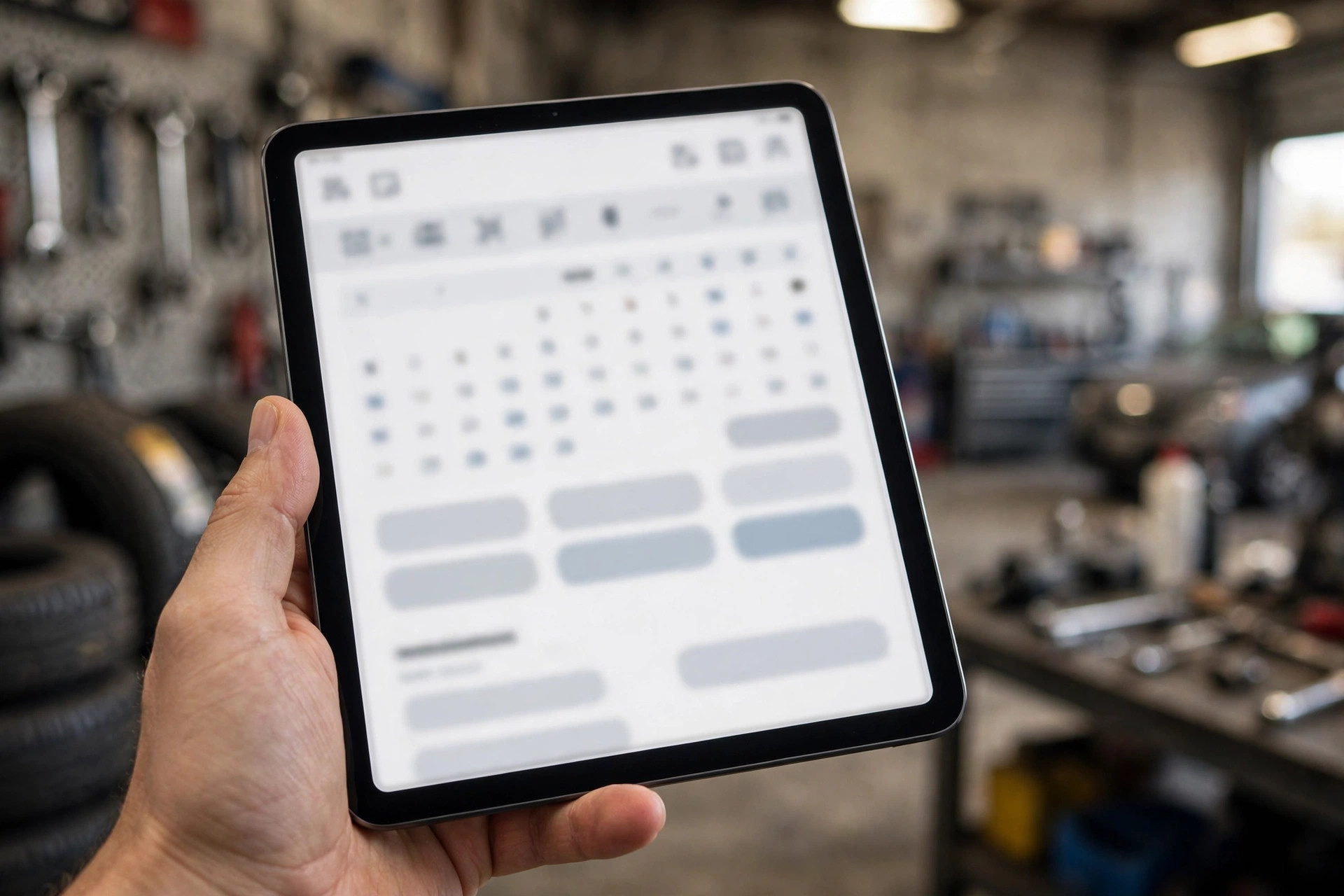
Real availability on a phone screen is what turns a search into a repair order.
Level 3: Live bay scheduling
The site shows actual bay availability, accounts for job duration by service type, handles loaner cars or shuttles, and syncs two ways with the shop system so nothing double-books. This is custom integration work and typically adds $3,000 to $8,000 to a build. Shops with 6 or more bays and a full schedule feel the payoff daily: fewer phone interruptions, fewer scheduling mistakes, and a booking flow that works at midnight. Smaller shops rarely need this level, and honest agencies will tell you so.
The features that turn visitors into repair orders
Digital vehicle inspection display
Modern shops send customers digital inspections with photos: here is your brake pad at 3mm, here is the leaking strut. When the website lets customers view these reports, approve work, and pay deposits online, the site becomes part of the service experience, not just the marketing. Building the inspection display into the site or integrating with the inspection tool typically adds $1,000 to $3,000. The payoff is trust: customers who see the photos approve more work, and they approve it faster.
Estimate request forms
Not every job starts with a booking. The driver with a strange noise wants a price range first. A good estimate form asks for year, make, model, mileage, and a description of the problem, then routes to the service writer. Keep it short: every extra field loses people. The form should promise a response time (“we respond within 2 business hours”) and the shop should actually meet it. An AI chatbot for auto repair shops can take this further, answering common pricing questions instantly and collecting the vehicle details while the shop is closed.
Review widgets and trust signals
Auto repair is a low-trust industry for first-time customers. Everyone has a story about being upsold. Live Google reviews on the site, certifications (ASE, AAA), and real photos of the shop and the team counter that directly. Review integration is inexpensive, usually a few hundred dollars of the build, and it converts. Pair it with a real review collection system so the widget shows fresh reviews, not three from last year.
Service pages that rank
Drivers search for problems, not shops: “brake repair,” “check engine light diagnosis,” “AC not blowing cold.” A page for each major service, written for humans and optimized for local search, is what puts the shop in front of those searches. This is content work more than design work, and it is where cheap builds fall shortest. Ten solid service pages take real writing time. Budget for it, because a site that ranks for “brake repair [city]” earns repair orders for years.

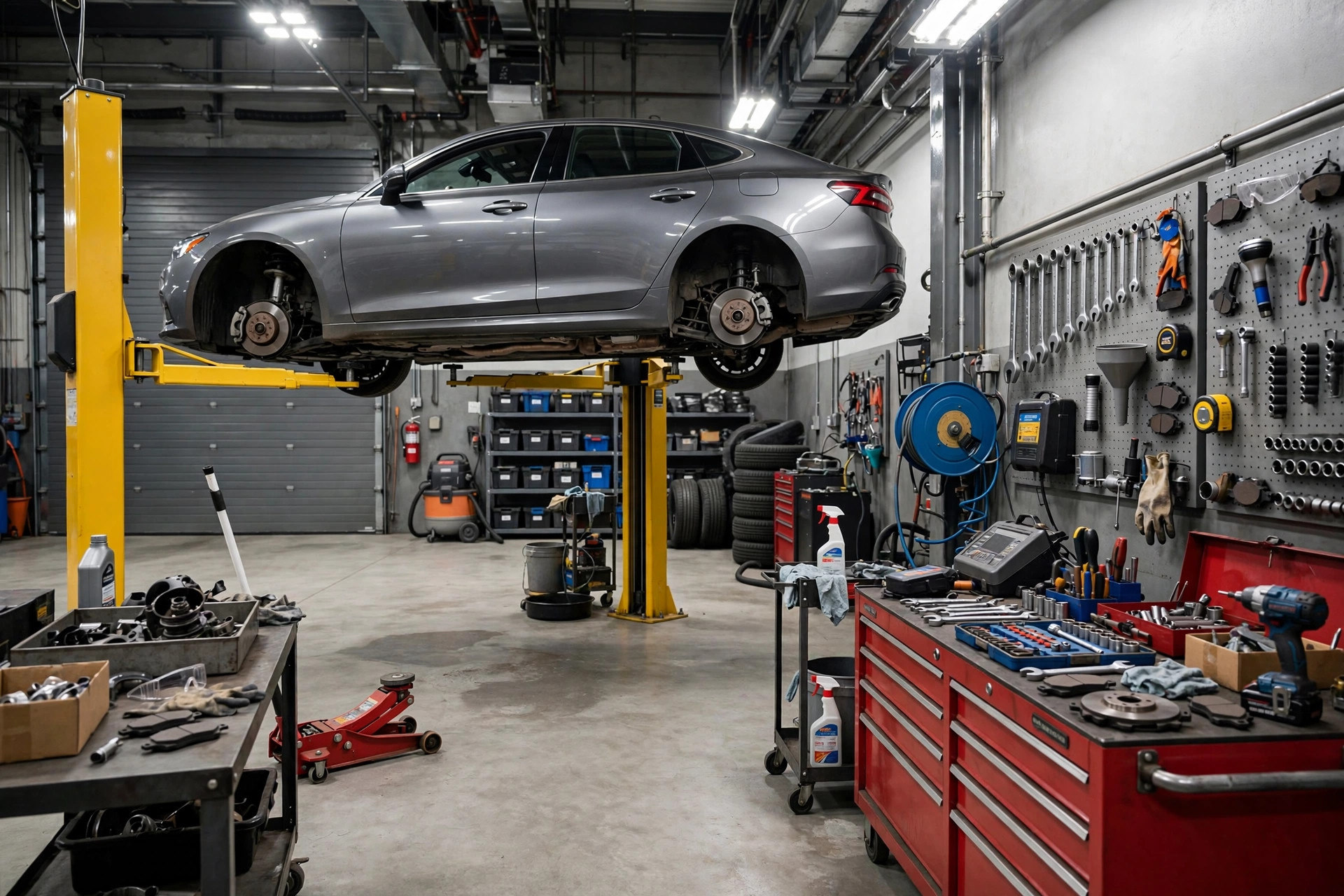
Real shop photos beat stock photos. Customers can tell the difference.
| Feature | DIY ($100-500/yr) | Freelancer ($1.5k-5k) | Small agency ($5k-12k) | Premium ($12k+) |
|---|---|---|---|---|
| Custom design | Template only | Yes | Brand-matched | Fully custom |
| Online scheduling | Request form | Request form | Live scheduling | Bay-level scheduling |
| Shop system integration | No | No | Yes | Two-way sync |
| Estimate request form | Basic | With vehicle fields | Smart routing | Smart routing |
| Digital inspection display | No | No | Integrated | Integrated |
| Review widgets | Manual | Google reviews feed | Live widgets | Live widgets |
| Service pages for SEO | 1-2 pages | 5-8 pages | 10-15 pages | 15+ pages |
| Local SEO foundation | Minimal | Basic | Full | Advanced |
| Speed optimization | No | Basic | Yes | Yes |
| Post-launch support | None | 30 days typical | 3-6 months typical | Retainer available |
What to budget every year
The build is the down payment. The site has monthly and yearly costs that keep it running, secure, and current. Shops that budget for these avoid the slow decay that turns a good site into an embarrassment.
| Yearly budget item | Typical range | Notes |
|---|---|---|
| Hosting and security | $15 to $60 per month | SSL, backups, and uptime monitoring |
| Domain renewal | $15 to $25 per year | Registered in the shop’s name, always |
| Scheduling software | $50 to $150 per month | Often bundled with your shop management system |
| Maintenance and updates | $50 to $250 per month | Updates, backups, small fixes, broken link checks |
| Content updates | $0 to $150 per month | New service pages, seasonal promotions, photo updates |
| SEO retainer (optional) | $400 to $1,500 per month | For shops competing hard in local search |
Most shops land between $80 and $250 a month without an SEO retainer. That covers a site that stays fast, stays secure, and keeps its scheduling working. The expensive failure mode is the $4,000 site with zero maintenance: two years later the scheduling widget breaks after an update, the service prices are outdated, and the site quietly stops producing appointments. A modest maintenance plan is the cheapest insurance a shop website has.
The math: what a booking site earns
Shop owners think in repair orders, so here is the website math in those terms.
The same logic applies to estimate requests. Every estimate form submission the shop answers quickly is a repair order the competitor does not get. Track two numbers monthly: online appointments booked and estimate requests received. If both are climbing, the site is working. If they are flat, the problem is usually the booking flow or the response time, not the design. For shops in competitive markets, our roofing website cost guide shows how the same booking math plays out in another trade.
Before you hire anyone: the 10-step checklist
- 1Decide what the site must do. Brochure, estimate collector, or booking engine. Write it down before talking to any designer.
- 2Audit your missed calls. Check a week of after-hours and busy-hour calls. That number is the revenue case for online scheduling.
- 3Pick your scheduling approach. Request form, embedded widget, or live bay scheduling, based on step 1 and your shop management system.
- 4List every service with a plain-English description. Drivers search for problems, so write the way customers talk: “brake repair,” not “friction system service.”
- 5Photograph the real shop. Clean bays, real techs, the front counter. Stock photos of spotless fake garages hurt trust.
- 6Get three quotes with matching scope. Same feature list to each bidder, so the prices are comparable.
- 7Confirm integration experience. Ask which shop management systems the builder has integrated with, and ask for a reference.
- 8Test the booking flow on a phone. Book a fake appointment on your own phone. If it takes more than two minutes, it needs work.
- 9Set up review collection. The review widgets only convert if the reviews are fresh. Build the ask into every invoice.
- 10Assign a site owner. One person responsible for prices, photos, and checking that scheduling still works every month. Sites without owners rot.

Online bookings should be the first thing you check each morning, next to the bays.
Frequently asked questions
How much does an auto repair shop website cost on average?
Most shops pay between $1,500 and $12,000 for a professional build. A freelancer site runs $1,500 to $5,000, a small agency build with live scheduling $5,000 to $12,000, and premium custom builds with bay-level scheduling $12,000 to $20,000 or more. DIY builders cost $100 to $500 a year.
How much does online scheduling add to the cost?
An embedded scheduling widget adds $500 to $2,000 to the build plus $50 to $150 a month in software fees. Full live bay scheduling with two-way shop system sync typically adds $3,000 to $8,000 to the project.
Can the website connect to my shop management software?
Yes, in most cases. The common systems (Tekmetric, Shop-Ware, Mitchell, and similar) offer scheduling widgets or APIs that a competent agency can integrate. Confirm the builder has done your specific system before, and get a demo of the integration working.
Do I need digital vehicle inspections on my website?
Not every shop does, but customer-facing inspection reports with photos build trust and lift approval rates on recommended work. Integrating the display into the site typically adds $1,000 to $3,000. Shops that already send digital inspections get the most value.
What are the monthly costs of running the site?
Plan $80 to $250 a month for hosting, domain, scheduling software, and maintenance. An SEO retainer for competitive local markets adds $400 to $1,500 a month.
How long does it take to build?
A DIY site takes a weekend. A freelancer needs 2 to 4 weeks. An agency build with scheduling integration runs 6 to 10 weeks, and premium custom builds take 3 to 5 months. Scheduling integration testing is the usual bottleneck, so start it early.
Get a shop website that fills your bays
Digital Hayder builds auto repair websites with online scheduling, estimate request forms, digital inspection displays, and local SEO that puts you in front of drivers searching for help. We also handle the follow-up: AI chatbots that answer pricing questions after hours and review systems that build trust. Tell us about your shop and we will quote the build that fits.
Contact Us