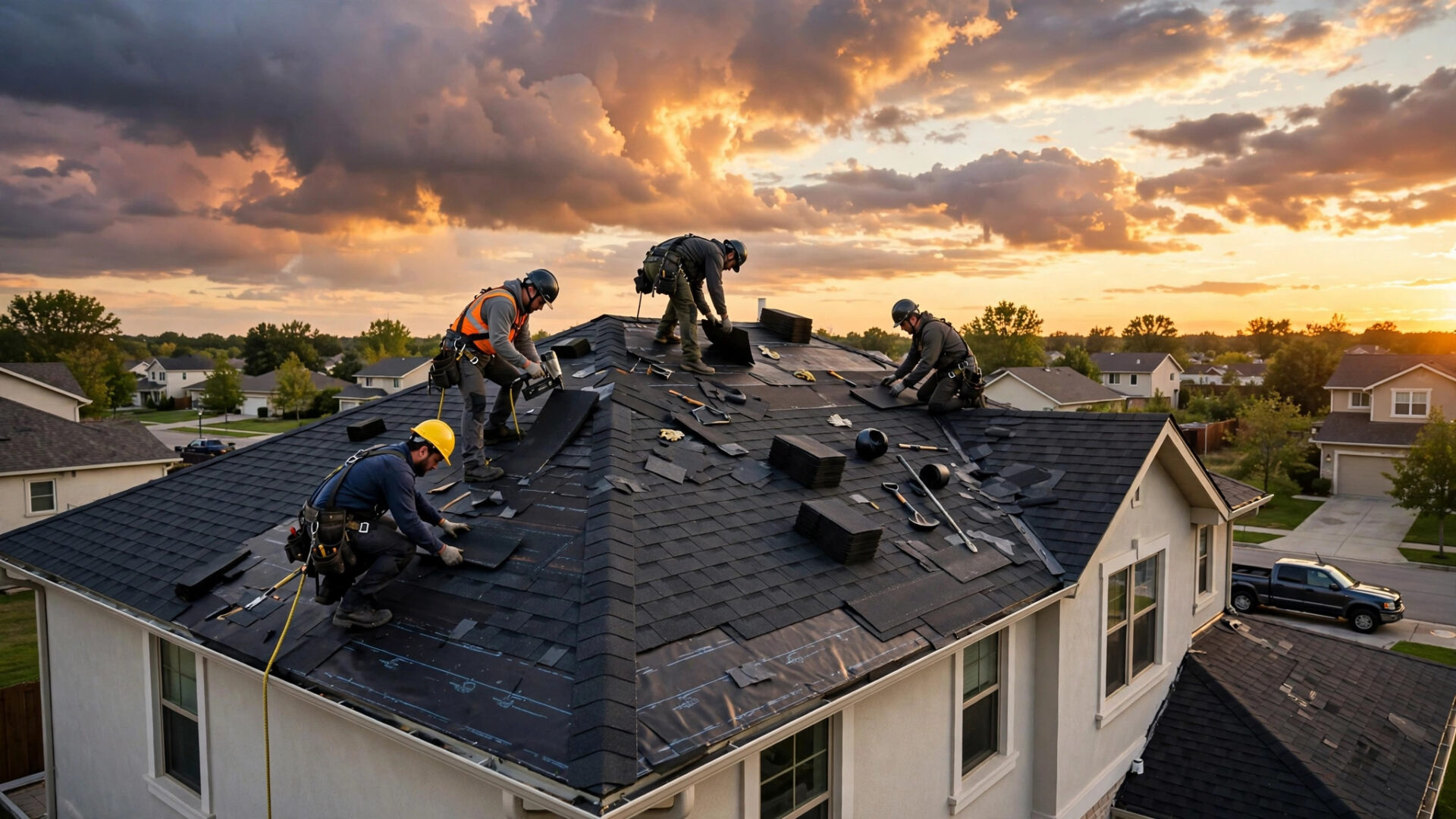
A roofing website has one job: turn worried homeowners into booked estimates. Nobody browses a roofer’s site for fun. They arrive with a leaking ceiling, a storm-damaged roof, or an insurance adjuster on the way. If you are trying to work out how much a roofing website costs, you have probably seen numbers from $500 to $20,000. Here is the frame that matters: one signed roof replacement often covers the entire website. The real question is not what the site costs, but whether it brings in jobs.
This guide breaks down real roofing website costs in, what each price tier buys, the lead-generation features that move the price, and the ongoing costs that quotes usually leave out.
The quick answer
- DIY website builder: $17-$50/month – fine for a basic presence, weak at generating estimate requests.
- Freelancer / template build: $500-$2,000 – decent starting point for a small residential roofer.
- Professional custom build: $3,000-$8,000 – the sweet spot for most roofing companies, with quote forms and local SEO done right.
- Specialized roofing agency: $8,000-$20,000 – industry-specific features, storm-season campaigns, and ongoing optimization.
- Commercial / multi-location: $10,000-$20,000+ – portfolio systems, certifications, and complex lead routing.
A note on these numbers: they are planning ranges compiled from published roofing marketing guides, useful for budgeting rather than fixed industry prices. Every quote depends on scope. Our dental website cost guide breaks down similar tiers for another contractor-style service business.
Roofing website cost: what each price tier actually buys
DIY website builders
$17 to $50 per month
Wix lists its roofing website builder plans starting around $17 per month, including hosting, templates, contact forms, and basic SEO tools (Wix roofing website guide). You get a site that says you exist. What you do not get: service-area pages that rank on Google, a quote form that pre-qualifies leads, or speed that survives a homeowner checking your site from a ladder-side phone. For a one-crew operation getting most work from referrals, this can be enough for a while.
Freelancer / template build
$500 to $2,000 one time
A freelancer sets up WordPress with a roofing theme, loads your services and photos, and adds a contact form. Wix’s own guide puts hiring a designer in the $500 to $5,000 range depending on customization (Wix roofing website guide). A documented case study of a commercial roofer’s rebuild puts the freelancer/agency tier at $3,000 to $8,000 for custom design, professional integration, and basic SEO over 4 to 8 weeks (Medium: commercial roofer website case study). The low end of this tier works for a residential roofer with a tight service area. Quality varies wildly, so check references and look at live sites the developer built for other contractors.
Professional custom build
$3,000 to $8,000 one time
A properly built roofing website in typically runs $3,000 to $10,000 depending on location pages, integrations, and custom features like cost calculators, according to roofing design specialists (Social Spike roofer website checklist). This tier buys a conversion-focused design, a quote form that pre-qualifies leads by project type and urgency, individual service pages (replacement, repair, metal, gutters), a real project gallery, review integration, and local SEO structure. For most roofing companies doing residential work, this is where the site starts paying for itself: one extra signed job per quarter covers it.
Specialized roofing agency build
$8,000 to $20,000+ one time
Agencies that only build for roofers charge $8,000 to $20,000 for industry-specific features, lead optimization, and ongoing SEO, typically over 6 to 12 weeks (Medium: commercial roofer website case study). Roofing marketing consultants quote website builds at $3,000 to $15,000, often on proprietary platforms (Keene Digital roofing marketing cost guide). You are paying for a team that already knows what a storm-damage landing page should say, how insurance-claim content converts, and which form fields kill quote requests. Commercial roofers needing portfolio systems, certifications display (GAF Master Elite, manufacturer credentials), and detailed pre-qualification forms land at the top of this range.
The lead-generation features that move roofing website costs
A roofing website is a lead machine or it is decoration. These are the features that separate the two, and each one adds to the build cost.
1. Instant quote forms and cost calculators
The generic “contact us” form is the weakest lead tool on a roofing site. Strong sites use multi-step estimate forms that ask about roof type, square footage, urgency, and insurance status, which pre-qualifies the lead and demonstrates expertise at the same time. Interactive cost calculators add $1,000 to $3,000 to a build but give homeowners a reason to hand over their contact details. Keep forms short on the first step: every extra field on step one reduces completions. The roofing specialists at Social Spike flag long forms with no trust signals as one of the most common conversion killers on roofer sites (Social Spike roofer website checklist).
2. Service-area pages for local SEO
One generic services page trying to rank for every city you serve wins none of them. The correct structure is a dedicated page per service per area: “roof replacement in Plano,” “storm damage repair in Frisco,” and so on. A roofer serving 10 towns needs 10 to 30 location pages, each with unique content about that area. Content for these pages is a real cost driver: $150 to $400 per page for properly written, locally relevant copy is typical. Cheap agencies skip this and your site never ranks outside your home zip code.
3. Storm-damage and project galleries
Before-and-after photos are the highest-converting content on a roofing website. Homeowners with hail damage want to see hail damage you already fixed. A proper gallery system with project categories (hail, wind, full replacement, metal), locations, and short descriptions adds $500 to $1,500 to a build. Stock photos of shingles and hardhats signal inauthenticity to every homeowner who has seen them before, so budget for real job-site photography on every completed project.
4. CRM and follow-up integrations
Most roofing leads do not book on the first visit. They get three quotes. The site needs to feed every estimate request into your CRM (JobNimbus, AccuLynx, or similar) and trigger follow-up automatically: instant text confirmation, an email with your reviews, a reminder if they go quiet. Integration work runs $500 to $2,000 depending on the CRM. Without it, leads sit in an inbox and go cold while competitors respond in minutes. Storm season makes this worse: when a hailstorm hits, the roofer with instant automated follow-up wins the jobs.
5. Reviews, financing, and insurance-claim content
Three supporting features move the needle for roofers specifically. A reviews page and Google review widgets build the trust a $12,000 purchase requires. A financing page matters because most homeowners cannot pay cash for a full replacement. And insurance-claim guidance content (“what to do after hail damage,” “how the claims process works”) captures the exact searches homeowners make in the week after a storm. Each is a modest build cost, but together they are what make a roofing site feel like it was built by someone who understands the trade.
Template vs custom roofing website
| Factor | Template site | Custom site |
|---|---|---|
| Upfront cost | $17-$50/month or $500-$2,000 build | $3,000-$20,000+ build |
| Quote forms | Generic contact form | Multi-step pre-qualifying estimate forms |
| Service-area SEO | One page for all areas, ranks for none | Dedicated pages per service per town |
| Galleries | Basic image grid | Categorized before/after project portfolios |
| Speed on mobile | Often slow, loses ladder-side visitors | Optimized for phones where leads arrive |
| CRM integration | Usually email notifications only | Direct feed into JobNimbus or AccuLynx with follow-up |
| Storm-season readiness | Manual updates, slow to react | Pre-built storm landing pages ready to launch |
The contract trap: who owns your website
Roofing marketing consultants report typical website quotes of $3,000 to $15,000, but flag that the real difference between vendors is contract length and asset ownership: a $4,000-a-month agency on a twelve-month term is a $48,000 decision, and if the website stays with them when you leave, you rebuild from zero (Keene Digital roofing marketing cost guide). Before signing anything, get written answers to three questions: do I own the website outright, can I move it to another host, and what happens to my content and reviews if I cancel. The cheapest quote in the pile is often the most expensive exit.
Storm season also deserves a budget line. Roofing consultants note that a residential roofer in a mid-size market should be ready to push Google ad spend to $5,000+ for the week after a storm, on top of the usual $1,500 to $3,000 monthly quiet-season budget. Your website needs pre-built storm landing pages ready to switch on, because the week after hail is when search volume explodes and the prepared roofer takes the market.
Roofing leads: website vs buying leads
Many roofers compare a website against buying leads from HomeAdvisor, Angi, or similar platforms. Purchased leads run $50 to $300 per lead and are usually shared with 2 to 3 other roofers, which means you are racing competitors to every call (Keene Digital roofing marketing cost guide). Once you account for the jobs your competitors win, purchased leads are the most expensive per signed job despite looking cheapest on paper. A website that ranks for “roofing contractor near me” generates leads you own exclusively, and the asset keeps working after the build is paid off. The math favors the website for any roofer planning to be in business three years from now.
How to get an accurate roofing website quote

- 1 List your services separately: replacement, repair, metal, gutters, commercial. Each needs its own page.
- 2 Count your service areas: every town you serve needs a dedicated location page for local SEO.
- 3 Define your quote process: instant estimate form, cost calculator, or simple contact form, and where leads should go.
- 4 Name your CRM: JobNimbus, AccuLynx, or other, so integration is quoted instead of discovered later.
- 5 Gather your proof: project photos, reviews, certifications, and manufacturer credentials for the gallery and trust sections.
- 6 Clarify ownership: confirm in writing that you own the domain, site, and content with no platform lock-in.
- 7 Plan for storm season: ask for pre-built storm landing pages and a plan to scale ad spend after hail events.
- 8 Ask for the monthly total: hosting, maintenance, SEO, and ad management as one number, not just the build price.
Roofing website cost FAQ
Does a roofing company really need a website?
Yes. Most homeowners start their search for a roofing contractor online, and a professional website builds the trust a five-figure purchase requires. Even referral-heavy roofers lose jobs when a referred homeowner checks the site and finds nothing convincing.
How much should a small roofing company spend on a website?
A small residential roofer should budget $3,000 to $8,000 for a professional build with quote forms and local SEO. Template builds under $1,500 almost always cut corners on speed, structure, and SEO setup, and owners often pay more to fix them later than they would have spent building properly the first time.
Is it cheaper to buy leads from HomeAdvisor or Angi?
On paper, yes: purchased leads run $50 to $300 each. In practice, those leads are shared with 2 to 3 competing roofers, and once you factor in the jobs competitors win, purchased leads are the most expensive per signed job. A website produces leads you own exclusively.
How long does it take to build a roofing website?
A freelancer template build takes 2 to 4 weeks. A professional custom build takes 4 to 8 weeks. A specialized roofing agency build with full SEO setup and content takes 6 to 12 weeks.
Do I need separate pages for each city I serve?
Yes, if you want Google to send you work from those cities. One generic services page cannot rank for ten towns. Dedicated location pages with unique local content are the standard structure for roofing SEO.
What about calls that come in after hours during storm season?
Storm damage does not wait for business hours. An AI receptionist that answers after-hours calls and books inspections can capture the leads your website and voicemail would otherwise lose on the busiest nights of the year.
Want a roofing website that books estimates?
We build roofing websites with pre-qualifying quote forms, service-area SEO, and storm-ready landing pages. Tell us about your company and get a clear fixed quote.
Contact Us