A homeowner’s faucet starts leaking on a Tuesday morning. By Tuesday afternoon they have searched “handyman near me,” clicked an ad, and booked a job. That is the entire sales cycle for most handyman work: short, local, and decided in minutes. Google Ads cost for handyman services reflects a friendlier auction than most trades face: broad handyman keywords are cheaper than plumber or electrician clicks, the jobs are frequent, and one good customer sends a steady stream of repeat work and referrals. This guide covers what handyman clicks cost by job type, how to bucket your keywords so the good jobs get the budget, what monthly spend fills a week of slots, and the landing pages and follow-up that turn one-off fixes into regular customers.
The quick answer
- Clicks are cheaper than most trades: broad handyman keywords typically cost $3 to $8 per click, while specific job keywords like drywall repair or TV mounting run $4 to $10.
- Expect $20 to $45 per booked job: a $15 to $35 cost per lead and a normal close rate put an acquired job in the $20 to $45 range for a well-run account.
- Bucket keywords by job type: separate campaigns for repairs, installations, and assembly keep budgets on the profitable work instead of the cheapest clicks.
- Start at $1,000 to $2,000 a month: that buys 150 to 400 clicks in most markets, enough to fill 15 to 40 weekly slots once the page and phones convert.
- One landing page per service group: a drywall page, a mounting and assembly page, and a general repairs page will out-convert a homepage every time.
- The repeat customer is the prize: one booked job often becomes three or four jobs a year plus referrals, so acquisition cost should be judged on the relationship, not the first ticket.
What handyman clicks actually cost
Handyman advertising sits in a sweet spot. The searches are local and urgent enough to convert well, but the auction is less crowded than plumbing or electrical, where emergency tickets pull in heavy spenders. The result is click prices that a solo operator or small crew can actually afford without a franchise-sized budget.
Broad searches like “handyman near me” or “handyman services” usually cost between $3 and $8 per click in a mid-size US market. In large metros the same searches can reach $9 to $12, still well below what plumbers pay for emergency keywords. These broad terms carry the highest volume, and they mix small jobs with bigger ones, which makes the keyword bucketing and the landing pages later in this guide so important.
Job-specific keywords tell you what the customer wants before they even call. “Drywall repair,” “door installation,” “fence repair,” and “gutter cleaning” typically cost $4 to $10 per click. The intent is clear, the ticket is predictable, and you can route each one to a dedicated landing page that speaks to exactly that job. These are the workhorse keywords of a profitable handyman account.
Assembly and mounting keywords are often the cheapest in the account. “TV mounting service,” “furniture assembly,” and “picture hanging service” can cost $2 to $6 per click in many markets. The individual tickets are smaller, often $100 to $200, but the jobs are fast, the customers are easy to please, and they become repeat callers for bigger work later. Do not dismiss cheap keywords; judge them by the customer they bring, not the first invoice.
Specialty and larger-project keywords cost more because the tickets justify it. “Bathroom tile repair,” “deck repair,” “drywall ceiling repair,” and “home repair contractor” can run $6 to $14 per click. Treat these like their own campaign with their own budget so the bigger jobs get the visibility they deserve instead of being drowned out by cheap assembly clicks.
| Keyword group | Typical CPC range | Typical job ticket | Why it matters |
|---|---|---|---|
| Broad: “handyman near me”, “handyman services” | $3 to $8 | $150 to $400 | Highest volume, mixed job sizes |
| Repairs: “drywall repair”, “door repair”, “fence repair” | $4 to $10 | $200 to $600 | Clear intent, predictable tickets |
| Installations: “ceiling fan installation”, “door installation” | $4 to $10 | $150 to $500 | Fast jobs, easy to schedule |
| Assembly and mounting: “TV mounting”, “furniture assembly” | $2 to $6 | $100 to $250 | Cheapest clicks, great repeat customers |
| Outdoor: “gutter cleaning”, “deck repair”, “pressure washing” | $4 to $9 | $200 to $800 | Seasonal volume, good upsell base |
| Projects: “bathroom remodel handyman”, “home repair contractor” | $6 to $14 | $800 to $3,000+ | Big tickets, fewer searches, own budget |
Compare this with the trades around you. Plumbers pay emergency-level CPCs for burst pipes and water heaters, which you can read about in our plumber Google Ads cost breakdown, and electricians face a similar pattern covered in our electrician Google Ads cost guide. Handyman owners get to compete in a cheaper auction with wider keyword coverage, which is an advantage you should use fully.
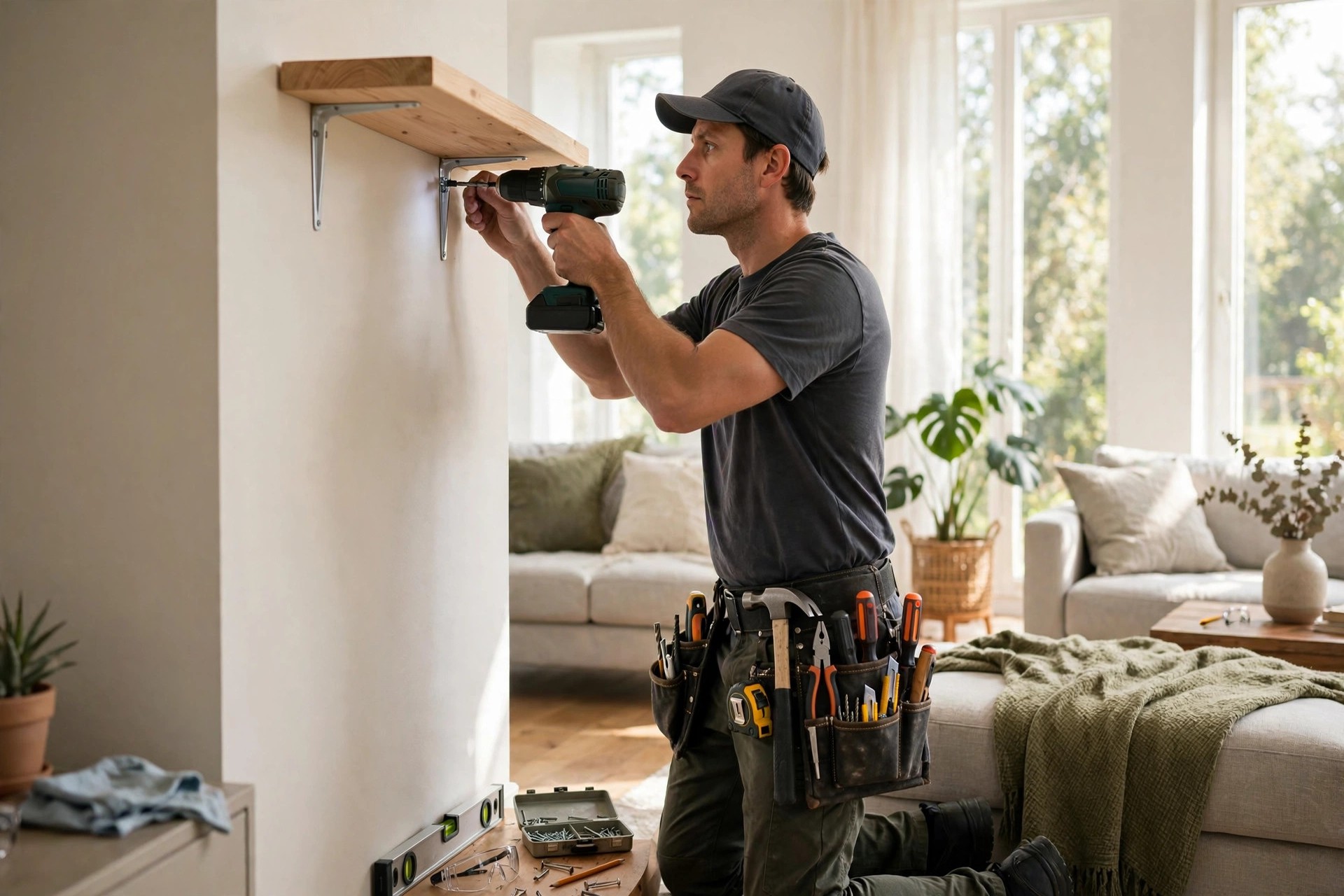
Mounting, assembly, and small repair jobs are the cheapest clicks in the account and some of the best long-term customers.
What a booked job actually costs you
Click price is the start of the chain, not the end. Run your own numbers through the same three steps every advertiser uses: clicks to leads, leads to booked jobs, and booked jobs to revenue.
First, the landing page conversion rate. A focused handyman landing page with click-to-call and a short quote form converts 10 to 18 percent of ad clicks into leads. A homepage with a buried contact form converts 3 to 6 percent. At a $5 average click, ten clicks cost $50. At 12 percent conversion that is roughly one lead for about $42. At 5 percent conversion the same traffic costs you $100 per lead. The page is doing half the work of your ad spend, whether you designed it that way or not.
Second, the close rate. Handyman leads close well when you answer fast and quote clearly, typically 50 to 70 percent for inbound calls and 30 to 50 percent for form fills. At a $42 cost per lead and a 60 percent close rate, your cost per booked job is about $70. Answer slowly or quote vaguely and that close rate drops to 35 percent, which pushes the same lead cost to $120 per job. Speed and clarity at the phone are the cheapest improvements in the business.
Third, the ticket mix. A realistic week might include two $150 mounting jobs, one $350 drywall repair, and one $600 deck repair. The blended ticket lands around $300, which means a $70 acquisition cost leaves healthy margin before you count the repeat business. The math only breaks when cheap clicks get spent on keywords that produce $80 jobs you cannot profitably serve, which is exactly what the bucketing section below prevents.
Bucket your keywords by job type
The biggest structural mistake in handyman accounts is one campaign holding every keyword. Google spends the budget on the cheapest clicks, so “furniture assembly” at $3 a click eats the budget while “deck repair” at $9 a click starves, even though the deck job pays four times more. Separate campaigns fix this by giving each job type its own budget and its own bids.
Campaign 1: General handyman. “Handyman near me,” “handyman services [city],” “home repair near me.” The volume campaign. Moderate bids, ad copy about the range of services, landing page showing the full service list with clear quote options.
Campaign 2: Repairs. “Drywall repair,” “door repair,” “window repair,” “fence repair.” Each ad group gets its own ad and its own landing page section. These keywords carry the best ticket-to-click-cost ratio in most accounts.
Campaign 3: Installations and mounting. “TV mounting service,” “ceiling fan installation,” “shelf installation.” Lower bids are fine here because the clicks are cheap; the goal is volume and a full schedule of fast jobs.
Campaign 4: Assembly. “Furniture assembly service,” “IKEA assembly,” “exercise equipment assembly.” The cheapest clicks in the account. Keep the budget modest and the scheduling tight, because these jobs only profit when they stack efficiently.
Campaign 5: Outdoor and seasonal. “Gutter cleaning,” “pressure washing,” “deck repair.” Seasonal budgets: push gutter cleaning in fall, deck repair in spring, pressure washing when the weather turns. Flat budgets all year waste money on out-of-season searches.
Campaign 6: Larger projects. “Bathroom tile repair,” “handyman for remodel,” “home repair contractor.” Higher bids, fewer clicks, bigger tickets. The landing page should show project photos and explain the quoting process, because these customers are comparing contractors, not just prices.
Negative keywords protect every campaign. Block “jobs,” “careers,” “salary,” “DIY,” “how to,” “free,” and “YouTube,” plus any service you do not offer. A handyman who does not do electrical work should block “electrician,” “wiring,” and “panel upgrade” before the first dollar is spent. Review the search-term report weekly for the first two months; it is where the wasted spend hides.
What you should spend each month
The learning floor for a handyman account is lower than for pricier trades, but it still exists. Each campaign needs roughly 10 to 15 clicks a day to gather data at a useful pace, which puts the practical minimum around $1,000 a month in ad spend for a two or three campaign account. Below that, the bidding never learns and the results never stabilize.
Think about the budget in terms of the week you want to fill. If your crew can handle 20 jobs a week and your close rate is 60 percent, you need about 33 leads a week. At a $30 cost per lead, that is roughly $1,000 a week, or about $4,000 a month. Work the same math backward from your actual capacity and your actual numbers, and the right budget reveals itself. Never spend to generate leads you cannot serve; unanswered quotes and week-long scheduling delays destroy the close rate the ads paid for.
| Monthly ad spend | Rough daily budget | Expected clicks | Expected leads | Best fit |
|---|---|---|---|---|
| $1,000 | $33 | 150 to 250 | 15 to 30 | Solo operator testing paid search, one service area |
| $2,000 | $66 | 300 to 450 | 30 to 55 | Small crew wanting a full week, steady growth |
| $3,500 | $116 | 500 to 750 | 55 to 95 | Multi-tech operation, aggressive scheduling |
| $6,000+ | $200+ | 900+ | 100+ | Large local brand, multiple crews, wide coverage |
These estimates assume a $4 to $6 blended click cost and a 10 to 14 percent conversion rate. If your market is a major metro, shift every band up by about a third; if it is a small town with thin competition, you may land below these ranges.
Starter: test the channel
For a solo handyman or two-person crew running a first serious test. Two to three campaigns, one tight service area, weekly search-term review. The goal is 15 to 30 leads a month and a clear read on cost per booked job.
- General and repairs campaigns only
- One landing page with click-to-call and a quote form
- Call tracking from day one
Growth: fill the week
For crews with real capacity to fill. Full campaign structure by job type, seasonal outdoor budgets, and follow-up on every quote. The goal is a predictable cost per job you can plan hiring around.
- All six keyword buckets with separate budgets
- Dedicated landing pages per service group
- Quote follow-up process within 24 hours
Scale: own the local market
For the company that wants to be the obvious choice in its market. Every profitable keyword covered, review-driven ad copy, and capacity planned around the lead flow. The goal is market share, not just jobs.
- Full coverage plus brand and competitor terms
- Seasonal pushes timed to demand peaks
- CRM tracking from click to paid invoice
The pattern holds across home services with the numbers shifting by trade. Our Google Ads cost for cleaning companies guide shows a similar broad-keyword structure at slightly different CPCs, and our Google Ads cost for pest control companies breakdown shows what the math looks like when recurring revenue enters the picture.

Work the budget backward from the week you want to fill: capacity first, leads needed second, ad spend last.
One landing page per service group
Handyman searches are specific, so the landing page should be specific too. A person searching “drywall repair” who lands on a generic homepage has to scroll, guess, and hope you do drywall. A person who lands on a drywall repair page with photos of patched walls, a price range, and a quote button is already halfway to booking. Build three pages to start and expand from there.
The repairs page covers drywall, doors, windows, and minor carpentry. Lead with before-and-after photos, because repair customers buy proof. Show a price range table: small drywall patch $150 to $250, medium repair $250 to $450, full room touch-ups quoted on site. End every section with the same quote button. This page serves your repairs campaign and usually produces the best cost per lead in the account.
The mounting and assembly page covers TV mounting, furniture assembly, shelf and mirror hanging. These customers want speed and certainty: “book today, done today” language, flat-rate pricing per item, and a booking calendar if you have one. Keep the page short and the form shorter. This is a volume page, not a persuasion page.
The general services page catches the broad “handyman near me” traffic. It needs the full service list with icons or short descriptions, the service area spelled out by town name, review highlights, and two quote paths: call now for urgent jobs, request a quote for planned work. This page also carries your trust content: licensed and insured status, years in business, and the satisfaction guarantee.
Every page follows the same above-the-fold formula: a headline matching the ad, the phone number as a large tap-to-call button, a three-field form (name, phone, job description), and one trust signal. On mobile, which carries most of your traffic, the call button stays visible while scrolling. Test the form on a real phone; if it takes more than 30 seconds, it is costing you leads.
Write ads that match the job
Handyman ad copy wins by being concrete. Vague claims like “quality workmanship” say nothing; “Drywall Repair, Most Jobs Done in One Visit” says everything. Match the headline to the search term, then add one reason to choose you: same-week availability, upfront pricing, or review count.
Price transparency is your secret weapon. Most handyman competitors hide behind “call for a quote,” so an ad that says “TV Mounting from $99” or “Furniture Assembly from $89” stands out immediately and pre-qualifies the clicker. You will get fewer curiosity clicks and more buyers, which lowers your cost per booked job even if the click itself costs the same.
Fill out every ad asset. Call assets for the phone-first customers, location assets to show you are nearby, sitelinks to the three landing pages, and callout assets for “Licensed and Insured,” “Same-Week Service,” and “Upfront Pricing.” Structured, complete ads get higher click-through rates, which improves quality scores and quietly lowers what you pay per click.
Run three ad variations per ad group and test the angle: one leads with price, one with speed, one with trust. Handyman markets are local enough that small wording differences move the needle. Review performance monthly, keep the winner, and always have a challenger running. The accounts that test beat the accounts that set and forget.
Follow-up: where handyman profit actually lives
Here is the uncomfortable truth about handyman advertising: most owners lose money on the first job and make it back on the repeats. A $200 drywall patch that cost $60 to acquire looks thin until that customer calls you for the bathroom caulking, the deck boards, and the ceiling fan, then refers two neighbors. The follow-up system is what converts a lead cost into a customer asset.
Quote every job fast and in writing. Send the written quote within 24 hours of the visit or call, and follow up once at 48 hours if they have not decided. A simple “Still need that drywall repaired? I can fit you in Thursday” message closes a meaningful share of quotes that would otherwise die quietly. Track your quote-to-booking rate; if it is under 40 percent, the problem is usually speed or clarity, not price.
After the job, ask for the review before you leave the driveway. Handyman businesses live on reviews because every new customer is choosing between strangers. A short text with the review link, sent while the customer is still happy with the finished work, produces far more reviews than an email three days later. Reviews then feed the ads: mention your review count in ad copy and watch click-through rates rise.
Build the repeat list deliberately. Keep every customer in a simple system with their job history, and reach out twice a year: once in spring for outdoor work and deck season, once in fall for pre-winter repairs and gutter cleaning. A $2 text or email to a past customer beats a $30 lead every time. This is also where a maintenance plan earns its keep: a twice-yearly home checkup visit at a flat rate gives you scheduled revenue and first refusal on every repair you find.

Outdoor and seasonal work fills the gaps between indoor jobs. Time your budgets to the seasons your market actually searches.
Retargeting past visitors and customers
Retargeting in a handyman account is cheap and simple. Past website visitors see your ads for 30 days after they leave, and the clicks cost $1 to $3 instead of $5 to $8. Two audiences cover nearly all the value.
Quote page visitors started the process but did not finish. Show them ads for two weeks with a direct reminder: “Still need a handyman? Get your free quote.” These are warm prospects who already chose you once; the ad just brings them back to finish. Keep this budget small, 5 to 10 percent of total spend, because the audience is limited and the intent is high.
Past customers are your seasonal campaign audience. Upload your customer list and show spring ads for deck repair and outdoor work, fall ads for gutter cleaning and pre-winter repairs. A past customer who books a $400 seasonal job from a $2 click is the best return in the account. Exclude customers from the last 60 days so you are not advertising to someone whose paint is still drying.
Set frequency caps at five to eight impressions a day. Nobody books a handyman because they saw the ad for the twentieth time; they book because the timing was right. Retargeting keeps you present until the timing is right.
Mistakes that waste handyman ad budgets
Bidding on jobs you do not do. Handyman is a broad word and Google will match you to “handyman electrician,” “handyman plumber,” and full remodel searches. If you do not do electrical, plumbing, or roofing, block those terms on day one. Every irrelevant click is a $5 donation to Google.
One campaign for everything. Covered in the bucketing section, but it bears repeating as a budget issue: blended campaigns let cheap assembly clicks starve the profitable repair keywords. Structure is not optional; it is where the profit hides.
Sending traffic to the homepage. A homepage converts at half the rate of a focused landing page or worse. Three service-group pages are the minimum viable setup, and they pay for themselves in the first month through lower cost per lead.
No call tracking. Most handyman leads call. Without call tracking tied to keywords, you cannot tell which campaigns produce jobs and which produce tire-kickers. Thirty to fifty dollars a month for tracking is the best money in the account.
Slow answering. The lead who calls three handymen books the one who answers first. If you are on a job site all day, get a call answering process in place before you spend on ads: an answering service, a dedicated scheduler, or an AI receptionist. Missed calls are the most expensive part of the account.
Quoting without follow-up. Sending a quote and never following up abandons a third or more of your potential bookings. One follow-up message at 48 hours is the minimum; make it a habit, not an afterthought.
Judging ads on the first job only. If you evaluate every campaign on first-ticket profit alone, you will kill the keywords that bring your best repeat customers. Track repeat bookings per customer for at least six months before you decide a keyword is unprofitable.
Your rollout checklist
Work through these in order. Each one builds on the last.
- 1Know your numbers. Average ticket, close rate, and repeat rate per customer, so every bidding decision has a target to beat.
- 2Define the service area honestly. Target only the towns you can reach profitably; exclude the rest before spending anything.
- 3Build the six keyword buckets. General, repairs, installations and mounting, assembly, outdoor and seasonal, and larger projects, each with its own budget.
- 4Write three ads per ad group. Test price, speed, and trust angles; keep the winner and always run a challenger.
- 5Build the three landing pages. Repairs, mounting and assembly, and general services, each with tap-to-call and a three-field form.
- 6Install call tracking. Tie every call back to its keyword and ad; without this you are guessing on most of your results.
- 7Fix answering before spending. Live answer or a fast callback process during work hours, so ad clicks become booked jobs.
- 8Launch with a full-month test budget. Commit $1,000 to $2,000 for four full weeks; do not judge before week three.
- 9Review search terms weekly. Block DIY, job-seeker, and out-of-scope searches for the first two months.
- 10Start the repeat-customer system. Review request after every job, 48-hour quote follow-up, and seasonal outreach to past customers.
Frequently asked questions
How much should a handyman spend on Google Ads per month?
Start with $1,000 to $2,000 a month. That buys 150 to 400 clicks in most markets, which should produce 15 to 55 leads with a good landing page. Scale up once you know your cost per booked job and have the crew capacity to handle more work.
What is a good cost per lead for handyman services?
Most accounts land between $15 and $35 per lead. Assembly and mounting keywords sit at the low end, repair and project keywords at the high end. If your cost per lead is over $50, check your landing page conversion rate and your negative keywords first.
Are Google Ads worth it for a solo handyman?
Yes, if you can answer the phone and handle the volume. A solo operator spending $1,000 a month can book 10 to 20 jobs from it, which is often a full schedule. The key is keeping the service area tight and the follow-up fast so no lead goes cold.
Which handyman keywords are the most expensive?
Project-level keywords like bathroom tile repair and home repair contractor cost the most, typically $6 to $14 per click. Repair keywords run $4 to $10. Assembly and mounting keywords are cheapest at $2 to $6 but bring smaller first tickets and strong repeat rates.
Should I advertise every service I offer?
Advertise the services you want more of, not everything you can do. Put budget behind profitable, repeatable job types like drywall repair, mounting, and seasonal outdoor work. Keep low-margin or one-off services out of paid search and let them come through referrals.
How fast will I see results from handyman Google Ads?
Leads usually start within the first few days. Stable cost-per-lead numbers take two to four weeks as the campaigns collect data. Give the account a full month at a real budget before deciding whether it works in your market.
Do I need separate landing pages for each service?
At minimum, build three: repairs, mounting and assembly, and general services. Sending all traffic to your homepage typically halves the conversion rate. Each page should match its ads, show relevant photos and prices, and make calling or requesting a quote effortless.
What bidding strategy works best for handyman ads?
Start with manual bidding or maximize clicks while the account collects its first 30 conversions per campaign. Then move to target cost per acquisition based on your real cost-per-lead history. Avoid fully automated bidding on day one with no data behind it.
How do I compete with bigger companies on Google Ads?
You do not need to outbid them everywhere. Win on relevance: tighter service areas, job-specific landing pages, faster answering, and better reviews in your ad copy. A focused local account often beats a sloppy big-budget account on cost per booked job.
Should I run Google Ads year-round as a handyman?
Yes, with seasonal shifts. Keep general and repair keywords running all year at a steady budget, push outdoor and gutter work in spring and fall, and lean into interior repairs during winter when outdoor work slows. Match the budget to when your market searches.
Fill your weekly slots with booked handyman jobs
Digital Hayder builds Google Ads campaigns for handyman businesses: keyword buckets by job type, landing pages per service group, call tracking tied to booked jobs, and follow-up systems that turn one-time fixes into repeat customers. Tell us about your service area and we will design the account around it.
Contact Us