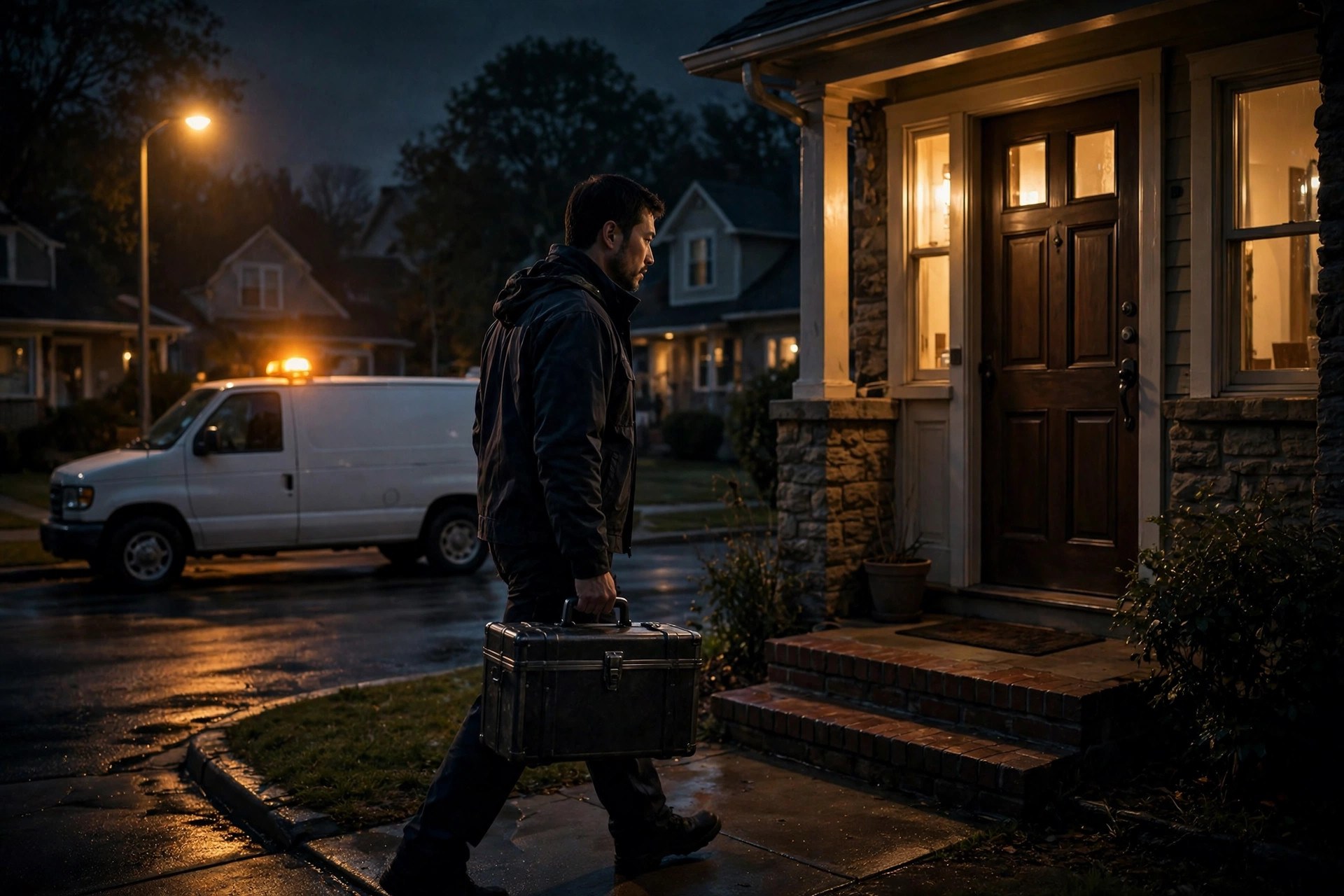
It is 1:40 AM. Someone is standing outside their own front door in the cold, keys sitting on the kitchen counter inside, phone in hand. They call the first locksmith on Google. Voicemail. They call the second. Voicemail. The third one answers, or texts back in thirty seconds, and gets the job. That is the entire locksmith business in one scene: emergency intent, zero patience, and the job going to whoever responds first. Locksmiths miss an enormous share of these calls. You are on another job, under a dashboard programming a car key, asleep at 2 AM, or in a dead zone between buildings. Every missed call is a customer with an urgent problem calling your competitor next. This guide covers the single highest-return fix for that leak: missed-call text-back. The moment a call goes unanswered, the caller gets an instant text that starts a conversation, captures the job details, and holds them until you or your tech can respond. It works at 2 PM and at 2 AM. It costs a few dollars a month. And for a trade where one after-hours lockout can be worth $200, it pays for itself the first week.
The quick answer
- Missed calls are lost jobs: locked-out callers hire the first locksmith who responds. A missed call with no follow-up is a gift to your competitor.
- Text-back recovers them in seconds: an automatic text fires the moment a call goes unanswered, starting a conversation while the caller is still deciding.
- After-hours is where it wins biggest: most lockout calls come evenings and weekends. Text-back holds them until morning or routes them to your on-call tech.
- One recovered lockout pays for months: after-hours jobs run $150 to $250 or more. The system costs a few dollars a month to run.
- Setup takes an afternoon: a business texting number, A2P 10DLC registration, the missed-call trigger, and a handful of templates.
- Pair it with dispatch: text-back captures the job; a simple on-call workflow with ETA texts closes it.
The missed lockout call problem
Locksmith demand is different from almost every other trade. Nobody plans a lockout. The customer is stressed, often outside, often at night, and the need is immediate. That creates buyer behavior with no patience in it: the caller tries one number, then the next, then the next, until someone picks up. Industry experience across emergency trades consistently shows that the first responder wins the overwhelming majority of these calls, and callers rarely circle back to the locksmith whose voicemail they hit. Now count how many calls a typical locksmith operation misses. You are on a job and cannot answer. You are driving between calls. The shop is closed and the phone forwards to a voicemail nobody checks until morning. After-hours callers, the highest-value ones, get nothing. A shop missing just two calls a day is missing sixty jobs a month. Even if only a third of those were real, bookable jobs, that is twenty lost jobs monthly. At $125 average, that is $2,500 walking to competitors every month. Most locksmiths have no idea how many calls they miss, because a missed call leaves no trace unless you look at the call log. Pull yours for the last thirty days before you read further. The number is usually the most convincing argument in this guide.
Why locksmiths lose more to missed calls than other trades
Three things stack against locksmiths. First, the urgency: a homeowner with a broken water heater might wait a day; a locked-out driver at midnight will not. Second, the hours: a huge share of locksmith revenue comes from evenings, nights, and weekends, exactly when small shops are least able to answer. Third, the competition density: most markets have a dozen locksmith listings, so the caller always has another number ready. An electrician who misses a call might get a callback tomorrow. A locksmith who misses a 1 AM lockout call never hears from that caller again. That is why text-back matters more here than in nearly any other trade.
How missed-call text-back works
The concept is simple and the execution is automatic. You connect your business phone number to a texting system. When a call rings unanswered for a set time, usually 20 to 30 seconds, or goes to voicemail, the system instantly sends the caller a text. The caller, who is staring at their phone anyway, gets a message within a minute: “Sorry we missed your call. This is Rapid Key Locksmith. Are you locked out right now? Reply with your location and we will get a tech to you.” The conversation has started. The caller stops dialing competitors because someone is already helping them. You or your on-call tech see the reply and take over, or an automated follow-up keeps the conversation warm: a second text a few minutes later asking for the address and the type of lock or vehicle. The whole thing runs without anyone touching it until a real job appears in the inbox.
Daytime versus after-hours texts
Use two versions. The daytime text assumes you will call back shortly: “Sorry we missed your call. This is Rapid Key Locksmith. What do you need help with? We will call you right back.” The after-hours text sets honest expectations and still captures the job: “Thanks for calling Rapid Key Locksmith. We are out on calls right now. Are you locked out? Reply with your address and we will confirm an ETA within 15 minutes.” If you run a true 24-hour operation with an on-call tech, say so: “We are available 24/7. Reply with your location and the tech on call will text you an ETA.” The worst after-hours message is silence. The second worst is a text that promises a callback “in the morning” to someone standing outside at midnight. Match the message to the reality of your coverage.
Every lockout call is urgent and impatient. The text-back reaches the caller while they are still choosing.
The jobs text-back saves: what each recovered call is worth
Not every missed call is equal, so here is what the recovered ones are typically worth. Daytime residential lockouts run $75 to $150 in most US markets. After-hours lockouts run $150 to $250 or more, with the premium hours between 10 PM and 6 AM commanding the top of the band. Car lockouts and key replacements run $100 to $250 depending on the key type; programmed transponder and smart keys run higher. Rekeys after a move or a breakup run $100 to $200 for a standard home. Lock installations and smart lock setups run $150 to $300 plus hardware. Safe openings start around $150 and climb with complexity. Commercial lock work varies widely but averages higher per visit than residential. The blended reality for a general locksmith shop: a recovered call is worth roughly $125 to $175 on average, with after-hours calls worth nearly double the daytime average. That is why the after-hours text matters most. Recovering five after-hours calls a month at $200 each is $1,000 in revenue from a system that costs less than a tank of gas.
| Job type | Typical US price band | When the calls come | Text-back value |
|---|---|---|---|
| Residential lockout, daytime | $75 to $150 | Evenings, weekends | High: caller is impatient |
| Residential lockout, after hours | $150 to $250+ | 10 PM to 6 AM | Highest: premium pricing, zero patience |
| Car lockout and key replacement | $100 to $250 | All hours, often parking lots | High: stranded callers convert fast |
| Rekey after move | $100 to $200 | Daytime, planned | Medium: less urgent, still worth capturing |
| Smart lock installation | $150 to $300 plus hardware | Daytime, planned | Medium: quote and schedule by text |
| Safe opening | $150 and up | Varies | Medium: qualify by text, book the specialist |
Setting it up: the afternoon build
A working text-back system takes an afternoon to set up and a week to tune. Do it in this order. First, pull your call log for the last thirty days and count the missed calls, split by business hours and after hours. That number is your baseline and your motivation. Second, get a business texting number. If your shop number is a mobile number, most platforms can text-enable it so texts come from the number customers already call. If it is a landline or VoIP number, get a dedicated texting number and put it on the website next to the call number. Third, register for A2P 10DLC through the platform. US carriers filter unregistered business texts, and a text-back that lands in a spam folder is no text-back at all. Fourth, connect the missed-call trigger: every unanswered ring after 25 seconds and every voicemail fires the text. Test it with your own cell phone before any customer sees it. Fifth, write the templates: the daytime text, the after-hours text, the address-and-details follow-up, and the ETA confirmation. Keep each under 160 characters. Sixth, decide who watches the inbox. Daytime, it is whoever answers the phone. After hours, it is the on-call tech or a simple rotation. Seventh, run it for a week and read every conversation. Tune the wording, fix the timing, and add any question customers keep asking. Our trade-specific walkthrough for the electrician version of this same system is the missed-call text-back for electricians guide.
Text-enabling your existing number
Customers call the number on your Google profile, your truck, and your website. If the text-back comes from a different number, some callers get confused. Text-enabling the main business number keeps everything on one thread: the caller sees the missed call and the text from the same number. Most modern business phone systems support this. If yours does not, that is a sign to upgrade the phone system first, because a shop number that cannot text in this decade is a liability.
Message templates for every locksmith scenario
One generic text works, but scenario-specific texts convert better because they show the caller you understand their exact problem. Build these five and rotate them by time of day and call source where you can.
The lockout text
“Sorry we missed your call. This is Rapid Key Locksmith. Locked out right now? Reply with your address and we will text you an ETA within 15 minutes.” This is the workhorse. It names the situation, asks for the one thing you need, and promises speed.
The car key text
“Sorry we missed you. This is Rapid Key Locksmith. Need a car key made or a vehicle opened? Reply with the year, make, and model and your location.”
The rekey and move-in text
“Thanks for calling Rapid Key Locksmith. Need locks rekeyed or changed? Reply with the number of doors and your address for a fast quote.”
The safe text
“Thanks for calling Rapid Key Locksmith. Need a safe opened or serviced? Reply with the safe brand if you know it and a photo of the dial or keypad.”
The scheduled-service text
“Thanks for calling Rapid Key Locksmith. For lock installs, smart locks, or commercial work, reply with what you need and a good callback time.”
After the first reply, the follow-up text keeps it moving: “Got it. Our tech can be there in about 30 minutes. The after-hours service call is $185. Want me to dispatch?” Stating the price by text before dispatch cuts the haggling at the door and filters out the price shoppers before you drive. For shops also running chat on the website, our AI chatbot for locksmiths guide covers the website side of instant response.
The text-back fires automatically. The tech only touches the conversations that turn into real jobs.
The after-hours dispatch workflow
Text-back captures the job. Dispatch closes it. For a small shop, the workflow can be simple: one on-call tech carries the phone for the week, with a rotation if you have two or three techs. When the text-back conversation turns into a real job, the tech gets the address, the job type, and the agreed price by text, confirms the ETA to the customer, and rolls. Three texts make the whole thing professional: the ETA text (“Tech is on the way, about 25 minutes”), the arrival text (“Your tech has arrived”), and the payment text after the job (“Thanks for choosing Rapid Key. Here is your receipt link, and a review would mean a lot: [link]”). The payment link matters at 2 AM: nobody wants to fumble with a card reader on a dark porch. Take cards by text link or mobile reader and email the receipt on the spot. For shops that close fully at night with no on-call tech, be honest in the after-hours text: capture the details, promise first response at 7 AM, and actually respond at 7 AM. A captured morning job still beats a lost midnight one.
Triage questions that save drive time
Two questions by text prevent wasted trips. One: “Is this a lockout, a broken key, or a lock that needs replacing?” Two: “House, apartment, or vehicle? And the address?” The answers tell the tech what tools and blanks to bring and whether the job is even serviceable. A safe opening needs the safe specialist, not whoever is closest. A high-security key needs the programming gear. Ten seconds of triage by text saves thirty minutes of driving to the wrong job.
What it costs
Text-back is among the cheapest systems a locksmith can run, because it is one automation, not a platform overhaul.
| Setup | Typical monthly cost | What you get | Best for |
|---|---|---|---|
| Texting platform with missed-call trigger | $20 to $60 | Instant text-back, templates, shared inbox, basic automation | Most locksmith shops |
| Texting plus simple CRM | $60 to $150 | Text-back plus job pipeline, review requests, reminders, reporting | Shops wanting follow-up too |
| Full trade CRM | $150 to $350 | Text-back plus dispatch, scheduling, invoicing, marketing automation | Multi-tech operations |
| Done-for-you by an agency | $297 to $997 | System built and managed: text-back, templates, dispatch texts, reporting | Owners who want it handled |
Message volume for text-back is small: you only text people who called you. A shop missing 100 calls a month sends roughly 100 to 200 texts, costing a few dollars in message fees on top of the platform. Compare that with the alternatives in the table below. If you are comparing phone-system options more broadly, our missed-call text-back for plumbers guide covers the same economics for another emergency trade.
| Option | Typical monthly cost | Speed | Downside |
|---|---|---|---|
| Missed-call text-back | $20 to $60 | Under a minute, automatic | Needs someone to handle replies |
| Answering service | $200 to $500 | Human answers live | Agents cannot quote or dispatch well; costly |
| AI phone receptionist | $100 to $400 | Answers every call conversationally | Higher cost; needs careful setup |
| Hiring a dispatcher | $2,500+/mo in wages | Human, full control | Expensive; still sleeps at night |
| Voicemail only | $0 | Never | Loses nearly every urgent caller |
Common mistakes that blunt the text-back
Six mistakes keep shops from getting the full value. One: a generic text with no scenario awareness. “Sorry we missed your call, call us back” is barely better than voicemail. Name the likely problem and ask for the address. Two: slow human follow-up. The text buys you fifteen to thirty minutes, not three hours. Someone must watch the inbox. Three: no after-hours plan. If the text promises an ETA and nobody is on call, the angry review writes itself. Match the message to real coverage. Four: forgetting the price. State the service-call fee by text before dispatch to avoid door-step haggling. Five: no review request after the job. The 2 AM lockout customer who got rescued in twenty minutes is your most grateful reviewer ever. Ask by text with a direct link. Six: never measuring. Count recovered jobs monthly: conversations started, jobs booked, revenue recovered. The number justifies the system and tells you when the templates need work.
The 2 AM rescue is your most grateful customer. Ask for the review by text while the relief is fresh.
Your rollout checklist
One afternoon of setup, one week of tuning, then it runs itself.
- 1Count your missed calls. Pull the last thirty days of call logs, split by business hours and after hours. That is your baseline.
- 2Text-enable the business number. Keep texts on the number customers already call, so the missed call and the text arrive as one thread.
- 3Complete A2P 10DLC registration. Register the number and campaign so texts deliver instead of getting filtered.
- 4Set the missed-call trigger. Fire the text on every unanswered ring after about 25 seconds and on every voicemail.
- 5Write the five templates. Daytime, after-hours, lockout, car key, rekey, safe, and scheduled-service variants, each under 160 characters.
- 6Assign inbox watchers. Daytime owner plus an on-call rotation for nights and weekends. The text buys minutes, not hours.
- 7Build the dispatch texts. ETA text, arrival text, and payment-plus-review text after every job.
- 8State prices by text. Confirm the service-call fee before dispatch to cut door-step haggling and filter price shoppers.
- 9Test with your own phone. Call, let it ring out, and read the text like a stressed customer at 1 AM. Fix anything confusing.
- 10Track recovered revenue monthly. Count conversations, booked jobs, and revenue recovered. Tune templates quarterly.
Frequently asked questions
What is missed-call text-back for locksmiths?
An automation that texts every caller whose call goes unanswered, within about a minute. The text apologizes for the miss, asks what they need, and starts a conversation while the caller is still deciding. For locksmiths, it is aimed squarely at lockout callers who would otherwise dial the next listing.
How fast does the text send after a missed call?
Usually within one minute of the unanswered ring or voicemail. Speed is the entire point: the text must arrive while the caller is still looking at their phone, before they call a competitor.
Will it work at 2 AM when nobody is awake?
Yes, with the right setup. The text fires automatically around the clock. If you run an on-call tech, the text routes the job to them. If you close at night, the text captures the details and promises first response in the morning, which still beats losing the caller entirely.
How much does missed-call text-back cost?
Most locksmith shops pay $20 to $60 a month for a texting platform with the missed-call trigger, plus a few dollars in per-message fees. Message volume is small because you only text people who called you.
Is it legal to text people who called my business?
Texting someone back after they called you is conversational, not marketing, and is standard practice. Keep it to the conversation about their inquiry, include an opt-out on any promotional follow-up, and register for A2P 10DLC so carriers treat your number as legitimate.
What should the text say?
Name the likely problem, ask for the one thing you need, and promise speed: “Sorry we missed your call. This is Rapid Key Locksmith. Locked out right now? Reply with your address and we will text you an ETA within 15 minutes.” Keep it under 160 characters.
Should I state prices in the text?
Yes, the service-call fee at minimum, before dispatch. It filters out price shoppers before you drive and removes the haggling at the door. After-hours rates should be stated plainly since they are higher.
Can text-back replace an answering service?
For most small shops, yes, and at a tenth of the cost. An answering service answers live but cannot quote accurately or dispatch well. Text-back plus an on-call rotation captures the job details and gets the tech moving faster, for $20 to $60 a month instead of $200 to $500.
How do I handle the replies when I am on another job?
Assign one inbox watcher per shift: the office during the day, the on-call tech at night. The automation can also send a holding text: “Got your address. The tech is finishing a job nearby and will confirm your ETA in 10 minutes.” That buys real time honestly.
How do I know it is working?
Track three numbers monthly: conversations started by the text-back, jobs booked from those conversations, and revenue recovered. Compare against your baseline missed-call count from before the setup. Most shops see the payback inside the first month.
Stop losing lockout calls to faster competitors
Digital Hayder builds missed-call text-back systems for locksmiths: instant recovery texts, after-hours dispatch workflows, review requests, and reporting on every recovered job. Tell us about your shop and we will design the system around your coverage hours.
Contact Us