A burst pipe at 6 am does not wait for a referral. The homeowner types “plumber near me” into a phone, glances at the three businesses in the map pack, and calls the one with the best reviews and the clearest emergency message. If your plumbing company is not visible in that moment, the job goes to a competitor, and the lifetime value of that customer goes with it. Local SEO is the discipline of showing up in those searches: the map pack, the local organic results, and the review stars that decide who gets the tap. This guide is a complete playbook for plumbers, covering your Google Business Profile, the review engine that drives both rankings and clicks, service pages built around how plumbing searches actually work, citations, website signals, content that earns links, and how to track whether any of it is producing booked jobs.
The quick answer
- Map pack first: for plumbers, the Google Business Profile drives most emergency calls, so complete it fully before spending on anything else.
- Reviews drive rankings and taps: more recent, service-specific reviews push you up and win the click when three plumbers look equal.
- One page per service: drain cleaning, water heaters, repiping, sewer lines, and emergency plumbing each deserve their own page with local detail.
- Citations must match: your name, address, and phone number need to be identical across every directory or rankings suffer.
- Speed and click-to-call win phones: most plumbing searches happen on mobile, so a slow site or a hidden phone number loses jobs.
- Track calls, not just rankings: a number-one ranking that produces no calls is a vanity metric. Measure booked jobs per channel.
What local SEO actually means for a plumbing company
Local SEO is not one thing. It is the combination of everything Google uses to decide which plumbers to show for local searches: your Google Business Profile, your reviews, your website’s local pages, your citations across directories, and how searchers behave when they see you. For plumbers, two surfaces matter most. The first is the map pack, the three listings with the map that appear for searches like “plumber near me” or “emergency plumber.” The second is local organic results, the regular listings below the map, where service pages and location pages compete. The map pack wins the emergency calls. The organic results win the planned jobs, water heater replacements, repipes, and remodels where homeowners compare options.
Plumbing searches split into two clear intents, and your whole strategy should respect that split. Emergency intent: burst pipes, sewage backups, no hot water, gas smells. These searchers call fast, compare little, and pick from the map pack. Research intent: water heater replacement cost, tankless vs tank, repipe estimates, bathroom remodel plumbing. These searchers read, compare, and convert days or weeks later, usually from organic pages. Most plumbers over-invest in one side and ignore the other. This guide covers both, because a company that wins emergency calls but loses the $4,000 repipe to a competitor with better content is leaving its best revenue on the table.
Your Google Business Profile is step one
If you do nothing else from this guide, do this section. For most plumbing companies, the profile produces more calls than the website, and it is free. The goal is simple: when someone searches “plumber near me” or “emergency plumber” in your service area, your listing looks like the obvious choice.
Categories, services, and emergency coverage
Set the primary category to “Plumber” exactly. Add “Drainage service,” “Water heater repair service,” and “Sewer service” as secondary categories if you do that work. Then build out the services list by job type, because each service is a separate doorway for a specific search: emergency plumbing repair, drain cleaning, sewer line repair and replacement, water heater installation and repair, tankless water heater installation, repiping, fixture installation, leak detection, gas line installation and repair, sump pump installation, and backflow testing. Write each with a plain description. Cover emergency phrases naturally in the description and posts: “24-hour emergency plumbing,” “burst pipe repair,” “sewage backup cleanup.” These are the highest-intent searches in the trade, and the profile that names them wins the call.
Service areas and dispatch photos
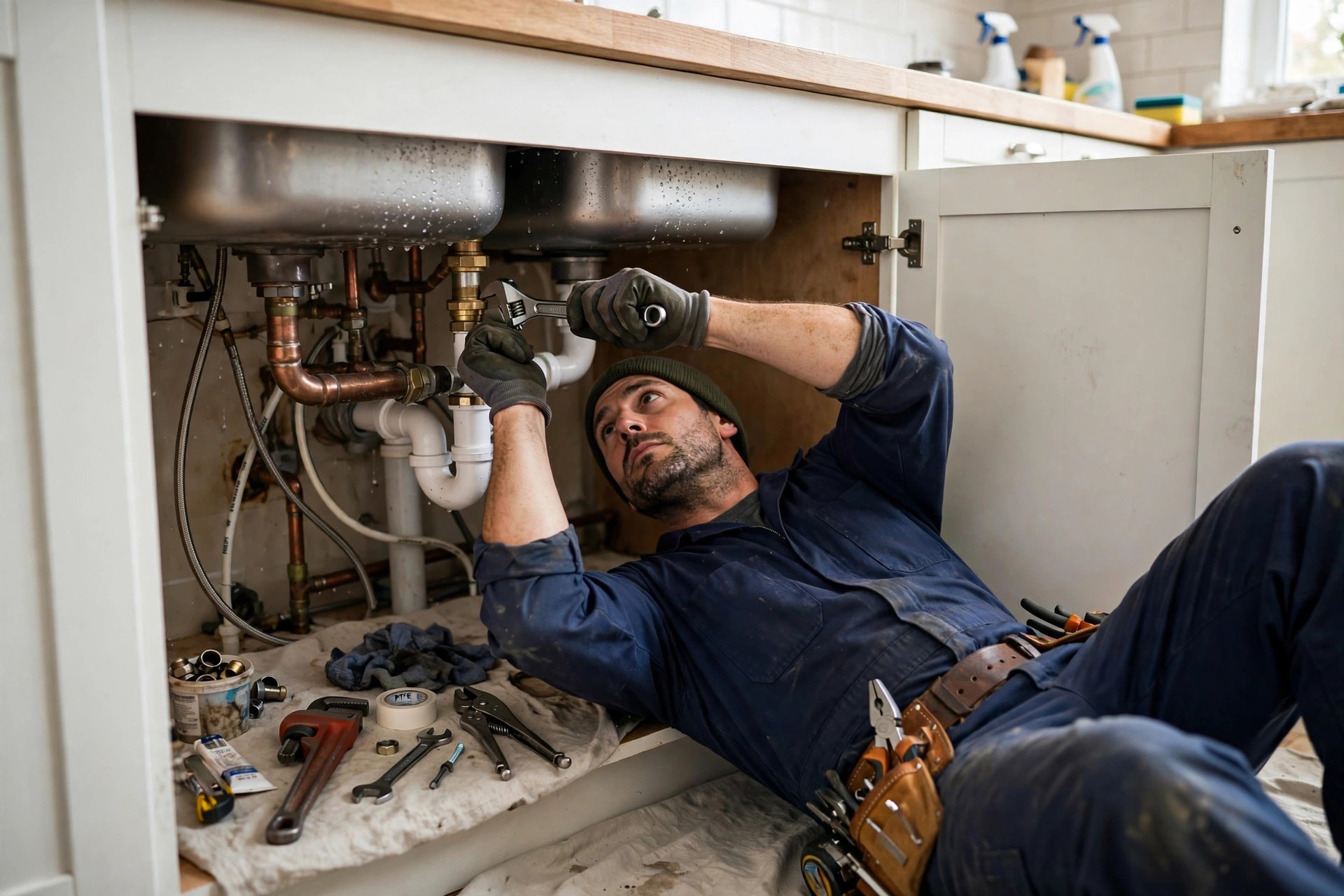
List the towns you genuinely serve, around 8 to 12 for most shops, and drop the rest. A tight service map ranks better than a huge radius. Then upload photos monthly: techs at work, before and after drain jobs, water heater installs, clean vans, uniformed crews. Plumbing is a trust trade, and a profile with 40 real photos beats one with 6, because customers compare side by side. Name files descriptively before upload, like “water-heater-install-austin.jpg.” If you are also running paid placement for these same emergency terms, our guide to Local Services Ads for plumbers covers how the paid and free listings work together.
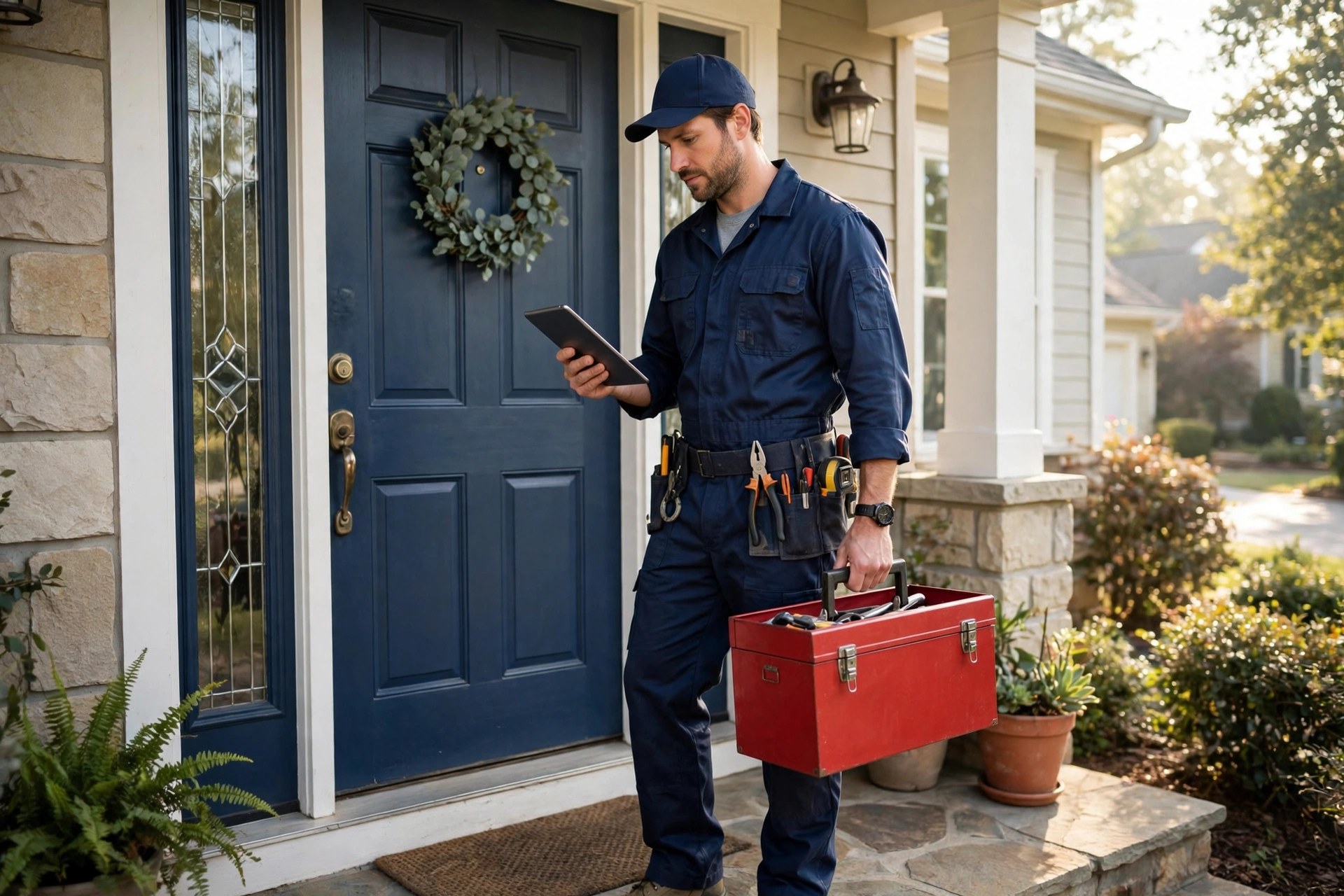
Professional arrival photos build trust before the customer ever meets your tech.
Reviews: the engine behind rankings and click-through
Reviews do double duty in local SEO. They are a ranking factor, feeding the map pack order, and they are the click factor, deciding which of three similar listings gets the call. A plumber with 180 reviews at 4.8 stars beats a plumber with 22 reviews at 5.0 stars almost every time, because volume signals a real, active business. The review gap between you and the top competitor in each town is the single most honest measure of your local SEO position.
Build the ask into every job
The system is simple and it has to run on every job: the tech asks in person right after the work is done and tested, while the customer is relieved. “Everything is flowing and tested. If you are happy, a Google review mentioning the drain cleaning would really help our business. I can text you the link now.” Text the link within the hour. Follow up once the next day with a thank-you text that includes the link again. Emergency jobs get the ask too, once the crisis is resolved and the customer is calm. Repipes and water heater installs, your highest-value jobs, deserve the ask in person plus a follow-up email with the link. For scripts, timing, and response templates, see our full guide on how to get more Google reviews for plumbers.
Answer every review, and mine them for keywords
Respond to every review within a few days. Thank the happy customers by name and mention the service: “Glad we could get the sewer line cleared for you, Maria.” Answer the unhappy ones calmly, factually, and briefly, then take the details offline. Beyond reputation, reviews are free keyword research. When customers write “water heater replacement” and “sewer line repair” in reviews, those phrases reinforce what your profile ranks for. The ask scripts above deliberately name the service so the reviews come back with the right words in them.
Service pages: one page per service
Your website needs a dedicated page for each major service, written for humans and structured for Google. A single “Services” page listing everything ranks for nothing. The pages that win are specific: “Drain Cleaning in [City],” “Water Heater Installation and Repair in [City],” “Sewer Line Replacement in [City].” Each page should answer the questions a homeowner has before calling: what the service includes, when it is needed, what it costs, how long it takes, and why your company is the safe choice.
What a strong service page contains
Every service page needs: a clear headline naming the service and the city, a click-to-call phone number visible without scrolling on mobile, a plain-language description of the work, signs the homeowner needs this service, your process step by step, honest pricing ranges, real photos from your jobs, customer reviews about that specific service, and a short FAQ answering the common questions. Add local detail that proves you work there: neighborhood names, common local plumbing issues like hard water or aging clay sewer lines, and permit requirements in your area. Generic pages that could belong to any plumber in any city do not rank.
The service-area page question
Many plumbers ask whether they need a separate page for every town. The honest answer: a handful of strong location pages beats thirty thin ones. Build dedicated pages for your top 5 to 8 towns, each with real local content: the areas you serve, local plumbing quirks, reviews from customers in that town, and photos from jobs there. Do not publish near-duplicate pages with only the town name swapped; Google treats those as thin content and they can drag the whole site down. One more rule: every service page and location page must have a clear next step, call, text, or online booking, above the fold on mobile.
| Local SEO factor | What to do | Expected impact |
|---|---|---|
| Google Business Profile completeness | All fields filled, services listed, photos monthly | Foundation for all map pack rankings |
| Review volume and recency | Ask on every job, text the link same day | Lifts map pack position and click-through rate |
| Review rating | Respond to all, fix the issues complaints name | 4.6 plus stars wins the side-by-side comparison |
| Service pages | One strong page per service per core area | Captures research-intent organic traffic |
| NAP consistency | Identical name, address, phone everywhere | Removes a common silent ranking drag |
| Site speed on mobile | Under 3 seconds load on a phone | Stops mobile visitors bouncing before they call |
| Click-to-call placement | Sticky call button on mobile, number in header | Converts the traffic the rankings produce |
| Local content | Cost guides, how-tos with local detail | Earns links and ranks for question searches |
Citations and NAP consistency
Citations are mentions of your business name, address, and phone number across directories: Yelp, Angi, HomeAdvisor, Thumbtack, BBB, Apple Maps, Bing Places, Facebook, and industry directories. They are not glamorous, but inconsistent citations quietly drag rankings down. The fix is unglamorous too: pick one exact format for your name, address, and phone, and make every listing match it character for character. “Smith Plumbing LLC” on one site and “Smith Plumbing” on another is a mismatch. A suite number on Google but not on Yelp is a mismatch.
The citation cleanup process
Start with the big ones: Google Business Profile, Apple Maps, Bing Places, Facebook, Yelp, and the BBB. Then cover the home-service marketplaces: Angi, HomeAdvisor, Thumbtack, Porch, and Nextdoor. Then add trade and local directories: your local chamber of commerce, trade associations, and city business listings. Audit once a year, because directories drift: old phone numbers resurface, duplicate listings appear, and moved businesses leave stale addresses behind. Duplicate listings are especially common after a rebrand or a phone number change; find them and merge or remove them. This work is tedious and it matters, which is why many plumbers hand it to whoever manages their local SEO rather than doing it in-house.

Consistent branding across trucks, listings, and your website reinforces every citation.
Website signals Google reads
Once the profile and reviews are working, the website becomes the conversion layer. Most plumbing searches happen on phones, often in a hurry, so the site has one job: make calling easy and make the company look trustworthy in under ten seconds.
Speed, mobile layout, and click-to-call
A plumbing site that takes more than 3 seconds to load on a phone loses a meaningful share of visitors before they see anything. Compress images, cut unused plugins and scripts, and test on a real phone over a cellular connection, not just office wifi. The phone number belongs in the header on every page and as a sticky call button on mobile that follows the visitor as they scroll. Online booking or a simple quote form should sit beside it for the customers who prefer not to call. Every extra tap between “I need a plumber” and a booked job costs you conversions.
Schema markup and trust elements
Add LocalBusiness schema to your site with your name, address, phone, hours, and service area. It is a small technical step that helps search engines understand the business clearly. Then layer the trust elements humans read: license numbers in the footer, insurance mention, real tech photos instead of stock, customer reviews pulled onto service pages, and guarantees stated plainly. A “licensed and insured” badge means little; a license number, a photo of the actual crew, and 200 recent reviews mean everything.
Content that earns links and ranks
Service pages capture demand that already exists. Content creates demand and earns the links that lift the whole site. For plumbers, the content that works is practical, local, and honest about money.
Cost pages and question guides
Homeowners search costs before they search companies: “water heater replacement cost,” “how much does repiping cost,” “sewer line replacement cost.” A cost page that gives real ranges, explains what moves the price, and ends with your quote process will outrank vague competitors and pre-sell the caller. Question guides work the same way: “why does my drain keep clogging,” “tankless vs tank water heater,” “signs your sewer line is failing.” Write them plainly, answer the question in the first paragraph, and add the local detail competitors skip. Each guide should link to the relevant service page, and each service page should link back to the guides.
Earn links the honest way
Links from other local sites remain a real ranking factor. The honest ways plumbers earn them: sponsor a youth sports team and get listed on the league site, join the chamber of commerce, get featured in local news for community work, publish genuinely useful local resources like a winter pipe-protection guide that local blogs link to, and ask suppliers and manufacturers for dealer or installer listings. What not to do: buy links, join link schemes, or pay for directory placements that exist only to sell links. One real local link beats fifty spammy ones, and spammy ones can actively hurt.
Track what matters: calls, forms, and rankings
Local SEO without tracking is guessing. Set up call tracking with a different number for the Google Business Profile, the website, and any ads, so you know exactly which channel produces which calls. Record the calls if your state allows one-party consent, because listening to a sample each month tells you whether the calls are real jobs or price shoppers, and whether your team is converting them. Track form fills and online bookings separately. Then track rankings: map pack position for your core terms in your core towns, checked weekly, not daily. Rankings bounce day to day; the trend over months is what matters.
| Search type | Example query | The page that should rank |
|---|---|---|
| Emergency | emergency plumber near me | Google Business Profile plus an emergency plumbing service page |
| Emergency | burst pipe repair | Emergency plumbing page with burst pipe section |
| Service plus city | drain cleaning austin | Dedicated drain cleaning page with local detail |
| Service plus city | water heater installation | Water heater page covering tank and tankless |
| Cost research | sewer line replacement cost | Cost guide page with real ranges |
| Comparison research | tankless vs tank water heater | Comparison guide linking to the water heater page |
| Problem diagnosis | why does my drain keep clogging | How-to guide that ends with your drain service |
| Brand | smith plumbing reviews | Your reviews page or Google profile |
The monthly numbers that tell the truth
Once a month, write down five numbers: calls from the profile, calls from the website, booked jobs attributed to search, review count and rating, and map pack positions for your top five terms. Compare month over month. If calls are rising but bookings are flat, the problem is phone handling, not SEO; our guide to lead follow-up automation for plumbers covers the systems that turn more of those calls into jobs. If rankings are rising but calls are flat, the problem is usually the listing itself: weak photos, few reviews, or no emergency message. Numbers first, then fixes.

Every completed job is a review opportunity and a ranking signal. Ask before you leave.
Costs, timelines, and DIY vs hiring an agency
Local SEO costs time or money. Knowing the real bands keeps you from overpaying or expecting too much too fast.
The DIY budget
Doing it yourself costs nothing but time: roughly 15 to 25 hours for the initial build across the profile, service pages, and citation cleanup, then 4 to 6 hours a month for reviews, posts, photos, and tracking. The DIY path works if you are consistent. It fails, most often, when the work stops after the first month. If you go DIY, put the monthly tasks on a calendar with an owner, or they will not happen.
What agencies charge plumbers
Local SEO agencies and freelancers serving plumbers typically charge $750 to $2,500 a month for ongoing work, with one-time setup projects at $1,000 to $3,000. At the low end you get citation cleanup and basic profile management. At the high end you get content, link building, review systems, and real reporting. Red flags: guaranteed rankings, secret methods, contracts over six months with no performance clauses, and reports that show rankings but never calls. Good questions to ask: how do you track phone calls, what did you do for your last three plumbing clients, and what happens to the work if we cancel.
A realistic timeline
Profile and citation fixes can move the needle within 30 to 60 days. Review velocity changes the listing’s strength within 60 to 90 days of launching the ask system. New service pages typically take 60 to 120 days to rank for competitive terms. Realistic expectation for a full program: noticeable call growth in 3 to 6 months, compounding after that. Anyone promising page one in 30 days is selling something Google will eventually punish.
Common mistakes plumbers make with local SEO
One “Services” page for everything. A single page listing all services ranks for none of them. Split into dedicated pages.
Keyword-stuffed business names. “Smith Plumbing Emergency Plumber 24 Hour” risks suspension. Real name only.
Service areas set too wide. Claiming a 60-mile radius weakens rankings in the towns you actually serve.
No review system. Reviews arrive randomly and the rating stalls below competitors who ask on every job.
Stock photos everywhere. Customers spot them instantly. Real job photos only.
Slow mobile site. A 6-second load time on a phone kills emergency conversions before they start.
Hidden phone number. If calling takes more than one tap on mobile, you are donating jobs to competitors.
Ignoring the Q and A section. Unanswered questions get answered by strangers, or never, while customers move on.
Duplicate thin location pages. Thirty near-identical town pages hurt more than they help. Build fewer, better ones.
Tracking rankings but not calls. A ranking report without call data is entertainment, not marketing.
Your rollout checklist
Work in order. Each step makes the next one stronger.
- 1Complete the Google Business Profile. Real name, correct categories, full services list, tight service areas, real hours, local phone number.
- 2Upload 15 real photos. Techs at work, before and after jobs, vans, crew. No stock photos.
- 3Launch the review system. Ask on every job, text the link within the hour, one follow-up the next day.
- 4Fix NAP consistency. One exact name, address, and phone format across Google, Apple, Bing, Yelp, and the BBB.
- 5Clean up citations. Claim the major directories and marketplaces, merge duplicates, remove stale listings.
- 6Build core service pages. Drain cleaning, water heaters, sewer lines, repiping, emergency plumbing, each with local detail.
- 7Fix mobile conversion. Sub-3-second load, sticky call button, quote form beside it, number in the header.
- 8Publish two cost guides. Real price ranges for your two highest-value services, with local factors explained.
- 9Set up call tracking. Separate numbers for the profile, the website, and ads. Review calls monthly.
- 10Track five numbers monthly. Profile calls, website calls, booked jobs from search, reviews, and map pack positions.
Frequently asked questions
How long does local SEO take for a plumber?
Profile and citation fixes can show movement in 30 to 60 days. Review velocity changes listing strength within 60 to 90 days. New service pages typically take 60 to 120 days to rank for competitive terms. Expect noticeable call growth in 3 to 6 months of consistent work.
What is the most important local SEO factor for plumbers?
The Google Business Profile, followed closely by reviews. For emergency-driven searches, the map pack decides who gets called, and the profile plus review count and rating decide the map pack order and the click.
Should plumbers pay for local SEO or do it themselves?
DIY works if you put in 15 to 25 hours for the setup and 4 to 6 hours monthly after, with an owner assigned to the monthly tasks. Agencies charge $750 to $2,500 a month. Many shops do the setup themselves and hire help for content and link building later.
How many reviews does a plumber need?
More than the top competitor in each town you serve, and growing every month. As a rough target, 100-plus reviews at 4.6 stars or better puts most shops in a competitive position. Recency matters: a steady stream of new reviews beats an old pile.
Do plumbers need a page for every town they serve?
No. Build dedicated pages for your top 5 to 8 towns with real local content, and keep the rest covered by your service area settings and main service pages. Dozens of near-duplicate town pages hurt more than they help.
What are citations and do they still matter?
Citations are listings of your name, address, and phone on directories like Yelp, Angi, and the BBB. They still matter as a trust signal, and inconsistent citations quietly drag rankings down. Clean them once, then audit yearly.
How much does local SEO cost for a plumbing company?
DIY costs time only. Agencies typically charge $750 to $2,500 a month plus $1,000 to $3,000 for initial setup. Compare any quote against the alternative: plumbing Google Ads clicks run $15 to $60 each, every month, with nothing compounding.
Can local SEO help with emergency plumbing calls?
Yes, that is its strongest use. Emergency searches are won in the map pack, and a complete profile with emergency services listed, strong reviews, and real photos captures calls that would otherwise go to whoever is ranked above you.
What is the biggest local SEO mistake plumbers make?
Tracking rankings without tracking calls. A number-one ranking that produces no booked jobs is a vanity metric. Set up call tracking first, then judge every SEO activity by the jobs it produces.
Does blogging help a plumbing company rank?
It helps when the content answers real customer questions, especially cost and comparison topics, with local detail. A few strong guides beat dozens of thin posts. Every guide should link to the service page it supports.
Turn “plumber near me” into booked jobs
Digital Hayder helps plumbing companies win local search with Google Business Profile optimization, review systems, service pages that convert, and websites built for mobile callers. Tell us about your service area and we will show you where your competitors are beating you.
Contact Us