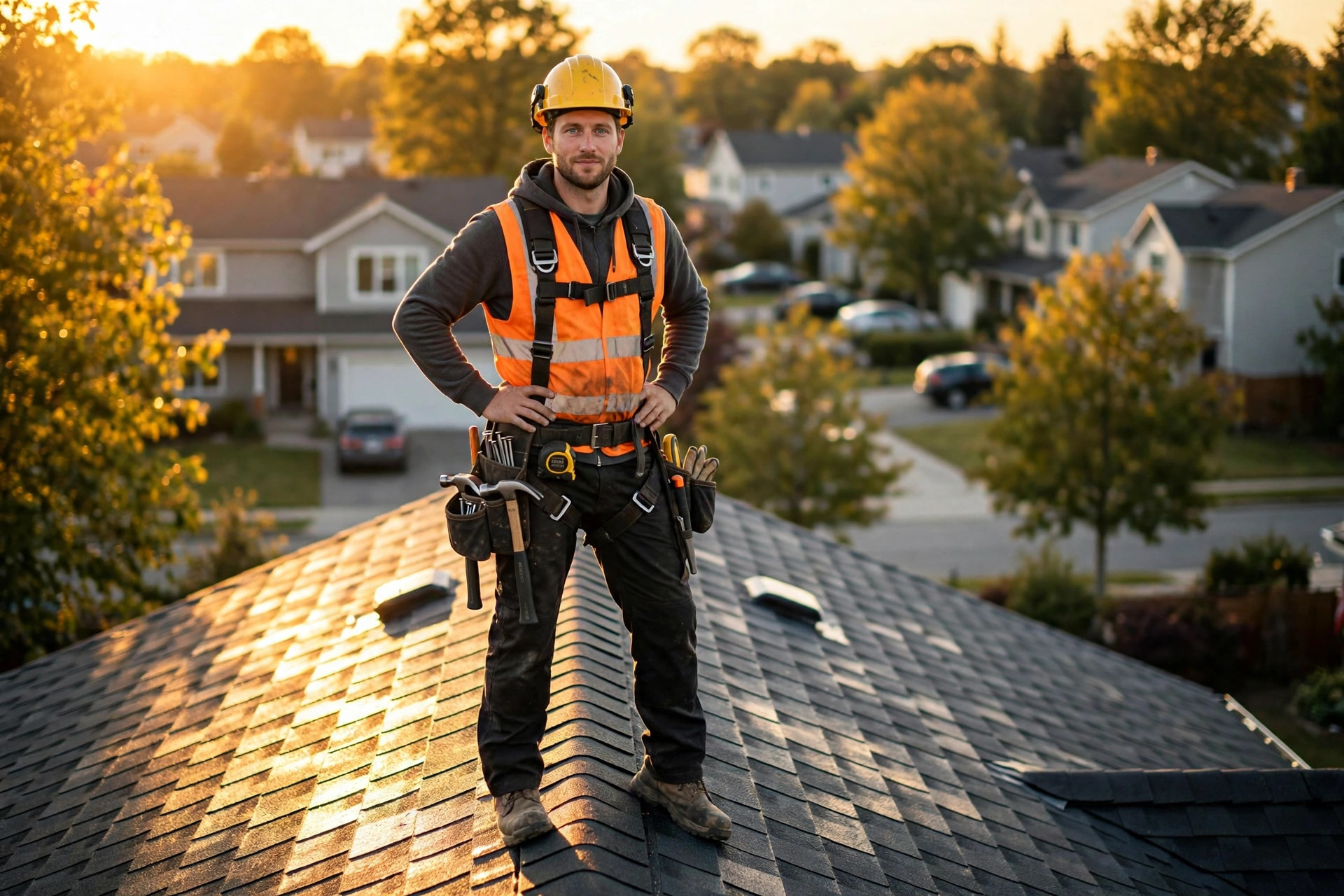
A homeowner needs a new roof. She cannot climb up to check the work, she cannot tell good flashing from bad, and the quotes range from $9,000 to $18,000 for what looks like the same job. So she does what every roofing customer does: she reads reviews. The roofer with 180 recent five-star reviews gets the call. The roofer with 12 reviews from three years ago does not, even if his work is better. Roofing is a high-anxiety purchase where the buyer cannot judge quality directly, which makes Google reviews the closest thing to proof that exists. This guide goes deeper than “ask for reviews.” It gives you the automation systems and workflows that roofing companies use to generate a steady flow of reviews: the post-job text and email sequence, the crew-triggered request, the timing for homeowners who were not home, and response scripts for every situation.
The quick answer
- Why reviews matter more in roofing: homeowners cannot assess roof quality themselves, so they rely on review count, recency, and rating to choose between similar quotes.
- The core system: an automatic review request text sent within 24 hours of job completion, a follow-up sequence for non-responders, and crew-triggered requests at the final walkthrough.
- The numbers: roofing companies that ask every customer get reviews from 20 to 35 percent of jobs. Companies that ask nobody get almost none.
- Timing rule: ask when satisfaction peaks, which is at the final walkthrough or within a day of completion, not two weeks later.
- Typical cost: $0 to $50 a month for the texting tool; most CRMs include review automation in their standard plans.
- Setup time: one day for the sequence and templates; a week to train the crews on the walkthrough ask.
Why roofing lives and dies on reviews
Most purchases let the buyer check the quality. You taste the food, you wear the shirt, you drive the car. A roof is different. The homeowner pays $10,000 to $20,000 for work they will never closely inspect, performed by people they met twice, with problems that might not show up for years. That uncertainty makes choosing a roofer genuinely stressful, and stressed buyers lean hard on social proof.
Three review factors decide who gets the call. First is count. A roofer with 200 reviews beats a roofer with 20, because the buyer reads count as experience. Second is recency. Ten reviews from last month beat fifty from two years ago, because the buyer wants to know you are still good now. Third is the rating itself, and here the bar is brutal: anything under 4.5 stars makes price-sensitive buyers suspicious, and anything under 4.0 sends most of them to the next listing. A single one-star review without a response can cost you more jobs than you will ever count, because you never hear from the people it turned away.
Reviews also feed your visibility directly. Google’s local rankings weigh review count, recency, and rating when deciding which roofers show in the map pack for searches like “roof replacement near me.” More reviews do not just convert the traffic you get, they increase the traffic you get. It is a compounding loop: reviews bring calls, calls bring jobs, jobs bring more reviews. Roofers who never ask stay stuck with a thin profile while competitors pull away a few reviews at a time.
The math is simple and unforgiving. A roofing company doing 8 jobs a month that asks every customer and converts 25 percent adds 24 reviews a year. A competitor doing the same volume that asks nobody adds maybe 3, all from unusually happy or angry customers. After two years the gap is 48 reviews to 6, and no amount of advertising closes it cheaply. Reviews are the one marketing asset that gets stronger the longer you collect them.
The post-job review sequence: the system that does the asking
Asking for reviews fails when it depends on memory. The owner means to ask, the crew forgets, the office gets busy, and the week passes. The fix is a sequence that triggers automatically when the job is marked complete in your system. Nobody has to remember anything. Here is the sequence that works for roofing companies, with timing tuned to how homeowners actually behave.
Step 1: the completion text (within 24 hours of the final walkthrough)
This is the highest-converting message you will ever send. The crew just left, the yard is clean, the roof looks brand new, and the homeowner is relieved. Send a text from your business number: “Hi [Name], this is [Company]. Your new roof is complete and the final walkthrough is done. If you are happy with our work, would you share a quick Google review? It takes about a minute: [review link]. Thank you for trusting us with your home.” Keep it to one link, the direct Google review link, not your homepage. Every extra click loses reviewers.
The direct review link matters more than people think. Google lets you generate a short link that opens the review form directly. Put it in your CRM template so it is always one tap away. Test it on your own phone before the sequence goes live. A broken link in a review request is worse than no request, because it trains the customer that your follow-through is sloppy.
Step 2: the email version (same day, for the record keepers)
Some homeowners live in email, not text. Send a short email the same day with the same ask, plus one addition: two or three photos of the finished roof. Before-and-after photos in the email remind the customer what they paid for and give them something to feel good about while they write. Subject line: “Your roof is done, [Name]. One quick favor?” Keep the body under 100 words. The photos do the persuading.
Step 3: the follow-up text (3 days later, only to non-reviewers)
About two-thirds of your reviews will come from the first text. The follow-up catches the people who meant to do it and forgot. “Hi [Name], quick reminder from [Company]. If you have a minute, your Google review would mean a lot to our crew: [review link]. Thanks again.” One follow-up is the sweet spot. A second follow-up a week later is acceptable for full roof replacements, where the ticket justifies it, but never more than two total. Past that you are annoying the customer you just delighted.
Step 4: the personal touch for big jobs (1 week later)
For full replacements over $12,000, add a personal call or text from the owner or project manager a week after completion: “Hi [Name], it is [Owner] from [Company]. Just checking that everything looks good after the first rain. If all is well, a Google review from you would really help us.” This does three things: it catches any issue before it becomes a bad review, it shows the kind of care that earns five stars, and the review that follows is usually detailed and glowing, which is exactly the kind Google and future customers value most.

Satisfaction peaks at the final walkthrough. That is when the review request belongs.
The crew-triggered request: your best review source
Automation handles the follow-through, but the single most effective review moment is human: the crew lead asking at the final walkthrough. A text from a system converts at 20 to 35 percent. A sincere in-person ask from the person who just finished the work, followed by the text, converts higher, because the homeowner has a face and a handshake attached to the request.
Train the crew lead on a simple script, not a sales pitch: “We are all done and everything passed the walkthrough. If you are happy with the work, we would really appreciate a Google review. I will have the office text you the link, it takes about a minute.” That is the whole script. It works because it is specific (the office will text the link, so the homeowner knows what is coming), short, and timed to the moment of peak satisfaction. The crew lead then marks the walkthrough complete in the system, which triggers the text. Human ask plus automatic follow-through is the combination that wins.
Make it a crew habit, not a crew option. Add the review ask to the job completion checklist, right next to the magnet sweep and the final photos. Track which crews generate the most reviews and recognize them. Some companies add a small bonus per review, $5 to $10, paid monthly. The bonus costs almost nothing next to the value of a review, and it turns the ask from an awkward extra into part of the job. The crews that resist usually just need to hear the script once and see that customers say yes far more often than they expect.
When the homeowner was not home
Many roofing jobs finish while the homeowner is at work. There is no walkthrough handshake, no peak moment, just a text saying the job is done. This is the most common reason roofing companies get fewer reviews than they should, and it needs its own workflow. First, the completion text should include photos: “Your roof is complete. Here are photos of the finished work.” Photos replace the walkthrough emotionally. Second, the office calls within 24 hours for a verbal walkthrough: “I wanted to walk you through what we did and answer any questions.” That call rebuilds the personal connection and ends with the review ask. Third, if the homeowner cannot be reached by phone, the follow-up text at day 3 carries more weight, so make it warmer and include the photos again. Jobs without a live walkthrough convert at lower rates, which is exactly why they need the extra steps.
| Review source | Typical conversion | Effort | Best for |
|---|---|---|---|
| Crew ask at walkthrough plus text | 30 to 45 percent | Training the crew on one script | Every job where the homeowner is present |
| Automatic text within 24 hours | 20 to 35 percent | One-time automation setup | Every completed job, the reliable baseline |
| Follow-up text at day 3 | 5 to 10 percent of non-reviewers | One extra automation step | Recovering the forgetful majority |
| Owner check-in call at week 1 | High, plus issue prevention | 10 minutes per big job | Full replacements over $12,000 |
| QR code on the final invoice | 5 to 15 percent | Printing the invoice template once | Customers who prefer paper and older homeowners |
Response scripts: what to say to every review
Getting reviews is half the job. Responding to them is the other half, and most roofing companies skip it. Google shows your responses next to the reviews, and future customers read them as a preview of how you treat people. A company that responds to every review looks attentive. A company with 100 reviews and zero responses looks like it stopped caring. Respond to every review within 48 hours, positive or negative, and keep responses short and human.
The five-star response
“Thank you, [Name]. We are glad you are happy with the new roof, and we appreciate you taking the time to share this. If you ever need anything, you know where to find us. [Your Name], [Company].” Personalize one line when you can: mention the crew, the neighborhood, or the shingle color. A response that could apply to any business wastes the opportunity. Never offer discounts or gifts in exchange for the review in your response, and never suggest the review was incentivized.
The four-star response
Read the four-star review carefully. It usually contains a small complaint wrapped in praise: great work, but the crew left at 6am, or the yard needed a second sweep. Address the specific point: “Thank you, [Name]. Glad you love the roof. You are right about the early start, and we have talked to the crew about timing on future jobs. Appreciate the honest feedback.” This turns a mild negative into proof that you listen, which future customers notice.
The negative review response
Speed and calm win here. Respond within 24 hours. Never argue, never blame, never discuss specifics of the dispute in public. “We are sorry to hear about your experience, [Name]. This is not the standard we hold ourselves to. Please call me directly at [number] so we can make this right. [Your Name], Owner.” Then actually call. Many negative reviewers will update or remove the review after a genuine fix, and even when they do not, your calm public response tells every future reader that you take problems seriously. One measured response to a harsh review can win you more business than ten five-star reviews, because it shows character under pressure.
The fake or mistaken review
Sometimes the review is for the wrong company, or it is clearly fake. Respond politely and briefly: “We do not have a record of working with you. Please contact us at [number] so we can look into this.” Then flag it to Google for removal through your Business Profile. Do not accuse the reviewer of lying in public. If Google removes it, good. If not, your calm response still protects you with future readers.
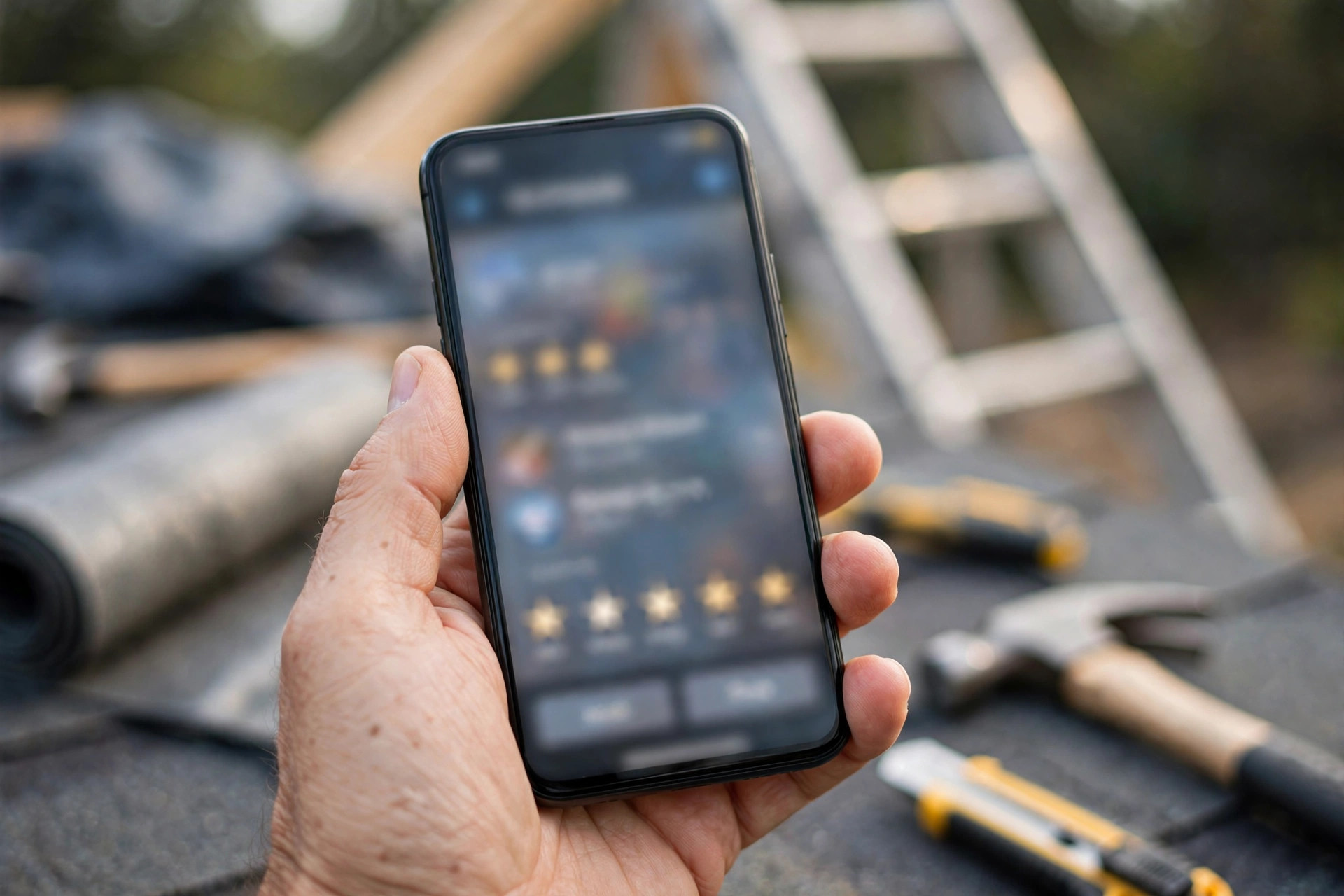
One tap on a direct review link is the difference between a review written and a review forgotten.
Building the automation: the one-day setup
The whole system can be built in a day with a CRM or a review automation tool. The trigger is the job status changing to complete. Everything else is messages and timing.
- 1Get your direct review link. Generate the short Google review link from your Business Profile. Test it on your own phone. Save it as a template variable so it is never typed by hand.
- 2Build the completion text. Job marked complete triggers a text within 24 hours with the homeowner’s name and the review link. Personalize the company signature.
- 3Add the same-day email. Short email with before-and-after photos and the same link. This catches the email-first homeowners.
- 4Add the day-3 follow-up. One text to customers who have not reviewed yet. Suppress it automatically for anyone who already left a review.
- 5Add the week-1 owner check-in task. For jobs over your big-ticket threshold, create a task for the owner or project manager to call. This is manual on purpose.
- 6Train the crews. Teach the walkthrough script, add the review ask to the completion checklist, and show crews the bonus or recognition for reviews generated.
- 7Set the response routine. Daily notification for new reviews. Owner or office manager responds within 48 hours using the scripts above. Negative reviews get a response within 24 hours plus a phone call.
Mistakes that stall roofing review growth
The most common mistake is asking two weeks later, when the excitement is gone and the roof is just background. Timing is the whole game. Ask at completion, not at invoicing, not at the 30-day check. The second mistake is the generic ask: “Please review us” with a link to your homepage. Give the direct review link and make it a one-tap action. The third is never following up. Two-thirds of your reviews come from the first ask, but the follow-up text is nearly free and catches the forgetful. Skipping it leaves easy reviews on the table. The fourth is ignoring the not-home homeowner. Jobs completed while the customer is at work need the photo text, the verbal walkthrough call, and the warmer follow-up, or they silently produce nothing. The fifth is responding to no reviews at all. Unanswered reviews, especially negative ones, tell future customers you do not pay attention after you get paid. The sixth is review gating: only asking happy customers, or filtering requests through a survey first. Google prohibits gating, and it is dishonest. Ask everyone, handle the unhappy ones well, and let the record speak.
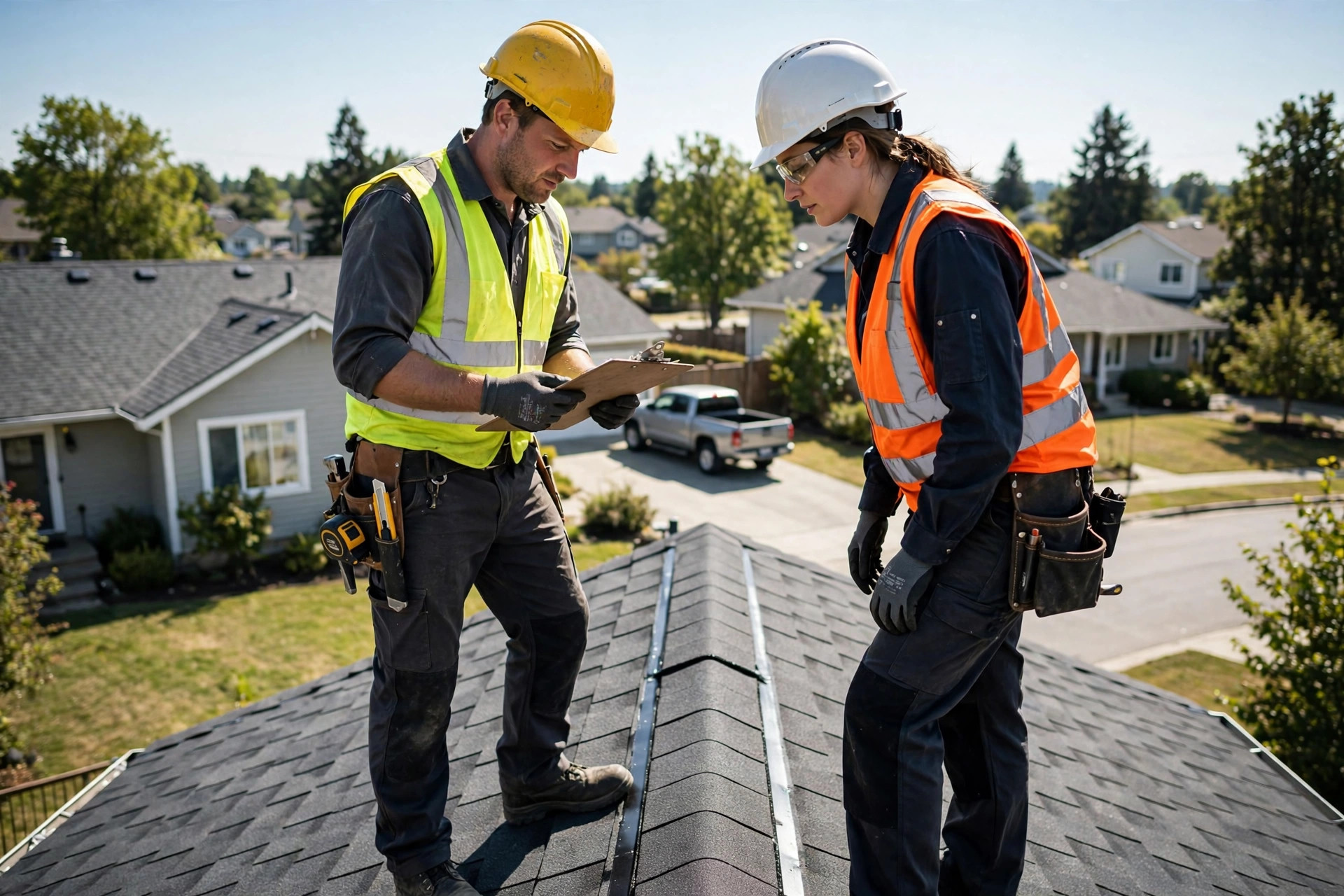
The walkthrough script is one sentence. The crew ask plus the automatic text is the highest-converting combination.
The roofer review playbook in one page
Ask every customer, not just the happy ones. Ask at the final walkthrough with a one-sentence script from the crew lead, then send the automatic text within 24 hours with a direct review link. Send the same-day email with before-and-after photos. Follow up once at day 3 with non-reviewers. Have the owner personally check in on big jobs at week 1. For homeowners who were not home, send photo texts and do a verbal walkthrough call. Respond to every review within 48 hours, negative ones within 24, with calm and specific replies. Track reviews per crew and recognize the leaders. Review the numbers monthly: requests sent, reviews received, average rating, response time. Do this for a year and the compounding loop takes over: more reviews bring more calls, more calls bring more jobs, more jobs bring more reviews, and the gap between you and the competitor who never asks becomes unbridgeable.
Reviews are one pillar of local visibility. Our guide to Google Business Profile optimization covers the profile side that reviews feed into, and how law firms get more Google reviews shows how the same system adapts to a professional service. For the full picture on turning local searches into roofing calls, pair reviews with a strong profile and a fast follow-up system like missed call text back for home services.
Frequently asked questions
How many Google reviews does a roofing company need?
There is no magic number, but the pattern is clear: more recent reviews beat fewer old ones at every level. Aim to add reviews every month without fail. A roofer adding 2 to 4 reviews a month will pass most local competitors within a year or two, because most competitors ask inconsistently or not at all.
When is the best time to ask a homeowner for a review?
At the final walkthrough or within 24 hours of completion, when satisfaction is at its peak. Asking at invoicing time or weeks later converts far worse. If the homeowner was not home, send photos with the completion text and do a verbal walkthrough call within a day.
Should we offer incentives for Google reviews?
No. Google prohibits offering money, discounts, or gifts in exchange for reviews, and incentivized reviews read as fake to future customers. Crew bonuses for generating review requests are a gray area, so keep any bonus tied to asking, not to the star rating, and never mention incentives to customers.
How should we respond to a negative review?
Within 24 hours, calmly, and without arguing or sharing dispute details in public. Apologize for the experience, invite them to call you directly, and sign with your name and title. Then call them. A genuine fix often leads to an updated review, and your measured response impresses every future reader.
Can we remove a fake or unfair review?
You can flag it to Google through your Business Profile and request removal if it violates policy, such as reviews for the wrong business or obvious spam. Google removes some and keeps others. While you wait, post a calm public response. Never accuse the reviewer of lying in your response.
Turn every finished roof into your next five calls
Digital Hayder builds review automation for roofing companies: the post-job text and email sequence, crew walkthrough scripts, response templates, and the dashboard that tracks reviews per crew. Tell us about your jobs and we will map your system before you pay anything.
Contact Us