
It is Saturday morning and your Facebook ad campaign just went live. The creative is working, the clicks are cheap, and the phone is ringing. Your two best closers are on roofs doing site surveys, your office manager is handling a permit issue, and the phone rings four times in an hour. Three of those calls go to voicemail. Each of those callers cost you real money to generate. Solar leads are among the most expensive in home services, and every one that hits voicemail and moves on is ad spend set on fire. The homeowner who called is standing in their kitchen with a $300 electric bill on the counter. They called three solar companies this morning. Yours was first on their list. You never picked up, they left nothing on your voicemail, and by the afternoon they had a consultation booked with the company that texted them back in forty seconds. Missed call text back is the cheapest insurance a solar company can buy against its own ad spend. The missed call triggers an instant text, the text qualifies the homeowner and books the consultation, and the expensive lead you already paid for actually turns into a sit instead of a bounce.
The quick answer
- The core job: text every missed caller back within a minute, because every solar caller is a lead you already paid for.
- What it qualifies: homeowner status, electric bill range, roof condition and shading, and real interest level, all by text.
- The booking flow: qualified callers get a one tap consultation booking link, then confirmation and reminder texts that protect the sit rate.
- Templates included: instant reply, bill range qualifier, consultation booking, and the ad campaign surge version for high volume days.
- The cost per lead math: recovering even a few consultations a month usually pays for the system many times over at solar ticket values.
- What it costs: about $150 to $400 per month for most solar companies.
Solar leads are too expensive to lose to voicemail
Solar has a lead cost problem that makes every other part of this article obvious once you see it. Industry estimates consistently put solar customer acquisition costs in the hundreds of dollars per closed deal, with individual leads from paid channels often costing $50 to $100 or more each. A residential install runs $20,000 to $30,000. The math only works when the leads convert, which means the moment a paid lead calls and gets voicemail, you have spent the money and handed the opportunity to whoever answered. Sales research keeps confirming the first responder advantage across industries, and in solar the advantage is amplified because the homeowner is usually comparing exactly two or three companies.
Ad campaigns make the problem spiky. A new campaign, a rate change announcement, or a storm season push can triple call volume in a week, and your staffing does not triple with it. The office that handles thirty calls a day fine drowns at ninety, and the overflow goes to voicemail precisely when lead flow is at its peak. That is the worst possible combination: maximum spend, minimum answer rate. Text back absorbs the spike without hiring, because it answers every missed call the same way whether there are three or thirty. For the same playbook in a sister trade, see our missed-call text-back guide for roofers.
The capture and qualify flow
The system detects the missed call and texts back automatically within a minute. The message is built for a homeowner who just saw your ad: “Hi, this is [Name] with [Company]. Sorry we missed your call, our team is out on installs right now. Thinking about solar for your home? Just reply here and I will get you answers.” The caller is still in research mode, still near their phone, and the text keeps them in your funnel instead of sending them to the next ad.
Then the qualification runs, and this is where solar text back earns its keep. Not every caller is worth a site visit, and the questions filter fast. Do you own the home. What is the average electric bill. Any major shading on the roof, and roughly how old is the roof. Four answers, and the system knows whether this is a qualified consultation or a polite decline with a future check in. Qualified callers get the booking link immediately. Unqualified callers get a graceful exit that keeps the door open. Your closers stop driving to houses with $80 bills and heavy tree cover, and your sit rate climbs because every consultation on the calendar actually deserved to be there.
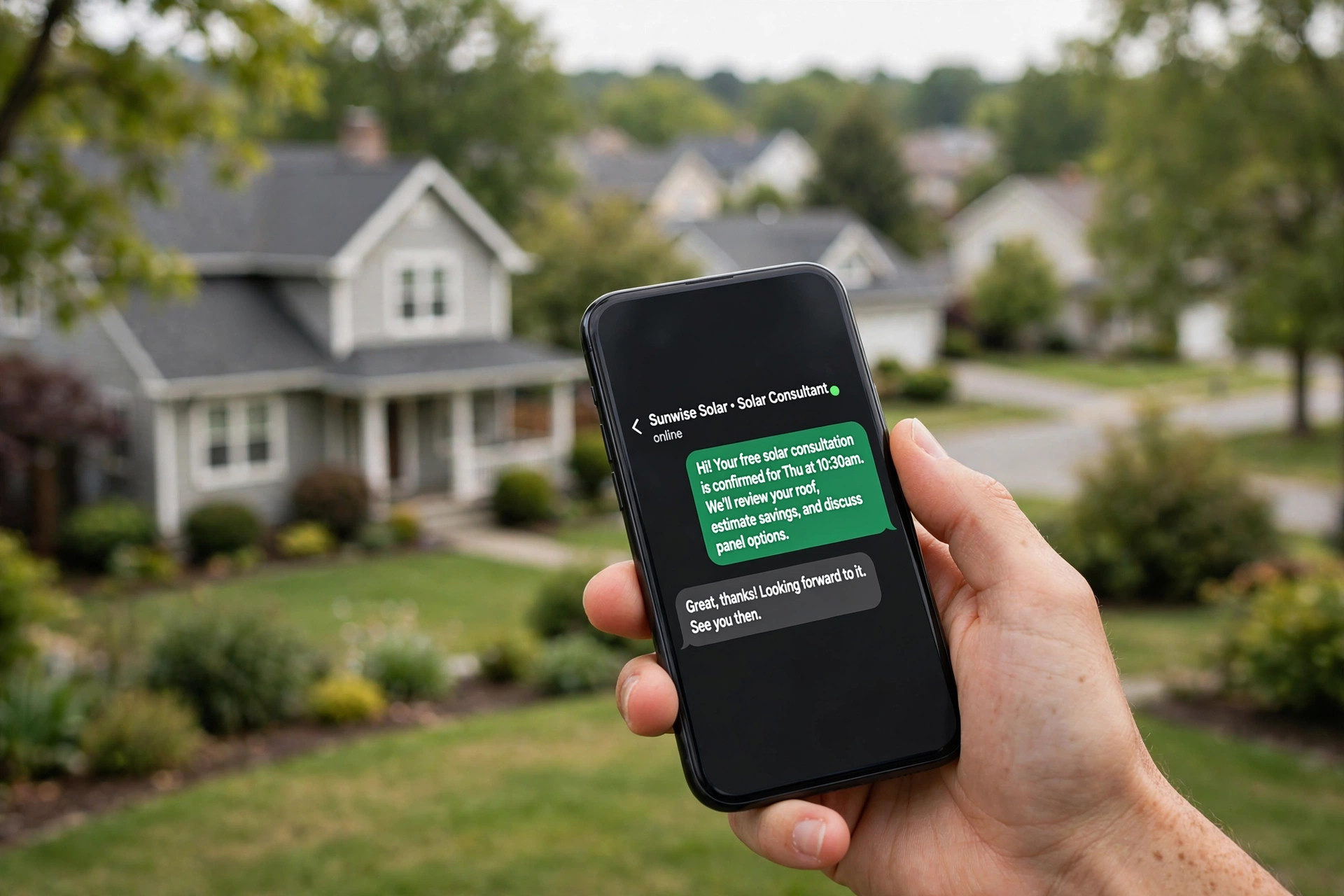
The paid lead called and nobody answered. The text back kept it in your funnel anyway.
Templates that protect your ad spend
Write every template like a person who respects the caller’s time. Short messages, one question at a time, and always a next step. These four carry the load.
The instant reply
“Hi, this is [Name] with [Company]. Sorry we missed your call, we are out on installs today. Are you looking into solar for your home? Reply here and I will get you taken care of.” This acknowledges the miss honestly and restarts the conversation in the channel homeowners actually answer.
The bill range qualifier
“Great, I can help with that. Quick questions so I point you the right way: do you own the home, and what does your electric bill run in a typical month?” Bill range is the single best early signal in solar. It tells you system size, savings potential, and whether the consultation is worth everyone’s time.
The consultation booking
“You are a great fit based on that. Want me to set up a free consultation? I have [day] at [time] or [day] at [time]. It takes about 45 minutes and we will show you real numbers for your roof.” Two time choices, a duration, and the promise of real numbers. That is what books the sit.
The campaign surge version
“Hi, this is [Company]. We are getting a ton of calls today, so I am texting to make sure nobody waits. What can I help you with?” Use this one when a campaign spikes volume. It turns “we are overwhelmed” into “we are popular and organized,” which is exactly how a homeowner reads it.
The consultation no show problem
Booking the consultation is half the battle. Solar consultations have a real no show rate, because the appointment is often set days out and the homeowner’s urgency fades. The reminder sequence is where text back pays for itself a second time. Confirmation the moment the appointment books, with the date, time, and the consultant’s name. A reminder the evening before: “Looking forward to tomorrow at 2. Quick reminder to have a recent electric bill handy.” A morning of nudge with parking or access notes if needed. Each message reduces the chance the homeowner forgets, and the “have your bill handy” line raises the quality of the sit because the consultant can run real numbers on the spot.
If they do not show, one text goes out within the hour: “We missed you today! Want to pick a new time?” That single message rescues a meaningful share of no shows, because the reason is usually a calendar conflict, not a lost interest. Rescheduling by text is frictionless in a way that rescheduling by phone tag is not. Track your sit rate before and after the sequence. Most companies see it move, and every recovered sit is a consultation you already paid to generate. For the follow up machinery that keeps the pipeline warm between touches, see our AI SDR for small business guide.

The consultation that started as a missed call. The handshake is the same; only the first contact changed.
The recovered cost per lead math
Solar is the trade where this math is most dramatic, because the lead costs are high and the ticket values are enormous. Typical numbers below.
| Cost component | Typical range | Notes |
|---|---|---|
| Monthly platform, basic | About $150 to $250 per month | Instant text back, qualification templates, consultation booking |
| Monthly platform, with sequences | About $250 to $400 per month | Reminder sequences, no show rescue, CRM routing, reporting |
| One time setup | About $500 to $1,200 once | Qualification flows, templates, calendar and CRM connected |
| What a recovered lead is worth | Typical value | Context |
|---|---|---|
| One paid lead saved from voicemail | $50 to $100 plus | The ad spend you already paid, recovered instead of wasted |
| One extra consultation per month | One sit closer to a close | At typical close rates, several extra sits a year become installs |
| One extra closed install per year | $20,000 to $30,000 in revenue | A single recovered close pays for the system for a decade |
Your rollout checklist
Build the qualification first, because a solar text back that books unqualified consultations will burn your closers’ trust fast.
- 1Write the instant reply in your voice. Honest about the miss, warm, restarts the conversation by text.
- 2Build the four question qualifier. Homeowner status, bill range, roof age and shading, interest level. Tag every answer.
- 3Define the disqualification rules. Renters, very low bills, heavily shaded roofs: graceful exit plus a future check in, not a consultation.
- 4Connect the consultation calendar. Qualified callers book directly from the text, with two time choices offered first.
- 5Build the reminder sequence. Confirmation, evening before reminder with the bill request, morning of nudge, no show rescue text.
- 6Add the campaign surge template. Swap it in during high volume weeks so the spike reads as popularity, not chaos.
- 7Route everything to the CRM. Every thread, qualification tag, and appointment lands in the pipeline your closers work.
- 8Track recovered leads and sit rate monthly. Count the consultations that started as missed calls, and watch the sit rate move with the reminders.
The install that started as a Saturday missed call. The crew never knew the difference.
Frequently asked questions
How fast does the text go out after a missed call?
Usually within seconds, always within a minute. The system detects the unanswered call on your business line and fires the reply automatically, which is what keeps the homeowner from dialing the next company.
Can it really qualify a solar lead by text?
Yes, for the first filter. Homeowner status, bill range, and roof basics are simple questions that text handles well. The in person or video consultation still does the real engineering. The text just makes sure the consultation is worth everyone’s time.
What about renters who call?
The qualifier catches them on the first question and routes them to a graceful exit: thanks, an explanation that the programs are for homeowners, and an offer to check back if they buy. No consultant time wasted, no rude brush off.
Will this work during a big ad campaign spike?
That is when it matters most. The system answers every missed call identically whether there are five or fifty, and the surge template frames the volume as popularity. It is the difference between a campaign that converts and one that just spends.
How do we handle the consultation no shows?
The reminder sequence does most of the work: confirmation, evening before, morning of, and the rescue text within an hour of a miss. Track the sit rate monthly and tune the reminder timing against the numbers.
Does it integrate with solar CRMs?
Most platforms connect to common solar and home services CRMs through native integrations or APIs. The requirement is simple: every conversation, qualification tag, and appointment must land in the pipeline your team already works.
Is texting compliant for solar?
Replying to someone who just called your business is conversational messaging, the lowest risk category. Use a registered business number, include opt out options, and keep templates factual. Have counsel review your setup if you run large outbound campaigns on top of it.
Stop burning the leads you already paid for
Digital Hayder sets up missed call text back for solar companies: instant replies, homeowner qualification, one tap consultation booking, and reminder sequences that protect your sit rate. Tell us about your operation and we will build the capture flow for your campaigns.
Contact Us