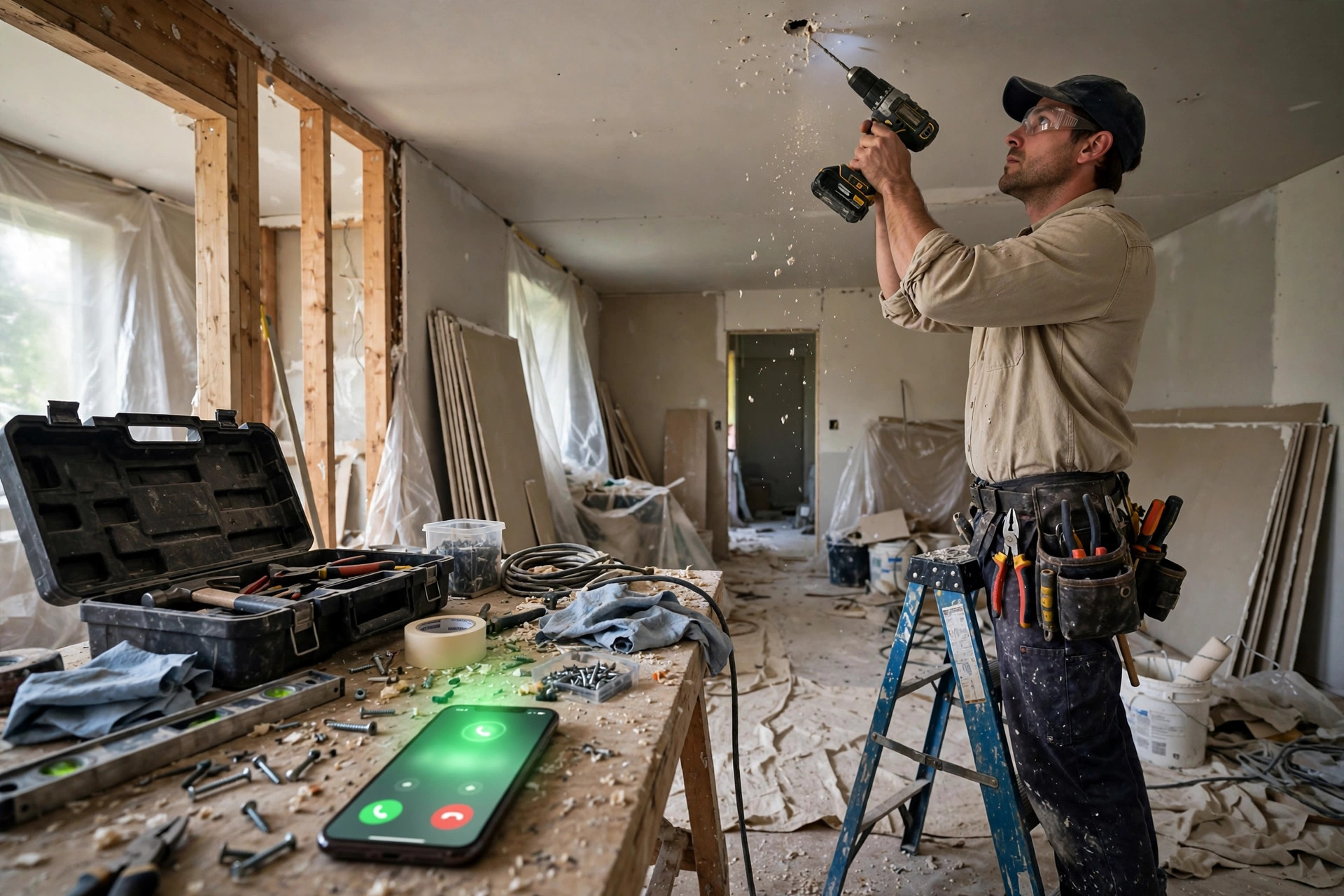
You are on a ladder with the drill running when your phone buzzes in your pocket. By the time your hands are free, the call has gone to voicemail, and the caller has already dialed the next handyman in the search results. This happens to handymen every single day, and it is one of the most expensive problems in the trade. Missed-call text-back fixes it with a simple idea: the moment you miss a call, the caller gets an instant automatic text from your business number. The conversation starts in seconds, not hours, and the small job they wanted gets booked before they move on. This guide explains how it works for handyman businesses, what to write in the messages, how to set it up, and what the captured jobs are worth.
The quick answer
- Instant response wins: an automatic text goes out seconds after a missed call, while a callback hours later usually finds the customer already booked elsewhere.
- Built for the trade: handymen miss calls because they are on jobs, on ladders, or under a sink, which is exactly when this system earns its keep.
- Small jobs love speed: most handyman calls are $150 to $400 repairs, and the customer picks whoever answers first, not whoever is cheapest.
- Setup takes under an hour: connect your business number, write two or three message templates, and turn on the automation.
- Costs are small: typical setups run $30 to $100 a month, and one captured job a month pays for the whole year.
- Scripts matter: the first text should name your business, say you are on a job, and ask what they need, with a clear way to book.
The call you never hear
Handyman work is hands-on in the most literal sense. Your hands are on a drill, in a wall, under a sink, or holding a ladder steady. The phone sits in a pocket or on a workbench, buzzing against tools while you work. Answering mid-job is not just rude to the customer in front of you, it is often impossible. So the call goes to voicemail, and here is what happens next.
The caller is a homeowner with a problem they want solved this week: a door that will not latch, a faucet that drips all night, a hole in the drywall the painter found. They searched, they picked your number, and they want to talk to someone now. Voicemail tells them nothing except that you are unavailable. Industry research on home-service calls consistently shows that most callers do not leave a message; they hang up and call the next business. The ones who do leave a message often get a callback hours later, by which time they have already booked someone who answered faster. Your competitor did not out-market you. They just picked up.
This is worse for handymen than for most trades, because handyman jobs are small and urgent-feeling. A $200 drywall patch is not a project the customer researches for a week. It is a nuisance they want gone, and they will hire whoever responds first. Every missed call is a small job walking to someone else, and small jobs add up: twenty lost calls a month at a $200 average ticket is $4,000 a month in revenue you never saw.
What missed-call text-back actually does
Missed-call text-back is automation with one job: when someone calls your business number and you do not answer, the system sends them a text message within seconds. It runs on your existing business number, so the caller sees a text from the same number they just dialed. No new app for the customer, no weird short code, no extra step.
The sequence looks like this. The phone rings and goes unanswered. Ten to sixty seconds later, the caller gets a text: “Hi, this is Mike with Mike’s Handyman. I am on a job and missed your call. What can I help you with?” The caller replies with their problem. The system notifies you, and you answer between tasks, or an automated follow-up keeps the conversation warm. By the time your hands are free, the customer is already talking to you instead of your competitor.
It also handles the calls you miss after hours. Roughly half of home-service inquiries arrive outside business hours: evenings when people get home and notice the broken thing, weekends when they finally have time to deal with it. A text at 9 PM that says “Sorry I missed you, I can call you in the morning or you can reply here” captures the job while the intent is hot. Without it, that caller is gone by sunrise.
The system usually includes a few extras: a missed-call log so you see every caller in one place, automatic follow-up texts if the caller does not reply, and basic conversation tracking. Some setups add simple booking: a link to your online calendar or a short series of questions that collects the job details. For a one-person handyman shop, the core text-back alone is the part that pays. Our guide to handyman marketing ideas shows where this fits in the bigger picture: it is the safety net under every other marketing dollar you spend.
Why small handyman jobs are the perfect fit
Not every business benefits equally from instant text-back. Handyman work is close to the ideal case, for three reasons.
First, the decision is fast and emotional. A dripping faucet at midnight, a door that will not lock, a hole in the wall before the in-laws visit: these are annoyance-driven calls. The customer is not comparing five quotes. They want the problem handled by someone competent, soon. Speed of response is the deciding factor far more often than price. An instant text makes you the fast one.
Second, the ticket size makes every capture count. Handyman jobs commonly run $150 to $400, with plenty of half-day jobs above that. Losing even a few calls a month to voicemail means losing thousands in revenue. At the same time, the cost of the system is tiny next to those tickets, which is why the payback math later in this guide looks so good.
Third, the callers are neighbors. Handyman customers are local and repeat. A caller you capture today is not just one $220 job; as our marketing guide explains, a good customer books 2 to 4 times a year. The text-back does not just save one job. It starts a relationship that compounds. Losing that first call to a competitor hands them the whole relationship.

The phone sits on the toolbox while you work. An instant auto-text turns that unanswered buzz into a booked job.
The speed-to-lead numbers for home services
Speed to lead is the time between a customer’s first contact and your first response, and in home services it decides who gets the job. The research is blunt: responding within a minute makes you dramatically more likely to win the customer than responding in an hour, and responding in an hour beats responding the next day by a wide margin. Callers are impatient because their problem is annoying and because three competitors are one tap away.
Put numbers on a typical solo handyman’s month. Say you get 60 calls a month and miss 20 of them because you are on jobs, driving, or off the clock. Without text-back, industry patterns suggest most of those 20 never become jobs: no message left, or a message that gets a slow callback. If you capture even half of those missed calls with an instant text, that is 10 extra conversations. If 4 of them book at a $220 average ticket, that is $880 a month in recovered revenue. Against a system cost of $30 to $100 a month, the math is not close.
After-hours calls sharpen the point. When someone calls at 8 PM and gets an instant, friendly text, you look professional and responsive. When they get voicemail, you look closed. The text also buys you the morning: the customer goes to bed knowing you will call back, instead of calling your competitor at 7 AM. Shops that add text-back commonly report that after-hours captures become one of their steadiest sources of new bookings within a couple of months.
Setting it up for a handyman business
Setup is a one-afternoon project. You do not need new hardware, a new number, or technical skills. Here is the order that works.
Step 1: pick the tool. You need a service that watches your business number for missed calls and sends texts automatically. Options include simple missed-call text-back apps, CRMs built for home services, and AI receptionist platforms that add call answering on top. For a solo handyman, start simple: a dedicated text-back tool or a home-service CRM with the feature built in. Expect $30 to $100 a month. Avoid anything that forces you to change your business number; the system should work on the number customers already have.
Step 2: connect your number. Most tools connect in minutes through your carrier or a number-porting step. Test it immediately: call your business number from another phone, let it ring out, and confirm the text arrives. If the text is slow or never comes, fix it now, not after you have told customers about it.
Step 3: write your messages. You need three templates: the first text after a missed call, a follow-up for non-replies, and an after-hours version. The next section gives you word-for-word scripts. Keep them short, friendly, and in your own voice. Customers can tell when a message sounds like a corporate robot.
Step 4: set your follow-up rules. Decide what happens when the caller does not reply. A good default: one follow-up text the next morning, and one more two days later. Then stop. You are being persistent, not pushy. Also decide how you get notified: a push alert on your phone is usually enough for a solo operator.
Step 5: tell your regulars nothing and your team everything. Customers do not need an announcement; the text just arrives and feels like good service. If you have a helper or office support, show them the missed-call log and agree on who replies and how fast.
Step 6: review weekly for the first month. Read the conversations. You will spot wording that confuses people and questions the templates do not cover. Tune the messages once, and the system runs itself.
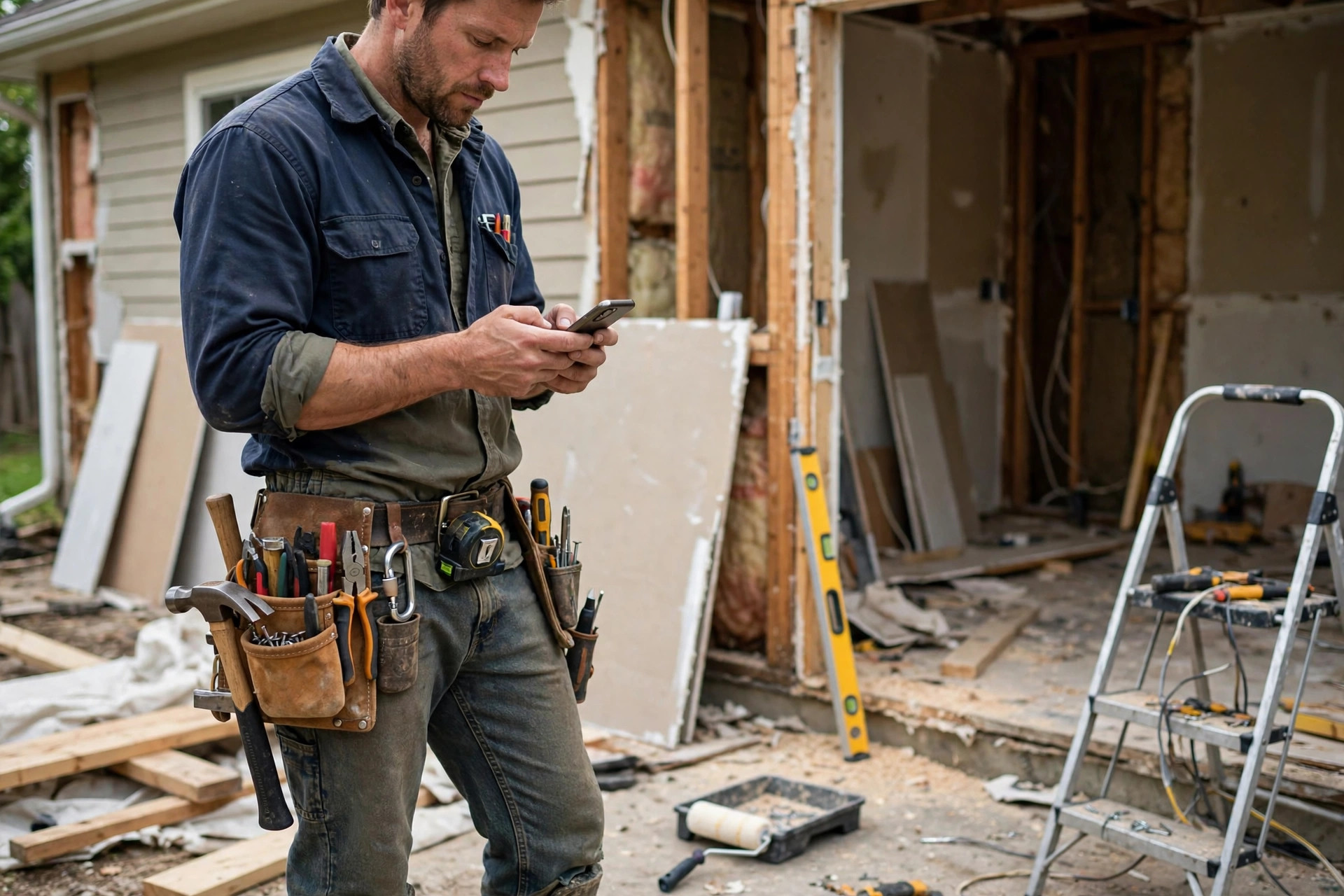
Once the automation starts the conversation, you pick it up between tasks: a quick reply from the job site is all it takes.
Message scripts that book the small jobs
The words matter. A good first text sounds like you, explains the miss, and makes replying easy. A bad one sounds like spam and gets ignored. Use these as starting points and adjust them to your voice.
The standard first text. “Hi, this is [Your Name] with [Business Name]. I am on a job and missed your call. What can I help you with?” Short, human, and it asks a question. Questions get replies.
The after-hours version. “Hi, this is [Your Name] with [Business Name]. Sorry I missed your call, I am done for the day. Reply here with what you need and I will call you first thing in the morning.” This one does heavy lifting: it acknowledges the miss, sets a clear next step, and gives the customer a way to get their problem on your radar tonight.
The next-morning follow-up. “Hi, this is [Your Name] following up on your call yesterday. Are you still looking for help with [the job]? I have openings [day] and [day].” Specific days beat “let me know when works for you.” Give them something to say yes to.
The two-day nudge. “Hi, just checking in once more. If you already found someone, no worries. If you still need a hand with [the job], I can usually fit small repairs in within a few days.” The “no worries” line is important. It removes the pressure and, oddly, makes people more likely to reply.
The booking closer. When they describe the job: “Got it. That sounds like a [1 to 2] hour job. I can come [day] between [time] and [time] for $[estimate range]. Does that work?” Name the scope, name the window, name the price range. Vague quotes stall; concrete ones book.
Keep a short list of answers for the questions that come up constantly: your service area, your minimum charge, whether you do free estimates, and how soon you can usually start. Paste them in as needed. The goal is a conversation that feels personal but never makes you type the same paragraph twice.
What it costs versus what it recovers
Pricing is simple, and the comparison with the alternative is what sells it.
| Option | Typical cost | What you get |
|---|---|---|
| Basic missed-call text-back app | $30 to $60 a month | Instant auto-text on missed calls, missed-call log, basic follow-ups |
| Home-service CRM with text-back | $60 to $150 a month | Text-back plus scheduling, invoicing, review requests, and customer records in one place |
| AI receptionist with text-back | $200 to $500 a month | An AI that answers the call itself, books the job, and texts when it cannot help |
| Hiring someone to answer phones | $1,500+ a month part time | A human on the phones, but only during the hours you pay for |
| Doing nothing (voicemail) | $0, plus lost jobs | Missed calls go to voicemail; most callers move on |
For most solo handymen, the basic app or the CRM tier is the sweet spot. The AI receptionist tier makes sense when call volume grows past what you can handle between jobs, or when you want after-hours calls answered with real conversation instead of just a text. Either way, compare the monthly cost against one number: the revenue from a single captured job. At a $220 average ticket, one saved job a month pays for even the priciest tier several times over.
Every captured call is a job on the schedule and a customer relationship that keeps paying for years.
Mistakes that make the auto-text backfire
Sounding like a robot. “Thank you for contacting [Business]. Your inquiry is important to us.” Nobody believes a human wrote that, and nobody replies to it. Write the way you talk. First name, short sentences, one question.
Waiting too long to send it. The whole point is speed. If the text arrives ten minutes later, the caller has already moved on. Test the timing during setup and keep it under a minute. Similar urgency rules apply in other trades; our guide to missed-call text-back for locksmiths shows how the same seconds matter for lockout calls.
Never checking the log. The automation starts conversations; it does not finish them. Check the missed-call log at least twice a day and reply personally to anything the templates did not close. The shops that treat the log like an inbox win. The ones that ignore it just have fancier voicemail.
Spamming non-replies. Two follow-ups is the limit. A third text a week later feels like harassment, and an annoyed homeowner will not call you next time either. Persistent is good; pushy is expensive.
Forgetting the after-hours message. A daytime template sent at 10 PM confuses people: “I am on a job” at night sounds wrong and slightly dishonest. Set the schedule so evening and weekend calls get the after-hours version automatically.
No booking path. A friendly chat that never asks for the booking is a missed opportunity twice over. Every conversation should end with a concrete offer: days, times, and a price range. Make saying yes the easiest next step.
Your rollout checklist
Work through these in order. Each one builds on the last.
- 1Count your missed calls. Check your phone log for the last 30 days. How many calls went unanswered? That number is your upside.
- 2Pick a text-back tool. A basic app at $30 to $60 a month is enough to start. It must work on your current business number.
- 3Connect and test. Link your number, then call it from another phone and let it ring out. Confirm the text arrives within a minute.
- 4Write your three templates. The daytime first text, the after-hours version, and the next-morning follow-up. Keep them short and human.
- 5Set the after-hours schedule. Evenings and weekends get the after-hours message automatically, so nobody gets a confusing “on a job” text at 10 PM.
- 6Set follow-up rules. One follow-up the next morning, one more two days later, then stop. Persistent, not pushy.
- 7Turn on push notifications. You need to see new conversations fast. Check the missed-call log at least twice a day.
- 8Prepare your quick answers. Service area, minimum charge, estimate policy, soonest availability. Paste, do not retype.
- 9Run it for 30 days. Read every conversation weekly. Tune the wording where callers get confused or go quiet.
- 10Measure captured jobs. Count the bookings that started as missed calls. Compare against the $50-a-month cost and decide whether to add booking automation next.
Frequently asked questions
What is missed-call text-back?
It is an automatic text message sent to anyone who calls your business number and does not get an answer. The text arrives within seconds, starts a conversation, and lets you book the job even though you missed the call. It runs on your existing number with no new app for the customer.
How much does missed-call text-back cost for a handyman?
Basic text-back apps run $30 to $60 a month. Home-service CRMs with text-back built in run $60 to $150 a month. AI receptionist platforms that also answer calls run $200 to $500 a month. For most solo handymen, the basic tier pays for itself with a single captured job a month.
Will customers think the text is spam?
Not when it comes from the number they just dialed and sounds like you. Keep it short, use your first name and business name, and ask a direct question. Messages that sound personal get replies; messages that sound corporate get ignored.
Do I need to change my business phone number?
No. The system works on your current number, which is important because that is the number your customers and Google listing already show. Avoid any tool that forces a number change.
What should the first text say?
Name your business, say you are on a job and missed the call, and ask what they need: “Hi, this is [Name] with [Business]. I am on a job and missed your call. What can I help you with?” Short, human, and ending in a question is the formula.
How fast should the text go out?
Under a minute. Speed is the entire point: the caller is deciding whether to dial the next business right now. Test the timing during setup from another phone and fix any delay before you rely on it.
Does this work after hours?
Yes, and after-hours calls are some of the highest-value captures, because without a text nearly all of them are lost. Use a separate after-hours template that promises a morning callback and invites the caller to describe the job tonight.
Can it book jobs automatically?
Basic tools start the conversation and you finish it with a quick reply. More advanced setups add booking links, calendar integration, or an AI that handles the whole exchange. Start simple, measure the captured jobs, and add automation only when the volume justifies it.
Does missed-call text-back work for other home services?
Yes. Any trade where the owner misses calls while working benefits: the same instant-response logic applies to movers, as our guide to missed-call text-back for moving companies explains, and to any service where the customer picks whoever answers first.
How do I know if it is working?
Count the bookings that started as missed calls each month and multiply by your average ticket. Compare that against the monthly cost. Most handymen see the payback in the first month; if the numbers are thin after 60 days, the problem is usually slow personal replies to the conversations the automation starts.
Stop losing jobs to voicemail
Digital Hayder sets up missed-call text-back and AI receptionist systems for handyman businesses: instant texts on every missed call, follow-up automation, and booking flows that run while you are on the tools. Tell us about your shop and we will get it running.
Contact Us