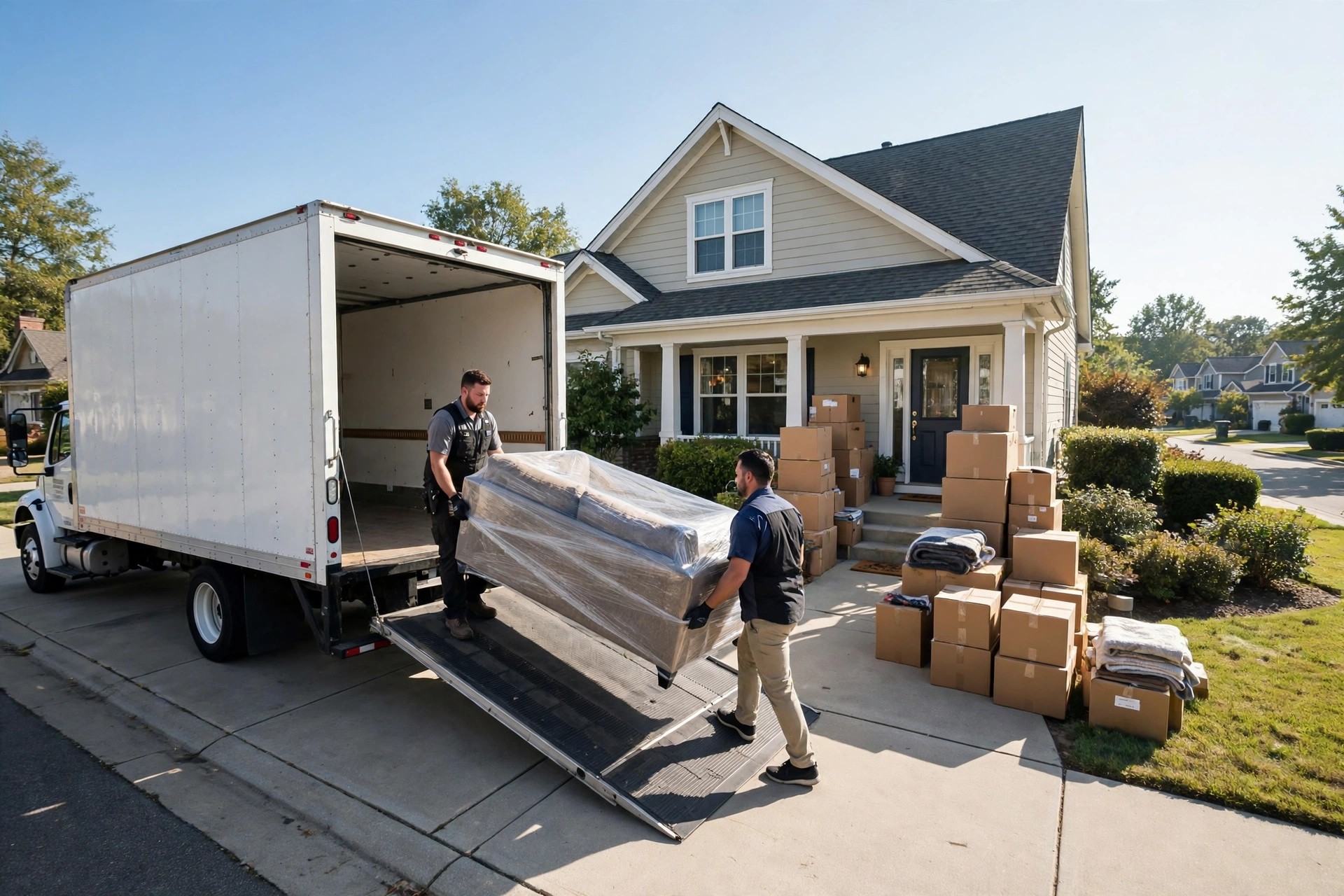
A family in a three-bedroom house needs to move across town in three weeks. At 10 PM, after the kids are in bed, they open three moving company websites. The first has a quote form that says “we will call you within 24 hours.” The second has a phone number and office hours. The third has a chat box that asks where they are moving from, where they are going, and how many bedrooms, then gives them a price band, checks date availability, and books a video survey for the next morning. Which company do you think got the move? Moving customers shop fast and decide faster: most request quotes from three to five companies and hire the one that responds first with a real number. This guide covers how an AI chatbot turns your website into that third company: quote calculators, inventory collection, date availability, deposit handling, the scripts that convert, and the costs and integrations that make it all work.
The quick answer
- Speed beats price in moving: customers request several quotes and usually hire the first company that answers with a real number. A chatbot answers in seconds.
- Quote calculators convert: local moves can be priced by bedroom count and distance. The bot collects the inventory and returns a realistic band instantly.
- Dates are inventory: showing real availability and holding a date with a small deposit turns quote shoppers into booked moves.
- Follow-up recovers the undecided: most shoppers do not book on the first visit. Automatic next-day follow-up on open quotes wins back a large share.
- Typical cost: $100 to $400 a month for a capable AI chatbot platform, plus a one-time setup of $500 to $2,500 for scripts and integrations.
- One booked move pays for months: a single local move at $600 to $1,000 covers the tool for the season. Everything after that is margin.
Why moving companies lose jobs they already earned
Moving is a high-intent, low-patience purchase. Nobody browses moving companies for fun. When someone is on your website, they have a date in mind, boxes half-packed, and a landlord waiting. The problem is that the moving industry sells the way it always has: quote forms, callbacks during office hours, and in-home estimates scheduled days out. That worked when customers had patience. It does not work now. The typical mover requests quotes from several companies in one evening, often after work, and the first company to give a real price band with a real available date gets a head start the others cannot close. Every hour of delay costs you position in a race where most shoppers decide within a day or two. Add the seasonality: summer weekends and month-ends book out, and the customers who cannot see your availability assume you are full and move on. A chatbot fixes all three gaps at once. It answers instantly at 10 PM, it prices the move from the details the customer gives it, and it shows the dates you actually have open. You are not buying more leads. You are converting the leads you already paid for.
What an AI chatbot does on a moving company website
At its core, the chatbot is a digital estimator that never sleeps. It asks the questions your best phone estimator asks, it applies your pricing logic, and it moves the customer toward a booked date instead of a callback. Here is what that looks like in practice.
The conversation the customer sees
The chat opens with a simple choice: “Planning a move? I can give you a price in about two minutes.” Then it walks through the quote: moving from (zip code), moving to (zip code), move date or date range, home size (studio, 1, 2, 3, 4+ bedrooms), and whether they need packing help or storage. Each answer is a tap on a button or a short typed reply, and the bot confirms as it goes: “Three-bedroom, from Austin 78745 to Round Rock, weekend of the 28th. Got it.” At the end of the questions it returns a price band: “For a 3-bedroom local move, most of our jobs land between $750 and $1,100. That includes two trucks and a three-person crew.” Then the availability check: “We have Saturday the 28th open in the morning. Want me to hold that date with a $150 refundable deposit?” In under three minutes the customer has a number, a date, and a next step. Compare that to a form that promises a callback tomorrow.
What happens behind the scenes
Every chat builds a move record: origin, destination, home size, date, inventory notes, price band quoted, and contact details. Connected to your CRM, that record lands in the pipeline tagged by move type and distance, with the transcript attached. Connected to your scheduling system, the held date becomes a tentative booking that a coordinator confirms. If the customer stops mid-quote, the bot follows up automatically the next morning: “Still planning the move on the 28th? The morning slot is still open, and I can hold it for you.” That follow-up alone typically recovers a meaningful share of abandoned quotes, because most shoppers did not say no, they just got distracted. The bot can also trigger a review request after the move is complete, feeding the reputation engine that brings the next round of quote shoppers to your site.
The quote calculator flow
The quote flow is the heart of the whole system. Get it right and the chatbot becomes your best salesperson. Get it wrong and it becomes a price-guessing machine that creates disputes. The difference is in the details you collect and the honesty of the bands you quote.
Inventory collection that actually prices the job
For local moves, the home size plus a short inventory list is usually enough to price accurately. The bot should ask bedroom count first, then the items that change the crew and truck math: pianos, gun safes, pool tables, hot tubs, large appliances, and anything that needs disassembly. A 3-bedroom house is one price; a 3-bedroom house with a piano and a gun safe is a different crew and a different price, and the customer knows that. The bot should also ask about access: stairs, lift, long carries from door to truck, and parking restrictions. These details do two jobs. They make the quote more accurate, which protects your margin, and they make the customer feel understood, which builds trust before anyone has visited. For long-distance moves, the bot collects the same basics and then books a video or in-home survey for a binding quote, because weight and volume drive interstate pricing and a chat cannot measure a house.
Date availability and deposit handling
Dates are the scarcest thing a moving company sells, so the chatbot should treat them that way. Connect the bot to your real availability calendar, even if it is just the coordinator’s shared calendar, and let it show open dates for the customer’s move window. When a customer picks a date, the bot should hold it with a deposit, not just a promise. Typical moving deposits run $100 to $300 or 10 to 20 percent of the estimated total, often refundable up to a few days before the move. The bot explains the terms plainly: “A $150 deposit holds Saturday the 28th. It is fully refundable if you cancel by the 25th, and it applies to your final bill.” Taking the deposit in chat, through a secure payment link, turns a quote into a commitment. Customers who have paid a deposit almost never keep shopping, which is exactly the outcome you want.

A two-minute chat can quote, check dates, and hold the move with a deposit.
Conversation scripts that convert
Good chatbot scripts sound like your best estimator on a good day. Below are two flows you can adapt, one for local moves and one for long-distance. Every line ends with a question or a button, because a chat that ends in a statement ends the conversation.
The local move script
Bot: “Planning a move? I can give you a price in about two minutes. First, what is the zip code you are moving from?”
Customer: “78745.”
Bot: “And the zip code you are moving to?”
Customer: “78664.”
Bot: “About 20 miles, that is a standard local move for us. How many bedrooms?”
Customer: “Three.”
Bot: “Anything that needs special handling? A piano, gun safe, pool table, or large appliances?”
Customer: “Just a washer and dryer.”
Bot: “Easy. Do you need packing help, or will everything be boxed and ready?”
Customer: “Boxed and ready.”
Bot: “For a 3-bedroom local move like yours, most jobs land between $750 and $1,100 with a three-person crew. What date are you thinking?”
Customer: “The 28th, a Saturday.”
Bot: “We have the 28th open in the morning. A $150 refundable deposit holds it, and it applies to your final bill. Want me to hold it?”
The script collects nine facts in about two minutes, quotes a band, and asks for the deposit. Notice it never promises an exact price for a home it has not seen; the band is honest, and the deposit terms are stated before anyone pays.
The long-distance move script
Long-distance pricing depends on weight and distance, so the bot should not pretend to give a binding number. Its job is to qualify, estimate, and book the survey.
Bot: “Long-distance moves need a quick survey for an exact price, but I can give you a realistic range right now. Moving from and to which cities?”
Customer: “Dallas to Denver.”
Bot: “How many bedrooms, and roughly when?”
Customer: “Two bedrooms, mid next month.”
Bot: “For a 2-bedroom Dallas to Denver move, most of our jobs land between $2,800 and $4,200 depending on how much stuff there is. A free 15-minute video survey gets you an exact binding price. I have Thursday at 6 PM or Saturday at 10 AM. Which works?”
Customer: “Thursday.”
Bot: “Booked. You will get a video link by text 30 minutes before. What is the best number?”
The bot gives a range, sets the expectation that the survey produces the binding price, and books the survey in the same conversation. The customer leaves with a number and an appointment instead of a “we will call you.”
| Move type | Typical US price band | Typical deposit | What the chatbot should do |
|---|---|---|---|
| Studio / 1-bedroom local | $300 to $700 | $100 | Quote the band, check dates, take the deposit |
| 2-bedroom local | $500 to $900 | $100 to $150 | Quote the band, check dates, take the deposit |
| 3-bedroom local | $750 to $1,200 | $150 | Quote the band, ask about special items, take the deposit |
| 4+ bedroom local | $1,100 to $2,000 | $200 to $300 | Quote the band, flag special items, take the deposit |
| Long-distance (500 to 1,000 miles) | $2,000 to $5,000 | 10 to 20 percent | Give the range, book the video survey |
| Cross-country (1,500+ miles) | $4,000 to $8,500 | 10 to 20 percent | Give the range, book the video survey |
| Packing service add-on | $300 to $800 | Included in move deposit | Offer as an upsell during the quote |
Booking, deposits, and crew scheduling
Quoting gets the customer’s attention. Booking gets their money. The handoff between the two is where most moving websites leak revenue, because the quote lives in one place and the schedule lives in someone’s head.
Connect the chatbot to your real availability. The minimum viable setup is a shared calendar the coordinator keeps current: the bot shows open dates in the customer’s window and marks a held date the moment the deposit is paid. The better setup connects to your moving software so the tentative booking creates a job record with the crew size, truck assignment, and the inventory notes from the chat. Either way, the customer gets an instant confirmation by text with the date, the arrival window, the deposit receipt, and the cancellation terms. That text does quiet work for weeks: it sits in their phone as proof the date is theirs, and it kills the urge to keep shopping. The morning of the move, the crew sees the chat transcript: stairs at the origin, lift at the destination, washer and dryer to disconnect. Prepared crews finish faster, damage less, and earn the reviews that feed the next month’s quotes.

Inventory notes from the chat tell the crew what to expect before moving day.
Chatbot vs live chat vs quote forms
Every moving company already has a quote form. The question is whether to add live chat, an AI chatbot, or both. The comparison below is for a typical local mover doing $400K to $1.5M a year.
| Factor | AI chatbot | Live chat (human) | Quote form |
|---|---|---|---|
| Availability | 24/7, instant | Office hours, unless staffed | Always visible, answered next day |
| Response speed | Seconds | Minutes, when staffed | Hours to a day |
| Monthly cost | $100 to $400 | $2,000+ for part-time staffing | Free, but loses most shoppers |
| Quote accuracy | As good as your price bands | As good as the agent | Requires a callback to price |
| Date availability | Shows real open dates | Checks manually | No visibility at all |
| Deposit collection | In-chat payment link | Manual, by phone | Separate step, often dropped |
| Abandoned-quote follow-up | Automatic next morning | Only if remembered | Rarely happens |
| Best for | Most moving companies | High-volume shops with staff | As a backup, never the main channel |
The winning pattern is the same as in other home services: chatbot first, human backup for the strange cases. The bot handles the 80 percent of chats that are standard local moves with standard questions. Anything unusual, an international move, a customer disputing a past bill, a shipment with fine art, escalates to a person with the transcript already collected. For the broader comparison across industries, see our AI chatbot vs live chat guide.
CRM integrations and what they cost
A chatbot that does not talk to your systems is a novelty. A chatbot wired into your pipeline is a closer. Add the connections in this order: the CRM first, so every chat becomes a tagged move record with the transcript; the calendar or moving software second, so dates held in chat become real tentative bookings; SMS third, so confirmations, reminders, and review requests go by text; and your ad platforms last, so chatbot bookings feed back as conversions and you can see which keywords produce moves, not just chats.
On pricing, moving chatbots sit in the same bands as other home-service chatbots. Basic scripted widgets run $30 to $100 a month but feel robotic. Capable AI chatbots with natural conversation, quoting logic, and CRM connections run $100 to $400 a month, which is where most movers should shop. Fully managed setups, where an agency builds the flows and maintains them, run $500 to $1,500 a month plus a one-time build of $1,000 to $3,000. The one-time setup, writing your scripts, loading your price bands, connecting your calendar and payment link, usually costs $500 to $2,500 as a project. If you are also weighing the phone side of AI, our AI receptionist cost guide covers what voice AI runs, and AI phone agents for home services shows how voice and chat work as a pair.
Mistakes movers make with chatbots
Mistake one: quoting exact prices for unseen homes. A chatbot cannot measure a house. Price bands for local moves and ranges plus a survey for long-distance keep you honest and protect your margin. A bot that promises an exact number will create move-day arguments.
Mistake two: no deposit step. A quote without a deposit is a suggestion. The customers who pay $100 to $300 to hold a date stop shopping. The ones who do not keep collecting quotes, including yours.
Mistake three: hiding the human option. International moves, damage claims, and storage questions need a person. Put “talk to our team” in the first menu. Forcing every chat through the bot frustrates exactly the customers with the biggest jobs.
Mistake four: fake availability. If the bot shows dates that are not really open, the coordinator has to call back and move people, which is worse than never showing dates at all. Keep the calendar current or do not show it.
Mistake five: ignoring abandoned quotes. Most shoppers do not book on the first visit. A bot with no follow-up leaves that money on the table. The automatic next-morning check-in is the cheapest revenue in the whole system.
Mistake six: never reading the transcripts. The first month of chats shows you the questions customers actually ask, the prices that make them pause, and where they drop off. Shops that read transcripts and tune the scripts get steadily better close rates. Shops that set and forget plateau.

Tentative bookings from chat become confirmed jobs once the coordinator reviews them.
Your rollout checklist
From first demo to a bot that quotes and books on its own, most movers need three to six weeks. Work the list in order.
- 1Write down your local price bands. By bedroom count, with crew sizes and typical hours. These are the numbers the bot quotes.
- 2Define your long-distance ranges and survey policy. Which moves get a video survey, who runs it, and how the binding quote follows.
- 3Set your deposit rules. Amount by move size, refund window, and the exact payment link the bot will send.
- 4Map your service area. Zip codes and cities you serve, plus the long-distance lanes you run. The bot must decline the rest politely.
- 5Pick the platform. Shop in the $100 to $400 a month band and confirm natural conversation, quoting logic, and CRM connections.
- 6Connect the CRM first. Every chat creates a tagged move record with the full transcript. Test with sample chats before launch.
- 7Connect real availability. A current calendar or moving software feed. Never let the bot show or hold a date that does not exist.
- 8Add SMS confirmations and reminders. Deposit receipts, the arrival window, a reminder the day before, and a review ask after the move.
- 9Test on a phone at 10 PM. Run the full quote flow on a mobile device after hours. Fix anything slow, confusing, or hard to tap.
- 10Review transcripts weekly for a month. Tune the questions shoppers stumble on, update price bands quarterly, and track quotes to bookings.
Frequently asked questions
Can an AI chatbot really price a move?
For local moves, yes, using your price bands by bedroom count, distance, and special items. For long-distance moves, the bot gives a realistic range and books a video or in-home survey for the binding quote. It should never invent an exact price for a home it has not seen.
How much does an AI chatbot cost for a moving company?
Expect $100 to $400 a month for a capable platform, plus a one-time setup of $500 to $2,500 for scripts, price bands, and integrations. Managed setups run $500 to $1,500 a month. One booked local move typically covers several months of the subscription.
Can the chatbot take deposits?
Yes, through a secure payment link sent in the chat. Typical deposits run $100 to $300 or 10 to 20 percent of the estimate. State the refund terms before taking payment. Customers who pay a deposit almost never keep shopping.
What happens if the customer’s date is already booked?
The bot should show real availability from your calendar, so this rarely happens. If a date fills between the quote and the booking, the bot offers the nearest open dates and, with your permission, a waitlist option for cancellations.
Does the chatbot handle long-distance moves?
It qualifies them, gives a price range, and books the video survey that produces the binding quote. It should not give binding long-distance prices itself, because weight and volume drive interstate pricing and a chat cannot measure a home.
Will a chatbot replace my sales team?
No, it feeds them. The bot handles standard quotes and bookings around the clock, and your estimators spend their time on surveys, complex moves, and closing. Most companies find the same team closes more moves with a chatbot qualifying first.
How do abandoned quotes get followed up?
Automatically. The bot sends a check-in the next morning to anyone who quoted but did not book, restating the price band and the open date. That single message recovers a meaningful share of shoppers who simply got distracted.
Can the chatbot connect to my moving software?
Most platforms connect directly or through integration tools. The bot creates a tentative booking with crew size, inventory notes, and the transcript. If your software has no connection option, the fallback is a completed booking form plus an instant notification to the coordinator.
What about customers who want to talk to a person?
Keep a visible “talk to our team” option in the first menu and make escalation fast. Many customers will still use the bot for speed, and the ones who want a person reach one quickly with their details already collected.
How long does it take to set up?
Three to six weeks for most movers: one week to document price bands and deposit rules, one to two weeks to build the scripts and integrations, and one to two weeks of testing and transcript tuning before it runs on its own.
Turn quote shoppers into booked moves
Digital Hayder builds AI chatbots for moving companies: instant quoting, real date availability, in-chat deposits, and CRM connections that turn 10 PM shoppers into confirmed jobs. Tell us about your service area and we will design the flows around your pricing.
Contact Us