Your techs are under sinks, on roofs, and inside crawl spaces all day. They cannot answer the phone, and every call they miss is a homeowner with a broken AC or a flooded basement dialing your competitor next. An AI phone agent for home services answers every call in one ring, books the job into your schedule, flags emergencies for immediate dispatch, and follows up on quotes your team never had time to chase. Here is what it does for HVAC, plumbing, electrical, and other trade businesses, what it costs, and how to set one up without disrupting your dispatch.
The quick answer
- What it does: answers every call 24/7, books service appointments, routes emergencies to your on-call tech, and takes detailed job notes.
- Typical cost: roughly $200 to $500 a month for a home service company with 2 to 10 techs.
- Biggest win: after-hours and weekend calls, which are often emergencies with the highest job values and the highest close rates.
- Dispatch: a good agent creates the job ticket with the caller’s details, address, and problem description, so your dispatcher starts ahead.
- Quote follow-up: automatic texts and calls chase unsold estimates, recovering jobs you already paid to quote.
- Setup time: a few days to two weeks, including service-area rules, pricing scripts, and emergency routing.
Why home service businesses lose so many calls
The structure of a trade business almost guarantees missed calls. Your best people spend their day doing the work, not sitting by a phone. The office manager is scheduling, ordering parts, and handling walk-ins. During a heat wave or a cold snap, call volume triples and the phones melt down exactly when each call is worth the most. After 5pm and on weekends, most shops have nobody answering at all, which is precisely when pipes burst and AC units die.
The homeowner’s behavior makes it worse. Someone with water pouring through a ceiling does not leave a voicemail and wait. They call the next listing on Google. Research on lead response has shown for years that the business which answers first wins the job far more often than the one with the best reviews or the lowest price. In home services, “first” usually means “within a minute.” If your phone setup cannot do that around the clock, your marketing is feeding your competitors.
Hiring your way out is expensive. A dispatcher costs roughly $3,000 to $4,500 a month fully loaded, covers 40 hours a week, and still cannot answer ten calls at once during a storm surge. An answering service costs $300 to $1,500 a month, but most services only take messages, which means the homeowner still waits hours for a callback. The gap between “someone takes a message” and “the job gets booked” is where the money leaks.
What an AI phone agent does for a trade business
An AI phone agent is voice software that answers your business line and talks with callers naturally. For home services, it is configured around the way trade businesses actually work: jobs, dispatch, emergencies, and estimates. Here is what a well-built one handles day to day.
Books service calls into your real schedule
The agent asks what the problem is, where the caller is located, and when they are available, then offers open slots from your actual calendar or dispatch board. The caller picks a time and gets a confirmation text. No phone tag, no “let me check and call you back.” For shops running ServiceTitan, Housecall Pro, Jobber, or similar software, the booking can flow straight into the job schedule with the customer record attached.
Triages emergencies and routes them instantly
Not every call can wait until morning. The agent is trained to recognize emergency language: no heat in winter, water actively leaking, sparking outlets, gas smell. Those calls get transferred immediately to your on-call tech or dispatcher, with a text alert as backup. Everything else gets booked normally. This is the feature that pays for the whole system: one saved emergency job a month often covers the subscription several times over.

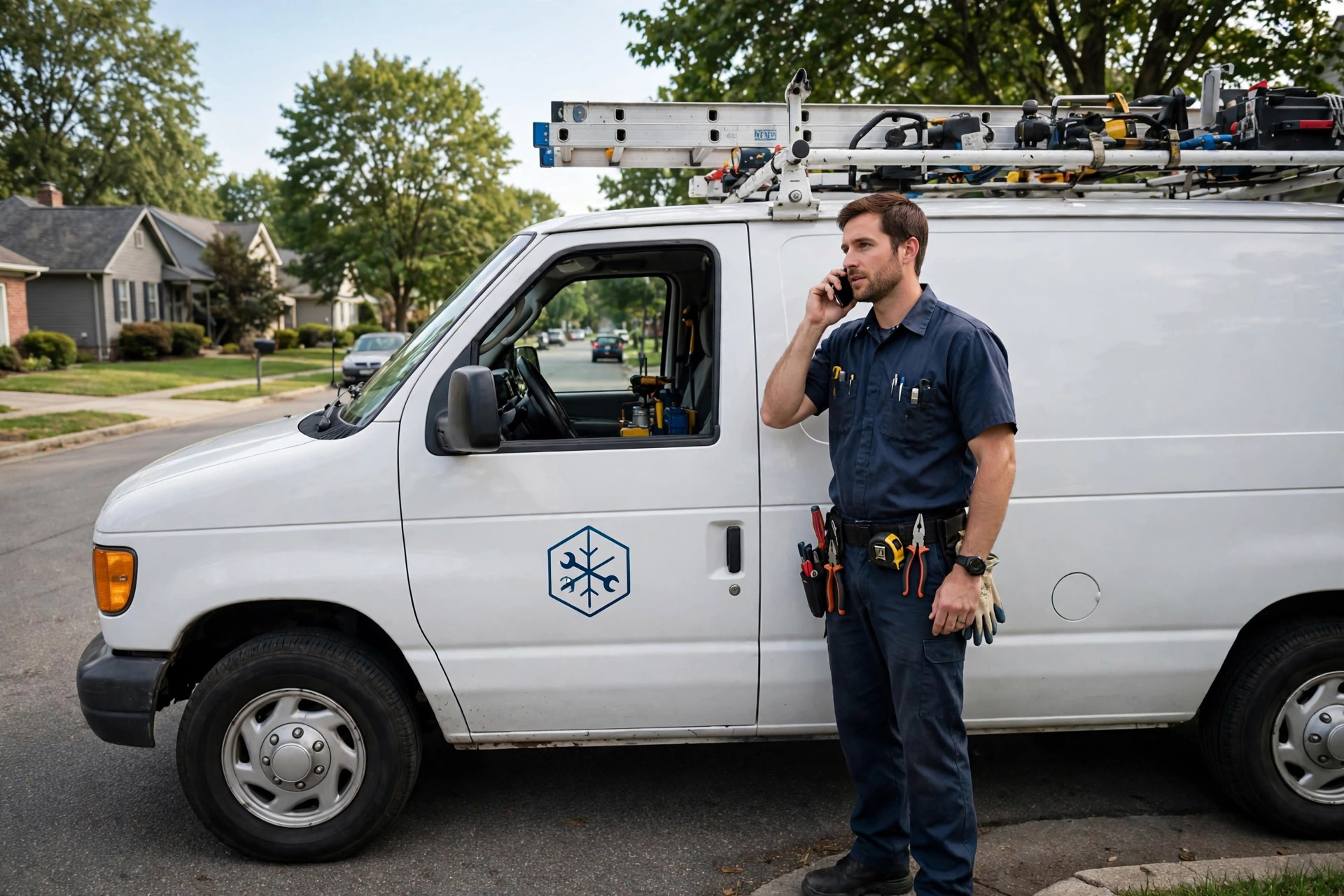
Techs stay on the tools while every incoming call still gets answered.
Qualifies callers and takes detailed job notes
“My AC is blowing warm air, the unit is about ten years old, and I am at 412 Maple Street.” The agent captures the equipment type, the symptoms, the address, and the caller’s availability, then packages it as a job ticket your tech can read before arriving. Techs stop walking into jobs blind, and dispatchers stop playing telephone with half-remembered details.
Answers the questions your office answers fifty times a week
Do you service my area? What is your service call fee? Do you offer financing? Are you licensed and insured? The agent answers all of it consistently, using your actual service area list, your real trip-charge policy, and your real credentials. Callers get straight answers in seconds instead of waiting on hold.
Follows up on unsold estimates automatically
This is the quiet moneymaker. The average shop sends a tech out, quotes a $4,000 system replacement, hears “we need to think about it,” and never calls again. That quote cost a truck roll and an hour of skilled labor. An AI phone agent can call or text the homeowner the next day, answer follow-up questions, offer to schedule the work, and check in again a week later. Even a modest recovery rate on dead estimates is pure profit, because the marketing and labor were already spent.
Requests reviews after completed jobs
A text after the job is done, with a direct link to your Google review page, sent while the homeowner is still happy. Shops that systematize the ask collect reviews steadily; shops that hope for them do not. Reviews feed your map rankings, which feed your call volume, which the agent then converts. It is a loop, and the agent runs two steps of it.
What it costs a home service company
Most home service businesses land in the professional tier of AI voice agent pricing. Typical all-in costs:
| Setup | Typical cost | What you get |
|---|---|---|
| After-hours only | $100 to $250/mo | Nights, weekends, and holidays covered; message taking and morning summaries |
| Full 24/7 with booking | $250 to $500/mo | Round-the-clock answering, calendar booking, emergency routing, CRM logging |
| Multi-crew or multi-location | $500 to $1,200/mo | Several numbers or territories, custom dispatch rules, reporting per location |
| With outbound follow-up | Add $100 to $300/mo | Automated estimate follow-up calls and texts, review requests, reactivation campaigns |
Setup fees typically run $0 to $500 for standard configurations. Custom dispatch integrations or complex multi-department routing can add $500 to $2,000 one-time. All figures are typical market ranges. For the full pricing breakdown across industries, see our guide on how much an AI voice agent costs.

The agent acts as a dispatcher that never sleeps, feeding clean job tickets to your team.
What to look for in a home services phone agent
Generic AI answering is not enough for the trades. The difference between a system that books jobs and one that just takes messages comes down to these features:
- Service-area logic: the agent must know exactly which zip codes and towns you serve, and politely decline or refer out the ones you do not. Booking a job two hours outside your territory wastes everyone’s day.
- Emergency detection and routing: clear rules for what counts as an emergency in your trade, with immediate transfer to the on-call number and text alerts that do not depend on anyone checking email.
- Dispatch software integration: bookings should land in ServiceTitan, Housecall Pro, Jobber, or whatever you run, with customer details attached. Manual re-entry defeats the purpose.
- Trip charge and pricing scripts: the agent should state your diagnostic fee, trip charge, and financing options exactly the way you want them stated, every time.
- Technician-aware scheduling: if certain techs handle certain job types or territories, the agent should book accordingly instead of filling the calendar randomly.
- Spam and solicitor filtering: trade businesses get hammered with robocalls and sales pitches. The agent should screen them out so you never pay minutes or attention for junk.
- Call recordings and transcripts: you need to hear how the agent handled the tricky calls, especially in the first month, so you can fix scripts fast.
- Seasonal scaling: the plan should handle your peak season call spikes without punitive overage fees. Ask what a triple-volume month costs before summer or winter hits.
Setting it up without disrupting dispatch
The fear every owner has: “What if it books something wrong and my dispatcher has a mess to clean up?” A careful rollout avoids that. Here is the order that works:
- 1Start with after-hours only. Let the agent cover nights and weekends first, where the alternative is voicemail. Low risk, immediate proof of value.
- 2Write down your rules. Service area, trip charge, emergency definitions, on-call rotation, booking windows. If it is not written down, the agent cannot follow it.
- 3Connect the calendar and the CRM. Test bookings end to end: call in, book a fake job, and confirm it appears correctly in your dispatch software with the right details.
- 4Review recordings daily for two weeks. Listen to the odd calls, the long calls, and any escalations. Fix the scripts where the agent hesitated or guessed.
- 5Expand to overflow during business hours. Once the agent proves itself, let it catch the calls your office cannot pick up within three rings. Your staff handles the rest.
- 6Add outbound follow-up. With inbound working, switch on estimate follow-up calls and review requests. This is where the ROI jumps.

Every booked job starts with an answered call. The agent makes sure none slip through.
Common mistakes to avoid
A few patterns separate the shops that love their phone agent from the ones that cancel after two months. Do not skip the tuning period: the first month’s recordings are where you catch the misbookings and awkward phrasing, and owners who never listen to calls never fix them. Do not let the agent quote prices you have not approved: give it exact scripts for trip charges and ranges, and a rule to escalate anything unusual to a human. Do not hide the fact that it is automated from your own team: tell your dispatchers and techs how it works, what it books, and where to find the tickets, so nobody is surprised. And do not set it and forget it: service areas change, prices change, on-call rotations change, and the agent’s configuration has to change with them. Ten minutes a month keeps it accurate.
Frequently asked questions
How much does an AI phone agent cost for a home service business?
Typical all-in pricing runs $100 to $250 a month for after-hours coverage, $250 to $500 a month for full 24/7 answering with appointment booking, and $500 to $1,200 a month for multi-crew or multi-location setups. Outbound estimate follow-up usually adds $100 to $300 a month.
Can it handle emergency calls?
Yes, when configured properly. The agent is trained to recognize emergency descriptions for your trade and transfer those calls immediately to your on-call tech or dispatcher, with text alerts as backup. You define what counts as an emergency during setup.
Will it work with my dispatch software?
Most professional setups integrate with common field service platforms such as ServiceTitan, Housecall Pro, and Jobber, creating job tickets with caller details automatically. Confirm your specific software is supported before you sign, and test a booking end to end during the trial.
What if a caller wants to speak to a real person?
The agent transfers them to your office or on-call line on request. Good setups treat “let me talk to someone” as an instant escalation, not something to argue about. Most routine callers never ask, because they get what they need faster from the agent.
How long does setup take?
A standard home services setup takes a few days to two weeks: service-area rules, pricing scripts, calendar connections, and emergency routing, followed by a tuning period where you review recordings. Starting with after-hours coverage first keeps the rollout low risk.
Stop losing jobs to voicemail
Digital Hayder builds AI phone agents for HVAC, plumbing, electrical, and home service companies: 24/7 answering, emergency routing, dispatch integration, and automated estimate follow-up. Tell us about your trade and your call volume, and we will map out a setup that books jobs while your techs work.
Contact Us