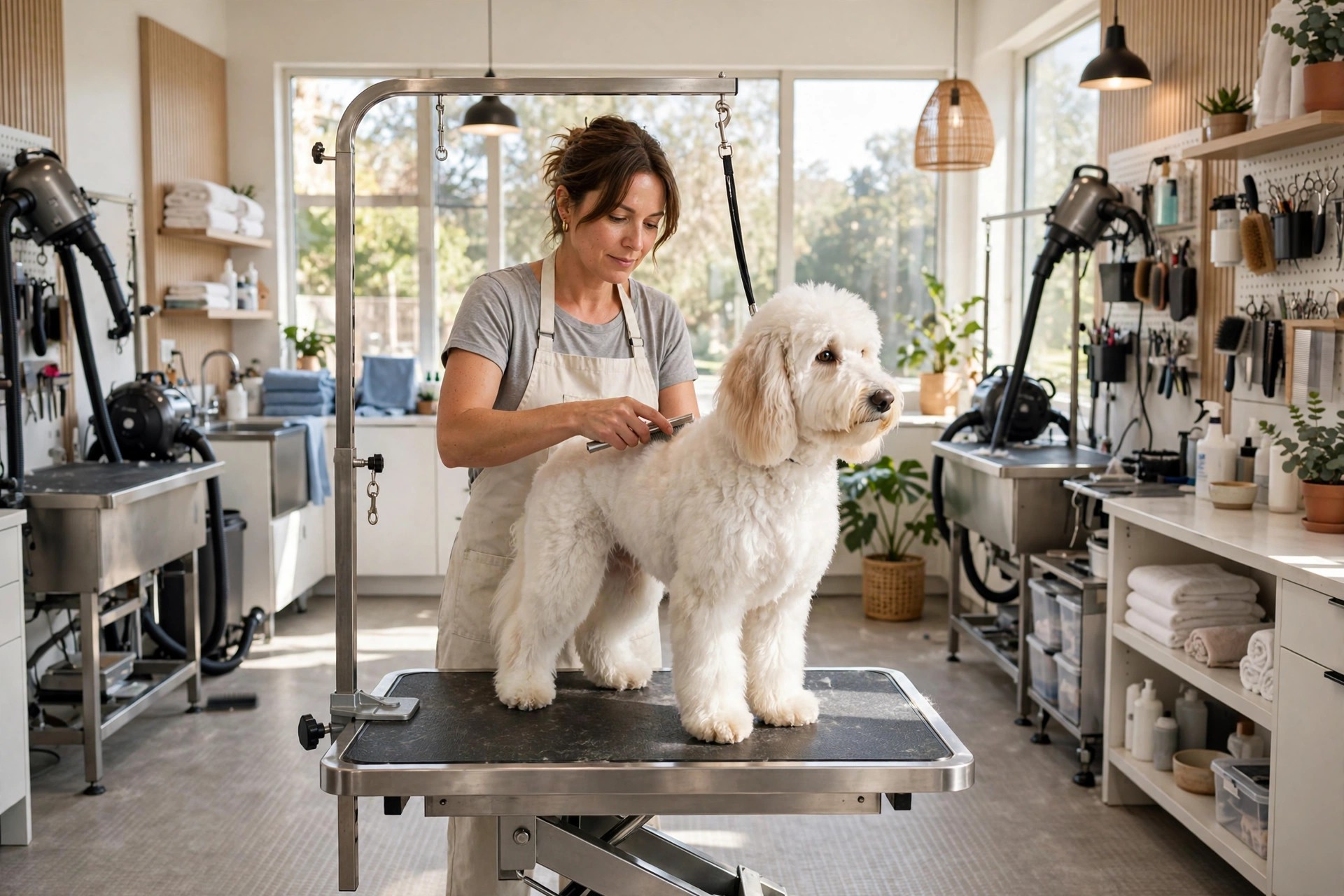
Most grooming salons still book the old way: a phone that rings while the groomer has clippers in hand, voicemail catching pet owners after closing, and a paper book or a group chat that only the owner fully understands. Pet owners have changed how they book everything else, and they expect the same from their groomer. An online booking system for pet groomers fixes the mismatch. It lets owners pick a service by breed and size, choose a real open slot, pay a deposit when your policy asks for one, and get reminders that bring them back on schedule, while your tables fill themselves overnight. This guide covers how grooming booking works, booking by breed and size, deposits and cancellation policies, the software options and costs, calendar density, reminder and rebooking cycles, and the math on filled grooming tables.
The quick answer
- Booked by breed and size: a poodle cut and a beagle bath take very different table time, so the system prices and blocks time by breed, size, and service.
- Deposits cut no-shows: a small deposit or card hold on full grooms commonly drops no-shows from double digits to low single digits.
- Calendar density is the game: groomers earn by the table-hour, so filling gaps and stacking compatible appointments is where the money is.
- Software runs $29 to $200 a month: simple schedulers at the low end, grooming-specific platforms with deposits and intake forms at the high end.
- Reminders plus rebooking: reply-to-confirm reminders stop empty tables, and automatic rebooking prompts keep the 6-to-8-week cycle full.
- Live in about a week: map breeds to time blocks, set the deposit policy, connect reminders, then put the link on every after-visit text.
Why grooming salons lose bookings to the phone
Picture a normal Tuesday. The groomer is mid-haircut on a nervous doodle when the phone rings. Nobody answers; hands are wet and the dog is half-clipped. The caller is a new pet owner who just moved to the neighborhood, and they will call the next salon on the list. Industry surveys of service businesses consistently show that around half of new inquiries arrive outside business hours, and grooming is no exception: owners browse for groomers in the evening after work, on weekends, and during lunch breaks.
The phone problem compounds because grooming appointments are long and specific. A full groom on a large doodle can take two to three hours of table time, while a nail trim takes fifteen minutes. Quoting and scheduling that by phone means the person answering needs to know every breed, every coat type, and every groomer’s speed, and they need to do it while the salon is running. Mistakes are common: a matted shih tzu booked into a 60-minute slot blows up the whole afternoon, and an underquoted price leads to an awkward conversation at pickup.
There is also the rebooking gap. Most dogs need grooming every 4 to 8 weeks, which means the salon’s future revenue is sitting in a list of past clients who simply forgot to book. Phone-only salons rely on the owner remembering or on the groomer mentioning it at pickup, and both fail regularly. An online booking system with automated rebooking prompts turns that forgotten cycle into a full calendar, because the reminder arrives with a booking link at exactly the right week.
How online booking works in a grooming salon
An online booking system for pet groomers is a scheduling page, usually on your own website and linked from your Google Business Profile and Instagram, where pet owners book appointments without calling. The owner selects the pet’s breed and size, picks the service, sees the price for that exact combination, chooses from real open slots, and gets an instant confirmation. Behind the scenes the system blocks the right amount of table time, attaches the booking to the right groomer, and can collect a deposit or card hold according to your policy.
The breed and size picker is what makes grooming booking different from every other kind. A salon cannot offer one flat “full groom” slot, because a chihuahua bath and a full groom on a giant schnauzer are different jobs with different prices and different durations. Good systems use a breed list mapped to size categories, small, medium, large, extra-large, with per-service time blocks and prices for each. The owner picks “Goldendoodle, large, full groom” and sees “$95, about 2.5 hours” with only the slots that fit that block.
Pet profiles make the second visit effortless. The system stores each pet’s breed, size, coat notes, temperament warnings, and service history under the owner’s account. A returning owner books in three taps: pick the pet, pick the service, pick the time. The groomer sees the notes before the appointment: “Bella is anxious around dryers, use the low setting” or “Max has a skin sensitivity, hypoallergenic shampoo only.” That continuity is something a phone book can never deliver, and it is a big part of why owners stay loyal to salons that remember their dog.
If you also run a veterinary-adjacent business or want ideas for filling slow weeks, our collection of vet clinic marketing ideas adapts well to grooming salons, from seasonal packages to referral programs.
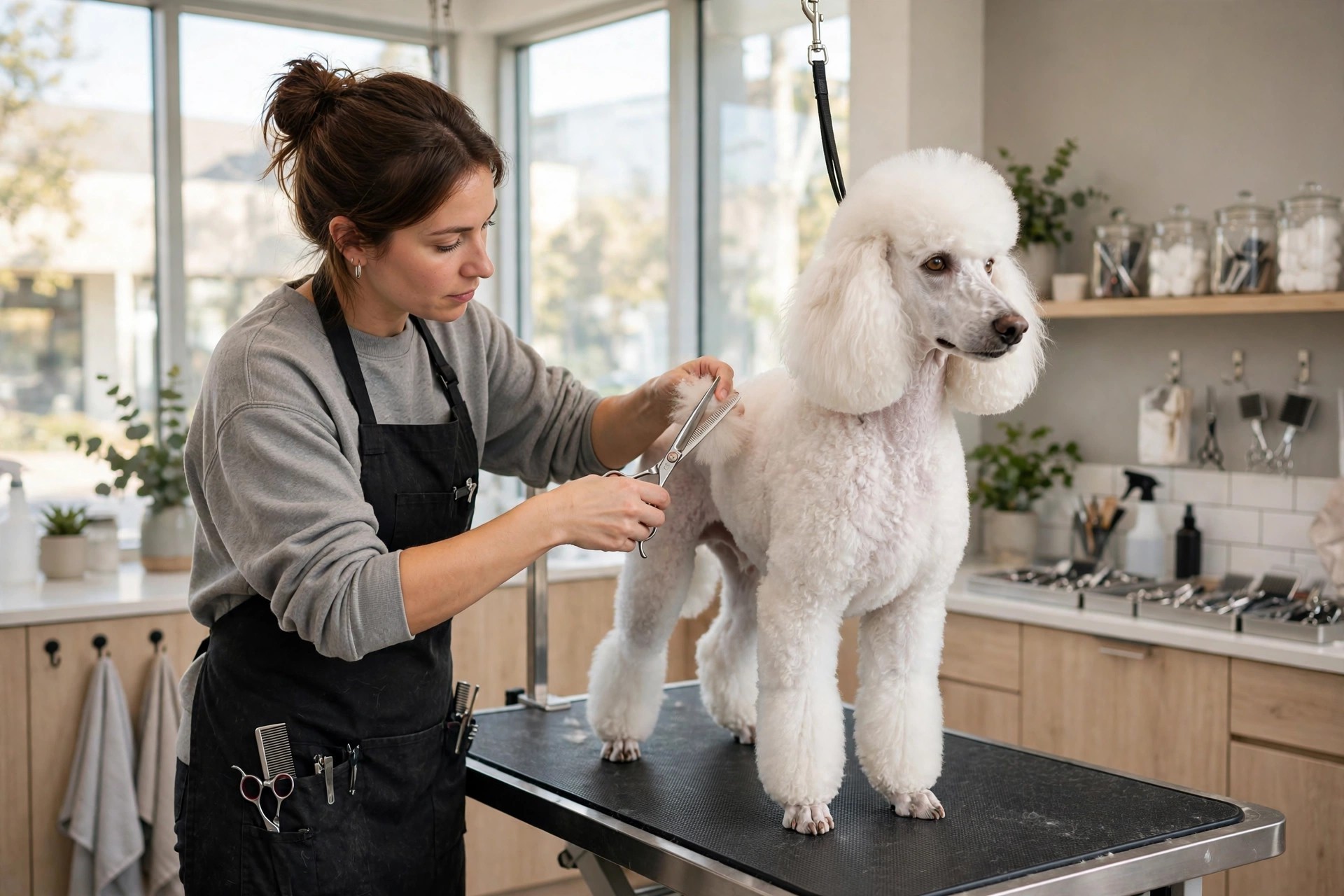
Booking by breed and size means every appointment gets the right table time, so a doodle groom never squeezes the schedule around it.
Booking by breed, size, and service
Getting the breed-size-service matrix right is the single most important setup task, because every downstream number, price, duration, capacity, depends on it. Start with your actual service menu and time it honestly for a week: how long does a small-breed bath really take including drying, how long does a large-breed full groom take including the inevitable wiggles.
| Service and size | Typical table time | Typical price band | Notes |
|---|---|---|---|
| Bath and brush, small | 45 to 60 minutes | $35 to $55 | Include drying time; small dogs still need full dry |
| Bath and brush, large | 60 to 90 minutes | $55 to $85 | Double-coated breeds take the longest to dry |
| Full groom, small | 60 to 90 minutes | $55 to $85 | Breed-standard cuts add 15 to 30 minutes |
| Full groom, medium | 90 minutes to 2 hours | $70 to $110 | The core revenue slot for most salons |
| Full groom, large or doodle | 2 to 3 hours | $95 to $150 | Price for the real time; underpricing this slot loses money |
| Nail trim or grind | 15 minutes | $10 to $20 | Great gap-filler between long grooms |
| De-shedding treatment | Add 30 to 45 minutes | Add $20 to $40 | Book as an add-on, not a standalone slot |
| Teeth brushing | Add 10 to 15 minutes | Add $10 to $15 | Easy add-on revenue at checkout or booking |
Three rules keep the matrix honest. First, time the job including everything: intake chat, bath, dry, cut, nails, and cleanup. Groomers consistently underestimate by 20 percent when they guess from memory. Second, price the large-doodle full groom for what it really costs you; it is the most underpriced slot in the industry and the one most likely to burn out your groomers. Third, build add-ons as true add-ons: the booking page should offer de-shedding, teeth brushing, and specialty shampoo as checkboxes on top of the base service, because add-ons booked online have higher take rates than add-ons pitched at drop-off.
Deposits and cancellation policies that protect your tables
A no-showed full groom is two to three hours of dead table time that cannot be refilled on short notice. Grooming has one of the highest no-show costs per appointment of any service business, because the slots are long and the demand is specific. Deposits and card holds are the standard fix, and online booking makes them painless to collect.
The policy most successful salons use is simple: no deposit for quick services like nail trims, a card hold or small deposit for full grooms, and a larger deposit for new clients booking long appointments. A $25 to $50 deposit on a full groom, applied to the service, filters out casual no-shows without scaring off real customers. First-time clients get the strictest version of the policy, because an unknown name on a three-hour slot is the riskiest booking on your calendar.
Write the cancellation terms in plain words on the booking page, not in fine print: “Cancel or reschedule up to 24 hours ahead and your deposit moves to the new appointment. Inside 24 hours, the deposit is kept.” Then enforce it consistently. The software handles the awkward part automatically: it charges the card on file or keeps the deposit when the policy triggers, so your groomers never have to argue about it at the counter. Pair the policy with reply-to-confirm reminders and most salons see no-shows fall from the 10 to 15 percent range into the low single digits.
One caution: check your local rules on deposits and card holds for services, since consumer protection rules vary. Keep the policy the same for every client, apply it the same way every time, and keep a written record in the booking system. Consistency is what makes a cancellation policy fair and defensible.
Calendar density: filling every grooming table
Groomers earn by the table-hour. A salon with three tables open eight hours a day has 24 table-hours to sell, and every unsold hour is gone forever. Calendar density, the share of available table-hours that are actually booked, is the number that decides whether the salon thrives or scrapes by. Online booking raises density in three specific ways.
First, it fills the gaps. A cancellation at 10 AM used to mean an empty table until the next booked appointment, because filling it required calling down a waitlist. With online booking, the released slot appears on the page instantly, and the waitlist gets an automatic text: “A 10 AM full-groom slot just opened Thursday. Tap to claim it.” Waitlists that used to be a notebook nobody called become a real fill mechanism.
Second, it stacks compatible work. Smart scheduling rules let you book a nail trim in the 15-minute gap while a large groom’s conditioner sets, or overlap a bath-only dog with a full groom on the next table. The system knows each service’s true duration and each groomer’s speed, so it can offer the short slots around the long ones instead of leaving dead 20-minute gaps nobody can use.
Third, it smooths the week. Most salons are slammed Saturday and dead Tuesday. Online booking lets you steer demand with price and availability: show more Saturday slots at full price, open extra Tuesday slots with a small midweek discount, and watch the week even out. Even a 10 percent shift of Saturday demand into Tuesday and Wednesday transforms the salon’s economics, because the same staff and tables produce more booked hours with less burnout.
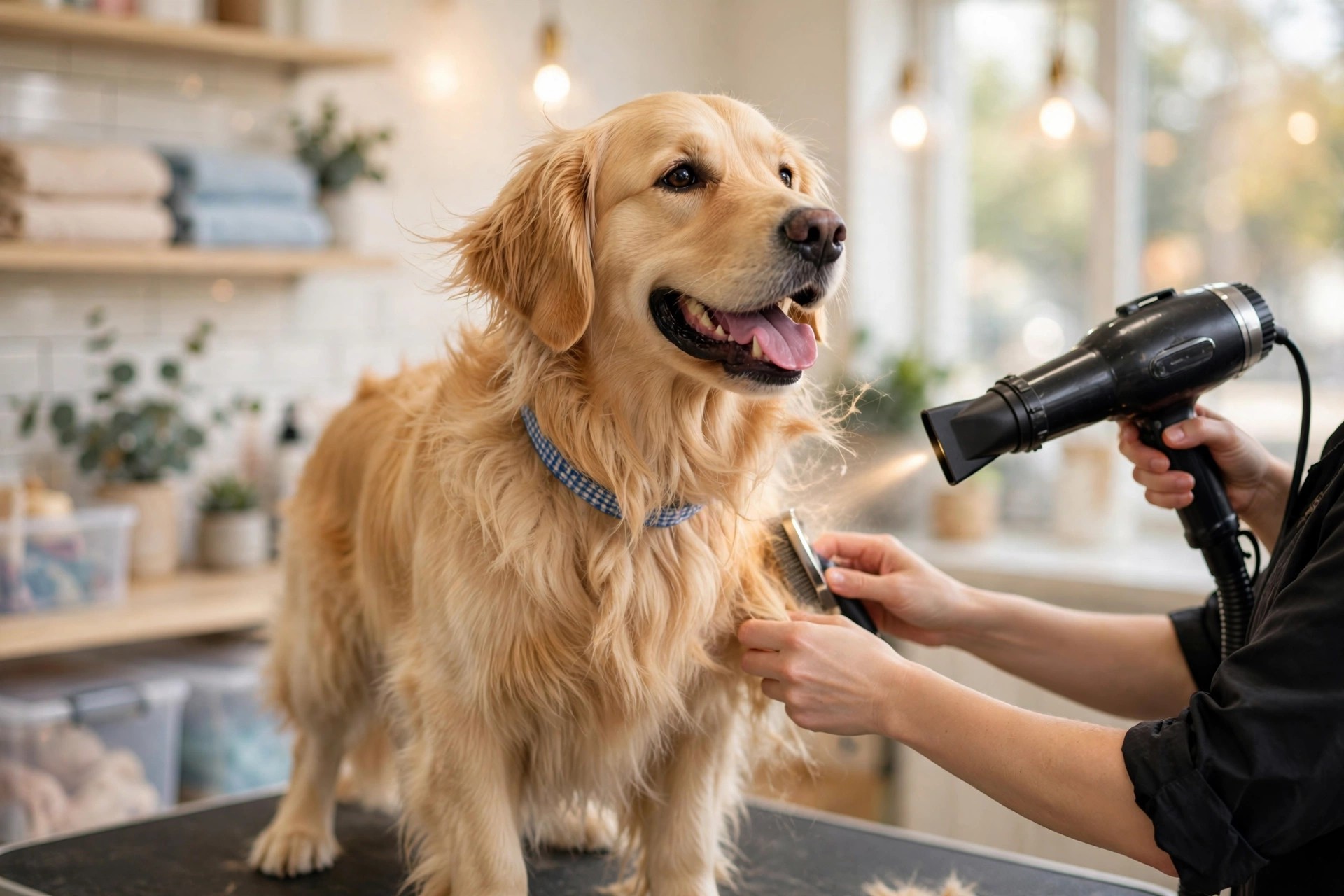
Full tables all week come from rebooking prompts and waitlist automation, not from hoping owners remember to call.
Booking software options for pet groomers
Groomers have better software choices than most trades, because pet care was an early adopter of online booking. The options range from simple schedulers to grooming-specific platforms that handle breeds, deposits, and intake forms out of the box.
| Option | Typical cost | What you get | Best for |
|---|---|---|---|
| Grooming-specific platform | $50 to $200 per month | Breed and size pricing, deposits, intake forms, pet profiles, reminders, often card processing | Salons that want everything built for grooming |
| General pet-care software | $75 to $200 per month | Booking plus boarding, daycare, or retail modules if you offer them | Multi-service pet businesses |
| Standalone scheduler | $29 to $99 per month | Generic booking page with calendar sync and reminders; you configure breed pricing manually | Solo groomers and mobile groomers |
| Website booking plugin | $0 to $200 per year plus setup | Booking inside your own site with full design control; you wire payments and reminders | Salons with a WordPress site and someone technical |
| Done-for-you booking setup | $500 to $2,500 one time, plus software | Agency builds the page, maps breeds to time and price, connects deposits and reminders, trains the team | Owners who want it live fast with no DIY |
The grooming-specific platforms earn their price through the breed matrix and the deposit handling, which generic schedulers make you build by hand. If you are a solo groomer or mobile, a standalone scheduler configured carefully gets you 90 percent of the value. If you are weighing a website rebuild at the same time, our guide to how much a pet grooming website costs covers what a booking-ready salon site should include. And for a look at how a neighboring trade handles the same scheduling problems, see our guide to online booking systems for auto repair shops.
What each price tier buys you
Starter: simple scheduler
A clean booking page with service selection, calendar sync, and automatic confirmations. Best for solo groomers booking straightforward services.
- Online service picker with time blocks
- Automatic email and text confirmations
- Basic calendar sync and manual breed pricing
Growth: grooming platform with deposits
Adds breed and size pricing, deposit and card-hold collection, intake forms, and reply-to-confirm reminders. The tier where no-shows collapse.
- Breed and size price matrix built in
- Deposits, card holds, and cancellation enforcement
- Pet profiles with coat and temperament notes
Full salon system
Booking, reminders, rebooking automation, review requests, and reporting in one place, with multi-groomer scheduling and payroll-friendly time tracking.
- Multi-groomer calendars with skill-based routing
- Automatic rebooking prompts on the 6-to-8-week cycle
- Revenue and density reporting per groomer and table
Reminder and rebooking cycles
Reminders stop empty tables this week; rebooking fills the calendar for the next two months. The two systems work together, and both should run automatically off the same booking calendar.
The reminder sequence for grooming is a 48-24-2 pattern with a grooming-specific twist. The 48-hour message confirms the appointment and asks about coat condition: “Hi Lisa, confirming Bella’s full groom Thursday at 10 AM. Has she been brushed since her last visit? Matting may add time and cost.” That one question saves more schedule chaos than any other message a salon can send, because it surfaces the matted-dog problem before the dog is on the table. The 24-hour reminder covers drop-off logistics: “Please arrive 5 minutes early; late arrivals may need rescheduling to protect the next appointment.” The morning-of nudge is short: “See you at 10 today.”
Every reminder must be replyable with one-tap rescheduling, so a moved appointment releases its table time back into availability instead of becoming a no-show. Unconfirmed appointments the afternoon before become a short call list. The rebooking cycle runs after the visit: two weeks before the dog is due again, the owner gets a text with a booking link pre-set to the same service and groomer. “Bella is due for her groom next week. Tap here to grab your usual Thursday slot with Maria.” Salons running this cycle commonly lift rebooking rates from under 40 percent to 60 percent or higher, which is the difference between chasing new clients and having a waiting list.
The booking flow pet owners finish
Pet owners book from their phones, usually in the evening, often while the dog is asleep on their lap. The flow must be short, visual, and forgiving, because a confused owner just calls, and calling after hours means a lost booking.
Step 1, the pet. Returning owners pick from their saved pets. New owners answer three quick questions: breed or mix, size, and coat type. Keep the breed list searchable; scrolling 200 breeds is where mobile users quit.
Step 2, the service. Show the services with the price for this exact pet: “Full groom for Bella, large doodle: $115, about 2.5 hours.” Add-on checkboxes below: de-shedding, teeth brushing, specialty shampoo. Prices shown up front cut pickup-time arguments dramatically.
Step 3, the groomer and time. Offer “first available” plus named groomers, then show three to five real openings. Label morning and afternoon clearly. If the owner picks a named groomer, only show that groomer’s availability.
Step 4, details and deposit. Contact info, pet notes (“anxious around dryers”), vaccination confirmation if your salon requires it, then the deposit or card hold if the service calls for one. Keep it to one screen.
Step 5, the confirmation. “Bella is booked for a full groom Thursday at 10 AM with Maria. Plan on about 2.5 hours. We will text you a reminder two days before.” Include drop-off instructions and the salon number for special needs: “First visit, matting, or special needs? Call us and we will set it up personally.”
Intake forms, photos, and special needs
Online booking gives you something the phone never did: information before the dog arrives. Use it. A short digital intake form at booking time collects vaccination status, medical conditions, bite history, and grooming preferences, and it does it when the owner is relaxed at home, not rushed at drop-off with a pulling leash.
Photos are the quiet superpower. Ask owners to upload a photo of the dog at booking, or at least of the desired cut. “Show us a photo of the cut you want” eliminates the most common grooming disappointment: the owner imagined a teddy-bear cut and the groomer delivered a kennel cut. The photo lands in the appointment record, the groomer reviews it before the dog arrives, and pickup-time surprises drop sharply.
Special needs get a dedicated path. Aggressive dogs, elderly dogs, dogs with seizures or medical conditions: the booking flow should flag these with a simple question and route them to a call or a special-needs slot with extra time. Never let a high-risk dog book a standard slot silently; the extra ten minutes of screening protects your groomers, the other dogs in the salon, and your liability. Note the policy kindly on the page: “Every dog is welcome here. Some friends need a little extra planning, so tell us about special needs and we will set up the perfect appointment.”

One shared calendar for bookings, reminders, and rebooking keeps every table, groomer, and waitlist in sync.
What it costs and what it earns
Total cost has three parts: the software subscription, the one-time setup, and the small cost of reminder texts and card processing on deposits. A solo groomer on a standalone scheduler pays roughly $40 to $80 a month all-in. A three-table salon on a grooming platform pays $100 to $200 a month. One-time setup, breed matrix mapping, deposit policy, intake forms, reminder sequences, team training, runs $500 to $2,500 if an agency does it, or a few evenings of careful configuration if you do it yourself.
The return comes from three places. First, after-hours bookings that used to be voicemail: pet owners browse in the evening, and every captured booking is revenue the phone would have lost. Second, fewer no-shows: deposits plus reply-to-confirm reminders turn the most expensive empty slot in the service industry into booked, paid table time. Third, rebooking: automatic prompts on the 6-to-8-week cycle lift repeat rates without anyone remembering to mention it at pickup. Most salons find the system pays for itself within the first month, and the rebooking lift compounds every month after.
Mistakes that cost groomers money
Guessing at time blocks. Time every service for a week with a stopwatch. Underestimating the large-doodle groom by 30 minutes wrecks the afternoon and burns out the groomer.
One flat price for every dog. A chihuahua bath and a giant schnauzer full groom are different jobs. Flat pricing either overcharges small dogs or loses money on big ones, usually both.
No deposit on long slots. A three-hour groom with no card on file is the highest-risk booking in the business. Deposits on full grooms are standard; owners expect them.
Skipping the matting question. The 48-hour reminder should ask about coat condition. A matted dog discovered on the table costs you an hour you did not plan for.
Forgetting the Google profile and Instagram. Pet owners find groomers on Google and Instagram first. If the booking link is not in both places, the page sits unseen.
Letting anyone book any groomer. New or difficult dogs should go to experienced groomers. Route by skill level or you will spend mornings reshuffling the day.
Never asking for the rebook. The owner will not remember the 6-week cycle; the system must. No automatic rebooking prompt means a calendar that empties itself every two months.
Your rollout checklist
Work through these in order. Each one builds on the last.
- 1Time every service. Stopwatch each service by size for a week; include bath, dry, cut, nails, and cleanup in every block.
- 2Build the breed-size-price matrix. Every breed mapped to a size, every service priced and timed per size, add-ons as checkboxes.
- 3Pick the software. Grooming-specific platform if you want breeds and deposits built in, standalone scheduler if you are solo.
- 4Set the deposit policy. Card hold or deposit on full grooms, plain-words cancellation terms on the booking page, applied to everyone.
- 5Build the five-step flow. Pet, service with exact price, groomer and time, details plus deposit, confirmation; mobile-first.
- 6Add intake and photo upload. Vaccination status, medical and temperament notes, and a photo of the desired cut.
- 7Set the special-needs route. Flag question for aggression, age, or medical issues, routed to a call or an extended slot.
- 8Build reminders and rebooking. 48-24-2 replyable reminders with the matting question, plus automatic rebooking prompts on the cycle.
- 9Put the link everywhere. Website header, Google Business Profile, Instagram bio, after-visit texts, and a sign at the front desk.
- 10Review the first 100 bookings. Fix the breeds owners pick wrong, the time blocks that run long, and the wording that confuses people.
Frequently asked questions
Will online booking reduce my phone calls?
It reduces scheduling calls, the routine bookings and rebookings, while the calls that still come are the ones worth having: first visits, special needs, matting questions, and nervous new owners. Most salons find the phone gets quieter and the conversations get better.
What does an online booking system cost for a groomer?
A standalone scheduler runs $29 to $99 a month, a grooming-specific platform runs $50 to $200 a month, and agency setup runs $500 to $2,500 one time. Reminder texts and card processing add a small monthly cost. Most salons spend $40 to $200 a month all-in after setup.
Should I take deposits for grooming appointments?
For full grooms, yes: a $25 to $50 deposit or card hold applied to the service is standard and expected. Skip deposits for quick services like nail trims, where friction costs more than the occasional no-show. Always state the cancellation terms in plain words on the booking page.
How do I price by breed and size fairly?
Time each service by size with a stopwatch for a week, then price from your target hourly rate. Publish the price for the exact pet at booking time so there are no pickup surprises. Review the matrix quarterly; coat trends and your own speed change over time.
What about aggressive or special-needs dogs?
Build a flag question into the booking flow and route those dogs to a call or an extended special-needs slot with your most experienced groomer. Never let a high-risk dog book a standard slot silently; the screening protects your team and the other dogs.
How do reminders work with the booking calendar?
The reminders read the same calendar the booking page writes to, so confirmations, reschedules, and cancellations stay in sync. A 48-24-2 sequence of replyable reminders, with the matting question at 48 hours, commonly cuts no-shows from the 10 to 15 percent range into the low single digits.
Can the system handle rebooking automatically?
Yes, and this is where the real money is. Two weeks before the dog is due again, the owner gets a text with a booking link pre-set to the same service and groomer. Salons running this cycle commonly lift rebooking rates from under 40 percent to 60 percent or higher.
What if a client no-shows even with a deposit?
The deposit or card hold covers part of the lost table time according to your stated policy, and the released slot goes instantly to your waitlist. Track repeat no-shows in the pet profile; clients who no-show twice can be moved to prepayment-only booking.
How long does setup take?
About a week for the standard path: time your services, build the breed-size-price matrix, configure deposits and intake forms, connect reminders and rebooking, and train the team. The matrix is the step that takes real thought; everything else is configuration.
How do I measure whether it is working?
Track five numbers monthly: calendar density as a share of table-hours booked, no-show rate, rebooking rate on the grooming cycle, after-hours bookings captured, and average ticket with add-ons. Compare against the two months before launch; density and rebooking usually move first.
Fill your grooming tables without living on the phone
Digital Hayder builds online booking systems for pet groomers: breed and size pricing matrices, deposit handling, intake forms, reply-to-confirm reminders, and automatic rebooking on the grooming cycle. Tell us about your salon and we will design the booking flow around it.
Contact Us