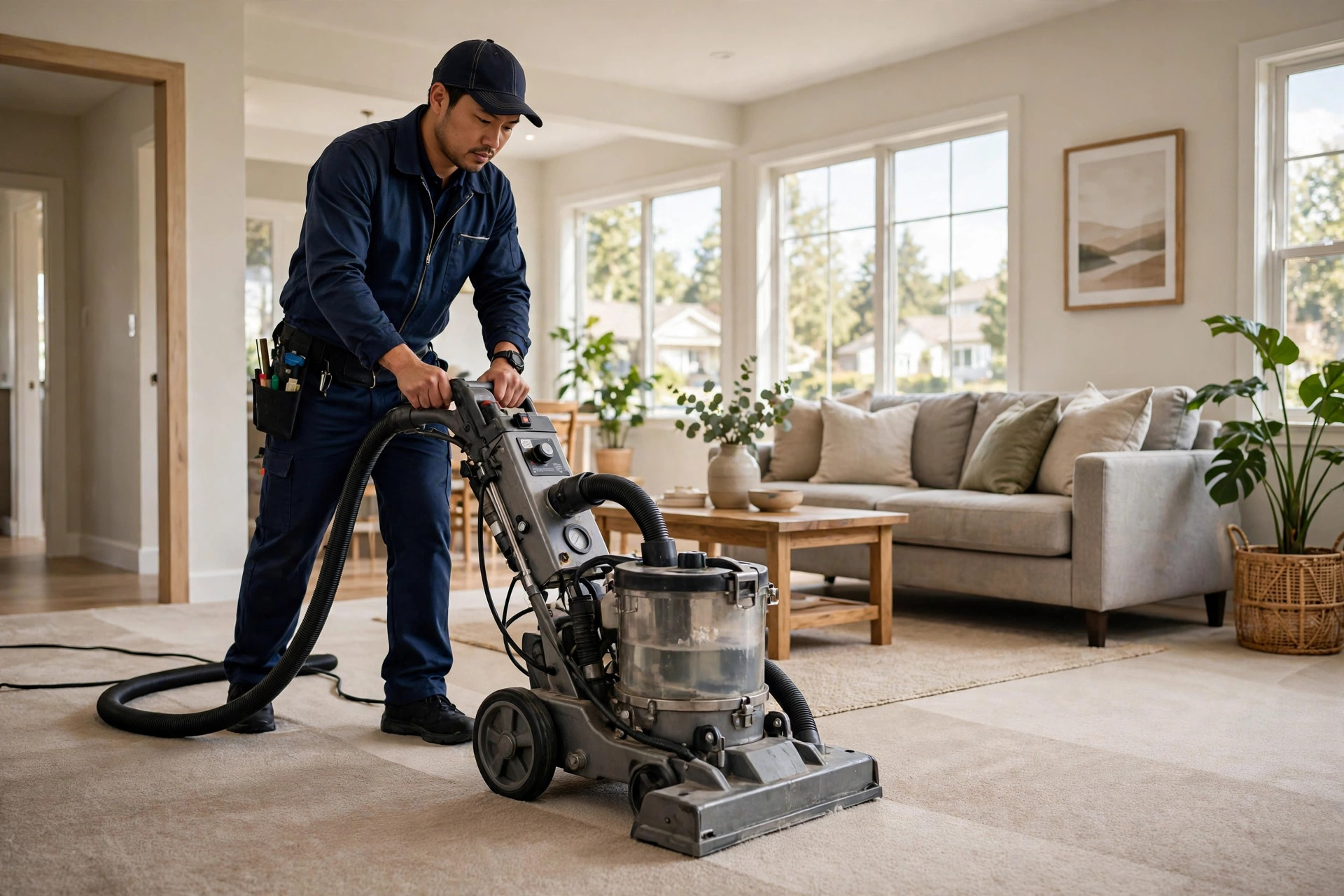
Carpet cleaning is one of the few home services where a single job can pay for the ad that booked it, sometimes twice over. Google Ads for carpet cleaning companies typically costs $2 to $8 per click in most US markets, a fraction of what plumbers and electricians pay for their keywords. A single-truck operation can run a real, lead-producing campaign on $750 to $1,500 a month. The catch is that cheap clicks only help if the ads, the offer, and the landing page are built for carpet cleaning specifically. Generic ads that say “quality service” and point to a homepage burn the budget without booking jobs. This guide gives you the real click costs, the keywords worth bidding on, a month-by-month budget table, the room-pricing offers that turn searches into scheduled cleanings, and the landing page fixes that cut your cost per lead in half.
The quick answer
- Click costs are low: most carpet cleaning keywords cost $2 to $8 per click, far below plumbing or HVAC keywords.
- A workable budget is $750 to $2,500 a month: single-truck operations start at the low end, multi-crew companies scale from there.
- Room-pricing offers win: ads with a concrete offer like “3 rooms for $129” beat vague “call for a quote” ads on clicks and bookings.
- Expect $25 to $60 per lead: well-run campaigns turn those leads into booked cleanings at $50 to $120 per job.
- The landing page decides the outcome: a page built around one offer with tap-to-call converts two to three times better than a homepage.
- The math works: with a $250 average ticket, one booked cleaning usually covers its own ad cost and leaves profit behind.
What Google Ads actually costs carpet cleaning companies
Let us start with the numbers owners ask about first. In a typical mid-size US city, the core carpet cleaning keywords, “carpet cleaning near me,” “carpet cleaners,” “carpet cleaning prices,” trade between $2 and $8 per click. High-competition metros can push the top service keywords toward $9 or $10, and small towns often sit under $3. Stain-specific searches like “pet stain removal carpet” and “red wine stain carpet cleaning” usually cost $3 to $6. Commercial terms such as “office carpet cleaning” land in a similar band. For comparison, our breakdown of Google Ads cost for cleaning companies shows house cleaning keywords in roughly the same range, so carpet cleaning sits comfortably in the affordable tier of home services.
Clicks are only the start of the math. What matters is the cost per lead and the cost per booked cleaning. A carpet cleaning landing page that matches the ad, shows the price, and makes calling easy converts 8 to 15 percent of clicks into leads: calls, form fills, and quote requests. At a $5 average click and a 10 percent conversion rate, that is $50 per lead. Close a third of those leads into booked jobs, which is realistic for a company that answers fast and quotes clearly, and each booked cleaning costs about $150 in ad spend. The average residential carpet cleaning ticket runs $200 to $350 for a few rooms, so the job covers its ad cost with room to spare, and that is before repeat bookings.
Monthly spend for a working campaign usually lands between $750 and $2,500. A single-truck owner in a mid-size market can keep the phone busy on $750 to $1,200 a month. A two-crew operation targeting a metro area, or running commercial terms alongside residential, often needs $1,500 to $2,500. Companies spending less than $500 a month rarely get enough data to optimize; the campaign runs for weeks without enough clicks to tell which keywords book jobs and which just spend money. Start with a budget that buys at least 150 to 200 clicks a month, learn what works, then scale the winners.
Why carpet cleaning clicks cost less than other trades
Not all home service keywords are priced the same, and carpet cleaning sits on the friendly end of the scale. The price of a keyword reflects how much revenue one customer is worth and how many competitors are bidding. An emergency plumber can bill $500 for a single visit, so plumbing companies bid aggressively. A carpet cleaning job averages a few hundred dollars and repeats once or twice a year, so bidding stays calmer. Fewer national franchises dominate the auction in carpet cleaning than in, say, pest control or HVAC, which keeps prices down in most markets.
The table below puts carpet cleaning next to other trades so you can see the gap. The ranges are typical for mid-size US markets and shift with city size and season.
| Trade | Typical cost per click | Typical cost per lead | Why it prices this way |
|---|---|---|---|
| Carpet cleaning | $2 to $8 | $25 to $60 | Moderate ticket, calm auction, fewer national bidders |
| House cleaning | $2 to $7 | $20 to $55 | Recurring revenue but lower one-time ticket |
| Plumbing | $8 to $25 | $60 to $150 | Emergency jobs with high tickets and fierce bidding |
| Electrical | $7 to $20 | $55 to $130 | Licensed trade, high ticket, strong competition |
| HVAC | $8 to $30 | $70 to $160 | System replacements worth thousands drive bidding up |
| Pest control | $5 to $15 | $40 to $100 | Recurring contracts make each customer valuable |
The takeaway for carpet cleaners is simple: you compete in one of the cheapest auctions in home services, which means a modest budget goes further and the margin for error is wider. A plumbing company that mismanages its campaign bleeds hundreds a day. A carpet cleaner who does the same loses tens. That is an advantage, not an excuse to run sloppy campaigns.
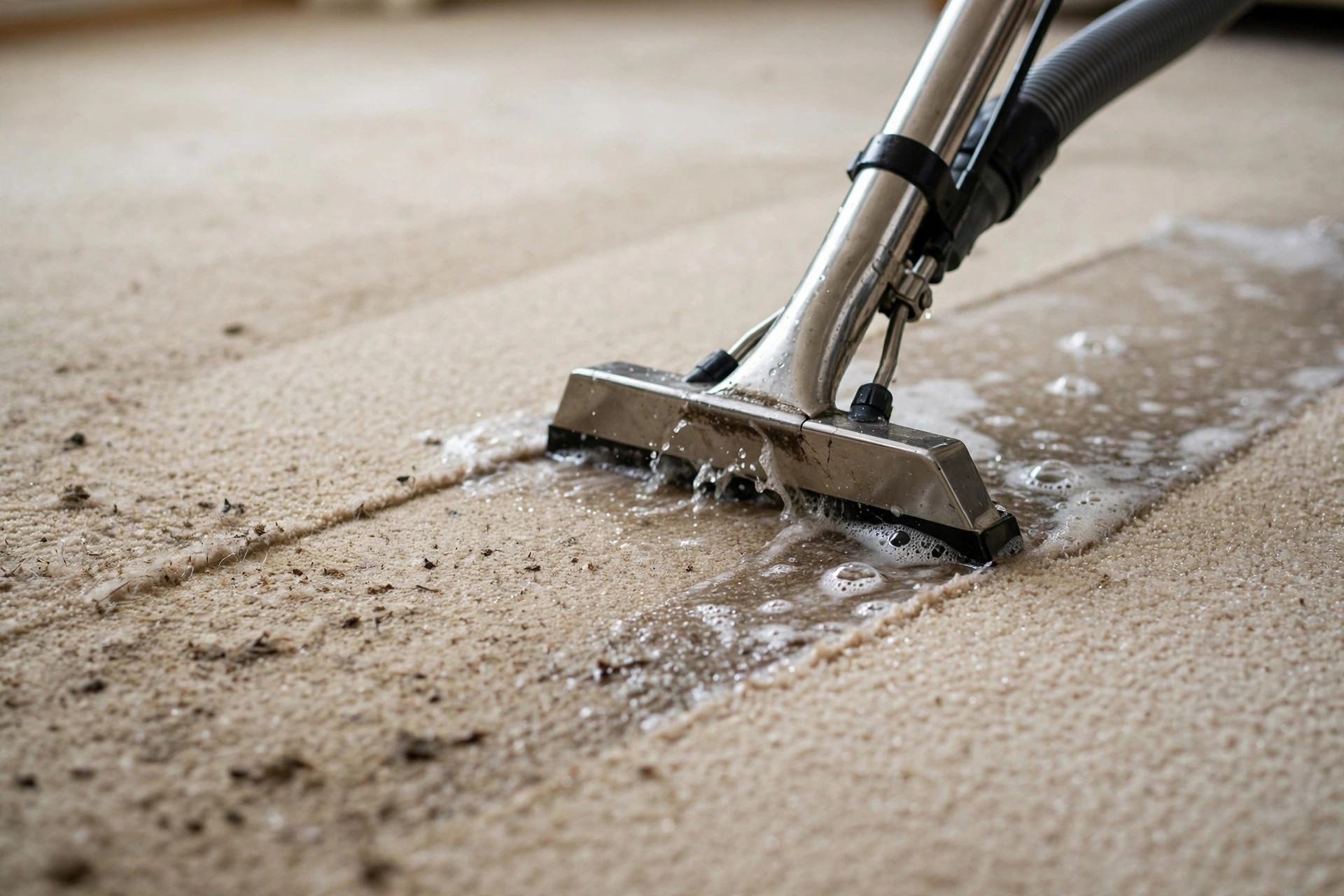
Carpet cleaning keywords sit in one of the cheapest ad auctions in home services, so a modest monthly budget can keep a truck booked.
The keywords worth your money
Carpet cleaning searches fall into three buckets: people ready to book, people comparing prices, and people with a specific problem. Bid on the first and third buckets first. Price shoppers in the second bucket convert too, but they need an offer on the page, not just a phone number.
The money keywords are the service plus location pattern: “carpet cleaning near me,” “carpet cleaners in [city],” “best carpet cleaning [city].” These searchers have decided they want the service and are picking who does it. Bid on them with exact and phrase match so your ads show for the real thing and not for “carpet cleaning jobs” or “carpet cleaning machine rental,” which are job seekers and DIYers. The problem keywords are gold for carpet cleaners: “pet stain removal,” “coffee stain on carpet,” “carpet odor removal,” “red wine stain carpet.” Someone searching these has an urgent, specific need and converts well when the ad promises a fix. Commercial keywords, “office carpet cleaning,” “commercial carpet cleaners,” cost a bit more per click but one contract can be worth dozens of residential jobs.
| Keyword group | Example searches | Typical CPC | Booking intent |
|---|---|---|---|
| Service plus location | carpet cleaning near me, carpet cleaners Denver | $3 to $8 | Highest: ready to pick a company |
| Price research | carpet cleaning prices, how much to clean 3 rooms | $2 to $5 | Medium: converts with a clear offer |
| Stain and odor problems | pet stain removal carpet, carpet odor removal | $3 to $6 | High: urgent need, wants it fixed now |
| Specific rooms | stairs carpet cleaning, area rug cleaning | $2 to $5 | Medium-high: add-on friendly jobs |
| Commercial | office carpet cleaning, commercial carpet cleaners | $4 to $9 | High value: fewer jobs, bigger tickets |
| Upholstery add-ons | couch cleaning service, upholstery cleaning near me | $2 to $6 | Medium: great for raising ticket size |
Equally important is the negative keyword list. Block “jobs,” “careers,” “hiring,” “salary,” “rental,” “rent,” “DIY,” “machine,” “how to,” “homemade,” and “recipe.” These searches cost you clicks from people who will never book. Review the search terms report every week for the first month and add every irrelevant query you find. Most wasted spend in carpet cleaning campaigns comes from a short list of repeated junk searches, and a ten-minute weekly review keeps it under control.
Your monthly budget: what different spend levels buy
Budget decides how fast you learn and how many jobs you book. The table below shows what typical monthly budgets produce at a $5 average click, a 10 percent landing page conversion rate, and a 33 percent lead-to-booking rate. Your market will differ, but the ratios hold: more budget means more data, faster learning, and more booked cleanings.
| Monthly budget | Clicks (approx) | Leads (approx) | Booked jobs (approx) | Best for |
|---|---|---|---|---|
| $750 | 150 | 15 | 5 | Single-truck startup testing the water |
| $1,250 | 250 | 25 | 8 | Single-truck owner who wants steady work |
| $2,000 | 400 | 40 | 13 | Growing company, one to two crews |
| $3,500 | 700 | 70 | 23 | Multi-crew operation covering a metro |
| $5,000 | 1,000 | 100 | 33 | Large company running residential plus commercial |
Three budget tiers cover most carpet cleaning companies. Pick the one that matches your trucks, then move up when the schedule is full.
The Starter: proving the channel
One tight campaign, five to eight core keywords, one city or a 15-mile radius. Goal: 5 to 8 booked cleanings a month and enough search-term data to know which keywords convert.
- Exact and phrase match on service-plus-location keywords
- One landing page with one room-pricing offer
- Call ads during business hours, search ads around the clock
- Weekly search-term review to build the negative list
The Grower: filling the schedule
Separate campaigns for residential, stain and odor, and commercial. Wider radius, ad scheduling matched to your booking hours, and remarketing to site visitors who did not call.
- Split campaigns so budgets follow the best performers
- Stain and odor ad groups with problem-focused ad copy
- Remarketing ads to past visitors for 30 days
- Landing pages per service: residential, pet stains, commercial
The Scaler: owning the market
Full metro coverage, commercial terms running alongside residential, YouTube and display remarketing, and dedicated budget for seasonal pushes like spring cleaning and holiday prep.
- Commercial campaign with its own landing page and quote form
- Seasonal campaigns with limited-time room offers
- Call tracking by keyword so you know what books jobs
- Monthly creative tests on headlines and offers
Room-pricing offers that turn clicks into bookings
Carpet cleaning has a built-in advertising advantage: the service is easy to price by the room, and price-first shoppers convert when they see a number. Ads that lead with a concrete offer consistently beat ads that say “call for a free quote.” The classic is “3 rooms for $129” or “whole house up to 1,000 sq ft for $199.” The number does two jobs: it filters for buyers instead of browsers, and it gives the clicker a reason to call now instead of opening five more tabs.
Your offer has to be real and sustainable. Work backward from your costs. If a three-room job takes 90 minutes, uses $15 in chemicals, and your target is $60 per labor hour, a $129 offer leaves about $60 in gross margin before ad cost. If the ad cost per booked job is $50 to $70, the job still clears a profit and the customer enters your repeat cycle. Carpet cleaning repeats: a happy customer books again in 6 to 12 months and refers neighbors. Price the first clean to acquire the customer, not to maximize one visit.
Rotate secondary offers around the core one. Pet stain packages work well: “pet stain treatment included with any 3-room clean.” Upholstery add-ons raise the ticket: “add a sofa cleaning for $49 with any whole-house clean.” Commercial prospects respond to “free on-site quote within 24 hours” rather than room pricing. Test one offer per ad group at a time so you know which one moved the needle. Change the offer when it stops working, which usually takes three to six months in one market, not every week.
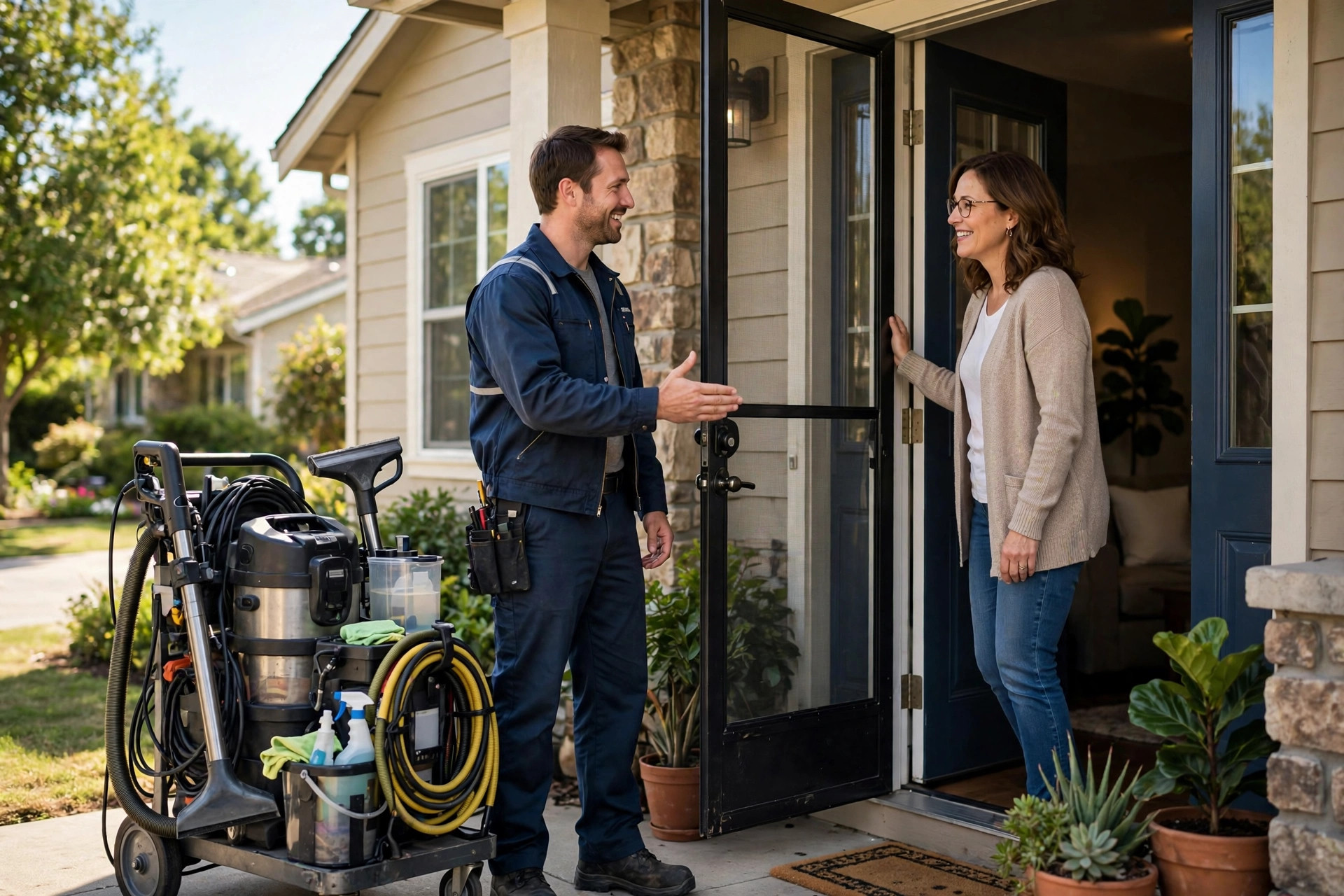
A concrete room-pricing offer in the ad sets the price expectation before the call, so the conversation starts with scheduling, not haggling.
Landing page tips that cut your cost per lead
The landing page is where carpet cleaning campaigns are won or lost. A click costs the same whether the page converts or not, so doubling the conversion rate halves your cost per lead without spending a dollar more on ads. The most common failure is pointing ads at the homepage. Homepages serve everyone and convert no one. Build one page per offer, and make the page do a single job: turn the click into a call or a booking.
Put the offer in the headline, word for word as it appeared in the ad. If the ad said “3 rooms for $129,” the page headline says “3 rooms for $129.” This match between ad and page is the single biggest trust signal in paid search. Below the headline, put the call button and the booking form above the fold, visible without scrolling on a phone. Most carpet cleaning searches happen on mobile, often from someone standing in a room staring at a stain. A tap-to-call button that follows the visitor down the page captures the ready buyers. If you are rebuilding the site anyway, our guide to how much a carpet cleaning website costs covers what a booking-ready site should include.
The rest of the page answers the objections that stop people from calling. A short list of what is included: pre-treatment, deep extraction, deodorizer, furniture moving policy. Real photos of your team and trucks, not stock photos of spotless mansions. Three to five recent reviews with names and neighborhoods. A service area list with the towns you cover. A simple price table for rooms, stairs, and add-ons so shoppers stop wondering. And a guarantee: “love the result or we re-clean it free.” Each element removes one reason to leave the page, and together they lift conversion from the 3 to 5 percent a homepage gets into the 10 to 15 percent range a good landing page hits.
Speed matters as much as copy. A page that loads in under two seconds on a phone converts far better than one that takes five. Compress the images, skip the video background, and keep the form to four fields: name, phone, service needed, preferred day. Every extra field costs you leads. Test the page on your own phone before you launch; if you would not call from it, neither will a stranger.
Campaign settings carpet cleaners get wrong
Most carpet cleaning campaigns fail on settings, not strategy. The first is location targeting. Set a radius around your real service area, 15 to 25 miles for most companies, and use “presence” targeting so ads show to people physically in the area, not people searching about it from elsewhere. A company in Austin does not need clicks from someone in Dallas researching a move. Review the geographic report monthly; you will usually find a few zip codes eating budget without booking jobs, and excluding them lifts the whole account.
The second is ad scheduling. Carpet cleaning searches peak in the evenings and on weekends, exactly when many owners are off the phones. If nobody answers, those clicks still cost you. Two fixes work: run call ads only during hours someone answers, and let an AI receptionist for carpet cleaning companies answer every call around the clock, quoting prices and booking jobs while the crew is on site. Companies that answer every call close dramatically more of their leads than companies that let half go to voicemail.
The third is match types and bidding. Start with manual or maximize-clicks bidding on exact and phrase match keywords until you have 30 to 50 conversions, then switch to target-based smart bidding. Broad match on day one is a budget fire: Google will find creative ways to spend it on “carpet installation” and “carpet stores.” Add call extensions, location extensions, and price extensions to every ad; they take up more screen space on mobile and lift click rates for free. Finally, separate campaigns by intent. Residential, stain and odor, and commercial should never share one budget, because the $8 commercial click will starve the $3 residential keywords of spend.
Where carpet cleaning ad money gets wasted
The same five leaks drain most carpet cleaning accounts. First, bidding on DIY and rental terms: “carpet cleaner rental,” “rent rug doctor,” “how to clean carpet yourself.” These searchers want to do it themselves; block them. Second, ignoring the search terms report. Google adds new queries every week, and without a weekly review the junk accumulates silently. Third, sending traffic to the homepage, which we covered above: it is the most expensive common mistake because it wastes good clicks. Fourth, no call tracking. If you cannot tie calls to keywords, you cannot tell which half of the budget works, so install call tracking from day one and review which keywords produce booked jobs, not just calls.
Fifth, and the most painful, is slow follow-up. A carpet cleaning lead goes cold fast. Someone with a pet stain wants it handled this week, and they called three companies. Data across home services consistently shows that the company that answers first wins most of the jobs. If your crew is in a customer’s home with the machine running, nobody is answering the office line. Pair the ads with fast response: an AI receptionist, a dedicated call answering setup, or at minimum a text-back within five minutes. For the broader playbook on turning attention into booked jobs, see our cleaning business marketing ideas guide, which covers the follow-up systems that make paid clicks pay off.

One booked cleaning usually covers its own ad cost, and the repeat visits that follow are where the real profit sits.
Seasonality: when to spend more and when to pull back
Carpet cleaning demand moves with the calendar, and your budget should move with it. Spring is the biggest season in most markets: people open the windows, see the winter’s damage, and book. Early summer stays strong with move-outs and rentals turning over. Demand dips in late summer, climbs again before the holidays when people want clean carpet for guests, and drops in the deep winter weeks. Plan the year in advance instead of reacting to it.
Raise budgets 30 to 50 percent going into spring and the pre-holiday stretch, and tighten targeting so the extra spend lands on the highest-intent keywords. Pull back in the slow weeks rather than pausing entirely; pausing kills your quality history and the campaign restarts cold. Use the slow periods for maintenance: rebuild landing pages, shoot new photos, refresh ad copy, and build the negative keyword list. The companies that spend steadily and adjust with the seasons book more jobs per dollar than the ones that turn the tap on and off.
Your rollout checklist
Work through these in order. Each one builds on the last.
- 1Set the monthly budget. Start at $750 to $1,200 for one truck, enough for 150 to 200 clicks a month of learning data.
- 2Define the service area. A 15 to 25 mile radius with presence-only targeting around the towns you actually serve.
- 3Build the keyword list. Service-plus-location, stain and odor, and price keywords on exact and phrase match.
- 4Write the negative list. Block jobs, rentals, DIY, and how-to searches before the first click.
- 5Price one core offer. A room-pricing deal like 3 rooms for a flat rate that leaves margin after ad cost.
- 6Build the landing page. Offer in the headline, tap-to-call above the fold, four-field form, real photos and reviews.
- 7Set up call tracking. Tie every call to its keyword from day one so you know what books jobs.
- 8Fix the phones. Answer every call during ad hours or add after-hours coverage so clicks turn into bookings.
- 9Launch and review weekly. Check search terms, add negatives, and shift budget to the keywords that book.
- 10Scale the winners. Raise budget on converting campaigns, add commercial terms, and test new offers quarterly.
Frequently asked questions
How much should a carpet cleaning company spend on Google Ads per month?
Most single-truck operations do well on $750 to $1,500 a month, and growing companies spend $1,500 to $2,500. Below $500 a month you rarely get enough clicks to learn what works. Start with a budget that buys at least 150 clicks a month, then scale the campaigns that book jobs.
What is the average cost per click for carpet cleaning keywords?
Typical CPCs run $2 to $8 in most US markets. Core terms like “carpet cleaning near me” sit in the $3 to $8 range, stain-specific searches cost $3 to $6, and small-town markets often see clicks under $3. Competitive metros can push top terms toward $10.
How much does one carpet cleaning lead cost from Google Ads?
Well-run campaigns produce leads at $25 to $60 each. That assumes a landing page converting 8 to 15 percent of clicks and an average click cost around $5. Homepage traffic and weak offers push the number much higher.
Are Google Ads worth it for carpet cleaners?
Usually yes, because the math is favorable. A booked cleaning costs roughly $50 to $150 in ad spend against a $200 to $350 average ticket, and 25 to 40 percent of customers rebook. The channel fails when ads point to a homepage, nobody answers the phone, or follow-up is slow.
Should I use Google Local Services Ads instead?
Use both if you can. Local Services Ads charge per lead instead of per click and sit above regular ads, but lead volume is capped and categories vary by market. Regular Google Ads give you control over keywords, offers, and landing pages. Many carpet cleaners run Local Services for baseline leads and search ads for growth.
What is the best offer to run in carpet cleaning ads?
Flat room pricing wins: “3 rooms for $129” or “whole house up to 1,000 sq ft for $199.” Price the offer so one job covers its ad cost with margin left over, and remember the real profit comes from repeat bookings and referrals.
How long until Google Ads produces results?
Calls usually start within days of launch. The campaign needs four to six weeks of data before you can judge it: enough clicks to see which keywords book jobs and which just spend. Most accounts hit their stride in the second or third month.
Should I run ads year round or only in peak season?
Run year round and adjust. Raise budgets 30 to 50 percent for spring and pre-holiday demand, pull back in slow weeks, but do not pause entirely. Pausing resets your campaign history and the restart costs you weeks of learning.
Can I manage Google Ads myself or do I need an agency?
A hands-on owner can manage a small account with a few hours a week: search-term reviews, bid checks, and offer tests. Agencies make sense above $2,000 a month in spend or when you want commercial campaigns and remarketing run properly. Either way, keep call tracking so you see what books jobs.
Why do my competitors show up above my ads?
Ad position comes from bid, ad quality, and landing page relevance, not budget alone. Check that your ads match the keyword, your landing page matches the ad, and your location targeting is tight. A focused small account often outranks a sloppy big spender.
Turn carpet cleaning searches into booked jobs
Digital Hayder builds Google Ads campaigns for carpet cleaning companies: keyword research, room-pricing offers, landing pages that convert, and call tracking that shows exactly what each booked cleaning costs. Tell us about your service area and we will map out the campaign.
Contact Us