Med spa clients make decisions in chat. They ask about Botox pricing at 10 PM, they want to know if laser hair removal hurts, and they reschedule facials from the couch. If your front desk is the only way to book, a large share of those clients books with whoever answers first. A WhatsApp chatbot for med spas closes that gap. It answers treatment questions around the clock, books appointments on your real schedule, sends reminders clients actually reply to, and pulls lapsed clients back with personal feeling reactivation messages. This guide covers what the chatbot does day to day, the exact message scripts to use, what it costs, and the money math on a reactivation campaign.
The quick answer
- Booking where clients already chat: message based scheduling captures evening and weekend inquiries that voicemail and missed calls never convert.
- Reply to confirm reminders: interactive WhatsApp reminders commonly cut no show rates by a third or more compared with one way texts.
- Treatment specific answers: the bot handles pricing, downtime, and aftercare questions for injectables, laser, and facials instantly.
- Lapsed client reactivation: a short personal message to clients who have not booked in months brings a meaningful share back at almost no cost.
- Costs are modest: WhatsApp itself is nearly free per message, and chatbot software runs $50 to $400 a month depending on setup.
- Live in one to two weeks: connect the booking calendar, build treatment flows and reminder templates, train the team, then launch.
Why med spa clients live on WhatsApp
WhatsApp is the most used messaging app in the world, with more than 2 billion users and over 100 million monthly users in the US. The core med spa buyer, women between 25 and 54, is also the heaviest messaging demographic. These clients already use WhatsApp for family, friends, and work groups, so a message from their med spa lands in a familiar, low friction place. Consumer research consistently shows that younger buyers prefer messaging a business over calling it, and that preference gets stronger every year.
The med spa buying process fits chat perfectly. Clients rarely book on impulse. They research treatments, compare prices, ask about pain and downtime, and read reviews before they commit. That research happens in the evening, on the phone, in bed. A static website FAQ cannot hold a conversation. A phone call feels like too much commitment for a first question. A WhatsApp chat gives them a personable answer in seconds, at the exact moment they are deciding, which is why chat based med spas convert more first time inquiries than phone only ones.
There is also a privacy angle that matters in this industry. Clients ask personal questions: is this treatment right for my skin, how bad is the swelling, will anyone be able to tell. A private chat feels safer than a phone call at the front desk or a public comment on Instagram. The chatbot answers the routine questions and quietly routes the sensitive ones to your team.
What a WhatsApp chatbot does for a med spa
A WhatsApp chatbot is an automated assistant that holds text conversations with your clients inside WhatsApp. Clients message your spa number the same way they message a friend, and the bot replies instantly with answers, open appointment slots, and reminders. When a conversation needs a human, for example a medical question or a complaint, it hands off to your team with the full chat history attached. Think of it as a front desk coordinator who never sleeps, never puts anyone on hold, and handles the repetitive work in seconds. If you also take bookings on your website, our guide to AI chatbots for med spas explains how the website and WhatsApp flows should share one calendar.
Books treatments and consults
The core job is scheduling. The bot shows open slots for each treatment type, takes the client’s pick, and writes it straight into the booking calendar. It asks the questions your front desk asks: new or returning client, treatment or consult, any contraindications flagged on the intake, preferred provider. New clients get the short intake one question at a time instead of a long form. Consult bookings get a prep message: arrive 15 minutes early, come without makeup for skin treatments, bring a list of current medications.
Answers treatment questions after hours
Clients ask the same questions every night: how much is Botox per unit, does laser hair removal hurt, how many sessions do I need, what is the downtime for microneedling, can I wear makeup after a chemical peel. The bot answers from your treatment menu and pricing, any hour of the day. For questions it cannot answer safely, it takes a message and promises a reply by a specific time the next morning, then alerts the team.
Sends reminders clients reply to
Instead of a one way text, the bot sends an interactive reminder: “Hi Emma, this is Glow Studio confirming your hydrafacial tomorrow at 2 PM with Maria. Reply YES to confirm, or tap here to reschedule.” Clients reply. Your team sees exactly who is confirmed, who moved, and who went silent, and gets a short call list of unconfirmed appointments instead of calling the whole day’s schedule.
Pulls lapsed clients back
Every med spa has clients who came twice and disappeared. They are not unhappy; they just drifted. A WhatsApp reactivation message reaches them where they will see it, with a short personal note and a one tap booking link. Response rates on WhatsApp reactivation routinely beat email by wide margins, and each returning client is worth hundreds with zero ad spend.
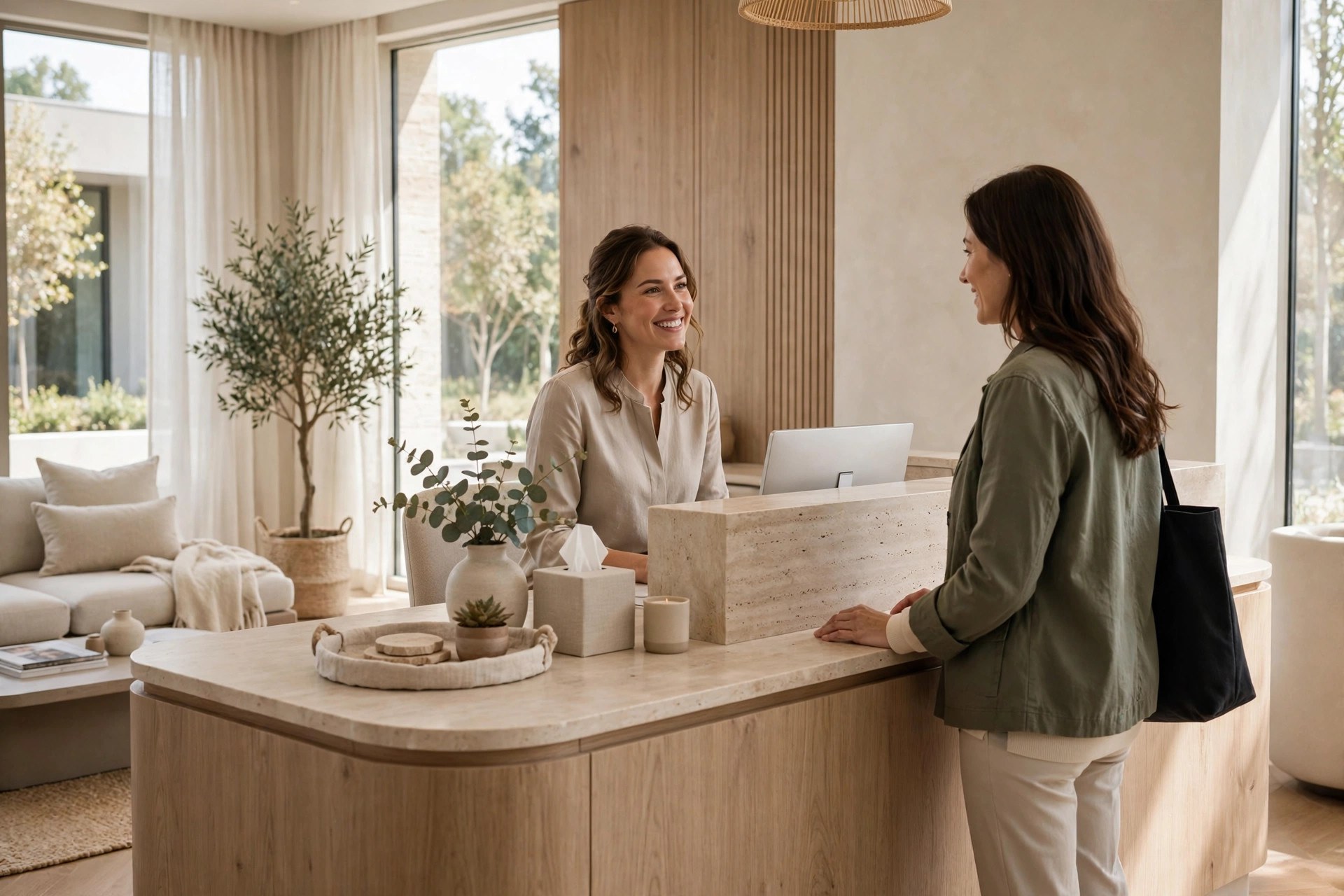
Chat booking meets clients in the app they already open daily, so evening questions turn into booked appointments instead of lost inquiries.
Booking treatments in chat: the flow clients finish
The difference between a chatbot that books clients and one that annoys them is the flow. Keep it short, give clear choices, and never ask for information you already have. Below is a proven booking flow for a med spa. Adapt the wording to your spa name and treatment menu.
Step 1, the greeting. “Hi, this is Glow Studio. Are you looking to book a treatment, ask about a treatment, or reschedule? Reply 1, 2, or 3.” Three options, no open ended essay prompt.
Step 2, the treatment. If they pick booking: “Which treatment? 1) Injectables 2) Laser hair removal 3) Facials and peels 4) Body treatments 5) Not sure, I need advice.” The last option routes to a consult booking, which is where high value clients convert.
Step 3, new or returning. “Have you visited us before? Reply YES or NO.” Returning clients get matched by name and phone number; new clients get the short intake.
Step 4, the time pick. “We have these openings this week: Wednesday 11:00 AM, Thursday 3:30 PM, Saturday 10:15 AM. Reply with the number, or say MORE for next week.” Never show more than three or four slots at once; a wall of times causes people to stall.
Step 5, the confirmation. “You are booked for a hydrafacial on Thursday at 3:30 PM with Maria. Please arrive 15 minutes early and come without makeup. We will send a reminder the day before. Anything else I can help with?” Short, warm, done.
The upsell moment comes right after confirmation, and it should be one line, not a sales pitch: “Many clients add a dermaplane to their hydrafacial for an extra glow. Want me to add 15 minutes for $45?” One line, easy yes or no. Med spas running this single line report a steady lift in average ticket with no complaints, because the suggestion is relevant and the client can decline in one word.
Reply to confirm reminders that cut no shows
A missed appointment in a med spa is expensive: an empty treatment room for an hour can mean $150 to $400 in lost revenue, and a missed injectable appointment can cost far more. Most no shows are not deliberate. Clients forget, their day shifts, or they meant to cancel but never got around to calling. Interactive WhatsApp reminders fix all three by making confirmation and rescheduling effortless.
The 48-24-2 reminder sequence
Send the first reminder 48 hours before the visit. This is the planning reminder: it gives the client time to rearrange their day and gives your spa time to fill the slot if they cancel. Send the second 24 hours before, with the confirm or reschedule prompt. Send a short final nudge 2 hours before: “See you at 2 today. We are at 450 Main Street, free parking behind the building.” Spas running this three touch sequence commonly report no show rates dropping from the 10 to 15 percent range down to 5 to 8 percent. On a schedule of 300 appointments a month, that is 15 to 21 saved visits.
Make every reminder replyable
The magic is the reply. A one way reminder informs; a two way reminder converts. Let clients confirm with a single word, reschedule with a tap, and ask questions in the same thread: “Can I wear sunscreen before my laser appointment?” or “Should I avoid coffee before fillers?” The bot handles the routine ones and flags the rest for the team. Track confirmations in your booking software so the front desk sees at a glance who still needs a personal call the afternoon before. The goal is simple: nobody should arrive surprised, and nobody should no show because canceling felt harder than just not coming.
Treatment FAQs the bot answers on its own
Write these answers once, in your own voice, and the bot handles them forever. Cover the questions your team answers ten times a day. Below are the topics every med spa chatbot needs, with the shape of a good answer for each.
Injectables: Botox and fillers
Clients ask about price per unit, how many units they need, how long results last, bruising and swelling, and whether they can work out or drink alcohol after. The bot gives your per unit pricing, typical unit ranges for common areas, and standard aftercare: no lying flat for four hours, no strenuous exercise for 24 hours, bruising is possible and fades in a few days. Medical suitability questions go to a human: the bot books a consult instead of advising.
Laser hair removal
Clients ask if it hurts, how many sessions they need, the price per area, whether it works on their skin tone, and what to do before and after. The bot answers with your pain management approach, the standard 6 to 8 session course, per area pricing, and prep rules: shave before, no waxing for four weeks, no sun exposure before and after. Skin tone questions get a careful answer plus a consult offer, since device suitability varies.
Facials, peels, and microneedling
Clients ask about downtime, redness, when they can wear makeup, and how often to repeat. The bot gives your downtime expectations per treatment, the makeup waiting period, and the recommended series: for example monthly facials, or three microneedling sessions spaced four to six weeks apart. It also states clearly which treatments need a consult first.
Aftercare and prep
The bot sends the right instructions automatically: pre visit prep the day before, aftercare the evening after the appointment. Clients follow written instructions they can re read far better than verbal ones at checkout, which means better results and fewer worried messages.
Bringing back clients who stopped coming
Client reactivation is the highest return campaign a med spa can run, and WhatsApp is the best channel for it. Start by pulling three lists from your booking software: clients with no visit in 3 to 6 months, 6 to 12 months, and over 12 months. Exclude anyone with an unresolved complaint; reactivation is for drifters, not detractors. Then send a short, personal feeling message to each group, spaced a quarter apart.
The message should sound like it came from the spa, not a marketing department: “Hi Emma, this is Maria from Glow Studio. It has been a while since your last hydrafacial, and we have some new openings next week if you would like to get your glow back. Tap here to pick a time.” No discount needed for most clients; the reminder itself does the work. For the 6 to 12 month group, add a gentle nudge about what they might be due for: “Most of our facial clients come every 4 to 6 weeks to keep results.” For the oldest group, a modest incentive can help: $25 off a treatment, or a complimentary skin analysis with any booking.
Send each campaign once per group per quarter, not weekly. Watch the replies: people will book, ask questions, or tell you they moved, and each answer updates the record. A typical med spa with 800 lapsed clients can expect 4 to 8 percent to book from a well run WhatsApp reactivation series. At $200 to $350 average revenue per returning visit, that is $6,400 to $22,400 in recovered revenue from a campaign that costs a few dozen dollars to send. The exact scripts for each message are in the setup section below.
When the chatbot handles booking and reminders, your providers spend their day on treatments instead of phone tag.
WhatsApp vs SMS vs phone vs booking apps
Most med spas already use some mix of phone calls, SMS, and an online booking app. WhatsApp does not replace them; it takes the jobs it does best and leaves the rest. The comparison below shows where each channel wins.
| Task | WhatsApp chatbot | SMS | Phone or booking app |
|---|---|---|---|
| After hours inquiries | Answered instantly, books directly | Auto reply only, no conversation | Voicemail, or a form nobody reads |
| Appointment reminders | Interactive: confirm or reschedule in chat | One way or basic reply | App push, often ignored |
| Rich content | Photos, videos, price lists, location pins, before and after galleries | Plain text, links only | Verbal, or buried in an app menu |
| Cost per message | A few cents per automated conversation | 1 to 3 cents per segment | Staff time per call |
| Client preference under 45 | Highest: the app they already use daily | High but impersonal | Lowest: most avoid calling |
| Medical or sensitive questions | Hands off to a human with full history | Poor fit | Best: tone and privacy |
The practical setup for most spas is all of them working together: WhatsApp for booking, questions, and reminders; SMS as a backup for clients who do not use WhatsApp; the phone for consults, sensitive questions, and anyone who prefers to talk. For the email side of retention, pair chat with email marketing for med spas, which covers newsletters and longer campaigns that chat is not suited for. The chatbot’s handoff feature is what makes the mix work, because a conversation that starts in WhatsApp can move to a call with zero repeated questions.
What a med spa WhatsApp chatbot costs
Pricing has three layers: WhatsApp’s own conversation charges, the chatbot software, and setup. None of them are large compared with one returning client.
| Cost layer | Typical US price band | What it covers |
|---|---|---|
| WhatsApp Business app | Free | Basic messaging from one phone; fine for very small spas, no automation |
| WhatsApp Business Platform conversations | Roughly 1 to 3 cents per marketing conversation; replies inside the 24 hour window are free | Meta’s per conversation charge for automated outbound messages like reminders and campaigns |
| Chatbot software (DIY) | $50 to $200 per month | Flow builder, calendar integration, reminder automation; you build and maintain it |
| Chatbot software (managed platform) | $200 to $400 per month | Done for you flows, analytics, human handoff, ongoing tuning |
| Agency setup | $800 to $3,000 one time | Number setup, treatment flow design, booking integration, team training |
| Agency management | $200 to $600 per month | Monitoring, monthly optimization, campaign management, reporting |
A realistic mid size spa budget looks like this: $1,500 one time setup plus $300 a month for software and management, plus perhaps $40 to $80 a month in Meta conversation charges. That is roughly $350 a month all in after setup. One returning injectable client or two returning facial clients cover it. The expensive option is not the chatbot; it is the status quo of missed messages and empty treatment rooms.
Every returning client is worth hundreds in revenue with zero ad spend, which is why reactivation pays for the whole system.
From zero to live: setup steps and message scripts
A med spa WhatsApp chatbot is a two week project, not a two month one. The spas that stall are the ones that try to automate everything on day one. Start with booking, reminders, and FAQs, add reactivation later. Below are the steps plus the exact scripts to use.
Week 1, days 1 to 2: the number and the account. Decide whether the bot runs on your main spa number or a dedicated line. The main number is better for clients because it is the number they already know. Set up the WhatsApp Business profile with your spa name, address, hours, treatment list, and website.
Week 1, days 3 to 5: the flows. Build the booking flow, the reschedule flow, and the treatment FAQ answers. Connect the booking calendar so the bot sees real availability; a bot that offers slots you do not have is worse than no bot. Write the reminder templates and submit them for WhatsApp approval, which usually takes a day or two. Dental practices run a very similar playbook, and our guide to WhatsApp chatbots for dentists covers reminder wording you can adapt.
Script 1: the booking greeting
“Hi, this is Glow Studio. Are you looking to book a treatment, ask about a treatment, or reschedule? Reply 1, 2, or 3.”
Script 2: the 24 hour reminder
“Hi Emma, this is Glow Studio confirming your hydrafacial tomorrow at 2 PM with Maria. Reply YES to confirm, or tap here to reschedule. Please arrive 15 minutes early and come without makeup.”
Script 3: the reactivation message (3 to 6 month list)
“Hi Emma, this is Maria from Glow Studio. It has been a while since your last hydrafacial, and we have some new openings next week if you would like to get your glow back. Tap here to pick a time.”
Script 4: the reactivation message (6 to 12 month list)
“Hi James, this is Glow Studio. We noticed it has been about 8 months since your last visit. Most of our clients come every 4 to 6 weeks to keep their results. We saved a few spots next week if you want back on track. Tap here to book.”
Script 5: the review request
“Hi Emma, thanks for visiting Glow Studio today. If you loved your treatment, a quick Google review would mean the world to us. Tap here to leave one. It takes 30 seconds.”
Week 2, days 6 to 8: testing. Run every flow with real staff phones. Book, reschedule, cancel, ask about prices, ask a medical question the bot should not answer. Fix the dead ends. Test the human handoff: when the bot gives up, does the right person get notified, and do they see the chat history?
Week 2, days 9 to 10: team training. Show the front desk the handoff inbox, the confirmation dashboard, and the escalation rules. Agree on response time targets: handoffs answered within 15 minutes during business hours, medical questions flagged for the provider the same day.
Week 2, days 11 to 14: soft launch. Turn the bot on for new inquiries first, then add reminders for next week’s appointments, then launch the first reactivation campaign to the 3 to 6 month list. Watch the first 100 conversations closely and tune the wording where clients get confused.
Mistakes that hurt bookings
Letting the bot give medical advice. The bot answers pricing, scheduling, and general treatment information. It never advises whether a treatment is right for a specific person, never discusses medications or conditions, and every medical question routes to a consult booking with a human. Put that boundary in writing before launch.
Sending from an unknown number. Clients ignore messages from numbers they do not recognize. Use the spa’s main number or announce the new chat line clearly on the website, in the spa, and on the aftercare card.
Blasting promotions. WhatsApp is a conversation channel, not a coupon list. Spas that send weekly discount blasts get blocked and reported, which can restrict the number. Keep campaigns to reactivation and genuinely useful updates: a few times a year, not a few times a week.
Flows that trap people. Every automated conversation needs an escape hatch: “Reply 0 to talk to our team” at every step. A client with a reaction or a concern who cannot reach a human will leave a one star review, not a booking.
No calendar integration. A bot that takes booking requests and promises a callback is just a fancy contact form. Real availability, real confirmation, or do not launch.
Forgetting the team. The bot changes the front desk’s job; it does not remove it. If the team is not trained on handoffs and does not trust the system, they will quietly route around it and the investment dies.
Setting it and forgetting it. Review the conversation logs monthly. You will find questions the bot fumbled, wording that confused people, and new FAQs to add. Fifteen minutes a month keeps the bot sharp.
Your rollout checklist
Work through these in order. Each one builds on the last.
- 1Pick the number. Main spa line or a dedicated chat line, announced everywhere clients see your contact details.
- 2Set up the WhatsApp Business profile. Spa name, address, hours, treatment list, website, and a profile photo clients will recognize.
- 3Connect the booking calendar. Real time availability per treatment and provider, with buffer rules your schedulers trust.
- 4Build the booking and reschedule flows. Five steps or fewer, three to four slot options at a time, instant confirmation with prep instructions.
- 5Write the treatment FAQ answers. Pricing, pain, sessions needed, downtime, and aftercare for each treatment category.
- 6Write the no medical advice boundary. Exact handoff wording for medical questions, and a consult booking path the bot offers instead.
- 7Build the reminder sequence. 48 hour, 24 hour, and 2 hour reminders, every one of them replyable.
- 8Write the five scripts. Booking greeting, 24 hour reminder, two reactivation messages, and the review request, all approved before launch.
- 9Set handoff rules and train the team. Who answers handoffs, response time targets, and where the chat history lives.
- 10Soft launch, then reactivate. New inquiries first, then reminders, then the first reactivation campaign to the 3 to 6 month list.
Frequently asked questions
Will clients actually book treatments over WhatsApp?
Yes. Med spa clients already research and ask questions on their phones in the evening, and chat booking removes the friction of calling during business hours. Keep the flow short, five steps or fewer, and always offer a human handoff for anyone who prefers to talk.
Is WhatsApp allowed for med spa client communication?
Yes, with the right setup. Use the WhatsApp Business Platform, collect clear consent for reminders and campaigns, and keep clinical details minimal in chat. Discuss your specific compliance obligations with your own advisor, since rules vary by state and message type, and never let the bot give medical advice.
How much does a med spa WhatsApp chatbot cost per month?
Most spas pay $50 to $400 a month for the chatbot software, plus a few cents per automated conversation to Meta, which usually adds $40 to $80 a month. Agency managed setups add $200 to $600 a month. All in, a typical mid size spa spends about $350 a month after a one time setup of $800 to $3,000.
Can the chatbot connect to my booking software?
Yes, if your software has an open calendar or API. The common med spa booking systems integrate with the major chatbot platforms, either directly or through a connector. The integration is what makes real time booking work, so confirm it before you sign anything.
What happens when the chatbot cannot answer a question?
It hands the conversation to your team with the full chat history attached, so nobody repeats themselves. Set a response time target, 15 minutes during business hours is a good standard, and make sure handoffs go to a person or inbox that is actually monitored.
Can the bot answer questions about Botox and fillers?
It can answer pricing, typical unit ranges, how long results last, and standard aftercare. It must not advise whether treatment is right for a specific person or discuss medical conditions. Those questions route to a consult booking with your provider, which is also where high value clients convert.
Will clients get annoyed by automated messages?
Not if you respect the channel. Reminders and confirmations are welcome because they are useful. Reactivation messages a few times a year are welcome because they are personal. Weekly promotional blasts are what get numbers blocked and reported. Keep campaigns rare and useful.
How long does setup take?
One to two weeks for booking, reminders, and treatment FAQs. The calendar integration and the reminder template approvals are the longest steps. Reactivation campaigns can be added in week three. Spas that try to automate everything on day one take far longer; start with the core flows.
Do I still need my front desk team?
Yes. The chatbot removes the repetitive work, pricing questions, booking, reminders, so your team can focus on check ins, consults, retail conversations, and the clients standing in front of them. Spas usually redeploy the saved hours rather than cutting staff.
How do I measure whether it is working?
Track five numbers monthly: after hours inquiries captured, bookings completed in chat, no show rate, reactivation bookings, and handoff response time. Compare against the two months before launch. Most spas see the no show and reactivation numbers move first, usually within 60 days.
Fill empty treatment rooms without adding front desk hours
Digital Hayder builds WhatsApp chatbots and AI booking systems for med spas: after hours treatment booking, reply to confirm reminders, treatment FAQs, and reactivation campaigns that run on your real schedule. Tell us about your spa and we will design the chat system around it.
Contact Us