
A family calls three moving companies on a Saturday morning. The first two go to voicemail because the owners are out on jobs. The third picks up, books the estimate, and gets the move. That is the entire game in moving: the company that answers first usually wins the job, and the call you miss is the call your competitor takes. Moving companies miss calls constantly, not from carelessness but from the nature of the work. The owner is driving a truck, the dispatcher is on another line, the crew is mid-move and the office is empty. Every one of those missed calls is a quote request that will either wait for you or move on. Missed call text back is the safety net: the moment a call goes unanswered, the caller gets an automatic text that keeps the conversation alive and routes the quote request back to you. This guide covers how it works for moving companies, what the texts should say, what it costs, and the mistakes that make it fail.
The quick answer
- Why movers lose calls: owners and dispatchers are on jobs, on other calls, or out of the office. Peak season and weekends make it worse.
- What missed call text back does: an automatic text goes out seconds after a missed call, asking how you can help and keeping the lead warm.
- The money math: one recovered local move a month typically pays for the system many times over, given average job values.
- Speed matters most: the first text should land within 60 seconds. Callers who hear back fast stop shopping around.
- Typical cost: $29 to $99 a month as a CRM add-on, or $97 to $297 a month as a standalone lead recovery tool.
- Biggest mistake: a generic “sorry we missed you” text with no question and no path to a quote. The text has to start a conversation.
Why moving companies miss the calls that matter most
Walk through a normal week at a mid-size moving company and the missed calls are easy to explain. Monday morning the dispatcher is booking two estimates while three more calls stack up. Tuesday the owner is on a full-day move with no one in the office. Wednesday evening a couple calls after dinner to compare quotes, and nobody is answering at 8 pm. Saturday, the busiest calling day of the week, the whole team is on jobs. None of this is a staffing failure. It is the shape of the business: the work happens away from the phone, and the phone rings hardest exactly when the team is busiest.
The cost of a missed call in moving is unusually high because of how customers shop. A family planning a move calls two to four companies, and they do it in a short burst, often within an hour. They are not patiently waiting through business hours. Industry data on lead response has consistently shown that the business that responds first wins the majority of competitive quotes, and moving is one of the most time-sensitive examples. If your competitor texts back in two minutes and you call back four hours later, you are not the second choice. You are forgotten. A local move averages $1,200 to $2,500 in revenue depending on market and crew size, and a long-distance move runs several thousand. Losing even a few of these a month to slow response is a five-figure annual problem hiding in your call log.
There is also a seasonal pattern. Late spring through early fall is peak moving season, and call volume can double while staffing stays flat. Overflow is where the worst losses happen: the calls you miss during your busiest month are the most valuable calls of the year, and they go to whoever picks up. Missed call text back does not replace answering the phone. It catches what falls through when answering is impossible, and in moving, something always falls through.
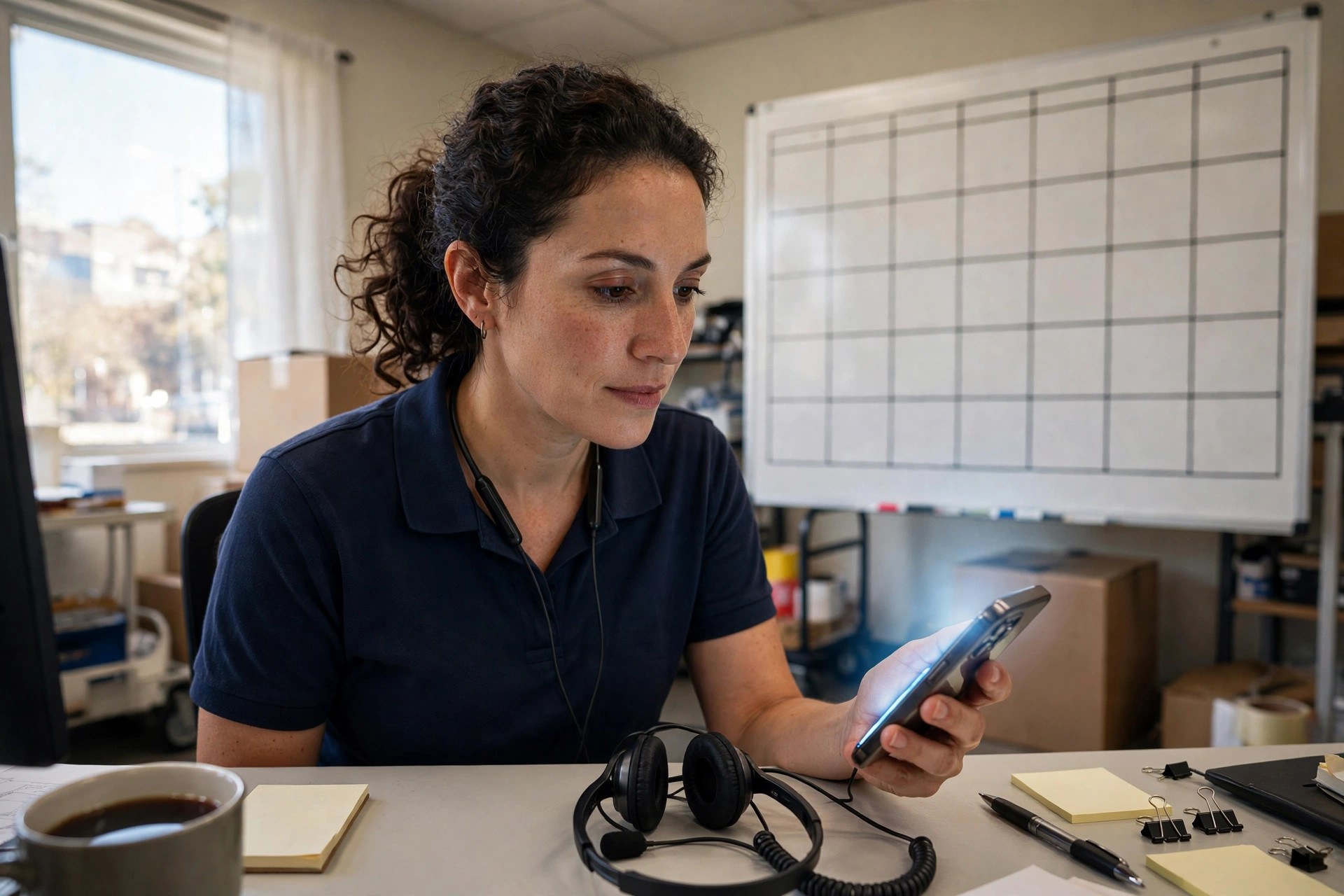
The busiest calling hours are usually the hours the team is out on jobs. An automatic text bridges that gap.
How missed call text back works
The mechanism is simple, which is why it works. Your business phone number connects to a system that watches for missed calls. When a call goes unanswered, voicemail or no voicemail, the system sends a text to the caller’s number within seconds. The text is conversational, not robotic: it apologizes for missing the call, identifies your company, and asks what the caller needs. From there, the exchange can go two directions. Some systems let a team member take over the conversation manually from a shared inbox. Others run a short automated back-and-forth that collects the key details and books the estimate or the call-back.
For a moving company, the phone number question matters. Customers should text the same number they called, so use a system that texts from your main business line rather than a random short code. People trust a text from the number they just dialed. They ignore texts from unknown five-digit codes. Most modern CRM and phone systems support this, and it is worth confirming before you buy.
The other technical piece is the after-hours question. Missed call text back runs around the clock, so a caller at 10 pm gets the same fast text as a caller at 10 am. The message should be honest about the hour: “Thanks for calling. We are out for the night but I will make sure someone reaches out first thing in the morning. Are you looking for a quote on a local move?” That honesty beats pretending someone is awake. Morning follow-up then has to actually happen, which is where the sequence matters. The pattern is the same across home services: our guide to missed call text back for HVAC companies shows how emergency-driven trades handle the same after-hours problem.
What a good text-back sequence looks like
One text is not a sequence. The first message catches the lead, and the follow-ups convert the ones who were busy, driving, or still comparing when the first text arrived. A complete missed call text back system for a moving company has three layers: the instant response, the short-term follow-up, and the quote-specific conversation.
The first text, inside 60 seconds
Speed is the whole point, so the first text has to fire automatically, not when someone gets around to it. The message needs three elements: your company name, a human tone, and a question that is easy to answer. A strong version: “Hi, this is Mike with Apex Moving. Sorry we missed your call. Are you looking for a moving quote? If so, what date are you thinking?” The question does the heavy lifting. “How can I help” is too open and gets ignored. A specific question about their move date gets answered because the caller already has the answer in their head.
Avoid the two common failures. The first is the dead-end text: “Sorry we missed your call. Call us back at your convenience.” That asks the customer to do the work you failed to do. The second is the wall of text with your hours, your service list, and three links. Keep it to two or three short sentences. One question. That is it.
The follow-up cadence
Most callers do not reply to the first text. They are at work, they are mid-errand, or they are waiting to hear from the other companies they called. The follow-ups are where the recovered revenue lives. A practical cadence for moving companies:
- 2 hours later: a short nudge. “Just checking back in. Happy to get you a quick quote whenever you have a minute. What are you moving and when?”
- Next morning: a value line. “Morning. We still have openings the week of the 12th. Want me to hold a slot while you decide?” Specific dates beat vague availability.
- Day 3: a different angle. “Most of our moves this month are booking 2 to 3 weeks out. If your date is flexible, I can usually find a better rate mid-week.”
- Day 7: the honest close. “I do not want to keep bugging you. If you already booked with someone else, no worries at all. If you are still looking, I am here.”
Stop after day 7 for a single missed call. Persistence converts, but pestering burns the brand, and a moving company lives on its reputation. Anyone who replies at any point drops out of the automated sequence and into a real conversation. For a deeper look at quote follow-up persistence in another trade, see our lead follow-up automation for plumbers guide.
Copy-ready templates for the three caller types
Moving callers fall into three buckets, and the text should match the bucket. The quote shopper wants a number fast. The planner wants details and reassurance. The urgent mover, lease ending Friday, needs to know you can handle it now.
For the quote shopper: “Hi, this is [Name] with [Company]. Sorry we missed you. To get you a fast quote: where are you moving from and to, and what date? Even a rough idea works.” For the planner: “Hi, this is [Name] with [Company]. Sorry we missed your call. Happy to walk through the whole process, pricing, and timing whenever works for you. What questions can I answer first?” For the urgent mover: “Hi, this is [Name] with [Company]. Sorry we missed you. If this is time-sensitive, reply with your move date and I will check our trucks right now.” Each one ends with a question the caller can answer in ten seconds.
| Step | Timing | Message goal | What to include |
|---|---|---|---|
| Instant text | Within 60 seconds of the missed call | Catch the lead before they call a competitor | Company name, apology, one specific question |
| Nudge | 2 hours later | Re-engage callers who were busy | Short check-in, easy reply question |
| Morning follow-up | Next morning | Create urgency with real availability | Specific open dates, offer to hold a slot |
| Value angle | Day 3 | Give price shoppers a reason to talk | Mid-week rate tip, booking window guidance |
| Honest close | Day 7 | End cleanly, leave the door open | Permission to stop, open invitation back |
The moving-specific details your texts should handle
Generic text-back systems fail moving companies in one specific way: they treat every missed call like a generic inquiry. A moving quote needs particular facts, and the text conversation should start collecting them from the first exchange. The five facts that shape every quote are the move date, the origin and destination, the size of the home, any specialty items, and access details like stairs or lift.
Move date and inventory
The move date drives everything: price, availability, and urgency. Your texts should ask for it early, even roughly. “Are you thinking this month or next?” is enough to start. Inventory comes next, but keep it light in text. Nobody wants to type a room-by-room list into SMS. Ask for the home size and the big items: “How many bedrooms, and anything heavy like a piano or a safe?” That is enough for a ballpark. The full inventory happens on the estimate call or the virtual survey. The text conversation exists to get the caller to that estimate, not to replace it.
Service area and access
Two fast disqualifiers save everyone time: moves outside your service area, and buildings your trucks cannot serve. A quick area check in the second or third text avoids a wasted estimate: “Just to confirm, is the move within the metro area?” Access details matter for pricing and crew planning: stairs, lift, long carries, and parking. Ask one access question before the estimate call: “Any stairs or lift at either place? It helps us send the right crew size.” Callers appreciate this because it signals competence. A company asking about stairs sounds like a company that has done this before.

Every missed call during a job like this one is a quote request. The text-back keeps it from going to a competitor.
What it costs and what it pays back
Missed call text back usually comes in two forms. The first is an add-on inside a CRM or phone system you already use, typically $29 to $99 a month, sometimes bundled with review requests and other automations. The second is a standalone lead recovery tool at $97 to $297 a month, which usually includes the shared inbox, the sequences, and some reporting. Setup is generally light: connect the phone number, write the messages, set the timing, and test it with your own phone before it goes live.
The payback math is friendly because moving jobs are large. Take a company doing 40 moves a month that misses 30 calls a month. If the text-back gets a reply from a third of those callers, that is 10 conversations. If a third of those conversations turn into quotes, that is 3 extra quotes. If one of those quotes books at an average job value of $1,800, the system just produced $1,800 in revenue against a cost of under $100 a month. Even at a modest close rate, the first recovered job of the month pays for the entire year of the tool.
| Option | Typical monthly cost | What you get | Best for |
|---|---|---|---|
| CRM add-on | $29 to $99 | Text-back plus review and follow-up automations in one system | Companies already running a CRM for estimates and scheduling |
| Standalone text-back tool | $97 to $297 | Missed call texting, shared inbox, sequences, basic reporting | Companies that want lead recovery without changing systems |
| Full answering plus text-back | $300 to $800 | Live agents answer, then text-back catches anything they miss | High-volume companies in peak season overflow |
| Manual callback discipline | $0 | Staff calls back every missed call within minutes | Almost nobody, because it breaks the first busy week |
Mistakes that kill response rates
The technology is simple, so failures are almost always message or process failures. The most common is the generic dead-end text described earlier: an apology with no question and no path forward. The second is slowness. A text-back that fires 20 minutes later because the system batches messages is barely better than a voicemail. Test the timing with your own phone and demand seconds, not minutes.
The third mistake is no human handoff. Automation should start the conversation, not carry it forever. When a caller replies with real details, a person should take over quickly. Companies that let a bot argue about pricing for six exchanges lose the lead to a human at the next company. Set a rule: any reply with a move date or an address goes to a person within minutes during business hours.
The fourth is ignoring after-hours honesty. Texting “we will call you right back” at 11 pm and then calling at 9 am teaches customers that your texts lie. Say what will actually happen: someone reaches out first thing in the morning. Then do it. The fifth is no tracking. If you do not tag text-back leads in your system, you cannot tell which quotes and jobs came from recovered calls, and the tool looks like a cost instead of the revenue source it is.

When the phones stack up, the automatic text makes sure no caller waits in silence.
Measuring what the texts earn you
Four numbers tell you whether the system is working. Response rate: what share of missed-call texts get any reply. A healthy rate is 25 to 40 percent. Quote rate: what share of those conversations turn into estimate requests. Expect 30 to 50 percent of engaged conversations to reach the quote stage. Booking rate: what share of text-back quotes become moves. This should track close to your normal quote close rate; if it lags far behind, the handoff from text to estimator needs work. Recovered revenue: the booked job value from leads tagged as text-back recoveries, which is the number that justifies the cost.
Review these monthly, not daily. Text-back performance moves with the season: response rates climb in peak months when callers are urgent, and dip in slow months when shoppers are browsing. Compare against your own baseline, not someone else’s benchmark. The question that matters is simple: did recovered jobs this month exceed the cost of the tool? In moving, the answer is almost always yes by a wide margin.
One more metric worth watching: speed to first human contact. Track how long it takes from the missed call to a real person engaging, not just the automated text. If the bot chats for an hour before a person appears, tighten the handoff rules. The text buys you time. It does not buy you forever. Route-based businesses face the same measurement question; our missed call text back for pool companies guide covers recovery tracking for service routes.
Your rollout checklist
Get the foundation right in week one, then tune the messages from real conversations.
- 1Text-enable your main business number. Callers must get texts from the number they dialed, not a random code. Confirm this with your provider before anything else.
- 2Write the instant text. Company name, short apology, one specific question about their move. Keep it to two or three sentences.
- 3Build the 2-hour, next-morning, day-3, and day-7 follow-ups. Each with a different angle: nudge, real availability, value tip, honest close.
- 4Write the three caller templates. Quote shopper, planner, and urgent mover versions so replies get a matched response.
- 5Set the human handoff rule. Any reply with a move date or address routes to a person within minutes during business hours.
- 6Write the after-hours version. Honest about the hour, promises morning contact, asks one easy question tonight.
- 7Test with your own phone. Call from a personal number, time the text, and read every follow-up as a customer would.
- 8Tag text-back leads in your system. Every recovered quote and job gets a tag so you can measure recovered revenue.
- 9Train the team on the shared inbox. Whoever watches it knows the handoff rule and the quote-qualifying questions.
- 10Review monthly and tune. Response rate, quote rate, booking rate, recovered revenue. Rewrite the weakest message each month.
Frequently asked questions
What is missed call text back for a moving company?
It is an automatic text message sent to anyone whose call your company misses. The text apologizes, names your company, and asks a question about their move, which starts a conversation that can lead to a quote instead of a lost lead.
How fast should the first text go out?
Within 60 seconds. The entire value of the system is speed: a caller deciding between three moving companies will engage with whoever responds first. Test the timing with your own phone and do not accept delays of several minutes.
Does missed call text back work after hours?
Yes, and after-hours is one of its best uses. Evening and weekend callers get an honest text saying the office is closed and someone will reach out in the morning, plus one easy question to answer tonight. Morning follow-up has to actually happen.
How much does missed call text back cost?
As a CRM add-on, typically $29 to $99 a month. As a standalone tool, $97 to $297 a month. Given average moving job values of $1,200 to $2,500 locally, a single recovered job per month pays for the system many times over.
Will customers find the automatic text annoying?
Almost never, because they called you first. An instant, helpful text after their call went unanswered reads as good service, not spam. Keep messages short, stop after day 7 for non-responders, and always honor an opt-out immediately.
Should the texts come from my main business number?
Yes. Customers trust a text from the number they just dialed and ignore texts from unknown short codes. Confirm with your provider that your main line can send and receive texts before you launch.
What should the first text say?
Your company name, a short apology, and one specific question. Example: “Hi, this is Mike with Apex Moving. Sorry we missed your call. Are you looking for a moving quote? What date are you thinking?” Avoid generic dead ends like “call us back at your convenience.”
How do I handle callers who reply with detailed questions?
Hand them to a person fast. Set a rule that any reply containing a move date or an address routes to a team member within minutes during business hours. Automation starts the conversation; people close the quote.
Can missed call text back help during peak moving season?
That is when it helps most. Call volume can double in summer while staffing stays flat, so overflow losses peak exactly when each job is most valuable. The text-back catches the calls your team cannot physically answer.
How do I measure whether it is working?
Track response rate, quote rate, booking rate, and recovered revenue from leads tagged as text-back recoveries. Review monthly. The deciding question is simple: did recovered jobs this month exceed the cost of the tool?
Stop losing quote requests to voicemail
Digital Hayder builds missed call text back systems for moving companies: instant texts from your business number, follow-up sequences tuned for quote shoppers and planners, and CRM tagging so you can see every recovered job. Tell us about your call volume and we will design the recovery system around it.
Contact Us