Cleaning companies face a strange paradox on Google Ads. The clicks are not cheap: “house cleaning near me” runs $8 to $20 a click, and commercial cleaning keywords push $15 to $35. A $120 cost per lead makes a lot of owners wince. But here is the twist most guides miss: a recurring cleaning client is worth $3,000 to $6,000 a year, and the average one stays for years. Spend $120 to win a client who pays $400 a month for three years, and that is $14,400 in revenue for one lead. The math works, as long as you judge it by lifetime value instead of first-job value. This guide covers the real costs for cleaning companies on Google Ads: cost-per-click bands by service, the honest economics of Search versus Local Services Ads, cost-per-lead benchmarks for residential and commercial, monthly budget sizing, campaign structure, landing pages, the mistakes that burn money, and how ads compare to every other way of winning cleaning clients.
The quick answer
- Typical CPC: $8 to $20 for residential cleaning, $10 to $25 for deep and move-out cleans, $15 to $35 for commercial cleaning keywords.
- Typical CPL: $60 to $180 for residential leads on Search, $150 to $400 for commercial leads; Local Services Ads often run $25 to $75 per lead.
- Starter budget: $2,000 to $4,000 a month for residential in one market, $4,000 to $10,000 for mixed residential and commercial.
- Search vs LSA: LSA usually wins on cost per lead for residential; Search wins on control, volume, and commercial contracts.
- The LTV twist: a recurring client worth $3,000 to $6,000 a year makes even a $150 lead cheap. Judge by lifetime value, not first clean.
- Biggest lever: landing page conversion rate and same-day quote speed decide profitability far more than bids do.
What Google Ads costs for cleaning companies
Cleaning sits in the middle of the home-services cost range: cheaper clicks than solar or roofing, pricier than lawn mowing. Residential keywords like “house cleaning near me” and “maid service” run $8 to $20 a click in most markets, rising in large metros. Deep cleaning, move-in/move-out, and post-construction keywords run $10 to $25, because the jobs are bigger and the searchers are more urgent. Commercial and office cleaning keywords are the priciest at $15 to $35, driven by contract values that run into the thousands per month. The spread matters less than what happens after the click. Cleaning has one of the best lead-to-customer economics in home services, because the product is recurring, the sale is simple, and the decision is fast. A homeowner who clicks at 10 AM can be a paying recurring client by Friday.
The LTV twist: why cleaning ads can afford to be expensive
Do the lifetime math before you judge any CPL. A biweekly residential client at $180 a visit pays about $4,300 a year. Industry retention for good operators runs two to four years, so that client is worth $8,000 to $17,000 over their life with you. Even at a painful $150 cost per lead, with half of leads becoming clients, you pay $300 per customer to win $10,000 in lifetime revenue. That is a 33-to-1 return. Commercial is even better: a $1,500-a-month office contract is $18,000 a year, and a $400 commercial lead that closes at one in four costs $1,600 per customer against $54,000 in three-year revenue. The companies that lose money on cleaning ads are not the ones paying $120 a lead. They are the ones who cannot retain the client past month three, because then the LTV never materializes. Fix retention first, then the ad math takes care of itself. For ideas on keeping the schedule full between paid campaigns, see our cleaning business marketing ideas guide.
Cleaning keyword cost benchmarks
Typical US cost-per-click ranges. Expect the high end in large metros and the low end in smaller markets, and note how the commercial terms jump.
| Service type | Example keywords | Typical CPC range | Why it costs that |
|---|---|---|---|
| House cleaning | “house cleaning near me”, “maid service” | $8 to $20 | High volume, strong competition |
| Deep cleaning | “deep house cleaning service” | $10 to $25 | Bigger one-time jobs, urgent intent |
| Move-in/move-out | “move out cleaning service” | $12 to $25 | Time-pressured, books fast |
| Airbnb and rental | “airbnb cleaning service” | $8 to $18 | Recurring turnover work |
| Post-construction | “post construction cleaning” | $12 to $28 | Specialized, fewer bidders |
| Commercial and office | “office cleaning services”, “commercial cleaning company” | $15 to $35 | Contract values justify the bids |

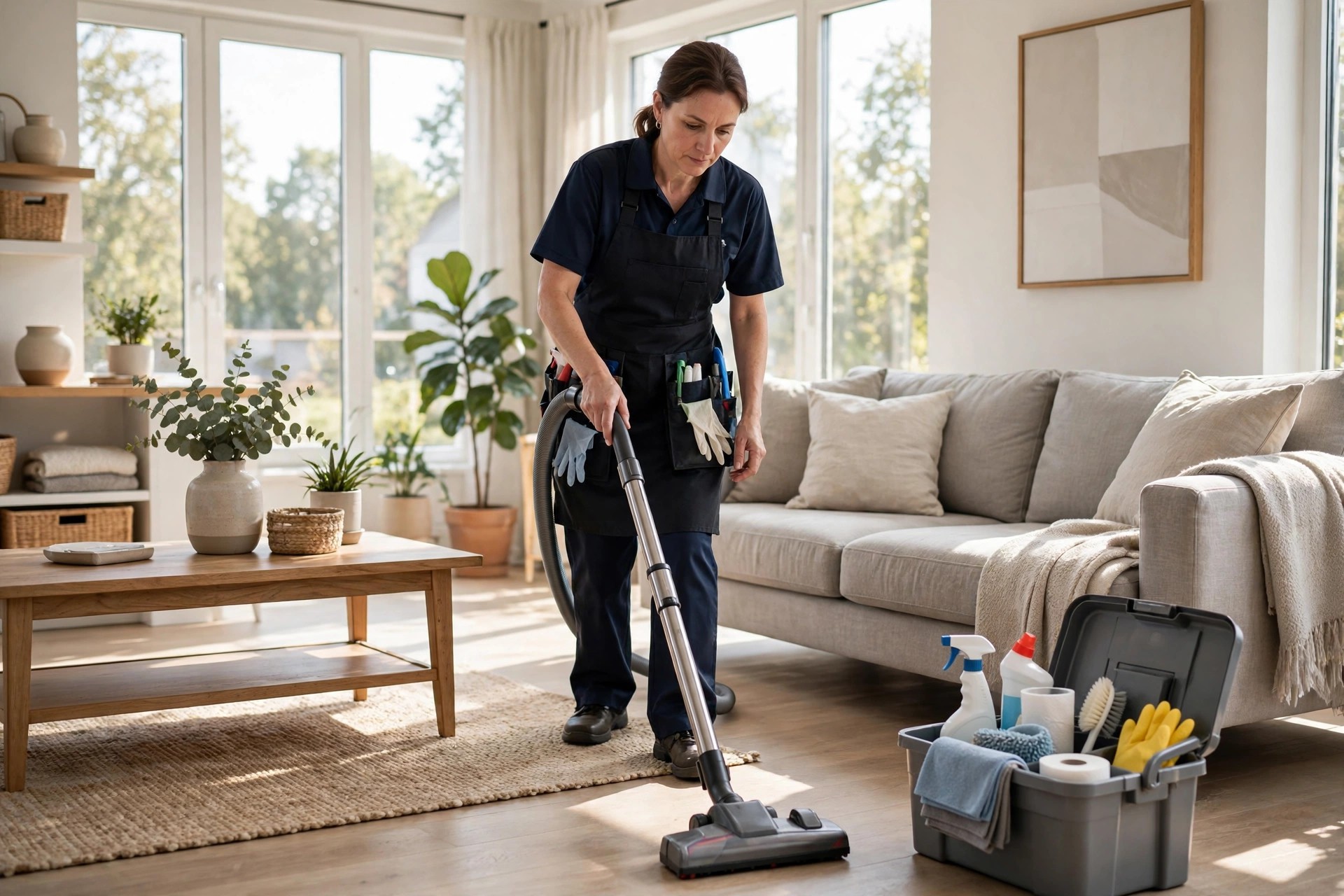
Residential clicks convert fast because the sale is simple: quote today, clean this week.
Search Ads vs Local Services Ads: the real economics
Cleaning is one of the trades where Local Services Ads genuinely compete with Search, and most companies should run both. They work differently, cost differently, and fail differently, so here is the honest comparison.
When Local Services Ads win
LSA charges per lead instead of per click, shows above the regular ads with a “Google Guaranteed” badge, and typically produces residential leads at $25 to $75 each, well under Search CPLs. For a residential cleaning company, LSA is often the cheapest reliable lead source available. The catches: volume is capped by your review count, responsiveness score, and market; you cannot control keywords or targeting the way Search allows; and disputed or junk leads take time to get credited. LSA also rewards the fundamentals: companies with 50+ reviews and fast response times get the most calls. If your review count is thin, LSA will underperform until you fix that.
When Search Ads win
Search wins everywhere LSA cannot go: commercial and office cleaning contracts, post-construction, and any service where the buyer researches and compares. It gives you full control over keywords, ad copy, landing pages, budgets, and schedule, and it scales: if the math works at $5,000 a month, it usually works at $15,000. Search also captures the long-tail intent LSA ignores, like “biweekly house cleaning service with eco products.” The trade-off is that you pay per click whether or not the visitor converts, so a weak landing page makes Search expensive fast. The practical setup for most cleaning companies: LSA for steady residential volume, Search for growth, commercial, and everything LSA cannot reach.
| Factor | Google Search Ads | Local Services Ads |
|---|---|---|
| Pricing model | Pay per click | Pay per lead |
| Typical residential CPL | $60 to $180 | $25 to $75 |
| Commercial contracts | Strong fit | Weak fit, limited categories |
| Control and targeting | Full control | Limited, Google decides |
| Scalability | Raise budget, more leads | Capped by reviews and market |
| What it demands | Good landing pages, tracking | Reviews, fast response, background check |
Cost per lead and the recurring revenue math
Residential cleaning leads on Search typically cost $60 to $180, and the range is wide because landing page quality varies so much. A page with instant online booking, clear pricing ranges, and real reviews converts 12 to 20 percent of clicks. A generic “contact us” page converts 4 to 8 percent, which doubles or triples the CPL on the same keywords. Commercial leads cost $150 to $400, but each one can turn into a contract worth tens of thousands, so the CPL is almost irrelevant next to the close rate and the contract size.
Residential recurring vs one-time deep cleans
Separate these two in your head and in your campaigns. The recurring lead (weekly, biweekly, monthly house cleaning) is the business: it closes fast, pays for years, and justifies the highest CPL you can afford. The one-time lead (deep clean, move-out, post-party) pays once and often at a discount-driven price. One-time jobs are worth buying only if you have a system to convert them into recurring clients: the upsell pitch at the first clean, the recurring discount, the follow-up email. Track what share of one-time jobs convert to recurring, because that number decides whether a $100 deep-clean lead is a bargain or a loss. Companies that convert 30 percent or more of one-timers into recurring clients can bid aggressively on deep-clean keywords. Companies that do not should keep those campaigns small.
Commercial contracts: a different game
Commercial cleaning leads are fewer, pricier, and slower, but one contract can be worth 50 residential clients. Decision-makers search during business hours, compare proposals, and care about insurance, references, and reliability more than price. Your landing page for commercial needs proof: client logos or industry types served, insurance and bonding details, and a consultation offer rather than an instant quote. The sales cycle runs weeks, so the follow-up system matters as much as the ads: a proposal sent Tuesday needs a call Thursday and an email the following week. Track cost per signed contract, not cost per lead, because ten $200 leads that produce zero contracts are infinitely more expensive than two $400 leads that produce one $2,000-a-month contract.
Monthly budget sizing for cleaning companies
Cleaning ads work at smaller budgets than solar or roofing, because clicks are cheaper and leads close faster. The minimum that produces learnable data is around $2,000 a month for residential in one market: enough for 130 to 250 clicks, 15 to 35 leads, and a clear read on CPL within 30 days. Below that, the data is too thin to optimize.
| Company profile | Monthly budget range | Expected monthly leads |
|---|---|---|
| Residential, one market | $2,000 to $4,000 | 15 to 50 |
| Residential, two to three markets | $4,000 to $8,000 | 40 to 120 |
| Mixed residential and commercial | $6,000 to $15,000 | 50 to 150 |
| Commercial-focused | $5,000 to $12,000 | 15 to 60, higher value |
Campaign structure for cleaning companies
The structural rule mirrors the business: residential and commercial never share a campaign. They have different keywords, different buyers, different landing pages, and wildly different economics. Inside residential, split further by intent.
The residential vs commercial split
Build a residential campaign cluster with ad groups for house cleaning, deep cleaning, move-in/move-out, and any specialty like Airbnb turnover. Each ad group gets its own ad copy and landing page, because a move-out searcher and a biweekly-cleaning searcher want different things. Build a separate commercial cluster with ad groups for office cleaning, commercial cleaning, and specialty services like post-construction. Commercial ads should speak to facility managers: reliability, insurance, references, and a consultation, not a price. Keep the budgets separate so a hot residential month never starves the commercial pipeline, which closes slower but pays bigger.
Match types, negatives, and geo targeting
Use phrase and exact match for the core buyer keywords, and keep broad match in a tightly controlled testing campaign. Cleaning attracts a specific set of junk clicks: jobs (“cleaning jobs near me,” “house cleaner jobs”), DIY (“how to deep clean,” “cleaning checklist”), products (“best vacuum for pet hair”), and price-only researchers (“free house cleaning”). A shared negative list blocking jobs, hiring, DIY, checklist, recipe, and product terms saves a meaningful share of budget every month. Geo-target your real service area with presence-based targeting, because cleaning buyers choose the closest credible option and clicks from two towns over rarely convert. Schedule ads around your office hours for commercial, and keep residential running into the evening, when homeowners do their searching. Pair the ads with instant response: an AI receptionist for cleaning companies answers the calls your crew cannot take from a job site, and an AI chatbot for cleaning companies captures the after-hours website visitors.
Landing pages that convert cleaning clicks
The cleaning landing page has one job: turn a click into a booked quote. The pages that do it share the same anatomy. A headline that matches the search (“Biweekly House Cleaning in Austin,” not “Welcome to SparklePro”). A short form above the fold: name, phone, zip code, and cleaning frequency. Real proof: review count, a few short testimonials, and photos of actual cleaned homes. A clear next step: “Get your quote in 60 seconds” or an instant online booking calendar. And a reason to act now: same-week availability or a first-clean discount. The pages that fail do the opposite: stock photos, a long “about us” essay, a contact form with eight fields, and no mention of price. Every extra field costs you leads; every missing proof element costs you trust. Test the headline and the form length first, because those two changes usually move conversion rate more than anything else.
Where cleaning ad budgets get burned
The most common burner is the one-page-fits-all site: the same page for house cleaning, office cleaning, and move-outs, with generic copy that speaks to nobody. Split the pages and each converts better. The second is bidding on “cleaning” without a qualifier and paying for job seekers, DIY researchers, and product shoppers. The third is the slow quote: a lead comes in at 7 PM, the office replies at 10 AM, and the homeowner already booked the competitor who answered at 7:15. Cleaning is a speed business; the quote has to go out in minutes. The fourth is no retention plan: winning a recurring client for $100 and losing them in month two because nobody followed up, asked for feedback, or fixed the small complaint. The ad did its job; the operation dropped it. The fifth is ignoring LSA while overpaying on Search for the same residential leads LSA would sell for half the price. Run both, and let each do what it does best.
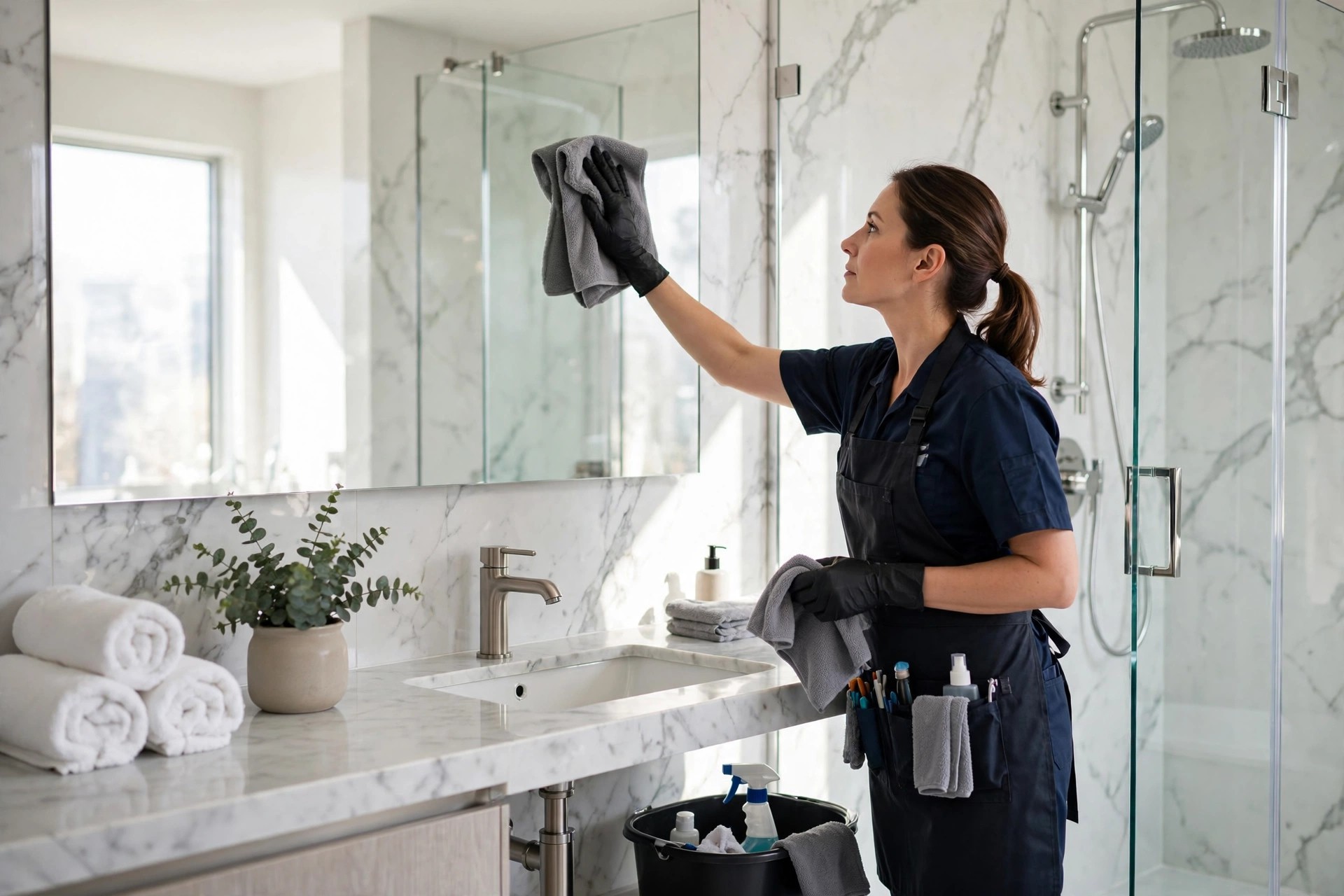
Deep cleans and move-outs convert fast, but only pay off when they turn into recurring clients.
Google Ads vs other lead sources for cleaning companies
Ads are the fastest way to fill a schedule, but the best cleaning companies layer channels. Referrals from happy clients are the cheapest and highest-converting leads in the business. Nextdoor and neighborhood groups produce steady local work for companies with good reviews. Real estate agents and property managers are gold for move-out and turnover cleans. Review platforms and marketplaces sell leads at a per-lead fee with mixed quality. None of these scale on demand the way ads do, which is why ads remain the growth engine even for companies with strong referral flow.
| Lead source | Typical cost per lead | Best for | Scalability |
|---|---|---|---|
| Google Search Ads | $60 to $180 residential | Growth, commercial, specialties | Raise budget, more leads this week |
| Local Services Ads | $25 to $75 | Residential volume | Capped by reviews and market |
| Facebook/Instagram ads | $20 to $60 | Before/after creative, offers | High, needs strong creative |
| Referrals | $0 to $50 in rewards | Highest-quality everything | Slow, compounds over years |
| Nextdoor and local groups | $0 to $30 | Neighborhood density | Medium, reputation-driven |
| Realtor and property manager partnerships | $0 to $75 | Move-out and turnover cleans | Medium, relationship-driven |
Tracking and attribution that keeps you honest
Most cleaning leads call or book online, so track both. Use call tracking with dynamic numbers tied to keyword and campaign, and make sure your online booking tool records the source of every appointment. Log outcomes, not just volume: quote given, booked, no-showed, one-time, converted to recurring. The metric that runs the account is cost per recurring client, and you can only compute it if you know which leads became regulars. Push booked appointments back into Google Ads as conversions so bidding optimizes for bookings, not clicks. Review monthly which keyword themes produce recurring clients versus one-time jobs, and shift budget toward the themes that build the route, because a route that grows every month is the whole business.
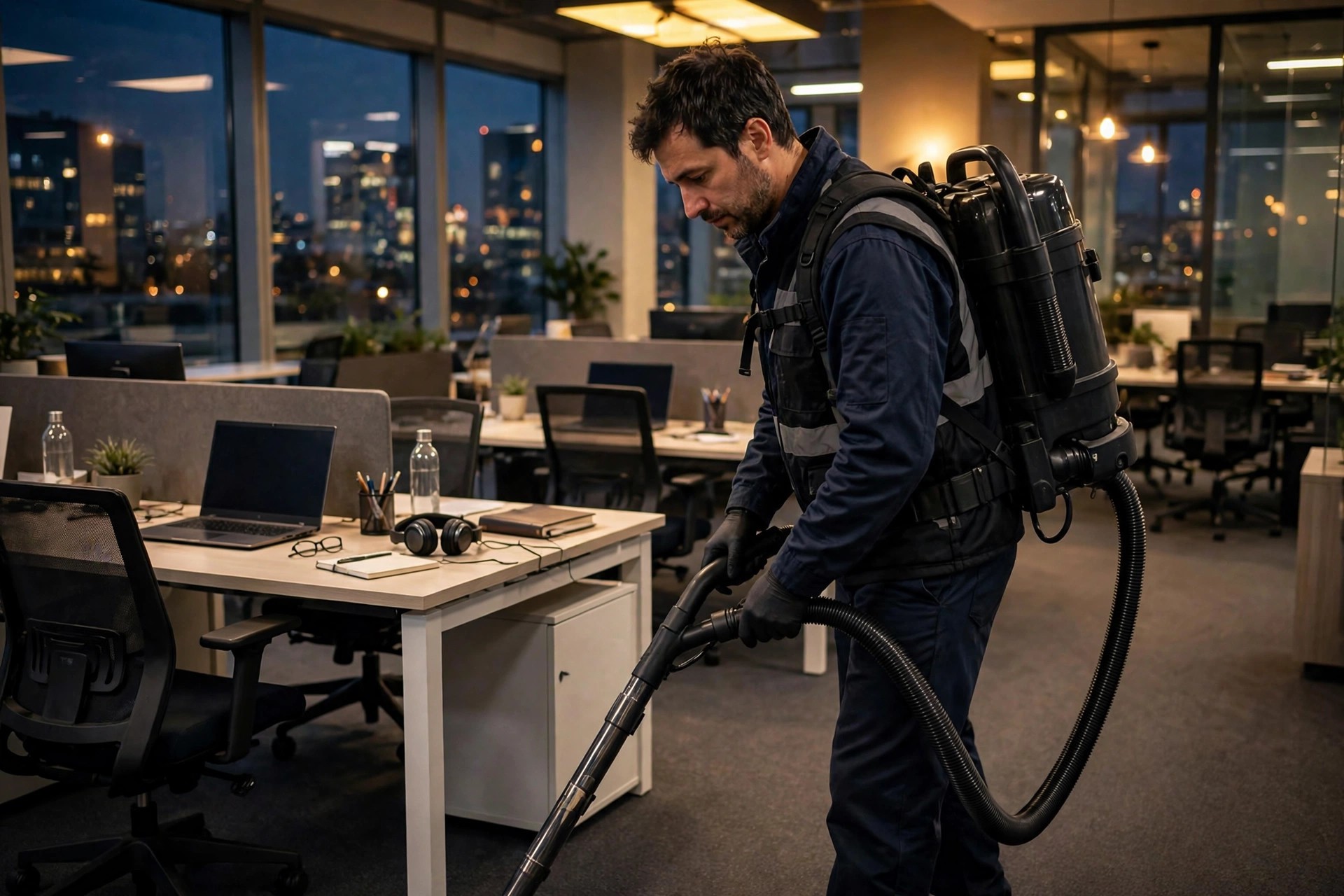
Commercial leads cost more and close slower, but one contract can equal fifty residential clients.
Your rollout checklist
Set up the measurement and the pages first, then spend.
- 1Set up LSA and Search together. Get Google Guaranteed, build reviews, and launch Search in parallel so each covers the other’s gaps.
- 2Split residential and commercial campaigns. Different keywords, budgets, ad copy, and landing pages for each.
- 3Build dedicated landing pages. One per core service, short form above the fold, real reviews, clear next step.
- 4Add online booking. Let searchers book a quote or a clean without calling; it lifts conversion on evening traffic.
- 5Install call tracking. Dynamic numbers by campaign, with outcomes logged so you can compute cost per recurring client.
- 6Load a shared negative list. Block jobs, hiring, DIY, checklists, and product terms from day one.
- 7Target your real service area. Presence-based targeting and a tight radius; cleaning buyers pick the closest credible option.
- 8Build a minutes-fast quote process. Instant auto-reply plus a live quote within minutes, with after-hours capture.
- 9Create the one-time to recurring upsell. A first-clean offer, a recurring discount, and a follow-up sequence for every one-time job.
- 10Review by cost per recurring client. Monthly, shift budget to the keyword themes that build the route.
Frequently asked questions
How much do Google Ads cost for a cleaning company?
Expect $8 to $20 per click for residential keywords, $15 to $35 for commercial, $60 to $180 per residential lead on Search, and a starting budget of $2,000 to $4,000 a month in one market. Local Services Ads often produce residential leads cheaper, at $25 to $75 each.
Should cleaning companies use Google Ads or Local Services Ads?
Both. LSA usually wins on cost per lead for residential work, while Search wins on control, volume, commercial contracts, and specialties. Run LSA for steady residential volume and Search for growth and everything LSA cannot reach.
What is a good cost per lead for a cleaning company?
On Search, $60 to $180 for residential and $150 to $400 for commercial are normal. Judge against lifetime value: a recurring client worth $3,000 to $6,000 a year makes even a $150 lead cheap, as long as retention holds.
How much should a cleaning company spend on Google Ads per month?
Start at $2,000 to $4,000 a month for residential in one market, $4,000 to $8,000 for multiple markets, and $5,000 to $12,000 for a commercial focus. Below $2,000 the data is too thin to optimize well.
Do Google Ads work for commercial cleaning companies?
Yes, and commercial is where Search shines, since LSA coverage is limited. Clicks cost $15 to $35 and leads $150 to $400, but one contract can be worth tens of thousands a year. Track cost per signed contract and run a real proposal follow-up process.
What landing page works best for cleaning ads?
A dedicated page per service with a headline matching the search, a short form above the fold, real reviews and photos, and online booking or a 60-second quote promise. Long generic pages with eight-field forms typically convert at half the rate.
How fast should a cleaning company follow up on leads?
Within minutes. Cleaning shoppers contact several companies and book the first credible quote. Use an instant auto-reply plus a live quote, and capture after-hours traffic with booking or a chatbot.
Why are my cleaning ad leads not converting?
The usual causes are a generic landing page, a slow quote process, no online booking for evening searchers, and bidding too wide geographically. Fix the page and the response speed first; most CPL problems are conversion problems, not bid problems.
Are deep cleaning and move-out ads worth it?
Yes, if you convert one-time jobs into recurring clients. Deep-clean keywords convert fast and book quickly, but they only pay off long-term through the upsell to recurring service. Track your one-time to recurring conversion rate to decide how aggressively to bid.
How long until cleaning Google Ads pay off?
Leads usually start in week one and the account finds its rhythm in 30 to 60 days. Because cleaning closes fast and recurs monthly, most companies see the revenue math work within the first quarter, as long as retention holds past month three.
Turn clicks into recurring clients
Digital Hayder runs Google Ads for cleaning companies: Search and Local Services Ads working together, landing pages with online booking, call tracking that shows cost per recurring client, and follow-up automation that converts one-time cleans into weekly routes. Tell us about your services and we will build the plan around it.
Contact Us