An electrical contractor in a mid-size city was spending $3,000 a month on Google Ads and getting plenty of clicks. The dashboard looked busy. The phones, however, told a different story: a handful of booked jobs, a pile of price shoppers, and a cost per booked job that made the owner wonder whether the whole channel was a scam. It was not a scam. It was a campaign built wrong: one ad group for everything from emergency calls to ceiling fan installs, no negative keywords, and nobody answering the phone fast enough when the expensive clicks turned into calls. Electrician Google Ads can be the most profitable channel in the business or the fastest way to burn money, and the difference is almost never the budget. It is the cost structure: what you pay per click for emergency versus routine keywords, how campaigns are split by job type, what monthly budget actually buys in your market, and the follow-up speed that decides whether a $40 click becomes a $2,500 panel upgrade. This guide lays out all of it with real numbers.
The quick answer
- Emergency clicks cost the most: expect $25 to $60 per click for emergency terms, $8 to $25 for routine work, with big-city premiums on top.
- Cost per lead runs $60 to $200: a realistic blended range for electrical work, driven by your close rate and response speed.
- Split campaigns by job type: emergency, panel upgrades, EV chargers, and small jobs each need their own budget and ads.
- Realistic budgets start at $1,500 a month: small markets can work with $1,500 to $2,500; large metros need $5,000 or more to compete.
- Speed decides ROI: answering within minutes instead of an hour can double or triple the jobs you close from the same ad spend.
- Track cost per booked job: clicks and calls are vanity metrics. The only number that matters is revenue per dollar of ad spend.
CPC reality: emergency vs. routine electrical keywords
Not all electrician clicks are priced equally, because not all searches are worth equally. Someone typing “emergency electrician near me” at 11 PM has a sparking outlet and will hire whoever answers first; every electrical company in town bids on that click, so it costs $25 to $60. Someone typing “ceiling fan installation cost” is researching a $200 job and may never hire; fewer companies fight for it, so it costs $8 to $20. Your cost per click is a direct reflection of the job value behind the keyword and the competition for it. The table below shows typical US cost bands. Your market will vary: large metros run 30 to 50 percent above these bands, and smaller markets run below them.
| Keyword type | Example searches | Typical CPC | Why it costs that |
|---|---|---|---|
| Emergency | emergency electrician near me, power outage electrician | $25 to $60 | Highest intent, every competitor bids, after-hours premium |
| Panel and service upgrades | electrical panel upgrade cost, 200 amp service install | $20 to $45 | High job value ($2,000 to $4,500), strong commercial competition |
| EV charger installation | tesla charger installation, EV charger electrician | $18 to $40 | Growing demand, $800 to $2,000 jobs, national installers bidding |
| General residential | electrician near me, licensed electrician | $15 to $35 | Broad intent, mixed job values, heavy local competition |
| Commercial | commercial electrician, office electrical contractor | $20 to $50 | Large contract values, fewer but aggressive bidders |
| Small routine jobs | ceiling fan installation, outlet replacement cost | $8 to $20 | Low job value, less bidding pressure, more researchers |
What this means for your bidding
The expensive clicks are worth it only if you can close the jobs behind them. A $45 emergency click that becomes a $400 after-hours call is a great trade. The same $45 click landing on a generic homepage, answered by voicemail, is money burned. Before raising bids on emergency terms, make sure the landing experience matches the urgency: a click-to-call button above the fold, “24/7 emergency service” in the headline, and a human or AI answering service picking up at night. For broader tactics on turning this traffic into booked work, see our electrician marketing ideas guide. And if the emergency keyword auction in your city is simply too rich, Local Services Ads can be a cheaper path to the same callers; more on the cost comparison in our guides to the format.

Watch cost per booked job, not cost per click. The dashboard only tells half the story.
Campaign structure by job type
The single most common mistake in electrician Google Ads is one campaign for everything. Emergency searches, panel upgrades, and ceiling fan installs have different values, different urgency, and different ideal landing pages. Lumping them together means one bid strategy, one budget, and one ad trying to serve all of them badly. Split them.
The four-campaign skeleton
Start with four campaigns. Campaign one: Emergency, with exact and phrase match terms around emergency electrician, power outage, and sparking outlet, running 24/7 with call-only or call-heavy ads. Campaign two: Panel and Service Upgrades, targeting high-value searches with ads that mention free estimates and financing. Campaign three: EV Chargers and Specialty, catching the growing electrification demand with dedicated landing content. Campaign four: General Residential, the catch-all for “electrician near me” and small-job searches, with the tightest budget cap since these clicks convert worst. Give each campaign its own daily budget weighted by job value: emergency and panel upgrades deserve the lion’s share. This structure also gives you clean data: you will know exactly what a panel upgrade lead costs versus a ceiling fan lead, instead of guessing from a blended average.
Negative keywords are profit protection
Electrical searches attract a flood of irrelevant clicks: DIYers (“how to wire,” “wiring diagram”), job seekers (“electrician jobs,” “apprenticeship”), and parts shoppers (“buy breaker panel,” “Romex price”). Every one of those clicks costs you real money and converts at zero. Build a shared negative keyword list with at least 100 terms covering DIY, jobs, training, wholesale parts, and automotive electrical, and review the search terms report weekly for the first two months. Most electricians find 15 to 25 percent of their spend was going to junk searches before they cleaned this up. That is found money: the same budget, redirected to real buyers.
Geo targeting: tight beats wide
Set your radius to the area you will actually drive to for the job type, and no wider. Emergency campaigns can run a tighter radius (15 to 20 minutes) because response time is the product; panel upgrades can run wider because the job value justifies the drive. Use location bid adjustments to push spend toward your best zip codes, and exclude areas you do not serve. A common leak: Google’s default “presence or interest” setting shows your ads to people merely interested in your area. Switch it to “presence” only, so you pay for people physically in your service area.
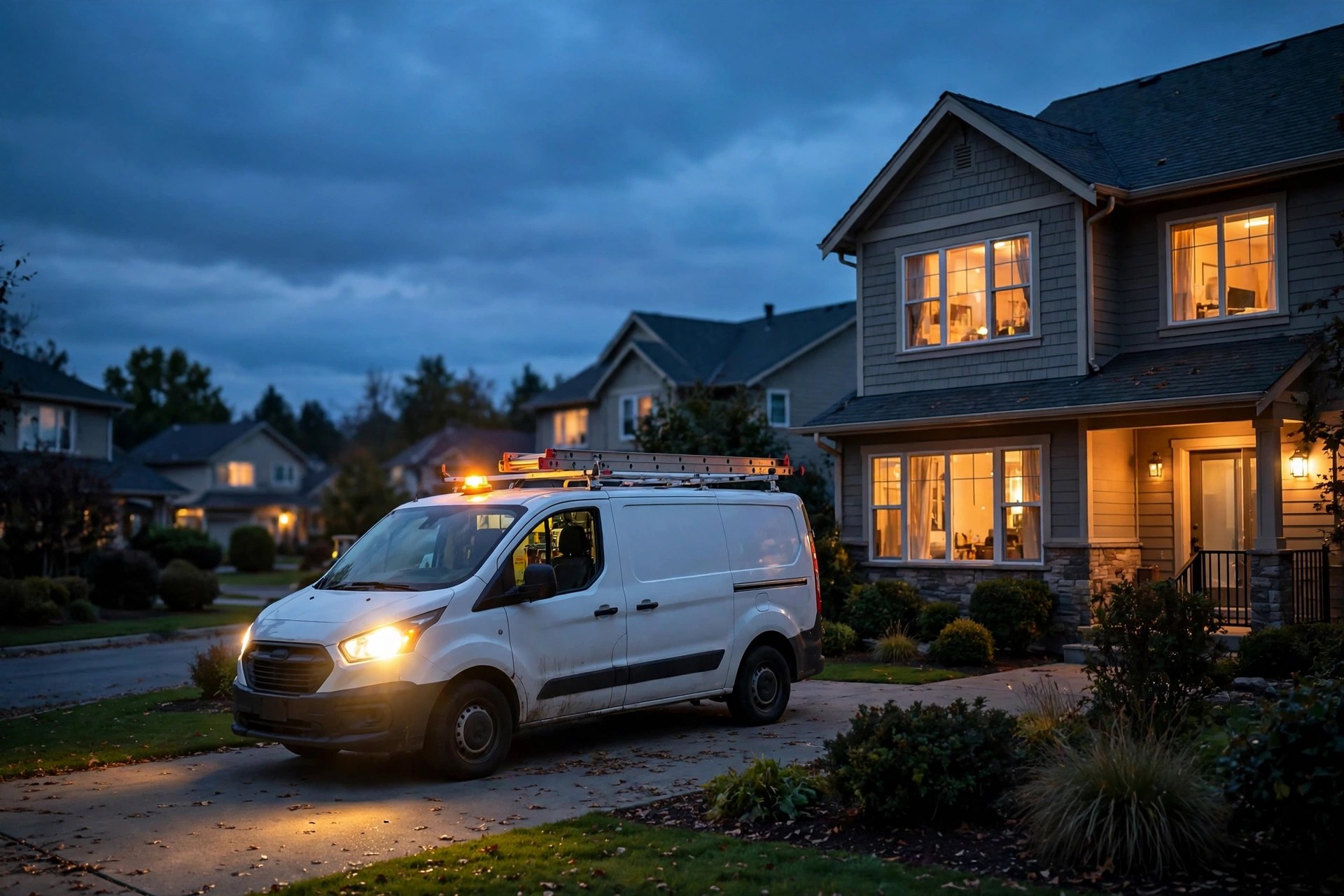
Emergency clicks cost the most because the intent is highest. Make sure the after-hours experience earns them.
Realistic monthly budgets
There is no magic budget number, but there are honest ones. Google Ads for electricians is an auction, and your budget has to be big enough to buy a meaningful number of clicks in your market after the auction takes its cut. Too small a budget means the campaign never exits learning mode and you conclude “Google Ads doesn’t work” from ten clicks of data.
Budget bands by market
In small markets and suburbs (under 200,000 people), $1,500 to $2,500 a month buys enough volume to test and optimize, focused on emergency and high-value terms. In mid-size metros, plan on $3,000 to $6,000 a month to compete across all four campaign types. In large metros, $6,000 to $12,000 or more is realistic if you want real share of voice on emergency and panel upgrade terms; below that, stay narrow and own one job type rather than spreading thin. Whatever the band, commit to at least 90 days before judging: month one is data collection, month two is optimization, month three is where the real cost per lead emerges. A useful rule of thumb: your monthly budget should buy at least 100 clicks in your core campaign. If $1,500 buys only 40 clicks at your CPCs, narrow the targeting until the math works.
What the budget actually buys
Work backward from revenue. If your average booked job is $800 and you close 30 percent of leads, each lead is worth $240 in expected revenue. If your cost per lead is $120, every lead doubles your money before overhead. At $3,000 a month and $120 per lead, that is 25 leads, 7 to 8 jobs, and about $6,000 in revenue: a 2x return on ad spend. Push cost per lead to $80 through better follow-up and tighter targeting, and the same $3,000 buys 37 leads and 11 jobs. The budget did not change; the efficiency did. That is why experienced advertisers obsess over follow-up speed and close rate instead of chasing cheaper clicks.
The follow-up-speed math that decides ROI
Here is the uncomfortable truth behind most electrician ad accounts: the campaign is fine, but the follow-up is slow. An emergency searcher calls three companies and hires the first one that answers. A panel upgrade shopper requests three quotes and remembers the one that responded in minutes. Widely cited industry research has long shown that the vast majority of customers go with whichever company responds first, and that contact rates collapse as response time stretches from minutes to hours. Your $40 click is a wasting asset from the second it converts.
Answer in minutes, not hours
Set a hard standard: every ad-driven call answered live, every form fill contacted within 5 minutes during business hours. After hours, emergency calls need a live answer or an immediate callback, which is exactly what an AI answering service or a dedicated on-call rotation provides; see our guide to AI answering services for electricians for the after-hours options. Missed calls need an automatic text-back within 60 seconds: “Sorry we missed you, this is Bright Spark Electric, how can we help?” Our guide to missed-call text-back for electricians walks through the setup. Track response time like you track CPC, because a 10-minute improvement in response time is often worth more than a 20 percent cut in cost per click.
Quote follow-up recovers the maybe-laters
Most panel upgrade and EV charger quotes do not close on the first visit. Build a short follow-up sequence: a same-day text with the quote recap, a call or text at 48 hours, and an email at one week with financing options or a scheduling nudge. Electrical contractors who follow up systematically routinely report closing 10 to 20 percent more quoted work, which drops straight to the bottom line since the ad spend is already paid. And every completed job should trigger a review request within 24 hours; see how to get more Google reviews for electricians. Reviews lift both your ad quality signals and your organic presence, compounding the paid spend.

The click is a wasting asset. Whoever answers first usually wins the job.
Your rollout checklist
Structure first, then speed, then scale.
- 1Split campaigns by job type. Emergency, panel upgrades, EV chargers, and general residential each get their own campaign, budget, and ads.
- 2Build the negative keyword list. At least 100 terms covering DIY, jobs, training, and parts. Review search terms weekly for two months.
- 3Tighten geo targeting. Presence-only location setting, radius matched to each job type, bid adjustments for your best zip codes.
- 4Set an honest budget. Enough to buy 100+ clicks a month in your core campaign, committed for 90 days before judging.
- 5Fix the landing experience. Click-to-call above the fold, urgency-matched headlines, and a dedicated page per job type.
- 6Answer in minutes. Live answer on every ad call, 5-minute form-fill response, automatic text-back on every missed call.
- 7Follow up every quote. Same-day recap, 48-hour check-in, one-week nudge with financing or scheduling options.
- 8Track cost per booked job. Connect ad spend to real revenue per campaign, and reallocate monthly toward the job types that pay.
Frequently asked questions
How much do electricians pay per click on Google Ads?
Emergency keywords typically cost $25 to $60 per click, panel upgrades $20 to $45, EV charger installs $18 to $40, general residential terms $15 to $35, and small routine jobs $8 to $20. Large metros run 30 to 50 percent above these bands. Your exact CPC depends on competition and your quality signals.
What is a good cost per lead for an electrician?
A realistic blended range is $60 to $200 per lead, depending on job mix and market. Emergency-heavy accounts run higher per lead but close faster; routine-job accounts run cheaper per lead but close slower. Judge the number against your average job value and close rate, not in isolation.
How much should an electrical company spend on Google Ads per month?
Small markets: $1,500 to $2,500. Mid-size metros: $3,000 to $6,000. Large metros: $6,000 to $12,000 or more for real share of voice. Whatever the band, budget for at least 100 clicks a month in your core campaign and commit to 90 days before judging results.
Are emergency electrician keywords worth the high CPC?
Usually yes, if you can answer fast. A $45 click that becomes a $400 after-hours call is an excellent trade. They are worth it only with live after-hours answering, click-to-call ads, and urgency-matched landing pages. Without those, the expensive clicks leak away.
Why is my electrician Google Ads account getting clicks but no jobs?
The usual culprits: one campaign for all job types, junk searches eating the budget (fix with negative keywords), slow or missed follow-up on calls and forms, and generic landing pages. In most accounts we see, follow-up speed is the biggest leak, not the campaign settings.
Should electricians use Local Services Ads instead of Google Ads?
They serve different roles. Local Services Ads charge per lead rather than per click and carry the Google Guaranteed badge, which many electricians find cheaper for routine calls. Standard Google Ads gives you more control over keywords, budgets, and landing pages. Many shops run both: LSA for steady call flow, search ads for high-value job types.
How long before electrician Google Ads become profitable?
Plan on 90 days: month one collects data, month two optimizes targeting and negatives, month three shows the true cost per lead. Accounts with fast follow-up and tight campaign structure often see profitable cost-per-booked-job numbers by month two or three.
Make every click count toward booked jobs
Digital Hayder builds Google Ads systems for electrical companies: job-type campaign structure, negative keyword protection, landing pages that convert, and follow-up automation that answers in minutes. Tell us about your market and we will design the ad account around your most profitable work.
Contact Us