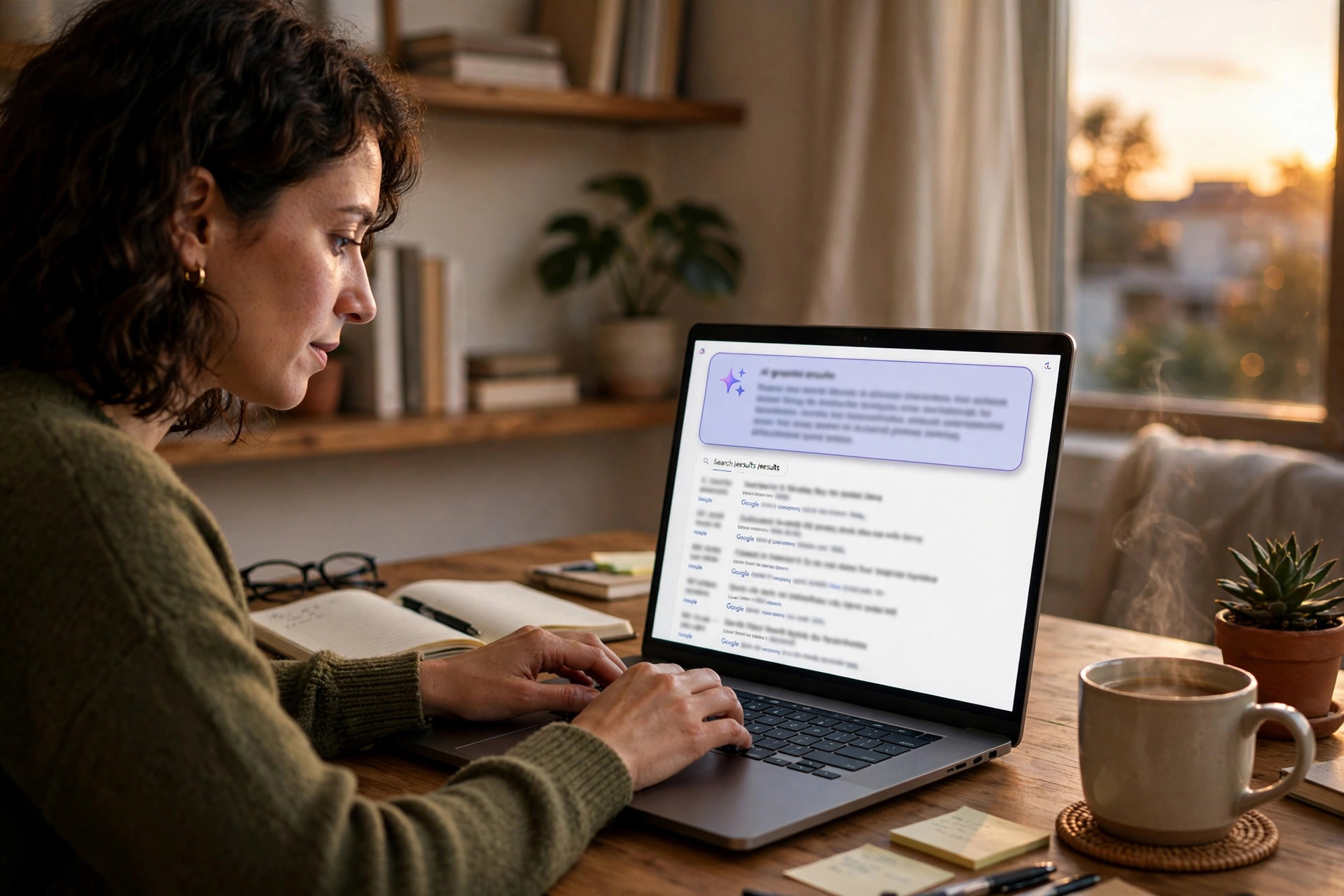
Search Google for “how much does a roof replacement cost” or “best time to aerate a lawn” and the first thing you see is no longer ten blue links. It is an AI-generated answer sitting above everything else, with a few cited sources tucked underneath. That box is Google AI Overviews, and it now answers a large share of informational searches before anyone scrolls. For local businesses, this shifts how being found works: ranking number one matters less if an AI summary answers the question and most searchers never click through. This guide explains how AI Overviews choose what to cite and the exact steps to make your business one of the cited sources.
The quick answer
- AI Overviews answer first: Google generates an AI summary at the top of many searches, pushing organic listings and ads further down the page.
- Citations are the new clicks: getting your business named or linked as a source in the overview keeps you visible even when clicks drop.
- Structure wins citations: clear headings, direct answers in the first sentences, FAQ formatting, and schema markup make your pages easy for Google to quote.
- Your Google Business Profile feeds it: complete profiles with strong reviews supply the local facts AI Overviews state about businesses.
- Informational content is the entry point: “how much,” “how to,” and “best” guides are the pages most likely to be cited.
- Typical cost: $0 to $500 a month DIY for content and tools; $1,500 to $4,000 a month for an agency running content plus local SEO.
What Google AI Overviews are and when they appear
AI Overviews are AI-generated summaries that Google places at the top of the search results for many queries. Google builds the answer from multiple web pages, then lists those pages as cited sources with links. The searcher gets a complete answer without clicking anything, and the cited sites get whatever clicks remain.
Overviews appear most often for informational and question-based searches: “how much does X cost,” “how to do Y,” “what is the best Z for,” “why does my …”. They appear less often for simple navigational searches like a business name, and their behavior on purely local “near me” searches keeps shifting as Google tests layouts. The trend is clear in one direction: more searches answered on the results page, fewer clicks to websites.
How they differ from featured snippets
Featured snippets pulled one answer from one page. AI Overviews synthesize an answer from several pages and cite each one. That is both a threat and an opening. The threat: your page can lose the click even when it ranks well, because the overview already gave the answer. The opening: you no longer need to be the single chosen page. If your content contributes a clear fact, a useful step, or a good price range, you can be cited alongside bigger sites.
Which local searches trigger them
Watch for overviews on the research questions your customers ask before they buy: cost questions (“how much does a dental implant cost”), comparison questions (“tank vs tankless water heater”), how-to questions (“how to unclog a drain without chemicals”), and timing questions (“when should I service my AC”). These are the searches where a well-structured page from a local business can be cited right next to national publishers. Transactional searches like “emergency plumber near me” still show the map pack first, but even those increasingly carry AI elements.
How Google chooses what to cite
Google has not published the formula, but the cited sources visible in overviews follow clear patterns. The system favors pages that directly answer the question, present facts in quotable form, and come from sources with demonstrated expertise on the topic.
The sources AI Overviews pull from
Citations cluster around a few source types. First, pages that already rank well in organic results, because the overview draws heavily from the same index. Second, pages with clear question-and-answer structure: headings phrased as questions, direct answers immediately after. Third, sources with topical depth: sites that cover a subject thoroughly across many pages get cited more than one-page wonders. Fourth, fresh and specific content: current prices, current regulations, and specific local details beat generic advice. A page that says “in Texas, AC units need service twice a year because of the long cooling season” is more citable than “service your AC regularly.”
Why your Google Business Profile matters more than ever
For the local facts inside overviews, business names, hours, ratings, service areas, Google leans on Google Business Profiles and reviews. When an overview mentions “highly rated clinics in the area,” the ratings come from your profile. A complete profile with 200 reviews and detailed services gives the overview accurate material about you. A thin profile gives it nothing, and the overview will name your competitors instead. Everything in the classic local SEO playbook still applies; it now feeds two outputs, the map pack and the AI summary.

AI Overviews draw local facts from the same profiles and reviews that power the map pack.
Step 1: Strengthen your Google Business Profile for AI citations
Before writing a word of new content, make your profile the best source of facts about your business on the internet. AI Overviews can only state what they can verify, and your profile is the most verifiable source you control.
- Complete every field: categories, services with descriptions, hours including holidays, service areas, attributes (women-led, veteran-led, wheelchair accessible), and a full business description with your main keywords written naturally.
- Add 50 or more photos: team, vehicles, storefront, real job photos, interior. Profiles with photos earn far more actions, and images give Google more signals about what you do.
- Post weekly: offers, completed jobs, seasonal tips. Posts keep the profile fresh, and freshness feeds AI citations.
- Build reviews aggressively: ask on every job with a direct link, respond to all of them within 48 hours. Review count and rating are the facts overviews quote most.
- Seed the Q&A: ask and answer the real questions customers call about. Each answered question is a quotable fact.
This work costs nothing but time, and it pays off in the map pack at the same time. There is no reason to skip it.
Step 2: Structure your content so AI can quote it
Most business websites are written to impress visitors. To win AI citations, write to be quoted. That means putting the answer first, using clear structure, and marking up the page for machines.
Answer-first formatting
Start each page or section with the direct answer in one to three sentences, then expand with details. “A roof replacement in Dallas typically costs $8,000 to $15,000 for an average home. Architectural shingles run $4 to $7 per square foot installed; metal runs $8 to $14.” That opening is instantly quotable. Burying the answer in paragraph six means the AI quotes whoever put it first. Use headings phrased as the questions customers type: “How much does it cost?” “How long does it take?” “Do you serve my area?”
Use lists, tables, and short paragraphs
AI systems extract structured information easily. A table comparing three service tiers with prices is more citable than three paragraphs describing them. A numbered list of steps is more citable than a narrative. Keep paragraphs under four lines, use descriptive subheadings every 150 to 250 words, and put key facts in bold or in callout boxes. You are formatting for a machine reader that rewards clarity, and human readers benefit from the same clarity.
Add FAQ and article schema
Schema markup labels your content for Google’s systems: this block is a question, this is the answer, this is the author, this is the publish date. FAQ schema and Article schema take a developer an hour or two to implement, typically $150 to $400 hired out. It does not guarantee citations, but pages with clean schema get parsed more reliably, and reliable parsing is the precondition for being quoted.

A complete, current profile supplies the verified facts AI summaries state about your business.
Step 3: Publish the informational content overviews cite
The pages most likely to earn AI Overview citations are the ones that answer pre-purchase questions: costs, comparisons, timelines, how-tos, and local specifics. Most local businesses publish none of these and wonder why only national sites get cited.
Build a cost and pricing content hub
Cost questions trigger overviews constantly, and customers ask them before every purchase. Publish one detailed cost guide per main service: what it costs in your area, what drives the price up or down, what is included, and how your pricing compares to the range. Use real numbers. “Dental implants in Austin typically cost $3,000 to $5,000 per tooth, including the crown” is citable. “Affordable implant options” is not. One strong cost page can earn citations for years and pre-sell customers before they call.
Write comparisons and local guides
Comparison content earns citations because overviews love presenting options: “tank vs. tankless water heaters,” “Invisalign vs. braces,” “lawn aeration vs. overseeding.” Present both sides fairly with a clear recommendation for specific situations, and include local angles national sites cannot match: climate, local regulations, neighborhood-specific advice. A fair comparison that mentions your service area naturally is exactly the kind of page an overview cites when answering “which is better.”
Answer the questions your staff hears daily
Ask your team for the ten questions they answer every week, and turn each into a focused page or a deep FAQ entry. These are, by definition, the questions your market asks, which means they are the questions triggering overviews. A 400 to 800 word page that answers one question thoroughly, with local specifics and real numbers, outperforms a 3,000 word generic article every time for citation purposes.
Step 4: Reviews and mentions feed the overview
AI Overviews do not only cite articles. They also summarize what “customers say” and “reviewers mention,” drawing on review text from Google, Yelp, and industry sites. This means your review profile is content, not just social proof.
Encourage detailed reviews by asking specific questions in your follow-up: “What problem did we solve for you?” Customers who describe the actual job give AI systems quotable specifics about your work. Respond to reviews with specifics too: “Glad the tankless install went smoothly” adds service keywords to your public footprint. And keep earning mentions on independent sites: local “best of” lists, news coverage, and forum threads all become material the overview can draw on when describing your business.
How to track whether you appear in AI Overviews
You cannot measure what you do not watch. Set up a simple monthly routine to see where you stand.
- Manual checks: search your ten most important question-based keywords in a private browser window and note whether an overview appears, whether you are cited, and which competitors are cited instead. Screenshot the results.
- Search Console: watch impressions and click-through rates on your informational pages. A page whose impressions hold steady while clicks fall is often being summarized by an overview. That page needs stronger citable facts, not deletion.
- Rank tracking with AI features: tools like Semrush, Ahrefs, and ZipTie now report AI Overview presence and citations for tracked keywords. Plans with these features typically run $130 to $500 a month. Even one quarter of tracking data shows you exactly which overviews cite you and which cite competitors.
- Competitor citation analysis: for every overview where a competitor is cited and you are not, open their page and study the structure. What question does it answer first? What facts does it state plainly? Mirror the structure with your own local specifics.
Do not panic if an overview answers the question without a click. A citation with your business name in front of thousands of searchers is branding you could not buy at that price. The goal is presence in the answer, not just traffic to the site.

Track overview citations monthly; a cited page with fewer clicks still puts your name in front of buyers.
What does AI Overview optimization cost?
Most of this work overlaps with content marketing and local SEO you should be doing anyway. Typical ranges:
| Item | Typical cost | Notes |
|---|---|---|
| DIY content program | $0 to $500/mo | Your time plus a rank tracker and schema plugin; one strong page per week is a solid pace |
| Freelance content writer | $200 to $600 per article | For 1,000 to 1,500 word cost guides and comparisons with real local numbers |
| Schema implementation | $150 to $400 one-time | FAQ, Article, and LocalBusiness markup across the site |
| AI visibility tracking tools | $130 to $500/mo | Overview presence and citation monitoring for your keyword set |
| Agency program (content + local SEO) | $1,500 to $4,000/mo | Profile management, review system, monthly content, citation tracking, monthly reporting |
Typical ranges, not fixed prices. A single cost guide that earns overview citations for two years is among the cheapest visibility you can buy.
Your 90-day AI Overviews plan
- 1Days 1 to 14: complete your Google Business Profile fully and restart the review ask on every job. Run manual overview checks on your top ten question keywords and screenshot who gets cited.
- 2Days 15 to 30: add FAQ and Article schema to your site. Rewrite your top five service pages answer-first: direct answer in the opening sentences, question headings, key facts in tables or lists.
- 3Days 31 to 60: publish two cost guides with real local numbers and one fair comparison page. Seed your profile Q&A with the questions customers actually ask.
- 4Days 61 to 90: publish two more question-based guides from your staff’s FAQ list. Set up overview tracking in a rank tool. Study every competitor citation and close the structural gaps in your pages.
Frequently asked questions
Are AI Overviews killing organic traffic for local businesses?
They reduce clicks on informational searches, yes. But local transactional searches still drive calls through the map pack, and being cited in an overview keeps your name visible. Businesses that adapt their content to win citations lose less and sometimes gain, because the overview sends pre-sold visitors.
Can a small business outrank big publishers in AI Overviews?
You do not need to outrank them. Overviews cite multiple sources, and they favor specific, local, current facts that national publishers rarely provide. A local cost guide with real numbers from your market can be cited right alongside a national site.
How long until my content gets cited in AI Overviews?
Typically 1 to 3 months after publishing, once Google has crawled and indexed the page and judged it useful. Pages on sites with existing authority get picked up faster. Updating and improving the page monthly speeds things along.
Should I still invest in classic SEO if AI answers everything?
Yes. AI Overviews draw from the same index and reward the same fundamentals: relevance, authority, and clear structure. Classic SEO builds the foundation; overview optimization is the formatting layer on top. Neglect the foundation and you get neither rankings nor citations.
Does paying for Google Ads get me into AI Overviews?
No. Citations are earned through content quality and relevance, not ad spend. Ads still buy visibility below the overview, which remains valuable for transactional searches, but there is no paid path into the AI answer itself.
Want your business cited in Google’s AI answers?
Digital Hayder builds AI Overview visibility for local businesses: profile optimization, review engines, answer-first content with real local numbers, schema markup, and monthly tracking of which overviews cite you. Tell us about your business and we will map the plan.
Contact Us