A referred HVAC customer is the cheapest job you will ever book. A homeowner who trusts you tells a neighbor, and that neighbor calls with none of the price shopping that ad clicks produce. Yet most HVAC companies run their referral effort on hope: a tech says “tell your friends if you are happy” at the door, once, and never again. A referral program for HVAC companies turns that hope into a system: a reward customers actually want, an ask at the exact moment they are happiest, and a way to share that takes 30 seconds. This guide covers reward structures that get used, when to ask after installs and tune-ups, how maintenance plan members become your referral engine, the review plus referral combo, what it costs, and the money math on referral job value versus ad cost.
The quick answer
- Referrals close higher and cost less: a referred HVAC lead typically costs under $50 to acquire versus $200 to $400 or more through paid ads.
- Maintenance plan members refer most: customers who see you twice a year know your techs by name and trust the company.
- Cash and account credit win: $100 to $250 per booked referral beats gift cards and swag that nobody wants.
- Ask at the peak moment: right after a new install or a clean tune-up, while the comfort is fresh and the tech is standing there.
- Pair reviews with referrals: one follow-up flow collects the Google review and the referral share in the same minute.
- Launch in two weeks: pick a reward, write the ask scripts, train the techs, and put a simple share link on every invoice.
Why referrals beat every ad channel in HVAC
HVAC is a high-trust, high-ticket business, and that combination makes referrals unusually powerful. A system replacement runs $8,000 to $15,000. Nobody picks a company for that job on a whim. Homeowners ask neighbors, coworkers, and family members who they used and whether they would use them again. A referred lead arrives pre-sold: the trust transfers from the person who recommended you. That is why referred leads close at higher rates, haggle less on price, and complain less during the job.
Compare the economics. A paid search lead for an HVAC install can cost $50 to $150 per click and $200 to $400 or more per booked job once you account for the leads that never answer and the estimates that never close. A referral reward of $150 per booked job costs a fraction of that, and the closing rate on referred estimates is commonly double what cold leads produce. One referral that becomes a $10,000 install on a $150 reward is a customer acquisition cost of 1.5 percent of revenue. Ads rarely get below 10 percent.
Referrals also feed the part of the business ads ignore: maintenance and repair. A neighbor who hears “these guys keep my system running great” calls for a tune-up, joins the maintenance plan, and becomes a repeat customer for a decade. That lifetime value, thousands in service and plan revenue plus the eventual replacement, is what makes a referral program compound. Every happy customer you create today is a quiet salesperson for the next ten years, and unlike ads, that salesperson never sends you a bill. Referrals deserve a central place in your HVAC marketing ideas alongside the paid channels, not a footnote.
The reason most programs fail is not that customers refuse to refer. It is that the company makes referring hard, pays a reward nobody wants, or asks at the wrong moment. Fix those three things and the program runs. The sections below walk through each one.
Maintenance plan members: your built-in referral engine
If you have a maintenance plan, you already own a referral engine. Plan members see your techs twice a year, know them by name, get priority service, and feel like insiders. They are the customers most likely to recommend you, because recommending you makes them look smart to their friends. The mistake is treating them like everyone else and never asking.
Run the numbers on a modest base. A company with 500 plan members where just 10 percent refer one new customer a year gets 50 referred leads. If half of those become customers at an average first-year value of $600 in service and plan revenue, that is $15,000 in new revenue from one ask, before a single replacement or install enters the picture. Now add the big jobs: even two of those 50 referrals turning into $10,000 replacements adds $20,000 more. All of it on reward costs of a few thousand dollars.
Give plan members a reason to feel special about referring. A member-only referral bonus, say $200 in account credit instead of the standard $100, costs you little and makes members feel like partners. Put the referral ask into the plan renewal letter and the post-tune-up visit, the two moments when members are most aware of the value they get. And track referrals per member so you can thank your top referrers personally: a handwritten note from the owner to someone who sent you three neighbors is worth more than any gift card, and it costs almost nothing.
If your plan base is small, the same logic applies to your best service customers: the ones with multiple visits, the ones who always say yes to the recommended work, the ones who leave five-star reviews. Your CRM can flag them. Ask those people first and the program gets its early wins, which is what keeps the techs believing in it.

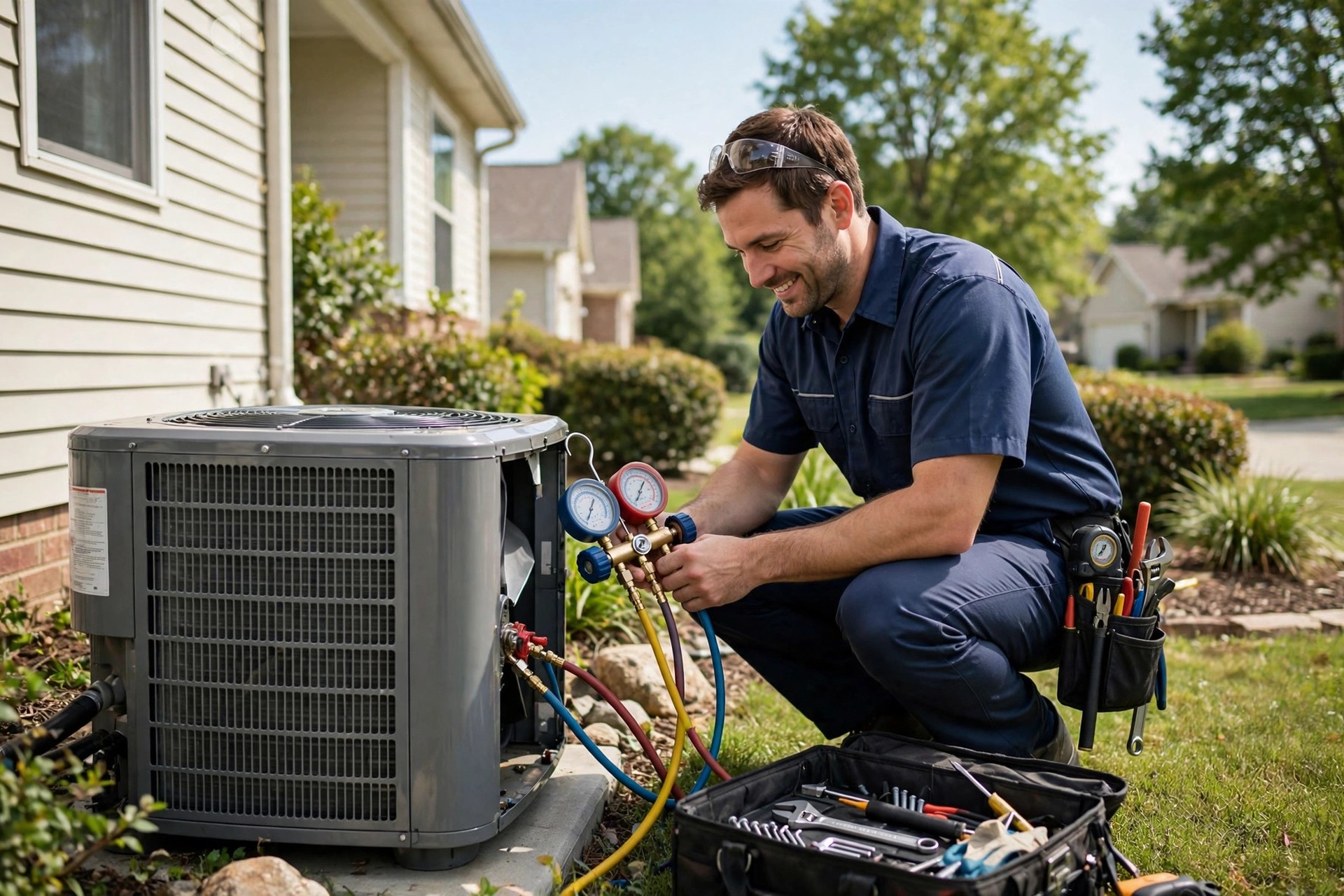
The referral ask lands best in person, right after a job well done, when trust is at its peak.
Reward structures customers actually use
The reward is the engine of the program, and most companies get it wrong in one of two ways: they pay too little to motivate anyone, or they pay in something nobody wants. A $10 coffee card for sending you a $12,000 install customer is an insult, not an incentive. A complicated points system that requires a login, a dashboard, and a math degree never gets used. The best rewards are simple, valuable, and paid fast.
| Reward type | Typical value | Best for | Watch out |
|---|---|---|---|
| Cash or check | $100 to $250 per booked job | Install and replacement referrals | Pay on completed install, not on the lead, and pay within 30 days |
| Account credit | $100 to $200 | Plan members and repeat service customers | Credit only works if the customer plans to use you again |
| Gift card | $50 to $100 | Quick thank-you tier for service referrals | Feels less valuable than the same amount in cash |
| Discount on next service | $25 to $50 | Small service and tune-up referrals | Too weak to motivate a big install referral |
| Donation to a local cause | $50 to $100 | Community-minded customers | Harder to track and harder to explain at the door |
| Tiered bonus | Escalating per referral | Super-referrers who send many | Complexity kills participation; keep the tiers to two or three |
Cash wins for one reason: everybody understands it. A $150 check for a booked install referral is clear, fair, and motivating. Account credit is the runner-up for plan members, because it deepens the relationship instead of ending the transaction. If you use both, make the structure dead simple: $150 cash or $200 in account credit for every referred job that gets installed, $25 credit for every referred tune-up that gets booked. One sentence, no fine print.
Two rules protect the economics. First, pay on the booked or completed job, never on the lead. Paying for names fills your pipeline with cousins who were never going to buy. Second, pay fast. A reward that arrives in two weeks gets talked about; a reward that takes four months gets forgotten, and the customer never refers again. Build the payout into your weekly office routine so it happens without anyone having to remember.
When to ask: the moments that produce referrals
Timing decides whether the ask feels natural or awkward. Ask too early, before the work is done, and it feels presumptuous. Ask too late, three months after the install, and the glow has faded. The right moments all share one trait: the customer has just experienced the value and the tech is standing right there.
| Moment | When exactly | Why it works |
|---|---|---|
| After the install walkthrough | Tech finishes showing the new system, customer is smiling | Highest ticket, highest emotion, comfort is brand new |
| After a clean tune-up | Tech reports everything checked out fine | Relief and gratitude; the system is ready for the season |
| After an emergency save | Heat or cooling restored, customer comfortable again | Gratitude peaks when you fixed a crisis fast |
| At invoice payment | Customer pays happily for work well done | Payment confirms satisfaction; the ask rides that confidence |
| Plan renewal | Member renews for another year | Renewal is a vote of trust; ask them to spread it |
| After a five-star review | Customer just wrote glowing words about you | They already said it in writing; sharing it with a friend is one small step |
The install walkthrough deserves special attention because it is the single best referral moment in the business. The tech has spent hours in the home, the new system is humming, the customer is relieved and happy, and the family is already telling the tech how much better the house feels. That is the moment for one sentence, not a pitch: “I am glad you are happy with it. If you know anyone whose system is getting old, we pay $150 for every referral that gets installed. Here is a card with your name on it.” Then hand them two cards. The second card is the point: one for the friend, one to keep.
Train techs to read the room. If the customer is stressed about the bill, complaining about the mess, or rushing out the door, skip the ask that day and let the follow-up text do it. One forced ask at a bad moment costs more goodwill than ten good asks earn. The program should feel like a tech sharing good news, not a sales quota.
The review plus referral combo
Reviews and referrals are the same motion: a happy customer telling the truth in public. Running them as one flow doubles the return on every happy customer and costs no extra effort. The sequence is simple: finish the job, earn the smile, ask for the review, then ask for the referral while the customer is already in sharing mode.
Do the review ask first and in person. The tech says, “If you were happy with the work today, a Google review helps us more than you know,” and hands over a card with a QR code or sends the link by text before leaving the driveway. Then the referral ask follows naturally: “And if you know anyone with an old system or no AC, we pay $150 for referrals. There is a share link in the same text.” One text, two links, 30 seconds of the customer’s time.
The follow-up text should arrive within an hour of the visit, while the experience is fresh. Keep it short: thanks by name, the review link, the referral share link, and the reward in one line. If the customer leaves the review but does not share the referral link, that is fine; the review feeds your Google profile and your ad landing pages, which lifts every other channel. If they share the referral link but skip the review, you still got the higher-value action. Automate this text so it goes out after every completed job without the tech having to remember, and your review count and your referral pipeline both grow on autopilot.
One more pairing most companies miss: ask the referrer for a review too, when their reward arrives. “Your $150 is on the way, thanks for sending the Johnsons. If you have a minute, a review of your own experience would mean a lot.” Customers who refer are your happiest customers; their reviews are your most convincing ones.
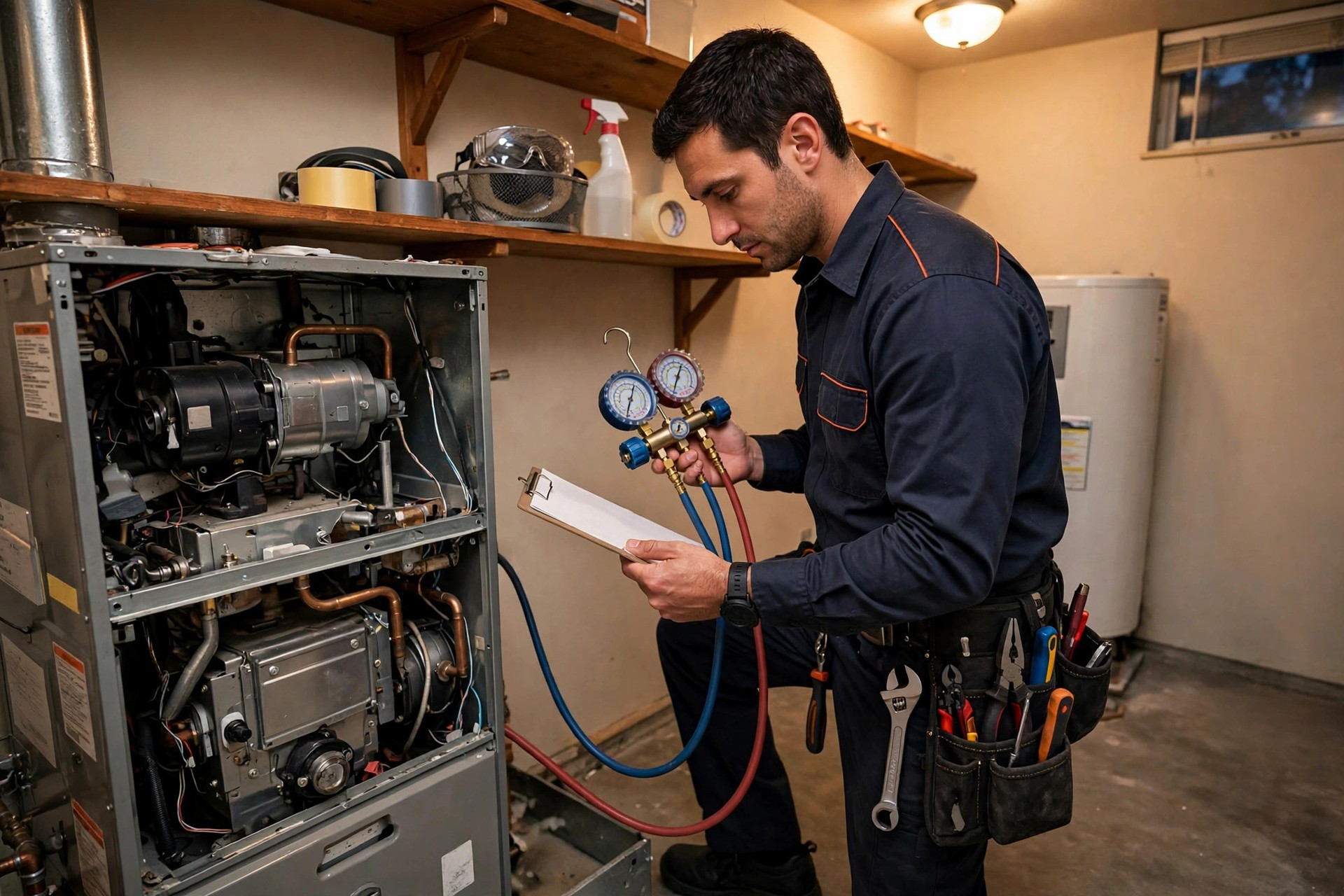
A clean tune-up visit is one of the best referral moments: the customer is relieved, grateful, and talking to your tech.
Make it easy: cards, links, and tech scripts
A referral program dies the moment referring takes effort. The customer’s job must be: tap a link, type a name and number, done. Your job is building the rails so that is all it takes.
Personal share links are the backbone. Every customer gets a unique link, sent by text after each visit and printed on the invoice. When someone books through that link, the system credits the referrer automatically. No codes to remember, no “tell them I sent you” that the dispatcher forgets to write down. Most CRMs and referral tools generate these links; if yours does not, a simple web form with a “who referred you” field plus a weekly office review of new bookings works at small scale.
Referral cards still matter because techs hand them to people, and people put them on fridges. The card needs five things and nothing else: your company name and phone number, the reward amount in big type, the customer’s name handwritten by the tech, a QR code to the share link, and one line of instruction. Print them in batches of 500; they cost pennies. Give every tech a stack in the truck and restock it like any other supply.
The tech script should be one paragraph the tech can say in their own words, not a speech to memorize: who the program is for, what the customer gets, and how easy it is. “We pay $150 for every referral that gets a new system installed. You just share your link and we handle the rest.” Role-play it in a team meeting once, then let techs make it theirs. The ones who believe in it will outperform the script anyway.
Dispatcher follow-up catches what the tech misses. Two days after an install, the office calls or texts: “Just checking the new system is running great. By the way, your referral link is in the text we sent, $150 for anyone you send our way who gets installed.” That one touch routinely produces referrals the in-person ask missed, because some customers need a day to think of who to send. For the broader follow-up system that keeps every lead warm, see our guide to lead follow-up automation for HVAC companies; referral leads deserve the same fast, persistent follow-up as any other lead, or the program’s reputation suffers.
What a referral program costs to run
A referral program has four cost layers: the rewards, the materials, the tracking, and the staff time. All four are small next to the value of one referred install.
| Cost item | Typical US price | What it covers |
|---|---|---|
| Referral rewards | $100 to $250 per booked install | The payout that motivates sharing; only paid on results |
| Cards and print materials | $50 to $150 per batch | Referral cards, invoice inserts, truck stock |
| Referral tracking software | $0 to $100 per month | Personal links, attribution, payout lists; often inside your CRM already |
| Staff time | 2 to 4 hours a month | Paying rewards, reviewing attribution, restocking cards |
| Tech incentive | $25 to $50 per converted referral | Optional bonus so techs keep asking; pays for itself fast |
| Agency setup, one time | $500 to $2,000 | Program design, scripts, link and form setup, team training |
A realistic first-year budget for a company doing 300 jobs a year: $150 average reward times 30 converted referrals is $4,500 in payouts, plus $300 in print, plus a few hours of office time a month. Call it $5,500 all-in. If those 30 referrals include just five installs at $10,000 each, the program generated $50,000 in install revenue plus 25 service customers, on $5,500 of cost. The three common ways to run it:
DIY with your CRM
You build the share form, print the cards, and track attribution in a spreadsheet or your CRM. Cheapest path and fine for companies under 200 jobs a year. The risk is dropped attribution: if nobody owns the tracking, referrers go unpaid and the program dies quietly.
- Lowest cost, full control
- Works with the CRM you already have
- Needs one person owning payouts
Referral software add-on
Dedicated referral tools or CRM modules generate personal links, track bookings to referrers automatically, and produce the payout list. This is the sweet spot for most residential HVAC companies: attribution happens without office heroics.
- Automatic attribution from link to booking
- Payout reports the office can run weekly
- Share links on every invoice automatically
Done-for-you managed program
An agency designs the program, writes the scripts, builds the links and flows, trains the techs, and reports on referrals monthly. Best for companies that want the system running without learning the machinery.
- Professional scripts and materials from day one
- Monthly referral and ROI reporting
- Review plus referral flows automated

A referred customer arrives pre-sold on trust, which is why referral jobs close higher and haggle less.
Mistakes that kill referral programs
A reward too small to matter. A $10 gift card for a $12,000 install referral tells the customer their help is worthless. Keep the reward proportional: $100 to $250 for installs, real money the customer can feel.
Paying for leads instead of booked jobs. Paying for names fills the pipeline with people who were never going to buy and burns the budget on nothing. Pay when the referred job books or installs, and say so clearly.
Asking at the wrong moment. Asking before the work is done feels presumptuous; asking three months later feels random. Build the ask into the install walkthrough, the tune-up wrap-up, and the follow-up text, and skip it when the customer is unhappy.
Slow or missing payouts. A reward that takes four months to arrive teaches the customer that referring is a hassle. Pay within 30 days, build it into the weekly routine, and watch referrals repeat.
Forgetting to tell the referred customer who sent them. “Your neighbor Mike thought we would take good care of you” is a powerful opening line. If the new customer never learns they were referred, the trust transfer never happens.
No follow-up with the referrer. When a referral books, tell the referrer: “The Johnsons just scheduled their install, your $150 is on the way.” That message is what turns a one-time referrer into a repeat source.
Running it as a one-month promotion. A “referral month” trains customers to wait for the next promotion. A permanent, always-on program with a standing reward becomes part of how the company operates.
No tracking, so nobody knows it works. If attribution is a sticky note on a monitor, rewards get missed and techs stop asking. Track every referral from link to payout, and share the monthly numbers with the team so they see the ask paying off.
Your rollout checklist
Work through these in order. Each one builds on the last.
- 1Set the reward. $100 to $250 per booked install, paid on results within 30 days, in cash or account credit.
- 2Build the share link. One personal link per customer, tracked from share to booking, printed on every invoice.
- 3Print the cards. Company name, reward amount, QR code, handwritten customer name, one line of instruction.
- 4Write the tech script. One paragraph in plain language: who it is for, what they get, how easy it is.
- 5Train the team. Role-play the ask once, teach reading the room, and stock every truck with cards.
- 6Automate the follow-up text. Review link plus referral link within an hour of every completed job.
- 7Launch with plan members first. Your most loyal customers get the first ask and produce the early wins.
- 8Assign payout ownership. One person runs the weekly payout list so no referrer waits or gets missed.
- 9Close the loop. Tell every referrer when their referral books and when their reward ships.
- 10Report monthly. Referrals shared, booked, and installed, plus cost per acquisition versus ads, shared with the team.
Frequently asked questions
How much should an HVAC company pay for a referral?
$100 to $250 per referred job that gets booked or installed is the range that motivates sharing without hurting margins. Pay on results, never on leads, and pay within 30 days. Account credit can run slightly higher than cash since it keeps the value inside your business.
When is the best time to ask for a referral?
Right after the work is done and the customer is happy: the install walkthrough, the end of a clean tune-up, or the moment an emergency repair restores comfort. A follow-up text within an hour of the visit catches the customers the in-person ask missed.
Do I need special software to run a referral program?
Not to start. A simple web form with a “who referred you” field plus a weekly office review of new bookings works at small scale. Once volume grows, referral tools or CRM modules that generate personal links and track attribution automatically are worth the $30 to $100 a month.
Should techs get a bonus for referrals too?
Yes, a small one. $25 to $50 per converted referral keeps techs asking without turning the ask into a hard sell. The tech bonus pays for itself the first time it produces one extra install referral.
How do I track who referred whom?
Personal share links are the cleanest method: each customer gets a unique link, and bookings through it credit them automatically. At small scale, a required “who referred you” field on the booking form plus a disciplined weekly office review works fine.
Can I ask for a review and a referral at the same time?
Yes, and you should. Ask for the review first while the tech is there, then follow with the referral ask while the customer is already in sharing mode. One follow-up text with both links keeps it to 30 seconds of the customer’s time.
What if a customer refers someone who does not buy?
Thank them anyway. A short “thanks for thinking of us” text costs nothing and keeps the relationship warm. Never pay for unbooked leads, or the program fills with names instead of customers. The next referral from that customer may be the one that installs.
How do maintenance plan members fit into the program?
They are your best referrers because they see your techs twice a year and trust the company. Give them a slightly better reward, put the ask in the renewal letter and the post-tune-up visit, and thank top referrers personally.
How long until a referral program produces results?
Most companies see the first referred bookings within 30 days of launch, since the ask goes out on jobs already being completed. The program compounds over 6 to 12 months as more customers get links and past referrers get paid and refer again.
Will a referral program replace my advertising?
No, and it should not have to. Referrals are your cheapest and highest-closing channel, but they scale with your happy customer base. Run the program as the core of your marketing mix and keep ads for steady lead flow; the two together produce the lowest blended acquisition cost.
Turn happy customers into your best sales team
Digital Hayder builds referral and follow-up systems for HVAC companies: share links, review plus referral flows, tech scripts, reward tracking, and automated follow-up that runs on your real schedule. Tell us about your company and we will design the program around it.
Contact Us