When someone searches for junk removal in your town, they see a map with three companies, a star rating under each name, and a review count. Most callers never scroll past that. They pick the company with the most reviews and the highest rating, call once, and book. That one screen decides who gets the job, and the company that wins it usually wins because of reviews, not because its trucks are newer or its prices are lower. This guide shows junk removal owners exactly how to get more Google reviews: when to ask, what to say, how to make leaving a review take 30 seconds, how to train your crew to ask without being pushy, and how to turn every review into more calls.
The quick answer
- Timing wins: ask within an hour of the job, while the clean driveway and the relief are still fresh in the customer’s mind.
- Text beats email: a short text with a direct review link gets five to ten times more responses than a review request sent by email.
- Ask in person first: when the crew member asks face to face at the job, the follow-up text feels expected, not random.
- Reviews with photos count double: ask happy customers to attach a photo; Google shows them first and future customers trust them more.
- Answer every review: replies take two minutes, show future customers you pay attention, and cost nothing.
- Keep the flow steady: a slow drip of new reviews every week beats a one-time push, because Google and customers both notice recency.
Why Google reviews decide who gets the junk removal job
Junk removal is a trust business. Customers hand a stranger the keys to their garage, their rental property, or the house their mother just moved out of. They are not comparing your truck fleet. They are asking one question: can I trust these people inside my property? A wall of recent five-star reviews answers that question before you ever pick up the phone.
Google’s map results do most of the deciding for you. When someone searches “junk removal near me,” Google shows the local pack: three businesses with star ratings and review counts right under the name. Ranking in that pack depends on several factors, and review quantity, review recency, and average rating are among the heaviest. That means reviews do double duty: they push you higher in the map results, and they win the click once you are there. A company with 300 reviews at 4.8 stars will out-book a company with 25 reviews at 4.9 stars almost every time, because volume reads as proof.
The buyer behavior is just as important as the ranking math. Junk removal is a fast, low-research purchase. A flooded basement, a tenant who left a unit full of furniture, a garage that has to be empty by Friday. Nobody reads ten websites. They call the first company that looks trustworthy, and “looks trustworthy” means recent reviews that mention fair pricing, on-time arrival, and a crew that swept up after itself. If that is not you, the call goes to the competitor whose customers said exactly that last week.
There is also a price effect most owners miss. Strong reviews let you hold your price. When a customer sees 200 neighbors vouching for you, a quote that is $40 higher than the no-name competitor stops being a problem. Reviews are the cheapest pricing power a junk removal company can buy, and they compound: more reviews bring more calls, more calls bring more chances to earn reviews.
Ask at the golden moment: right after the truck leaves
The single biggest factor in whether a customer leaves a review is when you ask. There is a golden window that opens the moment your crew finishes the job and closes fast. The customer is standing in a clean garage, the thing they dreaded is gone, and they feel grateful. Ask then, and the answer is usually yes. Ask three days later by email, and the feeling is gone, the inbox is full, and the answer is usually silence.
The best sequence is simple. First, the crew asks in person before they leave. Second, you send a text with the review link within the hour, while the truck is still warm. Third, if nothing comes back, you send one gentle follow-up the next day. That is the whole system, and companies that run it collect three to five times more reviews than companies that send one email and hope.
Here is how response rates typically break down by timing and channel, based on what service businesses report when they track this properly:
| When and how you ask | Typical response rate | Why it works or fails |
|---|---|---|
| Crew asks in person at the job, then text follows within the hour | 20 to 35 percent leave a review | Gratitude is at its peak and the text arrives while the ask is expected |
| Text sent within the hour, no in-person ask | 10 to 18 percent leave a review | Timing is right but the text feels slightly random without the personal ask first |
| Text sent the next day | 5 to 10 percent leave a review | The moment has cooled; still fine as a follow-up, weak as the only ask |
| Email sent same day | 2 to 5 percent leave a review | Email competes with everything else in the inbox and feels formal |
| Email sent three or more days later | Under 2 percent leave a review | The customer has moved on; most of these never get opened |
The takeaway is plain: in-person ask plus a fast text is the engine. Everything else is a backup. Build your whole review system around that one-two punch, and the numbers take care of themselves.
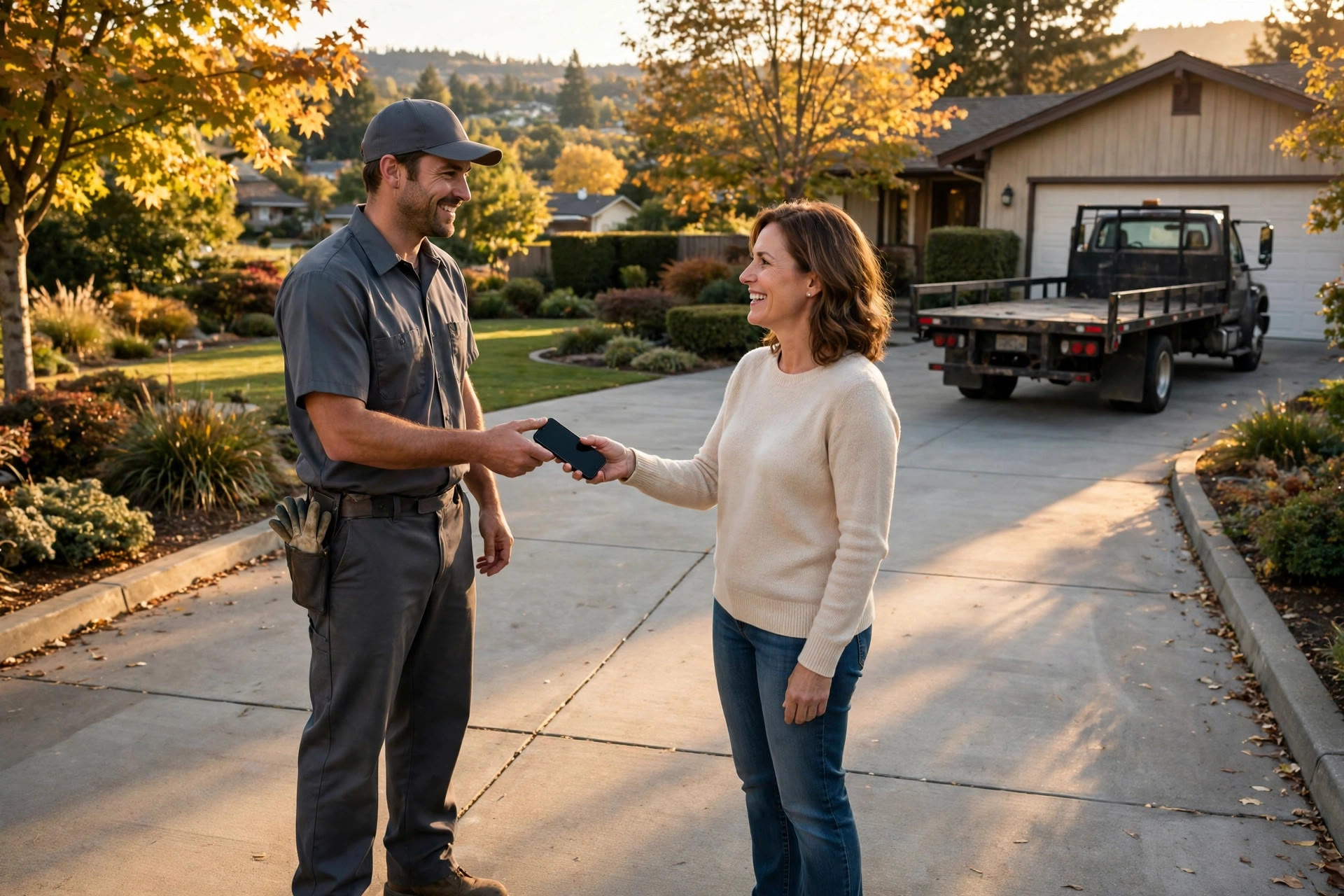
The in-person ask is the engine of every strong review flow: the crew asks at the job, the text with the link follows within the hour.
Review request scripts that actually work
Most review requests fail because they are vague. “Please leave us a review” puts all the work on the customer. A good script does three things: it reminds them of the specific good thing you did, it tells them exactly where to go, and it makes the whole thing sound like 30 seconds of effort. Below are scripts you can copy word for word. Swap in your company name and your own details.
The in-person crew script
This is said by the crew lead after the final walkthrough, when the customer is looking at the clean space. Keep it natural, one or two sentences, never a speech: “We are all done, and it looks great in here. If you are happy with the work, would you mind leaving us a quick Google review? I will have the office text you a link, it takes about 30 seconds.” That is it. The customer says yes, the text arrives within the hour, and the review happens. Train every crew lead to say some version of this on every single job, not just the ones where the customer seems chatty. The quiet customers review too, sometimes at even higher rates, because nobody else asks them.
The text within the hour
Send this from your business number within 60 minutes of the job ending: “Hi [Name], this is [Company]! Thanks for choosing us today. If you have 30 seconds, would you share your experience on Google? It really helps our small team: [review link].” Short, warm, specific. The link must go straight to your Google review form, not your homepage, not your Facebook page. Every extra tap loses people. If your texting tool supports it, this is the message to automate: job marked complete in your system, text goes out automatically.
The next-day follow-up
One follow-up, no more. Send it the next afternoon to customers who got the first text but did not review: “Hi [Name], just a quick follow-up from [Company]. If yesterday’s cleanup earned it, we would love a short Google review: [review link]. No worries at all if not. Thanks again!” The “no worries at all if not” line matters. It keeps the message friendly instead of nagging, and friendly messages get answered. Do not send a third text. Do not call about the review. One reminder is the line between persistent and annoying.
The photo request
Reviews with photos carry extra weight with both Google and future customers. Add this line to the in-person script when the job had a dramatic before-and-after: “If you happened to snap a before photo, adding it to your review helps other customers see what we do.” Many customers took one and never thought to share it. Those photo reviews become your best marketing assets. Just as important: ask permission to reuse their photos on your website and social pages. Most will say yes on the spot, and that content is free.
The commercial and property-manager version
Repeat commercial work, property managers, realtors, and contractors book differently and review differently. They will not tap a text link between showings. Send a short email instead, and make the ask about the relationship, not the single job: “Hi [Name], we have cleared [number] units for you this quarter. If our crew has made your turns easier, a Google review from a property manager carries a lot of weight with other managers. Here is the direct link: [link].” One detailed review from a property manager can be worth twenty residential ones, because it speaks directly to your most valuable buyers.
Make leaving a review take 30 seconds
Every tap you remove between the customer and the review form raises your response rate. Your goal is one tap from the text message to a screen where they can pick five stars and type. Here is how to set that up.
First, get your direct Google review link. Open your Google Business Profile, go to the section for getting reviews, and copy the short link Google gives you. Test it on your own phone: it should open a review form for your business with no searching and no scrolling. That link goes in every text, every email, and behind every QR code.
Second, put a QR code on the paper invoice or the printed receipt. Many junk removal customers are older homeowners who are comfortable with a phone camera but will not type a link. A QR code labeled “Scan to review us on Google” catches the ones the text misses. Print it large, test the scan yourself, and make sure the code points at the review link, not your homepage.
Third, consider an NFC tag for your crew leads. A small sticker on the back of the crew lead’s phone or on the invoice lets a customer tap their phone and land on the review form. It feels modern, it takes two seconds, and it gives the crew a natural prop for the in-person ask: “Just tap your phone here and it opens our review page.” NFC tags cost a few dollars each and work with most modern phones.
Finally, check your Google Business Profile itself. A customer who taps your link should land on a profile that looks alive: correct hours, a real phone number, recent photos of your trucks and crew, and replies on your recent reviews. If the profile looks abandoned, some customers will bail before writing. The profile is the last inch of the funnel, so keep it sharp.
Review tools compared: which one fits a junk removal crew
You can run a review system with nothing but your phone and a spreadsheet. Software just makes it automatic and consistent, which is where most owner-run systems fall apart. Here is how the options stack up for a typical junk removal operation.
| Approach | Typical cost | How it works | Best for |
|---|---|---|---|
| Manual texting | Free | Crew lead or office staff sends the review link by text after each job, tracks follow-ups in a list | One- or two-truck operations doing under 30 jobs a month; works fine if someone owns the habit |
| Review software | $75 to $400 per month | Connects to your job system, sends review texts automatically when a job is marked complete, sends one follow-up, shows a dashboard of who reviewed | Growing companies doing 40 or more jobs a month, or owners who want it to run without daily attention |
| All-in-one CRM with review tools | $150 to $600 per month | Review requests built into the same system that handles booking, reminders, and customer messages | Companies that also want to fix missed calls and automate follow-ups in one place; pairs well with an AI chatbot for junk removal companies that answers after-hours inquiries |
| Google Business Profile alone | Free | You share the review link manually and rely on customers to find it | Nobody, as a primary strategy; fine as the destination, not as the system |
The honest advice: start manual, prove the habit, then automate. If your crew will not ask in person and nobody sends the text, software will not fix that; it will just automate an empty process. Get two weeks of consistent in-person asks and same-hour texts working by hand. Once the habit is real, software multiplies it by removing the busywork of sending every text and follow-up yourself. If missed calls are also costing you jobs while the crew is on site, a missed-call text-back system for junk removal plugs the other hole in the same funnel.
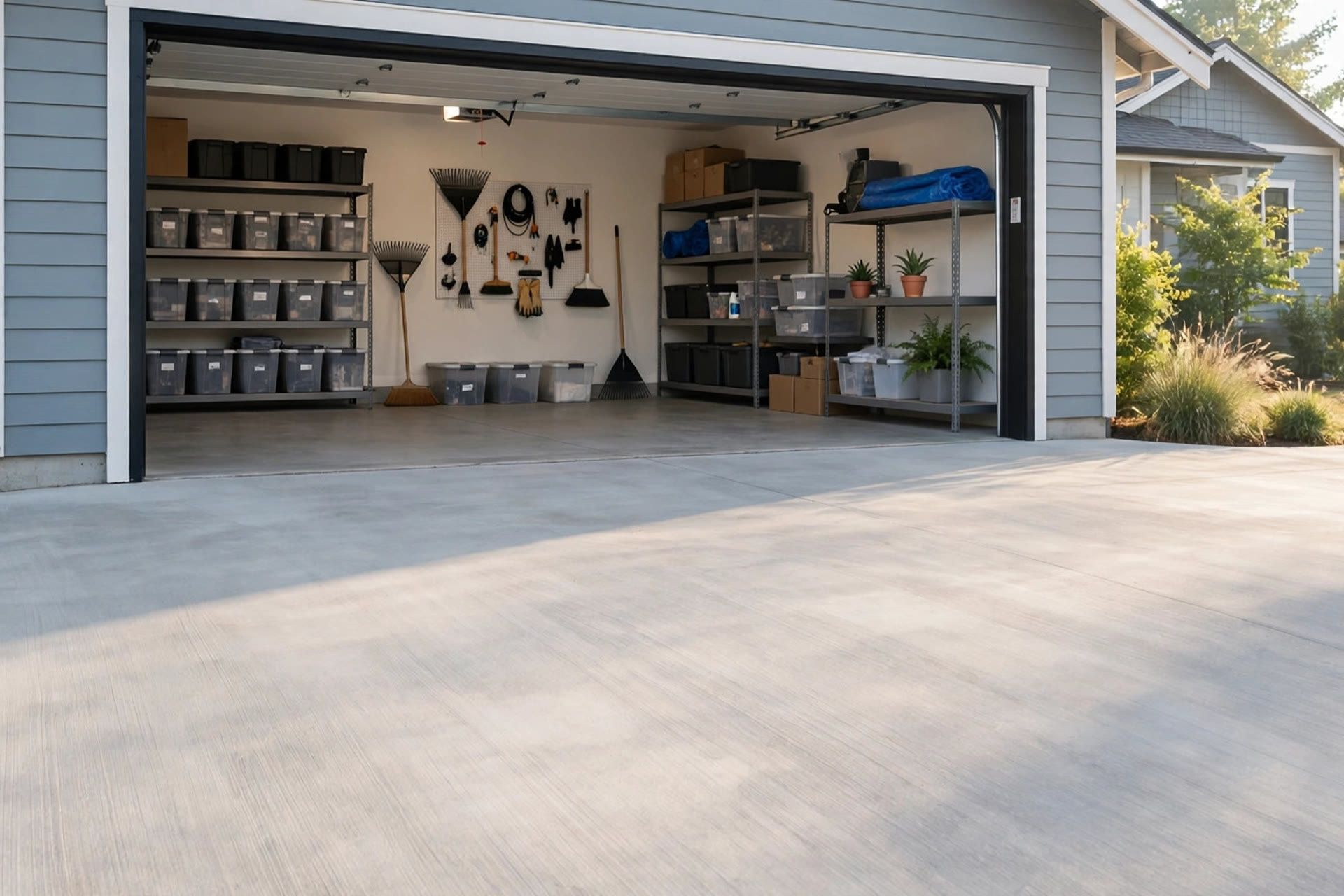
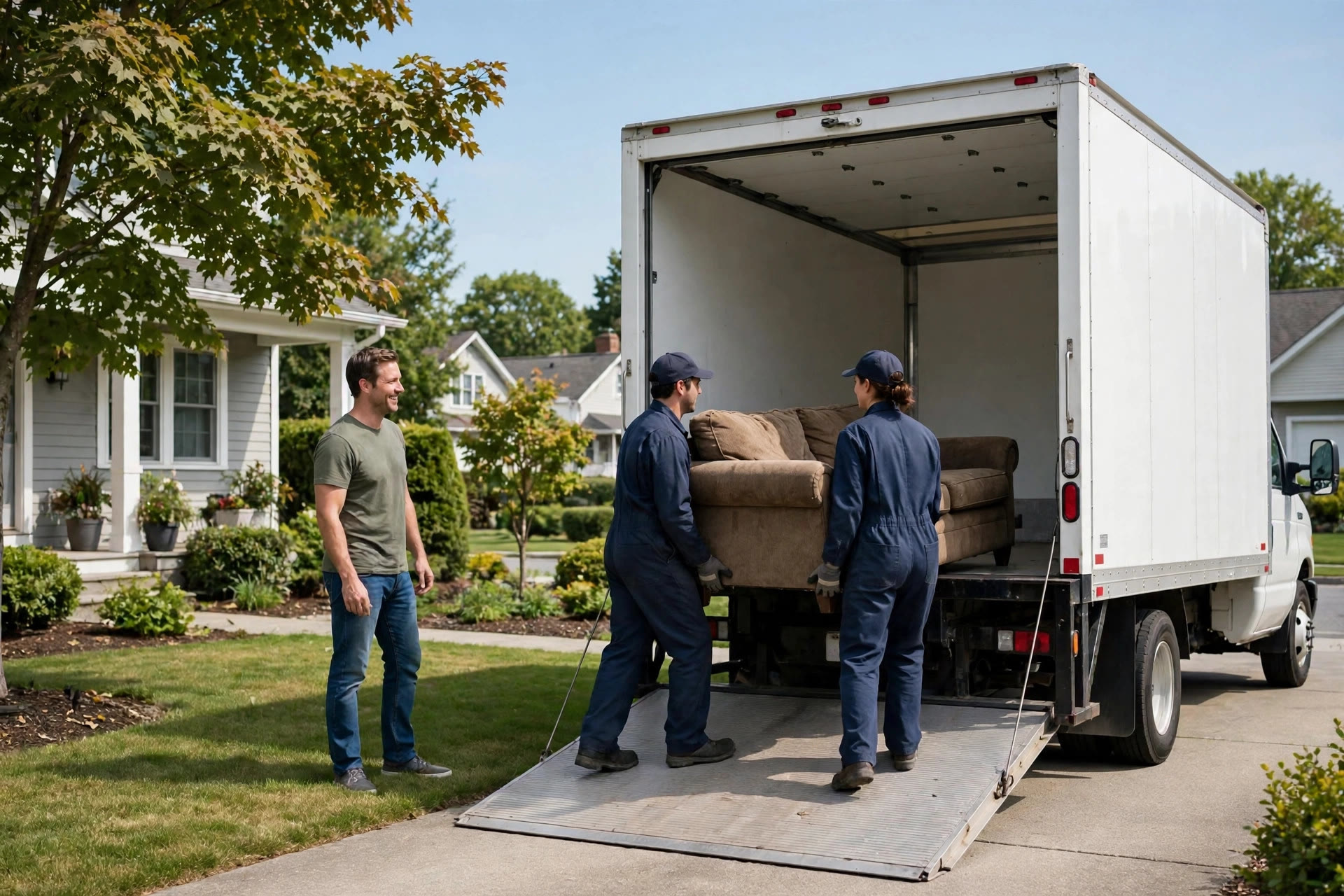
The golden window opens the moment the customer sees the clean space. That feeling is what turns into a five-star review.
Train your crew to ask without being pushy
Your crew talks to every customer. Your office talks to almost none. That makes the crew the most important part of the review system, and most owners never train them on it. Training is not a pep talk. It is a short, specific routine baked into the job checklist.
Add the ask to the job completion steps, right after the final walkthrough and payment. The crew lead already walks the customer through the finished space. That is the moment. Give them one sentence to memorize and permission to say it in their own words. Role-play it once in a team meeting so it stops feeling awkward. The first three times feel strange. By the tenth time it is just part of the job.
Make it worth their while. A small bonus for every review that mentions a crew member by name works better than a general team goal. Even $5 per named review adds up to real money for a crew member and costs you almost nothing per job. Post a simple leaderboard in the office: reviews earned per crew this month. Friendly competition does the rest. What you must never do is punish a crew for a bad review or tie their pay to the star rating. That creates fear, fear creates fake-sounding asks, and customers can smell a forced ask from across the driveway.
There is one hard rule to drill into everyone: never offer a discount, gift card, or any reward in exchange for a review. Google’s policy forbids review incentives, and a competitor or a disgruntled customer can report you. Reviews earned this way can be removed, and the profile can be penalized. Ask for honest reviews from happy customers. That is the whole policy, and it is also the strategy that works long term.
Answer every review, especially the bad ones
Replying to reviews is the highest-ROI ten minutes of your marketing week. Future customers read your replies as closely as they read the reviews. A business that answers looks active, accountable, and human. A business with 200 reviews and zero replies looks like it stopped caring.
For five-star reviews, keep it short and personal. Use the reviewer’s name, mention something specific from their review, and thank them. “Thanks, Maria! Glad we could get that garage cleared before your move. Enjoy the new place!” takes twenty seconds and shows the next hundred readers that a real person is behind the business. Rotate who replies if you have office staff, so the voice stays fresh.
For bad reviews, follow a strict playbook. Reply within 24 hours. Apologize once for the experience, without groveling and without admitting things that are not true. Show you take it seriously and move the conversation offline: “We are sorry the pickup ran late and the communication fell short, James. That is not how we run our routes. Please call me directly at [number] so we can make this right. – [Your name], Owner.” Then actually fix it. Never argue, never blame the customer, never post a defensive essay. Readers are not judging the complaint; they are judging your response. A calm, professional reply to a one-star review can win you more business than ten five-star reviews, because it shows how you handle problems.
Watch for the review patterns, not just individual reviews. If three reviews in a month mention late arrivals, that is an operations problem wearing a marketing costume. Reviews are free customer research. Read them monthly, sort the complaints by theme, and fix the top one. The review count keeps climbing because the service keeps improving, and that is the only sustainable way to hold a high rating at scale.
Put your reviews to work beyond Google
Reviews you already earned are marketing assets sitting unused. Put them to work everywhere a customer makes a decision.
Start with your website. A testimonials page that pulls in your best Google reviews, with names and job types, turns your site from a brochure into proof. Add a short review strip to your homepage and your quote pages, right where the visitor is deciding whether to call. If you run Google Ads or Local Service Ads, your star rating and review count show up in the ad itself, and higher ratings directly lift click rates. The same reviews that help you rank organically make your paid clicks cheaper per booked job.
Use them in your quotes and follow-ups too. When you send a written estimate, include two or three short review quotes from similar jobs: a garage cleanout quote gets garage cleanout reviews. For repeat commercial clients, a one-page sheet of property-manager reviews can be the difference in a bid. And do not forget the truck. A simple line on the back of the truck, “Rated 4.8 from 600+ local reviews,” turns every mile into advertising. Just keep the number honest and update it twice a year.
The same playbook works in any home service trade. If you want to see how the timing and scripts change for a different kind of job, our guide on getting Google reviews for moving companies covers the differences, and the towing version at getting Google reviews for towing companies shows how to ask customers who called you in a stressful moment.
The money math: review count vs call volume
Reviews are not vanity. They move the two numbers that matter: how many people call, and how many callers book. The table below shows what typically happens as a junk removal company climbs the review ladder, for a company doing about 60 jobs a month.
| Review profile | Map visibility | Calls per month | Booking rate |
|---|---|---|---|
| Under 30 reviews, 4.2 stars or lower | Rarely in the top 3 map results | Baseline | Baseline |
| 80 to 150 reviews, 4.6 stars or higher | Regularly in the top 3 | About 25 to 40 percent more calls | Callers arrive pre-sold, so close rates rise |
| 250+ reviews, 4.7 stars or higher, recent reviews weekly | Dominates the map pack | About 50 to 80 percent more calls | Highest: trust is established before the first hello |
Mistakes that quietly kill your review flow
Asking too late. The three-day-later email is the most common review system in junk removal, and it barely works. If your only ask goes out after the gratitude has faded, you are leaving most of your reviews on the table. Move the ask to the job site and the first hour after.
Only asking the chatty customers. Crews naturally ask the friendly talkers and skip the quiet ones. The quiet ones review at high rates when asked, because nobody ever asks them. The rule is every job, every customer, no exceptions.
Review gating. Some tools ask the customer “were you happy?” and only send the Google link to the ones who say yes. Google forbids this. It is called review gating, and it can get reviews removed and profiles penalized. Send every customer the same link, every time.
Linking to the wrong place. A QR code that opens your homepage, a text link that opens your Facebook page, a button that opens a dead page. Test every link and code on a real phone monthly. One broken link can silently kill months of asks.
Ignoring bad reviews. An unanswered one-star review sits at the top of your profile for years, and every future customer reads it. Answer within 24 hours, every time, with the playbook above.
Fake reviews. Buying reviews, writing your own, or having family post them. Google’s detection keeps improving, and one cleanup can wipe out a year of real reviews along with the fake ones. It is never worth it.
Stopping when the count looks good. Reviews have a shelf life in the customer’s mind. A profile whose newest review is four months old looks dormant, even with 300 total. Google also weighs recency in rankings. A steady few reviews a week beats a burst twice a year.
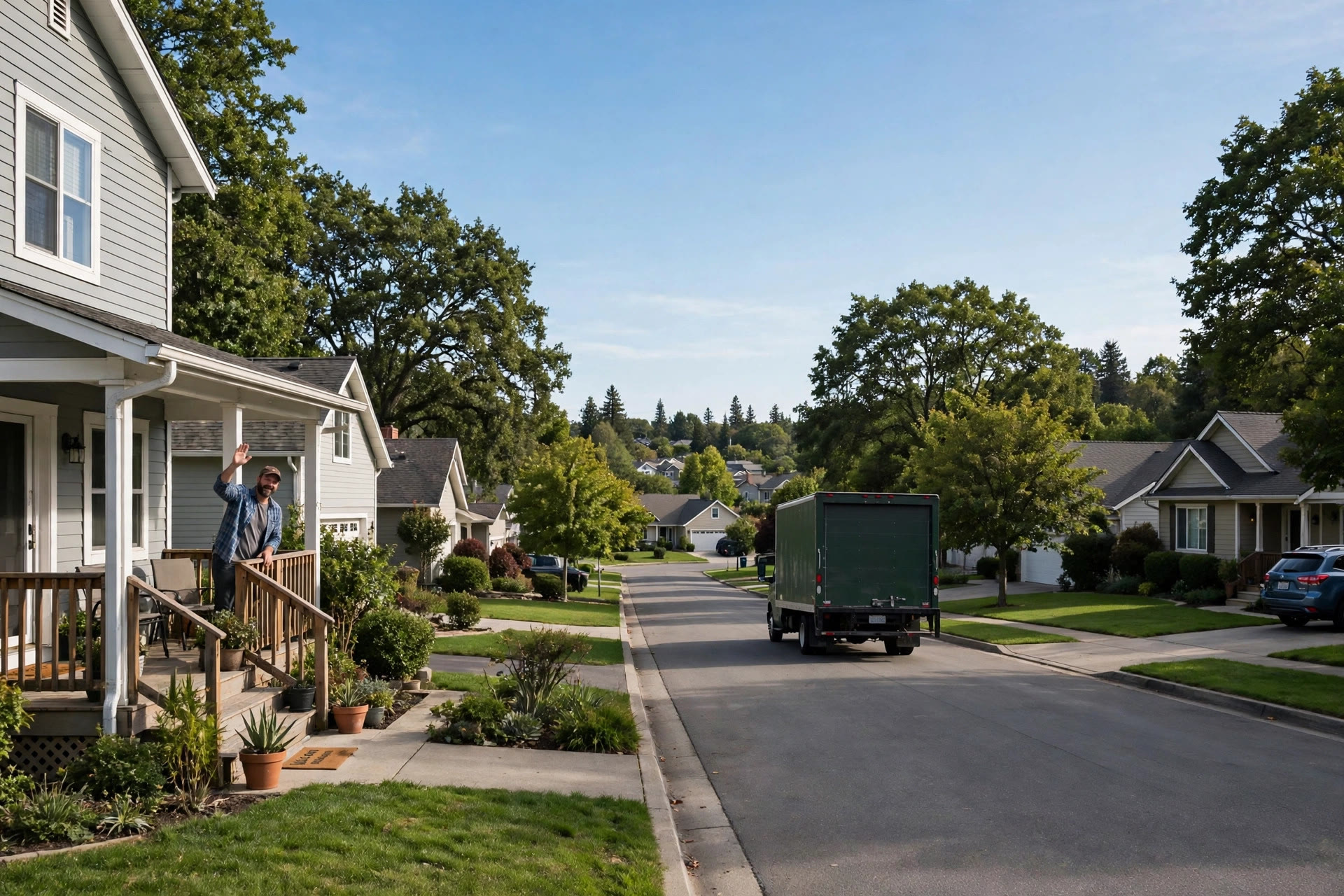
Every finished job is a review waiting to happen. The companies that ask consistently are the ones that dominate the map.
Your rollout checklist
Work through these in order. Each one builds on the last.
- 1Claim and polish your Google Business Profile. Correct hours, phone, service area, and ten or more real photos of trucks, crew, and finished jobs.
- 2Get your direct review link. Copy Google’s short review link and test it on your phone: one tap should open your review form.
- 3Write your three scripts. The in-person crew ask, the within-the-hour text, and the one next-day follow-up. Keep each under 40 words.
- 4Add the ask to the job checklist. Final walkthrough, payment, then the crew lead asks for the review. Every job, every customer.
- 5Set up the same-hour text. Manual at first, automated later: job marked complete triggers the review link text within 60 minutes.
- 6Print the QR code. Put “Scan to review us on Google” on the invoice or receipt, pointing at the direct review link, and test the scan.
- 7Train the crew. One team meeting, role-play the ask twice, explain the no-incentive rule, and announce the named-review bonus.
- 8Assign review replies. One person owns replies, answers good reviews weekly, and answers every bad review within 24 hours.
- 9Reuse your best reviews. Add review quotes to your website, estimates, and the back of the truck once you have them.
- 10Track it monthly. New reviews, average rating, response rate by crew, and calls from Google. Fix whatever the numbers flag.
Frequently asked questions
How many Google reviews does a junk removal company need?
Enough to beat the top three competitors in your service area, and then keep going. In most local markets that means 100 to 200 reviews to compete and 250 or more to dominate. After that, recency matters more than the total: a steady flow of new reviews each week keeps you ahead.
Is it against Google’s rules to ask customers for reviews?
No. Asking for honest reviews is fully allowed and Google expects it. What is forbidden is offering payment, discounts, or gifts in exchange for reviews, and review gating, which means only sending the review link to happy customers. Ask everyone, offer nothing, and you are fine.
Should we ask for reviews by text or email?
Text, for residential jobs. Text messages get opened within minutes and the customer can tap straight to the review form. Email works as a backup and for commercial clients like property managers, who live in their inbox. The winning combo is a text within the hour plus one email for commercial accounts.
What do we do about a fake or unfair review?
Reply calmly first, because your response is public and permanent. Then flag the review in your Google Business Profile if it clearly violates policy, such as a review from someone who was never a customer. Google removes some and ignores others, so do not count on removal. The best defense is volume: ten new honest reviews bury one unfair one.
Can we get reviews removed if the customer was rude?
No. Rudeness is not a policy violation, and Google will not remove a review just because you disagree with it. A professional public reply that shows you tried to fix the problem does more for your business than a removal ever would, because future customers read the reply.
How do we get customers to include photos in reviews?
Ask at the moment of peak satisfaction, right after the final walkthrough. Say the specific line: “If you took a before photo, adding it to your review really helps other customers.” Many did take one. You can also ask permission to use their photos in your own marketing, which most customers grant on the spot.
Should the owner reply to reviews or can staff do it?
Either works as long as one person owns it and the voice sounds human. Owner replies carry extra weight on bad reviews, so sign those personally. For good reviews, a trained office team member replying weekly is plenty. The only wrong answer is nobody replying.
Do reviews really affect our Google ranking?
Yes. Review quantity, average rating, and review recency are established local ranking signals for the map results. They also affect click-through rate, which feeds back into visibility. Companies with more recent reviews consistently outrank otherwise identical competitors.
How long before we see results from a review system?
You will see new reviews within the first week if the crew asks consistently. Ranking and call-volume movement usually takes one to three months of steady review flow. Most companies notice the phone ringing more before they notice the ranking change, because click-through improves first.
What is the biggest mistake junk removal companies make with reviews?
Asking too late or not at all. The typical company does great work, the customer is thrilled for an hour, and nobody asks. Then the moment passes. A simple in-person ask plus a text within the hour fixes the biggest leak in the entire system.
Turn every finished job into your next five jobs
Digital Hayder builds review and follow-up systems for junk removal companies: automated review texts after every job, missed-call text-back so no inquiry goes cold, and AI chat that answers after hours. Tell us about your operation and we will design the system around it.
Contact Us