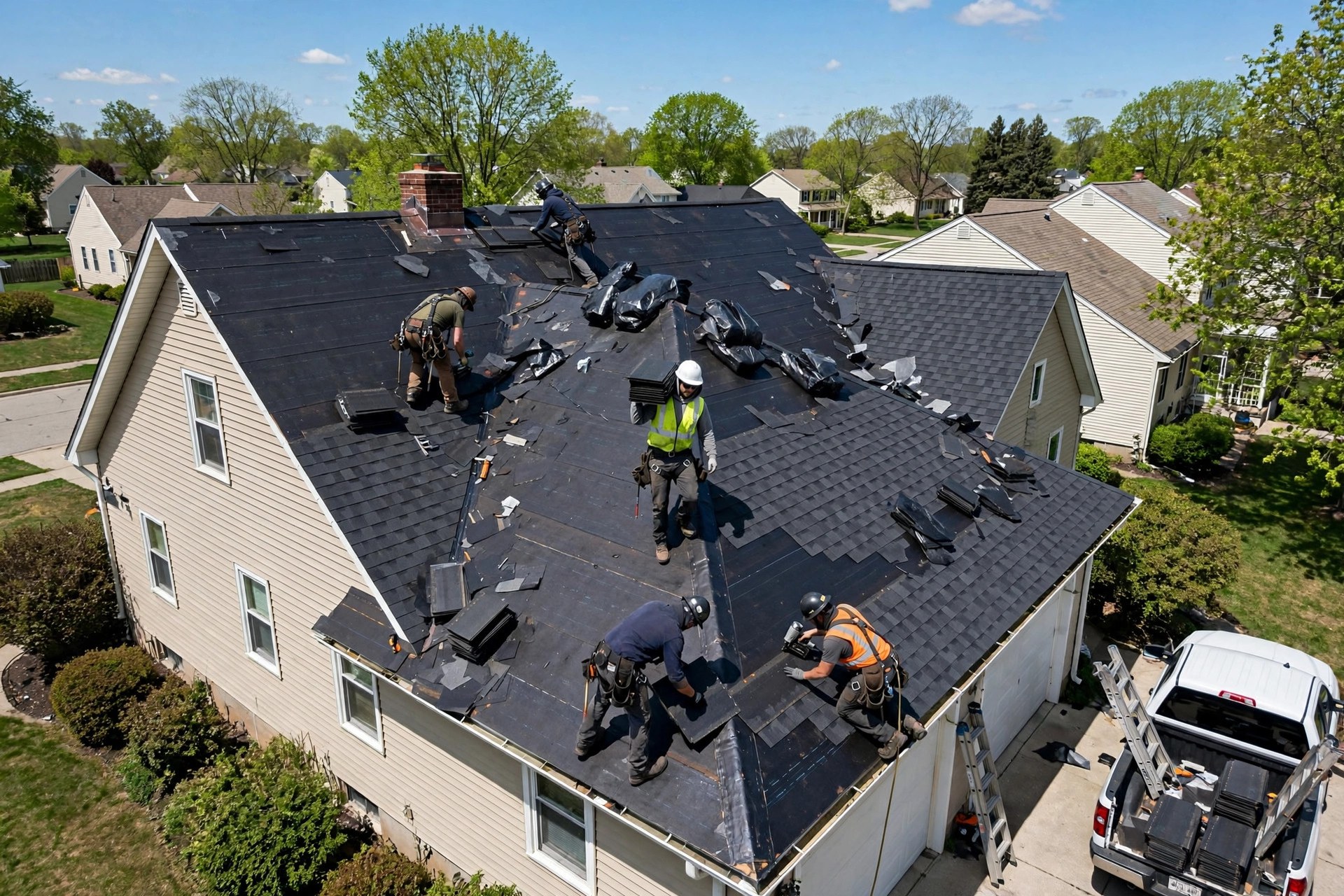
Roofing is the most event-driven trade in home services. One hailstorm can create six months of demand overnight, and the roofers who are visible when homeowners start searching capture it. The ones who are not watch storm-chasing out-of-towners take the work. Local SEO for roofers is about being the obvious local choice in both modes: the storm surge, when homeowners search “hail damage roof repair” and “roofing companies near me” in a panic, and the steady season, when they research “roof replacement cost” and compare roofers over weeks. This guide covers the full playbook: your Google Business Profile, a storm keyword strategy, project galleries that sell $15,000 jobs, a review system built for roofing, service pages, citations, website conversion, and how to track whether the phone is ringing because of search.
The quick answer
- Storm season is the Super Bowl: hail and wind damage searches spike after every storm, so your storm content and profile must be ready before the clouds gather.
- Profile built for roofing: correct categories, storm damage services listed, and a photo library of real roofs prove you are local and legit.
- Project galleries sell replacements: before and after photos of real roofs in real neighborhoods do more than any headline.
- Reviews beat the storm-chaser fear: homeowners worry about fly-by-night roofers, so volume, recency, and local detail in reviews win.
- Service pages per job: roof replacement, roof repair, storm damage, metal roofing, and gutters each need a dedicated page.
- Track estimates, not just calls: a roofing lead is only real when it becomes an inspection or an estimate. Measure that.
Why roofing local SEO runs on storms and trust
Most trades have steady demand. Roofing has weather. A single severe hailstorm can damage thousands of roofs in one metro area, and within 48 hours every affected homeowner is searching for a roofer. The companies that appear in those searches, with strong reviews and clear storm-damage messaging, book inspections for months. The companies that do not appear lose the work to whoever does, including out-of-area storm chasers who arrive with no local reputation and leave when the claims dry up. Homeowners know this, which is why trust signals matter more in roofing than in almost any other trade. Every element of your local SEO has to answer one question: is this a real local roofer I can trust with a five-figure job?
Between storms, demand runs on the slow cycle: aging roofs, planned replacements, and repairs. These homeowners research. They read cost guides, compare warranties, and check reviews carefully. Your organic pages, your gallery, and your content win these jobs over weeks, not minutes. A roofing company that only prepares for storms starves between them. A company that only builds slow-cycle content gets overrun when the hail hits. This guide builds both.
Your Google Business Profile for roofing
The profile is where storm searches land. “Roofing companies near me” and “hail damage roof repair” both trigger the map pack, and the homeowner calls from the listing. A roofing profile has to look established, local, and busy.
Categories, services, and storm coverage
Set the primary category to “Roofing contractor” exactly. Add “Roof repair service,” “Gutter cleaning service” if you do gutters, and “Siding contractor” only if you genuinely do siding. Build the services list around real roofing jobs: roof replacement, roof repair, storm damage repair, hail damage inspection, wind damage repair, emergency roof tarping, metal roofing installation, flat and low-slope roofing, gutter installation and repair, skylight installation, and roof maintenance plans. Write each with a plain description. Cover storm phrases in the description and posts: “hail damage roof repair,” “wind damage,” “storm damage inspection,” “insurance claim assistance.” After a storm, post immediately: “Hail hit [area] last night. We are offering free storm damage inspections this week. Here is what hail damage looks like,” with a real photo.
Photos that prove you are local
Roofing photos should do two jobs: prove quality and prove locality. Upload before, during, and after shots of real replacements: the old roof, the tear-off, the new shingles going on, the finished roof. Add drone or high-angle shots of completed roofs, crew photos on job sites, and your trucks and trailers at real addresses. Name files with the neighborhood or town. A profile with 50 photos of real local roofs tells a homeowner everything they need to know. If you run paid ads during storm season too, our guide to roofer Google Ads costs helps you budget paid and organic together.
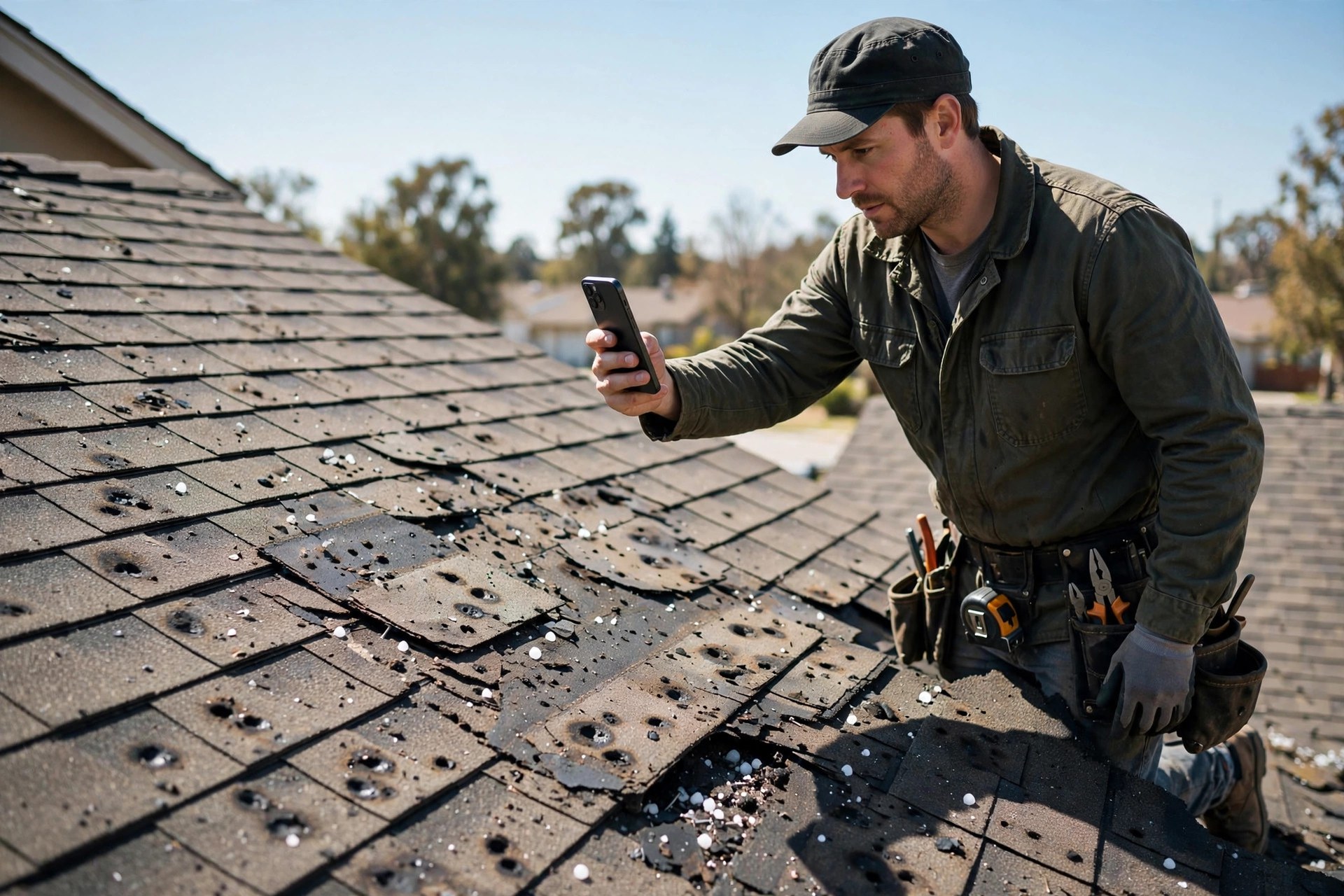
Documented damage photos from real inspections build credibility for storm-related searches.
Storm keyword strategy: hail, wind, and insurance searches
Storm searches follow a predictable pattern, and your content and profile should be positioned for each stage. Understanding the pattern is what separates roofers who capture storm demand from roofers who watch it pass.
The three stages of storm search
Stage one, the night of the storm: “hail damage,” “roof leaking after storm,” “emergency roof repair.” Panic searches, map pack winners. Stage two, the week after: “hail damage roof repair,” “roofing companies near me,” “free roof inspection.” Comparison searches, reviews and photos decide. Stage three, the month after: “roof replacement cost,” “how to file a roof insurance claim,” “best roofing shingles.” Research searches, content and guides win. Your profile covers stages one and two. Your website content covers stage three. Most roofers prepare for none of them in advance and scramble when the storm hits, which is exactly when you cannot afford to be building pages.
Insurance claim content wins stage three
The insurance claim process confuses homeowners, and the roofer who explains it clearly wins trust before the estimate. Build a plain-language guide: how to tell if you have hail damage, what to document before calling anyone, how the adjuster visit works, what “recoverable depreciation” means in plain terms, and how your company helps through the process. Be careful and honest: explain that you help document damage and meet the adjuster, not that you “handle the whole claim” or guarantee approval. This content ranks for high-value searches, gets shared in neighborhood groups, and pre-sells the caller. It also positions you against storm chasers, who never invest in this kind of local content.
Project galleries: the before and after engine
Nobody buys a $12,000 to $25,000 roof from a headline. They buy it from proof. Project galleries are the highest-converting asset a roofing website can have, and they double as local SEO fuel because each project page can rank for its neighborhood and roof type.
Build galleries that sell
Photograph every replacement: the worn roof before, the tear-off in progress, underlayment going down, shingles being installed, and the finished roof from the street and from above. Publish them as project pages with the neighborhood, the roof size, the shingle type and color, the timeline, and a short note on what was wrong with the old roof. “Roof replacement in [neighborhood]: 2,400 sq ft, architectural shingles, completed in two days.” These pages rank for “[neighborhood] roofing” searches, give your sales team proof to share, and show homeowners exactly what their street could look like. Ten strong project pages beat a generic gallery of unlabeled photos every time.
Video walkthroughs and drone footage
Short video walkthroughs of completed roofs, even shot on a phone, outperform photos for engagement. A 60-second walkaround where you point out the ridge vent, the flashing details, and the clean gutters shows craftsmanship that photos cannot. Drone footage of finished roofs makes strong profile and social content. Keep it real: homeowners trust a slightly rough real video more than a polished stock clip, because the rough one proves you were actually on that roof.
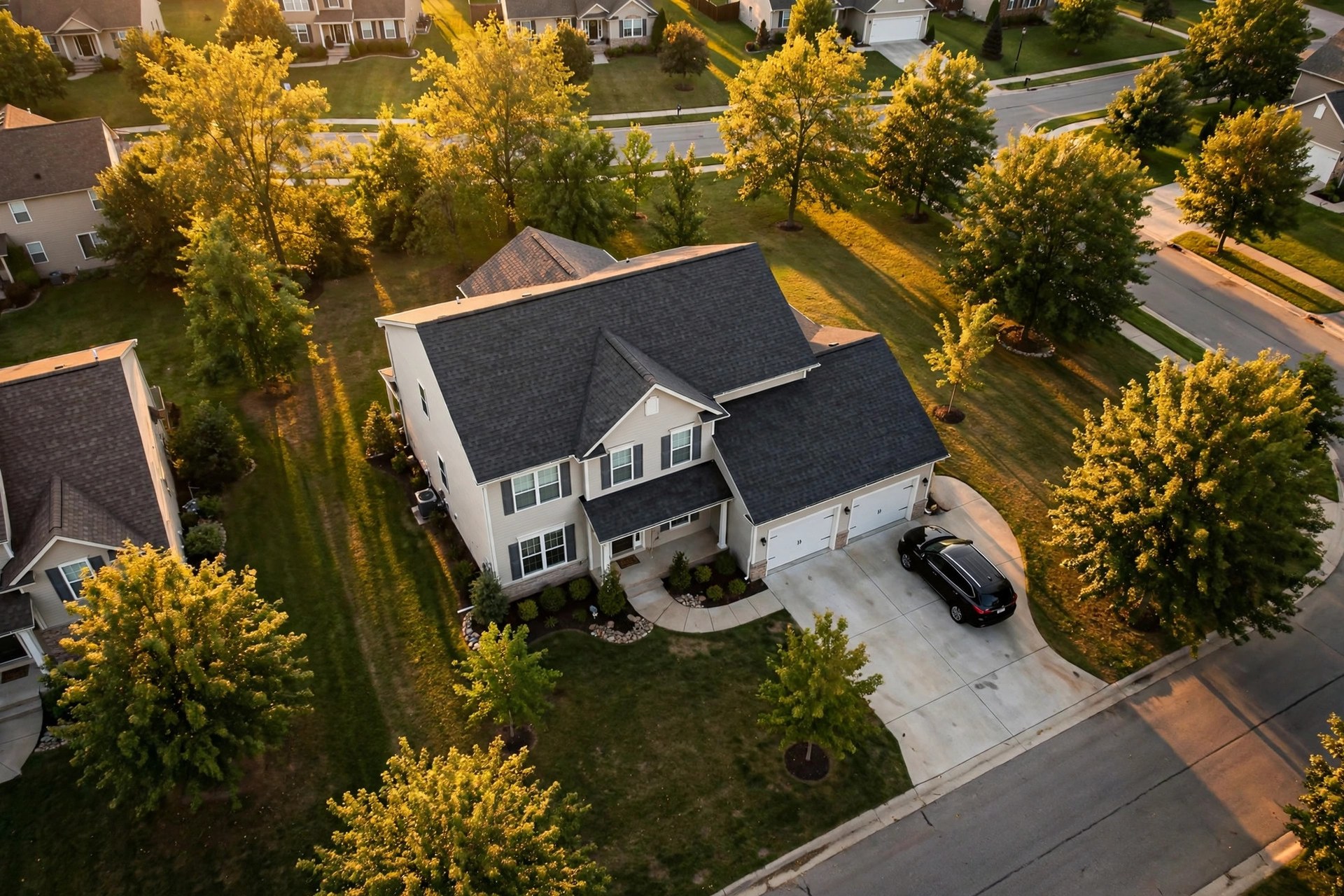
Finished-roof photography, especially from above, is the proof that sells five-figure replacements.
Reviews for roofers: timing, scripts, and the storm-chaser fear
Roofing reviews carry more weight than reviews in most trades because the purchase is large and the storm-chaser fear is real. Homeowners read reviews looking for proof that you are local, that you finish jobs, and that you handle insurance claims honestly. Volume, recency, and local detail all matter. For the complete system, see our guide on how to get more Google reviews for roofers.
When to ask on roofing jobs
Repairs: ask at completion, when the leak is fixed and the customer is relieved. Replacements: ask at the final walkthrough, with the new roof gleaming and the yard clean. The script names the job and the place: “The new roof is done and the yard is clean. If you are happy, would you leave a Google review mentioning the roof replacement here in [neighborhood]? I can text you the link.” Text the link the same day. For replacements, follow up a week later after the first rain, when the customer has seen the roof perform: “Hope the roof handled the rain well last night. If you have a minute, that review link is still good.” Storm and insurance jobs get the ask after the claim is approved and work is complete, when relief is highest.
Answer reviews like a local
Respond to every review, and write like a neighbor, not a corporation. Thank customers by name, mention the neighborhood and the work: “Thanks, Maria. That hail damage in [neighborhood] was some of the worst we saw this spring. Glad the new roof is holding up.” These responses do triple duty: they show future customers you are local and attentive, they add neighborhood keywords to your profile, and they demonstrate the follow-through that separates local roofers from storm chasers. Answer negative reviews calmly and factually, then take details offline.
Service pages: one page per roofing job
Your website needs a dedicated page for each major roofing service, written for homeowners and structured for Google. A single “Services” page ranks for nothing.
The pages every roofer needs
Roof replacement, roof repair, storm and hail damage repair, metal roofing, flat and low-slope roofing, and gutter installation. Each page needs: a headline naming the service and the city, a click-to-call number and an estimate form visible on mobile, a plain description of the work, signs the homeowner needs it, your process from inspection to final walkthrough, honest pricing ranges, real project photos, reviews about that service, and an FAQ. The storm damage page is the most important one in hail country: it should cover what hail damage looks like, the free inspection offer, the insurance process, and emergency tarping. Local detail matters: common shingle types in your area, local building codes, and typical roof lifespans in your climate.
Cost pages for the researchers
“Roof replacement cost” is one of the highest-value searches in home services, and the roofer who answers it honestly wins the researcher. Publish real ranges: architectural shingle replacement typically runs $8,000 to $20,000 depending on size, pitch, layers, and local labor; metal roofing runs higher; repairs run $300 to $1,500 for common fixes. Explain what moves the price: roof size and complexity, material choice, tear-off layers, decking repairs, and permit costs. End with your estimate process. Homeowners who read your cost guide call you already half-sold, and they price-shop less because you were the honest one.
| Search stage | Example query | What should rank |
|---|---|---|
| Storm night (panic) | roof leaking after storm | Google Business Profile with emergency tarping listed |
| Storm night (panic) | emergency roof repair near me | Profile plus a concise emergency service page |
| Week after (compare) | hail damage roof repair | Storm damage service page with inspection offer |
| Week after (compare) | roofing companies near me | Profile backed by strong reviews and photos |
| Month after (research) | how to file a roof insurance claim | Insurance claim guide on your site |
| Month after (research) | roof replacement cost | Cost guide with real ranges |
| Planned (research) | metal roof vs shingles | Comparison guide linking to both service pages |
| Planned (compare) | best roofing company [city] | Reviews, project gallery, and about page |
Citations and NAP consistency
Citations are listings of your name, address, and phone across directories: Yelp, Angi, HomeAdvisor, Thumbtack, BBB, Apple Maps, Bing Places, Facebook, and trade directories. Inconsistent citations quietly drag rankings down. Pick one exact format for name, address, and phone and match it everywhere, character for character. Roofing companies rebrand and change numbers often, which makes duplicates common; audit yearly and merge or remove stale listings.
Roofing-specific directories
Beyond the majors, get listed where roofing buyers look: manufacturer certification programs, which double as trust signals, the BBB with accreditation if you qualify, your local home builders association, and neighborhood platforms like Nextdoor, where roofing recommendations spread fast after storms. A complete Nextdoor business page with reviews is worth real effort in hail country, because that is where neighbors ask neighbors for roofer recommendations the week after a storm.
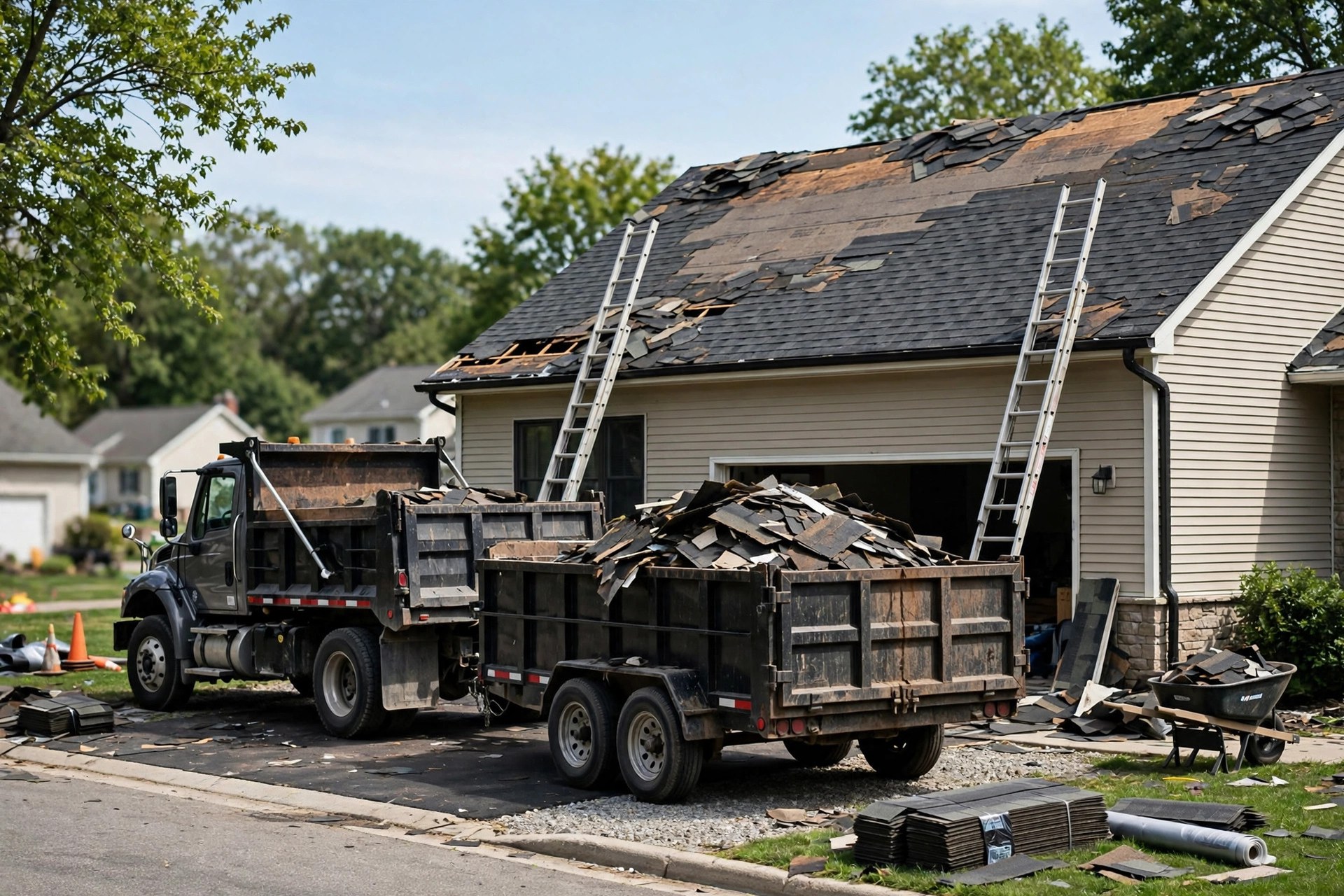
Branded trucks and clean job sites in your photos tell homeowners the crew is professional.
Website conversion: estimates, financing, and insurance help
Rankings produce visitors. The website turns visitors into inspections. Roofing sites have to serve two very different visitors: the storm victim who needs help now, and the planner comparing options over weeks.
Make the estimate path obvious
Every page needs two clear paths: call now, and request a free inspection or estimate. The estimate form should be short: name, phone, address, and what is wrong. Long forms kill conversions; you can collect details on the call. Add click-to-call prominently on mobile. Mention financing plainly, because a $15,000 roof is a financing decision for most homeowners: “financing available” with the real terms beats hiding it. For storm visitors, a dedicated banner or pop-up after storms works: “Hail hit [area]? Free storm damage inspections this week,” linking to the inspection form.
Trust elements that close five-figure jobs
Large purchases need large proof. Layer it: manufacturer certifications stated plainly, license and insurance with numbers, workmanship warranty terms in writing, project galleries with neighborhoods named, reviews pulled onto service pages, and a team page with real photos. Address the storm-chaser fear directly on the site: “Locally owned, [X] roofs completed in [metro area], here before the storm and here after.” Specific numbers beat vague claims. A counter of completed local roofs, updated yearly, is worth more than any badge.
Costs, timelines, and DIY vs hiring an agency
Local SEO costs time or money. Here are the real bands for roofing companies.
The DIY path
Doing it yourself costs nothing but time: roughly 20 to 30 hours for the initial build across the profile, service pages, and citation cleanup, then 5 to 8 hours a month for reviews, posts, photos, galleries, and tracking. Storm season adds spikes: after a hail event, expect extra hours for posts, inspection-form monitoring, and review follow-up. The DIY path works if someone owns it. It fails when the work stops, which usually happens right when storm season demands the most.
What agencies charge roofers
Agencies serving roofers typically charge $1,000 to $3,000 a month for ongoing local SEO, with setup projects at $1,500 to $4,000. Roofing costs more than some trades because the content and gallery work is heavier and storm response matters. Red flags: guaranteed rankings, secret methods, and reports showing rankings but never inspections booked. Ask how they track estimate requests, what they did for their last three roofing clients, and how fast they respond after a storm. For the bigger marketing picture beyond SEO, see our roofing marketing ideas guide.
A realistic timeline
Profile and citation fixes can move the needle in 30 to 60 days. Review velocity changes listing strength within 60 to 90 days. New service pages typically need 60 to 120 days to rank. The storm factor compresses everything: a roofer who prepares in the quiet months captures the surge, while one who starts optimizing after the hail is already behind. Realistic expectation: noticeable lead growth in 3 to 6 months, with storm seasons acting as accelerators for whoever is ready.
| Season | Searcher behavior | Your SEO move |
|---|---|---|
| Pre-storm season | Quiet, some planned replacements | Publish storm content, build galleries, stockpile reviews |
| Storm hits | Panic searches spike overnight | Post immediately, activate inspection banner, monitor forms hourly |
| Weeks after storm | Comparison and insurance searches | Push inspection content, claim guides, fresh review requests |
| Months after storm | Research and late claims | Cost guides, comparison content, project pages from storm jobs |
| Off season | Planned replacements, slow | Content library, citation audit, site speed and conversion work |
Common mistakes roofers make
No storm content ready. Scrambling to build pages after the hail means missing the surge. Prepare in the quiet months.
Generic photo galleries. Unlabeled stock-style photos prove nothing. Neighborhood-named project pages prove everything.
Ignoring the insurance question. Homeowners search claim help constantly. The roofer who explains it wins the trust.
Keyword-stuffed business names. “ABC Roofing Hail Damage Roof Replacement” risks suspension. Real name only.
No review system. Reviews arrive randomly and stall below competitors who ask on every job.
One “Services” page. Replacement, repair, storm damage, and metal roofing each need their own page.
Hiding prices. Researchers search costs first. Honest ranges pre-sell; silence sends them elsewhere.
Slow storm response online. Forms unmonitored for days after a storm donate inspections to faster competitors.
Tracking calls but not inspections. A roofing lead is only real at the inspection. Measure the full funnel.
Looking like a storm chaser. No local address, no local reviews, no local photos. Fix all three visibly.
Your rollout checklist
Work in order, and finish the storm preparation before the season starts.
- 1Complete the profile. Real name, “Roofing contractor” primary category, full services list including storm damage, tight service areas.
- 2Upload 20 real photos. Before, during, and after shots of real roofs, crews, trucks. Name files by neighborhood.
- 3Launch the review system. Ask at final walkthrough, text the link same day, follow up after the first rain.
- 4Build the storm damage page. Damage signs, free inspection offer, insurance process, emergency tarping.
- 5Publish the insurance claim guide. Plain-language help with documentation and the adjuster process.
- 6Build core service pages. Replacement, repair, metal roofing, flat roofing, gutters, each with local detail.
- 7Start project pages. Every replacement becomes a neighborhood-named page with photos, size, and materials.
- 8Fix NAP and citations. One exact format everywhere, roofing directories and Nextdoor included.
- 9Fix conversion paths. Short estimate form, click-to-call on mobile, financing stated plainly, storm banner ready.
- 10Track the full funnel. Calls, inspections booked, estimates sent, jobs won, attributed per channel monthly.
Frequently asked questions
How long does local SEO take for a roofing company?
Profile and citation fixes can show movement in 30 to 60 days. Reviews change listing strength within 60 to 90 days. Service pages typically need 60 to 120 days to rank. Storm seasons accelerate everything for roofers who prepared in the quiet months.
What is the most important local SEO factor for roofers?
The Google Business Profile plus reviews for storm and emergency searches, and service pages plus content for planned replacements. Roofing needs both because demand comes in both modes.
How should roofers prepare for storm season SEO?
Before the season: publish storm damage and insurance claim content, stockpile reviews and photos, and prepare a storm post template and inspection banner. When hail hits, post immediately and monitor estimate forms hourly. Speed wins the surge.
Do roofers need project galleries for SEO?
Yes. Before and after project pages with neighborhood names rank for local searches, convert researchers, and give your sales team proof to share. They are the highest-converting asset on most roofing sites.
How many reviews does a roofing company need?
More than the top local competitor, growing every month. For most markets, 100-plus reviews at 4.6 stars or better with local detail is a strong position. Storm-chaser fears make review volume especially persuasive in roofing.
Should I write about insurance claims on my roofing site?
Yes. Homeowners constantly search for claim help, and the roofer who explains the process plainly wins trust before the estimate. Be honest about your role: documenting damage and meeting the adjuster, not guaranteeing approvals.
What does local SEO cost for a roofing company?
DIY costs time: 20 to 30 hours for setup, 5 to 8 hours monthly plus storm spikes. Agencies charge $1,000 to $3,000 a month plus $1,500 to $4,000 for setup. Compare against ad costs: roofing clicks often run $20 to $70 each.
How do I compete with storm chasers in search?
Look unmistakably local: real local address, years of local reviews, neighborhood-named project photos, and local content they never invest in. Homeowners actively filter out out-of-towners when the signals are clear.
What pages does a roofing website need?
Roof replacement, roof repair, storm and hail damage, metal roofing, flat roofing, and gutters, plus cost guides, an insurance claim guide, and neighborhood project pages. Each with real photos and a clear estimate path.
What is the biggest local SEO mistake roofers make?
Having no storm content ready. Building pages after the hail means missing the surge. The quiet months are for preparation; storm season is for harvesting.
Win storm season before your competitors do
Digital Hayder helps roofing companies win local search with Google Business Profile optimization, storm content strategy, project galleries, review systems, and websites built to turn searches into inspections. Tell us about your market and we will show you where competitors are beating you.
Contact Us