The crew is at the door with the vacuum and the caddy. The homeowner walks into the kitchen after they leave, runs a hand across the counter, and just stands there for a second. Everything is clean. The floors shine, the bathrooms smell fresh, the beds are made with those tight corners nobody in the house ever manages. Then she does what every happy cleaning customer does: she opens her phone. Maybe she texts a friend. Maybe she takes a photo of the living room. What she almost never does on her own is leave a Google review, and that is the quiet tragedy of the cleaning business. Your customers are delighted every single week, and your Google profile shows 31 reviews while a competitor with half your quality shows 400. Cleaning companies have a structural advantage almost no other trade has: you see the same happy customers again and again. This guide shows how to turn every visit into a review opportunity, how to rotate the ask across recurring clients, how to get your cleaners to ask without awkwardness, and how review volume wins the recurring contracts and commercial accounts that make a cleaning business valuable.
The quick answer
- The core job: build the ask into every visit. A text with the review link should arrive within 15 minutes of the crew leaving.
- The recurring advantage: you see the same customers weekly or biweekly. Rotate the ask across visits so it stays welcome and every client eventually reviews.
- Who asks: the cleaners themselves, with a short script, plus an automated text backup. Incentivize the ask, never the rating.
- What to send: a short personal text with a direct Google review link. Mention the cleaner by name so reviews name your team.
- Why volume wins contracts: property managers and offices choose cleaning vendors by review count and recency. Reviews are your commercial sales deck.
- The target: every recurring client reviewed within their first 90 days, then a steady stream of fresh reviews every month.
The ask belongs inside every visit
Most service businesses get one shot at a review per customer. Cleaning companies get dozens. A biweekly client sees your crew 26 times a year, and each visit ends with the same small moment of delight: the walkthrough of a clean home. That repetition is your unfair advantage, but only if the ask is part of the visit routine. BrightLocal’s consumer research finds that 98 percent of people read online reviews for local businesses, and industry surveys find that roughly three quarters of consumers have been asked to leave a review. Your customers will say yes. You just have to ask, and in cleaning, the right time is always the same.
The 15-minute window after the crew leaves
The review request should arrive as a text within 15 minutes of the crew finishing. The customer is walking through the clean house right then. The text comes from the company number, names the cleaner, and carries the direct review link: “Hi Lisa, Ana just finished your cleaning and everything looks great. If you are happy with today’s visit, a quick Google review for Ana’s work means a lot to us: [link]”. Naming the cleaner does two things: it makes the review personal, so the customer writes about a person instead of a brand, and it gives your team public credit they can see. Trigger the text from your scheduling software when the job is marked complete, so it fires for every visit without anyone remembering to send it.
Why recurring clients are your review engine
A one-time deep clean customer might review you once. A recurring client can review you, update the review, refer neighbors, and mention you for years. Prioritize getting every recurring client to review within their first 90 days, when the novelty of the service is still fresh and the gratitude is highest. After that, the client becomes a source of review velocity: an occasional updated review or a new review mentioning a specific cleaner keeps your profile alive. Google weighs recent reviews heavily, and a cleaning company with ten new reviews this month looks more alive than a competitor with 200 reviews from two years ago.
Every visit ends with the same moment of delight. The text should arrive while the customer is still walking through it.
Rotate the ask across recurring visits
Asking every visit burns out the welcome. A biweekly client asked 26 times a year will start ignoring the texts, and the cleaners will feel awkward sending them. The answer is rotation: not every visit is a review visit.
The rotation schedule
A simple pattern works: ask after the first visit, after the first month, and then once per quarter, plus after any visit where something special happened. The first-visit ask captures the strongest impression. The first-month ask catches the client who meant to review but forgot. The quarterly asks keep velocity steady without nagging. The special-moment asks, after a move-in clean, a post-party rescue, or a problem fixed fast, produce the longest and most emotional reviews. Build this rotation into your CRM or scheduling software with tags: when a job completes, the system checks when this client was last asked and only fires the text if the rotation says so. Clients who have already reviewed get the referral version instead: “Know anyone who needs this feeling every week?”
Not every visit is a review visit
Teach the team the suppression rule: if anything went wrong on the visit, no ask goes out. A broken item, a missed room, a client complaint in the notes, all of these pause the automation until the issue is resolved and the client is happy again. Asking for a review after a bad visit does not just fail, it can provoke the negative review you were trying to avoid. The crew should also have a simple way to flag “great visit, definitely ask” in the job notes, which overrides the rotation for that day. The cleaners know which visits were exceptional. Let them trigger the ask when they feel it.
Get your cleaners to ask
The automated text is the backbone, but the in-person ask from the cleaner multiplies conversion. Customers find it much harder to say no to the person who just cleaned their home than to ignore a text. The key is making the ask comfortable for the team.
The cleaner’s script
Give cleaners one sentence, not a speech: “If you loved today’s clean, a Google review with my name in it really helps me. I will text you the link.” That is it. Short, personal, and it frames the review as helping the cleaner, which customers respond to. Train it the way you train the cleaning checklist: demonstrate it, role-play it once, and make it part of the job closeout. Cleaners who are shy about asking usually just need permission. Tell them explicitly that asking is part of the job, that every top cleaner in the company does it, and that customers expect it. Our guide to getting reviews for salons covers similar frontline-ask training for another repeat-visit business.
Incentives that stay within the rules
Pay a small bonus per posted review that names the cleaner, framed as a bonus for making the ask and doing great work. Never tie it to five stars, and never pay the customer anything for reviewing. Google’s policy forbids incentivized reviews, and the bonus must be about the team’s effort, not the rating. A monthly leaderboard in the break room, cleaner names and review counts, does the rest. Public recognition matters to cleaning teams, and a cleaner who sees their name in twenty Google reviews takes visible pride in the work. That pride shows up in the next clean, which earns the next review.
| Ask method | When it fires | Strengths | Watch out for |
|---|---|---|---|
| Automated text after the visit | 15 minutes after job completion | Fires every time, zero effort, catches the delight window | Needs rotation logic so recurring clients are not spammed |
| Cleaner’s in-person ask | At the door, before leaving | Highest conversion, personal, names the cleaner | Requires training and permission; shy staff need coaching |
| Quarterly rotation text | Once per quarter per client | Steady velocity without nagging | Must skip clients with open complaints |
| Special-moment ask | After exceptional visits | Longest, most emotional reviews | Relies on crew flagging the moment in job notes |
| Email follow-up | Next-day backup if no text response | Catches customers who missed the text | Lowest conversion; use only as a backup |
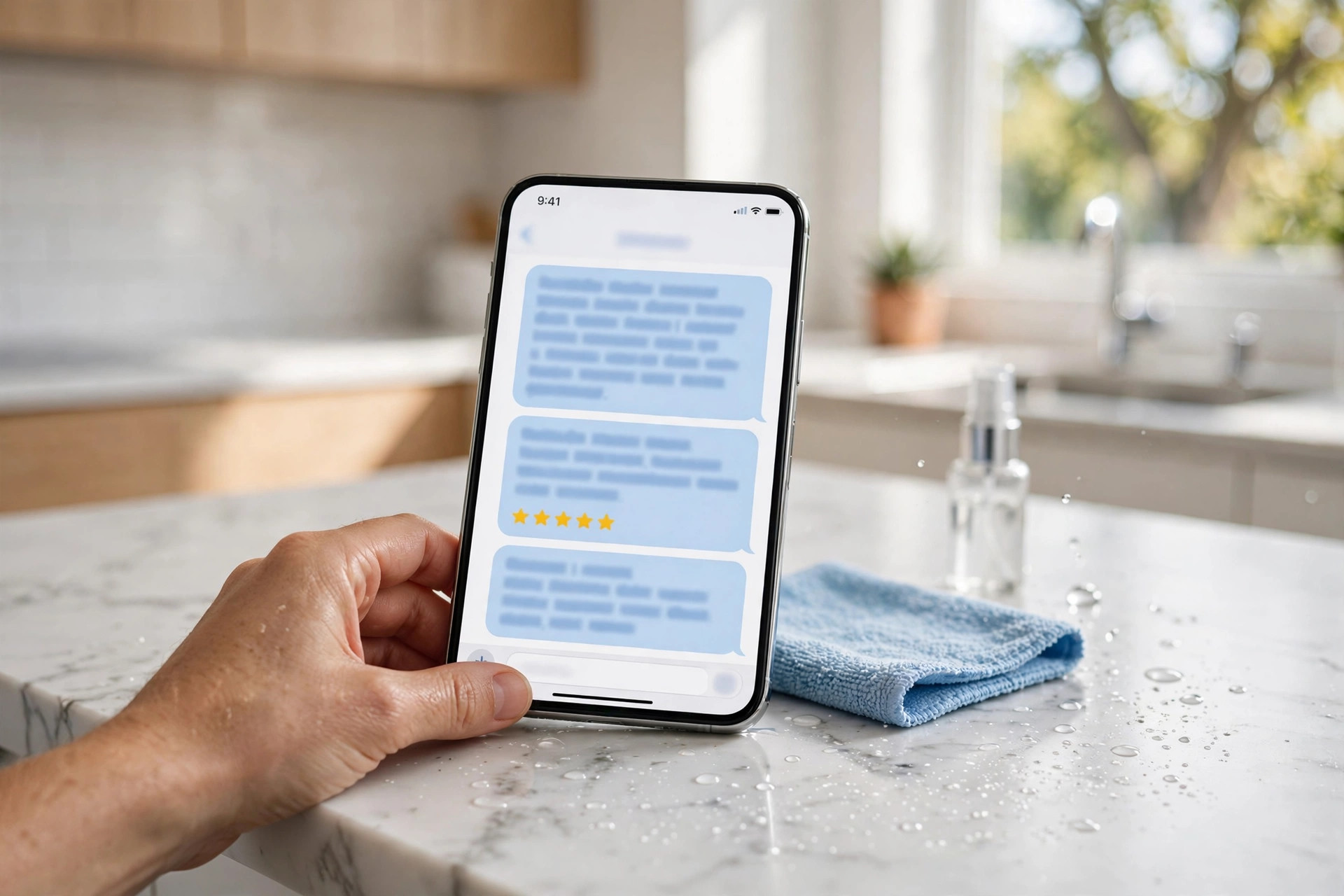
The text names the cleaner and carries the direct link. Personal beats generic every time.
Review volume wins recurring contracts and commercial accounts
Residential reviews are the foundation, but the real money in cleaning is recurring contracts and commercial accounts. Both are decided by reviews before you ever get the call.
Property managers read reviews first
When a property manager needs a turnover cleaning vendor or an office manager needs a nightly crew, they Google, and they read. They are not just checking your star rating. They are reading for reliability: do reviewers mention showing up on time, consistent quality, the same cleaner each visit. Those are the exact words your reviews should contain, which means your ask texts can gently prompt them: “If Ana’s consistency has made your life easier, mentioning that in a review helps other busy families find us.” Commercial bids should carry your review count and rating on the cover page, with a link to the profile. A 4.8 with 300 reviews beats a cheaper bid from a company with 12 reviews, because the manager is buying reliability and the reviews are the proof. Keep your profile complete too, since reviews convert best on a finished profile: our contractor GBP optimization guide applies to cleaning companies as well.
Recurring residential: the lifetime value case
A biweekly client at $180 a visit is worth over $4,600 a year, and the average recurring client stays for years. Reviews lower your cost of acquiring each one. When a neighbor sees your cleaner’s name in three local reviews and calls you instead of clicking an ad, that client arrived for the price of a text message. Track it simply: ask every new client how they found you, and log “Google reviews” as a source. When the owner sees that reviews produce a third of new recurring clients, the review system stops being a nice-to-have and becomes the marketing budget. An AI phone agent for home services can make sure those review-driven calls get answered and booked even when the office is closed, so the reviews never go to waste.
Your rollout checklist
Start with your best crew and your happiest clients. Prove the system, then roll it company-wide.
- 1Get the direct review link. Pull the short review link from your Google Business Profile. One tap must land on the review form.
- 2Write the visit text template. Short, names the cleaner, direct ask, link. Under 300 characters.
- 3Automate the 15-minute trigger. Job marked complete fires the text. No human has to remember.
- 4Build the rotation. First visit, first month, quarterly, special moments. Suppress the ask when a complaint is open.
- 5Train the one-sentence ask. Every cleaner learns it, role-plays it once, and knows it is part of the job.
- 6Launch the bonus and leaderboard. Small bonus per posted review naming the cleaner, monthly leaderboard in the break room.
- 7Respond to every review. Within 48 hours, thank by name, mention the cleaner. See our guide to responding to negative Google reviews for the hard ones.
- 8Put reviews in commercial bids. Rating and count on every bid cover page, with a link to the profile.
Reviews that name the cleaner build personal trust and give your team public credit.
Frequently asked questions
How often should we ask recurring clients for reviews?
Ask after the first visit, after the first month, and then quarterly, plus after exceptional visits. That keeps velocity steady without nagging. Clients who have already reviewed get referral asks instead of review asks.
Can we pay cleaners a bonus for reviews?
Yes, for making the ask and doing great work. Frame the bonus around effort, not outcomes, and never tie it to five-star ratings. Never pay or discount the customer for reviewing. That violates Google’s policy.
What if a client leaves a bad review about a specific cleaner?
Respond publicly with calm specifics, take it offline with a phone number, and address it with the team privately. Do not name or blame the cleaner in the public response. One professional response often impresses future customers more than the complaint worried them.
Should commercial clients get the same review ask?
Yes, with adjusted timing: ask at contract renewal, after a seasonal deep clean, or after you resolve an issue fast. Facility managers rarely review on their own, so the direct ask matters even more.
How many reviews does a cleaning company need?
Enough to lead your market, usually 150 to 300 for residential, with fresh ones arriving monthly. For commercial work, recency and mentions of reliability matter as much as the total.
What if a cleaner is uncomfortable asking?
Give them the exact one-sentence script, role-play it once, and make clear that asking is part of the job that every top cleaner does. Most discomfort disappears after the first few asks when customers respond warmly.
Should we ask for reviews on other sites besides Google?
Google first, always. It feeds the local results customers actually see. Once Google is strong, a second platform like Yelp or a local directory is a reasonable backup. Do not split the ask across many sites.
Turn every clean into five-star proof
Digital Hayder builds review systems for cleaning companies: the automated post-visit texts, the rotation logic for recurring clients, the cleaner incentive program, and the profile optimization that turns reviews into contracts. Tell us about your crews and client base and we will design it around how you already operate.
Contact Us