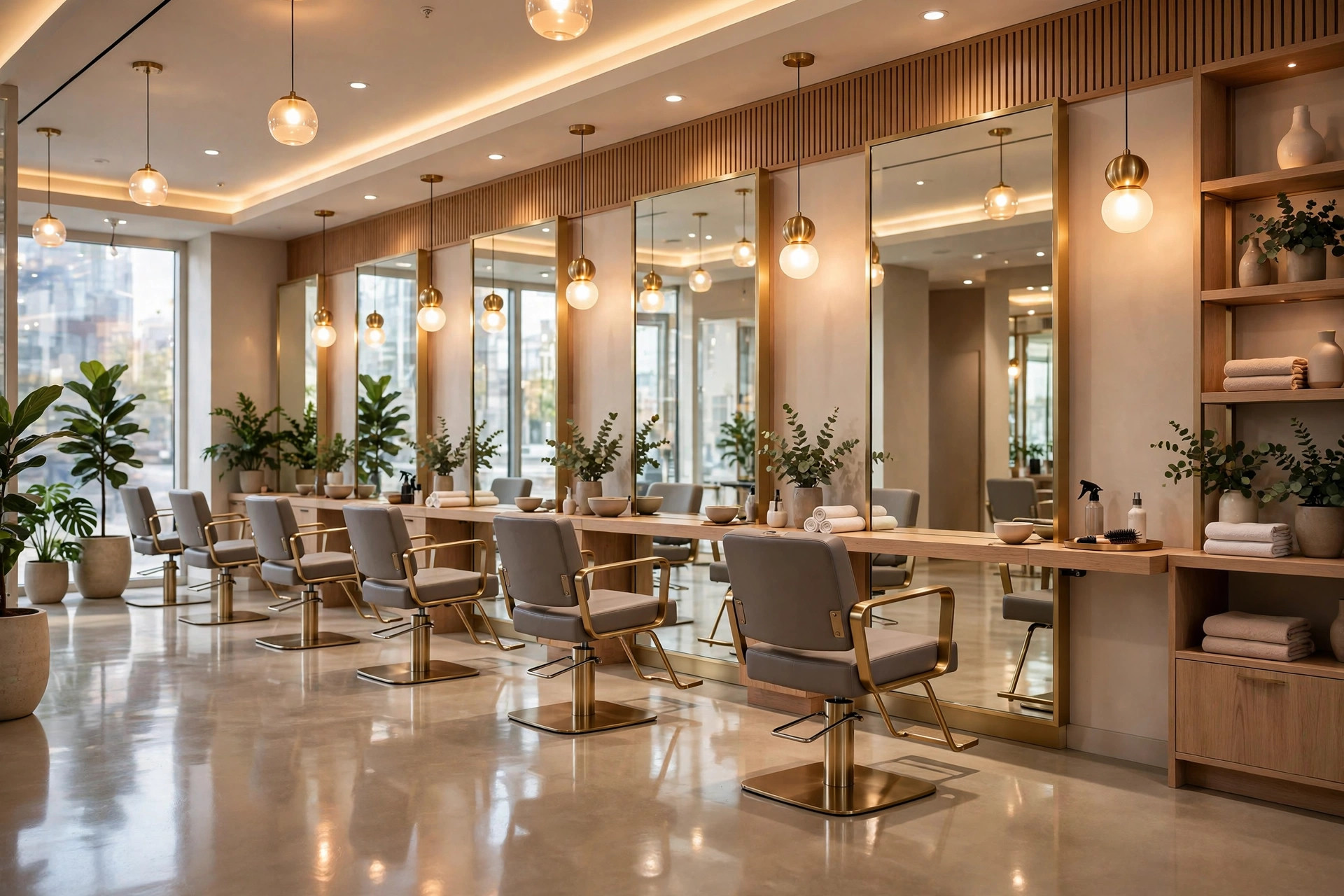
Your stylist is mid color with foils in a client’s hair. The phone rings. Your receptionist is checking out two clients at once and the call rolls to voicemail. That caller wanted to book a Saturday balayage, and by the time anyone calls back, she has booked somewhere else. This is the daily reality of salons: your team cannot stop a treatment to answer the phone, so booking calls arrive exactly when nobody can take them. An AI receptionist for salons answers every call, books appointments into your real schedule, handles reschedules and cancellations, knows your treatment menu, and sends reminders that cut no shows. This independent guide covers what these systems do for salons, what to demand before you buy one, and the math on what missed booking calls actually cost.
The quick answer
- What it does: answers every salon call around the clock, books and reschedules appointments, knows your services and prices, handles cancellations, and sends confirmation and reminder messages.
- Why salons buy it: booking calls arrive while stylists are mid treatment and cannot pick up, and most callers who reach voicemail book elsewhere instead of calling back.
- No show math: industry data puts salon no show rates at 15 to 30 percent without a prevention system. A single stylist losing two appointments a day at an $85 ticket loses roughly $42,500 a year.
- Reminder math: two reminders, one the day before and one two hours out, cut no shows by 29 to 38 percent according to industry reporting.
- Typical cost: roughly $150 to $400 a month for a salon, against the cost of even a part time receptionist at several thousand a month.
- Setup time: one to two weeks, most of it spent loading your service menu, prices, and booking rules.
Why salons lose booking calls
Salons have a structural phone problem that most businesses do not. In most businesses, someone sits near the phone. In a salon, the people who could answer are standing at a chair with color processing in a client’s hair, a blow dryer in one hand, or foils that cannot wait. Answering the phone means stopping a paid service, washing hands, and walking to the desk, which means the client in the chair waits and the service runs long. So the phone rings out, and it rings out during exactly the hours when booking demand is highest.
Missed calls during treatments
The busiest booking windows for salons are also the busiest treatment windows. Late mornings and early afternoons, when every chair is full, are when prospective clients call to book. Saturdays are the worst of both worlds: peak treatment volume and peak booking intent, with a thin front desk team trying to check clients in and out. A salon owner I spoke with described her Monday mornings as starting with eleven missed calls from the weekend, several of them booking inquiries that had gone cold because nobody replied until Tuesday.
Most of those callers do not leave a voicemail and do not try again. Booking a salon appointment is a low friction decision made on impulse: the client sees your Instagram, likes the work, and calls while the motivation is fresh. A voicemail greeting breaks that impulse. She hangs up and calls the next salon whose work she liked. Your marketing bought the call. The unanswered ring gave the booking to a competitor.
No shows and late cancellations
The second leak is quieter. Industry data puts salon no show rates at 15 to 30 percent without a prevention system, and the Professional Beauty Association’s industry reporting pegs the average at 15 to 20 percent. Run the numbers on a typical salon: a single stylist losing two appointments a day at an $85 average ticket loses $170 a day, $850 over a five day week, and roughly $42,500 over fifty working weeks. For a three chair salon, that exceeds $125,000 a year.
The causes are ordinary. Forgetfulness drives the majority of missed appointments, not disrespect. Clients book weeks out, life happens, and without a reminder the appointment slips their mind. Late cancellations are the same problem with a shorter fuse: the client calls or texts two hours before, and the slot is too late to refill. Both problems respond to the same fix, which is systematic reminders and easy rescheduling, not scolding clients. For more on the marketing side of keeping chairs full, see our salon marketing ideas guide.
What an AI receptionist for salons actually does
An AI receptionist is a voice system that answers your salon’s phone with natural spoken conversation. Callers talk to it the way they would talk to a receptionist: they say what they want, and it books, reschedules, or answers. Here is the day to day work it takes off your team.
Books appointments into your real schedule
The core job is booking. The AI connects to your booking system, knows which stylists do which services, and offers real open slots that fit the service length. A caller asking for a cut and color with a specific stylist gets offered that stylist’s real openings, with the right amount of time blocked for the service. A caller with no preference gets the earliest suitable opening. The booking lands in your system with the client details, service, and any notes attached, and the caller gets a confirmation text.
Getting the service length right is where salon booking differs from simpler appointment businesses. A men’s cut takes thirty minutes. A full highlight and tone takes three hours. A bridal trial takes ninety minutes. The AI must know your service durations and block the right time, or your day falls apart. This is one of the first things to test in a trial: book a long color service and check that the calendar shows the full block, not a thirty minute gap.
Handles reschedules and cancellations gracefully
A large share of salon calls are not new bookings. They are clients moving an existing appointment, cancelling, or asking about the cancellation policy. The AI looks up the booking by phone number or name, offers alternative slots for reschedules, and processes cancellations according to your policy: how many hours notice you require, whether you charge a fee, and how deposits work.
This is also where the AI protects your team from awkward conversations. Nobody enjoys telling a client about a late cancellation fee. The AI states the policy plainly and consistently, every time, without the hesitation a human receptionist feels when the client is upset. Consistent policy enforcement is one of the quiet ways these systems pay for themselves: policies that are enforced are policies that change behavior.
Knows your treatment menu and prices
Callers ask about services and prices constantly. How much is a balayage. Do you do keratin treatments. What is the difference between a partial and a full highlight. Do you do men’s cuts. Do you offer bridal packages. The AI answers from your approved service menu, with your real prices and your real descriptions, so every caller gets the same answer your best receptionist would give.
The menu knowledge also powers upselling that feels like service. A caller booking a color is told the appointment includes a toner and asked whether they want to add a deep conditioning treatment. A caller booking for a wedding party is told about your bridal packages. These are the offers a great receptionist makes naturally, and they are exactly the offers that get skipped when the desk is slammed. Keep the approved answers tight, though. Service questions should quote your menu, not improvise new services or prices. If the AI does not know, it should offer to have someone call back.
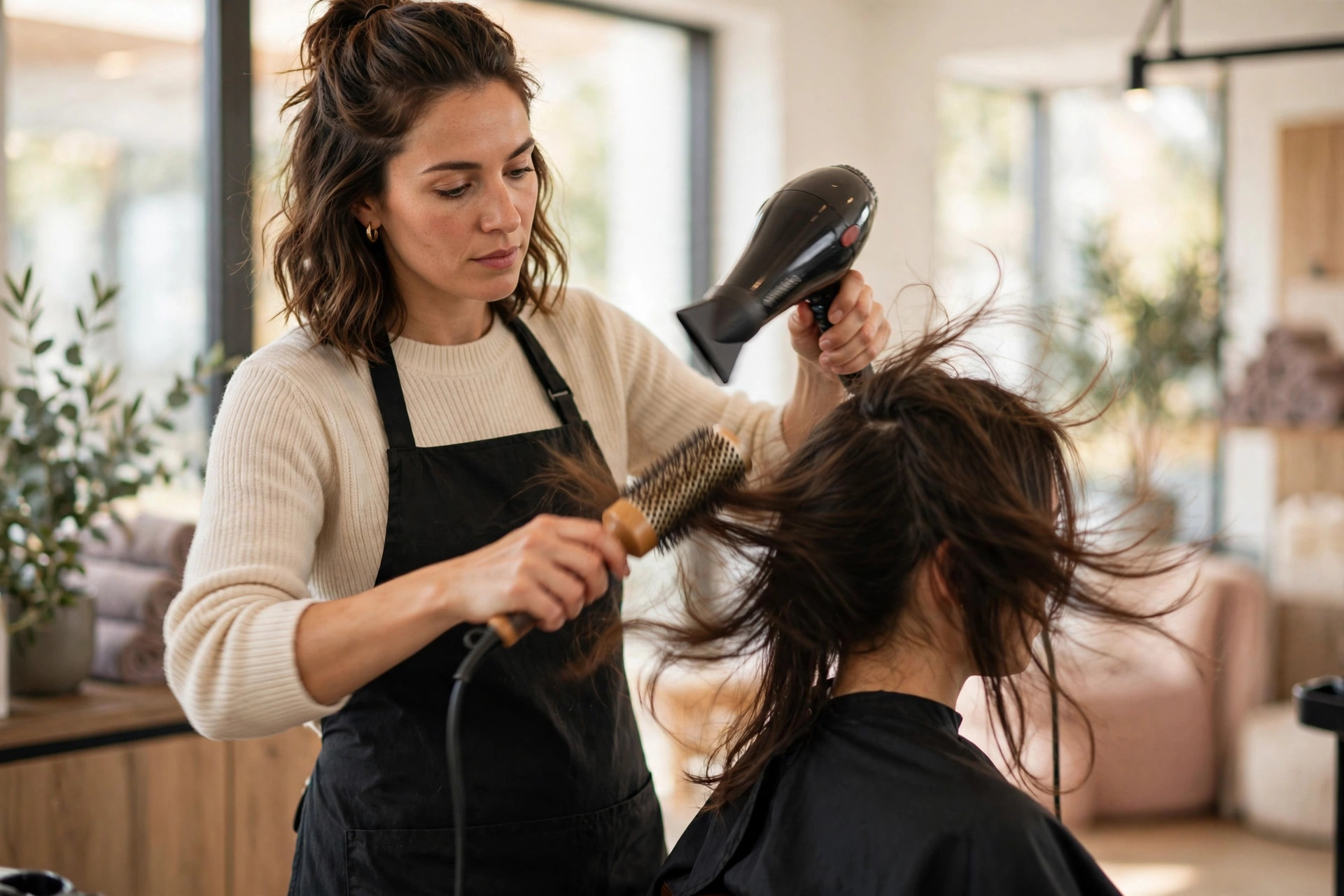
Your stylists should never have to stop a treatment to answer the phone. The AI handles the call while the appointment continues.
Sends reminders that cut no shows
Reminders are the highest return feature in the whole system. Industry reporting shows that two reminders, one the day before and one two hours before the appointment, cut no shows by 29 to 38 percent. The AI sends confirmation texts at booking, reminder texts on your schedule, and handles the replies: a client who texts back “need to move this” gets offered new slots immediately instead of becoming a no show.
The two hour reminder deserves special attention. It catches the clients who forgot and gives them a one tap path to reschedule instead of ghosting. It also gives your team early warning: a cancellation two hours out is still hard to fill, but a cancellation confirmed two hours out is better than a no show discovered at the appointment time, because at least the chair is officially open and the waitlist can be offered the slot.
What to look for before you buy
Most vendors will show you a polished demo with a calm caller booking a simple haircut. Real salon calls are messier. Judge every option against the five points below, and use the table that follows as a script for vendor calls.
Service menu accuracy
Ask the vendor to load your actual service menu during the trial: every service, every price, every duration, and which stylists perform which services. Then test it the way clients talk. Ask for “something for my roots” and see if it offers root touch up options. Ask how long a balayage takes and check the answer against your real duration. Ask for a stylist by name and confirm the AI only offers that stylist’s openings. A system that guesses at services will misbook chairs, and misbooked chairs are the fastest way to lose your stylists’ trust in the whole project.
Booking system integration
Name your booking software during the trial and demand a live test, not a slide. Book a color service, move it, cancel it, and book it again, and watch your real calendar at every step. The booking must show the right service, the right duration, the right stylist, and the client notes. Confirmations and reminders must fire from your system so everything stays in one place. If the vendor’s system keeps its own separate calendar that someone has to copy over, walk away. A system that needs manual copying will be abandoned within a month.
Reschedule and cancellation logic
Ask the vendor to show you the reschedule flow and the cancellation flow separately, because they are different problems. Rescheduling needs the AI to find the existing booking, offer sensible alternatives, and move it without double booking. Cancellation needs the AI to apply your policy: notice period, fees, deposit forfeiture, and what happens to the deposit on a reschedule versus a cancellation. Write your policy down before the trial and hand it to the vendor. If they cannot configure it exactly, the product is not ready for salons.
After hours and weekend coverage
Salons get booking calls at night and on Sundays when the shop is closed. The AI should answer those calls with full booking ability, not just take a message. Test a Sunday evening call during the trial: book an appointment for Tuesday, and check that it lands in the calendar correctly. Also ask how the AI handles the calls your team needs to see first thing Monday: a clean summary of weekend bookings, cancellations, and anything unusual, delivered where your team will actually read it.
Human handoff that actually works
Test the words a frustrated caller would say: “I want to talk to a person,” “your system is not helping,” “this is urgent.” The handoff should be immediate and obvious, with the conversation notes going to whoever picks it up. Also ask what happens when the AI does not understand a caller after two tries. The right answer is a handoff, not a third guess. And check the accent and name problem: salon clients have diverse names and accents, and the AI must handle them gracefully rather than mangling a booking because it misheard a name twice.
| Question to ask the vendor | Why it matters | A good answer sounds like |
|---|---|---|
| Can you load my real service menu in the trial? | Wrong durations misbook chairs and lose stylist trust | “Yes, send us the menu and we will configure every service and price.” |
| Does it block the right time per service? | A balayage is not a thirty minute haircut | A live demo booking a long color service with the full block shown |
| Which booking systems do you integrate with? | Manual copying kills adoption | Your software named specifically, with a tested book, move, and cancel cycle |
| How does it enforce my cancellation policy? | Inconsistent policy enforcement costs real money | “We configure your notice period, fees, and deposit rules exactly.” |
| Can it book at 9pm on a Sunday? | Booking intent does not keep shop hours | A test call outside hours that lands correctly in the calendar |
| What happens when it cannot understand a caller? | Trapped callers book with competitors | Immediate human handoff with the conversation notes attached |
| How do reminders and reschedule replies work? | Reminders are the highest return feature | “Confirmation at booking, day before and two hour reminders, one tap reschedule.” |
| How do I review call transcripts? | You need to catch misbookings before clients arrive | A review screen with editable bookings and weekly summaries |

Booking calls arrive while every chair is full. An AI receptionist answers them all without pulling a stylist away from a client.
AI receptionist vs a part time receptionist
Many salons compare an AI receptionist against hiring a part time receptionist for the desk. It is a fair comparison, and the honest answer depends on what you need the person for. Here is how the two compare.
| AI receptionist | Part time receptionist | |
|---|---|---|
| Monthly cost | Roughly $150 to $400 | Several thousand a month even part time, plus training and turnover |
| Coverage | Every call, 24 hours a day, including Sundays and holidays | Only the scheduled shifts; evenings and days off are uncovered |
| Simultaneous calls | Handles unlimited calls at once | One call at a time; the rest go to hold or voicemail |
| Menu knowledge | Quotes your approved prices perfectly every time | Varies with training and memory; new hires guess |
| Policy enforcement | States cancellation policy plainly every time | Often softens it to avoid awkwardness |
| Reminders | Sends every reminder on schedule, handles replies | Fits reminders around desk work, or forgets them |
| In person work | Cannot greet walk ins, take payments, or tidy the desk | Handles the whole front of house experience |
| Upselling warmth | Offers add ons from a script | Reads the client and sells with genuine warmth |
The right answer for most salons is not either or. The AI covers the phones, the bookings, the reminders, and the after hours calls. Your front desk person, if you have one, covers the in person experience: greeting, checkout, retail, and the warmth that keeps clients loyal. If you do not have a front desk person, the AI gives you phone coverage you could never afford to hire for, and your stylists get to do what they are paid for.
What it costs
Salon AI receptionists price by call volume and integration depth. Typical market ranges:
| Setup | Typical cost | What you get |
|---|---|---|
| Starter, single location | $100 to $250/mo | Call answering around the clock, booking, text confirmations, basic reminders |
| Standard, with integrations | $200 to $400/mo | Everything above plus booking system sync, service menu accuracy, reschedule logic, two stage reminders |
| Multi location group | $350 to $600/mo | Everything above plus per location routing, centralized reporting, group wide reminder campaigns |
Setup fees typically run $0 to $500, covering the service menu load, booking connection, and policy configuration. If email is part of your retention plan too, see our guide to email marketing for salons for how reminders and campaigns work together.
Rolling it out without disrupting the salon
The salons that get value from an AI receptionist treat the first month as a tuning period, not a launch event. This order keeps risk low:
- 1Load your service menu first. Every service, price, duration, and which stylists perform it. Test book a long color service and a short cut and check the calendar blocks.
- 2Write your booking rules. Cancellation notice period, late fees, deposit rules, and what happens on a reschedule versus a cancellation. Hand the written policy to the vendor.
- 3Connect the booking system. Test a full cycle: book, confirm, remind, reschedule, cancel. Fix anything that needs manual copying before going live.
- 4Run thirty test calls. Include the hard ones: “something for my roots,” a stylist name said wrong, “I want a human,” a caller who interrupts, and a Sunday evening booking. Fix every wrong answer.
- 5Start with after hours and overflow. Let the AI cover nights, Sundays, and simultaneous daytime calls for two weeks. Review every transcript, tune the scripts, then expand.
- 6Review transcripts weekly for a month. Look for misbooked durations, wrong stylist assignments, and policy answers the AI fumbled. Tune the scripts, then move to a monthly review.

Start with after hours and overflow coverage, review the transcripts, then expand once the service menu is proven accurate.
Mistakes salons make with AI receptionists
The most expensive mistake is a sloppy service menu. If durations are wrong, the AI misbooks chairs, stylists lose trust in the system, and the whole project gets blamed for a data entry problem. Load the menu carefully and test it hard. The second mistake is ignoring the reminder settings. The booking feature gets all the attention, but reminders are the highest return feature in the system; a salon that skips the two hour reminder leaves the biggest win on the table. The third is weak cancellation policy configuration. If the AI does not know your notice period and fees, it improvises, and improvised policies create the exact arguments you bought the system to avoid. The fourth is hiding the human handoff. Clients with a complaint or a complicated request need a person fast, not a third attempt from the AI. The fifth is treating launch day as the finish line. Prices change, stylists join and leave, services get added, and the AI needs to know all of it. A menu nobody updates for a year quietly starts giving wrong prices to callers. Finally, do not buy on demo charm. The vendor that loads your actual menu and connects your actual booking system in the trial is showing you the product. The vendor that plays you a recording is showing you marketing.
Frequently asked questions
How much does an AI receptionist for salons cost?
Salons typically pay $100 to $250 a month for a starter setup with call answering and booking, $200 to $400 a month with booking system integration and two stage reminders, and $350 to $600 a month for multi location groups. Setup fees usually run $0 to $500. Compare that to several thousand a month for even a part time receptionist.
Can an AI receptionist really know my service menu?
The ones worth buying can, but only if you load it properly. Every service, price, duration, and stylist assignment goes in during setup, and you test it hard before going live. Ask the vendor to load your real menu in the trial and book a long color service to check the calendar block.
Will it handle reschedules and cancellations correctly?
It should, if your policy is configured exactly. Notice period, late fees, deposit rules, and the difference between a reschedule and a cancellation all go in as written rules during setup. Test the full cycle in the trial: book, reschedule, cancel, and check your calendar at every step.
Do reminders actually reduce salon no shows?
Yes. Industry reporting shows two reminders, one the day before and one two hours before, cut no shows by 29 to 38 percent. Deposits cut them further. The key is that reminders go out automatically every time, which is where manual systems fail.
Will clients be put off by talking to an AI instead of a person?
Most callers care about getting booked fast, not about who takes the booking. A system that answers on the second ring and books the appointment beats a voicemail that asks them to call back tomorrow. Be honest that it is automated and make the human handoff instant for anyone who asks.
Fill every chair without hiring for the desk
Digital Hayder builds AI receptionists for salons with accurate service menus, real booking integration, cancellation policy enforcement, and reminders that cut no shows. Tell us your services and we will map your booking flows before you pay anything.
Contact Us