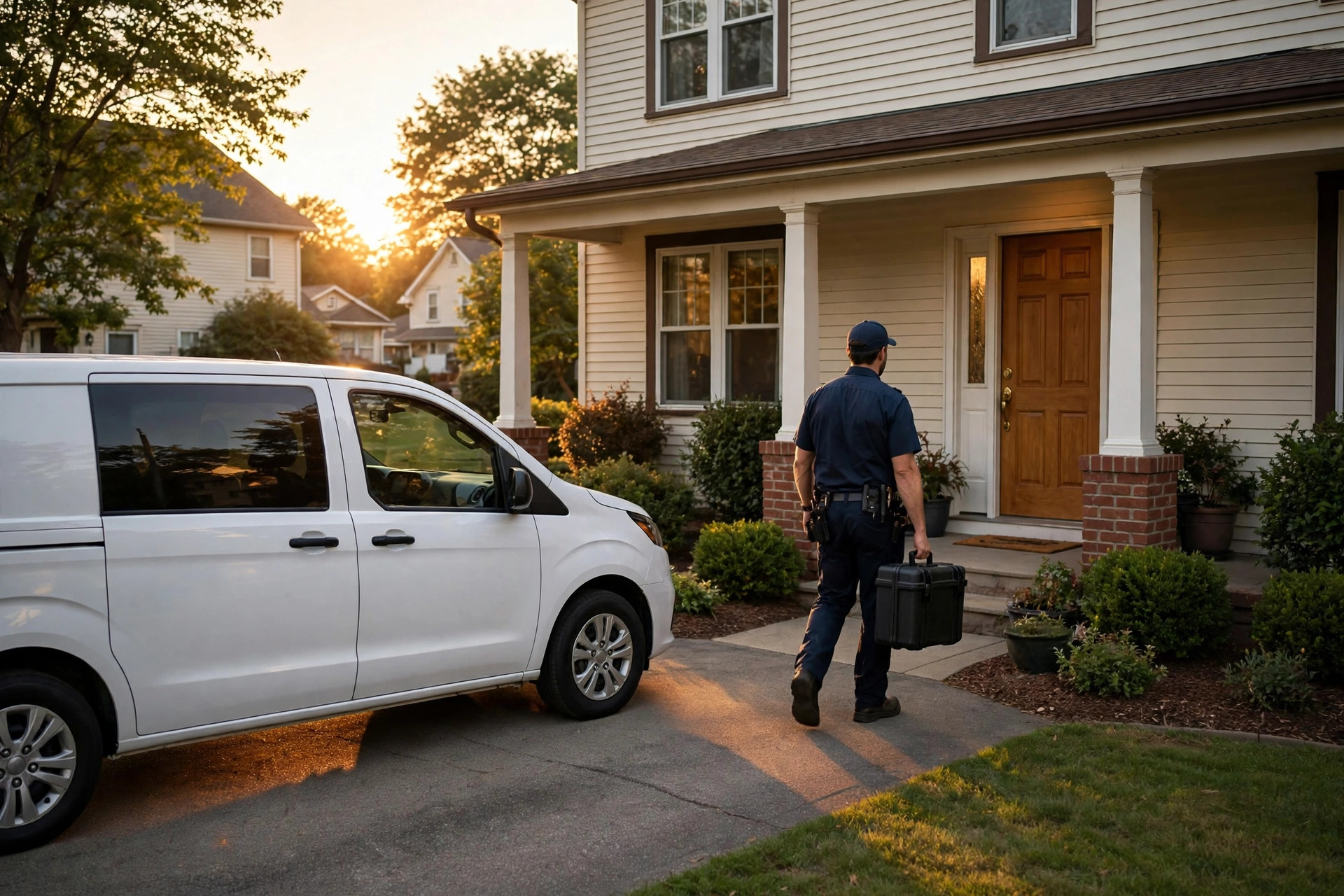
A homeowner finds wasps pouring out of the siding at 8pm on a Sunday. A renter wakes up with itchy red bites on a Saturday morning and types “bed bugs” into a phone. A restaurant manager spots droppings in the storage room an hour before opening. Pest problems create panic, and panicked people buy fast. In pest control, the company that answers first usually gets the job. A website with only a phone number and a contact form asks all three of these people to wait until morning. An AI chatbot for pest control companies answers them right now: it asks what they are seeing, helps identify the pest, gives a price range, and books the inspection while the fear is fresh. This guide covers what a pest control chatbot should do on your website, how it compares to a contact form, what to demand before you buy, and what it costs.
The quick answer
- What it does: asks pest-ID questions, triages emergencies like wasp nests and bed bugs, gives price ranges, captures quote requests, and books inspections around the clock.
- Why pest companies buy it: pest calls skew toward evenings and weekends, and sales research has found that 78% of buyers go with the first company to respond.
- The job math: a one-time treatment runs $100 to $400 and a bed bug job runs $500 to $3,000 or more, so one or two extra jobs a month pays for the chatbot many times over.
- Chatbot vs. contact form: the chatbot answers in seconds and books the inspection; the form promises a callback tomorrow, and tomorrow is usually too late.
- Typical cost: roughly $100 to $350 a month; setup usually runs $0 to $750.
- The golden rule: the chatbot gives price ranges, never firm quotes sight unseen, and routes true emergencies to your on-call line immediately.
Why pest control websites lose jobs after dark
Pest control is one of the most urgency-driven home services there is. Nobody browses for an exterminator the way they browse for a new sofa. They search because something is crawling, stinging, biting, or scratching inside their walls, and they want it gone now. That urgency peaks exactly when your office is closed: wasp nests get noticed on weekend yard work, bed bug bites get discovered on Saturday mornings, scratching in the attic gets heard at night. Your website gets plenty of these visitors after 6pm. Without a chatbot, it has nothing useful to say to them.
Pest emergencies do not wait for Monday
Think about the pests that drive emergency calls. A wasp nest by the front door with kids coming home from school. Bed bugs in a guest room two days before family visits. Rats in a restaurant kitchen. A bat in the bedroom. Every one of these situations produces a phone search within minutes, and the searcher is ready to book whoever picks up first. Industry pricing data shows emergency pest services typically cost 50 to 100% more than scheduled treatments, which tells you how much people will pay for speed. If your site cannot respond at 9pm, the visitor clicks the next result, and that competitor gets a premium-priced emergency job that could have been yours.
The quote shoppers disappear fast
Not every visitor is in full panic mode. Many are comparing: three tabs open, three pest control sites, looking for a price range and a company that feels responsive. Sales research from XANT found that 78% of buyers purchase from the first company to respond to their inquiry, and their lead-response study found that contacting a lead within five minutes makes conversion dramatically more likely than waiting even thirty minutes. A contact form that says “we will get back to you within one business day” is a formal way of losing that race. The chatbot wins it by answering the price question in seconds and offering an inspection slot before the visitor closes the tab.
Your office staff cannot cover every hour
The honest alternative to a chatbot is a human answering everything around the clock, and the math does not work for most local companies. A full-time customer service rep costs $2,500 to $4,000 a month fully loaded and covers forty hours a week. An after-hours answering service runs $200 to $400 a month and mostly takes messages, which is barely better than voicemail for someone who wants answers now. The chatbot sits between those options: it answers questions, qualifies the lead, and books the inspection at 11pm for a fraction of either cost. Companies that also want the phones covered should look at the voice side: our guide to the AI phone agent for home services covers 24/7 call answering that pairs naturally with website chat.
What an AI chatbot for pest control companies should do
A pest control chatbot is not a generic “how can I help you” widget. The ones worth buying are built around the way pest jobs actually get sold: identify the pest, judge the urgency, establish the price range, and get the inspection booked. Here is the work it should take off your plate.
Pest-ID questions that sound like your best technician
Your best technician asks a short series of questions before naming the pest: where did you see it, what does it look like, how big is it, how many are there, and is there damage. A good chatbot runs the same sequence in plain language, one question at a time, with conditional logic per pest. Ant questions branch toward colony location and trails. Bed bug questions ask about bites, mattress seams, and recent travel. Wasp questions ask about the nest location and whether anyone has been stung. Rodent questions ask about droppings, gnaw marks, and noises at night. Termite questions ask about mud tubes, swarmers, and damaged wood. This matters for two reasons: the visitor feels heard instead of interrogated, and the inspection your tech walks into comes with a useful head start. Offer photo upload too. A blurry phone photo of the pest, attached to the lead record, helps your tech bring the right products on the first visit.
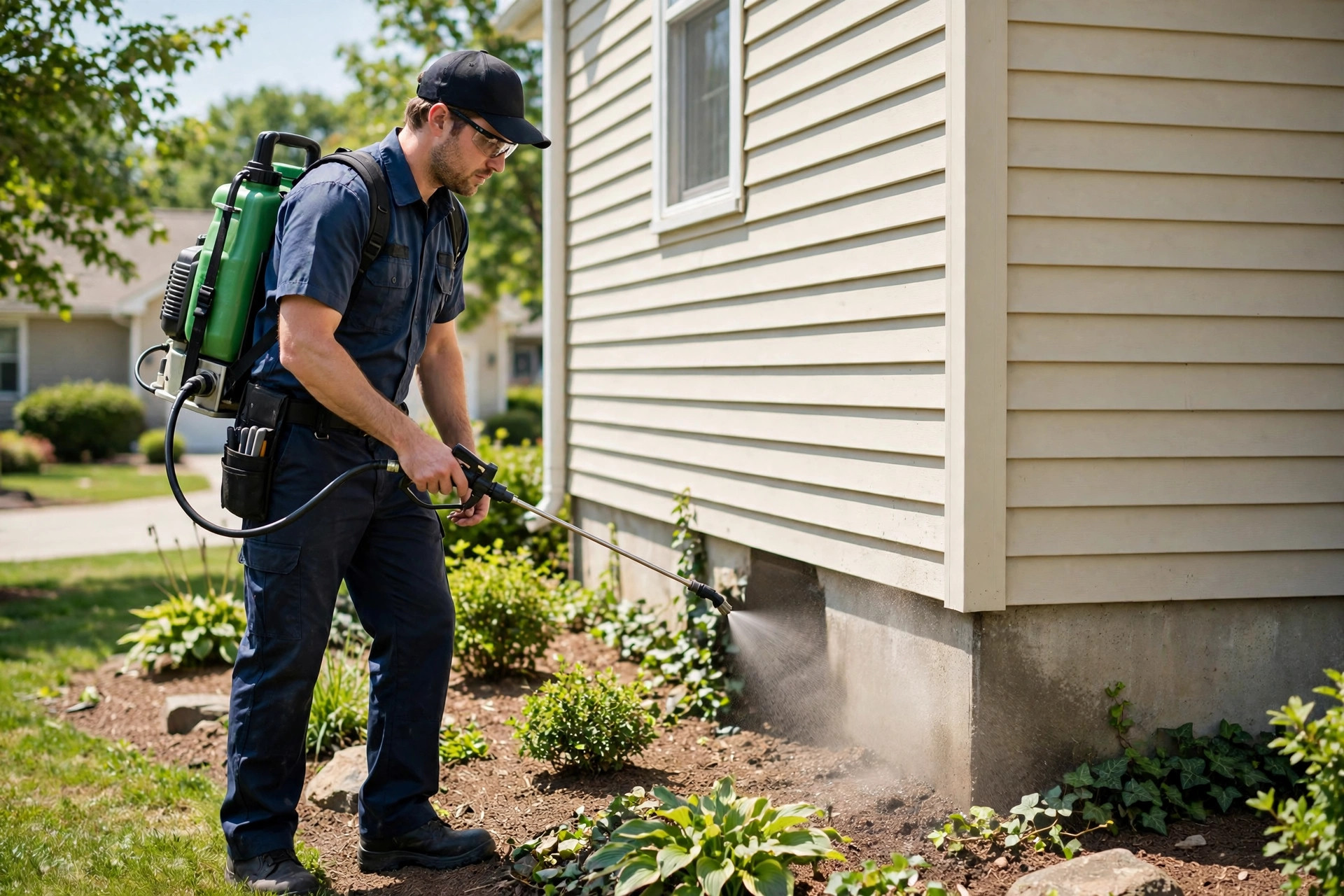
Good pest-ID questions in the chat mean your technician arrives knowing what to expect.
Emergency triage: wasps, bed bugs, and the 2am calls
Some chats cannot wait for the morning queue. The chatbot should recognize urgency signals, phrases like “wasp nest,” “stung,” “bed bugs,” “rats in the kitchen,” “bat in the house,” and “wildlife in the attic”, and do two things at once: reassure the visitor with immediate safety guidance you have approved (stay away from the nest, do not seal a bat in a room, keep pets away from the area), and route the conversation to your on-call number or an urgent text alert right away. This is the feature that separates a pest control chatbot from a generic lead widget. Emergency jobs carry a 50 to 100% price premium, so every emergency chat the bot handles correctly is one of your highest-value leads. Ask any vendor to demo urgency routing live. If they cannot show it, keep shopping.
Quote capture without the phone tag
“How much does it cost” is the most common question on every pest control website, and it is the one most sites refuse to answer. The chatbot should answer it with honest ranges, and it should never give a firm quote sight unseen. Approved pricing language looks like this: one-time treatments $100 to $400 depending on the pest and home size, quarterly plans $100 to $300 per visit, monthly service $40 to $70 per visit, bed bug treatments $500 to $3,000 or more depending on severity, termite treatments $400 to $1,500 or more. The chat then collects what a quote needs: ZIP code for the service-area check, home size, the pest, and how bad it looks. That combination, pest plus severity plus location, produces a tighter range and a booked inspection instead of a vague “call for pricing” dead end. The quote request lands in your CRM with the full transcript, so whoever follows up never asks the visitor to repeat themselves.
After-hours booking that fills tomorrow’s route
Collecting details is only half the job. The other half is getting the inspection on the calendar while intent is hot. A proper pest control chatbot connects to your scheduling system and offers real inspection slots: same-day emergency windows, next-day inspections, and quarterly plan start dates. The visitor picks a time, gets a confirmation text, and your schedule shows the booking with the pest details attached. Add a reminder text the evening before and the morning of, and no-show rates drop noticeably. For companies running tight routes, this is pure found revenue: inspections booked at 10pm that your competitors never saw. Once the booking exists, keep the conversation going with follow-up texts; our guide to WhatsApp marketing for local businesses covers turning one-time treatments into quarterly plan renewals.
Chatbot vs. contact form: the honest comparison
Every pest control site already has a contact form. Here is what changes when the chatbot replaces it as the main conversion path.
| Contact form | AI chatbot | |
|---|---|---|
| Response time | Next business day, if someone checks the inbox | Seconds, at any hour |
| Pest identification | A free-text box; visitors write “bugs” | Guided questions per pest, plus photo upload |
| Emergency handling | None; the message sits until morning | Urgency keywords trigger instant on-call routing |
| Price questions | “Call for a free quote” | Honest ranges on the spot, inspection booked |
| Booking | “We will call you back to schedule” | Real inspection slots picked in the chat |
| After-hours coverage | None | Full qualification and booking, 24 hours |
| Lead quality | Often just a name and “need pest control” | Pest, severity, ZIP, home size, photos, transcript |
| Service-area filter | Manual; you find out on the callback | ZIP checked before booking, out-of-area politely declined |
What to look for before you buy
Most chatbot vendors will show you a polished demo. Judge every option against the four points below, and use the table that follows as a script for vendor calls.
Service-area and scheduling logic
Pest control is a route business. A chatbot that books inspections outside your service area, or stacks them impossibly across town, creates more problems than it solves. The bot should check the visitor’s ZIP against your service map before offering slots, and it should understand your scheduling reality: emergency windows versus standard inspections, same-day cutoffs, and blackout days. Ask the vendor to show you the ZIP logic in the trial with your actual service map. If the product cannot do geography, it was not built for home services.
Pricing guardrails
The chatbot must give ranges and never firm quotes. This is both a business rule and a trust rule: a firm quote in chat that your tech cannot honor on site creates angry customers and bad reviews. The vendor should let you set the ranges per pest and per plan type, update them seasonally (mosquito pricing in summer, rodent pricing in fall), and attach the standard disclaimers: final price confirmed at inspection, severity may change the range. Test this by asking the demo bot “how much for bed bugs” three different ways and reading exactly what it says each time.
CRM, reviews, and follow-up integration
A chatbot that drops leads into a dashboard nobody checks is a contact form with better manners. Quote requests and bookings should flow into your CRM with the transcript attached, trigger your confirmation texts, and feed your review requests after the job is done. Ask about your tools by name and test a full loop: chat, booking, confirmation text, CRM record, notification. Manual copying anywhere in that chain means the system will slowly stop being used.
Human escalation that actually works
Test the words a frustrated visitor types: “I want a real person,” “this is urgent,” “your bot is useless.” The handoff should be immediate, with the transcript going to whoever picks it up. After hours, escalation must reach your on-call path, not a dead end. Also ask what happens when the bot cannot identify the pest after two tries. The right answer is a handoff to a human and a booked inspection, not a third guess. A chatbot that traps people spends your company’s credibility to save a phone call.
| Question to ask the vendor | Why it matters | A good answer sounds like |
|---|---|---|
| Can it check my service area by ZIP before booking? | Out-of-area bookings waste route time | A live demo with your ZIP list loaded |
| How does emergency routing work? | Wasp nests and bed bugs cannot wait for morning | Keywords triggering an immediate on-call alert, shown live |
| Can I set price ranges per pest that the bot cannot exceed? | Firm quotes in chat become broken promises on site | “Yes, ranges only, and you edit them yourself” |
| Does it handle photo upload? | Photos help techs arrive prepared | Photos attach to the lead record automatically |
| Which CRMs and schedulers does it connect to? | Manual copying kills adoption | Your tools named specifically, tested end to end |
| What happens when it cannot identify the pest? | Guessing wrong damages trust | Human handoff plus a booked inspection |
| Can the scripts change with the seasons? | Mosquito questions in summer, rodent questions in fall | Seasonal script sets you can switch yourself |
| How do I review conversations? | You need to catch wrong pest IDs fast | A transcript review screen with weekly summaries |

Emergency chats need instant routing, not a morning callback. Test urgency keywords before you buy.
What it costs
Pest control chatbots price like other home-service chatbots, driven by conversation volume and integration depth. Typical market ranges:
| Setup | Typical cost | What you get |
|---|---|---|
| Starter, single location | $80 to $200/mo | Website chatbot, core pest-ID flows, after-hours coverage, email and text notifications |
| Standard, with booking | $150 to $350/mo | Calendar booking, CRM integration, emergency routing, photo upload, seasonal scripts |
| Multi-location | $300 to $600/mo | Everything above plus per-location routing, separate service maps, consolidated reporting |
Setup fees typically run $0 to $750, covering pest-ID flow building, calendar connections, and script review. Compare that to an after-hours answering service at $200 to $400 a month that only takes messages, and the chatbot usually wins on value. If you want the full picture on voice automation costs, see our breakdown of how much an AI voice agent costs. And since the chatbot lives on your website, make sure the page around it converts: our guide to landing page conversion rate optimization covers the fixes that matter most for local service sites.
Rolling it out in 30 days
The companies that get value from a pest control chatbot treat the first month as a tuning period. This order keeps risk low:
- 1Write your pest-ID questions first. One short flow per pest you treat: ants, roaches, bed bugs, termites, wasps, rodents, wildlife. Five to eight questions each, maximum. Decide which answers change the routing.
- 2Set your price ranges. One-time, quarterly, monthly, and per-pest ranges with the “confirmed at inspection” disclaimer. Decide the emergency premium and how it is disclosed.
- 3Define urgency rules. List the situations that page the on-call tech immediately and the exact words that trigger them. Test each trigger phrase yourself.
- 4Load your service map. Every ZIP you serve, plus the polite out-of-area response with a referral option. Test addresses at the edges of your map.
- 5Connect the calendar and CRM. Test a full booking end to end: chat to calendar event to confirmation text to CRM record. Fix anything that needs manual copying.
- 6Review transcripts weekly for a month. Look for wrong pest IDs, missed urgency flags, and price questions the bot fumbled. Tune the scripts, then move to a monthly review.

Most inspection bookings happen after dinner. The chatbot turns those evening visits into tomorrow’s route.
Mistakes pest control companies make with chatbots
The most expensive mistake is letting the bot give firm quotes. It starts innocently, a “helpful” flat price for ant treatments, and ends with a technician on site explaining why the real price is double. Ranges only, always. The second mistake is the twenty-question intake. Every question past the essential eight costs you completions, and a half-finished chat at 11pm is a lost job. The third is skipping the service-area filter. Booking inspections forty miles outside your routes burns technician hours and diesel. The fourth is pesticide advice beyond the approved scripts. The bot can share your standard safety guidance; it must not recommend specific products, dosages, or DIY treatments, and it must send anything medical, like a reaction to a sting, straight to a human with a “call emergency services if severe” line. The fifth is launching in April and never updating the scripts. Mosquito season, termite swarm season, and fall rodent pressure each need their own question sets. A chatbot with January scripts in July is a liability with a login.
Frequently asked questions
How much does an AI chatbot for pest control companies cost?
Most single-location companies pay $80 to $200 a month for a starter setup, $150 to $350 a month with calendar booking, CRM integration, and emergency routing, and $300 to $600 a month for multi-location operations. Setup fees usually run $0 to $750.
Can the chatbot identify the pest from a description?
It can narrow it down with guided questions and a photo upload, which is usually enough to quote a range and prepare the technician. It should not state a definitive identification or recommend specific pesticide products. Anything uncertain gets a human review and a booked inspection.
Will the chatbot quote prices to website visitors?
It should give price ranges only, never firm quotes sight unseen. Typical ranges: one-time treatments $100 to $400, quarterly visits $100 to $300, bed bug jobs $500 to $3,000 or more, with the final price confirmed at inspection. Ranges answer the visitor’s question without creating promises your tech cannot keep.
What happens when someone has a pest emergency at night?
The chatbot recognizes urgency keywords like “wasp nest,” “stung,” “bed bugs,” or “rats in the kitchen,” gives your approved immediate safety guidance, and routes the chat to your on-call number or an urgent text alert right away instead of queueing it for morning.
Should I get a chatbot or an answering service?
An answering service at $200 to $400 a month takes messages after hours. A chatbot at a similar or lower price answers questions, identifies the pest, gives price ranges, and books the inspection itself. Most pest control companies get more value from the chatbot; companies with very high call volume often run both.
Stop losing after-hours jobs to the company that answers first
Digital Hayder builds AI chatbots for pest control companies with pest-ID flows, emergency triage, price-range guardrails, and inspection booking that fills your routes overnight. Tell us your service area and we will map your chat flows before you pay anything.
Contact Us