
The agent closed fourteen deals last year and has four hundred past clients and leads in the database. This month the pipeline is empty, the ad budget is gone, and the phone is quiet. Meanwhile the database sits untouched, full of people who already trust her and will all move again someday. This is the most common marketing failure in real estate: agents spend thousands chasing cold strangers while ignoring the warmest audience they own. Listings do not come from one-off campaigns. They come from being the obvious choice in a neighborhood, from stories that prove you sell homes, from reviews that stack up after every closing, and from a database that hears from you on schedule. This guide covers listing-focused marketing ideas built as low-cost, repeatable systems: neighborhood content, sold-story social posts, review capture after every closing, and database reactivation for past clients.
The quick answer
- Own a neighborhood, not the whole city: weekly neighborhood content makes you the agent homeowners think of when they decide to sell.
- Post every sold story: each closing is proof. A simple sold post with the story behind the sale beats any ad.
- Capture a review at every closing: ask on closing day, text the link the same day, and watch the profile become your best listing tool.
- Reactivate the database: past clients and old leads are the cheapest listings you will ever win. Contact them on a system, not when you panic.
- Systems beat campaigns: a weekly rhythm of content, reviews, and follow-up outperforms any single expensive push.
- Keep it low-cost: every idea in this guide runs on time and consistency, not ad spend.
Neighborhood content that wins listings
Homeowners choose a listing agent they believe knows their neighborhood. Not the city, the neighborhood: the streets, the schools, the price trends, the feeling of the place. Neighborhood content proves that knowledge publicly, and it compounds. Every post, video, and market update teaches the algorithm and the audience that you are the agent for that area.
The weekly neighborhood rhythm
Pick one to three farm areas, neighborhoods where you want listings, and publish something about each one every week. Rotate through four content types. Market updates: what sold this week, at what price, and what that means for values, in plain language. Street tours: a two-minute video walking or driving a street, pointing out what makes it desirable. Local spotlights: the coffee shop, the park, the school, the things that make someone want to live there. Listing-adjacent news: new developments, zoning changes, school ratings. This is not expensive production. A phone, decent light, and genuine local knowledge outperform a polished ad every time. After six months of this rhythm, homeowners in those neighborhoods know your name before you ever knock.
Turn content into listing appointments
Content alone does not book appointments; the call to action does. End every neighborhood post with a soft, specific offer: “Thinking about what your home is worth in this market? I do free home value reports for [neighborhood] homeowners, no pitch attached.” The homeowners who respond are pre-sold on your expertise because they have been watching you demonstrate it for months. Track which content type produces the most value-report requests and make more of it.

Weekly neighborhood content makes you the obvious listing choice before the homeowner ever calls an agent.
Sold-story social posts
Every closing is a marketing asset, and most agents waste it on a generic “Just Sold!” graphic. The graphic gets a few likes from other agents. The story gets shared by the neighborhood. Write the story: the sellers who raised three kids in the house, the first-time buyers who lost two bidding wars before winning this one, the downsize that took six months to find. Keep it respectful and get permission, but tell the human story, because humans share stories and ignore graphics.
The sold-post formula
Photo of the house or the happy clients at closing. Two to four sentences of story. One line about the result: sold in nine days, $25,000 over asking, whatever is true and impressive. One soft call to action: “If you are thinking about selling in [neighborhood], I would love to tell you what this market is doing.” Tag the neighborhood, not just the city. Post within 48 hours of closing while the excitement is real. Over a year, fifty-two sold stories become an undeniable public record that you sell homes in these neighborhoods, which is exactly what a nervous seller wants to see.
Review capture after every closing
Reviews are the highest-impact listing tool an agent owns. Sellers interview two or three agents, and they check Google before the interview. An agent with 120 recent five-star reviews walks into that appointment with proof; an agent with 12 walks in with promises. The system is simple: ask at the closing table, text the link the same day.
The closing-day ask
At closing, when the clients are signing the last papers and the relief is setting in: “You two were wonderful to work with. Reviews are how sellers find me, and yours would mean a lot. I will text you the link today.” Then text it that afternoon with their names and a personal note. One follow-up text three days later, then stop. The review request should also go to sellers and buyers separately when you represented both sides well; that is two reviews from one transaction. Prompt the content lightly: “If you mention the neighborhood, it helps future clients find me.” For the full review playbook, see our guide to getting more Google reviews as a real estate agent.

Ask at the closing table and text the link the same day. Every closing should produce at least one review.
Database reactivation for past clients
The average homeowner moves every seven to ten years, which means a database of 400 past clients contains 40 to 60 people who will sell within the next two years, plus their referrals. The agent who stays in touch gets those listings. The agent who goes quiet gets forgotten. Reactivation is not a campaign; it is a contact system.
The quarterly touch system
Every past client hears from you four times a year, minimum, through a mix that feels personal rather than automated. A home anniversary message on the date they bought: “Three years in your home today. Hope it is still treating you well.” A market update for their neighborhood twice a year: what their area is doing, in two sentences. One personal check-in call per year, no agenda beyond catching up. And one piece of genuinely useful content: the pre-listing checklist, the renovation ROI guide, the “what your home is worth now” report. Each touch is an excuse to be helpful, and helpful is what gets remembered when the for-sale thought arrives. Our email marketing guide for real estate agents covers the automation side.
Wake up the cold leads
Old leads, people who inquired months or years ago and went quiet, are a separate goldmine. Run a reactivation pass twice a year: a simple personal text to every lead older than six months. “Hi [Name], this is [Agent] with [Brokerage]. You asked about [area] homes a while back. Are you still looking, or did you find something?” Expect 5 to 10 percent to re-engage, and a share of those to transact within months. These are people who already raised their hand once. For the follow-up mechanics, see our real estate lead follow-up automation guide.
Low-cost systems beat one-off campaigns
The temptation in real estate marketing is the big push: the expensive mailer, the billboard, the month of heavy ads. One-off campaigns spike and vanish. Systems compound. Here is the difference in practice.
| One-off campaign | Repeatable system | |
|---|---|---|
| Example | $3,000 mailer to 5,000 homes | Weekly neighborhood video, every week |
| Cost | High, paid up front | Near zero, paid in time |
| Duration of effect | Two to three weeks | Compounds for years |
| Listing attribution | Hard to trace | Homeowners mention the content by name |
| What happens when you stop | Nothing was built | The archive keeps working |
| Best for | Launching a new farm area fast | Owning the farm area long-term |
The weekly system in one hour a day
The full system fits into about an hour a day. Monday: film and post the neighborhood update. Tuesday: write and schedule the sold story or market post. Wednesday: review requests from recent closings and replies to all reviews. Thursday: database touches, anniversary messages and check-in calls. Friday: one old-lead reactivation batch. None of this requires ad spend. It requires a calendar and the discipline to follow it. Agents who run this system for a year report that inbound listing inquiries become a meaningful share of their business, and every one of those listings costs almost nothing to acquire.
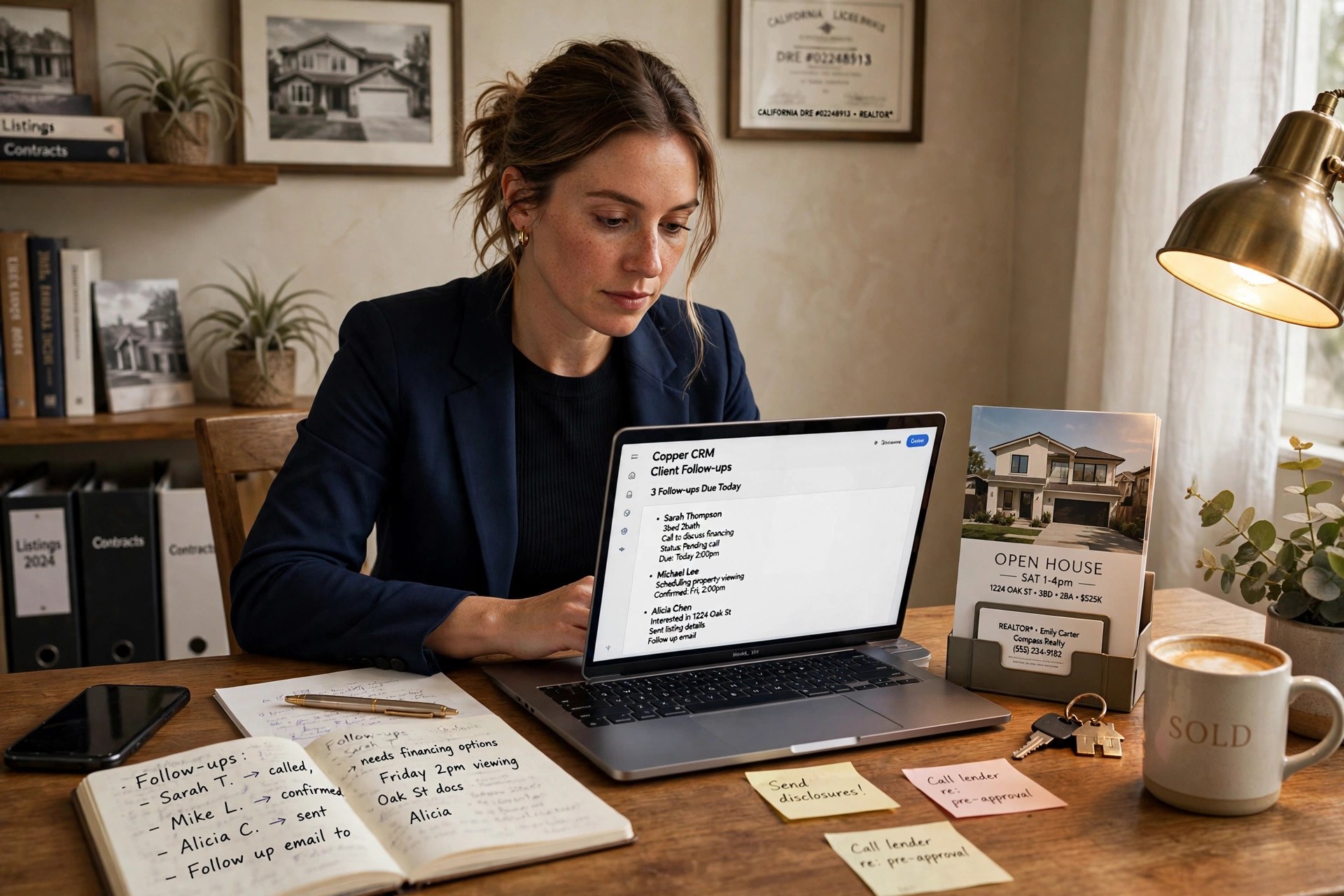
An hour a day on the system beats a month of expensive campaigns every time.
Your rollout checklist
Start this week. Every item is free except your time.
- 1Pick one to three farm neighborhoods. Areas where you want listings and already have some sales history.
- 2Start the weekly neighborhood post. Rotate market updates, street tours, local spotlights, and area news.
- 3Write the sold-story formula. Story, result, soft call to action. Post within 48 hours of every closing.
- 4Build the closing-day review system. Verbal ask at the table, text with the link the same day, one follow-up.
- 5Segment the database. Past clients, old leads, and sphere, tagged by neighborhood and last contact date.
- 6Launch the quarterly touch system. Home anniversaries, market updates, one personal call per client per year.
- 7Run the first cold-lead reactivation. Personal text to every lead older than six months, twice a year.
- 8Block the daily hour. Content, reviews, database touches, and reactivation on a fixed weekly rhythm.
Frequently asked questions
What is the best low-cost marketing for real estate agents?
Weekly neighborhood content in one to three farm areas, sold-story posts after every closing, review capture at every closing, and a quarterly touch system for the past-client database. All of it runs on time and consistency rather than ad spend.
How do real estate agents win more listings?
Be the obvious neighborhood expert before the homeowner decides to sell. Weekly local content, a strong review profile, and staying in touch with past clients mean sellers already know and trust you when they start interviewing agents.
How often should agents contact past clients?
At least four meaningful touches a year: a home anniversary message, two neighborhood market updates, and one personal check-in call. Every touch should be helpful or personal, never a generic blast.
Do sold posts on social media actually generate listings?
Yes, when they tell the story instead of just announcing the sale. Story-driven sold posts get shared in the neighborhood, and each one is public proof that you sell homes there. Over a year they become a powerful listing portfolio.
When should an agent ask for a Google review?
At the closing table, then by text the same day. Ask buyers and sellers separately when you served both well. Reviews are the first thing sellers check before the listing interview, so every closing should produce at least one.
How do I reactivate old real estate leads?
Send a simple personal text to every lead older than six months, twice a year, asking if they are still looking. Expect 5 to 10 percent to re-engage. These people already raised their hand once, which makes them far warmer than any cold audience.
Should agents spend money on ads or focus on organic systems?
Build the organic systems first: content, reviews, and database follow-up. They compound and cost almost nothing. Add paid ads only after the systems run, to amplify what already works rather than to substitute for it.
Win more listings without raising your ad budget
Digital Hayder builds marketing systems for real estate agents: neighborhood content engines, review automation, database reactivation, and websites that turn your expertise into listing appointments. Tell us about your market and we will design the system around your farm areas.
Contact Us