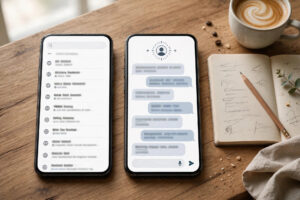
You are on your knees scrubbing a move-out clean across town when your phone buzzes three times. Two are quote requests from your website. One is a “how much for a 3 bed 2 bath” message you will not see until the job is done, three hours from now. By then, that homeowner has gotten an instant answer from someone else. This is the daily reality for cleaning company owners: you are the cleaner, the scheduler, the bookkeeper, and the sales team, and the sales team is always the job that gets dropped. An AI chatbot for cleaning companies fixes exactly that. It acts as your estimator around the clock: instant quotes by bedroom, bathroom, and square footage, upsells for deep cleans and add-ons, conversion of one-time quotes into recurring bookings, and deposit collection before you ever pick up the phone. This guide walks through how the quoting flow works, how to turn one-time jobs into recurring revenue, and a buyer guide covering pricing training, booking integrations, and costs.
The quick answer
- The core job: instant cleaning quotes from bedroom, bathroom, and square footage inputs, delivered in under a minute, day or night.
- The upsell engine: the bot offers deep clean upgrades and add-ons (oven, fridge, laundry, interior windows) at quote time, when buyers say yes most.
- The real money: converting one-time quotes into weekly or biweekly recurring bookings, which are worth many times a single visit over a year.
- Deposit collection: the bot takes a card deposit at booking, which cuts no-shows and protects your schedule.
- Training the bot: your base rates, add-on prices, minimums, travel fees, pet and condition surcharges, and service area, all loaded before launch.
- What it costs: about $80 to $400 per month plus setup for most cleaning businesses, with booking and payment integrations in the upper half.
Why a cleaning business needs an estimator that never sleeps
Cleaning companies have a structural problem most trades do not: the owner is usually the labor. When you are the one doing the cleans, every hour on a job is an hour not answering quote requests, and quote requests have a short shelf life. Studies of local consumer behavior keep finding that shoppers contact the first business that responds, and cleaning shoppers are comparison shopping by nature. They open three tabs, and the tab that gives them a price wins.
Speed matters more than polish here. A homeowner asking “how much for a 3 bed 2 bath” does not need a brand experience. They need a number and a booking button. A chatbot that delivers both in sixty seconds converts the visitor your delayed reply would have lost. And because cleaning quotes follow a formula, bedrooms, bathrooms, square footage, condition, they are the easiest quotes in home services to automate well. If your shop is growing past the point where you can answer every inquiry yourself, the chatbot is the hire that costs less than one clean a month.
The instant-quote flow: from three inputs to a price
The flow that converts is short on purpose. Every extra question drops completion, so the bot asks the minimum that sets an accurate price, then layers the upsells where they belong: after the base quote lands.
The three inputs that set the price
Bedrooms, bathrooms, and square footage price roughly nine out of ten residential quotes. Bathrooms drive the number most, because bathrooms take the longest to clean. The bot asks for all three up front, then two qualifiers: the home’s condition on a simple scale (well kept, average, needs extra attention) and whether there are pets. Condition and pets adjust the price honestly, because a home that needs extra attention at the base price is a job you lose money on.
The bot should also ask which service type they want, and this is where many cleaning sites confuse people. Present the tiers the way customers think: standard recurring clean, deep clean for first visits or neglected homes, and move-in or move-out clean with its own checklist. Each tier gets a one-line description of what is included. Most first-time customers should be guided toward the deep clean, and the bot should explain why: the first visit always takes longer, and quoting it as a standard clean guarantees either a rushed job or an argument about the price on arrival.
Upsells that raise the ticket at quote time
The moment after the base quote appears is the highest-converting moment for add-ons in the entire business. The customer has already decided the price is reasonable. Now the bot offers the extras as simple checkboxes: inside the oven, inside the fridge, laundry and folding, interior windows, baseboards, garage sweep-out. Each shows its price plainly. No pressure language, just options.
Two rules keep upsells honest. First, price them to be worth doing. A $25 oven add-on that takes forty minutes trains your team to resent the work. Second, let the bot bundle intelligently: a move-out clean already includes the oven and fridge in most shops’ checklists, so the bot should not offer them again there. Done right, add-ons lift the average ticket by 15 to 30 percent with zero extra marketing spend, which is the cheapest revenue growth a cleaning company can buy.
Presenting the quote so it books
Show the price as a clear number with the service tier named, then three lines underneath: what is included, the arrival window, and how long the visit usually takes. Then the booking button, right there, with the next open slots. Below that, the recurring option, which gets its own section next. The quote should also carry the honest notes: the price assumes the condition described, the final price is confirmed if the home differs significantly, and the deposit policy. Customers respect clear terms. They distrust quotes with no terms at all.

Three inputs, one minute, one price. That is the bar every cleaning quote flow has to clear.
Converting one-time quotes into recurring bookings
A one-time clean is a transaction. A biweekly client is an asset. The math is not close: a $180 one-time clean is $180, while a biweekly $160 clean kept for a year is over $4,000, and recurring clients refer friends at far higher rates. The chatbot’s most valuable sentence is the one it says right after the one-time quote: “Most of our clients save with biweekly service at $X per visit. Want to see those times instead?”
The recurring pitch needs three elements. First, the price difference has to be real. A 10 to 15 percent discount for recurring service is standard and honest: the home stays cleaner between visits, so each visit genuinely takes less time. Second, the bot should explain the practical benefits in one line: same cleaner each time, priority scheduling, no re-quoting. Third, the switch has to be one tap. If converting to recurring means starting the quote over, nobody does it. The bot keeps the quote, applies the recurring rate, and shows the new schedule.
Recurring conversion also needs a follow-up track for the ones who book one-time anyway. A text after the first clean, “How did everything look? Most clients switch to biweekly from here,” with a one-tap upgrade link, converts a meaningful share of satisfied one-time customers. Your best recurring leads are people who just watched you do good work.
Deposit collection: the no-show killer
No-shows are pure loss in cleaning: a blocked half day, a cleaner standing by, and a slot that could have gone to a paying client. The chatbot fixes this by collecting a deposit at booking, as a matter of policy, not as an awkward ask. A 20 to 30 percent deposit or a flat booking fee, charged to a card on file, changes the psychology completely. Customers who have paid show up.
The deposit flow has to be smooth or it costs you the booking. The bot states the policy once, plainly: “We take a $X deposit to hold your appointment, applied to your total. It is fully refundable if you reschedule more than 24 hours ahead.” Then the card entry, the confirmation text with the date, arrival window, and total, and the reminder text the day before. Also build the reschedule path into the bot: life happens, and a customer who can move their appointment in thirty seconds stays a customer. One who has to call and negotiate often just cancels. For the follow-up side of keeping the schedule full, an AI SDR for small business can work the quote requests that did not book on the first visit.

Deposits turn “maybe Thursday” into a committed appointment with a crew assigned.
Buyer guide: training the bot on your pricing
A cleaning chatbot is a pricing engine with a friendly face, so the training data is the product. Before launch, load everything below. Missing items are the exact places where bots invent answers, and invented prices are how you end up honoring a $99 deep clean.
| What to train | Example | Why it matters |
|---|---|---|
| Base rates by tier | Standard, deep, and move-in/out pricing by beds and baths | The core quote; wrong here means wrong everywhere |
| Square footage adjustments | Homes over 3,000 sq ft priced by quote or tier jump | Bed/bath formulas break on very large or small homes |
| Add-on prices | Oven $45, fridge $35, laundry $30, interior windows $60 | Upsells must be priced to be worth doing |
| Minimums | $120 minimum per visit | Protects you on small apartments that eat travel time |
| Condition and pet surcharges | Extra-attention condition plus 15 percent; pet homes plus $20 | The two variables that turn profitable jobs into losses |
| Travel fees and service area | Zip codes served; $25 fee past 20 miles | The bot must decline or surcharge out-of-area before booking |
| Recurring discounts | Weekly 15 percent off, biweekly 10 percent off | The bot cannot pitch recurring without the real numbers |
| Cancellation and reschedule policy | Free reschedule over 24 hours ahead; deposit forfeited inside 24 | Stated at booking, enforced without argument later |
Keep a human in the pricing loop
Even with good training, review quoted prices weekly for the first two months. Look for the outliers: quotes far above or below your manual quotes for similar homes. Those are the spots where the formula needs tuning. Also give the bot a strict fallback: anything unusual, hoarding situations, post-construction, commercial spaces, goes to a custom-quote request with photos, never a guessed number. The bot should say, “That one needs a custom quote. Send a few photos and we will price it today.” Fast honesty beats a wrong instant number.
Integrations with booking tools: what to demand
A quoting chatbot that cannot book is a calculator. These are the integrations that make it a salesperson.
| Integration | What it must do | Questions to ask the provider |
|---|---|---|
| Calendar and scheduling | Show real availability, book the slot, block travel time between jobs | Does it write to my actual calendar or email someone to book later? |
| Payments and deposits | Collect card deposits at booking, store cards on file securely | Which processor? Who holds the PCI burden? What are the fees? |
| CRM or customer list | Every quote becomes a contact with home details, quote history, and source tags | Is my CRM supported natively or through a generic webhook? |
| Text messaging | Booking confirmations, day-before reminders, review requests after the clean | Are texts included or a separate per-message cost? |
| Review requests | Automatic text after the job asking for a Google review | Can it trigger off the completed appointment, not just the booking? |
The calendar integration deserves a special warning: it must understand your real capacity. A bot that books four deep cleans in one day for a two-person team is not helping. The scheduling rules, jobs per day, job types per day, travel buffers, service-area days, have to be configured, not assumed. And the review-request text after the clean is the cheapest marketing in the business; a cleaning company lives on its review count, so make sure the integration fires it automatically. Our contractor Google Business Profile guide covers the profile side that those reviews build.
What an AI chatbot for cleaning companies costs
Cleaning chatbots are among the most affordable in home services because the quoting logic is simple and the integrations are standard. Working ranges:
| Cost component | Typical range | Notes |
|---|---|---|
| Monthly platform, basic | About $80 to $180 per month | Instant quotes, lead capture, email alerts |
| Monthly platform, with booking and payments | About $180 to $400 per month | Calendar booking, deposit collection, texting, CRM sync |
| One-time setup | About $400 to $1,500 once | Pricing training, quote flows, integrations, testing |
| Payment processing fees | Around 3 percent per transaction | Standard card fees on deposits; confirm who charges them |
| Managed service via an agency | About $400 to $1,000 per month | Setup, pricing tuning, and reporting handled for you |
A checklist for evaluating cleaning chatbot providers
Use this in vendor conversations. The pricing and booking questions come first, because that is where cleaning chatbots live or die.
- 1Quote accuracy you can test. Give the provider five real homes and compare the bot’s quotes to yours. If they cannot demo with your numbers, walk away.
- 2Your full price book loaded. Tiers, add-ons, minimums, surcharges, travel fees, recurring discounts. Ask to see the training sheet they will use.
- 3Real booking into your calendar. The bot books actual slots with your capacity rules, not a request form. Test a booking and a reschedule live.
- 4Deposit collection built in. Card capture at booking, clear policy language, and secure processing. Ask who holds the compliance burden.
- 5Recurring conversion flow. The bot pitches biweekly and weekly at quote time and makes switching one tap. Ask for the exact wording.
- 6Fallback to custom quotes. Unusual jobs route to a photo-based custom quote, never a guessed number. Ask what triggers the fallback.
- 7Texting included and automated. Confirmations, reminders, and review requests fire automatically. Get the per-message cost in writing if it is separate.
- 8Reporting in bookings and revenue. Quotes given, bookings made, deposits collected, recurring conversions. Not chat counts.

The goal of every quote flow: a recurring client, not a one-time job.
Frequently asked questions
How accurate can instant cleaning quotes be?
Very, for standard homes: bedrooms, bathrooms, and square footage price most residential cleans within 10 to 15 percent. Accuracy breaks on unusual conditions, which is why the bot asks about condition and pets, and why anything truly unusual should route to a photo-based custom quote instead of a guessed number.
Will customers trust a chatbot with their home details?
They already hand those details to quote forms. A chatbot that asks for beds, baths, and address to produce a price feels more legitimate than a form that asks for the same and promises a callback someday. Keep the questions minimal and show the price fast, and trust follows.
Should the bot quote deep cleans and move-outs automatically?
Yes, with tier selection built into the flow. Deep cleans and move-outs follow checklists, so they price by formula like everything else. The bot should explain what each tier includes so customers pick the right one, and default first-time customers toward the deep clean with the reason stated.
How much deposit should the chatbot collect?
Most cleaning companies take 20 to 30 percent or a flat booking fee in the $50 to $75 range. Enough to make the appointment real, not so much that it scares off first-time bookers. State the refund and reschedule terms at payment time, in plain words.
Can the chatbot sell recurring service, or is that my job?
It can do the first pitch and the one-tap conversion, which captures the buyers who decide in the moment. Your follow-up text after the first clean catches the rest. Between the two, most shops convert far more one-time clients to recurring than with either alone. If you want help choosing the right setup, our guide on how to choose an AI receptionist covers the evaluation questions that apply to chatbots too.
What if a customer disputes the quoted price at the door?
The bot’s terms do the work: the quote assumes the condition described, and significant differences get confirmed before work starts. Train your team to confirm scope at arrival for anything borderline. Disputes drop sharply when the quote, the inclusions, and the terms were all shown before booking.
Get an estimator that quotes while you clean
Digital Hayder builds AI chatbots for cleaning companies with instant quotes, add-on upsells, recurring-booking conversion, and deposit collection built in. We train it on your price book, connect your calendar and payments, and report in bookings and revenue. Tell us about your business and we will design the quote flow for your website.
Contact Us