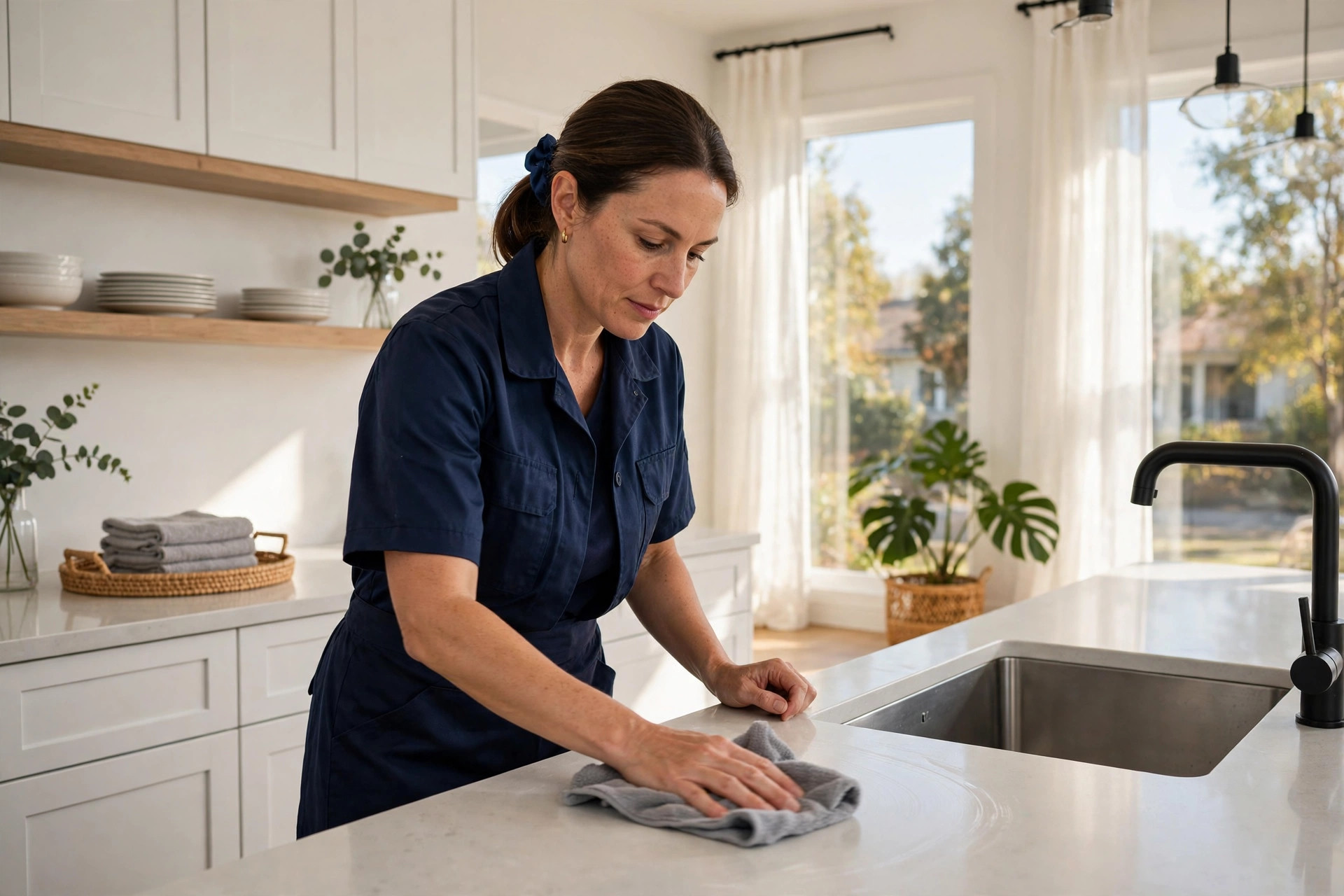
A busy parent searches for house cleaners on a Sunday night, opens three company websites on a phone, and books with the one that shows clear prices, real reviews, and a booking button that actually works. The other two cleaners might do a better job. It does not matter. The website decided. Cleaning is one of the few home services where customers expect to book online the way they book a haircut or order food. If your site still says “call for a quote” and nothing else, you are losing the exact customers you want: busy, willing to pay, and allergic to phone tag. This guide breaks down what a cleaning company website really costs, tier by tier, with special attention to the booking and quoting features that make or break a cleaning business online.
The quick answer
- DIY website builders: $0 to $600 a year. Gets you online fast. Cannot do real online booking, which is the whole point for cleaners.
- Freelancer build: $1,500 to $4,500 one time. Professional site with quote forms and review integration. Good for solo cleaners and small teams.
- Small agency build: $4,000 to $10,000 one time. The sweet spot for a growing company: online booking, instant quote calculator, recurring-service signup, local SEO.
- Custom booking platform: $10,000 to $25,000+. Real-time scheduling, customer accounts, cleaner dispatch integration, multi-location structure.
- Ongoing costs: budget $100 to $400 a month for hosting, maintenance, and a care plan, plus booking software fees.
- The features that pay for themselves: online booking, an instant quote calculator, and recurring-service signup. Cleaning customers buy convenience.
The honest price ranges for a cleaning company website
Cleaning company websites live in the same price bands as other home-service sites, but the money goes to different features. A painter’s site lives or dies on its gallery. A cleaning company’s site lives or dies on its booking flow. Keep that in mind as you read the tiers, because a $3,000 site with great booking will outperform a $8,000 site with a pretty homepage and a dead-end contact form. We used the same plain format in our breakdown of how much a dental website costs, adjusted here for what cleaning businesses actually need.
DIY website builder
You build it yourself on Wix, Squarespace, or a similar platform at $15 to $50 a month, plus a domain.
- 5 to 8 template pages: home, services, pricing, about, contact
- Basic contact or quote form
- You write everything and handle every update
- Booking is a phone number or a link to a third-party scheduler
Honest take: acceptable as a placeholder when you are just starting out. The problem is structural: template builders do not do real booking logic well, and booking is the feature your customers care about most. A DIY cleaning site usually ends up as a phone-number page with extra steps.
Freelancer build
A freelance designer builds a WordPress site on a premium theme, customized with your branding and copy.
- 8 to 15 pages: services, pricing, service areas, reviews, about, contact
- Mobile responsive with fast load times
- Quote request form with service selection and home details
- Google reviews embedded, trust badges, bonded and insured messaging
- Basic local SEO: titles, meta descriptions, Google Business Profile guidance
- Integration with a third-party booking tool (you pay the tool’s monthly fee)
Honest take: the right tier for most solo cleaners and small teams. You look established, the quote form does the heavy lifting, and a booking tool link covers online scheduling without custom development. Get all logins and a handover video before final payment, since freelancers move on.
Small agency build
An agency builds the site around how cleaning customers actually buy: compare prices, check reviews, book a time, set up recurring service.
- Custom or heavily customized design, 15 to 30 pages
- Instant quote calculator: bedrooms, bathrooms, home size, service type, frequency
- Online booking with real availability, confirmations, and reminders
- Recurring-service signup: weekly, bi-weekly, monthly plans with customer accounts
- Service area pages per town, built for local search
- Full local SEO setup: schema markup, speed optimization, review strategy
- CRM connection with automated follow-up for quotes that go quiet
Honest take: this is where the website becomes your best employee. The quote calculator answers the price question instantly, which is what most visitors want to know first. The booking flow captures the Sunday-night searchers. The recurring signup turns one-time deep cleans into weekly revenue. For a company with regular crews, this tier typically pays back within a year.
Custom booking platform
For established companies where the website is the operating system: scheduling, dispatch, and customer management in one place.
- Fully custom design with tested booking and checkout flows
- Real-time cleaner availability and route-aware scheduling
- Customer portal: manage bookings, skip a week, update payment, leave reviews
- Integration with cleaning business software for dispatch and payroll
- Multi-location structure with per-location pages and tracking
- Commercial cleaning section with its own quote process
Honest take: buy this when booking volume justifies it, not before. If you are still answering every booking inquiry personally, the agency tier plus a good scheduling tool gets you 90 percent of the benefit for half the money.

Cleaning customers expect to book online. The booking flow is the most important page on your site.
What each tier actually buys a cleaning company
The numbers above are the budget. This is what changes in your business at each level.
At the DIY level, you are buying a phone number with decoration
A template site lets people confirm you exist and find your number. That is genuinely useful when someone hears about you from a neighbor and checks you out online. But DIY builders fight you on the features that matter: pricing tables that update cleanly, quote logic based on home size, booking calendars that sync with your real schedule. You will spend weekends wrestling with the builder instead of cleaning houses or resting. Fine for month one. Plan the upgrade as soon as you have steady work.
At the freelancer level, you are buying credibility
The visible jump is trust. A clean, fast, professional site with real reviews, clear pricing, and a proper quote form changes who contacts you. You get fewer “how much for a whole house” messages with no details and more inquiries from people who have already read your pricing and decided you are in their range. For residential cleaning, that filtering effect alone is worth the money: every hour you do not spend quoting a job you will never win is an hour you can spend on a job you will.
At the agency level, you are buying bookings while you sleep
This is the first tier where the site works your off hours. The Sunday-night searcher gets an instant quote, picks a time, and books without ever calling you. The quote that goes quiet gets an automatic follow-up text the next day. The one-time deep clean customer gets offered a bi-weekly plan at checkout. Each of these is a small automation, and together they are the difference between a website that informs and a website that sells. Cleaning has natural repeat revenue, which makes this tier’s math unusually good: one recurring customer won through the site can be worth $3,000 to $6,000 a year.
At the custom level, you are buying back office hours
Past a certain size, scheduling eats your week: reschedules, skip-a-week requests, cleaner assignments, payment updates. A custom platform pushes that work onto the customer portal, where customers happily do it themselves at midnight. You are paying to remove phone calls and texts from your day, which at scale is worth more than any marketing feature.
The cleaning-specific features that change the price
Two quotes for “a 15-page website” can differ by thousands of dollars. The gap is almost always in features built for how cleaning companies operate. Here they are, in the order they usually earn their keep.
Online booking and scheduling
This is the feature customers ask for by name. Real online booking means the visitor picks a service, picks a date and time from your actual availability, enters their details, and gets a confirmation, all without calling you. The cheap version is a link to a third-party scheduler embedded on your site: it works, it costs $30 to $100 a month for the tool, and it looks slightly less polished. The proper version is booking built into the site’s design, synced with your calendar, sending confirmation texts and reminder texts automatically. Built-in booking typically adds $1,500 to $4,000 to a build. Either way, reminders matter enormously: cleaning businesses that send an automatic reminder the day before see meaningfully fewer no-shows and locked-door visits, which are pure lost labor.
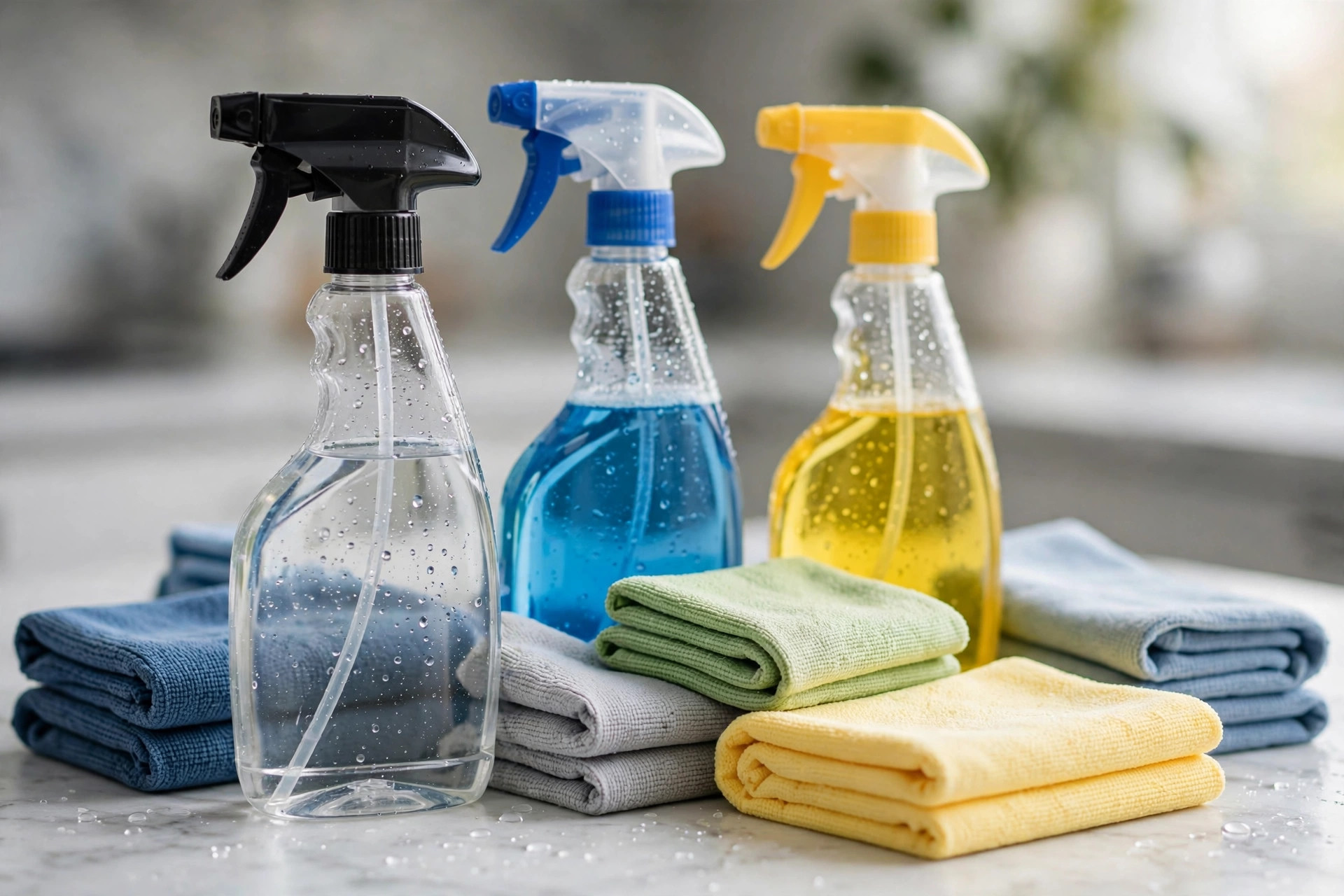
Professional presentation starts with the supplies photo and ends with the booking button. Customers judge both.
Instant quote calculator
Price is the first question almost every cleaning website visitor has, and most cleaning sites refuse to answer it. An instant quote calculator fixes that: the visitor enters bedrooms, bathrooms, square footage, service type (standard, deep, move-in/out), and frequency, and gets a price range on the spot. Then the site asks for their details to confirm the exact quote and book. Calculators typically add $1,000 to $3,500 to a build. They pay for themselves two ways: they convert price shoppers who would otherwise bounce, and they filter out bargain hunters before they take your time. One honest note: the calculator’s prices must match what you actually charge. A calculator that lowballs to win the lead creates angry customers at the door. Build it from your real price sheet.
Recurring-service signup and customer accounts
A one-time deep clean might bill $250. A bi-weekly customer bills $150 every two weeks for years. The math is obvious, which makes it strange how many cleaning websites treat every booking as one-time. Recurring signup means the booking flow offers weekly, bi-weekly, and monthly plans, usually with a small discount for frequency, and creates a customer account where the client can manage their schedule. Customer accounts add $1,000 to $3,000 to a build because of the login, payment, and management screens. If you are not ready for that, the simpler version still works: after any one-time booking, an automated email offers a recurring plan with one click to accept. That email sequence costs a fraction of the portal and captures a real share of conversions. Our guide to dental patient reactivation covers the same idea from the other side: the cheapest customer to win is the one who already bought from you.
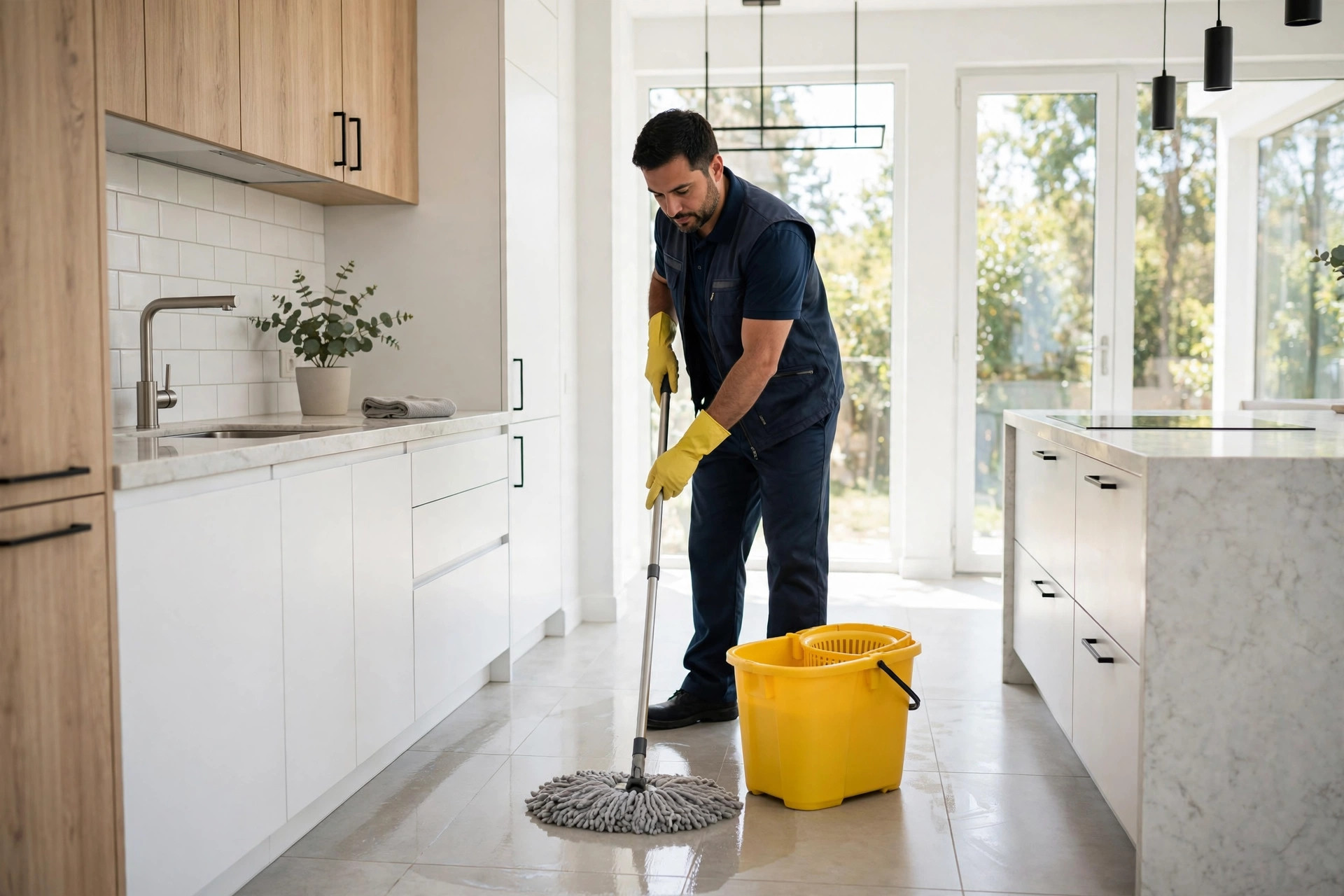
Recurring customers are the profit engine of a cleaning company. Your website should sell the plan, not just the one-time clean.
Service area pages for local search
Like every home service, cleaning lives on local search: “house cleaners near me”, “deep cleaning in [town]”. A dedicated page per town, with unique copy, local reviews, and town-specific details, is what ranks. Each page adds roughly $150 to $400 to a build. The common mistake is listing twenty towns on one page and calling it done. That page ranks for nothing. Ten real town pages, each with something genuinely local on it, will outperform it every time. If your crews only serve five or six towns, that is fine: build five or six good pages and skip the rest.
Trust signals for letting strangers into homes
Cleaning has the highest trust bar in home services. You are sending people into customers’ homes, often when nobody is there. Your website has to answer that anxiety directly: bonded and insured, stated plainly with what it covers; background-checked cleaners, explained in one sentence; a satisfaction guarantee with a real re-clean promise; real team photos, because stock photos of smiling models with spray bottles make trust worse, not better; and Google reviews embedded and current. None of these are expensive. Most are copy decisions. But a site that hides them, or buries them three clicks deep, converts worse at every price tier.
| Feature | DIY builder | Freelancer ($1.5k-$4.5k) | Agency ($4k-$10k) |
|---|---|---|---|
| Online booking | Phone number only | Third-party scheduler embedded | Built-in booking with reminders |
| Instant quote calculator | Not available | Rare at this tier | Bedroom/bath/size/frequency logic |
| Recurring plans signup | Not available | Mentioned in copy, manual setup | Plan selection at checkout plus follow-up offers |
| Customer accounts | Not available | Not available | Available as an add-on, $1k-$3k |
| Service area pages | One list page | A few town pages | Full town-by-town pages for search |
| Review integration | Manual screenshots | Embedded Google reviews | Automatic feed plus review request automation |
| Local SEO setup | Defaults only | Titles, meta, Business Profile guidance | Schema, speed work, citation plan |
| CRM and follow-up | Email notifications | Email plus basic notifications | Pipeline, instant texts, quote follow-up sequences |
DIY vs hiring a pro: an honest comparison
The DIY route tempts every cleaning company owner, because the monthly fee looks tiny next to a $4,000 quote. Run the real comparison before you decide. A DIY site costs $300 to $600 a year in fees plus 40 to 60 hours of your time to build and maintain. A freelancer build costs $1,500 to $4,500 once, plus a few hours of your time for photos and feedback. Now value your time honestly: if an hour of your time spent cleaning or quoting bills at $50 to $100, those 50 DIY hours cost you $2,500 to $5,000 in lost revenue, which is already more than the freelancer. And that is before counting the bookings the DIY site never won because its booking flow was clumsy.
DIY makes sense in exactly one situation: you are brand new, cash is truly tight, and you need something online this week while you get your first ten customers from referrals and flyers. In every other situation, the professional build is cheaper once you count your time and the lost bookings. The middle path works well too: hire a freelancer for the build, then learn to update the site yourself for the small stuff, so you are not paying hourly for every text change.
Ongoing costs after the site launches
Hosting: $15 to $50 a month for solid WordPress hosting. Domain and email: $15 to $30 a year for the domain, a few dollars monthly per mailbox. Bookings sent to a Gmail address look temporary; yourname@yourcompany.com does not. Booking software: $30 to $150 a month depending on the tool, unless booking was built custom. Care plan: $100 to $400 a month for updates, backups, security monitoring, and small changes. A booking site that breaks on a Saturday morning costs you the whole weekend’s bookings, which makes the care plan cheap insurance.
SEO and content: separate from the build. Local SEO retainers for home services commonly run $750 to $2,500 a month. Paid ads: also separate; local cleaning companies often start Google Ads at $1,000 to $3,000 a month in spend. Review generation: nearly free. After every clean, an automated text asks for a Google review. This single habit, wired into your booking flow, compounds for years: review count is one of the strongest local ranking and conversion factors a cleaning company has, and our law firm lead generation strategies guide covers review systems in depth because the mechanics transfer across local services.
How to get quotes without getting burned
Get three quotes against the same brief: your services and pricing, your service towns, the booking behavior you want, and two or three competitor sites you like. Then check each quote against this list.
- 1Ask who owns everything. Domain, site files, content, photos, analytics, booking tool accounts, customer data. In the contract, before work starts.
- 2Test the booking flow yourself. Make a test booking on their demo. Time how long it takes and count the steps. If it feels clumsy to you, it will feel clumsy to your customers.
- 3Ask how the quote calculator gets its numbers. It must run on your real price sheet, and you must be able to update prices yourself without calling the designer.
- 4Ask what happens when a booking comes in at 11pm. Listen for confirmations, reminders, and CRM notifications. “It emails you” is the minimum; automatic customer confirmation is the standard.
- 5Check contractor experience. Ask for two home-service sites they built and how those sites take bookings. Booking-driven sites are a different skill from pretty brochure sites.
- 6Clarify post-launch support. Who fixes it when booking breaks on a Saturday, what the care plan covers, and what counts as billable. Get the response-time promise in writing.
Red flags in a cleaning website quote
The cheapest bid by a mile usually means missing scope or a disappearing designer. Guaranteed rankings in 30 days is a sales line. A quote with no real booking plan, just “contact form”, misses the entire point of a cleaning website. Proprietary platforms that hold your site hostage if you leave are a trap; insist on a portable system like WordPress. And if the designer cannot walk you through the visitor’s path from landing page to booked cleaning in plain words, they are selling pages, not customers.
Frequently asked questions
How much does a website cost for a small cleaning company?
Solo cleaners and small teams typically spend $1,500 to $4,500 with a freelancer for a professional site with quote forms and review integration, or $4,000 to $10,000 with an agency for online booking, a quote calculator, and recurring-service signup. DIY builders cost $0 to $600 a year but cannot do real booking well.
Do cleaning company websites really need online booking?
Yes. Cleaning customers book the way they book everything else: on their phones, often in the evening, without wanting a phone call. Sites with working online booking consistently convert more of their visitors than sites that only offer a phone number, and automatic reminders cut no-shows and locked-door visits.
What is the most important feature on a cleaning company website?
Online booking, followed by an instant quote calculator. Price is the first question visitors have, and booking is the action you want them to take. Clear pricing plus one-click booking beats a beautiful homepage with a contact form every time.
Should I offer recurring cleaning plans on my website?
Absolutely. A bi-weekly customer can be worth $3,000 to $6,000 a year, so the booking flow should offer weekly, bi-weekly, and monthly plans with a small frequency discount. Even without customer accounts, an automated email offering a recurring plan after each one-time booking converts a real share of customers.
What are the ongoing costs after my cleaning website launches?
Budget $15 to $50 a month for hosting, $30 to $150 a month for booking software if you use a third-party tool, and $100 to $400 a month for a care plan covering updates and security. SEO retainers ($750 to $2,500 a month for home services) and ad spend are separate budget lines.
Want a cleaning website that books jobs while you are on one
Digital Hayder builds websites for cleaning companies with online booking, instant quote calculators, recurring-plan signup, and review automation built in. Tell us about your services and your service area and we will scope it precisely.
Contact Us