
When a homeowner searches “plumber near me,” the very first thing they see is not the map, not the organic results, and not regular Google Ads. It is a row of Local Services Ads with photos, star ratings, and a Google Guarantee badge. For plumbers, this is the most valuable real estate on the entire search page, and unlike regular ads you pay per lead, not per click. This guide explains exactly how Local Services Ads work for plumbing businesses, what they typically cost, how the ranking works, how to get approved, and how to dispute the bad leads so you only pay for real opportunities.
The quick answer
- What they are: pay-per-lead ads at the very top of Google for local service searches, backed by the Google Guarantee badge.
- Typical cost: plumbing leads usually run $25 to $50 each, varying by market and job type.
- Budget: plan $500 to $1,000 a week in most markets to appear consistently.
- Ranking factors: review count and rating, how fast you answer, proximity, hours, and profile completeness.
- Approval: requires license verification, insurance proof, and background checks for owners and techs.
- Key advantage: you can dispute invalid leads (wrong service, spam, out of area) and get credited.
What Local Services Ads are and why they matter for plumbers
Local Services Ads, often called LSAs or Google Guaranteed ads, are a separate ad format from regular Google Ads. They appear above everything else on the search results page for service searches like “plumber near me” or “emergency plumber.” Each ad shows the business name, photo, star rating, review count, hours, and service area, plus the Google Guarantee badge. That badge matters: it tells the homeowner Google has verified the business and backs the job with a satisfaction guarantee, which removes a huge amount of hesitation from hiring a stranger.
Pay per lead, not per click
The pricing model is the biggest difference from regular Google Ads. With standard ads you pay every time someone clicks, whether they call or not, and plumbing clicks in competitive markets can cost $20 to $50 each. With LSAs you pay only when someone contacts you through the ad: a call or a message. If a hundred people see your ad and nobody calls, you pay nothing. That shifts the risk from you to the platform and makes the math much easier to evaluate.
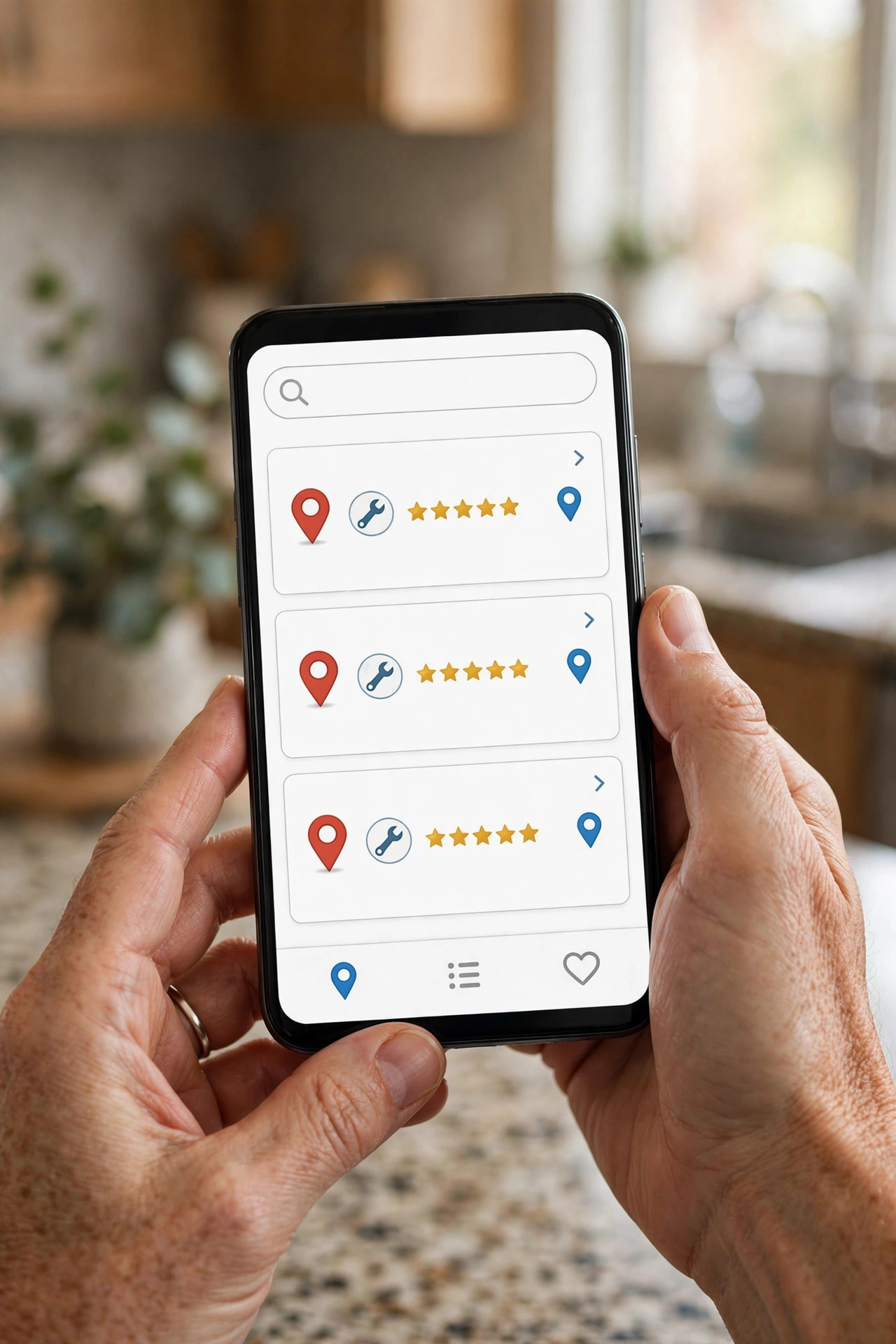
Local Services Ads sit above everything else when homeowners search for a plumber.
How much do Local Services Ads cost for plumbers?
Google sets the per-lead price by market and service type, and you cannot negotiate it. The ranges below are typical for plumbing businesses. Treat them as planning ranges: your city, competition, and the mix of job types you receive move the real numbers.
| Lead type | Typical cost per lead | Notes |
|---|---|---|
| General plumbing calls | $25 to $40 | The most common lead type; repairs, installs, general service |
| Emergency plumbing | $30 to $50 | Higher intent, higher value; after-hours calls included |
| Drain cleaning | $20 to $35 | Lower ticket jobs; watch booking rate carefully |
| Water heater work | $30 to $50 | Strong ticket value makes these leads worth more |
| Sewer line jobs | $40 to $60+ | Rare but high value; few leads needed to pay for the channel |
Budget: what it takes to show up
You set a weekly budget, and Google shows your ad until the budget is spent. In most markets, $500 to $1,000 a week is the realistic range to appear consistently for plumbing searches. Smaller budgets often mean the ad barely shows, especially in competitive metros. Start at the higher end for two to three weeks to gather data on your real cost per lead and booking rate, then adjust. A budget that produces 15 to 25 leads a week gives you enough volume to judge the channel fairly.
How the ranking works: why some plumbers show first
Multiple plumbers advertise in every market, so Google decides the order. Understanding the ranking factors tells you exactly where to invest your effort.
1. Reviews: count and rating
This is the heaviest factor. A plumber with 200 reviews at 4.8 stars outranks one with 20 reviews at 5.0 stars, almost every time. The reviews that count are the ones on your Google Business Profile, so every LSA dollar should be paired with a review engine: ask on every job, send the link by text within the hour, and respond to every review. Dropping below about 4.5 stars visibly hurts placement.
2. Responsiveness
Google tracks how quickly and reliably you answer calls and messages from the ads. Businesses that answer fast and consistently rank higher than those that let calls go to voicemail. This is measured, not guessed: missed calls and slow message replies drag your position down. An instant text-back on missed calls protects both your ranking and your revenue.
3. Proximity and hours
Google favors businesses close to the searcher and open when the search happens. A shop marked open at 9pm wins the evening emergency search over a competitor marked closed. Set your LSA hours to match your real availability, including after-hours if you take emergency calls, because every hour you are listed as open is an hour you can outrank closed competitors.
4. Profile completeness
Fill in everything: every service type you offer, your full service area, business hours, photos, and license information. Each completed field is a small ranking signal and a trust signal for the homeowner reading the ad. Plumbers who select only two or three service types miss searches they could have won.
Getting approved: licenses, insurance, and background checks
Google verifies every LSA advertiser before the ads go live. This is what earns the Guarantee badge, and it is also why homeowners trust these ads. The process takes one to three weeks in most cases, so start it before you need the leads.
What Google requires from plumbing businesses
- Business license: proof that your plumbing business is licensed in each area you want to advertise. Requirements vary by state and city, so check what your jurisdiction requires.
- Insurance: proof of general liability insurance, typically with minimum coverage amounts set by Google for your market. Upload current certificates; expired documents stall the review.
- Background checks: the business owner and every technician who will enter customers’ homes must pass a background check through Google’s screening partner. Typical cost is around $50 per person, paid to the screening provider.
- Google Business Profile: a claimed, verified profile with accurate information that matches your LSA application. Inconsistencies between the two slow approval.
Tips for a smooth approval
Submit everything at once rather than in pieces, and make sure names, addresses, and phone numbers match exactly across your license, insurance, and business profile. If a background check flags an issue, address it directly with the screening provider rather than resubmitting the same documents. Most delays come from mismatched paperwork, not from failing the checks themselves.
Every tech who enters homes must pass Google’s background check before ads go live.
Understanding your leads and disputing the bad ones
Not every contact that arrives through LSAs is a real opportunity. Google lets you dispute leads that should not have been charged, and disputing consistently is one of the highest-value habits in this channel. Review every lead weekly and dispute the ones that qualify.
Leads you can usually dispute
- Wrong service: the caller wanted something you do not offer or that is outside your selected service types.
- Wrong location: the job is outside the service area you set.
- Spam or solicitation: robocalls, sales pitches, and obvious spam.
- Duplicate: the same person contacting you twice about the same job within a short window.
- Unreachable or nonsense: disconnected numbers or calls with no real inquiry.
Leads you generally cannot dispute
A lead who got a quote and chose a competitor is still a valid lead. So is a price shopper, a caller who changed their mind, or a job you declined because the schedule was full. Google charges for the connection, not the outcome. That is why your close rate matters as much as your cost per lead: the channel only pays if you convert the real opportunities it sends.
How disputes work in practice
You flag the lead in the LSA dashboard with a reason, and Google reviews it, usually crediting valid disputes within a few days. Shops that dispute diligently often recover 10 to 20% of their spend in credits. Build it into a weekly routine: every Monday, review the previous week’s leads, dispute the invalid ones, and note patterns. If wrong-service leads keep arriving, your selected service types probably need adjusting.
Local Services Ads vs Google Ads vs organic: how they compare
| Local Services Ads | Google Ads (search) | Organic / map pack | |
|---|---|---|---|
| You pay for | Leads; typically $25 to $50 each | Clicks; plumbing clicks often $20 to $50 | Nothing per click; SEO investment instead |
| Position | Above everything, with Guarantee badge | Below LSAs, above organic | Map pack below ads; organic below that |
| Speed | Leads within days of approval | Traffic the day campaigns launch | Months to build rankings |
| Trust signal | Google Guarantee badge | None built in | Reviews and ratings |
| Control | Limited: Google sets lead price | Full: keywords, bids, landing pages | Full: content and site under your control |
| Best for | Steady flow of calls fast | High-ticket jobs: repipes, sewer lines | Long-term, lowest cost per lead |
Most successful plumbing shops run all three eventually. LSAs buy calls this week, Google Ads capture high-value searches LSAs miss, and organic rankings compound into the cheapest leads over time.
Making Local Services Ads profitable: the five rules
1. Answer every call, or text back in minutes
Responsiveness is both a ranking factor and a revenue factor. A missed LSA call is a lead you paid for and gave to a competitor. During business hours, have a live person answering. After hours, use an answering service or an automatic text-back so the caller hears from you within a minute. Track your answer rate weekly; anything below 90% is leaking money.
2. Keep the review engine running
Reviews are the heaviest ranking factor and the first thing homeowners compare. Ask on every completed job, send the review link by text within the hour, and respond to every review within 48 hours. A shop adding five to ten reviews a month will steadily climb past competitors who let their profiles sit still.
3. Set a budget that actually shows
Underfunded LSAs barely appear, which means you pay for the setup effort and get nothing back. In most markets that means $500 to $1,000 a week. If the budget is a stretch, run LSAs for your highest-value service types first rather than spreading a small budget across everything.
4. Select every service type you truly offer
Each service type you select is a set of searches you can win. Plumbers who select only “plumber” miss drain cleaning, water heater, and sewer searches that carry their own lead flow. Select everything you actually do well, and remove anything you cannot deliver profitably.
5. Dispute invalid leads every week
Treat the Monday dispute review as non-negotiable. The credits add up, and the patterns you spot, wrong service types, out-of-area calls, tell you how to tune the profile. Shops that never dispute effectively pay 10 to 20% more per real lead than shops that do.
Consistent ad presence plus fast response turns searches into booked jobs.
Common mistakes that waste LSA spend
| Mistake | What it costs you | Fix |
|---|---|---|
| Letting calls go to voicemail | Paid leads lost to competitors; lower ranking | Live answering plus instant text-back on missed calls |
| Ignoring review collection | Competitors outrank you on the heaviest factor | Ask on every job; text the link within the hour |
| Budget too small to show | Ads rarely appear; no data, no leads | $500 to $1,000 a week in most markets |
| Never disputing bad leads | 10 to 20% of spend wasted on invalid contacts | Weekly Monday review and dispute routine |
| Wrong or narrow service types | Missing searches you could win; paying for ones you cannot serve | Audit selections quarterly against real job mix |
| Hours set too narrow | Invisible during evening and weekend emergency searches | Match hours to real availability, including on-call |
Your first 90 days with Local Services Ads
- 1Days 1 to 21: start the approval process: gather licenses, insurance certificates, and background check details for the owner and techs. Claim and complete your Google Business Profile. Start the review ask on every job now, so reviews are building during approval.
- 2Days 22 to 35: complete the LSA profile: every service type, full service area, accurate hours, photos. Set a weekly budget of $500 to $1,000. Set up call tracking and instant text-back before the first lead arrives.
- 3Days 36 to 60: run and observe. Track cost per lead, answer rate, and booking rate weekly. Start the Monday dispute routine. Adjust service types if wrong-service leads appear.
- 4Days 61 to 90: evaluate cost per booked job by service type. Shift budget toward the winners, keep the review engine running, and decide whether to expand hours or service area based on the data.
Frequently asked questions
How much do Local Services Ads cost for plumbers?
Typical cost per lead ranges from $25 to $50 depending on market and job type, with emergency and sewer work at the higher end. Most shops need $500 to $1,000 a week in budget to appear consistently. You pay per lead, not per click, and you can dispute invalid leads for credit.
Are Local Services Ads worth it for plumbers?
For most plumbing shops, yes. The ads sit above every other result, carry the Google Guarantee badge, and charge per lead rather than per click. At typical lead costs against average plumbing ticket values, the math works as long as you answer fast, keep reviews strong, and dispute invalid leads weekly.
How long does LSA approval take?
Usually one to three weeks, depending on how quickly you submit complete documents and how fast the background checks clear. Mismatched paperwork between your license, insurance, and business profile is the most common cause of delays, so submit everything at once with matching details.
What is the Google Guarantee?
It is Google’s backing for jobs booked through Local Services Ads. If a customer is dissatisfied with work quality from a Guaranteed business, they can request reimbursement from Google up to a set limit. The badge builds instant trust with homeowners choosing between unfamiliar plumbers.
Can I run Local Services Ads and Google Ads at the same time?
Yes, and many shops do. LSAs capture the general “plumber near me” searches at the top of the page, while standard Google Ads let you target specific high-value searches like “sewer line replacement” with custom landing pages. Together they cover more of the search page than either one alone.
Want Local Services Ads managed for maximum booked jobs?
Digital Hayder sets up and manages Local Services Ads for plumbing and home service businesses: approval handling, profile optimization, review engines, instant lead follow-up, and weekly dispute reviews so you never pay for junk leads. Tell us about your shop and we will estimate your lead flow.
Contact Us